Why Essay Outlines Matter
Creating an outline before writing might seem like unnecessary extra work, but this preparation step dramatically improves both your writing process and final essay quality. Understanding why outlines matter motivates you to invest time in this crucial planning phase.
- Outlines reveal structural problems early. When you see your entire argument laid out visually, gaps in logic, missing evidence, and weak connections become immediately obvious. Fixing structural issues takes five minutes in an outline but could require hours of rewriting in a complete draft. Catching problems before writing full paragraphs saves enormous time and frustration.
- Outlines prevent writer's block. The paralyzing question "What should I write next?" disappears when you have a detailed outline. You're never staring at a blank page unsure how to proceed because your outline tells you exactly which point to develop next, what evidence supports it, and how it connects to surrounding paragraphs. This clarity makes drafting significantly faster and less stressful.
- Outlines ensure coherent arguments. Without outlines, essays often wander between disconnected ideas or repeat the same points in different paragraphs. Outlines force you to organize thoughts logically before writing, ensuring each paragraph builds on the previous one and advances your thesis. The visual organization reveals redundancies and tangents that would undermine your final essay.
- Outlines improve time management. Breaking essay writing into distinct phases—outline creation, drafting, revision—makes large assignments feel manageable rather than overwhelming. You can outline one day, draft another, and revise a third, distributing work across multiple sessions instead of panicking through last-minute marathon writing sessions.
- Outlines facilitate better analysis. The outline stage forces you to think critically about how evidence supports claims and how individual points work together to prove your thesis. This analytical thinking happens before you commit to full prose, when it's easiest to refine and strengthen arguments.
- Outlines make revision more efficient. When you revise essays written from outlines, you're polishing already-organized content rather than simultaneously restructuring and editing. This focused revision produces better results in less time because you're not fixing fundamental organizational problems during late-stage editing.
Master the complete writing process with our comprehensive essay writing guide covering every step from brainstorming to final submission!
FIRST ORDER FREE — UP TO 2 PAGES
See the Quality Before You Pay
Trusted by 50,000+ students. Zero AI.
The 4-Step Outline Creation Process
Follow this systematic approach to create effective essay outlines that make writing easier and produce better final essays.
Step 1: Understand Your Essay Topic and Requirements
Before outlining, ensure you completely understand what your assignment requires. Misunderstanding the prompt wastes effort on outlines that don't address the actual question.
- Analyze the essay prompt thoroughly: Read the assignment multiple times, highlighting directive words like "analyze," "compare," "argue," or "explain" that tell you what type of thinking and writing the assignment requires. Note specific requirements including word count, source numbers, formatting style, and due date. Identify any restrictions on topic choice, required elements, or content to avoid.
- Determine your essay type: Your outline structure varies based on essay type. Argumentative essays need sections for your position, supporting evidence, counterarguments, and rebuttals. Analytical essays require sections breaking down components and examining relationships. Compare and contrast essays need parallel structures examining similarities and differences. Narrative essays follow chronological or thematic organization showing story progression. Understanding your essay type shapes your outline's organizational strategy.
- Clarify your thesis or main argument: You need a working thesis before outlining effectively. Your thesis might evolve during writing, but you need a clear position or main idea to organize your outline around. If you're struggling with thesis development, see our guide on writing thesis statements that create focused, arguable claims.
- Gather your research materials: Complete research before outlining so you know what evidence you have available. Trying to outline without knowing your supporting evidence creates vague, unhelpful outlines. Review your research notes, identify the strongest evidence for each potential point, and note connections between different sources.
Step 2: Brainstorm and Organize Main Points
With a clear understanding of requirements, generate and organize the main ideas that will support your thesis.
- Generate potential main points: List every idea related to your thesis without judgment or organization. Free writing, mind mapping, or simple listing all work well for idea generation. Aim for more ideas than you'll ultimately use—you'll select the strongest during organization. Consider different angles, types of evidence, and perspectives that support your thesis.
- Group related ideas together: Review your brainstormed list and identify ideas that relate to similar concepts or themes. Group these related ideas into clusters that could become body paragraphs. Look for natural categories or logical relationships between ideas. This grouping reveals the 3-5 main points that will structure your essay.
- Arrange points in logical order: Decide which sequence makes most sense for your argument. Common organizational patterns include strongest to weakest (save best for last), weakest to strongest (build momentum), chronological (time-based progression), spatial (location-based organization), or cause to effect (show relationships). The right order depends on your topic and essay type. For maximum impact, many writers use weakest to strongest organization, ending with their most compelling point.
- Test your organization: Read through your main points in order. Does each point build on the previous one? Is the connection between points clear? Does the sequence guide readers naturally through your argument? If the progression feels jumpy or disconnected, reorder points until the flow improves.
Step 3: Add Supporting Details and Evidence
Transform your main points into a detailed outline by adding the specific evidence, examples, and analysis that will appear in each section.
- Identify evidence for each main point: Under each main point in your outline, list the specific evidence that supports it. Include source information, page numbers, and brief notes about what the evidence shows. Strong body paragraphs typically need 2-3 pieces of evidence, so ensure you have sufficient support before proceeding.
- Plan your analysis: For each piece of evidence, note how you'll explain its significance. Jot down a few words about how this evidence proves your point and connects to your thesis. This preliminary analysis ensures you won't just drop quotes into your essay without explanation—a common weakness in student writing.
- Add transitions between points: Note how each paragraph will connect to the next. Strong transitions show relationships between ideas (addition, contrast, cause-effect, example, emphasis, sequence). Planning transitions during outlining creates smooth flow in your final essay. Learn to use transition words effectively to connect ideas seamlessly.
- Include counterarguments if relevant: For argumentative essays, plan where you'll acknowledge opposing viewpoints and how you'll respond to them. Adding counterargument sections to your outline ensures you address alternative perspectives rather than ignoring them.
- Note page or paragraph numbers: If your outline will be lengthy, include notes about which outline sections correspond to which pages or paragraphs in your final essay. This helps you maintain balanced development across your argument.
Step 4: Refine and Finalize Your Outline
Review your complete outline critically, making adjustments that strengthen organization and ensure comprehensive coverage.
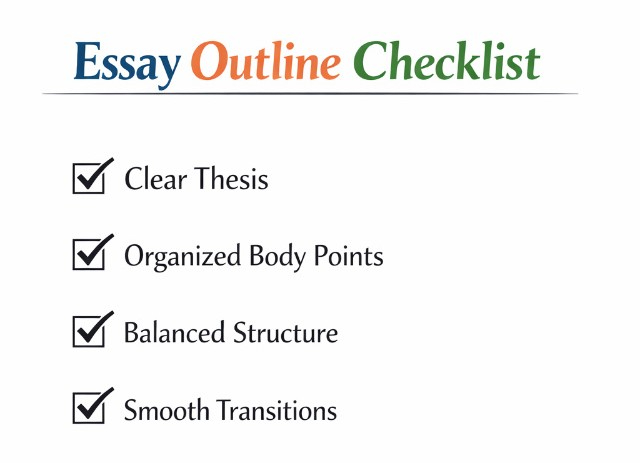
- Check thesis alignment: Verify that every main point in your outline directly supports your thesis. If any section seems tangential or doesn't advance your central argument, either cut it or revise it to strengthen the connection. Your outline should show clear relationships between all parts and your thesis.
- Verify balanced development: Compare the amount of detail under each main point. Roughly equal development suggests balanced argumentation. If one section is significantly longer or shorter than others, consider whether you're over-developing minor points or under-developing important ones. Balance doesn't require identical length, but dramatic disparities often indicate organizational problems.
- Confirm logical progression: Read through your entire outline from introduction to conclusion. Does each section follow naturally from the previous one? Are there awkward jumps or missing steps in your logic? Does the conclusion follow naturally from the evidence presented in body paragraphs? Adjust organization until the progression feels smooth and inevitable.
- Add structural elements: Include notes about your introduction's hook and background information. Plan your conclusion's synthesis and broader implications. Mark where you'll incorporate hook examples that capture attention immediately. These structural details ensure your outline covers all essential essay elements.
- Get feedback if possible: If time permits, ask a peer, tutor, or instructor to review your outline before you begin drafting. Fresh eyes often spot gaps, weaknesses, or organizational issues you missed. Outline feedback is incredibly valuable because adjustments take minutes rather than the hours required to revise complete drafts.
Craft compelling openings with our guide on how to start an essay using proven attention-grabbing techniques!
Standard Essay Outline Format
Understanding the basic structure that applies across most essay types provides a foundation for all outline creation.
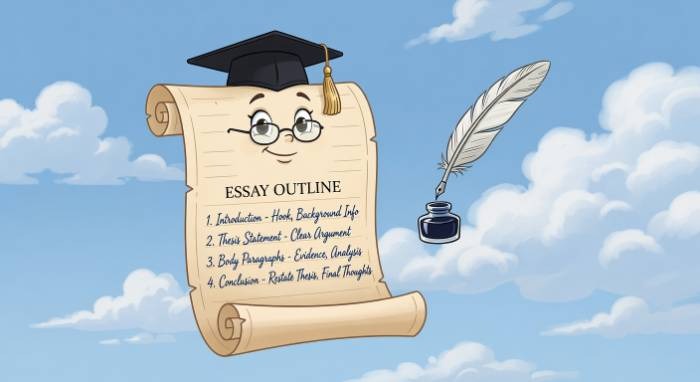
Introduction Section
Your introduction outline should include three essential elements that set up your entire essay.
Hook (1 sentence): Note what type of attention-grabbing opening you'll use—question, statistic, quote, anecdote, bold statement, or scenario. Write out the exact hook if possible, or note the general approach you'll take. Strong hooks relate directly to your topic while creating curiosity or surprise.
Background Information (2-3 sentences): Outline what context readers need to understand your topic and thesis. This might include historical background, key definitions, scope establishment, significance explanation, or current state of your topic. Keep background concise and focused on information essential for understanding your argument.
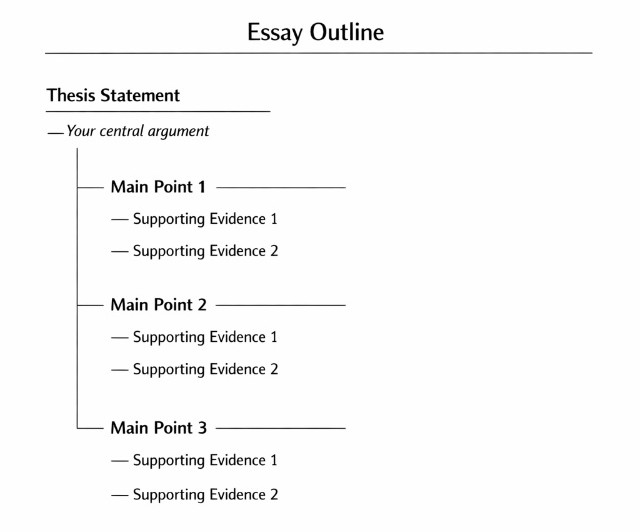
Thesis Statement (1-2 sentences): Write out your complete thesis statement in your outline. This is the most important sentence in your entire essay—your main argument that all body paragraphs will support. Make it specific, arguable, focused, and clear about your position. See our thesis statement examples for inspiration.
Body Paragraph Structure
Each body paragraph in your outline should follow this proven structure that ensures comprehensive development.
Topic Sentence: Write the exact topic sentence or note its main idea. Topic sentences state each paragraph's specific point and should directly support your thesis. Strong topic sentences are specific enough to focus an entire paragraph.
Context/Explanation (optional): Note any background information readers need for this specific point. Not every paragraph requires context, but complex points often benefit from brief setup before presenting evidence.
Evidence #1: List your first piece of supporting evidence including source, page number, and what it demonstrates. Note whether you'll quote, paraphrase, or summarize.
Analysis #1: Outline how you'll explain this evidence's significance. Note connections to your thesis and why this evidence matters.
Evidence #2: List your second piece of supporting evidence with similar details.
Analysis #2: Note your analytical explanation for this evidence.
Evidence #3 (if needed): Include a third piece of evidence for particularly important points.
Analysis #3: Outline corresponding analysis.
Transition: Note how this paragraph connects to the next one, showing the relationship between ideas.
Conclusion Section
Your conclusion outline ensures you end strongly by synthesizing rather than simply repeating.
Thesis Restatement: Note how you'll rephrase your thesis with more confidence now that you've proven your case. Don't copy your introduction word-for-word.
Synthesis of Main Points: Outline how your main points work together. Focus on relationships and connections rather than just listing what you discussed.
Broader Implications: Note what your argument means beyond your immediate essay. How does it apply to larger questions, other situations, future research, or practical applications?
Closing Thought: Plan your memorable final sentence—question, call to action, forward-looking statement, or powerful observation. Master conclusion writing that reinforces arguments without being repetitive.
Ensure proper structure with our comprehensive essay format guide covering all formatting requirements!
Limited Time Offer for New Customers
First Essay Free — Up to 2 Pages
Offer won't last. No AI. No catch.
Outline Formats: Alphanumeric vs. Decimal
Two standard formats organize essay outlines differently while accomplishing the same goal—showing hierarchy and relationships between ideas.
Alphanumeric Outline Format
Alphanumeric outlines use Roman numerals for main sections, capital letters for subsections, Arabic numerals for supporting points, and lowercase letters for additional details.
Structure:
I. First Main Point
A. First Subsection
1. Supporting Detail
a. Additional Detail
b. Additional Detail
2. Supporting Detail
B. Second Subsection
II. Second Main Point
A. First Subsection
B. Second Subsection
Advantages: Clear visual hierarchy makes relationships between levels immediately obvious. Traditional academic format most instructors expect. Works well for complex arguments with multiple levels of subordination.
When to use: Use alphanumeric format for traditional academic essays, when instructor specifies this format, for complex topics requiring multiple hierarchy levels, or when you want clear visual distinction between major and minor points.
Decimal Outline Format
Decimal outlines use numbered sequences to show relationships between sections and subsections.
Structure:
1.0 First Main Point
1.1 First Subsection
1.1.1 Supporting Detail
1.1.2 Supporting Detail
1.2 Second Subsection
2.0 Second Main Point
2.1 First Subsection
2.2 Second Subsection
Advantages: Shows clear progression through numbered sections. Allows infinite levels of subordination by adding decimal places. Some find decimal system more intuitive than Roman numerals.
When to use: Use decimal format for scientific or technical topics, when working with highly detailed or technical subjects, if you prefer numerical organization, or when instructor permits format choice and you find decimals clearer.
Choose the format that works best for your thinking style. Both accomplish the same organizational goals. Consistency matters more than which system you select.
Essay Outline Templates by Type
Different essay types require organizational adjustments. These specialized templates guide outline creation for common essay types.
Argumentative Essay Outline Template
Argumentative essays require structured presentation of your position, supporting evidence, and response to counterarguments.
I. Introduction
A. Hook: Attention-grabbing opening
B. Background: Context on debate/issue
C. Thesis: Clear position on debatable issue
II. Background/Context (if needed)
A. Necessary background information
B. Definitions of key terms
C. Scope of argument
III. First Main Argument
A. Topic sentence: First reason supporting your position
B. Evidence from credible sources
C. Analysis explaining how evidence supports your claim
D. Transition
IV. Second Main Argument
[Same structure as III]
V. Third Main Argument
[Same structure as III]
VI. Counterargument and Rebuttal
A. Strongest opposing argument
B. Evidence supporting opposition
C. Your rebuttal showing why your position is stronger
D. Evidence supporting your rebuttal
VII. Conclusion
A. Restate thesis with confidence
B. Synthesize how arguments work together
C. Call to action or implications
D. Closing thought
Master persuasive writing with our complete argumentative essay guide covering evidence and logical reasoning.
Compare and Contrast Essay Outline Template
Compare and contrast essays can use point-by-point or subject-by-subject organization.
Point-by-Point Organization:
I. Introduction
A. Hook introducing both subjects
B. Background on both subjects
C. Thesis stating main similarity/difference insight
II. First Point of Comparison
A. How Subject A demonstrates this point
B. How Subject B demonstrates this point
C. Analysis of similarity or difference
III. Second Point of Comparison
[Same structure as II]
IV. Third Point of Comparison
[Same structure as II]
V. Conclusion
A. Restate thesis
B. Synthesize insights from comparisons
C. Significance of similarities/differences
D. Closing thought
Subject-by-Subject Organization:
I. Introduction
II. Subject A: All points about first subject
III. Subject B: Parallel points about second subject
IV. Direct Comparison: Analyze similarities and differences
V. Conclusion
Analytical Essay Outline Template
Analytical essays break down topics into components and examine relationships.
I. Introduction
A. Hook introducing subject for analysis
B. Background on work/topic being analyzed
C. Thesis: Main analytical insight
II. First Analytical Point
A. Topic sentence: First component or pattern
B. Evidence from text/subject
C. Analysis of how this element functions
D. Significance to larger meaning
III. Second Analytical Point
[Same structure as II]
IV. Third Analytical Point
[Same structure as II]
V. Synthesis Section
A. How analyzed elements work together
B. Larger implications of analysis
VI. Conclusion
A. Restate analytical thesis
B. Synthesize insights
C. Broader significance
Develop strong analytical skills with our analytical essay guide focused on deep examination techniques.
Narrative Essay Outline Template
Narrative essays follow story structure while maintaining analytical purpose.
I. Introduction
A. Hook: Engaging story opening
B. Setting and context
C. Thesis: Main lesson or insight from story
II. Rising Action
A. Initial situation
B. Complication or challenge
C. Sensory details and character development
III. Climax
A. Turning point or most intense moment
B. Key realization or change
C. Detailed scene development
IV. Falling Action
A. Consequences of climax
B. Resolution of conflict
C. Changed perspective
V. Conclusion/Reflection
A. Restate lesson learned
B. How experience changed you
C. Broader significance
D. Memorable closing
Descriptive Essay Outline Template
Descriptive essays create vivid impressions through organized sensory details.
I. Introduction
A. Hook establishing subject
B. Overall impression
C. Thesis: Dominant impression or characteristic
II. Visual Description
A. Appearance details
B. Colors, shapes, sizes
C. Spatial organization
III. Sound and Smell Description
A. Auditory details
B. Olfactory descriptions
C. How these senses contribute to impression
IV. Touch and Taste Description (if relevant)
A. Tactile details
B. Taste descriptions
C. Physical sensations
V. Emotional/Subjective Response
A. Feelings evoked
B. Personal significance
C. Why subject matters
VI. Conclusion
A. Restate dominant impression
B. Synthesize sensory details
C. Lasting significance
Create powerful descriptions with our descriptive essay guide emphasizing show-don't-tell techniques.
Persuasive Essay Outline Template
Persuasive essays convince readers to adopt your viewpoint or take specific action through logical arguments and emotional appeals.
I. Introduction
A. Hook establishing issue importance
B. Background on topic
C. Thesis: Position you want readers to accept
II. First Persuasive Point
A. Topic sentence: First reason readers should agree
B. Logical evidence supporting this reason
C. Emotional appeal connecting to reader values
D. Real-world example illustrating point
III. Second Persuasive Point
[Same structure as II]
IV. Third Persuasive Point
[Same structure as II]
V. Addressing Objections
A. Most common objection to your position
B. Why this objection isn't sufficient
C. Evidence supporting your rebuttal
VI. Conclusion
A. Restate position emphatically
B. Summarize strongest persuasive points
C. Call to action: What readers should do
D. Emotional closing statement
Expository Essay Outline Template
Expository essays explain topics objectively without persuading or arguing positions.
I. Introduction
A. Hook introducing topic
B. Background establishing context
C. Thesis: Main point explaining topic
II. First Explanatory Section
A. Topic sentence: First aspect of topic
B. Facts and information
C. Examples clarifying concept
D. Explanation of how this works
III. Second Explanatory Section
[Same structure as II]
IV. Third Explanatory Section
[Same structure as II]
V. Conclusion
A. Restate main explanation
B. Synthesize information presented
C. Significance of understanding topic
Cause and Effect Essay Outline Template
Cause and effect essays examine why things happen and what results from those causes.
I. Introduction
A. Hook establishing topic
B. Background on situation
C. Thesis: Main cause-effect relationship
II. Causes Section
A. First cause
1. Explanation of cause
2. Evidence it exists
B. Second cause
C. Third cause
III. Effects Section
A. First effect
1. Description of effect
2. Evidence linking to causes
B. Second effect
C. Third effect
IV. Analysis Section
A. How causes connect to effects
B. Relative importance of causes
C. Significance of effects
V. Conclusion
A. Restate cause-effect relationship
B. Synthesize connections
C. Implications or predictions
Rhetorical Analysis Essay Outline Template
Rhetorical analysis essays examine how authors use persuasive strategies and techniques.
I. Introduction
A. Hook introducing text being analyzed
B. Context about author, audience, purpose
C. Thesis: Main argument about rhetorical strategies
II. Ethos Analysis
A. How author establishes credibility
B. Evidence of authority/character appeals
C. Effectiveness of ethos strategies
III. Pathos Analysis
A. Emotional appeals author uses
B. Evidence of emotional manipulation
C. Effectiveness of pathos strategies
IV. Logos Analysis
A. Logical arguments and reasoning
B. Evidence and factual support
C. Effectiveness of logos strategies
V. Other Rhetorical Devices
A. Metaphors, analogies, imagery
B. Tone and diction choices
C. Structure and organization effects
VI. Conclusion
A. Restate rhetorical effectiveness
B. Synthesize strategy analysis
C. Overall persuasive impact
Informative Essay Outline Template
Informative essays educate readers about topics without bias or persuasion.
I. Introduction
A. Hook creating interest in topic
B. Background providing context
C. Thesis: Main information you'll convey
II. First Category of Information
A. Topic sentence introducing category
B. Key facts and data
C. Examples illustrating information
D. Visual description if relevant
III. Second Category of Information
[Same structure as II]
IV. Third Category of Information
[Same structure as II]
V. Conclusion
A. Summarize key information
B. Synthesize categories
C. Why this information matters
Synthesis Essay Outline Template
Synthesis essays combine information from multiple sources to form new understanding.
I. Introduction
A. Hook introducing topic
B. Overview of sources being synthesized
C. Thesis: Your unique insight from synthesis
II. Source Analysis Section
A. Summary of Source 1 perspective
B. Summary of Source 2 perspective
C. Summary of Source 3 perspective
III. First Synthesis Point
A. Topic sentence: First combined insight
B. Evidence from multiple sources
C. Your analysis connecting sources
D. New understanding from combination
IV. Second Synthesis Point
[Same structure as III]
V. Third Synthesis Point
[Same structure as III]
VI. Conclusion
A. Restate synthesized thesis
B. Explain what synthesis reveals
C. Implications of combined understanding
Literary Analysis Essay Outline Template
Literary analysis essays examine how literary elements create meaning in texts.
I. Introduction
A. Hook introducing work being analyzed
B. Brief summary and context
C. Thesis: Main argument about literary meaning
II. First Literary Element
A. Topic sentence: First element (theme, symbol, etc.)
B. Evidence from text with quotes
C. Analysis of how element functions
D. Connection to overall meaning
III. Second Literary Element
[Same structure as II]
IV. Third Literary Element
[Same structure as II]
V. Synthesis Section
A. How elements work together
B. Author's overall achievement
C. Larger significance
VI. Conclusion
A. Restate analytical thesis
B. Synthesize literary insights
C. Text's broader importance
You've Done Enough. Let Us Finish It
Get an A-Worthy Essay Without the All-Nighter
No AI. No recycled papers. 100% original or your money back.
Definition Essay Outline Template
Definition essays explain complex terms, concepts, or ideas in depth.
I. Introduction
A. Hook introducing term to define
B. Standard dictionary definition
C. Thesis: Your extended definition
II. Denotative Meaning
A. Literal dictionary definition
B. Etymology and word origin
C. Related terms
III. Connotative Meaning
A. Cultural associations
B. Emotional implications
C. How context affects meaning
IV. Examples and Applications
A. Positive examples illustrating term
B. Negative examples showing what it's not
C. Gray-area examples exploring boundaries
V. Personal Understanding
A. What term means to you
B. Why accurate understanding matters
C. How definition affects usage
VI. Conclusion
A. Restate extended definition
B. Synthesize multiple meanings
C. Importance of clear definition
Evaluation Essay Outline Template
Evaluation essays judge subjects based on specific criteria and standards.
I. Introduction
A. Hook introducing subject being evaluated
B. Background on subject
C. Thesis: Your overall judgment and criteria
II. Criterion 1
A. Explanation of first evaluation standard
B. How subject meets or fails this criterion
C. Evidence supporting judgment
D. Rating or assessment
III. Criterion 2
[Same structure as II]
IV. Criterion 3
[Same structure as II]
V. Overall Assessment
A. Synthesis of criterion judgments
B. Comparison to alternatives or expectations
C. Final evaluation
VI. Conclusion
A. Restate overall judgment
B. Most important factors
C. Recommendation or implications
Problem-Solution Essay Outline Template
Problem-solution essays identify issues and propose viable solutions.
I. Introduction
A. Hook establishing problem importance
B. Background on problem
C. Thesis: Proposed solution overview
II. Problem Section
A. Description of problem
B. Causes of problem
C. Effects and consequences
D. Why current approaches fail
III. Solution 1
A. Description of first solution
B. How it addresses problem
C. Evidence it could work
D. Potential objections and responses
IV. Solution 2
[Same structure as III]
V. Implementation Section
A. Steps to implement solutions
B. Resources required
C. Timeline and priorities
VI. Conclusion
A. Restate problem and solutions
B. Benefits of implementation
C. Call to action
Scholarship Essay Outline Template
Scholarship essays demonstrate why you deserve financial assistance for education.
I. Introduction
A. Hook establishing your unique story
B. Brief background
C. Thesis: Why you deserve this scholarship
II. Academic Achievements
A. Educational accomplishments
B. Specific examples and evidence
C. How achievements demonstrate potential
III. Personal Challenges/Growth
A. Obstacles you've overcome
B. What challenges taught you
C. How experiences shaped goals
IV. Future Goals and Plans
A. Educational objectives
B. Career aspirations
C. How scholarship enables goals
V. Community/Leadership Involvement
A. Service activities
B. Leadership roles
C. Impact you've made
VI. Conclusion
A. Restate qualification summary
B. Gratitude and vision
C. Compelling closing statement
Reflective Essay Outline Template
Reflective essays examine personal experiences and analyze their significance.
I. Introduction
A. Hook describing experience
B. Context and setting
C. Thesis: Main lesson or insight gained
II. Experience Description
A. What happened chronologically
B. Sensory details
C. Your initial reactions
D. Other people involved
III. Reflection on Experience
A. What you learned about yourself
B. How you changed
C. Connections to prior beliefs/experiences
IV. Analysis of Significance
A. Why this experience mattered
B. Larger implications
C. How it affects your future
V. Application Section
A. How you'll apply lessons learned
B. Changes in perspective or behavior
C. Ongoing effects
VI. Conclusion
A. Restate main insight
B. Personal growth achieved
C. Lasting significance
Find inspiration for your next essay with 300+ essay topics organized by type and subject!
Common Outline Mistakes to Avoid
Even experienced writers make these frequent outline errors. Awareness helps you create more effective organizational plans.
- Too vague or general: Outlines with entries like "Talk about evidence" or "Discuss point" don't provide enough direction for effective drafting. Be specific about what evidence you'll use, what analysis you'll provide, and how ideas connect. Vague outlines fail to prevent writer's block because they don't actually tell you what to write.
- Too detailed or rigid: Conversely, outlines written as complete sentences for every point become inflexible scripts rather than flexible guides. Outlines should provide structure without eliminating spontaneity during drafting. Find the balance between too vague and too detailed—enough specificity to guide writing without straitjacketing your prose.
- Missing thesis statement: Creating outlines without clear thesis statements produces unfocused essays. Your thesis determines what belongs in your outline and what doesn't. Establish your thesis before detailed outlining begins, even if you refine it later.
- Illogical organization: Outlines with random point ordering or unclear connections between sections produce disjointed essays. Each section should follow logically from the previous one. Test your outline's logic by explaining the progression aloud—if you can't articulate why points appear in their current order, reorganize them.
- Unbalanced development: Dramatically uneven sections suggest organizational problems. If your outline shows one body paragraph with extensive detail and another with minimal support, you're either over-developing minor points or under-developing important ones. Aim for roughly balanced sections unless intentional emphasis justifies disparity.
- Forgetting transitions: Outlines that list main points without noting connections produce choppy essays with weak flow. Include transition notes showing how each section relates to the next, ensuring smooth progression through your argument.
- Outlining without research: Creating outlines before completing research produces vague frameworks lacking specific evidence. Complete research first so you know exactly what evidence supports each point. Outlines should include specific source information, not just general topics.
- Never revising outlines: Treating outlines as permanent plans rather than flexible guides limits your writing. Good outlines evolve as you develop ideas during drafting. Don't hesitate to adjust organization, add points, or delete sections when better approaches emerge.
Develop strong supporting paragraphs with our topic sentence guide for effective paragraph leadership!
Tips for Creating Effective Outlines
These professional strategies help you create outlines that actually improve your writing process and final essay quality.
- Complete research before outlining. You need to know what evidence exists before organizing your argument. Trying to outline without research produces generic frameworks that don't help during actual writing. Research first, then outline based on the specific evidence you've gathered.
- Write your thesis first. A clear thesis statement focuses your entire outline by establishing what your essay will argue. Every section in your outline should directly support this central claim. Thesis development drives outline organization, not the reverse.
- Use parallel structure. Maintain consistent grammatical structure across same-level outline entries. If one main point begins with a verb, others should too. Parallel structure makes outlines easier to read and reveals structural relationships more clearly.
- Include source information. Note which sources support each point in your outline, including author names and page numbers. This prevents scrambling for citation information during drafting and ensures you've distributed evidence appropriately across your argument.
- Note word count allocations. For longer essays, mark approximate word counts for each major section. This prevents over-developing minor points or under-developing important arguments. Balance helps maintain proportional development across your essay.
- Color-code related ideas. Use highlighting or font colors to mark related points, evidence types, or structural elements. Visual coding helps you see patterns, balance, and relationships that might not be obvious in plain text.
- Review example outlines. Study strong outline examples in your field to understand discipline-specific conventions and effective organizational strategies. Good models teach organizational principles that transfer to your own work.
- Get early feedback. Share outlines with peers, tutors, or instructors before investing hours in drafting. Five minutes of outline feedback can prevent hours of rewriting poorly organized essays. Early input is incredibly valuable.
- Maintain flexibility during drafting. Outlines guide writing but shouldn't constrain it completely. If better ideas emerge during drafting, adjust your outline rather than forcing the original plan. Outlines serve your writing process, not the reverse.
- Save your outlines. Keep outlines after completing essays. Reviewing successful outlines from past papers helps you recognize effective organizational patterns and improves your outlining skills over time.
Learn to organize complex ideas with proper writing conventions that meet academic standards!
From Outline to Essay: Making the Transition
Creating an excellent outline is only the first step. Transform your outline into polished prose with these transition strategies.
- Start writing from your strongest section. If your introduction feels daunting, begin with the body paragraph where you feel most confident. Writing what flows easily builds momentum and makes harder sections less intimidating. Your outline allows this flexibility because each section is pre-planned.
- Expand outline points into full sentences. Transform topic sentences from your outline into complete, well-crafted opening sentences for each paragraph. Develop evidence notes into properly cited quotations or paraphrases. Expand analysis notes into thorough explanations of significance and implications.
- Maintain outline organization. Resist the temptation to deviate from your planned structure unless you have strong reasons. Your outline represents deliberate organizational decisions—trust the planning you did unless drafting reveals genuine problems with the structure.
- Add transitions during drafting. While your outline notes connections between sections, you'll develop full transitional sentences during actual writing. These transitions should flow naturally from the end of one paragraph to the beginning of the next, showing relationships explicitly.
- Elaborate on analysis. Your outline's analysis notes are reminders of what to explain. During drafting, expand these reminders into thorough analysis that answers "so what?" and connects evidence explicitly to your thesis. Analysis should be your longest section in each body paragraph.
- Check outline periodically. As you draft, refer back to your outline to ensure you're covering all planned points and maintaining organizational integrity. This prevents wandering off-topic or accidentally omitting important sections.
- Adjust outline as needed. If drafting reveals that your planned organization isn't working, revise your outline rather than fighting against it. Better to adjust your plan than force awkward writing to match an outline that needs improvement.
- Focus on completion first. Don't stop drafting to perfect each sentence. Get all outlined points down on paper in roughly the right order, then revise comprehensively. Your outline's job is guiding first draft completion—perfection comes during revision.
Better Essays. Better Grades. Less Stress. Our professional writers have helped thousands of students succeed — you're next. Trusted. Confidential. 100% human-written.