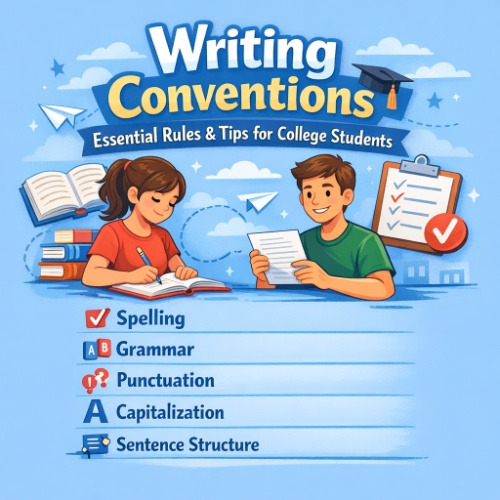
The Five Core Writing Conventions Every Student Needs
These five categories cover the fundamental rules that govern professional academic writing. Master these, and you eliminate 90% of the mechanical errors that cost you points.
1. Spelling: The Convention That Destroys Credibility Fastest
Spelling errors signal carelessness more than any other writing mistake. One typo looks like a slip. Three typos in the first paragraph make readers question whether you care about your work at all.
Why spelling matters more than you think:
Modern students often dismiss spelling as "not a big deal" because spell-check catches most errors. But spell-check can't catch wrong words spelled correctly, "their" vs "there," "affect" vs "effect," "principle" vs "principal." These errors appear in professional writing constantly and undermine credibility immediately.
Research on hiring decisions shows that 58% of employers would reject a resume containing spelling errors, even if the candidate was otherwise qualified. In academic settings, studies tracking grading patterns reveal that essays containing spelling errors receive consistently lower scores across all evaluation criteria, not just grammar scores, but content and analysis scores too. Readers unconsciously downgrade their assessment of your ideas when mechanical errors suggest carelessness.
Common spelling patterns that trip up students:
Homophones (words that sound alike but have different meanings and spellings):
- their/there/they're
- your/you're
- its/it's
- to/too/two
- affect/effect
- then/than
- lose/loose
- led/lead
British vs American spelling inconsistency:
- colour/color, honour/honor, favour/favor
- centre/center, theatre/theater
- analyse/analyze, organise/organize
- travelled/traveled, cancelled/canceled
Commonly misspelled academic words:
- separate (not seperate)
- definitely (not definately)
- occurred (not occured)
- argument (not arguement)
- accommodation (not accomodation)
- consistent (not consistant)
- necessary (not neccessary)
- conscientious (not consciencious)
Strategies for improving spelling accuracy:
Don't rely solely on spell-check. It catches "teh" but not "from" when you meant "form." Read your essay backward from the last sentence to the first, this forces you to see individual words rather than skimming for meaning. Keep a personal list of words you consistently misspell and review it before finalizing essays. For important submissions, have someone else proofread specifically for spelling, fresh eyes catch errors your brain automatically corrects when reading your own work.
Your Essays Keep Getting Marked Down for "Mechanical Errors"?
Professional writers understand that conventions aren't about perfection, they're about consistency and clarity:
- Pattern recognition that identifies your recurring error types
- Targeted strategies for eliminating your specific weaknesses
- Professional editing that shows you where conventions strengthen clarity
- Academic standards that meet your professors' expectations
Stop losing points for preventable mistakes that undermine your ideas.
Get Expert Writing Help2. Grammar: The Structure That Holds Meaning Together
Grammar rules govern how words combine into coherent sentences that express clear relationships between ideas. While some grammar rules feel arbitrary, most exist because they prevent ambiguity and confusion.
The grammar issues that actually matter in academic writing:
Subject-verb agreement means singular subjects take singular verbs and plural subjects take plural verbs. This sounds simple until you encounter compound subjects, indefinite pronouns, or collective nouns.
Wrong: "The list of requirements are posted on the syllabus." Right: "The list of requirements is posted on the syllabus." |
The subject is "list" (singular), not "requirements" (plural). The prepositional phrase "of requirements" doesn't change subject-verb agreement.
Pronoun-antecedent agreement requires pronouns to match their antecedents in number and gender.
Wrong: "Every student should submit their essay by Friday." Right: "Every student should submit his or her essay by Friday." Better: "All students should submit their essays by Friday." |
The singular "every student" technically requires a singular pronoun, though "their" is increasingly accepted as gender-neutral singular. Academic writing still tends toward traditional rules, so using plural forms or alternating "he or she" stays safest.
Pronoun reference clarity means readers should always know which noun your pronoun refers to.
Unclear: "When teachers assign homework over break, they get frustrated." Clear: "Students get frustrated when teachers assign homework over break." |
Who gets frustrated, teachers or students? The unclear pronoun reference creates ambiguity.
Verb tense consistency requires staying in one primary tense unless you have a clear reason to shift.
Inconsistent: "The study examines social media use and found correlation with anxiety." Consistent: "The study examines social media use and finds correlation with anxiety." (present tense) Consistent: "The study examined social media use and found correlation with anxiety." (past tense) |
Academic writing about literature typically uses present tense ("Shakespeare writes," not "Shakespeare wrote") because the work continues to exist. Writing about historical events or completed research uses past tense.
Sentence fragments occur when a dependent clause or phrase stands alone as a sentence without an independent clause.
Fragment: "Because the study failed to control for confounding variables." Complete: "The results are unreliable because the study failed to control for confounding variables." |
Fragments occasionally work for stylistic emphasis in creative writing but should be avoided in academic essays.
Run-on sentences and comma splices jam multiple independent clauses together without proper punctuation or conjunctions.
Run-on: "The policy reduces emissions critics argue it costs jobs." Comma splice: "The policy reduces emissions, critics argue it costs jobs." |
Correct: "The policy reduces emissions, but critics argue it costs jobs." Correct: "The policy reduces emissions; however, critics argue it costs jobs." |
3. Punctuation: The Signals That Control Meaning
Punctuation marks aren't optional decoration, they control pacing, show relationships between ideas, and prevent misunderstandings. The same words with different punctuation can mean completely different things.
"Let's eat, Grandma!" vs "Let's eat Grandma!"
Punctuation saves lives (and grades).
Commas separate elements, indicate pauses, and prevent ambiguity.
Use commas:
- After introductory phrases: "After completing the experiment, researchers analyzed the data."
- Between items in a series: "The study examined income, education, and health outcomes."
- Before coordinating conjunctions joining independent clauses: "The results were significant, but the sample size was small."
- Around nonessential information: "The theory, which dates to 1950, remains controversial."
- Between coordinate adjectives: "The long, difficult exam exhausted students."
Don't use commas:
- Between subjects and verbs: Wrong: "The students who studied hardest, passed easily."
- Before "that" clauses: Wrong: "Research shows, that meditation reduces stress."
- After coordinating conjunctions: Wrong: "The study failed but, researchers plan to try again."
Semicolons join closely related independent clauses or separate complex list items.
"Remote work increases flexibility; however, it blurs work-life boundaries." "The study included participants from Austin, Texas; Portland, Oregon; and Boston, Massachusetts." |
Many students avoid semicolons entirely because they're unsure how to use them. That's fine, you can write effective essays without semicolons. But when used correctly, they create sophisticated sentence rhythms that elevate your prose.
Colons introduce lists, explanations, or quotations.
"The study identified three factors: income inequality, education access, and healthcare availability." "The conclusion was clear: the policy had failed." |
Colons signal "here's what I'm talking about," they direct attention forward to what comes next.
Apostrophes show possession or form contractions.
Possession:
- Singular: "the student's essay"
- Plural: "the students' essays"
- Irregular plural: "the children's books"
Contractions:
- it's = it is (NOT possessive)
- its = possessive (NO apostrophe)
- they're = they are
- their = possessive
Academic writing typically avoids contractions (use "do not" instead of "don't"), but apostrophes for possession are essential.
Quotation marks enclose direct quotes and certain titles.
"According to the study, 'social media use correlates with increased anxiety.'" |
Place periods and commas inside closing quotation marks (American style). Place semicolons and colons outside.
Dashes and hyphens aren't interchangeable:
- Hyphens (-) connect compound words: "twenty-first-century technology," "well-written essay"
- En dashes (–) show ranges: "pages 45–62," "2020–2025"
- Em dashes (—) create emphasis or show interruption: "The results—surprising to everyone—contradicted predictions"
Most students overuse em dashes as all-purpose punctuation. Use them sparingly for emphasis, not as a substitute for commas or parentheses in routine situations.
Tired of Professors Marking "Unclear" Without Explaining Why?
Convention mastery isn't about memorizing every rule, it's about understanding the principles behind them:
- Clear explanations of why conventions exist and when to apply them
- Genre-appropriate standards that match your specific assignment type
- Practical strategies for catching errors during self-editing
- Professional examples showing conventions in action
Your ideas deserve writing that meets academic standards.
Transform Your Writing Today4. Capitalization: The Rules That Signal Importance
Capitalization conventions tell readers what's proper (specific names) versus common (general categories). Getting this wrong makes your writing look amateurish even if your content is strong.
Always capitalize:
Proper nouns (specific names):
- People: "Professor Johnson," "Maya Angelou," "Dr. Smith"
- Places: "New York City," "Harvard University," "Central Park"
- Organizations: "World Health Organization," "Democratic Party"
- Historical Events: "World War II," "the Renaissance," "the Civil Rights Movement"
- Days, Months, Holidays: "Monday," "December," "Thanksgiving"
- Languages, Nationalities, Religions: "English," "Japanese," "Buddhism"
The first word:
- Beginning sentences: "The study examined..."
- In titles: "How to Write an Essay"
- After colons when introducing complete sentences: "The conclusion was clear: The policy had succeeded."
Titles when used with names:
- "President Biden" but "the president visited"
- "Professor Martinez" but "my professor assigned"
Don't capitalize:
Generic terms:
- "I'm taking psychology" (the subject) vs "I'm taking Psychology 101" (the specific course)
- "my mother" vs "I asked Mother" (when used as a name)
- "the university implemented" vs "Stanford University implemented"
Seasons: "spring semester," "fall classes" (unless part of a proper name: "Spring 2025 Orientation")
Academic disciplines (unless languages): "I'm studying biology and French."
Directions (unless naming regions): "drive north" vs "the culture of the South"
The key principle: capitalize specific names, not general categories. If you can replace the word with a different name and it still makes sense, capitalize it.
5. Sentence Structure: The Architecture of Clear Communication
Sentence structure conventions determine how you organize words and clauses to express complete thoughts clearly. Violating these conventions creates confusion even when individual words are correct.
Every sentence needs a subject and verb:
Incomplete: "Running through the park." Complete: "Students were running through the park." |
That incomplete example is a phrase, not a sentence, it describes an action but doesn't tell us who performed it.
Parallel structure keeps related items in the same grammatical form:
Wrong: "The job requires attention to detail, working independently, and you must meet deadlines." |
Right: "The job requires attention to detail, independent work, and deadline adherence." Right: "The job requires that you pay attention to detail, work independently, and meet deadlines." |
All items in a list should follow the same grammatical pattern, all nouns, all verbs, all phrases, all clauses.
Modifier placement affects meaning:
Unclear: "I only told three people about the party." Does this mean: (a) I told (not shouted to) three people, (b) I told three people (not four), or (c) I told three people (not everyone)? Clear: "I told only three people about the party." (meaning b) |
Place modifiers as close as possible to the words they modify to prevent ambiguity.
Active vs passive voice changes emphasis:
Active: "Researchers conducted the experiment." Passive: "The experiment was conducted by researchers." |
Active voice emphasizes who performed the action. Passive voice emphasizes what received the action. Academic writing uses both strategically, active for clarity and directness, passive when the actor is unknown or irrelevant.
Genre-Specific Convention Variations
While core conventions remain consistent, different writing genres emphasize different elements:
Narrative writing conventions:
- Past tense for storytelling ("I walked to school")
- Vivid sensory details to create scenes
- Dialogue punctuation: "I asked, 'What happened?'"
- Chronological or flashback time structures clearly marked
Descriptive writing conventions:
- Present tense for creating immediacy ("The mountain towers above")
- Sensory language appealing to sight, sound, smell, taste, touch
- Figurative language: metaphors, similes, personification
- Spatial organization moving logically through a scene
Expository writing conventions:
- Clear topic sentences beginning paragraphs
- Transitions showing logical relationships between ideas
- Objective tone avoiding first person
- Evidence-based claims with citations
Persuasive/Argumentative writing conventions:
- Strong thesis statements taking clear positions
- Counterargument acknowledgment and refutation
- Evidence hierarchy: statistics, expert testimony, examples
- Logical fallacy avoidance
Understanding these genre variations prevents applying narrative conventions to research papers or academic tone to personal essays where it feels stiff and unnatural.
Common Convention Mistakes That Cost Grades
Even strong students fall into these patterns:
Mistake #1: Inconsistent citation style
Mixing MLA in-text citations with APA reference pages, or switching between formats mid-essay. Pick one style guide and follow it consistently throughout.
Mistake #2: Informal language in formal contexts
Using contractions ("don't," "can't"), colloquialisms ("a lot of," "kind of"), or conversational phrases ("basically," "at the end of the day") in research papers. Academic writing maintains professional distance.
Mistake #3: Switching verb tenses randomly
"The author argues that social media creates anxiety. She presented evidence from three studies..." Pick a primary tense and stick with it unless you have a specific reason to shift.
Mistake #4: Overusing passive voice
"It was found that..." "The data was analyzed..." "The conclusion was reached..." Passive voice isn't wrong, but overusing it makes writing feel lifeless. Aim for 70-80% active voice in academic essays.
Mistake #5: Ignoring assignment-specific requirements
Some professors want double-spacing, others single. Some accept first person, others prohibit it. Some require title pages, others don't. Convention mastery includes following assignment guidelines precisely.
Practical Strategies for Improving Convention Mastery
Knowing conventions intellectually doesn't automatically translate to using them correctly under deadline pressure. Here's how to build the skills:
Strategy 1: Create a personal error log
Track every grammar, punctuation, or spelling error marked on your returned essays. Patterns will emerge, maybe you consistently misuse commas with introductory phrases, or you struggle with subject-verb agreement when the subject comes after the verb. Once you know your patterns, you can target them during revision.
Strategy 2: Read your essays aloud
Your ear catches awkward phrasing and missing punctuation your eyes skip over. When you stumble while reading, that's a signal something needs fixing, unclear pronoun reference, missing comma, run-on sentence.
Strategy 3: Use the "24-hour rule"
Write your draft, then don't look at it for at least one day. When you return with fresh eyes, you'll spot errors that were invisible immediately after writing. Your brain fills in missing words and corrects errors automatically when the content is still fresh in your memory.
Strategy 4: Edit in multiple passes
Don't try to catch everything simultaneously. Make one pass checking only for spelling. Another pass checking only punctuation. Another for verb tense consistency. Focused attention finds more errors than trying to catch everything at once.
Strategy 5: Master one convention category at a time
If commas confuse you, spend a week focusing only on comma rules. If apostrophes baffle you, dedicate focused study to possession and contraction rules. Trying to master everything simultaneously overwhelms you and results in no meaningful improvement.
Sentence structure problems often stem from thinking in one language and translating to another, or from trying to sound "academic" by making sentences unnecessarily complex. The clearest writing uses direct subject-verb-object patterns as your default, saving complex structures for genuinely complex ideas. Our essay writing service helps international students and English learners master the sentence patterns that sound natural to native academic readers.
Technology Tools for Convention Checking
While spell-check and grammar-check tools catch many errors, they're not foolproof:
What technology catches well:
- Obvious spelling errors ("teh" – "the")
- Basic subject-verb agreement ("The students was" – "The students were")
- Missing or extra commas in common patterns
- Sentence fragments in straightforward cases
What technology misses:
- Context-dependent word choice ("affect" vs "effect" used correctly by spelling but wrong for meaning)
- Subtle grammar issues requiring understanding of sentence meaning
- Style consistency across the entire essay
- Discipline-specific terminology
- Proper noun capitalization without context
Use technology as your first line of defense, but never as your only proofreading method. Grammar checkers suggest "corrections" that are actually wrong about 20-30% of the time because they can't understand complex context.
Stop Losing Points for Preventable Convention Errors
Professional academic writing combines strong ideas with polished execution:
- Zero mechanical errors that distract readers or undermine credibility
- Consistent conventions that meet academic standards
- Clear communication that lets ideas take center stage
- Professional editing that catches what you miss
Transform adequate writing into submission-ready academic prose.
Get Professional Essay HelpFinal Thoughts
Here's what matters most: writing conventions exist to make communication clearer, not to torture students with arbitrary rules. When you master conventions, readers focus on your ideas instead of getting distracted by errors that make them question your credibility.
Perfect convention mastery isn't realistic or necessary. Professional writers make errors. Published books contain typos. The goal is consistency and accuracy at a level that doesn't distract readers or undermine your authority.
Think of conventions as the infrastructure of writing, like roads that let ideas travel from your mind to your reader's. When the infrastructure is solid, the journey feels smooth. When it's full of potholes (spelling errors, grammar mistakes, punctuation problems), the journey becomes exhausting and frustrating.
The students who succeed academically aren't necessarily those with the most brilliant insights, they're often those who present good ideas in professional, error-free formats that meet academic standards. Master conventions, and you give your ideas the best possible chance to be taken seriously.
Start with the conventions that appear most frequently in your professor's feedback. Fix those first. Then expand to less common issues. Convention mastery is a gradual process, not a one-time achievement. Even professional writers continue learning and refining their understanding of written English standards throughout their careers.
Your ideas deserve writing that does them justice. Conventions provide the framework that lets your insights shine.


-20154.jpg)