Why Essay Format Matters
Proper essay formatting serves multiple crucial purposes beyond simply following instructions. Understanding why format matters helps you appreciate the importance of these seemingly minor details and motivates careful attention to formatting requirements.
1. Format demonstrates academic professionalism.
Just as you wouldn't attend a job interview in pajamas, you shouldn't submit academic work with sloppy or inconsistent formatting. A professional presentation signals that you take your work seriously and respect your reader's time and expectations. Instructors form immediate impressions based on visual presentation before reading a single sentence of your content.
2. Proper formatting improves readability.
Standard fonts, appropriate spacing, and consistent margins aren't arbitrary preferences. These specifications developed over decades create optimal reading experiences that reduce eye strain and cognitive load. When readers can focus on your ideas rather than struggling with tiny fonts, cramped spacing, or inconsistent formatting, your arguments communicate more effectively.
3. Format affects credibility.
Academic writing requires citing sources to support claims and demonstrate engagement with existing scholarship. Proper citation formatting shows readers where information originated, allows verification of your sources, and prevents plagiarism accusations. Inconsistent or incorrect citation format undermines your credibility even when your arguments are sound and your research thorough.
4. Following format shows attention to detail.
Instructors view formatting as a proxy for overall work quality. If you can't follow straightforward formatting instructions, why should they trust your analysis, argumentation, or research findings? Careful formatting signals conscientiousness that extends to all aspects of your academic work.
5. Format requirements level the playing field.
Standardized formatting ensures all students meet the same expectations regardless of personal aesthetic preferences or prior educational experiences. These shared standards make evaluation more equitable and ensure your work is judged on intellectual merit rather than visual presentation choices.
6. Consistent format saves time.
Learning standard formatting styles once allows you to apply those skills across multiple courses and assignments throughout your academic career. The investment in understanding MLA, APA, or Chicago format pays dividends every time you write papers requiring those styles.
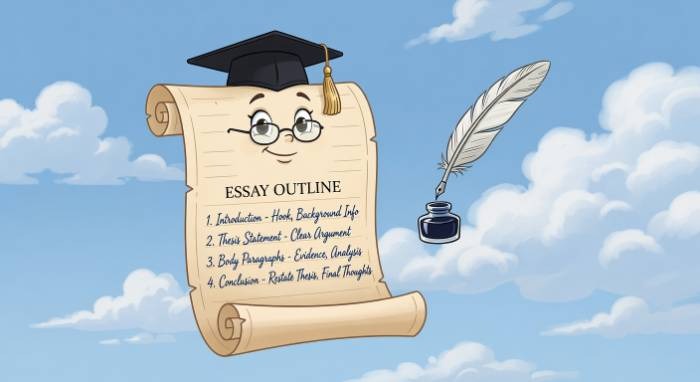
Master essay structure fundamentals with our comprehensive essay outline guide before focusing on formatting details!
Your GPA Doesn't Have to Suffer Expert Writers. Original Essays. Guaranteed Results Trusted by 50,000+ students. Zero AI. Zero plagiarism.
Basic Essay Formatting Guidelines
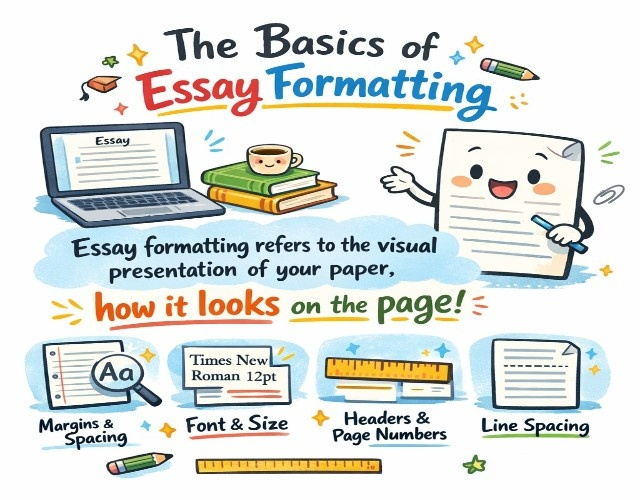
Certain formatting elements remain consistent across most academic essays regardless of which specific citation style your assignment requires. Master these basic guidelines before learning style-specific requirements.
Font selection and size:
- Use professional, readable fonts including Times New Roman, Arial, Calibri, or Georgia in 12-point size.
- Avoid decorative, script, or novelty fonts that reduce readability or appear unprofessional.
- Stick with standard serif fonts like Times New Roman for printed submissions or clean sans-serif fonts like Arial for digital submissions unless instructors specify particular preferences.
Margin specifications:
- Set 1-inch margins on all sides including top, bottom, left, and right edges.
- Standard margins provide adequate white space around text without wasting paper or making pages appear cramped.
- Most word processors default to 1-inch margins, but always verify margin settings before submitting work to ensure consistency.
Line spacing requirements:
- Most academic essays require double-spacing throughout the entire document including the main text, block quotations, and works cited pages.
- Double-spacing provides room for instructor comments, improves readability, and creates professional-looking documents.
- Some elements like your name and course information in headers may use single-spacing depending on the style guide.
Paragraph indentation:
- Indent the first line of each paragraph by 0.5 inches using the Tab key rather than manually spacing.
- Proper indentation visually signals new paragraphs without requiring extra line breaks between paragraphs.
- Never skip additional lines between paragraphs when using proper indentation in academic essays.
Text alignment:
- Use left alignment for essay text rather than full justification.
- Left-aligned text with a ragged right edge provides easier reading than fully justified text which creates uneven spacing between words.
- Center alignment should only be used for titles and headers as specified by style guides.
Page numbering:
- Include page numbers on every page except sometimes the title page depending on style requirements.
- Place page numbers in headers or footers as specified by your chosen format style.
- Continuous page numbering helps readers navigate your work and ensures pages remain in correct order.
Header information:
- Include identifying information in the upper left corner or header depending on format requirements.
- This typically includes your name, instructor's name, course number, and submission date.
- Specific placement and formatting varies by style guide.
Develop strong opening paragraphs using techniques from our how to start an essay guide!
You Deserve Better Than a C Get the Essay — and the Grade — You Actually Want No AI. No templates. Just essays that get results
MLA Format Essay Guidelines
- MLA format, established by the Modern Language Association, is the standard formatting style for humanities courses, including English, literature, languages, and cultural studies.
- Understanding MLA requirements ensures your essays meet expectations in these disciplines.
MLA title page format:
- MLA format typically does not require a separate title page unless your instructor specifically requests one.
- Instead, place identifying information in the upper left corner of the first page, including your name on the first line, instructor's name on the second line, course name and number on the third line, and submission date on the fourth line.
- Use day-month-year format for dates such as "1 December 2025."
MLA header format:
Create a header in the upper right corner of every page including your last name followed by the page number.
For example, "Smith 1" on the first page, "Smith 2" on the second page, and so forth.
This header should appear on every page including the works cited page.
MLA title formatting:
- After your identifying information, skip one line and center your essay title using standard capitalization.
- Do not use bold, italics, underlining, or quotation marks for your title unless it includes the title of another work.
- Only capitalize the first word, last word, and all principal words in the title.
MLA in-text citations:
- Cite sources within your essay text using parenthetical citations including the author's last name and page number with no comma between them. For example: (Smith 45).
- If you mention the author's name in your sentence, include only the page number in parentheses.
- Place citations before the period ending the sentence.
MLA works cited page:
- Create a separate page at the end of your essay titled "Works Cited" centered at the top.
- List all sources cited in your essay alphabetically by author's last name.
- Use hanging indentation where the first line starts at the left margin and subsequent lines indent 0.5 inches.
- Double-space all entries and the entire page.
MLA block quotations:
- For quotations longer than four lines of prose or three lines of poetry, format as block quotations.
- Start the quote on a new line indented 1 inch from the left margin, maintain double-spacing, and omit quotation marks.
- Place the parenthetical citation after the final punctuation.
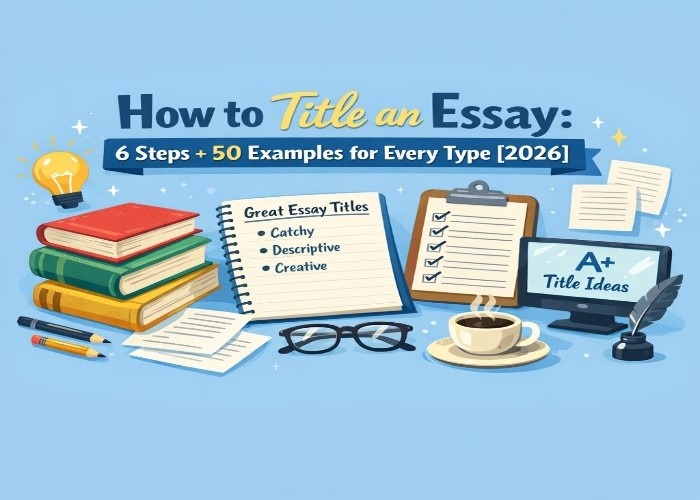
Create compelling essay titles using our how to title an essay guide for effective title construction!
APA Format Essay Guidelines
APA format, created by the American Psychological Association, serves as the standard for social sciences including psychology, sociology, education, and business courses. APA emphasizes clarity, precision, and accessibility in presenting research findings.
APA title page format:
- APA requires a separate title page including the essay title (bold and centered in the upper half of the page), your name centered below the title, institutional affiliation centered below your name, course number and name, instructor name, and submission date all centered on separate lines.
- Some instructors may require additional elements like running heads for longer papers.
APA header format:
- Include a page number in the upper right corner of every page including the title page.
- For professional papers, include a running head (shortened title in all capital letters) in the upper left corner of every page.
- For student papers, many instructors now allow omitting the running head except on the title page.
APA headings format:
- APA uses five levels of headings to organize longer papers.
- Level 1 headings are centered and bold with title case capitalization.
- Level 2 headings are left-aligned, bold, and title case. Level 3 headings are left-aligned, bold, italic, and title case.
- Use headings to organize content and guide readers through your paper's structure.
Imagine Submitting Without the Panic
Your Essay. Written by Pros. Delivered on Time
100% original. 100% human. Satisfaction guaranteed
APA in-text citations:
- Cite sources using author-date format with the author's last name and publication year in parentheses. For example: (Smith, 2024).
- If directly quoting, add the page number with "p." for a single page or "pp." for multiple pages: (Smith, 2024, p. 45).
- If mentioning the author in your sentence, include only the year in parentheses immediately after the name.
APA references page:
- Create a separate page titled "References" centered at the top in bold.
- List sources alphabetically by author's last name using hanging indentation.
- Include all sources cited in your text.
- Each entry should include author, publication date, title, and source information formatted according to APA guidelines for different source types.
APA abstract requirements:
- Some APA papers require an abstract, which is a brief 150-250 word summary of your paper appearing on its own page after the title page.
- Center the word "Abstract" in bold at the top of the page, then write a single paragraph summarizing your paper's purpose, methods, results, and conclusions without indentation.
Craft powerful conclusions with our how to write a conclusion guide for synthesizing arguments effectively!
Chicago Style Format Guidelines
- Chicago style, based on The Chicago Manual of Style, appears frequently in history courses and some humanities disciplines.
- Chicago offers two citation systems: notes-bibliography style using footnotes or endnotes, and author-date style similar to APA format.
Chicago title page format:
- Chicago style requires a title page with the essay title centered about one-third down the page.
- Center your name, course information, and submission date on separate lines in the lower third of the page.
- Do not include page numbers on the title page. Use standard capitalization for the title without bold, italics, or underlining.
Chicago page numbering:
- Include page numbers in the header or footer starting from the first page of text, not the title page.
- Place numbers in the upper right corner or centered at the bottom of pages depending on instructor preference.
- Use Arabic numerals throughout.
Chicago notes-bibliography citations:
- Use superscript numbers in your text to indicate citations, placing them after punctuation marks.
- Create corresponding footnotes at the bottom of each page or endnotes on a separate page before your bibliography.
- Footnotes and endnotes include complete publication information in a slightly different format than bibliography entries.
Chicago bibliography page:
- Create a bibliography page listing all sources consulted for your paper, not just those cited.
- Title the page "Bibliography" centered at the top.
- List entries alphabetically by author's last name using hanging indentation.
- Use the same font and spacing as your essay text.
Chicago block quotations:
- For quotations of five or more lines, format as block quotes indented 0.5 inches from the left margin.
- Maintain double-spacing and omit quotation marks.
- Place the citation note number after the final punctuation.
- Introduce block quotations with complete sentences followed by colons.
Chicago formatting flexibility:
- Chicago style allows some flexibility in formatting details.
- Always follow your instructor's specific requirements when they differ from standard Chicago guidelines.
- Some instructors prefer footnotes while others require endnotes; some want single-spacing in notes while others require double-spacing throughout.
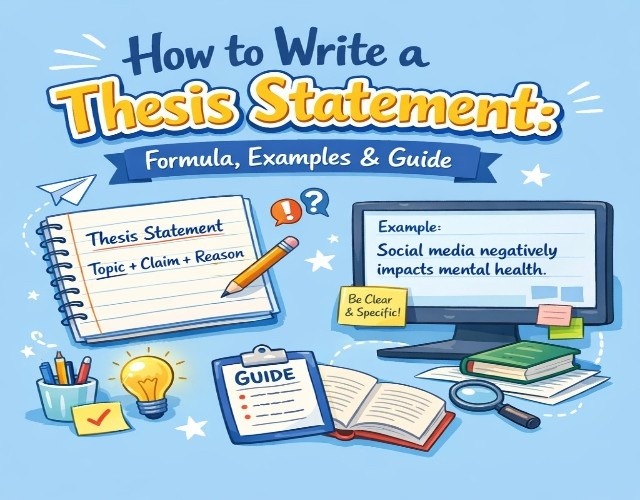
Structure complex arguments with our thesis statement examples guide for building strong foundations!
That Essay Won't Write Itself
But Our Writers Will Write It For You
No AI shortcuts. Real writers. Real results.
Essay Structure and Organization Format
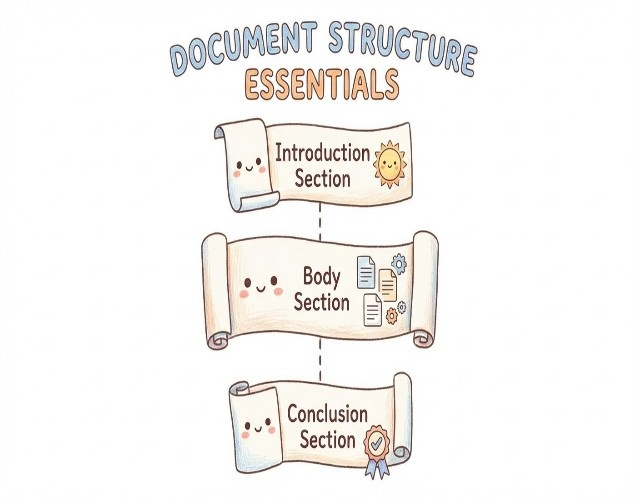
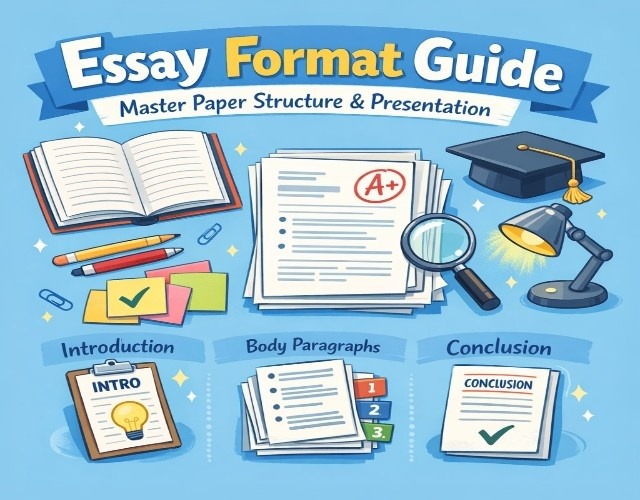
Beyond mechanical formatting requirements, proper essay structure organizes your ideas logically and guides readers through your arguments. Understanding structural formatting ensures your content flows effectively.
Introduction formatting:
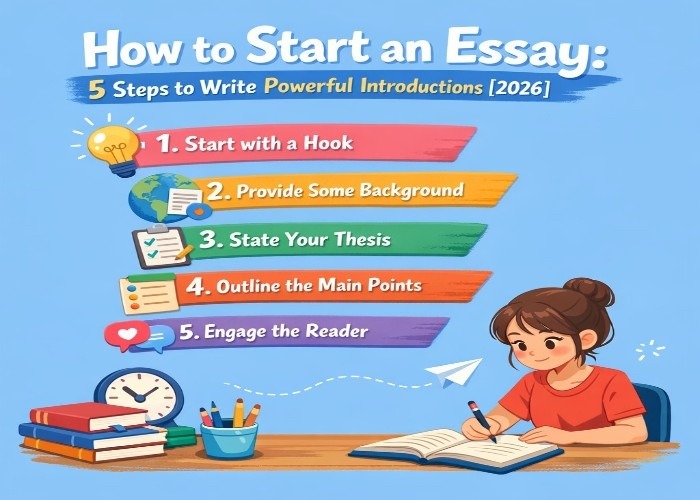
- Begin your essay with an introductory paragraph that captures reader attention, provides necessary background context, and presents your thesis statement.
- Keep introductions proportional to overall essay length, typically 10-15% of total word count.
- End the introduction with a clear thesis statement announcing your main argument.
Thesis statement placement:
- Position your thesis statement as the final sentence or two of your introduction paragraph.
- The thesis should clearly state your essay's main argument in one or two sentences.
- A strong thesis is specific, arguable, and provides a roadmap for the arguments that follow in your body paragraphs.
Body paragraph formatting:
- Organize body paragraphs around single main ideas that support your thesis.
- Begin each paragraph with a topic sentence stating the paragraph's main point.
- Follow with supporting evidence, analysis, and explanation.
- End with transition sentences connecting to the next paragraph.
- Maintain consistent paragraph length of 100-200 words for readability.
Transition formatting:
- Use transitional words and phrases to connect ideas between sentences and paragraphs.
- Transitions help readers follow your logic and understand relationships between different points in your argument.
- Place transitions at the beginning of sentences or paragraphs to signal shifts in focus or direction.
Conclusion formatting:
- Conclude your essay with a paragraph that synthesizes your main arguments, restates your thesis in light of the evidence presented, and provides final thoughts or implications.
- Conclusions should be roughly the same length as introductions.
- Avoid introducing new arguments or evidence in conclusions.
Heading usage:
- Longer essays may benefit from section headings that organize content and help readers navigate.
- Use consistent heading hierarchy following your chosen format style's guidelines.
- Headings should be descriptive and help readers locate specific information within your essay.
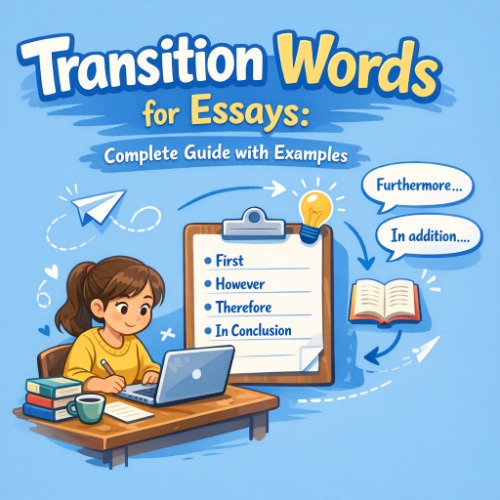
Connect ideas smoothly using our transition words for essays guide for improving flow!
Citation Format Requirements
Proper citation format gives credit to original sources, allows readers to verify your research, and demonstrates engagement with scholarly discourse. Each style guide prescribes specific citation formats for different source types.
In-text citation formatting:
- In-text citations acknowledge sources within your essay text.
- MLA uses author-page format, APA uses author-date format, and Chicago uses numbered notes.
- Place citations immediately after the borrowed information, typically before the period ending the sentence.
- Integrate citations smoothly without disrupting sentence flow.
Direct quotation formatting:
- When quoting sources directly, place the exact words in quotation marks and provide appropriate citation.
- Keep quotations under 4 lines (MLA) or 40 words (APA) to integrate them into your text.
- Introduce quotations with signal phrases identifying the source and explaining relevance to your argument.
Paraphrase citation requirements:
- Paraphrased information requires citations even without quotation marks.
- Rewrite source ideas completely in your own words while maintaining the original meaning.
- Cite the source using appropriate format for your style guide.
- Paraphrasing demonstrates understanding and allows you to highlight information most relevant to your argument.
Works cited formatting:
- Create complete bibliographic entries for all sources cited in your essay.
- MLA calls this page "Works Cited," APA uses "References," and Chicago uses "Bibliography."
- Alphabetize entries by author's last name, use hanging indentation, and double-space the entire page.
- Include all required publication information for each source.
Source type variations:
- Different source types (books, journal articles, websites, etc.) require different citation formats.
- Consult style guides for specific requirements for each source type you use.
- Pay attention to punctuation, capitalization, and italicization rules that vary by source type and citation style.
Citation management tools:
- Consider using citation management software like Zotero, Mendeley, or EndNote to organize sources and generate properly formatted citations.
- These tools help maintain consistency and save time when working with many sources, though you should always verify generated citations against official style guides.
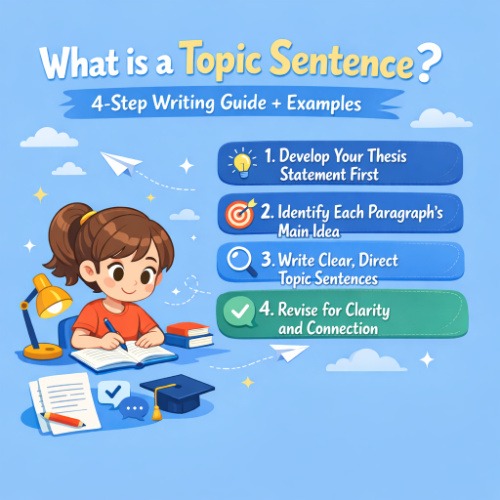
Build strong paragraphs with our topic sentence guide for effective paragraph construction!
One Click Away From Stress-Free
Let Experts Handle Your Essay Tonight
Human writers only. Original work always. Guaranteed.
Common Essay Formatting Mistakes

Students frequently make these formatting errors that undermine otherwise strong essays. Avoiding these mistakes ensures your work meets professional standards.
Inconsistent spacing:
- Switching between single and double spacing mid-essay or forgetting to double-space the works cited page creates inconsistent presentation.
- Set spacing before you begin writing and verify consistency throughout before submission.
Incorrect indentation:
- Manually spacing with the space bar instead of using the Tab key creates uneven indentation that looks unprofessional.
- Some students forget to indent paragraphs entirely or add extra line breaks between paragraphs instead of indenting.
Wrong font or size:
- Using fonts like Comic Sans, decorative scripts, or non-standard sizes makes essays appear unprofessional.
- Stick to Times New Roman or Arial in 12-point size unless instructors specify alternatives.
Missing or incorrect citations:
- Failing to cite sources leads to plagiarism accusations even when unintentional.
- Citing sources incorrectly by mixing citation styles, omitting page numbers, or formatting entries inconsistently undermines credibility.
Title formatting errors:
- Common title mistakes include underlining, using all capitals, putting the title in quotation marks when unnecessary, or using bold or larger fonts.
- Follow your style guide's specific title formatting requirements.
Page number problems:
- Forgetting page numbers entirely, placing them incorrectly, or including them on pages that shouldn't have them creates navigation difficulties.
- Verify page numbering appears consistently where required.
Works cited issues:
- Common bibliography mistakes include forgetting hanging indentation, listing sources in the wrong order, including sources not cited in the essay, or using inconsistent formatting across entries.
Heading inconsistencies:
- Using different heading formats throughout the essay or failing to follow the prescribed heading hierarchy confuses readers.
- Establish heading patterns and maintain them consistently.
Improve essay quality with our essay writing tips guide for comprehensive writing strategies!
Formatting Different Essay Types
- Different essay types may require specific formatting considerations beyond general style guide requirements.
- Understanding these variations ensures appropriate presentation for each assignment type.
Argumentative essay formatting:
- Argumentative essays benefit from clear section headings that organize your arguments, counterarguments, and rebuttals.
- Use strong topic sentences that clearly state each paragraph's argumentative point.
- Consider formatting your thesis statement in bold on your outline to ensure all body paragraphs connect to your central argument.
Narrative essay formatting:
- Narrative essays may allow more formatting flexibility including dialogue formatting, section breaks for different time periods or scenes, and less rigid paragraph structure.
- However, maintain standard formatting for font, spacing, and margins unless instructors specify otherwise.
- Use paragraph breaks to signal shifts in time, place, or focus.
Analytical essay formatting:
- Analytical essays typically follow standard formatting but benefit from clear organization that guides readers through your analysis.
- Use topic sentences that identify what element you're analyzing in each paragraph.
- Consider headings for longer analytical essays examining multiple aspects of a text, artwork, or phenomenon.
Your Time Is Worth More Than This Get Hours Back. Get a Better Essay Zero AI. Zero plagiarism. Just expert-level writing.
Compare and contrast essay formatting:
- These essays work well with clear organizational headings identifying what you're comparing in each section.
- Consider using tables or charts to summarize key differences and similarities when appropriate for your discipline and assignment.
- Ensure transitions clearly signal whether you're discussing similarities or differences.
Research paper formatting:
- Longer research papers require more complex formatting including multiple heading levels, an abstract page (APA), table of contents for very long papers, and potentially appendices for supplementary materials.
- Follow style guide requirements for organizing complex papers with multiple sections.
Short essay formatting:
- Essays under 1000 words typically don't require headings beyond the title.
- Focus on clear paragraph breaks, strong topic sentences, and smooth transitions to guide readers through your compressed argument.
- Every sentence must contribute to your thesis given the limited space.
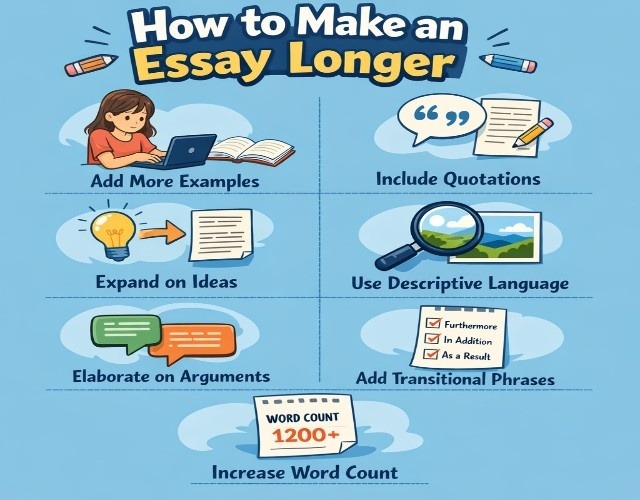
Extend your essay effectively with our how to make an essay longer guide without adding filler content!
Formatting Essays for Different Lengths
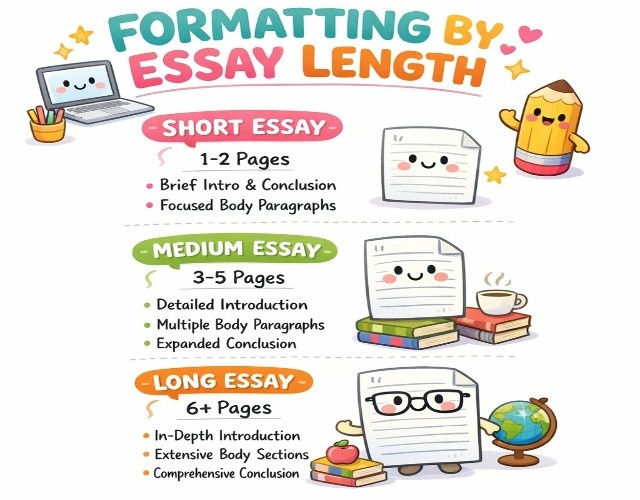
Essay formatting requirements adapt based on essay length. Understanding how format scales with length helps you meet requirements for assignments from 500 words to 5000 words.
500-word essay formatting:
Short essays of 500 words typically include 5 paragraphs with one introduction, three body paragraphs, and one conclusion.
- Use standard formatting for font, spacing, and margins.
- These brief essays rarely require headings beyond the title.
- Focus on concise topic sentences and efficient use of limited space.
Check our 500 word essay guide for specific requirements.
1000-word essay formatting:
Essays of approximately 1000 words allow for 4-6 body paragraphs providing more analytical depth.
- Maintain standard formatting throughout.
- Consider using one or two section headings to organize content if your instructor approves.
- These essays provide enough space for nuanced arguments while requiring focus and selectivity about what to include.
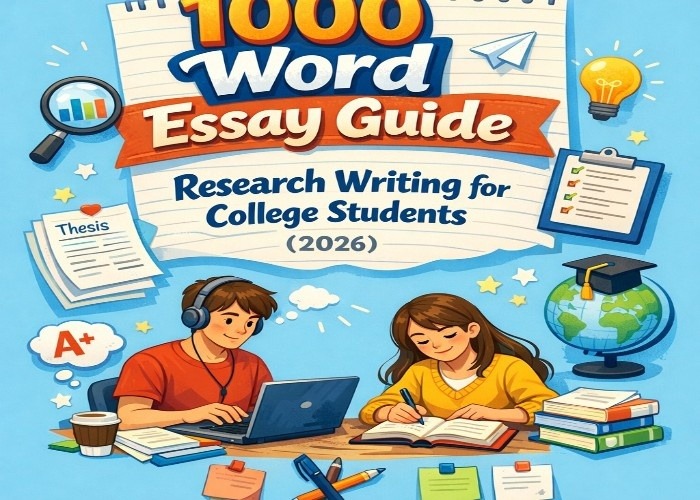
See our 1000 word essay guide for detailed structure.
2000-3000 word essay formatting:
Longer essays benefit from multiple heading levels organizing complex arguments.
- Use your style guide's heading hierarchy to create clear content organization.
- Include a strong introduction previewing your organizational structure.
- Consider using signposting sentences that explicitly tell readers where you're taking them through the argument.
Research paper formatting (5000+ words):
Extended research papers require comprehensive formatting including potentially an abstract, table of contents, multiple heading levels, appendices for supplementary materials, and extensive works cited pages.
- Break content into clear sections with descriptive headings.
- Use page breaks between major sections if appropriate for your discipline.
Formatting flexibility by length:
Shorter essays require strict adherence to standard formatting since every element is visible at a glance.
Longer essays allow more formatting flexibility including visual elements like tables, charts, or images if appropriate for your discipline and topic.
Always confirm with instructors before adding non-standard formatting elements.
Engage readers from the first sentence with our hook examples guide for compelling openings!
New Customer Offer
Your First Essay Is Free — Up to 2 Pages
No AI. No pressure. No catch.
Digital vs. Print Essay Formatting
Format requirements may vary depending on whether you're submitting essays digitally or in print form. Understanding these differences ensures appropriate presentation for each submission method.
Digital submission considerations:
- When submitting essays electronically, use file formats specified by instructors (typically .doc, .docx, or .pdf).
- Name files descriptively including your name, course number, and assignment title such as "Smith_ENG101_Essay1.docx."
- Verify that formatting remains consistent across different devices and software before submission.
PDF formatting advantages:
- Converting essays to PDF ensures formatting appears identical across all devices and platforms.
- PDF format prevents accidental editing and preserves your formatting choices including fonts, spacing, and page breaks. However, some instructors prefer editable Word documents for providing feedback.
Print formatting considerations:
- Printed essays should use high-quality paper and clear printing.
- Check that page numbers appear correctly, margins provide adequate white space, and all text is legible.
- Print a test page before printing the full essay to verify formatting appears as intended.
- Staple pages in the upper left corner unless instructors specify different binding methods.
Digital accessibility requirements:
- Some instructors require digital essays to meet accessibility standards including proper heading tags, alt text for images, and sufficient color contrast.
- Check if your course has accessibility requirements and ensure your digital document meets those standards.
Online platform formatting:
- When submitting through learning management systems like Canvas or Blackboard, verify that copy-pasted text maintains proper formatting.
- Some platforms strip formatting from pasted text.
- Consider uploading essays as attachments rather than pasting directly to preserve formatting integrity.
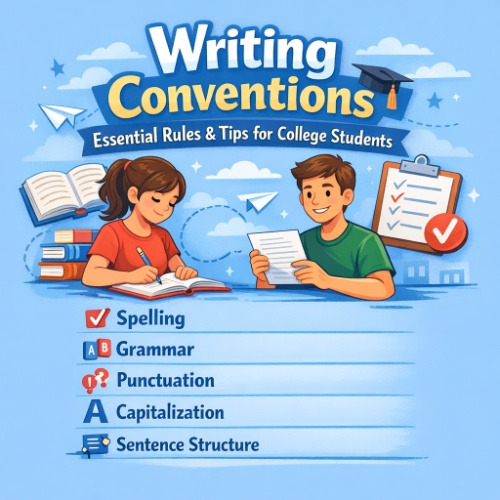
Follow academic conventions with our writing conventions guide for professional presentation!
Tools and Resources for Essay Formatting
Various tools can help you format essays correctly and maintain consistency throughout your writing process. Using these resources strategically saves time and reduces formatting errors.
Word processor formatting tools:
- Microsoft Word, Google Docs, and other word processors include built-in formatting tools for setting margins, spacing, indentation, and headers.
- Learn to use styles and formatting presets to ensure consistency.
- Set up formatting before you begin writing rather than fixing it later.
Citation generators:
Tools like EasyBib, Citation Machine, and Zotero generate formatted citations automatically when you input source information.
While convenient, always verify generated citations against official style guides as generators sometimes produce errors, particularly for unusual source types.
Grammar and formatting checkers:
Tools like Grammarly, ProWritingAid, and built-in Word grammar checkers identify formatting inconsistencies including spacing errors, font variations, and citation problems.
Use these tools as a first pass before manual proofreading, not as replacements for careful review.
Style guide resources:
- Keep official style guides or reputable online resources bookmarked for reference.
- Purdue OWL provides excellent free guides for MLA, APA, and Chicago formats.
- The official MLA Handbook, APA Publication Manual, and Chicago Manual of Style offer comprehensive guidance for complex formatting questions.
Templates and samples:
- Many instructors provide formatting templates or sample papers demonstrating proper format. Use these as models for your own work.
- Creating your own template with correct formatting saves time on future assignments requiring the same style.
Plagiarism checkers:
Tools like Turnitin, Grammarly, and Copyscape identify potential plagiarism including improperly cited sources. Run your essay through plagiarism checkers before submission to catch citation errors you may have missed.
Get Hours Back. Get a Better Essay Smart students outsource. Our writers deliver higher-quality work in less time. Zero AI. Zero stress. Just results.