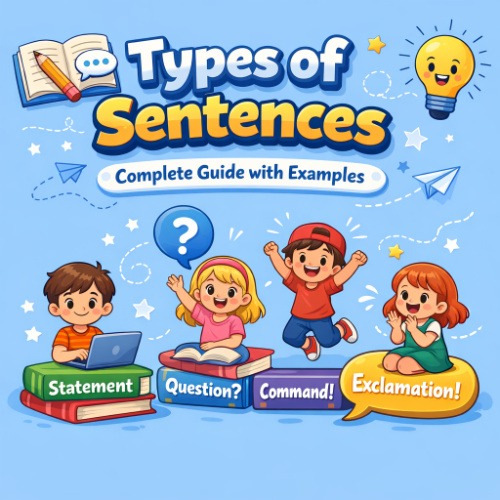
The Four Sentence Types by Purpose
These categories describe what your sentence accomplishes, whether it states information, asks a question, gives a command, or expresses emotion.
Declarative Sentences: Stating Facts and Opinions
Declarative sentences make statements and present information. They're the workhorses of academic writing, probably 90% of your essay sentences fall into this category. These sentences use standard subject-verb-object word order and always end with a period.
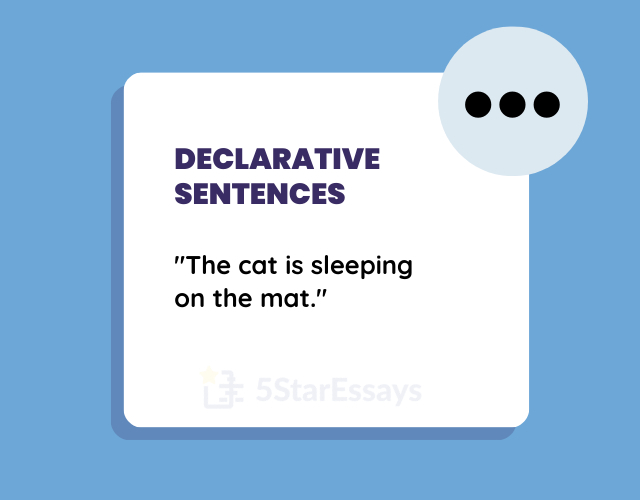
Structure: Subject + Verb + (Object/Complement)
"The experiment confirmed the hypothesis."
"Remote work increases productivity for individual contributors."
"Shakespeare wrote 37 plays during his lifetime."
Declarative sentences can be short and simple or long and complex, but they all share one feature: they declare something to be true (or at least claim it's true). Whether you're stating facts, presenting arguments, or analyzing evidence, declarative sentences do the heavy lifting in academic writing.
In essays: Use declarative sentences for thesis statements, topic sentences, presenting evidence, and analysis. They're your default sentence type for nearly everything you write. "Climate change threatens global food security through rising temperatures, shifting precipitation patterns, and increased frequency of extreme weather events." |
Interrogative Sentences: Asking Questions
Interrogative sentences ask questions and always end with a question mark. They invert normal word order by placing the helping verb before the subject or starting with question words like who, what, when, where, why, or how.
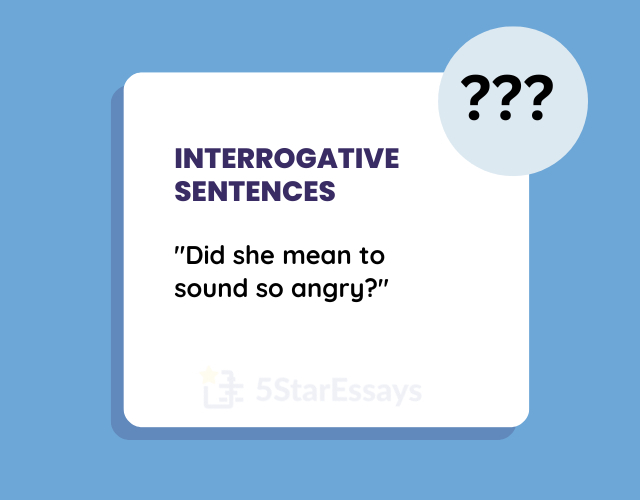
Structure: (Question word) + Helping verb + Subject + Main verb?
"What factors contributed to the French Revolution?"
"How does machine learning differ from traditional programming?"
"Why do some communities resist renewable energy projects?"
In formal academic writing, interrogative sentences appear less frequently than declarative ones, but they serve important strategic purposes. Rhetorical questions can introduce topics, create transitions between sections, or engage readers by prompting them to think critically.
In essays: Use interrogative sentences sparingly, typically in introductions to frame your topic, or as rhetorical devices to emphasize points. Overusing questions makes your writing feel uncertain rather than authoritative. "If carbon emissions continue at current rates, what kind of planet will future generations inherit? This question drives climate policy debates worldwide." |
Warning: Don't pose questions you won't answer. If you ask "What causes income inequality?" in your introduction, readers expect your essay to answer it. Empty rhetorical questions that go nowhere weaken your writing.
Your Essays Sound Monotonous and Robotic?
Professional essay writers understand that sentence variety isn't just about grammar rules—it's about creating rhythm and emphasis:
- Strategic variation that keeps readers engaged without sacrificing clarity
- Natural flow that sounds conversational yet maintains academic standards
- Proper emphasis placed on your most important points
- Expert editing that identifies monotonous patterns you can't see
Transform flat, repetitive writing into prose that actually sounds professional.
Get Started NowImperative Sentences: Giving Commands and Instructions
Imperative sentences give commands, make requests, or provide instructions. They typically omit the subject (which is understood to be "you") and start directly with the verb. Imperative sentences can end with either a period or an exclamation point depending on intensity.
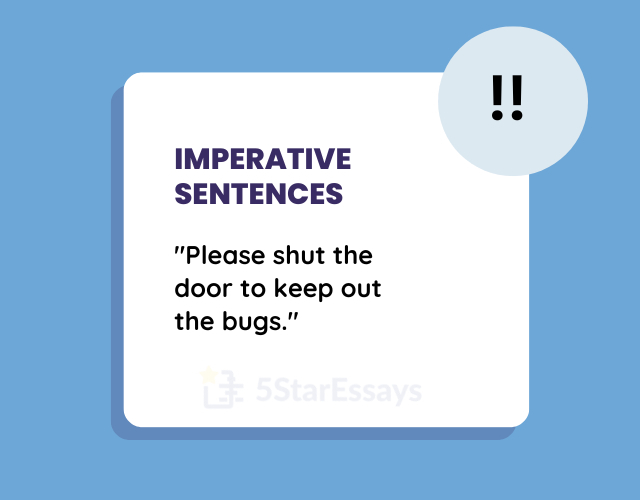
Structure: Verb + (Object/Complement)
"Consider the economic implications of universal basic income."
"Examine the evidence before drawing conclusions."
"Don't ignore the methodological limitations of this study."
"Submit your essays by Friday!"
In academic writing, imperative sentences often appear in softer, suggestion-based forms rather than direct commands. You're more likely to see "Consider how this applies to modern contexts" than "Do this now!" The understood subject remains "you" (the reader), but the tone stays professional.
In essays: Use imperative sentences when directly addressing readers, giving instructions in process essays, or making recommendations in conclusions. They work well for calls to action but should match your essay's tone. "Recognize that correlation doesn't establish causation, always examine whether confounding variables might explain observed relationships." |
Exclamatory Sentences: Expressing Strong Emotion
Exclamatory sentences express strong emotion, surprise, or emphasis and always end with an exclamation point. They can have the same structure as declarative sentences but with added emotional intensity.
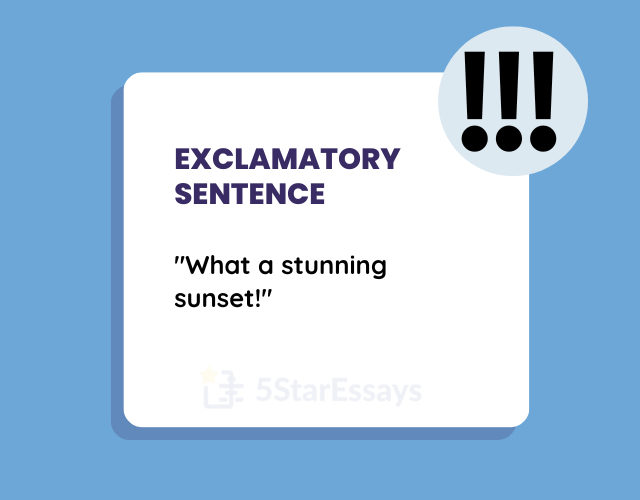
Structure: (Interjection or) Subject + Verb + Object!
"What a remarkable discovery!"
"The results contradicted every prediction!"
"How devastating these policies proved to vulnerable communities!"
Here's the thing about exclamatory sentences: they're rare in academic writing because formal essays prioritize objective analysis over emotional reaction. You might encounter them in persuasive essays, personal narratives, or when quoting sources, but professional academic tone generally avoids them.
In essays: Use exclamatory sentences extremely sparingly, if at all, in formal academic writing. They work better in creative writing, personal statements, or informal contexts. When you do use them, make sure the emotion is justified and strengthens rather than undermines your credibility. |
"The company's negligence wasn't just careless, it was criminal! Internal documents revealed executives knew about safety risks for years."
The Four Sentence Structures
While sentence types categorize by purpose, sentence structures categorize by grammatical construction, specifically, how independent and dependent clauses combine.
Quick grammar reminder: An independent clause expresses a complete thought and can stand alone as a sentence (it has a subject and verb). A dependent clause cannot stand alone, it starts with subordinating words like "because," "although," "when," "if," or "while." |
Simple Sentences: One Independent Clause
Simple sentences contain exactly one independent clause, one subject-verb combination expressing one complete thought. Don't confuse "simple" with "short." Simple sentences can include compound subjects, compound verbs, and multiple modifiers while remaining structurally simple.
Structure: Subject + Verb (+ Object/Complement)
"Students study."
"The research team analyzed data from 15,000 participants across three continents."
"Shakespeare and Marlowe revolutionized English drama."
That third example has a compound subject (Shakespeare and Marlowe) but remains a simple sentence because it contains only one independent clause. Simple sentences create clarity and emphasis; they're direct and unambiguous.
In essays: Use simple sentences to state your thesis clearly, emphasize important points, or provide relief after complex sentences. They're particularly effective when you want readers to stop and absorb a critical idea. "The evidence is undeniable. Climate change threatens human civilization." |
Compound Sentences: Two or More Independent Clauses
Compound sentences join two or more independent clauses using coordinating conjunctions (for, and, nor, but, or, yet, so, remember "FANBOYS") or semicolons. Each clause could stand alone as its own sentence, but combining them shows their relationship.
Structure: Independent clause + coordinating conjunction + independent clause
OR
Independent clause; independent clause
"Remote work increases flexibility, but it blurs boundaries between professional and personal time."
"The study controlled for confounding variables; the results remain statistically significant."
"Students prefer online courses for convenience, yet they report feeling less connected to classmates."
Compound sentences create balance and show relationships between equally important ideas. They're perfect for presenting contrasts, adding information, or showing cause-effect relationships between equivalent claims.
In essays: Use compound sentences to connect related ideas, present both sides of an argument, or build momentum in your analysis. They work especially well for showing contrast with "but" or "yet." "The policy promises economic growth, but early implementation shows minimal employment impact." |
Common mistake: Forgetting the comma before coordinating conjunctions in compound sentences. "The study succeeded yet critics questioned the methodology" needs a comma: "The study succeeded, yet critics questioned the methodology."
Complex Sentences: Independent Clause + Dependent Clause(s)
Complex sentences combine one independent clause with at least one dependent clause. The dependent clause starts with subordinating conjunctions like because, although, when, if, since, while, whereas, unless, or after.
Structure: Independent clause + dependent clause
OR
Dependent clause + independent clause
"The experiment failed because researchers didn't control for temperature variations."
"Although the sample size was small, the results showed statistically significant patterns."
"Students perform better when teachers provide immediate feedback."
Complex sentences show hierarchical relationships; one idea is primary (independent clause) while others provide supporting information, conditions, or context (dependent clauses). They're essential for sophisticated academic writing because they express nuanced relationships between ideas.
In essays: Use complex sentences to show cause-effect, acknowledge limitations, provide conditions, or add context to claims. They're your tool for expressing sophisticated thinking. "While correlation suggests a relationship, causation cannot be established without controlled experiments eliminating confounding variables." |
Punctuation rule: When the dependent clause comes first, use a comma after it. When it comes second, you typically don't need a comma (though some dependent clauses beginning with "although" or "though" may require one).
Your Professor Keeps Writing "Choppy" or "Monotonous"?
Sentence variety isn't something you can fix by following a formula. You need to understand how structure creates rhythm:
- Strategic mixing of simple, compound, complex, and compound-complex sentences
- Proper emphasis through sentence length variation
- Natural flow that guides readers effortlessly through ideas
- Expert revision that identifies monotonous patterns
Stop submitting essays that sound like they came from a robot.
Transform Your Writing StyleCompound-Complex Sentences: Multiple Independent Clauses + Dependent Clause(s)
Compound-complex sentences combine the features of compound and complex sentences; they contain at least two independent clauses and at least one dependent clause. These are your longest, most sophisticated sentence structures.
Structure: Multiple independent clauses + dependent clause(s) in any arrangement
"Although the initial results seemed promising, the replication study failed to confirm the findings, and subsequent research questioned the original methodology."
"Students who receive early intervention perform better academically, and they're more likely to graduate, though success rates vary by program design."
"The policy reduces carbon emissions because it incentivizes renewable energy adoption, but critics argue it disproportionately affects low-income communities."
Compound-complex sentences express multiple layers of related ideas in one grammatical unit. They're powerful for showing complex relationships but can become confusing if overused or poorly constructed.
In essays: Use compound-complex sentences for your most sophisticated analysis, when you need to present multiple related claims with conditions, contrasts, or additional context. Don't overuse them; mix them with simpler structures for readability. "Because algorithms prioritize engagement over accuracy, conspiracy theories spread faster than fact-checks, and this dynamic has accelerated political polarization." |
Warning: Compound-complex sentences can easily become run-ons if you're not careful. Make sure you're joining clauses properly with coordinating conjunctions and commas, not just stringing ideas together endlessly.
Why Sentence Variety Matters in Essay Writing
Here's what most grammar guides won't tell you: knowing sentence types and structures means nothing if you can't use them strategically. The goal isn't to check boxes ("I need one interrogative sentence and two compound-complex sentences per paragraph"). The goal is creating writing that flows naturally and emphasizes your most important points.
Rhythm and pacing: Alternating short, simple sentences with longer complex ones creates rhythm that keeps readers engaged. Too many short sentences sound choppy. Too many long sentences exhaust readers.
Compare these paragraphs:
Monotonous: "Climate change threatens food security. Rising temperatures reduce crop yields. Changing precipitation patterns disrupt growing seasons. Extreme weather events destroy harvests. These factors combine to create global food shortages." Varied: "Climate change threatens global food security through multiple mechanisms. Rising temperatures reduce crop yields, while changing precipitation patterns disrupt traditional growing seasons. When extreme weather events destroy harvests, these factors combine synergistically to create cascading food shortages." |
Same information, but the second version flows better because it varies sentence length and structure.
Emphasis and importance: Short, simple sentences create emphasis. They make readers stop and pay attention. Longer, complex sentences develop nuanced ideas but can bury your main point if every sentence follows that pattern.
Use simple sentences for your most important claims:
"The evidence is clear. Social media algorithms amplify extreme content because outrage drives engagement, and platforms prioritize metrics over wellbeing. This isn't accidental, it's by design. Companies have known for years that controversial content keeps users scrolling, yet they've refused to change their models because doing so would reduce profitability." |
Notice how the two simple sentences ("The evidence is clear" and "This isn't accidental, it's by design") create punch and emphasis while the complex sentences handle the analytical heavy lifting.
Practical Strategies for Mixing Sentence Types
Knowing the four types and four structures is one thing. Using them effectively is another. Here's how:
Strategy 1: Read your Essay Aloud
You'll immediately hear monotony if every sentence has the same length and rhythm; your writing sounds robotic. Mark places where you stumble or where sentences feel too long. Those spots need revision.
Strategy 2: Check your Paragraph Openings
If every paragraph starts with a subject-verb-object simple sentence, you've fallen into a pattern. Vary your opening sentences, start some paragraphs with dependent clauses, others with transitions, others with simple declaratives.
Strategy 3: Use Short Sentences for Emphasis
When you want readers to pause and absorb an important claim, use a short, simple sentence. It creates a moment of clarity after complex analysis.
"Remote work offers flexibility, reduces commuting costs, and allows companies to hire talent regardless of location. But it comes with hidden costs. The always-on culture that emerges when work and home occupy the same space leads to burnout rates 20% higher than traditional office environments." |
That short middle sentence ("But it comes with hidden costs.") creates emphasis through contrast with the longer sentences around it.
Strategy 4: Combine Related Short Sentences
If you have three consecutive short sentences that feel choppy, consider whether they're actually related ideas that should combine into a compound or complex sentence.
Choppy: "Students prefer online courses. They cite scheduling flexibility. They also mention reduced commuting time." Improved: "Students prefer online courses because they offer scheduling flexibility and eliminate commuting time." |
Strategy 5: Break up Overly Long Sentences
If a sentence runs more than 35-40 words and contains multiple ideas, consider whether you're cramming too much into one structure. Long sentences should express one complex idea, not multiple separate claims.
Too long: "Although remote work offers flexibility and reduces commuting costs while allowing companies to hire talent regardless of location, it blurs boundaries between professional and personal time and creates always-on cultures where employees struggle to disconnect from work, which leads to burnout rates significantly higher than traditional office environments because workers never truly leave the workplace." Better: "Although remote work offers flexibility and reduces commuting costs, it blurs boundaries between professional and personal time. This creates always-on cultures where employees struggle to disconnect, leading to burnout rates significantly higher than traditional office environments." |
Most students default to simple and compound sentences because they're comfortable. Complex and compound-complex sentences feel risky. But those sophisticated structures are what separate college-level writing from high school essays. Our essay writing service teaches you how to construct complex sentences that clarify rather than confuse.
Common Sentence Structure Mistakes to Avoid
Even strong writers fall into these patterns:
Mistake #1: Comma Splices
Joining two independent clauses with only a comma creates a comma splice, a grammatical error.
Wrong: "The study succeeded, the results were significant." |
Right: "The study succeeded, and the results were significant." (compound sentence with coordinating conjunction) Right: "The study succeeded; the results were significant." (compound sentence with semicolon) Right: "The study succeeded. The results were significant." (two simple sentences) |
Mistake #2: Sentence Fragments
Dependent clauses can't stand alone as sentences; they're fragments that confuse readers.
Wrong: "Because the researchers didn't control for confounding variables. The study's conclusions are questionable." Right: "Because the researchers didn't control for confounding variables, the study's conclusions are questionable." |
Mistake #3: Run-on Sentences
Joining multiple independent clauses without proper punctuation or conjunctions creates run-ons.
Wrong: "Students prefer online courses they offer flexibility they also eliminate commuting." Right: "Students prefer online courses because they offer flexibility and eliminate commuting." |
Stop Submitting Essays That Sound the Same from Start to Finish
Sentence variety creates the rhythm and emphasis that transform adequate writing into engaging prose:
- Strategic structure mixing that creates natural flow
- Proper emphasis placement through length variation
- Professional rhythm that keeps readers engaged
- Expert editing that catches monotonous patterns
Your ideas deserve writing that does them justice.
Get Professional Writing HelpFinal Thoughts
Here's what matters most: sentence types and structures aren't just grammar terminology to memorize for tests. They're tools that control how your writing sounds and how effectively you communicate ideas.
Master writers use sentence variety intuitively; they don't consciously think, "Now I'll write a compound-complex sentence." But they developed that intuition by first understanding the structures explicitly, then practicing until variation became natural.
If your essays feel monotonous, start by analyzing a paragraph you've written. Identify every sentence type and structure. If you've used six consecutive simple sentences or alternated between only simple and compound sentences, you know what needs fixing.
Then revise strategically. Combine related short sentences into compound or complex structures. Break up overly long sentences. Use short, punchy simple sentences to emphasize key claims. Vary your paragraph openings.
The goal isn't mechanical perfection where every paragraph contains exactly one of each sentence type. The goal is writing that flows naturally, emphasizes important ideas, and keeps readers engaged from thesis to conclusion.


-20154.jpg)