What is a Topic Sentence?
A topic sentence is the opening sentence of each body paragraph that introduces that paragraph's main idea.
Think of topic sentences as mini-thesis statements for each paragraph. While your thesis statement controls your entire essay, topic sentences control individual paragraphs.
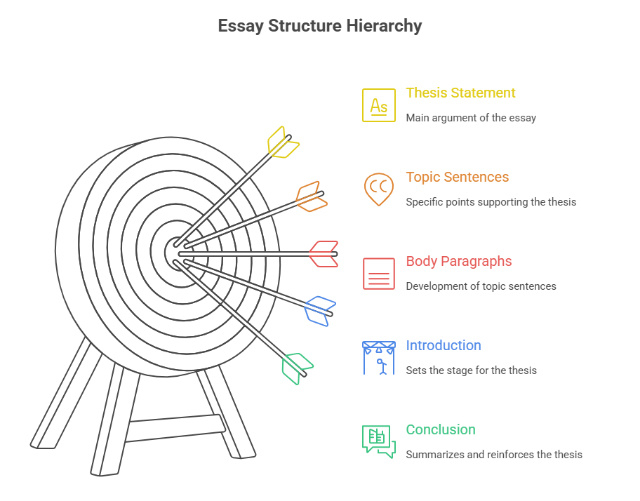
What Topic Sentences Do:
- Introduce the paragraph's main point: Tell readers what this paragraph will discuss
- Connect to your thesis: Show how this paragraph supports your overall argument
- Create organization: Signal transitions between ideas
- Guide readers: Provide roadmap of where your essay is going
Example:
Thesis: "Remote work increases productivity through elimination of commute time, reduced workplace distractions, and flexible scheduling."
Topic Sentence for Body Paragraph 1: "Eliminating daily commutes gives remote workers an additional 8-10 hours weekly for focused work."
Topic Sentence for Body Paragraph 2: "Working from home removes common office interruptions that fragment attention and reduce output quality."
Topic Sentence for Body Paragraph 3: "Flexible scheduling allows workers to complete tasks during their peak cognitive performance hours."
Notice how each topic sentence introduces one specific aspect of the thesis while connecting back to the overall argument about productivity.
Topic Sentence vs. Thesis Statement: Key Differences
Students often confuse topic sentences with thesis statements. Here's how they differ:
| Thesis Statement | Topic Sentence |
|---|---|
| Controls entire essay | Controls single paragraph |
| Appears at end of introduction | Appears at beginning of body paragraphs |
| Presents main argument | Presents one supporting point |
| Written once per essay | Written for each body paragraph |
Relationship analogy: If your thesis is a tree trunk, topic sentences are the main branches. Each branch grows from the trunk but has its own direction.
Learn more about crafting strong thesis statements in our thesis statement guide.
Transform Your Notes with Expert Help
Struggling to convert complex topics into digestible material? Get professional assistance to turn your notes into clear, concise content that works for you.
- Completely original work
- Custom-tailored to your academic needs
- Punctual, guaranteed delivery
- 1000s of satisfied students
Save time and boost your grades with tailored academic support.
Get Your Work Done RightHow to Write Topic Sentences: 4 Simple Steps
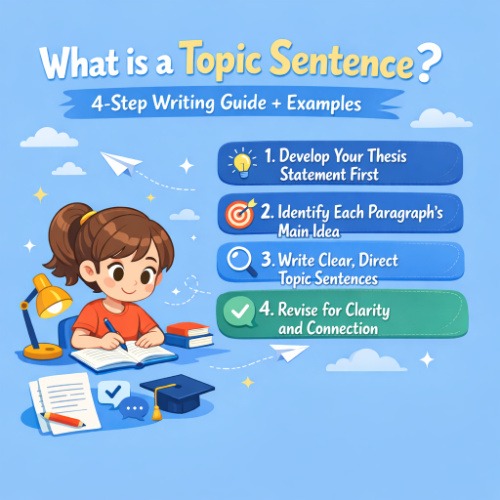
Step 1: Develop Your Thesis Statement First
You can't write effective topic sentences without knowing your main argument.
Your thesis determines what your body paragraphs will discuss. Start by crafting a clear, specific thesis that previews your main points.
Example thesis: "College should be tuition-free because current student debt prevents economic mobility, reduces entrepreneurship, and creates systemic inequality." |
From this thesis, you know you'll need three body paragraphs covering: 1. Student debt preventing mobility 2. Impact on entrepreneurship 3. Systemic inequality
Step 2: Identify Each Paragraph's Main Idea
Determine what single point each paragraph will prove.
Don't try to cover multiple ideas in one paragraph. Each body paragraph should focus on developing one specific aspect of your thesis.
Using our college tuition thesis:
|
Step 3: Write Clear, Direct Topic Sentences
State your paragraph's main point in one clear sentence.
Good topic sentences:
|
Example topic sentences for our thesis:
Paragraph 1: "Student loan debt prevents recent graduates from achieving economic mobility by delaying major life milestones like home ownership, marriage, and retirement savings."
Paragraph 2: "Fear of defaulting on student loans discourages college graduates from pursuing entrepreneurship, reducing new business formation by an estimated 14% annually."
Paragraph 3: "Rising tuition costs create systematic inequality by making higher education accessible primarily to wealthy families while excluding qualified low-income students."
Step 4: Revise for Clarity and Connection
After writing your essay, review topic sentences to ensure they accurately reflect paragraph content and connect logically.
Revision checklist:
- Does this topic sentence match what the paragraph actually discusses?
- Does it clearly connect to my thesis?
- Will readers understand the paragraph's focus from this sentence alone
- Do my topic sentences create logical progression through my argument?
Types of Topic Sentences
Different essay situations call for different topic sentence approaches:
1. Statement of Fact
Presents straightforward information that sets up the paragraph.
Example: "The Industrial Revolution fundamentally transformed global manufacturing processes between 1760 and 1840." Best for: Expository essays, research papers, informative writing |
2. Thought-Provoking Question
Engages readers by posing a question the paragraph will answer.
Example: "What would happen to marine ecosystems if ocean temperatures rise another 2°C by 2050?" Best for: Persuasive essays, analytical writing, discussion of complex issues |
3. Illustration or Example
Opens with a specific instance that represents the paragraph's main idea.
Example: "When Tesla introduced direct-to-consumer sales in 2012, the company challenged century-old automotive retail models and sparked nationwide regulatory battles." Best for: Case study analysis, narrative examples supporting arguments |
4. Transition Statement
Connects previous paragraph to current one while introducing new idea.
Example: "While renewable energy addresses environmental concerns, the economic implications require separate consideration." Best for: Moving between related but distinct points, showing progression of argument |
Use transition words to strengthen connections between paragraphs.
Topic Sentence Examples by Essay Type
Argumentative Essay
Thesis: "Social media companies must implement stricter content moderation to reduce misinformation spread."
Topic Sentences:
- "Current misinformation on social platforms directly influences voter behavior in democratic elections."
- "The psychological effects of false health information shared on social media create public health crises."
- "Self-regulation by tech companies has proven insufficient to address systematic misinformation problems."
Analytical Essay
Thesis: "Shakespeare uses light and dark imagery throughout Romeo and Juliet to represent the conflict between love and hate."
Topic Sentences:
- "Romeo first describes Juliet using light imagery, calling her 'a rich jewel in an Ethiope's ear' to emphasize her radiance in a dark world."
- "The balcony scene contrasts moonlight with dawn, symbolizing love's brief triumph before societal forces intervene."
- "Juliet's death chamber imagery shifts from light to darkness, showing how hate ultimately extinguishes love."
Master Your Coursework with Professional Assistance
Tired of feeling overwhelmed with dense study material? Let our experts help you craft high-quality content that’s easy to understand and perfectly structured.
- 100% original content for your assignments
- Works for all subjects and educational levels
- Personalized service with guaranteed timely results
- Professional writing assistance tailored to your needs
Join thousands of satisfied students
Order NowExpository Essay
Thesis: "Photosynthesis converts light energy into chemical energy through three distinct stages."
Topic Sentences:
- "The light-dependent reactions capture solar energy in chloroplast thylakoids, producing ATP and NADPH."
- "The Calvin cycle uses ATP and NADPH to convert carbon dioxide into glucose during light-independent reactions."
- "Plants regulate photosynthesis rates through stomata control, balancing CO2 intake with water loss."
Tips for Writing Better Topic Sentences
1. Be Specific, Not Vague
Vague: "Social media has effects on teenagers." Specific: "Instagram's algorithm amplifies comparison-based content that increases teenage anxiety levels." |
2. Keep It to One Main Idea
Don't try to cover multiple points in one topic sentence or paragraph.
Too much: "Social media affects teenagers' self-esteem and also impacts their sleep patterns while changing how they communicate and influencing political views." Focused: "Social media platforms disrupt teenage sleep patterns through blue light exposure and notification-driven nighttime usage." |
3. Connect Clearly to Your Thesis
Every topic sentence should obviously support your main argument.
Read your thesis, then read only your topic sentences. They should create a logical outline of your argument without needing to read full paragraphs.
4. Use Strong, Active Language
Weak: "There are many reasons why climate change is a problem." Strong: "Rising ocean temperatures threaten coral reef ecosystems that support 25% of marine life." |
5. Avoid Announcement Phrases
Don't write: "This paragraph will discuss..." or "I will talk about..."
Instead write: Direct statements about your topic
Bad: "In this paragraph, I will discuss how exercise improves mental health." Good: "Regular aerobic exercise reduces depression symptoms by 40% through increased endorphin production." |
Need help with more than organization? Our essay writing service delivers complete essays with strong thesis statements, clear topic sentences, and evidence-based arguments that earn top grades.
Common Mistakes: Topic Sentence
Even experienced writers mix up these elements. Here are the most common mistakes and how to avoid them:
Mistake #1: Restating the Thesis as Topic Sentences
Wrong approach:
- Thesis: "Schools should ban smartphones because they distract students."
- Topic Sentence 1: "Schools should ban smartphones because they distract students from learning."
- Topic Sentence 2: "Smartphones in schools are distracting and should be banned."
Why it fails: You're repeating the thesis, not developing it. Each paragraph becomes circular.
Correct approach: Each topic sentence should develop ONE specific aspect of your thesis with different evidence, not restate the entire argument.
Mistake #2: Topic Sentences That Don't Support the Thesis
Wrong approach:
- Thesis: "Renewable energy is essential for reducing carbon emissions."
- Topic Sentence: "Solar panels are expensive to install for homeowners."
Why it fails: This undermines rather than supports the thesis. If you're arguing for renewable energy's importance, don't lead with its drawbacks.
Correct approach: "Solar energy generates electricity without releasing greenhouse gases, making it a critical tool for meeting climate targets."
Mistake #3: Too Many Ideas in One Topic Sentence
Wrong: "Social media affects teenagers negatively by causing anxiety, reducing sleep, and also helps them stay connected with friends but decreases face-to-face interaction while promoting unhealthy comparison."
Why it fails: This tries to cover five different ideas in one sentence. Readers can't follow, and you can't develop all of this in one paragraph.
Correct (split into focused topic sentences):
- "Social media's constant connectivity triggers anxiety in teenagers through fear of missing out and pressure to maintain online personas."
- "Late-night social media use disrupts adolescent sleep patterns, contributing to reduced academic performance."
- "While social media enables global friendships, it simultaneously reduces face-to-face social practice essential for developing interpersonal skills."
Bottom Line
Topic sentences are the opening sentences of body paragraphs that introduce each paragraph's main idea and show how it supports your thesis. They create organization, guide readers, and ensure your essay flows logically.
Write topic sentences using the 4-step process: develop your thesis first, identify each paragraph's main idea, write clear statements introducing those ideas, then revise for clarity and connection.
Strong topic sentences are specific, focused on one main idea, and clearly connected to your thesis. Read your thesis and then your topic sentences; they should create a logical outline without needing full paragraphs.
Avoid vague language, announcement phrases like "this paragraph will discuss," and trying to cover multiple ideas in one sentence. Each topic sentence should make one clear claim that sets up everything that follows in that paragraph.
Topic sentences differ from thesis statements in scope and placement. Your thesis controls your entire essay and appears in your introduction. Topic sentences control individual paragraphs and appear at the beginning of each body paragraph.
Master topic sentences and your essays become dramatically more organized and easier to read. Professors can follow your arguments clearly, and your writing demonstrates the organizational skills expected in academic work.
If you need any help, check out our essay writing guide.
Get the Grades You Deserve with Expert Help
Don’t let tough assignments slow you down. Our service turns complex subjects into simple, organized content that’s easy to follow and excel in.
- Authentic, plagiarism-free work
- Designed specifically to meet your academic needs
- Timely delivery to keep you on track
- 100% original content for your assignments
Save time and improve your grades with expert assistance.
Start Today


-20154.jpg)