The 6 Essential Transition Categories you Actually Need
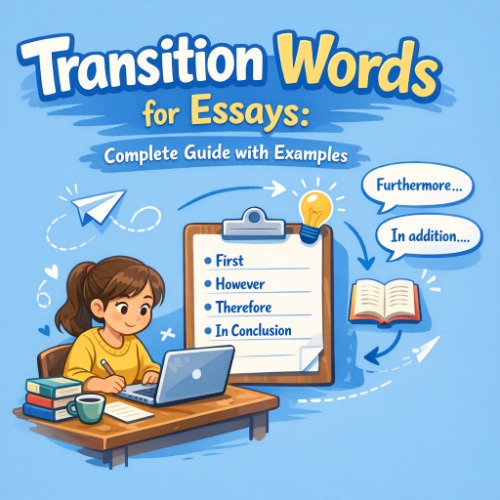
Forget memorizing 200 transition words you'll never use. Master these six categories and you'll handle 95% of essay situations:
Addition transitions build your argument by stacking supporting information: furthermore, additionally, moreover, in addition, likewise, also, similarly.
Contrast transitions show opposing ideas or shift perspective: however, nevertheless, on the other hand, conversely, in contrast, although, despite.
Cause-effect transitions explain logical relationships: therefore, consequently, as a result, thus, hence, accordingly, for this reason.
Sequence transitions show order or time progression: first, second, next, then, finally, subsequently, meanwhile, previously.
Example transitions introduce specific illustrations: for instance, for example, specifically, to illustrate, in particular, namely.
Conclusion transitions wrap up sections or entire essays: in conclusion, ultimately, in summary, overall, in brief, to sum up.
Understanding these categories matters more than memorizing individual words. Once you know the relationship you're showing (addition? contrast? cause-effect?), choosing the right transition becomes automatic.
Quick Decision Framework: Which Transition do you Need?
Before grabbing a random transition from a list, ask yourself what logical relationship you're showing:
Adding more supporting evidence or examples? Use addition transitions like furthermore, moreover, additionally, in addition.
Showing contrast or presenting an opposing view? Use contrast transitions like however, nevertheless, on the other hand, conversely.
Explaining why something happened or showing results? Use cause-effect transitions like therefore, consequently, as a result, thus.
Describing steps, order, or time progression? Use sequence transitions like first, next, then, finally, meanwhile.
Providing specific examples to illustrate a point? Use example transitions like for instance, specifically, to illustrate, particularly.
Wrapping up a section or concluding your essay? Use conclusion transitions like in conclusion, ultimately, in summary, overall.
This simple framework helps you choose the right transition in seconds instead of scrolling through endless lists hoping something sounds good.
Addition Transitions: Building your Argument Brick by Brick
Use addition transitions when you're piling on more evidence, expanding on a point, or introducing another reason that supports your claim.
Furthermore: formal, academic tone; use when adding significant supporting evidence |
"Remote work increases productivity for individual contributors. Furthermore, it reduces operational costs by 30% for companies with distributed teams."
Moreover: slightly more formal; emphasizes that the new point strengthens your argument |
"Minimum wage increases don't reduce employment in most sectors. Moreover, they stimulate local economies by increasing consumer spending power."
Additionally: neutral, versatile; works in any essay type |
"Social media platforms collect user data for targeted advertising. Additionally, they sell aggregated behavioral patterns to third-party marketers."
In addition: clear and direct; great for straightforward point-stacking |
"Electric vehicles eliminate tailpipe emissions. In addition, they reduce maintenance costs by 40% compared to combustion engines."
Similarly: shows parallel examples or comparable situations |
"Netflix disrupted cable television through streaming convenience. Similarly, Spotify transformed music consumption by offering unlimited access over ownership."
Likewise: emphasizes similarity between two points |
"Teachers benefit from professional development opportunities. Likewise, students perform better when schools invest in educator training."
Also: conversational; use sparingly in academic writing but effective in less formal contexts |
"The proposed policy would increase healthcare access. It would also reduce emergency room visits by providing preventive care options."
Common mistake: Stacking multiple addition transitions in consecutive sentences creates redundancy. If three sentences all start with "Furthermore," "Moreover," "Additionally," you're overusing transitions. Not every connection needs signaling, let some ideas flow naturally.
Struggling to Make Your Ideas Flow Smoothly?
Professional essay writers don't just know transition words, they understand exactly where and how to use them for maximum impact:
- Logical progression that guides readers effortlessly through complex arguments
- Strategic placement that signals relationships without overusing transitions
- Natural flow that doesn't sound forced or robotic
- Expert editing that identifies where transitions would strengthen connections
Your ideas deserve better than choppy, disconnected paragraphs.
Get Professional Essay HelpContrast Transitions: Showing the Other Side
Contrast transitions signal you're shifting perspective, introducing an opposing viewpoint, or acknowledging limitations in your argument.
However: the most versatile contrast transition; works everywhere |
"Remote work offers flexibility for parents and caregivers. However, it blurs boundaries between professional and personal time."
Nevertheless: emphasizes that despite the previous point, your claim still stands |
"The study shows correlation between screen time and anxiety. Nevertheless, correlation doesn't establish causation without controlled experiments."
On the other hand: introduces an alternative perspective |
"Standardized tests provide measurable outcomes for comparing student performance. On the other hand, they narrow curriculum to test-specific content."
Conversely: shows complete opposition or opposite outcomes |
"Wealthy districts benefit from property tax funding for schools. Conversely, low-income districts face resource shortages under the same system."
In contrast: highlights differences between two subjects |
"European countries treat healthcare as a public good. In contrast, the United States relies primarily on private insurance markets."
Although / Though: acknowledges a counterpoint before dismissing it |
"Although critics claim universal basic income discourages work, pilot programs show no significant decrease in labor participation."
Despite / In spite of: similar to "although" but emphasizes persistence despite obstacles |
"Despite initial skepticism, electric vehicles now outsell combustion engines in several European countries."
Yet: creates tension between two ideas |
"The policy promises economic growth. Yet early implementation shows minimal impact on employment rates."
Cause-Effect Transitions: Showing Logical Connections
These transitions explain why something happened, what resulted from an action, or how one idea leads to another.
Therefore: formal, academic; shows logical conclusion |
"The experiment controlled for confounding variables. Therefore, we can confidently attribute the results to the treatment intervention."
Consequently: emphasizes direct results |
"The company ignored cybersecurity warnings. Consequently, hackers accessed customer data for over 18 months."
As a result: clear and direct; good for straightforward cause-effect |
"Schools eliminated recess to maximize instructional time. As a result, teachers report increased behavioral issues and decreased attention spans."
Thus: concise, academic; often follows explanation |
"Carbon dioxide traps heat in the atmosphere, and methane has 25 times greater warming potential. Thus, reducing emissions requires targeting multiple greenhouse gases."
Hence: formal, implies inevitable conclusion |
"The data shows consistent patterns across three independent studies. Hence, the hypothesis gains support from converging evidence."
Accordingly: shows appropriate response to previous information |
"Budget projections indicate a $2 million shortfall. Accordingly, the committee recommends delaying non-essential infrastructure projects."
For this reason: explicitly connects cause to effect |
"Adolescent brains are still developing impulse control and risk assessment. For this reason, juvenile justice systems should emphasize rehabilitation over punishment."
Be specific about causation: Saying "therefore" or "consequently" implies strong causal relationships. If you're showing correlation or possibility rather than proven causation, use "this suggests" or "this may indicate" instead.
Sequence Transitions: Showing Order and Progression
Use sequence transitions to walk readers through steps, show chronological order, or indicate the progression of your argument.
First / Firstly / First of all: begins a sequence |
"First, gather all necessary materials before starting the experiment."
Second / Secondly / Third: continues numbered sequences |
"Second, measure ingredients precisely to ensure consistent results."
Next / Then / After that: shows what comes afterward |
"Next, combine the dry ingredients before adding liquids."
Subsequently / Afterward: more formal; indicates later events |
"Subsequently, the Supreme Court ruled the practice unconstitutional."
Meanwhile / In the meantime: shows simultaneous actions |
"The CEO announced restructuring plans. Meanwhile, employees organized protests against proposed layoffs."
Previously / Earlier: refers back to earlier points |
"Earlier, we discussed how algorithms amplify extreme content."
Finally / Lastly: concludes a sequence |
"Finally, proofread your essay before submission to catch errors."
Eventually / Ultimately: shows long-term outcome |
"Eventually, the protests forced the administration to reverse its decision."
Pattern tip: Maintain parallel structure in sequences. If you start with "First, the process requires," continue with "Second, the procedure involves" rather than switching to different sentence structures.
Example Transitions: Introducing Specific Illustrations
These transitions signal you're about to provide concrete examples supporting your claim.
For instance: versatile, works in any context |
"Social media algorithms prioritize engagement over accuracy. For instance, conspiracy theories spread faster than fact-checks because outrage drives clicks."
For example: most common, universally understood |
"Many cities have reduced traffic fatalities through infrastructure changes. For example, Oslo achieved zero pedestrian deaths in 2019 by redesigning intersections."
Specifically: narrows focus to precise details |
"The policy disproportionately affects low-income families. Specifically, households earning below $35,000 would pay 8% more in annual expenses."
To illustrate: emphasizes you're clarifying through example |
"Machine learning models reflect training data biases. To illustrate, facial recognition software misidentifies people of color at rates five times higher than white individuals."
In particular: highlights one especially relevant example |
"Several factors contributed to the company's failure. In particular, management ignored market research indicating declining customer satisfaction."
Namely: introduces specific items that comprise a category |
"The study examined three variables: namely, income level, education attainment, and geographic location."
Case in point: introduces a representative example |
"Small policy changes can yield significant results. Case in point: when Oregon auto-enrolled workers in retirement plans, participation jumped from 25% to 78%."
Pro tip: Don't just list examples, explain how they prove your point. "For example, X happened" is weaker than "For example, X demonstrates Y because Z."
Conclusion Transitions: Wrapping up your Argument
Use these transitions to signal you're summarizing, drawing conclusions, or ending a section.
In conclusion: signals final paragraph; use once per essay |
"In conclusion, addressing climate change requires coordinated international action rather than individual solutions."
Ultimately: emphasizes final judgment or outcome |
"Ultimately, the evidence supports investment in public transportation over highway expansion."
In summary / To summarize: condenses main points |
"In summary, the study identifies three key factors contributing to student success: teacher quality, class size, and parental involvement."
Overall: provides big-picture assessment |
"Overall, the benefits of renewable energy investment outweigh the transitional costs."
In brief / In short: offers condensed version |
"In brief, the policy failed because it addressed symptoms rather than root causes."
To sum up: informal alternative to "in summary" |
"To sum up, effective time management requires prioritization, not just efficiency."
All in all: conversational; implies considering everything |
"All in all, the experiment succeeded despite initial technical challenges."
On the whole: suggests balanced assessment |
"On the whole, remote work benefits outweigh drawbacks for knowledge workers."
Warning: Never introduce new information after conclusion transitions. These signal you're done arguing, adding new claims after "in conclusion" confuses readers about whether you're summarizing or still developing ideas.
Your Essay Reads Like a Choppy List?
Transform disconnected ideas into smooth, logical arguments with professional writing help:
- Strategic transitions placed exactly where they strengthen connections
- Natural flow that guides readers without feeling forced
- Logical progression from introduction through conclusion
- Expert revision that identifies weak connections
Stop submitting essays that feel disjointed and unclear.
Fix Your Essay Flow NowCommon Transition Mistakes That Weaken your Writing
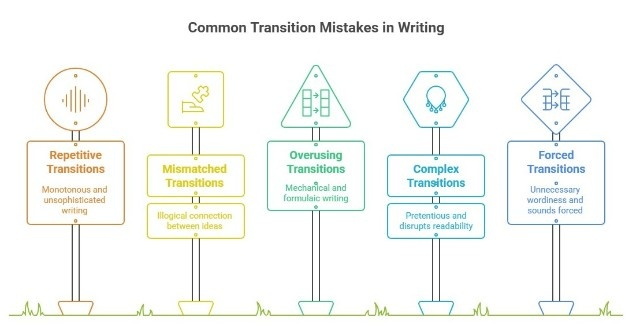
Even experienced writers fall into these traps. Here's what to avoid:
Mistake #1: Overusing Transitions
Weak: "Social media helps teenagers stay connected with friends. Furthermore, it also provides community spaces. Moreover, these platforms offer creative expression opportunities."
Better: "Social media helps teenagers stay connected with friends while providing community spaces for creative expression."
Why it's better: The ideas connect naturally without transitions. Adding them creates unnecessary wordiness and sounds forced.
Mistake #2: Using the Wrong Transition Category
Wrong: "The experiment failed to control for temperature variables. Furthermore, the results are unreliable."
Right: "The experiment failed to control for temperature variables. Therefore, the results are unreliable."
Why: This shows cause-effect (failed controls means unreliable results), not addition. "Furthermore" adds information; "therefore" shows logical consequence.
Mistake #3: Starting Every Aentence with Transitions
This makes your writing feel robotic and over-structured. Not every connection needs explicit signaling; some relationships are obvious from context.
Mistake #4: Using Overly Complex Transitions for Simple Ideas
Don't write "notwithstanding the aforementioned considerations" when "despite this" works fine. Match transition complexity to your essay type and audience.
Mistake #5: Forcing Transitions Where they Don't Belong
Weak: "Shakespeare wrote 37 plays. Furthermore, he also wrote 154 sonnets. Moreover, these works influenced literature for centuries."
Better: "Shakespeare wrote 37 plays and 154 sonnets that influenced literature for centuries."
The ideas connect naturally without transitions. Forcing them in makes the writing feel choppy rather than smooth.
Essay-specific Transition Strategies
Different essay types benefit from different transition approaches:
Argumentative essays need contrast transitions to acknowledge counterarguments and cause-effect transitions to show logical progression: |
"Critics argue remote work reduces productivity. However, studies measuring actual output show the opposite effect."
Narrative essays rely heavily on sequence transitions to move through time: |
"Initially, I resisted the idea of studying abroad. Eventually, though, I recognized my fear was holding me back."
Compare-contrast essays alternate between similarity and difference transitions: |
"Both novels explore themes of identity and belonging. However, Morrison examines these through racial lens while Lahiri focuses on cultural displacement."
Process analysis essays use sequence transitions almost exclusively: |
"First, preheat the oven to 350°F. Next, combine dry ingredients in a separate bowl. Finally, fold the wet mixture into the dry ingredients until just combined."
Cause-effect essays stack cause-effect transitions to show chains of consequences: |
"Social media algorithms prioritize engagement. Consequently, controversial content receives more visibility. As a result, users encounter increasingly extreme viewpoints."
Match your transition strategy to your essay's purpose. Don't use comparison transitions in a process essay or stack sequence transitions in an argumentative piece.
How to Practice Using Transitions Effectively
Knowing transition words doesn't automatically mean using them well. Here's how to build the skill:
Exercise 1: The Reverse Outline Test
After writing a draft, create a reverse outline listing only your topic sentences. Where do you need transitions to show how paragraphs connect? Add them during revision.
Exercise 2: Read your Essay Aloud
When you stumble or pause unnaturally, that's probably where you need a transition to clarify the relationship between ideas.
Exercise 3: Identify Relationships First, then Choose Transitions
Before picking a transition, ask yourself: Am I adding information? Showing contrast? Explaining cause-effect? Once you know the relationship, the right transition becomes obvious.
Exercise 4: Study Professional Writing
Pick a well-written article or essay and highlight every transition. Notice where writers use them heavily (when showing complex relationships) and where they skip them (when connections are obvious).
Exercise 5: Practice with Sentence Combining
Take two short sentences and combine them using different transitions to see how meaning changes:
- "The policy failed. Critics predicted this outcome." (Original)
- "The policy failed, as critics predicted." (Cause-effect)
- "The policy failed. Nevertheless, supporters defend the underlying approach." (Contrast)
- "The policy failed. Subsequently, the administration revised its strategy." (Sequence)
Same facts, different relationships, transitions control which relationship readers perceive.
Conclusion paragraphs shouldn't just repeat your thesis with different words. They should synthesize your argument and explain why it matters. Our essay writing service teaches you how to write conclusions that leave lasting impressions rather than feel like obligatory summaries.
Transition Placement: Where They Work Best
Transitions typically appear in three positions:
Beginning of sentences (most common): |
"However, recent studies challenge this conventional wisdom."
Middle of sentences (embedded): |
"Recent studies, however, challenge this conventional wisdom."
Between paragraphs (signaling major shifts): |
Use the first sentence of a new paragraph to transition from the previous one:
"While individual actions matter, systemic change requires policy intervention. [New paragraph] This systemic approach has succeeded in reducing emissions in European countries."
Mix placement to avoid monotony. If every sentence starts with a transition, your writing feels formulaic.
Downloadable Resource
Stop Submitting Essays That Sound Choppy and Disconnected
Professional essay writers understand the invisible architecture that makes arguments flow naturally:
- Strategic transition use that clarifies without overwhelming
- Logical connections readers can follow effortlessly
- Natural progression from thesis through conclusion
- Expert editing that strengthens weak connections
Your ideas deserve writing that does them justice.
Get Professional Writing HelpFinal Thoughts
Here's what matters most: transitions aren't decoration you sprinkle onto finished essays like parmesan on pasta. They're structural elements that reveal the logic connecting your ideas.
Bad writers use transitions randomly. Good writers use transitions strategically. Great writers know when to use them and when to let ideas flow naturally without explicit signaling.
Your goal isn't to use as many transitions as possible, it's to help readers follow your thinking effortlessly. Sometimes that requires explicit transitions. Sometimes your ideas connect so clearly that adding transitions just clutters the prose.
The real skill is knowing the difference.
Start by mastering the six essential categories: addition, contrast, cause-effect, sequence, example, and conclusion. Once you understand these relationships, choosing specific words becomes automatic.
Then practice identifying when you need transitions and when you don't. Overusing them sounds robotic. Underusing them sounds choppy. The sweet spot is using just enough to clarify relationships that aren't immediately obvious from context.


-20154.jpg)