What is a Synopsis?
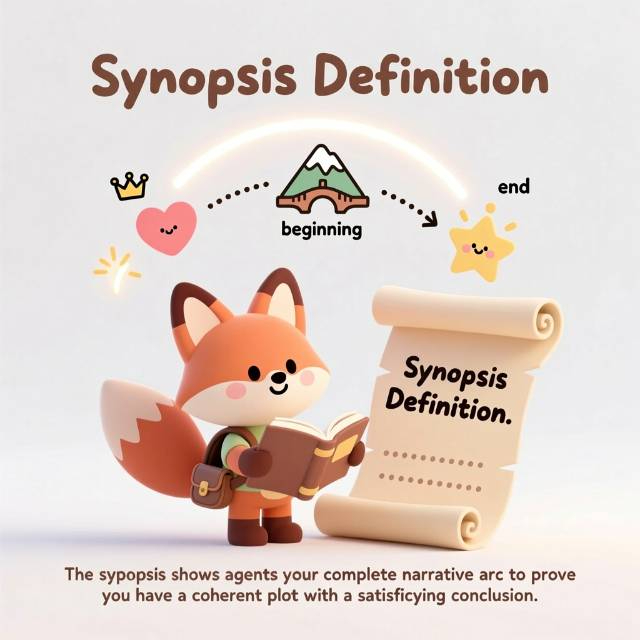
A synopsis is a 1-2 page summary of your entire story from beginning to end, including the climax and resolution, written specifically for literary agents and publishers.
The Three Essential Elements
- Complete plot summary: From inciting incident through resolution not just the first act
- Character arcs: Who changes and how (protagonist primarily, key supporting characters briefly)
- The ending: You MUST reveal how your story concludes, including major twists
What a Synopsis Is NOT
Understanding what it's not helps clarify what it should be:
- NOT a book blurb (marketing copy designed to intrigue readers)
- NOT a teaser (you don't withhold the ending)
- NOT a chapter outline (you write in prose, not bullet points)
- NOT a query letter (query pitches the premise; synopsis summarizes the entire plot)
- NOT your best prose (functional clarity matters more than beautiful writing)
| Synopsis is a professional industry document that helps agents evaluate your storytelling ability before investing time in your full manuscript. |
Why Literary Agents Require Synopses
Agents read your query letter first. If interested, they'll look at your sample chapters (typically first 5-50 pages). If those impress them, they think: "This opening is strong, but can this author sustain momentum and deliver a satisfying ending?"
That's where the synopsis comes in.
Your synopsis proves:
- You have a complete, coherent story (not just a strong beginning)
- Your plot makes logical sense with clear cause effect progression
- Character motivations are believable throughout
- You can deliver a satisfying resolution
- There are no major plot holes, deus ex machina endings, or "it was all a dream" cop-outs
Agent perspective from the research:
"If your synopsis doesn't show where the narrative is heading and make them want to read the rest, they won't ask for the full manuscript."
Bottom line: The synopsis isn't about your beautiful prose it's about proving you can tell a complete, compelling story.
Still Struggling With Your Synopsis?
Professional writing assistance tailored to your needs
- Professional synopsis writing
- Multiple length versions
- Clear narrative arc
- Quick turnaround
Join thousands of satisfied customers
Get Started NowSynopsis vs. Other Publishing Documents
Publishing involves several similar sounding documents. Here's how they differ:
Synopsis vs. Query Letter
| Query Letter | Synopsis |
|---|---|
| Length: 1 page (250-400 words) | Length: 1-2 pages (500-1,000 words) |
| Purpose: Hook agent's interest | Purpose: Prove plot works |
| Content: Premise, stakes, comp titles, your bio | Content: Complete plot from start to finish |
| Ending: Tease but don't reveal | Ending: Fully reveal resolution |
| Tone: Compelling pitch | Tone: Clear, functional summary |
Example query hook:
"When a teenage girl discovers she can manipulate time, she must choose between saving her dying mother or preventing a catastrophic future."
Same story in synopsis:
The protagonist uses newfound powers to save their mother, but this creates a timeline split. She realizes her actions will cause a global catastrophe in 10 years. Must choose: mother's life or humanity's future. Chooses humanity. Mother dies. The protagonist lives with grief but knows she made the right choice.
See the difference? Query creates intrigue. Synopsis reveals everything.
Synopsis vs. Book Blurb (Back Cover Copy)
- Book blurb: Marketing copy readers see on the back cover or Amazon description. It's designed to sell copies, so it teases without revealing the ending.
- Synopsis: Industry document agents/editors use. It reveals the entire plot, including twists and resolution.
Example blurb:
"When Emma discovers her grandmother's mysterious journal, she embarks on a journey that will change everything she thought she knew about her family..."
Same story synopsis format:
Emma finds her grandmother's journal, revealing that her grandmother was a WWII spy. Emma travels to France following journal clues. Discovers grandmother stole classified documents that are now targeted by a modern terrorist group. Emma must protect the documents while uncovering why her grandmother kept this secret. Learns grandmother made an impossible choice to save thousands. Emma makes a similar choice, protecting documents at the cost of her career. Realizes some secrets protect rather than harm.
Synopsis vs. Academic Summary
- Academic summary (for school): Brief objective overview of a published work's main points, written for educational purposes.
- Literary synopsis (for agents): Detailed plot summary of YOUR unpublished manuscript, written to secure representation.
Key difference: Academic summaries analyze existing works. Literary synopses sell your original work to industry professionals.
Format and Length Requirements (2025 Standards)
Different agents have different requirements. Here's what's standard in 2025:
Length Requirements
For Fiction & Memoir:
Create TWO versions:
Short version (most common):
Use this unless agent specifically requests longer version Long version (occasionally requested):
|
Which to submit?
Always submit the short version unless guidelines explicitly request the long version.
For Narrative Nonfiction:
Short version: 1-2 paragraphs (goes in query letter)
Long version: 1-2 pages (goes in book proposal)
Standard Formatting
Unless the agent specifies otherwise, use these defaults:
Page Setup:
Header:
File Naming:
Character Names:
Voice and Tense:
|
Example Opening:
THE FORGOTTEN SPY: Synopsis
Emma Richardson
EMMA HARTLEY discovers her grandmother's coded journal hidden in the attic after the funeral. The journal reveals that MARGARET HARTLEY wasn't just a homemaker she was a British intelligence officer who stole Nazi documents during WWII...
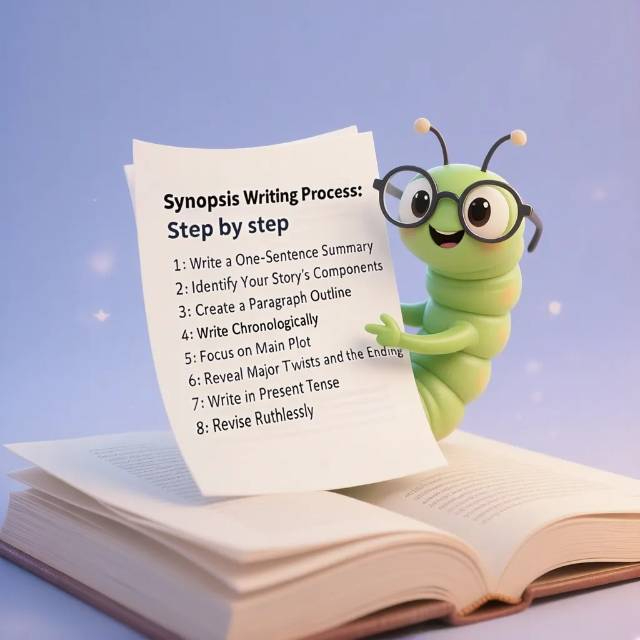
The 8 Step Synopsis Writing Process
Follow this process to transform your novel into a compelling synopsis:
Step 1: Write a One Sentence Summary
Before tackling the full synopsis, distill your entire story into one sentence. This becomes your north star.
Formula:[Protagonist] must [goal] or else [stakes], but [obstacle] forces them to [choice].
Examples:
- "A teenage girl who can manipulate time must choose between saving her dying mother or preventing the catastrophic future that her interference will create."
- "A detective investigating her sister's murder discovers the killer is their father, forcing her to choose between family loyalty and justice."
Why this matters:
If you can't summarize your story in one sentence, your synopsis will ramble. This sentence focuses your efforts.
Step 2: Identify Your Story's Core Components
Before writing prose, identify these elements:
- Protagonist: Who is your main character?
- Want: What do they want at the story's beginning?
- Need: What do they actually need (often different from want)?
- Inciting Incident: What disrupts their normal world?
- Escalating Conflicts: What obstacles prevent them from achieving their goal?
- Climax: What's the major turning point/decision/confrontation?
- Resolution: How does the story end? How has the protagonist changed?
Example breakdown:
- Protagonist: Emma, 32 year old historian
- Want: Understand grandmother's mysterious past
- Need: Accept that some secrets protect loved ones
- Inciting Incident: Discovers grandmother's WWII spy journal
- Conflicts: Modern terrorists target the documents; family doesn't believe Emma; Emma's academic career suffers
- Climax: Emma must destroy evidence (ending her research) or let terrorists obtain dangerous intel
- Resolution: Emma destroys documents, loses academic credibility, but saves lives and understands grandmother's sacrifice
Step 3: Create a Paragraph Outline
Organize your synopsis into 4-5 paragraphs that follow story structure:
- Paragraph 1: Protagonist introduction + inciting incident
- Paragraph 2: Rising action + escalating conflicts
- Paragraph 3: Midpoint turn / complication deepens
- Paragraph 4: Climax + resolution
- Paragraph 5 (optional): Thematic conclusion / character transformation
This structure prevents you from:
- Spending too much time on setup
- Getting bogged down in subplots
- Running out of space before revealing the ending
Step 4: Write Chronologically, Focus on Cause Effect
Write events in the exact order they occur in your manuscript. Each event should clearly cause the next.
Show cause effect progression:
Good: Bad: The good version shows why each action happens. The bad version just lists events without connection. |
Step 5: Focus on Main Plot Only
Your novel probably has subplots, secondary character arcs, and rich worldbuilding. Cut them from your synopsis unless they directly affect the main plot.
Rule of thumb:
If removing a plot element doesn't change your ending, don't include it in the synopsis.
Examples of what to cut:
- Romance subplot (unless it's central to main plot)
- Secondary character backstories
- Worldbuilding details
- Minor antagonists who don't affect resolution
- Setting descriptions
Maximum character count:
Include 4-5 characters maximum. Use descriptions for others: "a CIA agent," "Emma's colleague," "the terrorist leader."
Why this matters:
Agents aren't reading your synopsis to understand every nuance they're checking if your main story works. Subplots make synopses confusing and boring.
Step 6: Reveal Major Twists and the Ending
This is where writers panic. But remember: the synopsis is NOT for readers it's for agents.
You MUST reveal:
- Who the villain is
- What the "big secret" is
- How major plot twists unfold
- How the story ends
- Who lives/dies (in genres where this matters)
Agent perspective from research:
"If your story is compelling, spoilers of your plot twists won't stop them from reading but will only encourage them to dive right into your sample pages."
Why reveal everything?
Agents need to see you can deliver satisfying resolutions. Withholding the ending makes them think you either don't have an ending or it's disappointing.
Example of revealing twists:
"Emma discovers the documents reveal her grandmother was actually a double agent working for both Britain and Germany. This betrayal devastates Emma until she learns her grandmother used her position to save hundreds of Jewish families. In the climax, Emma must make the same impossible choice: destroy the evidence that would clear her grandmother's name to prevent terrorists from using the intel." See? The synopsis reveals the grandmother as a double agent twist. This doesn't ruin the reading experience it proves the twist works logically. |
Step 7: Write in Present Tense (Usually)
Standard: Write fiction synopses in third person, present tense even if your novel is written in first person past tense.
Why?
Present tense creates narrative momentum and makes summaries feel immediate rather than distant.
Example:
Past tense: "Emma discovered the journal and decided to travel to France. She learned about the terrorists and contacted MI6."
Present tense: "Emma discovers the journal and travels to France. She learns about the terrorists and contacts MI6."
Exception: Memoir synopses can use first person, past tense (matches memoir voice).
Get Synopsis Written by Professionals
Many brilliant novelists can't effectively summarize their own work because they're too emotionally close to it.
- Proper formatting
- Reveals your plot's strongest elements
- Both short and long versions
- Free revisions until you're satisfied
Get the synopsis that gets your manuscript requested.
Order NowStep 8: Revise Ruthlessly
First draft done? Now cut it down.
Revision checklist:
- Does every sentence move the story forward?
- Did I cut all unnecessary subplots?
- Is cause effect clear throughout?
- Did I reveal the ending?
- Can someone unfamiliar with my story follow this easily?
- Is it within the word/page limit?
Cutting strategy:
- Remove all adjectives and adverbs that aren't essential
- Combine sentences where possible
- Cut character backstory that doesn't affect plot
- Eliminate worldbuilding and setting descriptions
- Focus only on main character's journey
Remember: Your synopsis doesn't need beautiful prose. It needs clarity and efficiency.
What to Include (and Ruthlessly Cut)
Knowing what belongs in a synopsis and what doesn't prevents common mistakes.
ALWAYS Include
Your protagonist's arc
Who they are at the beginning
What they want
How they change by the end
The inciting incident
What disrupts the protagonist's normal world
What sets the plot in motion
Major plot points in chronological order
Key events that escalate conflict
The midpoint turn (where things get worse)
The climax (final confrontation/decision)
The resolution
The antagonist and main conflict
Who/what opposes the protagonist
What's at stake
The ending
How conflicts resolve
Who lives/dies (if relevant)
How the protagonist has changed
Major plot twists
Reveal them don't hide them
ALWAYS Cut
Subplots that don't affect main plot
Cut: Romance between secondary characters, backstory about protagonist's childhood, side quests that don't affect the ending
Excessive worldbuilding
Cut: Detailed magic system explanations, political structures, histories of fictional nations
Keep: Only worldbuilding essential to understanding the plot
Setting descriptions
Cut: Lengthy descriptions of locations
Keep: One sentence setting establishment: "This novel is set in a small village in Regency England"
Minor characters
Cut: Characters who don't directly affect the main plot
Keep: 4-5 maximum named characters
Detailed character backstories
Cut: Paragraphs about character histories, motivations, personality traits
Keep: One sentence characterization: "SARAH, Emma's skeptical sister and a journalist..."
Themes and symbolism
Cut: Analysis of your novel's deeper meanings
Keep: Let the plot itself convey themes implicitly
Your beautiful prose
Cut: Poetic language, metaphors, descriptive passages
Keep: Clear, efficient, functional prose
The "Does It Change the Ending?" Test
For every element you're considering including, ask: "If I remove this, does it change how my story ends?"
If YES = Include it
If NO = Cut it
Example:
Element: Protagonist has a pet dog who provides emotional comfort
Question: If I remove the dog, does the ending change?
Answer: No, the protagonist still makes the same final choice
Decision: Cut the dog from synopsis
Element: Protagonist discovers antagonist is actually her biological father
Question: If I remove this reveal, does the ending change?
Answer: Yes, the final confrontation loses all emotional weight
Decision: Keep this reveal in synopsis
How to Reveal Your Ending Without Killing Intrigue
This is the part that terrifies writers. "Won't revealing my ending ruin everything?"
Short answer: No. Here's why and how to do it right.
Why Agents Want Spoilers
Agent perspective from research:
"I prefer to see one page and want to come away from that page knowing whose story is being told, why that story is worth me following, and how their story ends (I like spoilers/plot twists to be included)."
Another agent:
"After all, you can't describe your twisty thriller accurately if you hide all the twists and leave out the conclusion! Let the literary agent know they can expect a satisfying ending from your novel."
Why agents want this:
|
How to Reveal the Ending Effectively
Strategy 1: State it directly
"In the climax, Emma confronts the terrorist leader and destroys the documents, preventing the attack but losing her academic career and the proof of her grandmother's heroism. She accepts that some truths must stay buried to protect the living."
Strategy 2: Focus on character transformation
"By the end, Emma understands that her grandmother's secrecy wasn't betrayal it was protection. She makes the same choice, prioritizing others' safety over her own vindication, finally at peace with the sacrifice."
Strategy 3: Reveal the twist, then show its impact
"The documents reveal Emma's grandmother was a double agent. This initially devastates Emma, but she discovers her grandmother used her position to save hundreds of Jewish families. Understanding this sacrifice helps Emma choose to destroy the documents."
What makes a strong ending reveal:
- Shows protagonist's transformation
- Demonstrates stakes were real
- Proves earlier events logically led here
- Indicates the emotional resolution
What weakens an ending reveal:
- Being vague: "Emma makes an important decision and everything works out"
- Withholding information: "Emma faces a shocking revelation"
- Suggesting mystery: "Readers will have to read to find out what Emma chooses"
Remember:
If your ending is truly compelling, knowing what happens won't diminish an agent's desire to read the beautiful execution of that ending.
What Literary Agents Actually Want (Real Feedback)
Here's what actual literary agents say they're looking for in synopses:
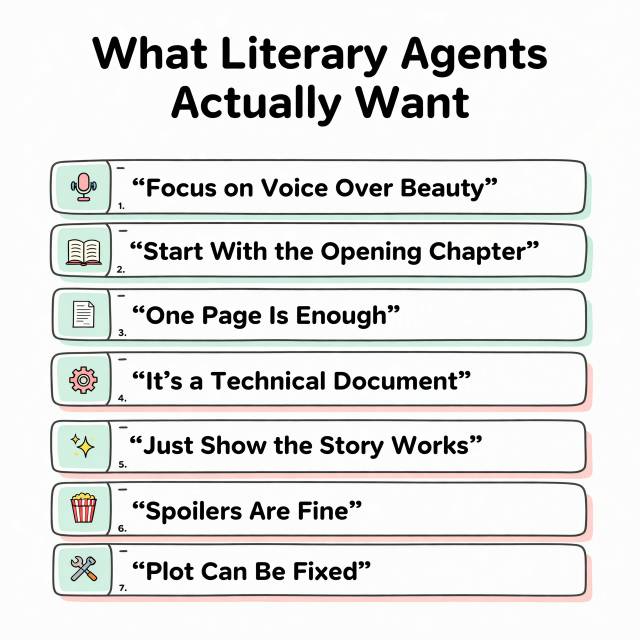
Agent #1: Focus on Voice Over Beauty
"A synopsis is a difficult beast (!) and if the novel is fantastic, I don't care in the slightest if you can't write the perfect synopsis. Focus on your novel and make the synopsis a short, simple map of the book."
Takeaway:
Don't obsess over making your synopsis perfect. Make it clear and functional.
Agent #2: Start With the Opening Chapter
"The quality of the prose and appeal of the voice are both vital to me so I dive straight into the novel, then once I have a sense of the writing I'll step back and look at the synopsis."
Takeaway:
Your manuscript quality matters more than synopsis perfection. But the synopsis still needs to work agents check it to confirm plot holds up.
Agent #3: One Page Is Enough
"For me, I prefer to see one page and want to come away from that page knowing whose story is being told, why that story is worth me following and how their story ends."
Takeaway:
Shorter is better. One page that covers protagonist, journey, and resolution is sufficient.
Agent #4: It's a Technical Document
"A synopsis is a technical document that no reader will ever see – it's just for the agent and publisher. It needs all the key information: main characters, setting, plot, resolution."
Takeaway:
Stop treating synopsis like marketing copy. It's internal industry documentation.
Agent #5: Just Show the Story Works
"It is the 'who, what, where and when' of your novel. It is not the 'why' – all of that (motivation, detail, backstory) is in the novel itself."
Takeaway:
Synopsis proves plot logic. Your manuscript provides the emotional depth.
Agent #6: Spoilers Are Fine
"Let the literary agent know they can expect a satisfying ending from your novel. If your story is compelling, spoilers of your plot twists won't stop them from reading but will only encourage them to dive right into your sample pages."
Takeaway:
Don't hide twists. Reveal them to prove they work.
Agent #7: Plot Can Be Fixed
"Plot can be fixed, but the quality of the writing itself is always the most important thing, and it's nice to dive in without any potential biases over how the story will play out."
Takeaway:
Some agents read manuscript first, synopsis second. Either way, your prose quality in the manuscript matters most.
Still confused? Get expert help from our essay writing service to ensure your manuscript shines.
Easy Synopsis Writing Tips
Follow the given tips to produce a well written synopsis.
- Even if your book is written in the first person, always write the synopsis in the third person. It maintains professionalism and a narrative distance.
- Keep it short and focus on the clarity of words.
- Don’t include dialogue in the synopsis. Instead, just summarize what the characters said.
- Always write in the present tense and use an active voice.
- It should present a unique point of view and creative writing.
- Include the elements that set your story apart from others.
- Use the emotions of the characters to advance your plot and story.
- Always state your category. It may include literary fiction, romance, love, interests, science fiction, fantasy, satire, and more.
- It must convey the narrative arc, problems, plot, characters’ motivations, actions, and the ending.
Chosen Your Prompt But Staring at a Blank Page?
Our professional writers help daily:
- Transform your chosen topic into a memorable narrative
- Balance storytelling with meaningful reflection
- Use your authentic voice
- Plagiarism Free Content
Fast turnaround. Unlimited revisions. Zero AI.
Get Started NowConclusion: Your Synopsis Gets Your Manuscript Read
Here's what matters most: Your synopsis doesn't need to be a masterpiece. It needs to do its job.
That job? Prove to a literary agent that:
- You have a complete, coherent story
- Your plot makes logical sense
- Character motivations are believable
- You can deliver a satisfying resolution
- Your story is worth their time to read
The essentials:
- Keep it short (1-2 pages, single spaced)
- Write in third person, present tense (for fiction)
- Reveal the entire plot including the ending
- Focus on main plot only cut subplots
- Include 4-5 characters maximum
- Show clear cause and effect progression
- Make it clear and functional, not poetic
- Follow submission guidelines exactly
Remember:
Even bestselling authors struggle with synopses. The synopsis is a necessary evil of the querying process but it's also your proof that you're not just a good writer, you're a good storyteller who can deliver complete, satisfying narratives.
Your manuscript is where you showcase beautiful prose and complex characters. Your synopsis is where you prove the story works.
Now go write that synopsis. You've got this.