Personal Essay Introduction (10–15% of essay)
Purpose: Hook readers and establish what your essay will explore.
What to include:
- Compelling opening (scene, dialogue, or vivid detail)
- Brief context (just enough background to understand the situation)
- Thesis or central question (what the essay explores)
What NOT to do:
- Don’t start with your birth (“I was born on…”)
- Don’t begin too broadly (“Since the beginning of time…”)
- Don’t announce your topic (“This essay is about…”)
Example:
| “The folder was labeled simply: ‘No Thank You.’ Inside, forty years of rejection letters sat in chronological order, each one carefully preserved in a plastic sleeve. ‘Rejection Letters,’ the subcategory specified, as if my grandmother had created an entire taxonomy for disappointment. That summer, cataloging books in her attic while she underwent chemotherapy, I learned more about persistence from those forty years of ‘no’ than from any of her published poetry.” |
Personal Essay Body Paragraphs (70–80% of essay)
Structure options:
Option 1: Chronological
- Tell the story from beginning to end
- Weave in reflection as you go
- Most straightforward structure
Option 2: Thematic
- Organize by ideas rather than timeline
- Jump between different moments that illustrate the same theme
- More advanced, but can be powerful
Option 3: Bookend
- Start with a key moment
- Flash back to how you got there
- Return to that moment with new understanding
Regardless of structure, include:
- Developed scenes
Not just “We talked” but the actual conversation - Sensory details
What did you see, hear, smell, feel - Internal thoughts
What were you thinking in the moment - Honest emotions
What did you actually feel, not what you should have felt - Reflection
What do you understand now that you didn’t then
Personal Essay Conclusion (10–15% of essay)
Purpose: Bring your reflection to a satisfying close without being heavy handed.
What to include:
- Return to opening image or theme (creates closure)
- Final insight or implication
- Forward looking statement (how this shapes your present or future)
What NOT to do:
- Don’t just summarize what you already said
- Don’t introduce completely new information
- Don’t spell out the lesson too obviously
- Don’t use “In conclusion…”
Example:
| “Last month, I submitted my first short story for publication. When the rejection email arrived, form letter, gentle, final, I printed it out. I don’t have a filing system yet, but I’m thinking about categories. Maybe I’ll call mine ‘Not Yet’ instead of ‘No Thank You.’ My grandmother would appreciate the optimism, though I think she understood better than anyone that the real lesson wasn’t about hope. It was about continuing anyway, rejection letter after rejection letter, because the alternative was worse than any editor’s decline: the silence of never having tried.” |
Chosen Your Prompt But Staring at a Blank Page?
Our professional writers help daily:
- Transform your chosen topic into a memorable narrative
- Balance storytelling with meaningful reflection
- Use your authentic voice
- Plagiarism Free Content
Personal Essay Writing Techniques That Work
These techniques elevate personal essays from simple storytelling to compelling narrative.
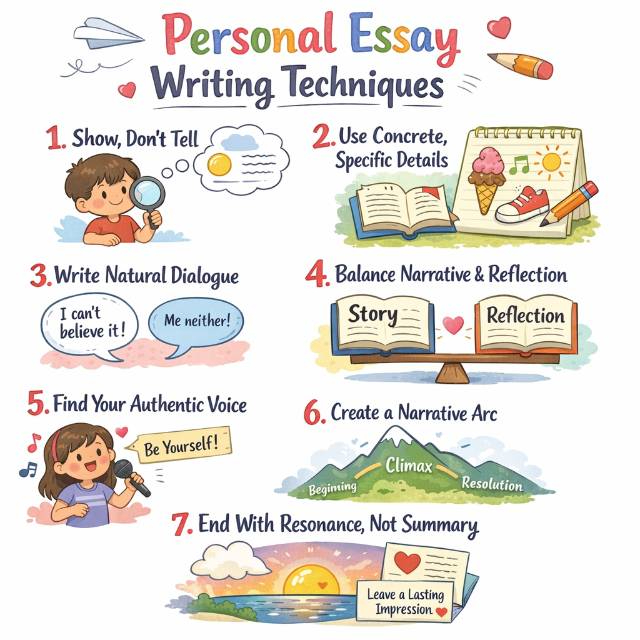
1. Show, Don’t Tell
The golden rule of personal writing.
Telling (weak):
“My grandmother was a persistent person who never gave up on her dreams.”
Showing (strong):
“My grandmother submitted her poetry to literary magazines for forty years. Every rejection letter lived in a plastic sleeve in a folder labeled ‘No Thank You.’ Not one got thrown away.”
How to show instead of tell:
- Replace emotion words with physical actions
- Use specific examples instead of generalizations
- Include dialogue and sensory details
- Let readers draw their own conclusions
2. Use Concrete, Specific Details
Vague = forgettable. Specific = memorable.
Vague:
“My father worked hard to provide for us.”
Specific:
“My father left for the factory at 5 AM when the street was still dark, and came home at 7 PM smelling like machine oil and sawdust, his hands permanently stained with work I never fully understood.”
The difference:
Specific details make your story real and unique.
3. Write Natural Dialogue
Good dialogue sounds like real speech.
Stilted (bad):
“My grandmother informed me that I should not discard those correspondence items as she had earned every single one.”
Natural (good):
“‘Don’t throw those away,’ my grandmother said sharply when I held up the stack. ‘I earned every one.’”
Dialogue tips:
- Use contractions (people say “don’t,” not “do not”)
- Include interruptions and fragments
- Add action beats: “She said, setting down her teacup”
- Make each person sound different
4. Balance Narrative and Reflection
Don’t just tell the story OR just analyze it, do both.
Too much narrative, no reflection:
“I went to the attic. I found the letters. I read them. I showed them to my grandmother. She explained why she kept them.”
Too much reflection, no narrative:
“Persistence is important. Many people give up too easily. We should learn from failure. Success requires dedication.”
Balanced:
“I spread forty years of rejection letters across her kitchen table, chronological order disrupted by my curiosity. ‘Did you ever think about giving up?’ I asked.
‘Every time,’ she said, running her finger along the edge of one envelope. ‘Every single time. But I had this rule: I couldn’t stop until I’d submitted to everyone. And by the time I reached the end of the list, I had new poems to send out, so I’d start over.’
At fourteen, I thought persistence meant never doubting yourself. But sitting in her kitchen, surrounded by evidence of forty years of professional rejection, I realized it meant something more complicated: continuing despite the doubts, not in the absence of them.”
5. Find Your Authentic Voice
Voice = how you sound on the page. It should sound like YOU.
Fake voice (trying too hard):
“As I traversed the dusty confines of my grandmother’s antiquated attic, I encountered a revelation of substantial magnitude.”
Authentic voice:
“The attic was hot, dusty, and full of boxes my grandmother had promised to sort through ‘eventually’, which, for her, meant never.”
How to find your voice:
- Write like you actually talk
- Use words you’d use in conversation
- Don’t try to sound smarter than you are
- Let your personality show through
6. Create a Narrative Arc
Even true stories need structure.
Basic narrative arc:
- Setup = You establish the situation
- Conflict = Something challenging happens or you face a problem
- Climax = The most significant moment
- Resolution = What happened as a result
- Reflection = What it means
7. End With Resonance, Not Summary
Your conclusion should echo, not recap.
Weak conclusion (just summary):
“In conclusion, my grandmother’s rejection letters taught me about persistence. This experience changed how I view failure. I will remember this lesson for the rest of my life.”
Strong conclusion (resonance):
“Last month, I submitted my first short story for publication. When the rejection email arrived, I printed it out. I don’t have a filing system yet, but I’m thinking about categories. Maybe I’ll call mine ‘Not Yet.’”
What makes this strong:
- Comes full circle (returns to rejection letters)
- Shows application to present life
- Ends on a specific image, not generic lesson
- Implies the lesson without stating it obviously
Common Personal Essay Mistakes to Avoid
Mistake 1: Choosing Too Broad a Topic
The problem:
“My relationship with my father” or “What I learned in high school”
These are themes, not stories. They’re too big to explore in an essay.
The fix:
Find ONE specific moment that illustrates that relationship or learning.
Instead of “My relationship with my father,” write about “The morning my father taught me to change a tire and I realized he was preparing me for his absence.”
Mistake 2: Starting at the Beginning
The problem:
“I was born in Chicago in 2006…”
Birth, early childhood, and years of background rarely hook readers.
The fix:
Start in the middle of your story, at an interesting moment. Add backstory only when needed.
Mistake 3: Telling Instead of Showing
The problem:
“My grandmother was persistent and inspiring. She never gave up on her dreams.”
Pure summary with no specific details.
The fix:
Show specific examples that demonstrate these qualities. Let readers draw their own conclusions.
Mistake 4: Generic “I Learned” Conclusions
The problem:
“This experience taught me to never give up. Now I know that persistence is important.”
Too obvious, too cliché.
The fix:
Dig deeper. What specifically did you learn that goes beyond the obvious? How did it complicate your understanding rather than simplify it?
Mistake 5: Forgetting to Reflect
The problem:
Just telling the story without explaining what it means.
You narrate events but never pause to explore significance.
The fix:
After describing key moments, add reflection. Ask yourself: “What did I think this meant then? What do I understand about it now?”
Mistake 6: Being Too Vague About Emotions
The problem:
“I felt bad when it happened.”
Not specific enough to be meaningful.
The fix:
Be specific about emotions. Not “sad” but “hollow, like someone had scooped out my chest.” Not “happy” but “giddy, unable to stop grinning even when I tried.”
Mistake 7: Trying to Sound Too Formal
The problem:
Using vocabulary and sentence structures you’d never use in normal speech.
Makes your essay sound stilted and inauthentic.
The fix:
Write like you talk. If you wouldn’t say “thereafter” in conversation, don’t write it.
100+ Personal Essay Topics
Stuck finding a story? These prompts, organized by category, will spark ideas.
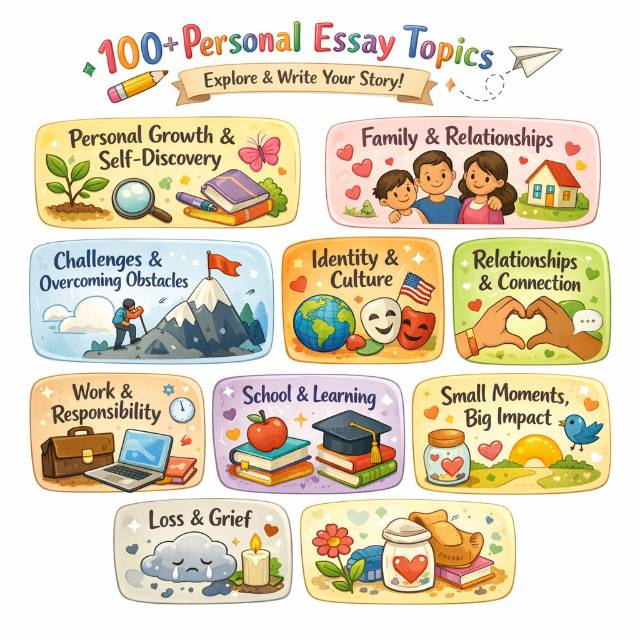
Personal Growth & Self Discovery
- The moment you realized you were wrong about something important
- When you discovered a hidden talent or interest
- The experience that made you question your beliefs
- A mistake that taught you more than any success
- The time you stood up for something despite consequences
- When you learned the difference between being alone and being lonely
- The day you realized your parents were just people
- An experience that challenged your self perception
Family & Relationships
- A conversation with a grandparent that changed your perspective
- The sibling moment that defined your relationship
- When you understood your parent differently
- A family tradition that means more to you now
- The relative who saw something in you no one else did
- Learning about family history that reframed your identity
- The day your family dynamic shifted permanently
- A childhood home or place and what it represents
Challenges & Overcoming Obstacles
- A failure that redirected your path productively
- Living with or overcoming a health challenge
- The hardest decision you've had to make
- When you had to choose between two important things
- Adapting to a major life change (move, loss, transition)
- The moment you realized you were stronger than you thought
- Dealing with discrimination or prejudice
- Learning something difficult that became important
Identity & Culture
- Navigating between two cultures
- When your identity became visible to you
- Understanding your privilege or lack thereof
- A moment when you felt like an outsider
- Connecting with your cultural heritage
- Language, accent, or name experiences
- The first time you saw someone like you represented
- Questioning or exploring your identity
Passion & Purpose
- Discovering what you want to do with your life
- The book, film, or art that changed you
- A mentor who shaped your path
- The moment you found your "thing"
- Questioning a path everyone expected you to follow
- Creating or making something meaningful
- The project that consumed you
- Finding purpose in unexpected places
Relationships & Connection
- A friendship that taught you about loyalty
- When you had to let someone go
- The stranger who influenced you
- Learning about love from an unexpected source
- A betrayal and what it taught you about trust
- The friend who helped you through something difficult
- Losing and finding friendship
- Learning to be a better friend/sibling/partner
Work & Responsibility
- Your first job and what it taught you
- Taking care of someone else
- The responsibility you didn't want but needed
- Learning about work ethic
- Understanding what your parents do differently
- A boss or coworker who influenced you
- The job that taught you about yourself
School & Learning
- A teacher who changed your trajectory
- The class that transformed how you think
- Academic struggle and what it taught you
- Discovering a subject you love
- When learning happened outside the classroom
- A school experience that shaped you
- The assignment that made you think differently
Loss & Grief
- Losing someone important and what they left you
- The pet that taught you about love and loss
- Saying goodbye to a place or phase of life
- Processing unexpected loss
- What loss taught you about what matters
Small Moments, Big Impact
- A seemingly ordinary day that changed everything
- The conversation you didn't know you needed
- A small act of kindness that stuck with you
- The question someone asked that made you reconsider everything
- A moment of beauty or connection in an unexpected place
If you get stuck during the writing process, all you need to do is reach out to the experts at our professional essay writing service and they will write essay for you accordingly.
Personal Essay Examples
Example 1: Personal Growth (High School Level)
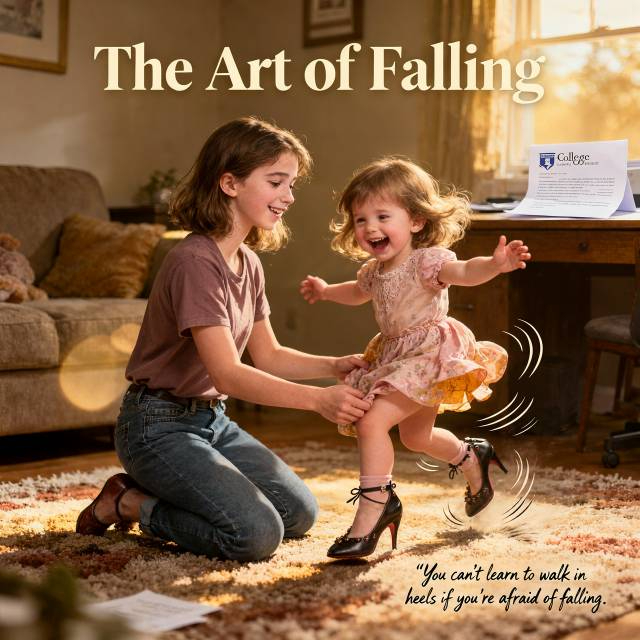
Title: The Art of Falling
I didn't expect to learn humility from a three year old, but there I was nineteen years old, babysitting my cousin Maya, watching her fall down approximately seventeen times while trying to walk in her mother's heels.
"Again!" she'd shout after each spectacular collapse, her face split with a grin that suggested falling was the entire point.
I'd been rejected from my first choice college three weeks earlier. The letter sat on my desk, still in its envelope, because looking at it made my chest feel tight. I'd told everyone I'd get in. I'd told myself I'd get in. The narrative of my life required that acceptance letter, and its absence felt like the story breaking.
"Help me," Maya demanded, extending her tiny hand.
I pulled her up, and she immediately launched herself forward again, wobbled, and face planted into the carpet. She laughed.
"Doesn't it hurt when you fall?" I asked.
She looked at me like I'd asked the world's stupidest question. "Yes. But then I get up."
At three, my cousin had already figured out what I was still learning at nineteen: falling isn't the opposite of success. Staying down is.
That night, I opened the rejection letter. I read it completely for the first time. Then I opened my laptop and started researching my second choice school the one I'd barely looked at because it was supposed to be my backup. The one where, it turned out, the journalism program was ranked higher than my "dream school" anyway.
I don't believe in signs or three year old wisdom, exactly. But I believe in moments that crack open your perspective just enough to let reality in. Maya didn't teach me to "never give up" or any other platitude that would fit on a poster. She taught me something more practical: you can't learn to walk in heels if you're afraid of falling. You can't build a life if you're terrified of the collapse.
I'm at that second choice school now. It turns out it wasn't second choice at all just the choice I wasn't brave enough to see until my first plan failed. Maya is four now and has moved on to roller skates. She still falls constantly. She's still completely unimpressed by the whole ordeal.
I'm trying to be more like her.
Example 2: Family & Identity (College Level)
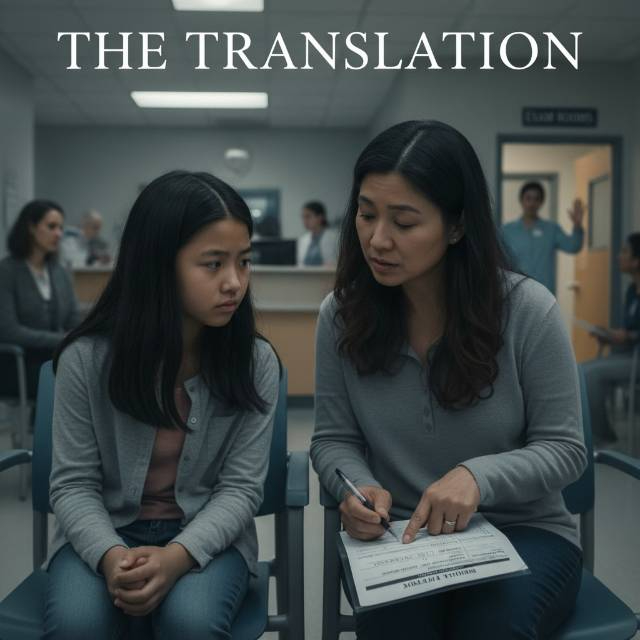
Title: Translation
My mother speaks three languages, but she dreams in Korean.
I know this because she told me once, when I was fifteen and angry that she'd forgotten the English word for "persimmon" while we were at the grocery store. I'd rolled my eyes, embarrassed that she couldn't remember something so simple, frustrated that I had to translate between her and the store clerk even though we'd lived in California for thirteen years.
"I dream in Korean," she said in the car afterward, not looking at me. "Every night, I dream in the language I learned first. I wake up and have to translate my own thoughts."
I didn't understand what she meant until college, when I took a linguistics class and learned about language dominance and code switching and the way bilingual people's brains actually function differently. The professor explained that your first language doesn't just teach you words it teaches you how to think, how to organize reality, what questions are even possible to ask.
That's when I realized: my mother doesn't struggle with English because she's bad at it. She struggles because she's being asked to live in a language that wasn't built for her thoughts.
I called her that night. "I'm sorry," I said, "about the persimmon thing. And everything else."
There was a long pause. Then, in Korean which I understand but barely speak she said something I had to ask her to translate: "You can't apologize for not knowing what you didn't know."
Here's what I know now: assimilation isn't a failure of effort. My mother didn't forget English words because she wasn't trying hard enough. She forgot them because she was working twice as hard as everyone around her, translating not just language but entire systems of thinking, every single day, while people like fifteen year old me rolled our eyes at how long it took.
I'm taking Korean classes now. I'm terrible at it, worse than my mother ever was at English, even though Korean is supposedly my heritage language. My pronunciation makes her laugh. My grammar makes her wince. But she's patient with me in a way I never was with her.
"How do you say 'I'm proud of you' in Korean?" I asked her last week.
She smiled. "Directly? We don't. We say other things that mean the same thing in different ways."
Some things, it turns out, don't translate. But that doesn't make them any less true.
Still Unsure How to Write Your Own Essay?
Our professional writers help you move from examples to a polished final draft:
- Personalized topic development
- Clear structure and strong storytelling
- Reflection that admissions officers value
- 100% original, human-written essays
Get support that turns examples into success.
Order Now
Bottom Line
A strong personal essay isn’t about telling your whole life story; it’s about choosing one meaningful moment, showing it through vivid detail, and reflecting honestly on why it matters. When you balance storytelling with insight, write in your natural voice, and focus on depth over breadth, your personal experience becomes a clear, compelling academic essay that resonates with readers.