Developing a Poetry Writing Practice
Consistent practice improves poetry more than talent alone.
Daily Writing Habits
Set a minimum commitment:
- 15 minutes daily beats 2 hours weekly
- Consistency matters more than duration
- Write even when uninspired
Morning pages (Julia Cameron method):
- Write 3 pages longhand every morning
- Don't edit, don't judge
- Generates raw material for poems
Prompt based practice:
- Use prompts to start when stuck
- Time yourself (10-15 minutes)
- Don't overthink just write
Exercises That Build Skills
1. Image collection: Keep a notebook of striking images you notice. Practice describing them in fresh ways.
2. Imitation: Choose a poet you admire. Write a poem using their style, form, or approach. Learn by copying, then develop your own voice.
3. Constraint based writing:
- Write using only one syllable words
- Write without using the letter "e"
- Write a poem where each line starts with the next letter of the alphabet
4. Object poems: Choose ordinary objects and write detailed observations. Find metaphors in the mundane.
5. Revision practice: Take an old poem and rewrite it completely. Same subject, different approach.
Start Writing Better Poems Today
Professional writing assistance tailored to your needs
- Develop your unique poetic voice
- Master imagery, metaphor, and sound
- Learn effective revision techniques
- Get expert guidance on every draft
Join thousands of satisfied students
Get Started NowReading Like a Poet
Good poets read constantly and analytically.
How to Read Poetry
First read: Experience
Second read: Analyze technique
Third read: Study craft
|
What to Read?
Read widely across:
Read journals and magazines:
Study craft books:
|
Essential Elements of Poetry Writing
Master these fundamental techniques.
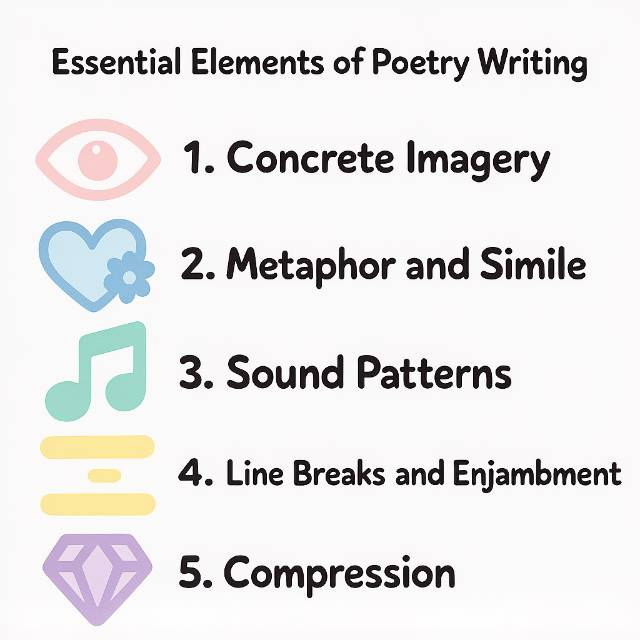
1. Concrete Imagery
Show specific, sensory details
Wrong: Abstract: "The room was sad"
Right: Concrete: "Dust gathered on the piano keys, / untouched since her funeral"
Practice: Describe emotions through physical objects and settings, never naming the emotion itself.
2. Metaphor and Simile
Create surprising but apt comparisons
Wrong: Cliché: "Her eyes were like stars"
Right: Fresh: "Her eyes held the cold distance / of stars beautiful, / unreachable"
Practice: Complete: "My loneliness is..." with 10 different endings. Choose the most surprising one that's still true.
3. Sound Patterns
Alliteration, assonance, consonance
Notice how poets use sound:
- "The silken, sad, uncertain rustling" (Poe)
- "Let be be finale of seem" (Stevens)
Practice: Write a stanza where every line contains alliteration, but make it sound natural, not forced.
4. Line Breaks and Enjambment
Use line breaks to create:
- Emphasis (end word matters)
- Rhythm and pacing
- Surprise and double meanings
Example:
"I want to tell you vs. "I want to tell you I love you. Different meanings, different impacts. |
5. Compression
Say more with less
Poetry compresses meaning. Every word must earn its place.
Wrong: Wordy: "She walked slowly and carefully down the stairs because she was feeling very tired"
Right: Compressed: "She descended / the stairs slowly, / exhausted"
Practice: Write a poem, then cut it by half. Cut it again. What remains?
Common Poetic Forms
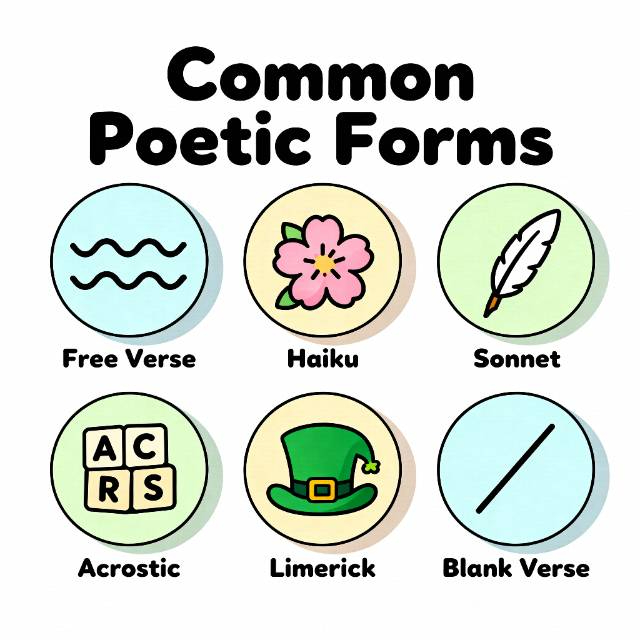
1. Free Verse
No set rhyme or meter
- Most common contemporary form
- Focus on image, sound, rhythm without rules
- Still requires craft (not just prose with line breaks)
Best for: Modern poetry, personal expression, experimental work
2. Haiku
Three lines: 5-7-5 syllables
- Focus on nature and seasons
- Present tense observation
- Emphasis on imagery
Example:
Winter twilight dims
Empty parking lot transforms:
Snow hides the oil stains
3. Sonnet
14 lines, specific rhyme schemes
Shakespearean: ABAB CDCD EFEF GG
Petrarchan: ABBAABBA CDECDE (or similar sestet)
Best for: Academic assignments, exploring form, love poems
4. Acrostic
First letter of each line spells a word
- Simple structure good for beginners
- Can be sophisticated or simple
Best for: Gifts, names, thematic organization
5. Limerick
Five lines, AABBA rhyme scheme
- Humorous, bouncy rhythm
- Lines 1, 2, 5 are longer; lines 3, 4 are shorter
Best for: Humor, light verse
6. Blank Verse
Unrhymed iambic pentameter
- Shakespeare's plays use this
- Formal but flexible
Best for: Narrative poetry, dramatic monologues
Finding Your Voice for Poetry Writing
Your poetic voice = your unique way of seeing and expressing the world.
What Is Poetic Voice?
Not: Trying to sound "poetic" or using archaic language
Is: Your authentic perspective, diction, subjects, and style
Examples of distinct voices:
- Mary Oliver: Accessible, nature focused, spiritually questioning
- Ocean Vuong: Lush imagery, queer and immigrant experience, tender brutality
- Billy Collins: Conversational, witty, everyday observations with depth
- Claudia Rankine: Experimental, confronting racism, blurred prose/poetry
How to Develop Your Voice
1. Write a lot
Voice emerges through volume. Write 100 poems before worrying about voice.
2. Write what only you can write
Your specific experiences, observations, questions. Don't imitate what's already been written.
3. Experiment widely
Try different forms, styles, subjects. See what feels natural.
4. Read yourself
Read your own poems. Notice patterns:
- What subjects recur?
- What images repeat?
- What rhythms feel natural?
- What concerns drive your work?
5. Trust your obsessions
The subjects you return to repeatedly those are yours. Don't apologize for them.
6. Revise toward clarity, not cleverness
Your authentic voice is clearer than your trying to impress voice.
How to Write a Poem: Step by Step
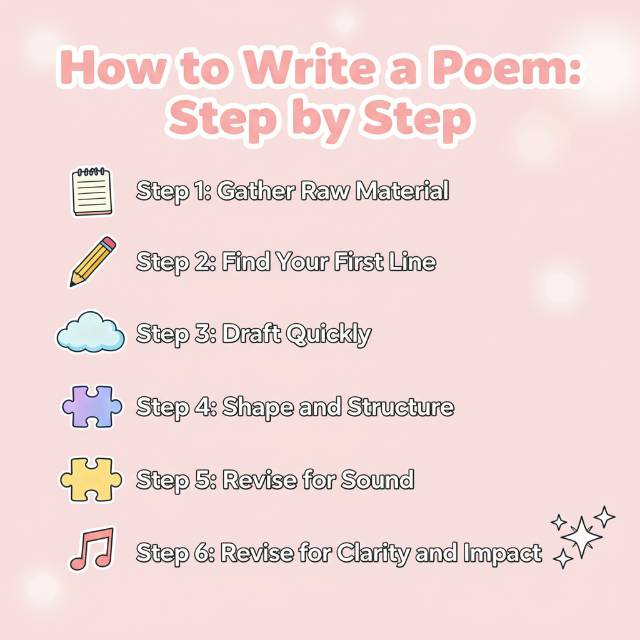
Step 1: Gather Raw Material
Free write about your subject for 10 minutes:
- Don't worry about poetry yet
- Just capture details, feelings, images
- Write everything you notice or remember
Mine for images:
Circle the most vivid, specific details from your free write
Step 2: Find Your First Line
Strong openings:
- Start with an image: "The kitchen smells like burnt toast and regret"
- Start with action: "She leaves her shoes by the door, untied, always untied"
- Start with a question: "How do you forgive someone who never asked?"
- Start mid moment: "Already I can't remember her voice"
Avoid:
- Obvious statements: "This is a poem about..."
- Abstract concepts without grounding: "Life is..."
- Clichés: "Roses are red..."
Step 3: Draft Quickly
Write without stopping for 15–20 minutes:
- Don't edit yet
- Let images flow
- Follow surprising connections
- Don't force rhymes or rhythm
Focus on:
- Specific details
- Sensory information
- Unexpected comparisons
- Honest emotion (not dramatic emotion)
Step 4: Shape and Structure
Break into lines:
- Where do you want emphasis?
- Where do you want pauses?
- What rhythm feels right?
Consider stanzas:
- Do you need breaks?
- Where do shifts occur?
- What pattern serves the poem?
Cut ruthlessly:
- Remove clichés
- Delete obvious explanations
- Eliminate weak images
- Trust your reader to understand
Step 5: Revise for Sound
Read aloud multiple times:
- Where do you stumble?
- What sounds awkward?
- Where does rhythm break?
Adjust:
- Replace clunky words
- Fix awkward rhythms
- Enhance sound patterns
- Vary sentence structure
Step 6: Revise for Clarity and Impact
Questions to ask:
- Is every image earning its place?
- Have I shown rather than told?
- Are metaphors surprising but clear?
- Does the ending resonate without explaining everything?
- What can I cut?
Common fixes:
- Replace abstractions with concrete images
- Cut the last stanza (often explanation you don't need)
- Strengthen verbs (eliminate "is," "was," "seems")
- Delete adverbs (they weaken images)
Elevate Your Poetry Skills
Transform Your Drafts into Polished Poems
- Build a consistent writing practice
- Analyze poems like a professional poet
- Receive personalized feedback
- Improve clarity, rhythm, and style
Get Expert Help with Your Essays
Get Started NowRevision Techniques for Poetry Writing
First drafts are just raw material. Revision creates the poem.
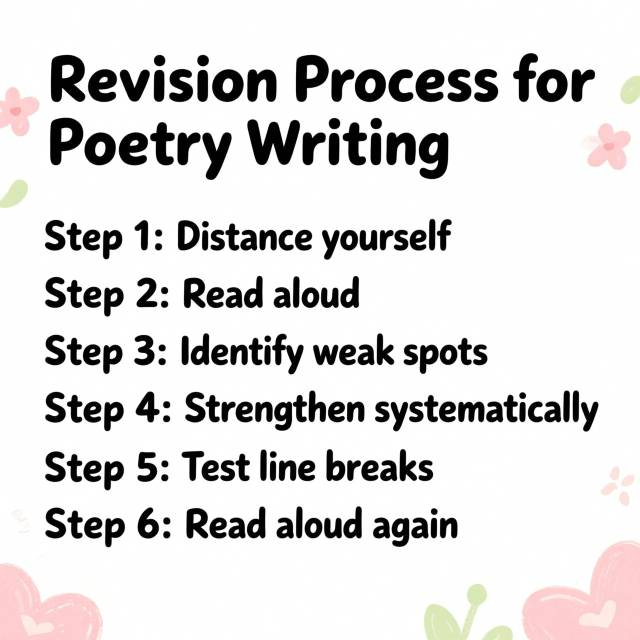
The Revision Process
Step 1: Distance yourself
Wait at least 24 hours (ideally a week) before revising. You need fresh eyes.
Step 2: Read aloud
Every. Single. Time. Hearing your poem reveals what reading silently misses.
Step 3: Identify weak spots
- Clichés
- Vague abstractions
- Clunky rhythms
- Obvious explanations
- Weak images
Step 4: Strengthen systematically
Replace abstractions with images: Eliminate weak verbs: Cut ruthlessly:
|
Step 5: Test line breaks
Try breaking lines in different places. Which creates the best rhythm and emphasis?
Step 6: Read aloud again
Does it flow? Where do you stumble? Fix those spots.
Revision Tips for Poetry
Cut These Common Weaknesses
1. Explanatory endings 2. Clichés 3. Vague abstractions 4. Forced rhymes 5. Telling emotions |
Strengthen With
1. Specific details 2. Active verbs 3. Surprising comparisons 4. Sound patterns 5. Strategic line breaks |
Questions to Ask
About imagery:
About sound:
About structure:
About meaning:
|
Resources for Poets
Where to Study
Online courses:
Local resources:
MFA programs: |
Where to Submit
When you're ready to publish: Literary magazines (online):
Contests: Poetry slams and readings: |
Common Beginner Mistakes in Poetry Writing
Mistake 1: Forcing Rhymes
The problem: Twisting syntax unnaturally to make words rhyme
The fix: Use free verse or only rhyme when it happens naturally
Mistake 2: Purple Prose
The problem: Using unnecessarily flowery language
The fix: Simple, precise language is stronger than elaborate vocabulary
Mistake 3: Explaining the Poem
The problem: Final stanza that tells readers what to feel or think
The fix: Trust images to convey meaning. Cut explanatory endings.
Mistake 4: All Telling, No Showing
The problem: "I was sad, I felt pain, I experienced loss"
The fix: Show through specific images and sensory details
Mistake 5: Cliché Overload
The problem: Relying on tired comparisons and overused phrases
The fix: Find fresh ways to express ideas. Twist clichés or avoid them entirely
Poem Examples
Free Verse Example
Last Visit
My grandmother's apartment smells
the same Pond's cold cream, instant
coffee, the faint sweetness of old carpet
but smaller now, as if the walls
have moved closer while I was away.
Her jade plant, the one she's kept alive
for thirty years through two divorces
and a cross country move, sits
on the same windowsill, thicker,
reaching for the same rectangle of sun.
I notice she's labeled everything:
Toaster. Coffee. Sugar. Tea.
White strips of masking tape,
her careful handwriting getting
larger, pressing harder.
She doesn't mention the labels.
I don't ask. We drink our coffee
hers with three sugars, like always
and she tells me the same story
about my grandfather. I let her.
Haiku Example
Three Seasons
Spring rain on window
I count drops instead of sheep,
pretending to sleep
Summer thunderstorm:
The dog hides under my bed,
I wish I could too
First snow of winter
Everything terrible, buried
Everything quiet
Sonnet Example (Shakespearean)
Sunday Morning, Second Coffee
The cat sits sphinx like on the kitchen sill (A)
While I brew coffee, third pot of the day, (B)
Your text sits unread; I check it, but still (A)
Can't think of single honest thing to say. (B)
We've played this game before the slow retreat (C)
From daily texts to weekly, then to none, (D)
Both pretending that we didn't feel complete (C)
Avoiding what we've known since we begun. (D)
The cat jumps down. The coffee's getting cold. (E)
I type and delete, type and delete again. (F)
This silence is familiar, something old (E)
Returning like a season. I know when (F)
It ends: when one of us admits the truth, (G)
Or gives up on recapturing our youth. (G)
Looking for expert guidance to refine your poems? Visit our professional essay writing service page to get personalized support.
How to Handle Rejection
Expect rejection. A lot.
Track submissions: Celebrate small wins: |
Unlock Your Creative Potential
Learn from Poetry Experts
- Master core craft elements
- Develop a strong, authentic voice
- Submit your work confidently
- Grow as a poet with structured guidance
From Inspiration to Publication
Order NowConclusion: Key Takeaways
Becoming a skilled poet is a journey, not a destination. The path combines consistent practice, attentive reading, careful revision, and developing your unique voice.
Key Takeaways:
- Practice consistently: Short daily writing sessions are more effective than occasional long bursts.
- Read like a poet: Analyze craft, sound, and structure in the work of others.
- Master core techniques: Focus on imagery, metaphor, sound patterns, line breaks, and compression.
- Revise deliberately: Treat first drafts as raw material; revise for clarity, precision, and impact.
- Find your voice: Write what only you can write, notice patterns, and trust your obsessions.
- Use resources wisely: Explore courses, workshops, journals, and MFA programs if desired.
- Embrace feedback and rejection: Both are essential for growth; track submissions and celebrate small wins.
By following these strategies, you can develop your craft, express yourself authentically, and enjoy the transformative power of poetry.