What Is Creative Writing?
Creative writing is imaginative composition that emphasizes narrative craft, aesthetic expression, and emotional truth over purely informational or academic purposes.
Includes:
- Fiction (short stories, novels)
- Poetry (all forms)
- Creative nonfiction (memoir, personal essays, literary journalism)
- Drama and screenwriting
- Flash fiction and microfiction
Distinguishes from:
- Academic writing (research papers, essays)
- Technical writing (manuals, reports)
- Business writing (proposals, emails)
- Journalism (news reporting)
Who is A Creative Writer?
A creative writer is one who presents the story in a creative manner.
- They use techniques to show ideas, not just tell them.
- The goal is to keep readers hooked from start to finish.
- Good creative writing makes your work memorable and unique.
- Without skill and creativity, keeping the audience interested is tough.
Get Stress Free Academic Help
Focus on learning while we handle your assignments
- Clear explanations of key points
- Original writing guaranteed
- Timely submission
- Supports essays, reports, and projects
Save time and boost grades with expert academic assistance.
Get Started NowTypes of Creative Writing
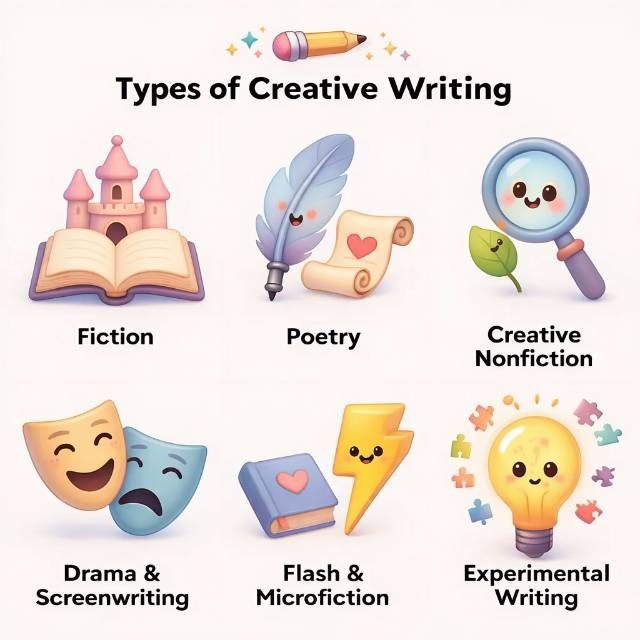
- Fiction: Stories you make up like novels, short stories, or novellas with interesting characters and plots.
- Poetry: Writing that plays with words, rhythm, and images to show emotions or ideas.
- Creative Nonfiction: True stories told in a fun or engaging way, like memoirs or personal essays.
- Drama & Screenwriting: Scripts for plays, movies, or TV shows with dialogue and action.
- Flash & Microfiction: Super short stories that tell a whole story in just a few words.
- Experimental Writing: Trying out new ways to write, play with language, or mix up the usual forms.
Essential Creative Writing Principles
These apply across all creative genres.
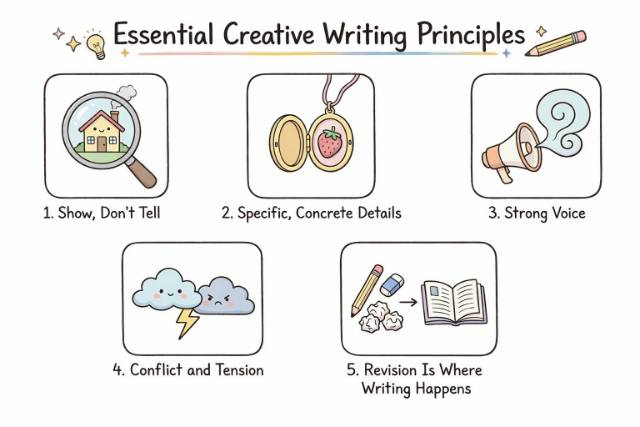
1. Show, Don't Tell
The golden rule of creative writing.
Telling: "Marcus was angry"
Showing: "Marcus slammed his laptop shut, coffee sloshing onto the keyboard"
Why it matters: Showing creates immersive experience. Telling just reports facts.
How to practice: Write a scene where a character experiences strong emotion without naming the emotion once.
2. Specific, Concrete Details
Vague generalities bore readers. Specific details engage.
Generic: "She drove an old car"
Specific: "She drove a 1987 Honda Civic with duct tape holding the passenger mirror"
Practice: Replace every generic noun with the most specific version you can imagine.
3. Strong Voice
Voice = how your writing sounds
Develop distinctive voice through:
- Word choice (diction)
- Sentence structure (syntax)
- Tone and attitude
- Rhythm and pacing
Find your voice by writing a lot. Voice emerges through practice, not planning.
4. Conflict and Tension
Stories need problems.
Without conflict, nothing happens. Readers need:
- Characters who want something
- Obstacles preventing them from getting it
- Stakes (what happens if they fail)
Even in poetry and creative nonfiction, tension drives interest.
5. Revision Is Where Writing Happens
First drafts are discovery. Revision creates art.
Professional writers revise extensively:
- Multiple drafts
- Ruthless cutting
- Rewriting weak sections entirely
- Getting feedback and revising again
Stephen King's ratio: Write first draft with door closed (alone), revise with door open (considering readers).
Core Techniques by Genre
1. Fiction Writing
Essential elements:
- Character: Who drives the story
- Plot: What happens (conflict, rising action, climax, resolution)
- Setting: Where and when it happens
- Point of view: Who tells the story (first, third, etc.)
- Theme: What it means (emerges through story, not stated directly)
| Practice: Write a complete short story (2,000–5,000 words) with beginning, middle, and end. |
2. Poetry Writing
Essential elements:
- Imagery: Concrete sensory details
- Sound: Rhythm, alliteration, assonance
- Line breaks: Where lines end creates meaning
- Compression: Say more with fewer words
- Metaphor: Fresh comparisons
| Practice: Write one poem daily for a month. Focus on images, not explanations. |
3. Creative Nonfiction
Essential elements:
- Truth: Based on real events/experiences
- Scene: Recreated moments with dialogue and detail
- Reflection: What events mean
- Research: Fact checking and context
- Narrative: Storytelling techniques applied to real life
| Practice: Write about a specific memory using scene, dialogue, and sensory details. |
Simplify Your Reading and Writing Tasks
Get professional academic support trusted by students worldwide.
- Clear, concise work
- 100% original content
- On time delivery, every time
- Expertly tailored to your needs
Let our experts turn tough readings into understandable content.
Get Started NowThe Creative Writing Process
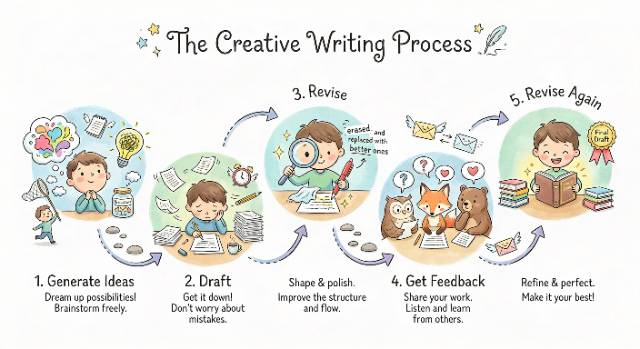
1. Generate Ideas
Sources:
- Personal experience
- "What if" questions
- Observation
- Reading and research
- Dreams and imagination
| Keep an idea notebook. Capture fragments, overheard dialogue, interesting observations. |
2. Draft
Write the first draft quickly:
- Don't edit while drafting
- Follow the energy
- Let it be messy
- Finish before judging
| Silence your inner critic during drafting. Editing comes later. |
3. Revise
Big picture revision:
- Does the structure work?
- Are characters/voice compelling?
- Where does it drag?
- What's missing?
Line level revision:
- Strengthen weak verbs
- Cut unnecessary words
- Vary sentence structure
- Check for clichés
4. Get Feedback
Share with:
- Writing groups
- Workshops or classes
- Trusted readers
- Professional editors
| Listen for: Where readers get confused, bored, or engaged. Don't defend learn. |
5. Revise Again
Based on feedback:
- Fix confusion points
- Strengthen weak sections
- Cut what doesn't work
- Polish language
Developing Your Practice
1. Write Regularly
Consistency beats occasional brilliance:
- Daily practice (even 15 minutes)
- Weekly word count goals
- Regular writing sessions
| Morning pages (Julia Cameron): Write 3 pages longhand every morning. Don't edit, don't judge. |
2. Read Constantly
Read in your genre:
- Study what works
- Notice techniques
- Analyze craft choices
Read outside your genre:
- Cross pollination creates freshness
- Different forms teach different lessons
3. Study Craft
Books on craft:
- Bird by Bird by Anne Lamott
- On Writing by Stephen King
- The Art of Fiction by John Gardner
- Writing Down the Bones by Natalie Goldberg
Take classes or workshops:
- Community college courses
- Online workshops
- MFA programs (for serious commitment)
4. Join a Community
Find other writers:
- Local writing groups
- Online communities
- Workshops and classes
- Literary events and readings
Why community matters:
- Feedback and accountability
- Learning from others
- Motivation and support
Common Creative Writing Mistakes to Avoid
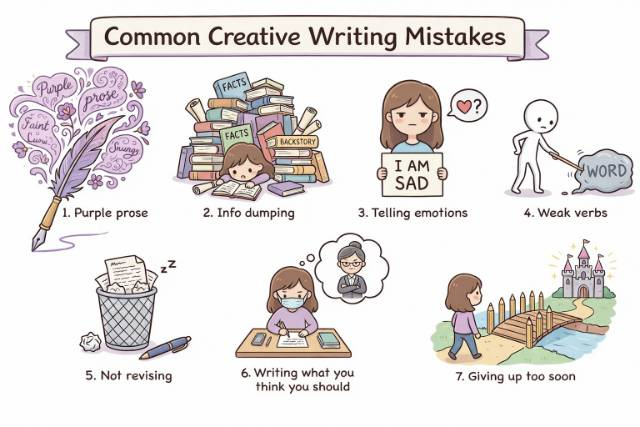
1. Purple prose
Using unnecessarily fancy language. Simple, clear beats elaborate and vague.
2. Info dumping
Explaining everything at once instead of revealing through action and dialogue.
3. Telling emotions
"She was sad" instead of showing sadness through behavior and detail.
4. Weak verbs
Relying on "is," "was," "seems" instead of strong, active verbs.
5. Not revising
Thinking first drafts are finished. They're not. Ever.
6. Writing what you think you should
Instead of what you're genuinely interested in exploring.
7. Giving up too soon
Craft takes time. Years. Keep writing anyway.
Struggling with writer’s block or structure? Our legit essay writing service can guide you from draft to finished piece.
Creative Writing Example
Have a look at the example of creative writing for a better understanding.
1. Fiction (Short Story Example)
The Map in the Attic
Liam had always been curious about the old forest behind his grandfather’s house. One rainy afternoon, he found a crumpled map in the attic, marked with strange symbols and a big red “X.” Heart racing, he grabbed a flashlight and followed the path through twisted trees and moss-covered stones. Hours passed, and just when he was about to turn back, he stumbled upon a hidden clearing. In the center was an ancient chest, half-buried in the ground. His hands shook as he lifted the lid, revealing a collection of letters, photographs, and trinkets from decades ago. Each item told a story of love, betrayal, and adventure that had been forgotten with time. Liam realized he was holding a treasure far more valuable than gold history waiting to be remembered. As he carefully packed the chest to take home, he knew this was only the beginning of his journey.
2. Poetry
Morning in a Quiet Town
The sun rises slowly over the sleepy town,
Casting golden streaks on rooftops brown.
Children’s laughter echoes down cobbled streets,
Mixing with the scent of fresh bread and sweets.
A cat stretches lazily on a windowsill high,
While clouds drift lazily across the sky.
The river hums a gentle, steady tune,
Reflecting the silver glow of the afternoon.
Every sound, every shadow, every light,
Tells a story of the morning turning bright.
And I, standing quietly beneath it all,
Feel the world awaken, answering its call.
3. Creative Nonfiction (Memoir Example)
My First Day at College
I still remember my first day at college like it was yesterday. The campus seemed endless, with towering buildings and crowded hallways filled with unfamiliar faces. I clutched my backpack tightly, feeling a mixture of excitement and fear. Every step I took echoed in my ears, reminding me how small and out of place I felt. But then I saw a group of students laughing under a tree, sharing stories and snacks, and something shifted. I realized that everyone was nervous in their own way, trying to find their place. By the end of the day, I had stumbled into a class discussion I wasn’t prepared for, laughed at a joke I didn’t understand, and made my first friend. That day taught me something important: stepping out of your comfort zone is scary, but it’s the only way to grow.
4. Drama & Screenwriting (Script Example)
Rain Between Us
Scene: Evening, a quiet café. Rain pours outside.
Anna: (frowning, stirring her coffee) “I can’t believe you forgot our anniversary again.”
Tom: (looking down, voice soft) “I’m sorry. I didn’t mean to. Let me make it right.”
Anna: “Make it right? You don’t even remember the last time you tried.”
Tom: (leans closer, eyes pleading) “I know. I’ve been careless. But I swear, I want to fix this. I don’t want to lose you.”
Anna: (silent, staring out the window as rain taps against the glass)
Tom: (reaching for her hand) “Please… just tell me how.”
(The camera pans out, the café dim and cozy, rain blurring the world outside, as tension hangs thick in the air.)
5. Flash Fiction & Microfiction Example
The Last Balloon
The carnival had ended, and the streets were empty. Emma held the last red balloon in her hand, watching it sway in the cool evening breeze. The lights flickered as the rides went silent, and the smell of popcorn lingered in the air. She released the balloon, letting it float into the sky. It rose higher and higher, glowing against the fading sunset. For a moment, she felt a strange mix of sadness and freedom. The balloon drifted out of sight, carrying with it the laughter, excitement, and dreams of the day. Emma smiled, realizing some things are meant to be let go but the memory, like the balloon, would always float within her.
6. Experimental Writing Example
Fragments of Thought
Words. Shapes. Sounds. Tick-tock. The page hums with thoughts I can’t catch. Letters scatter across the margins, spiraling, breaking, forming patterns that almost make sense. My mind jumps time bends. A sentence begins, fragments, disappears. Meaning hides behind images, behind the rhythm of breath and heartbeat. Reading this, you feel the motion, the confusion, the beauty of thought unshackled from rules. Language becomes painting, music, motion a storm captured on a page that refuses to sit still. You read, and you are part of the chaos. And maybe, just maybe, it tells you something you didn’t know you needed to hear.
Turn Notes into Knowledge
Transform dense materials into digestible content with professional help.
- Completely original work
- Suited for all subjects and levels
- Tailored to your study needs
- Guaranteed punctual delivery
Save time and boost grades with expert academic assistance.
Order NowBottom Line: Next Steps
Dealing with tough readings doesn’t have to be a headache. With a little help, you can turn confusing texts into simple, clear summaries that actually make sense. It saves you time, helps you remember the important stuff, and keeps your work 100% original. Whether it’s for essays, assignments, or just studying, getting guidance makes everything way easier. Start using these tips and make your study sessions way less stressful!
To improve quickly:
- Write every day (even 15 minutes)
- Read in your genre constantly
- Join a writing group for feedback
- Take a class or workshop
- Study craft books
- Revise ruthlessly
- Submit work for publication when ready
Remember: Every published writer started as a beginner. The difference between them and people who quit? They kept writing.