What is a Bio?
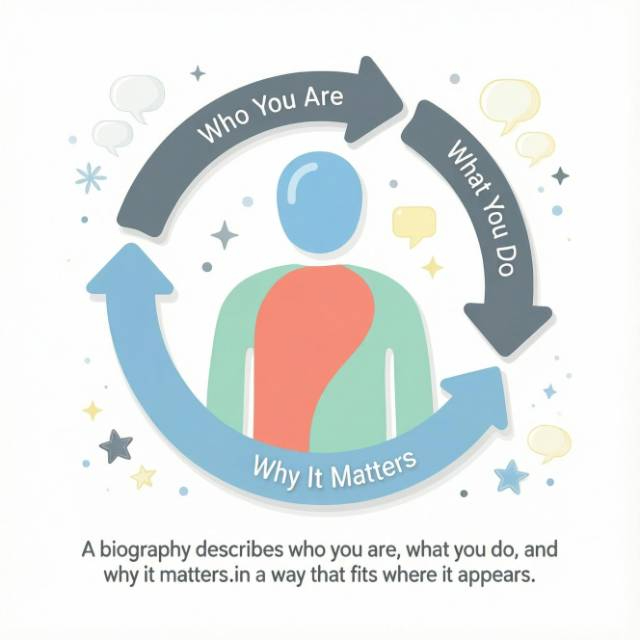
A bio (short for biography) is a brief summary of your professional identity, accomplishments, and relevant personal details written in narrative form, usually in third person for professional or public contexts.
The Three Essential Elements
- Professional identity: What you do and your expertise
- Key accomplishments: What makes you credible or notable
- Human element: Something that makes you relatable (when appropriate)
What Makes a Good Bio?
Strong bios share these qualities:
- Appropriate length: Matches the context (50 words for Twitter, 300 for website)
- Clear focus: Emphasizes what's relevant to the audience
- Professional tone: Credible but not stuffy (unless your field demands formal)
- Strategic detail: Includes impressive specifics, omits clutter
- Readable flow: Narrative style, not bullet points or list format
Bad bio: "John Smith has worked in various fields for many years. He has done many things and met many people. He enjoys spending time with his family." Good bio: "John Smith is a data scientist specializing in healthcare analytics, where he's helped reduce patient readmission rates by 23% across five major hospital systems. He holds a PhD in Statistics from MIT and previously led analytics teams at Blue Cross and Kaiser Permanente. When not parsing datasets, John runs ultramarathons and coaches youth robotics teams." See the difference? Specific, credible, focused, human. |
Why Write a Bio?
Professional contexts:
- Company websites and team pages
- Conference speaker introductions
- LinkedIn and professional social media
- Grant applications and proposals
- Book jackets and author pages
- Professional directories
Academic contexts:
- Faculty profiles
- Research paper author bios
- Conference presentations
- Academic job applications
Creative contexts:
- Artist statements
- Portfolio websites
- Gallery exhibitions
- Publication contributor pages
There's no single purpose bios serve anywhere you need to establish credibility quickly.
Craft Your Perfect Professional Bio Today.
Get expert help to highlight your skills and achievements.
- Clear, concise writing
- Showcases your expertise
- Engaging and readable
- Tailored for your audience
Stand out in every professional setting with a bio that truly represents you.
Get Started NowBio vs Other Professional Documents
Bios serve different purposes than related documents.
Document Type | Bio | Other Document | Key Difference |
Resume |
|
| Resumes list everything systematically. Bios narrate strategically selected highlights. |
CV (Curriculum Vitae) |
|
| CVs document your complete academic and professional history. Bios provide a snapshot. |
Personal Statement |
|
| Personal statements argue why you should be accepted/hired. Bios introduce who you are professionally. |
4 Main Types of Bios
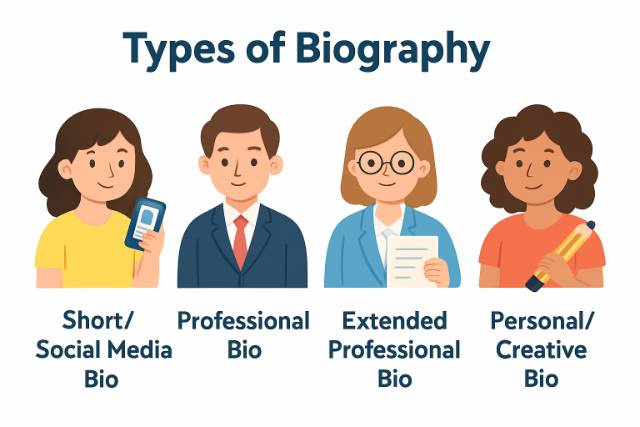
Not all bios serve the same purpose. Knowing the types helps you write appropriately.
1. Short/Social Media Bio
Ultra brief bio for Twitter, Instagram, conference badges.
Length: 50-150 words (Twitter: 160 characters)
Focus: Core identity and one standout detail
Example: "Data scientist helping healthcare systems reduce readmissions. PhD MIT. Previously Blue Cross, Kaiser Permanente. Ultramarathon runner."
Best for: Social media profiles, brief introductions, conference name tags
2. Professional Bio
Standard professional biography for websites, LinkedIn, and directories.
Length: 150-300 words (2-3 paragraphs)
Focus: Professional identity, key accomplishments, credentials, human touch
Example: Full paragraphs covering current role, expertise areas, major achievements, education, and personal interests
Best for: Company websites, LinkedIn "About" section, professional directories, speaker introductions
3. Extended Professional Bio
Comprehensive bio for formal contexts requiring more detail.
Length: 300-500 words (3-5 paragraphs)
Focus: Career arc, major achievements with context, philosophy or approach, credentials
Example: Detailed narrative covering career progression, specific projects with outcomes, methodology or perspective, complete credentials
Best for: Executive profiles, academic faculty pages, author pages, grant applications
4. Personal/Creative Bio
Personality forward bio for creative fields or personal branding.
Length: 100-300 words
Focus: Identity with personality, creative work, unique perspective, human elements
Example: Warmer tone, more personality, creative accomplishments, interesting details about approach or inspiration
Best for: Artist websites, creative portfolios, personal blogs, author pages for creative writing
Which Type Should You Write?
Consider your context:
- Twitter profile: Short bio (160 characters)
- LinkedIn: Professional bio (150-300 words)
- Company website team page: Professional bio (150-300 words)
- Conference speaker: Professional bio (200-300 words)
- Author page: Personal/creative bio (150-300 words)
- Faculty profile: Extended professional bio (300-500 words)
Consider your field:
- Corporate, medical, legal: More formal professional bio
- Creative, startup, media: Can be more casual
- Academic: Extended professional with full credentials
When in doubt, start with a standard professional bio you can always adapt it.
How to Write a Bio: Step by Step
Follow this 6 step process to craft an effective bio at any length.
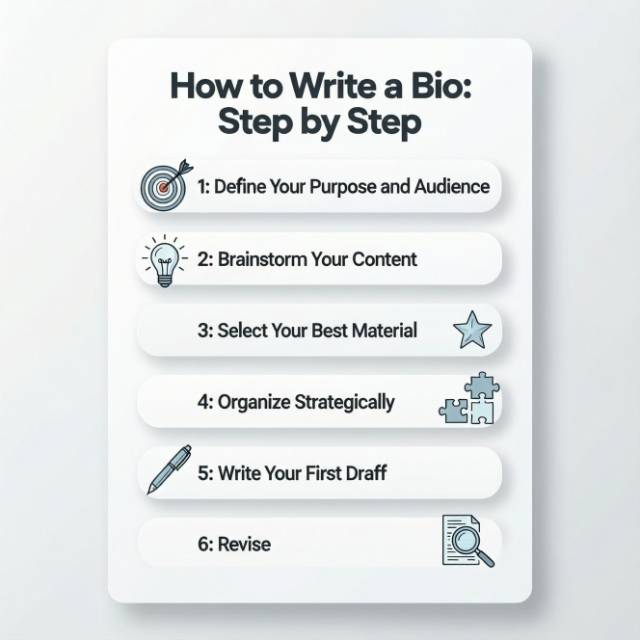
Step 1: Define Your Purpose and Audience
Before writing, know where this bio will appear and who will read it.
Ask yourself:
Where will it appear?
Who's the audience?
What should they know about you?
|
Example:
"Conference speaker bio for marketing professionals? Focus on marketing expertise, notable campaigns, current role. Skip unrelated credentials. Include just enough personality to be memorable."
Step 2: Brainstorm Your Content
List everything potentially worth including. You'll narrow later.
Professional information:
- Current position and company
- Previous notable positions
- Years of experience
- Areas of expertise
- Industries you've worked in
Accomplishments:
- Major projects and outcomes
- Awards and recognition
- Publications or speaking
- Certifications and credentials
- Quantifiable achievements
Education:
- Degrees (which ones matter for this context?)
- Prestigious institutions
- Relevant training or certifications
Personal elements:
- Hobbies that show dimension
- Volunteer work
- Interesting facts
- Location (when relevant)
- Personal philosophy (for creative bios)
Don't filter yet, just brainstorm everything.
Step 3: Select Your Best Material
Now cut ruthlessly. Most people try to include too much.
Selection criteria:
Relevance: Does this matter to this audience?
Recency: Is this current enough to matter?
Impressiveness: Does this establish credibility?
Uniqueness: Does this differentiate you?
|
The "So What?" test:
For each item, ask "So what? Why should the reader care?"
If you can't answer clearly, cut it.
Step 4: Organize Strategically
Structure your bio to lead with the most important information.
Standard Professional Bio Structure:
Paragraph 1: Core identity
- Current position and company
- Area(s) of expertise
- Years of experience OR most impressive credential
Paragraph 2: Credibility
- Major accomplishments with specifics
- Previous notable positions
- Key credentials or education
Paragraph 3: Human element (optional but recommended)
- Personal interest or hobby
- Volunteer work
- Fun fact
- Location
Step 5: Write Your First Draft
Opening sentence options:
Name + Current Position + Company: Name + Expertise + Experience: Name + Unique Angle: Choose based on context:
|
Middle sections:
Show, don't just tell: "Sarah's campaign repositioning increased enterprise deals by 47% in 18 months" "John has taught AP Biology for 12 years, with 94% of his students passing the AP exam" Use active voice: "Sarah managed the project" Include specific numbers when possible:
|
Closing paragraph tips:
Personal elements that work:
Personal elements that don't:
|
Step 6: Revise for Length and Tone
Check word count:
- Too long: Cut least important details
- Too short: Add one more accomplishment or credential
Adjust formality:
- Corporate/medical/legal: More formal
- Creative/startup/media: Can be conversational
- Academic: Formal with complete credentials
Read aloud:
- Does it flow naturally?
- Are any sentences awkward?
- Is it interesting or boring?
Check for common problems:
- Too many "I"s (if first person)
- Too many credentials without accomplishments
- No human element whatsoever
- Vague claims without specifics
Professional Bios That Open Doors.
We help you present your career confidently.
- Polished and professional
- Accurate representation
- Fully customized to you
- Suitable for any platform
Let our professionals make your accomplishments shine.
Order NowBio Length Guidelines
Different contexts require different lengths. Here's what works where.
Ultra Short (50-100 words)
Where used:
- Twitter/X bio (160 characters)
- Instagram bio (150 characters)
- Conference name badge
- Brief speaker introduction
- Directory listing
What to include:
- Core identity (role + company OR expertise)
- One standout credential or accomplishment
- Optional: One personal detail
Example (87 words):
"Dr. Marcus Williams is an emergency medicine physician at Boston General Hospital and associate professor at Harvard Medical School. He's published 47 peer reviewed articles on trauma care protocols and serves on the board of the American College of Emergency Physicians. When not in the ER, Marcus coaches his daughter's soccer team."
Twitter version (158 characters):
"ER doc @BostonGeneral. Harvard Med prof. Published 47 papers on trauma care. ACEP board member. Youth soccer coach. Views my own."
Short (150-200 words)
Where used:
- LinkedIn summary
- Company website team page
- Simple speaker introduction
- Professional directory
- Email signature link
What to include:
- Current position and company
- Area of expertise
- 1-2 key accomplishments
- Primary credential
- Optional: Personal detail
Example (174 words):
"Jennifer Park is Director of User Experience at StreamMedia, where she leads a team of 12 designers creating interfaces for the company's video streaming platform used by 40 million subscribers.
With eight years of UX design experience, Jennifer specializes in designing for accessibility and has spoken at UXPA International and Interaction Design Association conferences. Previously, she was Senior UX Designer at NetFlix, where her redesign of the mobile interface increased user engagement by 34%.
Jennifer holds a Master's in Human Computer Interaction from Carnegie Mellon University and a BFA in Graphic Design from RISD. Her work has been featured in UX Magazine and Communication Arts. Based in San Francisco, she mentors women entering tech through Girls Who Code and is an avid rock climber who's summited 30 peaks across the Western US."
Standard (200-300 words)
Where used:
- Conference speaker bio
- Professional website "About" page
- LinkedIn detailed summary
- Grant applications (professional section)
- Book contributor bio
What to include:
- Current position and detailed role
- Area(s) of expertise
- 2-3 major accomplishments with specifics
- Career progression (briefly)
- Education and credentials
- Publications, speaking, or awards (if relevant)
- Personal element
Example (287 words):
"Dr. Robert Chen is Professor of Environmental Engineering at Stanford University, where he directs the Water Resources Innovation Lab. His research focuses on sustainable water treatment technologies for developing regions, work that has impacted water access for over 2 million people across 15 countries.
Robert's team developed a low cost filtration system using locally available materials that removes 99.7% of waterborne pathogens technology now deployed in rural communities throughout sub Saharan Africa and Southeast Asia. This work earned him the National Academy of Engineering's Grainger Challenge Prize in 2023 and a MacArthur Fellowship in 2021.
Before joining Stanford in 2018, Robert was Associate Professor at MIT, where he established the Global Water Innovation Lab. He's published 87 peer reviewed articles, holds 12 patents, and his research has been featured in Science, Nature, and National Geographic. He serves on the advisory board for Water.org and Engineers Without Borders International.
Robert earned his PhD in Environmental Engineering from UC Berkeley, where he was a National Science Foundation Graduate Research Fellow, and his BS in Civil Engineering from Cornell University, graduating summa cum laude. He's delivered keynote addresses at the World Water Forum and Stockholm Water Week, and his TED talk on democratizing clean water technology has been viewed over 4 million times.
Originally from Taiwan, Robert came to the US for graduate school and became a US citizen in 2015. He lives in Palo Alto with his wife and two children, bikes to campus daily, and makes what his students describe as "surprisingly good" dumplings at lab celebrations."
Long (300-500 words)
Where used:
- Executive biographies
- Faculty profiles (academic)
- Book author pages (comprehensive)
- Major grant applications
- High level speaker introductions
What to include:
- Everything from standard bio
- More detail on career progression
- Additional accomplishments and projects
- Philosophy or methodology (when relevant)
- Complete publication/speaking record (or notable selections)
- More personal context
Example (448 words):
"Margaret Liu serves as Chief Executive Officer of BioGenesis Therapeutics, a role she's held since 2020. Under her leadership, the biotech company has advanced three drugs through FDA approval including a breakthrough treatment for pediatric leukemia that achieved a 76% five year survival rate in clinical trials, compared to 45% for standard treatment.
Margaret brings 25 years of pharmaceutical leadership to BioGenesis. Previously, she was President of Oncology at PharmaCorp, where she oversaw development of four cancer therapies that collectively generate $8 billion in annual revenue and serve over 200,000 patients globally. Before that, she spent 12 years at Merck in positions of increasing responsibility, rising from Clinical Trial Manager to VP of Global Drug Development.
Her career is distinguished by a focus on precision medicine developing treatments targeted to specific genetic markers rather than broad patient populations. This approach has become industry standard, but Margaret pioneered its application in oncology in the early 2000s when it was considered risky and expensive. Her persistence proved prescient; the five drugs she's shepherded to market all use precision medicine approaches and demonstrate significantly better outcomes than previous therapies.
Margaret holds an MD from Johns Hopkins University School of Medicine, where she was Arnold P. Gold Foundation Humanism and Excellence in Teaching Award recipient, and a BS in Molecular Biology from Yale University. She completed her residency in Internal Medicine at Massachusetts General Hospital and a fellowship in Hematology Oncology at Dana-Farber Cancer Institute.
She's published 64 articles in peer reviewed journals, including The New England Journal of Medicine, Journal of Clinical Oncology, and The Lancet. She serves on the board of directors for the American Association for Cancer Research, the Biotechnology Innovation Organization, and two other publicly traded pharmaceutical companies. In 2022, she was inducted into the National Academy of Medicine, and in 2021, she received the American Cancer Society Medal of Honor.
Margaret is a frequent speaker at medical and industry conferences and has testified before Congress on drug pricing and FDA approval processes. Her op-eds on pharmaceutical innovation have appeared in The New York Times, Wall Street Journal, and Washington Post.
She lives in Cambridge, Massachusetts with her husband, a cardiologist at Brigham and Women's Hospital. They have three adult children. Margaret serves on the board of Teach for America, mentors women executives through the Healthcare Businesswomen's Association, and is an accomplished cellist who performs occasionally with the Longwood Symphony Orchestra, an ensemble of healthcare professionals."
What to Include in Your Bio (and What to Leave Out)
Always Include
Current professional identity:
- Your role/title
- Company or institution
- Primary area of expertise
Key accomplishments:
- Major projects with outcomes
- Quantifiable achievements
- Recognition or awards
Relevant credentials:
- Degrees (at least your highest)
- Important certifications
- Professional memberships (if prestigious)
Usually Include
Career progression:
- Previous notable positions (especially for long bios)
- Years of experience in your field
- Significant career transitions
Publications/Speaking:
- If you've published or presented
- Number of articles or notable venues
- Significant media appearances
Personal element:
- One interesting hobby or activity
- Volunteer work
- Location (when relevant)
Sometimes Include
Philosophy or approach:
- For creative bios
- For thought leadership positioning
- For consultants explaining methodology
Education details:
- Honors or special recognition
- Thesis topic (for academics)
- Notable advisors or programs
Board service:
- If relevant to credibility
- If prestigious organizations
- For executive bios
Never Include
Age or birthdate:
- Irrelevant and potentially discrimination inviting
- Exception: "20 year old entrepreneur" if youth is relevant
Marital status/children (usually):
- Too personal for professional bio
- Exception: Very personal bio or creative fields
Political or religious views:
- Unless that's specifically your professional field
- Alienates roughly half your potential audience
Controversial opinions:
- Save for opinion pieces, not bios
- Bios establish credibility, not positions
Generic phrases:
- "Hard working professional"
- "Team player"
- "Results oriented"
- These mean nothing without specifics
Objective statements:
- "Seeking to leverage my skills..."
- That's for cover letters, not bios
High school (usually):
- Unless you're still in college
- Unless it's truly prestigious and relevant
Every job you've ever had:
- Focus on recent and relevant
- You're not writing a resume
Common Biography Mistakes to Avoid
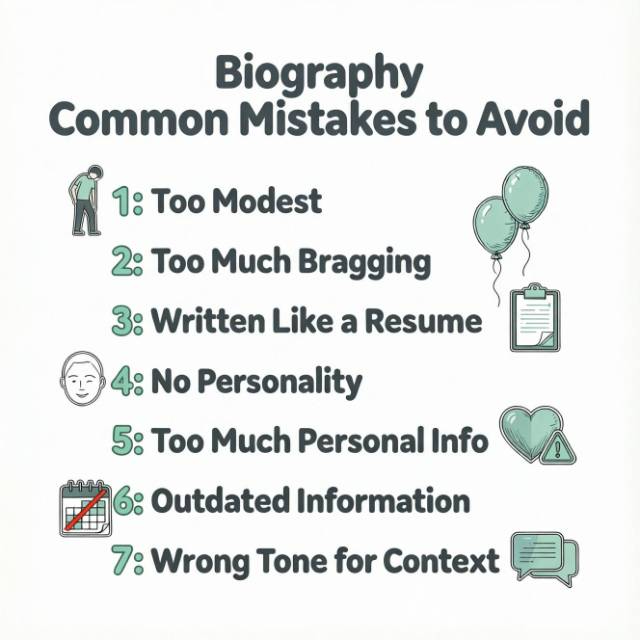
Mistake 1: Too Modest
The problem: You downplay your accomplishments or use vague language.
"Sarah has some experience in marketing and has worked on various projects."
This doesn't establish credibility or tell readers why they should care.
The fix: Be specific about your accomplishments. State facts, not opinions.
"Sarah has 15 years of B2B marketing experience and increased enterprise sales by 47% through her campaign repositioning at DataCorp."
Mistake 2: Too Much Bragging
The problem: Every sentence is self congratulatory without facts to back it up.
"John is an innovative thought leader and visionary expert who consistently delivers game changing solutions."
Empty superlatives without specifics sound like you're compensating.
The fix: Let your accomplishments speak for themselves. Show, don't tell.
"John has filed 12 patents in AI assisted diagnostics and developed the algorithm now used in 40% of hospital radiology departments nationwide."
Mistake 3: Written Like a Resume
The problem: You list everything in bullet points or choppy phrases.
"• 2020-Present: Marketing Director
• 2018-2020: Marketing Manager
• 2015-2018: Marketing Coordinator
• Skills: Marketing, management, leadership"
That's a resume format, not a bio.
The fix: Write in narrative paragraph format with natural flow.
"As Marketing Director at TechFlow since 2020, Sarah leads brand strategy for enterprise products. She progressed through three roles at the company over six years, building expertise in B2B positioning."
Mistake 4: No Personality
The problem: Your bio is all credentials with zero human element.
Reads like documentation, not a person.
The fix: Add one personal detail that shows dimension.
"When not analyzing healthcare data, Marcus coaches youth robotics teams and has summited 30 peaks across the Western US."
Mistake 5: Too Much Personal Info
The problem: Your bio reads like a dating profile or overshares.
"Sarah is happily married with three beautiful children. She loves Jesus, her family, and long walks on the beach. She struggled with anxiety but overcame it through therapy."
Way too personal for professional context.
The fix: Keep personal details professional and brief.
"Sarah lives in Austin with her family and mentors first generation college students through Braven."
Mistake 6: Outdated Information
The problem: Your bio lists accomplishments or positions from years ago.
"Sarah was named Rising Star in Marketing in 2012" (it's now 2025).
Old credentials make you look out of touch.
The fix: Update your bio regularly. Focus on recent accomplishments.
Mistake 7: Wrong Tone for Context
The problem: Your bio is too casual for corporate context or too stiff for creative field.
Creative portfolio with bio: "Ms. Jennifer Park, BFA, MFA, has extensive experience in the field of user experience design and has worked in various capacities..."
Too formal for creative field.
The fix: Match tone to your industry and where the bio appears.
"Jennifer creates interfaces that 40 million people use daily and most of them don't even notice the design, which is exactly the point."
Bio Examples by Type and Length
Example 1: Twitter/Social Media Bio (160 characters)
"Data scientist @TechFlow. PhD MIT. Helped reduce hospital readmissions 23%. Ultramarathon runner. Posts about ML, healthcare, & questionable life choices."
Why it works:
|
Example 2: Short Professional Bio (185 words)
"Marcus Thompson is Vice President of Product Development at StreamTech, where he leads teams building the next generation of video streaming technology. With 12 years of experience in media technology, he specializes in scalable infrastructure that delivers high quality video to millions of concurrent users.
Previously, Marcus was Director of Engineering at NetView, where his team's CDN optimization reduced bandwidth costs by 40% while improving playback quality. He's spoken at AWS re:Invent and VidCon about the challenges of streaming at scale.
Marcus holds a Master's in Computer Science from Carnegie Mellon and a BS in Electrical Engineering from Georgia Tech. His work has been featured in TechCrunch and Wired, and he holds 8 patents in video compression and delivery technology.
Based in Los Angeles, Marcus volunteers as a coding mentor with Black Boys Code and is an avid home chef who experiments with molecular gastronomy."
Why it works:
|
Example 3: Standard Professional Bio (276 words)
"Dr. Lisa Rodriguez is Chief Medical Officer at HealthTech Innovations, where she oversees clinical strategy for the company's AI powered diagnostic tools used in over 400 hospitals nationwide. A board certified radiologist with 18 years of clinical experience, she bridges the gap between cutting edge technology and practical medical application.
Lisa's leadership has been instrumental in HealthTech's FDA approval process for three diagnostic AI systems, including the first FDA cleared algorithm for detecting lung cancer in CT scans technology that now processes over 100,000 scans annually with 94% accuracy, matching or exceeding human radiologist performance.
Before joining HealthTech in 2021, Lisa was Associate Professor of Radiology at Johns Hopkins University School of Medicine, where she established the Medical AI Lab and published 63 peer reviewed articles on artificial intelligence in medical imaging. She also practiced clinically at Johns Hopkins Hospital, reading an average of 15,000 scans annually while teaching medical students and residents.
Lisa earned her MD from Harvard Medical School, completed her residency in Diagnostic Radiology at Massachusetts General Hospital, and holds a fellowship in Thoracic Imaging from Memorial Sloan Kettering Cancer Center. She's board certified by the American Board of Radiology and serves on the editorial board of Radiology: Artificial Intelligence.
She's a frequent keynote speaker at RSNA and SIIM conferences and has testified before the FDA on AI device approval processes. Her work has been featured in The New England Journal of Medicine, JAMA, and The New York Times.
Lisa lives in Baltimore with her husband and two teenage sons. She serves on the board of the Society for Imaging Informatics in Medicine and enjoys trail running in Patapsco Valley State Park."
Why it works:
|
Example 4: Creative/Personal Bio (223 words)
"Maya Patel makes books for people who think they don't like reading.
As a graphic novelist and illustrator, she's published four books that blend visual storytelling with narrative prose, including The Quiet Storm (winner of the Eisner Award for Best Graphic Novel) and Between Worlds (New York Times bestseller for 12 weeks). Her work focuses on first generation American experiences, mental health, and finding yourself when you're straddling two cultures.
Maya grew up in New Jersey in a Gujarati household where comic books were considered frivolous so naturally, she became obsessed with them. After studying illustration at RISD and spending five years as a graphic designer at Marvel Comics, she published her first graphic novel in 2018. Since then, her books have been translated into 14 languages and taught in high schools across the country.
When she's not drawing or writing, Maya teaches workshops on visual storytelling at the School of Visual Arts and mentors emerging artists through We Need Diverse Books. She's spoken at Comic-Con, the National Book Festival, and TEDxNewYork about the power of visual narrative to tell stories that traditional prose can't quite capture.
Maya lives in Brooklyn with two cats who insist on sitting on her keyboard. She drinks too much chai and maintains that breakfast tacos are superior to all other breakfast foods."
Why it works:
|
Example 5: Academic/Faculty Bio (412 words)
"Dr. James Patterson is Professor of American History at Columbia University, where he has taught since 2012. His research examines the intersection of labor movements, immigration, and urban development in early 20th century America, with particular focus on how immigrant workers shaped American cities and labor policy between 1880 and 1940.
James is the author of three books: Building America: Immigrant Labor and the Making of Modern Cities (Yale University Press, 2019), which won the Organization of American Historians' Avery O. Craven Award for best book on Civil War era or Reconstruction; Bread and Roses: The 1912 Textile Strike and the Making of Modern Labor Rights (Harvard University Press, 2016); and The Tenement City: Immigration and Urban Development in New York, 1880-1920 (Oxford University Press, 2014). His fourth book, The Factory Floor: Industrial Work and Worker Dignity in Progressive Era America, is forthcoming from Princeton University Press in 2026.
His articles have appeared in the Journal of American History, American Historical Review, Labor History, and Journal of Urban History, among others. He has also written for popular audiences in The Atlantic, The New York Times, and The Washington Post about connections between historical labor struggles and contemporary worker rights debates.
At Columbia, James teaches courses on American labor history, immigration history, urban history, and historical research methods. He has directed 14 doctoral dissertations to completion and served on 37 dissertation committees. His undergraduate courses regularly fill to capacity, and he received Columbia's Presidential Award for Outstanding Teaching in 2021.
James earned his PhD in History from Yale University, where he was a Predoctoral Fellow at the MacMillan Center for International and Area Studies. He holds an MA in History from the University of Chicago and a BA in History and Political Science from the University of Wisconsin-Madison, graduating summa cum laude and Phi Beta Kappa.
He serves on the editorial board of Labor History and the executive committee of the Labor and Working Class History Association. He was elected to the Society of American Historians in 2020 and named a Guggenheim Fellow in 2019.
James grew up in Milwaukee, Wisconsin, where his grandfather worked at the now-closed Allis-Chalmers manufacturing plant an experience that sparked his interest in labor history. He lives in Morningside Heights with his wife, a public school teacher, and their two children. Outside academia, he's an avid cyclist and volunteers with New York Cares tutoring adult immigrants in English."
Why it works:
|
Make Your Bio Stand Out Instantly.
Get a bio that impresses recruiters, clients, and readers.
- Professional tone
- Accurate and credible
- Engaging storytelling
- Flexible length options
Our experts craft bios that tell your story.
Order NowConclusion: Key Takeaways
- Know your purpose and audience: Tailor your bio for the platform and readers.
- Highlight achievements strategically: Focus on what establishes credibility and relevance.
- Balance professionalism and personality: Include human elements that make you relatable.
- Choose the right length and type: Short, standard, extended, or creative match context and goals.
- Keep it current: Update regularly with new roles, accomplishments, or credentials.
- Avoid common pitfalls: Don’t underplay your accomplishments, overshare personal info, or use outdated details.
- Use examples as guides: Learn from proven bios in professional, creative, or academic fields.
By following these steps, you can craft a bio that clearly communicates your expertise, showcases your achievements, and leaves a lasting impression.