What is a Case Study?
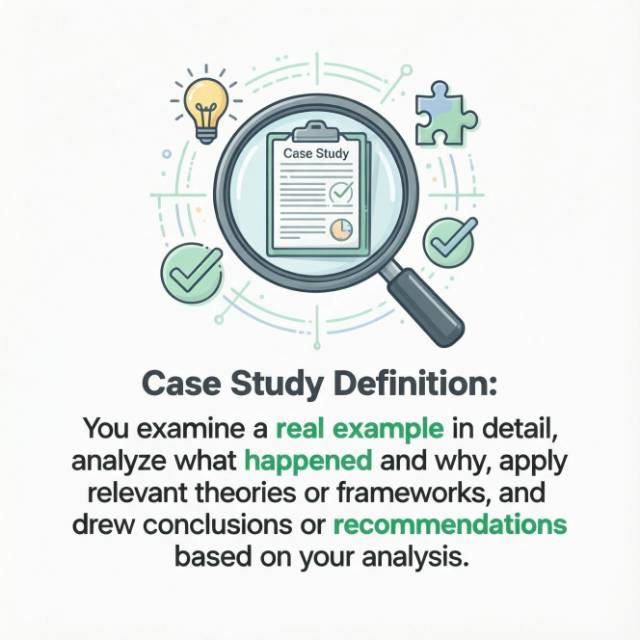
A case study is an indepth examination of a specific real world situation, individual, group, event, or organization that analyzes the subject within its context to illustrate broader principles, test theories, or develop solutions.
The Four Essential Components
- Description: What happened the facts of the case
- Analysis: Why it happened examination using frameworks or theories
- Evaluation: What worked, what didn't, and why
- Recommendations: What should be done (or could have been done differently)
What Makes a Good Case Study?
Strong case studies share these qualities:
- Real world focus: Based on actual situations, not hypotheticals
- Detailed examination: Thorough investigation of the specific case
- Analytical depth: Goes beyond description to explain causes and effects
- Theoretical application: Uses frameworks or theories to analyze
- Practical recommendations: Offers actionable insights
Bad case study: Good case study: See the difference? Specific, analytical, theory grounded, actionable. |
Why Write Case Studies?
- For business: Analyze strategy, operations, marketing, or management decisions
- For psychology: Examine individual cases to understand conditions or treatments
- For education: Study teaching methods, interventions, or programs
- For marketing: Demonstrate product/service value through client success
- For medicine: Document rare conditions or treatment approaches
- For research: Explore complex phenomena in real world contexts
Case studies bridge theory and practice they show how concepts apply in actual situations.
Ace Your Case Study Assignments, Stress Free!
Get expert help trusted by students worldwide.
- Thorough case analysis
- Original, plagiarism free writing
- Discipline specific frameworks
- On time delivery, every time
Boost Your Grades with Professional Case Study Help
Get Started NowTypes of Case Studies
Different fields use case studies for different purposes.
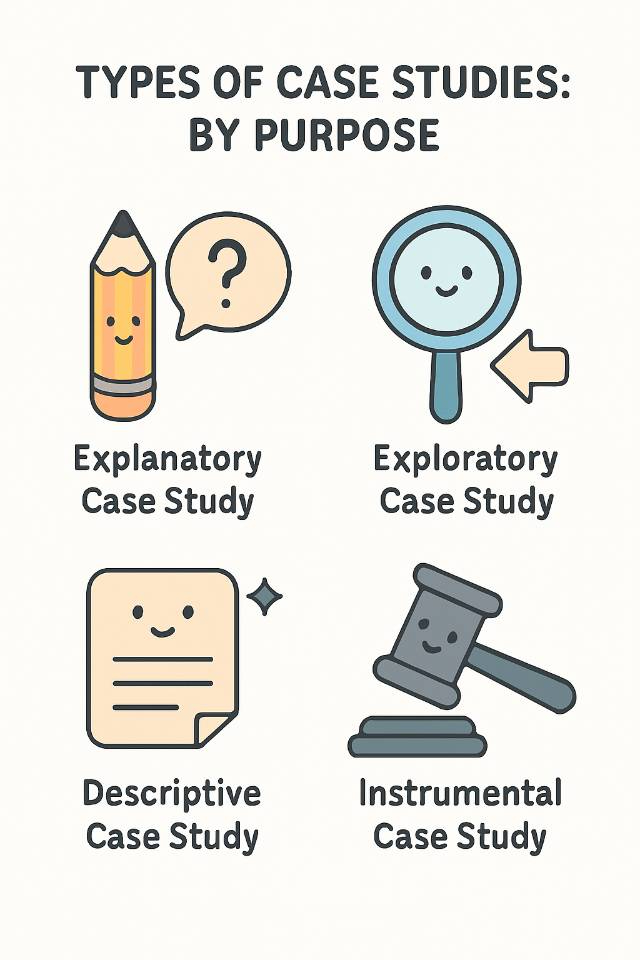
Case Study Types By Purpose
1. Explanatory Case Study
Explains causal relationships why something happened.
- Purpose: Understand causes and effects
- Example: "Why did Blockbuster fail while Netflix succeeded?"
- Best for: Business analysis, organizational studies
2. Exploratory Case Study
Investigates new or understudied phenomena.
- Purpose: Generate hypotheses, identify questions for future research
- Example: "How do early remote workers experience work life boundaries?"
- Best for: Emerging topics, pilot studies
3. Descriptive Case Study
Provides detailed account of a phenomenon within its context.
- Purpose: Document and describe thoroughly
- Example: "Implementation of new curriculum in urban school district"
- Best for: Education, program evaluation
4. Instrumental Case Study
Uses specific case to gain insight into broader issue.
- Purpose: Illuminate larger phenomenon through particular example
- Example: "Patient X's treatment to understand PTSD therapy effectiveness"
- Best for: Psychology, medicine, social sciences
Case Study Types By Subject
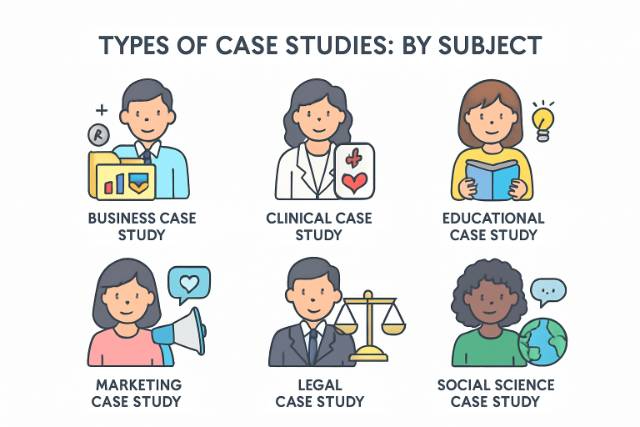
- Business Case Study: Company, strategy, decision, or market situation
- Clinical Case Study: Individual patient, condition, or treatment
- Educational Case Study: Student, classroom, program, or intervention
- Marketing Case Study: Campaign, strategy, or client success story
- Legal Case Study: Court case, legal principle, or precedent
- Social Science Case Study: Individual, group, community, or phenomenon
Which Type Should You Write?
Consider your purpose:
- Understanding why something happened: Explanatory
- Exploring new territory: Exploratory
- Documenting what occurred: Descriptive
- Illuminating broader principle: Instrumental
Consider your field:
- Business course: Typically explanatory business case
- Psychology course: Clinical or instrumental case
- Marketing context: Client success case study
- Research project: May be exploratory or descriptive
When in doubt, ask your instructor or check assignment requirements.
How to Write a Case Study: Step by Step
Follow this 6 step process to craft an effective case study.
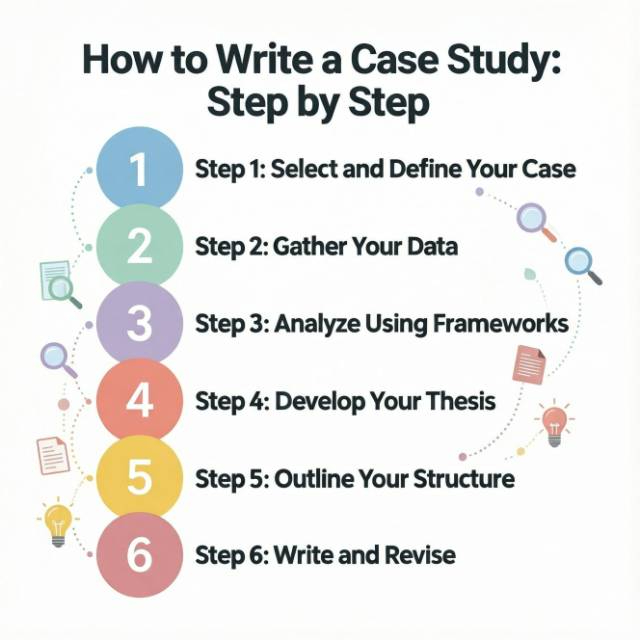
Step 1: Select and Define Your Case
Choose a case that's interesting, informative, and analyzable.
Good cases have:
- Clear boundaries: Specific timeframe, organization, or individual not too broad
- Available information: Sufficient data, documents, or access to analyze thoroughly
- Analytical potential: Complexity worth examining, not obvious or simple
- Relevance: Connects to theories, principles, or practical concerns
- Significance: Teaches something valuable or generalizable
Quick selection test: Right: "Netflix's transition from DVD to streaming (2011-2013)" Wrong: "How streaming companies work" |
Step 2: Gather Your Data
Collect comprehensive information about the case. Data sources vary by type:
Business cases:
- Company reports, financial statements
- Press releases, news coverage
- Industry analyses
- Interviews with stakeholders (if possible)
- Market data
Clinical cases:
- Patient records (maintaining confidentiality)
- Assessment results
- Treatment notes
- Relevant medical literature
Educational cases:
- Program documents
- Assessment data
- Observation notes
- Interviews with teachers/students
- Curriculum materials
Research tip:
Collect more than you think you'll need. Better to have unused information than discover gaps while writing.
Step 3: Analyze Using Frameworks
Don't just describe analyze using relevant theoretical frameworks.
Business frameworks:
- SWOT Analysis: Strengths, Weaknesses, Opportunities, Threats
- Porter's Five Forces: Industry competition analysis
- PESTEL: Political, Economic, Social, Technological, Environmental, Legal factors
- Value Chain Analysis: How company creates value
- BCG Matrix: Business portfolio analysis
Psychology frameworks:
- Biopsychosocial Model: Biological, psychological, social factors
- DSM-5 Criteria: Diagnostic classification
- Cognitive Behavioral Model: Thought behavior emotion connections
- Developmental Stage Theories: Age appropriate development
Education frameworks:
- Bloom's Taxonomy: Learning objectives and assessment
- Universal Design for Learning: Accessibility and differentiation
- Backward Design: Starting with outcomes
- Constructivist Principles: Student centered learning
Choose frameworks that:
- Fit your discipline and case type
- Provide analytical structure
- Are taught in your course (if academic)
- Illuminate important aspects of the case
Step 4: Develop Your Thesis
Your thesis should present your main analytical conclusion.
Weak thesis (descriptive):
"This case study examines Netflix's business model transition."
Strong thesis (analytical):
"Netflix's successful transition from DVD rentals to streaming demonstrates that established companies can survive disruptive innovation only by willingly cannibalizing profitable business models accepting short term losses to secure long term survival a principle applicable to any industry facing technological disruption."
Thesis formula:
[Case] demonstrates/reveals/shows [main insight] through [key factors], with implications for [broader application].
Step 5: Outline Your Structure
Organize your case study logically before writing.
Standard case study outline:
I. Introduction
Hook (why this case matters)
Case identification (who/what/when/where)
Background context
Thesis statement
II. Case Description
Situation before key events
Key players/stakeholders
Timeline of events
Critical decisions or developments
III. Analysis
Application of framework(s)
Examination of factors
Causes and effects
Alternative perspectives
IV. Evaluation
What worked well
What failed or underperformed
Why outcomes occurred
Lessons learned
V. Recommendations
What should be done
Implementation considerations
Expected outcomes
Limitations or risks
VI. Conclusion
Summary of key insights
Broader implications
Significance for theory or practice
Step 6: Write and Revise
Follow the following writing tips while revising your work.
Balance description and analysis:
- Provide enough detail to understand the case
- Don't let description overwhelm analysis
- Aim for 30–40% description, 60–70% analysis
Use section headings:
- Makes structure clear
- Helps readers navigate
- Shows logical organization
Support claims with evidence:
- Reference specific data, quotes, or examples
- Cite sources properly
- Don't make unsupported assertions
Stay objective:
- Present facts accurately
- Acknowledge limitations
- Consider multiple perspectives
- Don't let bias shape analysis
Write clearly:
- Define technical terms
- Use active voice
- Vary sentence structure
- Proofread carefully
Case Study Structure
Introduction (10–15% of case study)
Purpose: Establish the case and present your analytical thesis.
What to include:
- Hook showing why case matters
- Basic case identification (subject, timeframe, context)
- Brief background necessary to understand case
- Clear thesis statement
Case Description/Background (20–25%)
Purpose: Provide factual foundation for analysis.
What to include:
- Situation before key events
- Main players and stakeholders
- Timeline of critical events
- Context necessary for understanding
Keep this section:
- Focused (only relevant details)
- Objective (facts, not interpretation yet)
- Chronological (when appropriate)
- Well organized (use subheadings)
Analysis (30–35%)
Purpose: Examine the case using relevant frameworks and theories.
What to include:
- Application of analytical frameworks
- Examination of causes and effects
- Multiple perspectives
- Evidence supported arguments
Structure options:
|
Evaluation (15–20%)
Purpose: Assess what worked, what didn't, and why.
What to include:
- Success and failures identified
- Reasons for outcomes
- Alternative possibilities
- Lessons learned
Failed Strategies (Blockbuster)
Blockbuster's late stage responses failed because they treated streaming as supplement rather than replacement:
- Blockbuster Online (2004): Launched as defensive measure, not strategic priority
- Store streaming integration: Attempted to preserve store traffic instead of acknowledging stores' obsolescence
- Financial constraints: Debt from store expansion limited technology investment
Recommendations (10–15%)
Purpose: Provide actionable insights based on analysis.
What to include:
- Specific, practical recommendations
- Implementation considerations
- Expected outcomes
- Potential risks or limitations
Structure recommendations clearly:
For historical cases:
For ongoing cases:
|
Conclusion (5–10%)
Purpose: Synthesize insights and establish significance.
What to include:
- Brief summary of key findings
- Broader implications
- Significance for theory or practice
- Limitations of analysis
Analysis Frameworks by Discipline
Business Case Studies
Strategic Analysis:
Financial Analysis:
Marketing Analysis:
|
Psychology Case Studies
Clinical Assessment:
Treatment Evaluation:
|
Education Case Studies
Instructional Analysis:
Program Evaluation:
|
Case Study Example (Abbreviated)
Business Case Study: Starbucks China Market Entry Strategy
Introduction
When Starbucks entered the Chinese market in 1999, conventional wisdom suggested failure. China had thousands of years of tea culture, no coffee drinking tradition, and Starbucks' premium pricing model seemed incompatible with Chinese consumer behavior. Yet by 2023, China became Starbucks' second largest market with over 6,000 stores. This case study examines Starbucks' localization strategy through the lens of international market entry theory, demonstrating how companies can successfully enter culturally different markets by adapting products while maintaining brand identity. Analysis reveals that Starbucks succeeded by positioning coffee as aspirational lifestyle product rather than commodity beverage a strategy applicable to premium brands entering emerging markets.
Case Description
Initial Market Conditions (1999)
- Chinese per capita coffee consumption: 0.03 kg/year (vs. 4.2 kg in US)
- Tea deeply embedded in Chinese culture (4,000+ year history)
- Limited café culture; socialization occurred in restaurants, not coffee shops
- Rising urban middle class with increasing disposable income
- Growing interest in Western brands as status symbols
Entry Strategy
- Partnership with local operators (initially Beijing Mei Da)
- First store: Beijing (1999), positioned in high traffic tourist area
- Premium pricing maintained (no discounting for local market)
- Store design adapted to Chinese preferences (larger spaces, comfortable seating)
- Product customization (green tea lattes, red bean frappuccinos)
Growth and Adaptation (2000–2023)
- Rapid expansion: 6,000+ stores by 2023
- Strategic location selection: urban centers, shopping districts
- Chinese New Year themed drinks and merchandise
- Mobile payment integration (Alipay, WeChat Pay)
- Digital loyalty program adapted to Chinese digital ecosystem
Analysis: Applying International Market Entry Theory
Standardization vs. Localization
International business literature identifies tension between global standardization (efficiency, brand consistency) and local adaptation (cultural relevance, market fit). Starbucks' China strategy demonstrates selective adaptation:
Standardized Elements:
- Core brand identity (premium coffee experience)
- Quality standards (consistent drink preparation)
- Store ambiance (comfortable "third place" concept)
- Employee training (customer service standards)
Localized Elements:
- Product menu (tea based drinks, local flavors)
- Store design (larger spaces for group gatherings)
- Payment systems (Chinese digital platforms)
- Marketing (Chinese cultural celebrations)
This selective approach preserved brand identity while accommodating cultural differences avoiding both extremes of rigid standardization and complete localization.
Cultural Positioning Strategy
Rather than competing with tea as beverage, Starbucks positioned coffee as lifestyle choice associated with modernity, sophistication, and Western culture. This positioning succeeded because:
- Rising middle class sought Western brands as status symbols
- Coffee represented aspiration rather than daily necessity
- Store atmosphere valued over pure product functionality
- Social experience mattered more than beverage type
By focusing on experience rather than coffee preference, Starbucks sidestepped cultural resistance to new beverage.
Evaluation
Successful Strategies
- Patience with market development: Starbucks didn't expect immediate profit, investing instead in market education and brand building. First profitable year came after significant investment period.
- Partnership with local operators: Local knowledge helped navigate regulatory environment, real estate market, and consumer preferences that foreign company couldn't understand independently.
- Premium positioning maintenance: Resisting temptation to lower prices preserved brand perception as high quality, aspirational product.
Failed or Challenged Approaches
- Initial rural expansion: Early attempts to expand beyond major urban centers failed because rural areas lacked target demographic and cultural conditions supporting café culture.
- Some product adaptations: Certain localized drinks failed (some overly sweet versions didn't resonate), showing limits of adaptation.
Recommendations
For Companies Entering Culturally Different Markets
1. Position around lifestyle, not product features
When entering markets where your product category is unfamiliar, focus on the experience and identity your brand represents rather than functional product benefits.
2. Identify cultural trends supporting your entry
Starbucks succeeded partly because Chinese middle class was already interested in Western culture. Find cultural currents moving in your direction rather than fighting against established traditions directly.
3. Maintain premium positioning despite pressure to discount
Price reductions signal lower quality in emerging markets where consumers use price as quality indicator. Premium pricing supported Starbucks' aspirational positioning.
4. Invest in market development, not just market entry
Starbucks spent years educating Chinese consumers about coffee culture. Companies should budget for multi year investment in market development, not just initial entry costs.
Conclusion
Starbucks' China success demonstrates that companies can enter culturally different markets by selective adaptation: preserving core brand identity while adjusting peripheral elements to local preferences. The case validates international market entry theory emphasizing balance between standardization and localization. More broadly, it shows that premium brands can succeed in emerging markets by positioning products as aspirational lifestyle choices rather than functional commodities a strategy applicable across industries from fashion to technology to food service. As more Western brands eye Asian markets, Starbucks' experience provides valuable framework for market entry while highlighting that cultural sensitivity and long term investment are prerequisites for success.
Struggling to turn a complex case into a clear, well structured analysis? Our professional essay writing service helps you move from confusion to clarity with expert guidance.
Common Mistakes of Case Study to Avoid
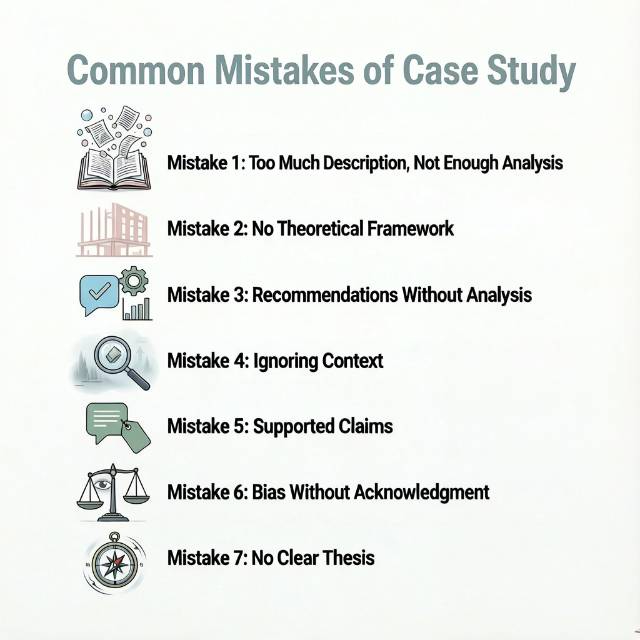
Mistake 1: Too Much Description, Not Enough Analysis
The problem:
Half your paper recounts what happened with minimal analysis of why.
The fix:
Limit description to 30–40% of total length. Focus on analysis and evaluation.
Mistake 2: No Theoretical Framework
The problem:
You describe and evaluate without applying any analytical framework.
The fix:
Choose relevant framework(s) from your field and apply them systematically to the case.
Mistake 3: Recommendations Without Analysis
The problem:
You jump to recommendations without thoroughly analyzing causes and effects.
The fix:
Base recommendations on findings from your analysis section. Show the logical connection.
Mistake 4: Ignoring Context
The problem:
You analyze the case as if it existed in a vacuum.
The fix:
Consider historical, cultural, market, or organizational context that shaped decisions and outcomes.
Mistake 5: Unsupported Claims
The problem:
"The company failed because of poor leadership" without evidence.
The fix:
Support every analytical claim with specific evidence from the case.
Mistake 6: Bias Without Acknowledgment
The problem:
Your personal opinions shape the analysis without transparency.
The fix:
Acknowledge your perspective and potential biases. Present evidence objectively.
Mistake 7: No Clear Thesis
The problem:
The case study examines various aspects without a unifying analytical argument.
The fix:
Develop a clear thesis that your analysis supports. Every section should connect to this main argument.
Submit High Quality Case Studies with Confidence
Trusted by students across business, psychology, and education.
- Application of relevant frameworks
- Analytical and actionable insights
- Proper structure & logical flow
- Timely delivery, every time
Turn complex cases into clear, compelling analyses.
Get Started NowReady to Write Your Case Study?
Writing effective case studies combines thorough research with systematic analysis and practical recommendations.
Here's what you now know:
- What case studies are and their different types
- How to select and analyze cases systematically
- Step by step process from selection to final draft
- Appropriate frameworks for different disciplines
- Proper structure balancing description and analysis
- Common mistakes and how to avoid them
The most important step?
Choose a case with sufficient complexity and available data to support deep analysis not too simple, not too broad.
Case studies aren't just description they're analysis that bridges theory and practice.