What is an Article Review?
An article review is a critical assessment of a scholarly article or research paper where you summarize the content and evaluate its quality, methodology, arguments, and contribution to the field.
The Three Essential Components
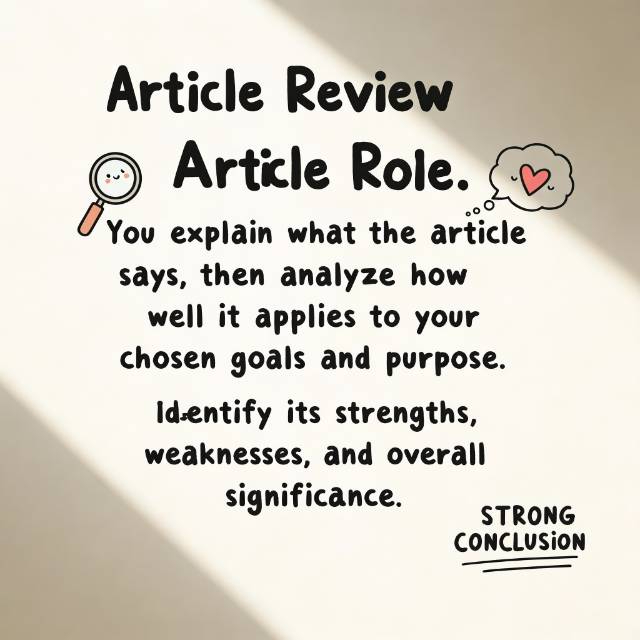
- Summary: Brief overview of the article's main points and arguments
- Critical evaluation: Analysis of methodology, evidence, logic, and conclusions
- Personal assessment: Your informed judgment about the work's quality and contribution
What Makes a Good Article Review?
Strong article reviews share these qualities:
- Balanced perspective: Acknowledges both strengths and limitations
- Specific evidence: Points to exact examples from the article
- Fair evaluation: Judges the work by appropriate standards
- Clear organization: Summary before critique, logical flow
- Professional tone: Objective and scholarly, not personal attacks
Bad article review: Good article review: See the difference? Specific, balanced, analytical. |
Why Write Article Reviews?
For school: Professors assess your comprehension and critical thinking skills, especially in research-focused subjects like those taught in a digital marketing course.
For research: Literature reviews require evaluating sources
For publication: Academic journals need peer reviewers
For yourself: Critical reading deepens understanding
For your field: Evaluation advances scholarly conversation
There's no single purpose; article reviews are foundational to academic work.
ARTICLE REVIEW DUE? LET’S START
Our experts deliver clear, critical, and properly structured article reviews ready to submit.
- 100% human-written analysis
- Discipline specific evaluation
- Proper citations and formatting
- Confidential and plagiarism free
You choose the article. We handle the review.
Get Started NowArticle Review vs Other Writing Types
Article reviews share similarities with related forms but have distinct characteristics.
Comparison | Article Review | Other Writing Type | Key Difference / Notes |
Article Review vs Summary | Includes summary and evaluation; analyzes strengths and weaknesses; makes judgments about quality; typically 3–5 pages | Summary: Only restates main points; no evaluation or judgment; purely objective; typically 1–2 pages | Summaries describe what the article says. Reviews evaluate how well it says it. |
Article Review vs Book Review | Focuses on a single scholarly article; evaluates research methodology; academic audience; 3–5 pages | Book Review: Covers entire book; evaluates overall argument and contribution; may be for general or academic audience; 5–10 pages | Article reviews examine specific research claims and methods. Book reviews assess broader arguments across chapters. |
Article Review vs Critique | Balanced assessment; highlights strengths and weaknesses; constructive tone; follows formal structure | Critique: Can be primarily negative; focuses more on problems; may be more assertive; less formal structure possible | Reviews aim for balanced evaluation. Critiques may emphasize flaws. |
Types of Article Reviews
Not all article reviews serve the same purpose. Knowing your options helps you write appropriately.
The 3 Main Types
1. Journal Article Review
Evaluates scholarly research published in academic journals. The most common type of college assignment.
Focus: Length: Best for: |
2. Critical Review
In-depth analysis of the article's arguments, assumptions, and implications.
Focus: Length: Best for: |
3. Literature Review Article
Summarizes and evaluates multiple articles on the same topic.
Focus: Length: Best for: |
Which Type Should You Write?
Check your assignment requirements:
- Says "review the article": Journal article review
- Says "critical analysis": Critical review
- Says "literature review": Multiple article synthesis
Consider your purpose:
- Understanding one study: Journal article review
- Analyzing an argument deeply: Critical review
- Mapping a research area: Literature review
When in doubt, ask your professor or default to a journal article review; it's the standard.
How to Write an Article Review: Step by Step
Writing an article review follows a clear 8 step process.
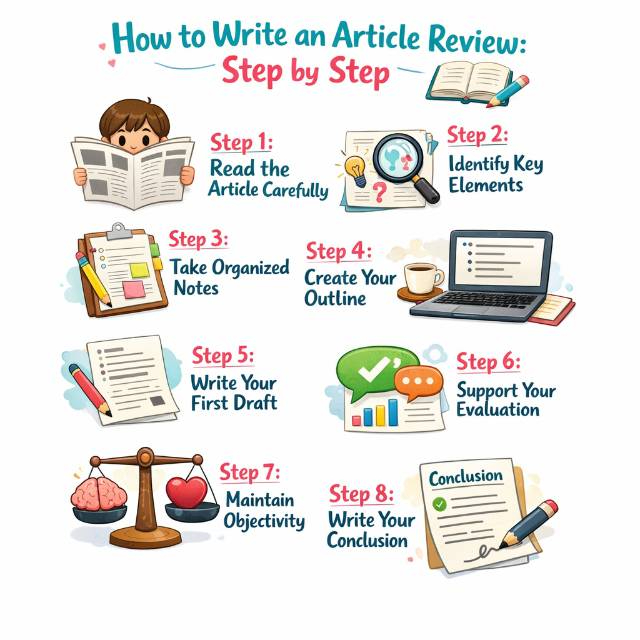
Step 1: Read the Article Carefully (Multiple Times)
First reading: Get the big picture:
- Read start to finish without stopping
- Don't take notes yet
- Identify the main argument or research question
What to find:
- What's the author's thesis or main claim?
- What methodology did they use?
- What are the key findings or arguments?
Second reading: Analyze deeply:
- Read again with a highlighter or a pen
- Mark's main points, evidence, and methodology
- Note strengths and potential weaknesses
- Question claims that seem unsupported
Third reading: Focus on evaluation:
- Assess how well arguments are supported
- Check if conclusions follow from evidence
- Identify gaps or limitations
- Consider alternative interpretations
Step 2: Identify Key Elements
Before writing, extract these components:
Bibliographic information:
- Author(s) name(s)
- Article title
- Journal name, volume, issue
- Publication year
- Page numbers
Main argument/thesis:
- What's the central claim?
- What's the research question?
Methodology (for research articles):
- What research method was used?
- Sample size and characteristics
- Data collection approach
Key findings/arguments:
- What are the main points?
- What evidence supports them?
- What conclusions does the author draw?
Assumptions and limitations:
- What does the author assume?
- What are potential weaknesses?
- What's left unexplored?
Step 3: Take Organized Notes
Create separate sections for different aspects:
Summary notes:
- Main thesis (1–2 sentences)
- Key supporting arguments (bullet points)
- Evidence used (specific examples)
- Conclusions drawn
Evaluation notes:
| Strengths: | Weaknesses: |
|
|
Questions raised:
- What's unclear?
- What needs further research?
- What would you do differently?
Step 4: Create Your Outline
Organize your review before writing.
Standard Article Review Outline:
I. Introduction
Article citation (author, title, journal, year)
Article's main topic/focus
Your thesis (overall evaluation)
II. Summary Section
The author's main argument
Key supporting points
Methodology (if research article)
Main findings/conclusions
III. Critical Evaluation
Strengths of the article
Weaknesses or limitations
Methodology assessment
Quality of evidence
Logical consistency
IV. Conclusion
Restate overall assessment
Significance and contribution
Recommendations (if appropriate)
Filled Example Outline
Article:
"Social Media Use and Adolescent Anxiety: A Longitudinal Study" by Johnson et al.
I. Introduction
Citation: Johnson, M., Smith, R., & Lee, K. (2024). Social Media Use and Adolescent Anxiety. Journal of Adolescent Psychology, 45(2), 112–134.
Topic: Relationship between social media use and anxiety in teenagers
Thesis: The article provides valuable longitudinal data, but methodological limitations weaken causal claims
II. Summary
Argument: Heavy social media use (3+ hours daily) correlates with increased anxiety
Method: 3 year study of 2,400 teens, self reported surveys
Findings: 60% increase in anxiety scores among heavy users
Conclusion: The authors suggest limiting teen social media access
III. Evaluation
Strengths: Large sample size, longitudinal design, controls for age and gender
Weaknesses: Self reported data, no baseline mental health screening, correlation vs. causation issue
Evidence quality: Statistics are robust, butthe interpretation is overstated
Methodology: Solid design but missing key controls
IV. Conclusion
Despite limitations, it contributes important data to understudied area
Suggests the need for further research with better controls
Valuable for practitioners and policymakers
Step 5: Write Your First Draft
Introduction writing tips:
Start with full citation in proper format:
APA: MLA: |
Then provide context:
- What's the article's focus?
- Why does this topic matter?
- What gap does it fill?
End the introduction with your thesis (overall evaluation).
Summary Section Writing Tips
Keep summary concise (1–2 paragraphs typically):
- State the main argument clearly
- Include key supporting points
- Mention methodology briefly
- Note main findings/conclusions
- Stay objective, no evaluation yet
Example summary paragraph:
| "Johnson et al. (2024) investigate the relationship between social media use and anxiety in adolescents through a three year longitudinal study of 2,400 teenagers across 50 schools. Using quarterly self reported surveys measuring both daily social media use and anxiety levels (via GAD-7 scale), the researchers found that teens using social media three or more hours daily showed a 60% increase in anxiety scores compared to minimal users. The authors argue these findings suggest a causal relationship and recommend limiting adolescent social media access." |
Critical Evaluation Writing Tips
This is the heart of your review. Develop your analysis thoroughly.
Discuss strengths first:
| "The study's primary strength lies in its longitudinal design, which allows tracking individuals over time rather than relying on crosssectional snapshots. The large sample size (n=2,400) across diverse geographic regions strengthens generalizability, and the quarterly measurement intervals provide granular data about changing patterns." |
Then discuss weaknesses:
| "However, several methodological concerns limit the strength of causal claims. First, the study relies entirely on self reported data for both social media use and anxiety levels, introducing potential reporting bias. Teens may under report or overreport both metrics, and no objective verification (e.g., phone usage logs) was conducted. Second, and more critically, the study did not screen for preexisting mental health conditions at baseline. Students with higher anxiety levels may self select into heavier social media use as a coping mechanism, reversing the causal arrow the authors suggest." |
Step 6: Support Your Evaluation
Every critical point needs specific evidence from the article.
Weak evaluation (no specifics): Strong evaluation (specific): |
How to support your points:
- Reference specific pages or sections
- Quote key passages (briefly)
- Point to specific data or examples
- Explain why your point matters
Step 7: Maintain Objectivity
Article reviews are scholarly, not personal.
Subjective (wrong): Objective (correct): |
How to stay objective:
- Focus on the work, not the author personally
- Use evidence based critiques
- Acknowledge what the article does well
- Keep tone professional and constructive
- Avoid "I think" or "I feel" unless presenting informed scholarly judgment
Step 8: Write Your Conclusion
What to include:
- Restate your overall assessment
- Summarize main strengths and weaknesses
- Note the article's contribution to the field
- Suggest implications or future research (if appropriate)
What NOT to do:
- Don't introduce new criticisms
- Don't just repeat your introduction
- Don't end weakly with "This article was okay"
Example conclusion:
| "Despite methodological limitations that constrain causal interpretations, Johnson et al.'s study represents an important contribution to adolescent psychology. The longitudinal design and substantial sample size provide valuable data that moves beyond previous cross sectional work. While future research must address the confounds identified particularly baseline mental health screening and objective usage verification this study establishes a foundation for understanding correlational patterns between social media use and anxiety. The findings warrant attention from educators, parents, and policymakers, though implementation of restrictive policies should await more conclusive evidence of causation." |
STUCK ANALYZING A JOURNAL ARTICLE?
We turn complex research papers into polished, well-argued article reviews.
- Clear summaries with critical insight
- Balanced strengths and weaknesses
- Academic tone professors expect
- On time delivery guaranteed
Send us the article. Get a complete review.
Get StartedArticle Review Techniques
These techniques help you evaluate articles effectively.
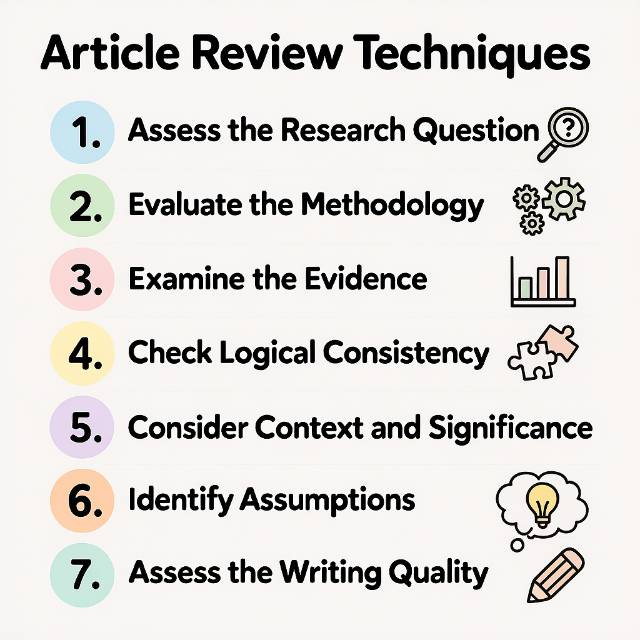
1. Assess the Research Question
Ask yourself:
- Is the research question clear and specific?
- Does it address a gap in existing knowledge?
- Is it answerable with the methods used?
2. Evaluate the Methodology
For quantitative research:
- Sample size adequate?
- Control group included?
- Variables clearly defined and measured?
- Statistical analysis appropriate?
- Potential confounds addressed?
For qualitative research:
- Sample selection justified?
- Data collection methods appropriate?
- Researcher bias acknowledged?
- Findings supported by sufficient examples?
- Alternative interpretations considered?
Red flags:
- Small sample sizes without justification
- Self selected participants (introduces bias)
- Missing control groups
- Conflating correlation with causation
- Cherry picked data
3. Examine the Evidence
Quality questions:
- Is the evidence from credible sources?
- Is it current and relevant?
- Are statistics properly interpreted?
- Do examples represent broader patterns?
- Are counterexamples addressed?
Strong evidence:
- Peer reviewed sources
- Appropriate statistical tests
- Multiple lines of converging evidence
- Acknowledges limitations
Weak evidence:
- Anecdotal examples treated as proof
- Outdated sources
- Misinterpreted statistics
- Selective citation (only supporting studies)
4. Check Logical Consistency
Look for:
- Do conclusions follow from evidence?
- Are assumptions stated or hidden?
- Are there logical fallacies?
- Does the argument flow coherently?
Common logical problems:
Non sequitur: Hasty generalization: False dichotomy: |
5. Consider Context and Significance
Ask yourself:
- How does this fit with existing research?
- Does it challenge or confirm previous findings?
- What's the theoretical contribution?
- What are the practical implications?
- What questions remain unanswered?
Example evaluation:
| "Johnson et al.'s findings align with previous cross sectional research (Smith, 2022; Lee, 2023) but provide the first longitudinal data tracking individuals over time. This methodological advance strengthens evidence for correlation, though the causal mechanism remains unclear. The study's practical significance is substantial if causal relationships are confirmed through future research with better controls, findings could inform screen time guidelines for adolescents." |
6. Identify Assumptions
Every article rests on unstated assumptions. Your job: make them explicit.
Common assumptions to question:
- Participants answered surveys honestly and accurately
- Self reported data reflects actual behavior
- Correlations suggest causation
- Laboratory findings apply to real world settings
- The sample represents the broader population
7. Assess the Writing Quality
Yes, clarity matters in scholarly work.
Evaluate:
- Is the argument clearly structured?
- Are terms defined adequately?
- Is the writing accessible to the intended audience?
- Are citations complete and properly formatted?
- Do figures and tables effectively support points?
Red flags:
- Jargon without explanation
- Unclear thesis statement
- Missing citations for claims
- Disorganized presentation
- Figures that don't match text
Article Review Structure
Review Introduction (10–15% of review)
Purpose: Introduce the article and state your overall evaluation.
What to include:
- Full citation in proper format
- Author's main argument/research question
- Brief context (why this topic matters)
- Your thesis (overall assessment)
Length:
1 paragraph for short reviews, 2 paragraphs for longer reviews
Summary Section (20–25% of review)
Purpose: Objectively describe what the article says.
What to include:
- Main argument or research question
- Key supporting points or findings
- Methodology (for research articles)
- Author's conclusions
What NOT to include:
- Your opinions or evaluation (save for next section)
- Every minor detail
- Long quotations
Length:
1–2 paragraphs typically
Critical Evaluation (50–60% of review)
Purpose: Analyze strengths, weaknesses, and overall quality.
Structure this section carefully:
Strengths paragraph(s): Weaknesses paragraph(s): Overall assessment paragraph: |
Review Conclusion (10–15% of review)
Purpose: Provide final assessment and broader context.
What to include:
- Restatement of overall evaluation
- Article's contribution to the field
- Implications or significance
- Suggestions for future research (if appropriate)
Length:
1 paragraph
Common Mistakes of Article Review to Avoid
Mistake 1: Too Much Summary, Not Enough Evaluation
The problem:
Your review is 80% summary, 20% analysis.
Article reviews aren't book reports; evaluation should dominate.
The fix:
Limit summary to 1–2 paragraphs (20–25% of review). Spend most space on critical analysis (50–60%).
Mistake 2: Only Finding Faults
The problem:
Your review is entirely negative with no acknowledgment of strengths.
Even flawed articles usually have some merit.
The fix:
Practice balanced evaluation. Every article has strengths and weaknesses. Present both fairly.
Mistake 3: Vague Criticism
The problem:
"The methodology was bad" or "The argument doesn't work."
General statements without specific examples aren't helpful.
The fix:
Point to specific problems with specific examples.
Mistake 4: Confusing Summary with Analysis
The problem:
Restating what the article says rather than evaluating how well it's said.
Summary (not analysis):
"The author argues that social media causes anxiety in teenagers."
Analysis (correct):
"The author's causal claim exceeds what the correlational data can support, as the study design cannot rule out reverse causation or third variable explanations."
The fix:
After every point from the article, ask "So what? Is this claim well supported? Are there problems with this reasoning?"
Mistake 5: Getting Too Personal
The problem:
"This article is boring, and the author clearly has never spent time with actual teenagers."
Attacking the author rather than evaluating the work professionally.
The fix:
Keep criticism focused on the work itself, using a professional academic tone.
Mistake 6: Missing the Context
The problem:
Evaluating the article in isolation without considering its field or purpose.
An exploratory pilot study has different standards than a definitive intervention trial.
The fix:
Consider what the article attempts to do, then evaluate how well it accomplishes those specific goals.
Mistake 7: No Clear Thesis
The problem:
Your review rambles through various points without a clear overall assessment.
Readers should know your judgment by the end of your introduction.
The fix:
State your overall evaluation in your introduction, then use body paragraphs to support that assessment.
Article Review Examples
Example 1: Psychology Article Review (Short Form)
Article:
Johnson, M., Smith, R., & Lee, K. (2024). Social media use and adolescent anxiety: A longitudinal study. Journal of Adolescent Psychology, 45(2), 112–134.
Johnson et al. (2024) examine the relationship between social media use and anxiety in adolescents through a three year longitudinal study. As concerns about teen mental health intensify, their research addresses an important gap in temporal data. While the study's large sample size and longitudinal design represent methodological strengths, significant limitations particularly lack of baseline mental health screening and reliance on self reported data prevent accepting the causal conclusions the authors propose.
The researchers surveyed 2,400 students (ages 13–17) quarterly over three years, measuring daily social media use and anxiety levels via the GAD-7 scale. Results indicate teens using social media three or more hours daily showed 60% higher anxiety scores than minimal users. The authors conclude that heavy social media use contributes to adolescent anxiety and recommend limiting teen access to platforms.
The study's primary strength lies in its longitudinal approach, tracking individuals over time rather than relying on cross sectional snapshots common in previous research. The substantial sample size across 50 geographically diverse schools enhances generalizability. Additionally, the researchers employ appropriate statistical techniques, using multilevel modeling to account for clustering effects and controlling for age and gender.
However, critical methodological weaknesses constrain interpretation. First, exclusive reliance on self reported data introduces measurement error research shows teens underestimate screen time by 30–50%, and social desirability bias may affect anxiety reporting. Second, absence of baseline mental health screening means the study cannot rule out reverse causation: anxious teens may use social media as a coping mechanism rather than social media causing anxiety. Third, unmeasured confounds like family conflict, academic stress, and socioeconomic factors may drive both variables, making social media's independent effect unclear.
Despite these limitations, the research contributes valuable correlational evidence to an understudied area. The temporal data provides foundations for future work incorporating baseline screening and objective measures. While the causal claims overreach the data's capacity, the study appropriately directs attention toward adolescent digital life and mental health an association warranting continued investigation with improved methodology.
If you’re feeling overburdened or need fast help, you can take help from our urgent essay writing service.
Example 2: Scientific Article Review (Detailed)
Article:
Rodriguez, L., Chen, M., & Patel, S. (2024). CRISPR-Cas9 off target effects in therapeutic applications: A systematic review. Molecular Therapy, 32(3), 445–467.
Rodriguez et al.'s systematic review examines off target effects in CRISPR-Cas9 therapeutic applications, addressing a critical safety concern for clinical translation. Published in Molecular Therapy (32(3), 445–467), the review synthesizes findings from 127 studies to evaluate off target frequency, detection methods, and mitigation strategies. While the comprehensive scope and rigorous methodology provide valuable synthesis for researchers and clinicians, limitations in primary study quality and rapidly evolving technology constrain the review's longterm applicability.
Summary
The authors systematically searched five databases (PubMed, EMBASE, Web of Science, Scopus, and Cochrane Library) for studies published between 2018–2023 examining off target effects in CRISPR-Cas9 applications. From 1,847 initial results, 127 studies met the inclusion criteria: peer reviewed empirical research examining off target effects in mammalian cells with quantifiable outcome measures. The review addresses three research questions:
(1) What is the frequency and nature of off target effects?
(2) How do detection methods compare in sensitivity and specificity?
(3) What mitigation strategies prove most effective?
Key findings indicate off target effects occur in 15–30% of therapeutic applications, with frequency varying by guide RNA design, delivery method, and target genomic region. Whole genome sequencing detected significantly more off targets than commonly used PCR-based methods (detecting 47 vs. 12 events per experiment on average). Mitigation strategies, including high fidelity Cas9 variants, truncated guide RNAs, and temporary Cas9 expression, reduced off target rates by 60–85% across studies. The authors conclude that while off target effects remain a concern, improved detection methods and mitigation strategies make therapeutic applications increasingly safe.
Evaluation: Strengths
The review's most significant strength is methodological rigor. The systematic search across five major databases with clearly defined inclusion/exclusion criteria enhances reproducibility and minimizes selection bias. The authors appropriately used PRISMA guidelines and registered their protocol with PROSPERO before data extraction, following gold standard systematic review practices. Additionally, two independent reviewers screened articles and extracted data, with disagreements resolved by a third reviewer. This triangulation increases reliability.
The comprehensive scope proves valuable. By synthesizing 127 studies rather than conducting meta analysis of a narrower subset, the authors provide a broader perspective on the field's current state. This approach works well given heterogeneous methodologies and outcome measures across primary studies that would complicate quantitative synthesis.
The quality assessment adds substantial value. Using a modified Newcastle Ottawa Scale adapted for CRISPR studies, the authors systematically rated each included study's quality, finding 34% high quality, 48% moderate quality, and 18% low quality. This transparent quality evaluation helps readers gauge confidence in synthesized findings a practice many reviews omit.
Evaluation: Weaknesses
Despite methodological strengths, three significant limitations constrain the review's impact. First, and most critically, the rapidly evolving nature of CRISPR technology means findings may quickly become outdated. The newest included studies (2023) already employ techniques not captured in earlier work, yet the synthesis treats all timepoints equally without accounting for temporal progression. This temporal heterogeneity masks potential trends toward improvement. The 15–30% off target rate aggregate statistic obscures that 2023 studies show consistently lower rates (8–15%) than 2018–2019 studies (25–40%).
Second, the review's scope creates interpretation challenges. By including diverse cell types (embryonic, somatic, stem cells), disease targets (cancer, genetic disorders, infectious disease), and delivery methods (viral, non viral, ex vivo, in vivo), the synthesis produces findings too general for specific clinical decision making. A clinician considering CRISPR for sickle cell disease cannot readily extract relevant guidance from aggregated data spanning dozens of conditions and approaches. More targeted subgroup analyses would enhance clinical utility.
Third, publication bias likely skews findings. The authors acknowledge but do not adequately address that positive results showing successful off target mitigation are likely to be published more readily than negative results or persistent off target problems. Their funnel plot analysis suggests potential bias (asymmetry p = 0.04), yet they do not adjust conclusions accordingly. This limitation means the review may present an overly optimistic picture of mitigation strategy effectiveness.
Evaluation: Significance and Contribution
Despite these limitations, the review makes important contributions to the field. It provides the first comprehensive synthesis specifically focused on off target effects in therapeutic (rather than research) applications, filling a critical gap as CRISPR transitions toward clinical use. The comparison of detection methods offers particularly valuable practical guidance. The finding that whole genome sequencing identifies 3–4× more off targets than PCR-based methods should inform future clinical trial design and regulatory requirements.
The review's greatest value may lie in identifying research gaps. The authors note critical unknowns: long term persistence of off target effects remains unstudied beyond 6–12 months, effects in non dividing cells are under examined, and patient specific factors affecting off target susceptibility are poorly understood. These identified gaps provide a roadmap for future research essential for safe therapeutic translation.
Conclusion
Rodriguez et al. deliver a methodologically rigorous systematic review addressing an essential question for CRISPR therapeutic development. While limitations particularly rapid technological evolution and heterogeneity of included studies constrain long term applicability and clinical specificity, the work provides valuable synthesis for researchers and clinicians navigating CRISPR safety concerns. The review succeeds in its stated goal of "informing evidence based approaches to minimizing off target effects" while appropriately highlighting remaining unknowns. Future reviews should consider temporal trends more explicitly and conduct focused sub group analyses to enhance clinical decision making utility. For now, this review represents the most comprehensive synthesis available on therapeutic CRISPR off target effects and will likely influence both research design and regulatory frameworks for emerging clinical trials.
ARTICLE SELECTED? WE’LL DO THE REST
From summary to evaluation, your review is written with precision and clarity.
- Evidence based critique
- APA, MLA, or Chicago style
- Unlimited revisions
- Strict privacy protection
One article. One strong review.
Order NowBottom Line: Key Takeaways
An article review goes beyond summarizing; it evaluates an author’s arguments, methods, and contribution to the field.
Effective reviews balance concise summary with indepth critical analysis.
The strongest evaluations focus on evidence quality, methodology, and logical consistency.
Both strengths and limitations should be discussed using clear, specific examples.
Most of the review should be dedicated to critical evaluation rather than description.
Scholarly tone matters opinions must be framed as evidence based judgments.
Disagreement with an author is acceptable when supported by sound reasoning and credible sources.
Length, structure, and citation style should always align with assignment or publication guidelines.