What is a Critical Analysis Essay: Introduction
A critical essay writing evaluates a text, artwork, film, or concept by examining its strengths, weaknesses, techniques, and underlying messages. You're not just summarizing, you're judging quality, questioning assumptions, and backing up your take with evidence.
Think of it like being a movie critic. You don't just recap the plot. You assess the cinematography, question the director's choices, point out what worked and what flopped, and explain why the film matters (or doesn't).
Critical analysis = Your informed judgment + Evidence from the source + Evaluation of effectiveness
When You’ll Be Asked to Write a Critical Analysis Essay
- Literature courses (analyzing novels, poems, plays)
- Film studies (evaluating movies, documentaries)
- Art history (critiquing paintings, sculptures)
- Communication (analyzing speeches, advertisements)
- Philosophy (evaluating arguments, theories)
Unlike a standard analytical essay that might just explain "what" and "how," critical essay writing demands you evaluate "how well" and "why it matters."
What is This Guide For:
|
Whether you're writing about literature, analyzing research studies, evaluating historical sources, or critiquing media and popular culture, these principles apply universally.
One Click Away From Stress-Free.
Let Experts Handle Your Essay Tonight
- You've already spent hours worrying
- Spend 2 minutes placing an order
- wake up to a finished paper in your inbox.
- Unlimited revisions included
Human writers only. Original work always. Guaranteed.
Order NowCore Components That Define Critical Analysis
1. Developing Your Critical Analysis Essay Thesis
Your critical analysis essay thesis must make an evaluative judgment, not just identify what the author does. It's the difference between observation and critique.
|
Critical Analysis Essay Thesis Formula
| [Author/Work] + [succeeds/fails/partially succeeds] + [specific technique] + [because/although] + [reason] + [limitation/strength] |
Examples Across Disciplines:
|
What Makes These Effective:
|
Your Critical Paper Thesis Checklist:
|
A strong critical analysis essay thesis guides your entire argument while demonstrating sophisticated analytical thinking from the opening paragraph.
2. Evidence Hierarchy
Not all evidence is equal in critical analysis:
Strongest:
- Direct quotes from primary source.
- Specific examples (scenes, lines, techniques).
- Contextual evidence (historical, cultural).
Weaker:
- Generalizations without examples.
- Personal feelings without reasoning.
- Unsupported opinions.
3. Evaluation Criteria
You need standards to judge against. Common criteria include:
- Effectiveness: Does it achieve its purpose?
- Coherence: Does it logically hold together?
- Originality: Is it fresh or derivative?
- Impact: How does it affect the audience?
- Craftsmanship: Is the execution skillful?
- Significance: Does it matter? Why?
4. Critical Distance
You're not the audience experiencing the work for fun; you're a critic examining it professionally. This means:
- Acknowledge your biases.
- Separate personal preference from objective quality.
- Consider the intended audience (not just yourself).
- Evaluate by genre standards, not universal ones.
A horror film should be judged by horror standards, not romantic comedy standards.
How to Write a Critical Analysis Essay: Building Your Draft
1. Active Reading (With a Critical Eye)
Don't just read; interrogate the text:
- What is the author trying to accomplish?
- What techniques are they using?
- What works? What doesn't?
- What assumptions does the author make?
- Who is the intended audience?
- What's the cultural/historical context?
Annotation is your friend. Mark passages that strike you as strong, weak, confusing, or significant.
2. Body Paragraph Pattern
Each paragraph should follow this pattern:
- Claim: State your evaluative point
- Evidence: Quote or reference specific examples
- Analysis: Explain how the evidence supports your judgment
- Evaluation: Assess effectiveness (what works, what doesn't, why).
You'll typically write 3-5 body paragraphs, each focused on a different aspect: technique, theme, structure, effectiveness, limitations, context, or impact.
3. Balance Strengths and Weaknesses
Strong critical analysis acknowledges complexity. Nothing is perfectly good or entirely bad.
Common Ways to Organize a Critical Analysis Essay
- Point-by-point (strength, then weakness for each element).
- Strengths-first (all positives, then all negatives).
- Criteria-based (evaluate against specific standards).
The best critical analyses recognize nuance. "This technique works brilliantly here but falls flat there" is more credible than "everything is perfect" or "everything is terrible."
4. Support Every Judgment
Never write "This is effective" or "This fails" without explaining why.
- Weak: "The symbolism is poorly executed."
- Strong: "The bird symbolism feels forced because it appears only twice in 300 pages, lacks thematic connection to the protagonist's arc, and contradicts the naturalistic tone established in earlier chapters."
- Evidence + reasoning = credibility.
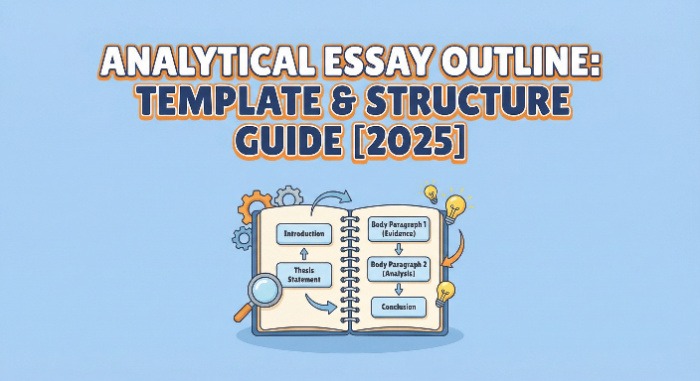
Need a structured framework for organizing your analysis? Check our analytical essay outline; it adapts perfectly to critical analysis.
5. Evidence Evaluation
Learning how to critique effectively means evaluating argument quality, not just summarizing content. Follow this systematic approach:
Step 1: Identify the Central Claim
What is the author's main argument? Look for explicit thesis statements in introduction or conclusion. In editorials or opinion pieces, the central claim may be implied rather than stated directly.
Step 2: Assess Evidence Quality
Evaluate each piece of supporting evidence using these criteria:
- Relevance: Does it directly support the claim?
- Sufficiency: Is there enough evidence, or just one example?
- Credibility: Are sources reliable and appropriately expert?
- Currency: Is evidence recent enough to be valid?
- Accuracy: Can it be verified through other sources?
Red Flags When Evaluating Evidence:
- Vague references ("studies show," "experts say")
- Cherry-picked data ignoring contradictory findings
- Anecdotal evidence presented as proof of patterns
- Outdated statistics for rapidly changing topics
- Sources with clear conflicts of interest
Step 3: Check Logical Reasoning
Identify common fallacies that weaken arguments:
- Hasty Generalization: Broad conclusion from limited evidence
- False Cause: Assuming correlation equals causation
- Ad Hominem: Attacking the person, not the argument
- Strawman: Misrepresenting opposing views
- False Dilemma: Presenting only two options when more exist
Step 4: Evaluate Counterarguments
Strong articles address opposing views fairly. Ask:
- Does the author acknowledge counterarguments?
- Are opposing views represented accurately?
- Does the author refute them with evidence?
- Are counterarguments dismissed without justification?
This systematic approach to critical writing ensures your critical analysis essay evaluates effectiveness rather than just describing content.
Citation Style in Critical Analysis Essays
You'll need to cite:
- Direct quotes from the primary source.
- Paraphrased ideas from the source.
- Secondary sources (if using critical theory).
MLA format is most common for literature:
In-text: (Fitzgerald 20)
Works Cited: Full bibliographic entry
APA format for social sciences:
In-text: (Fitzgerald, 1925, p. 20)
References: Full entry
Check your assignment guidelines for the required format.
Critical Analysis Essay Examples: Three Detailed Samples
1. Topic: The effectiveness of weather symbolism in Ernest Hemingway's "A Farewell to Arms"
Evaluative Thesis: While Hemingway's use of rain as a symbol of death and tragedy in "A Farewell to Arms" effectively establishes mood in the novel's opening chapters, its repetitive deployment throughout the narrative ultimately diminishes emotional impact and reduces what could have been a sophisticated literary device to a predictable pattern.
Sample Body Paragraph - Analyzing Strength:
Hemingway introduces rain symbolism masterfully in the novel's first chapter, where it appears organically within the narrative: "At the start of the winter came the permanent rain and with the rain came the cholera" (4). This connection between rainfall and mortality feels natural rather than contrived, emerging from the wartime setting without drawing undue attention to itself.
The restraint here demonstrates Hemingway's trademark minimalism at its best; the symbol works precisely because it's understated. When Catherine Barkley later confesses, "I'm afraid of the rain because sometimes I see myself dead in it" (126), the symbol has built sufficient weight to carry genuine emotional resonance. The reader has absorbed the rain death connection subconsciously, making Catherine's explicit statement feel like a revelation rather than exposition.
Sample Body Paragraph - Identifying Weakness:
However, Hemingway's continued reliance on rain symbolism becomes problematic as the novel progresses. By the final chapters, every mention of rain signals impending doom so reliably that it strips scenes of tension rather than building it.
When Catherine goes into labor during a rainstorm, the reader already knows the outcome, not because of careful foreshadowing but because Hemingway has trained us to equate precipitation with death. The symbol, used a dozen times, loses power through overuse.
A more skilled approach would have varied the symbolism or allowed rain to occasionally appear without tragic consequence, preserving its impact for crucial moments. Instead, Hemingway's weather becomes a narrative crutch, telling readers how to feel rather than allowing the story's events to generate emotion organically.
What Makes This Critical Analysis Work:
|
2. Topic: Christopher Nolan's use of non-linear narrative in "Memento"
Evaluative Thesis: Christopher Nolan's reverse chronological structure in "Memento" succeeds brilliantly in placing viewers inside Leonard's fragmented mental state, but the film's artistic ambition occasionally prioritizes formal experimentation over emotional accessibility, creating distance where intimacy would strengthen the viewing experience.
Sample Body Paragraph - Analyzing Effectiveness:
The reverse-chronological structure proves remarkably effective in generating viewer empathy for Leonard's condition. By forcing audiences to experience each scene without context, just as Leonard experiences his life, Nolan creates genuine disorientation that mirrors the protagonist's reality.
When Leonard encounters Natalie, viewers share his confusion: Is she trustworthy? An ally? A manipulator? We piece together her motivations backward, discovering her manipulation of Leonard at the same moment we understand why she's angry with him.
This structural choice transforms what could have been a straightforward revenge thriller into an exercise in perspective, making Leonard's disability experiential rather than merely observational. The technique doesn't just tell us about memory loss, it makes us feel it.
Sample Body Paragraph - Identifying Limitations:
Yet this structural complexity comes at a cost. The film's final act, which should deliver maximum emotional impact as we understand the full scope of Leonard's tragedy, instead requires such intense cognitive work that many viewers remain stuck in puzzle-solving mode rather than emotional engagement.
When we discover Leonard's role in his wife's death, the film's devastating revelation, the reverse structure has conditioned us to treat each scene as an intellectual exercise. We're busy tracking timeline logistics ("Wait, this happened before or after the Teddy confrontation?") when we should be devastated by Leonard's self-deception.
Nolan's formal brilliance creates what film theorist David Bordwell calls "art cinema narration," impressive in construction but occasionally cold in effect. A more conventional final sequence might have sacrificed structural purity but gained emotional clarity.
What Makes This Critical Analysis Work:
|
Too Much On Your Plate?
100% Plagiarism-Free Guarantee
- Deadlines piling up
- Research feels overwhelming
- Just want it done right
- Unlimited revisions included
Custom critical analysis essays, delivered on time.
Order Now3. Topic: Evaluating Mitchell's Argument Against Homework
[Annotation: Title clearly indicates this is evaluative, not just explanatory]
In her 2024 article "The Case for Banning Homework," education researcher Dr. Sarah Mitchell argues that elementary schools should eliminate homework entirely, claiming that after school assignments provide no academic benefits while causing family stress and reducing children's play time.
[Annotation: Brief, neutral summary of the text]
While Mitchell effectively uses emotional appeals to resonate with frustrated parents and cites relevant research about young children's learning needs, her argument ultimately fails to persuade because she oversimplifies complex educational research, ignores significant counterarguments, and proposes an impractical solution that many schools could not implement.
[Annotation: Clear evaluative thesis that acknowledges both strengths and weaknesses]
Mitchell's most persuasive moments come when she employs pathos to connect with her parent reader audience. She opens with a vivid anecdote about a six-year-old crying over spelling worksheets at 8 PM, immediately establishing emotional resonance with parents who have witnessed similar scenes.
[Annotation: Identifies a strength]
Throughout the article, she returns to such scenarios: family dinners interrupted by homework battles, weekends consumed by assignments, children too exhausted to play outside. [Annotation: Specific examples from text].
For her intended audience of parents and progressive educators, these emotional appeals work effectively to create initial agreement with her position. However, this same strategy becomes a weakness when addressing skeptical audiences, particularly teachers and administrators who require more than emotional appeals to change long-standing educational practices.
[Annotation: Shows how a strength can also be a limitation depending on the audience]
When Mitchell does employ logos, she selectively cites research that supports her position while ignoring substantial evidence that complicates her argument. She correctly notes that a 2023 study by Cooper and Robinson found no correlation between homework and academic achievement in elementary grades (Mitchell 4), which is her strongest piece of evidence.
[Annotation: Acknowledges effective use of research]
Yet she fails to mention that the same researchers found positive correlations in middle and high school, or that their findings suggest homework's effectiveness depends heavily on design quality rather than existence alone.
[Annotation: Points out omission that weakens argument].
This selective citation pattern appears throughout the article, with Mitchell cherry picking studies that support complete homework elimination while dismissing research suggesting that well-designed homework can build study skills and responsibility. Her argument would be substantially stronger if she acknowledged this complexity and refined her thesis accordingly, perhaps arguing for better homework design rather than complete elimination. Mitchell's proposal to ban all elementary homework represents her argument's most significant weakness.
[Annotation: Clear topic sentence stating evaluative claim]
She provides no practical discussion of implementation challenges, ignores questions about homework's role in developing responsibility and time management, and fails to address what schools should do instead during the hours currently devoted to homework review. When she briefly mentions that "teachers can cover more in class" (Mitchell 7), she offers no evidence that extended class time would produce better outcomes than the current homework plus instruction model.
[Annotation: Specific criticism with evidence]
This lack of practical detail suggests Mitchell has not carefully considered how her proposal would work in real classrooms with real constraints. Effective persuasive writing addresses likely objections and practical concerns; Mitchell's failure to do so significantly undermines her argument's credibility, particularly for readers who must make actual policy decisions.
The article's treatment of counterarguments further weakens its persuasive impact. Mitchell briefly acknowledges that "some educators believe homework teaches responsibility" (Mitchell 6) but then dismisses this concern in a single sentence, claiming children can learn responsibility through chores instead.
[Annotation: Quotes specific dismissal of counterargument]
This cursory treatment of opposing views makes Mitchell appear either unaware of the full debate or unwilling to engage with positions that challenge her own. Readers familiar with educational research will recognize significant counterarguments that Mitchell never addresses: homework's role in communicating with parents about children's learning, the need to practice certain skills beyond school hours, and evidence that homework can be effective when properly designed for the developmental level.
[Annotation: Lists important counterarguments the author ignored]
By failing to engage thoughtfully with these concerns, Mitchell misses opportunities to refine her argument and address legitimate questions her readers will have.
Despite these significant weaknesses, Mitchell deserves credit for raising important questions about homework overload in elementary schools.
[Annotation: Balanced assessment acknowledges value despite critique]
Her central concern that excessive, developmentally inappropriate homework causes stress without educational benefit has merit and aligns with recommendations from organizations like the National Association for the Education of Young Children. If Mitchell had argued for reforming homework practices rather than complete elimination, provided practical implementation guidance, and engaged more thoroughly with counterarguments, her case would be substantially more persuasive. As written, however, the article succeeds in starting a conversation among like-minded parents but fails to persuade skeptical educators or policymakers who might actually implement change.
[Annotation: Conclusion restates evaluation, acknowledges partial success, and explains what would have made the argument more effective]
What Makes This Critical Analysis Work:
|
This example demonstrates critical analysis of a persuasive article, but you'll benefit from seeing critical analysis applied across multiple subjects and text types. Our complete collection of analytical essay examples features critical analyses of literature, scientific research, historical documents, films, and advertisements, each with line by line annotations explaining evaluative techniques.
Critical Analysis Essay Topics: What to Analyze
Strong critical analysis essay topics invite evaluation of effectiveness, technique, and impact. Choose texts with debatable qualities neither universally praised nor completely dismissed.
Critical Analysis Topics For Literature & Poetry
- The effectiveness of unreliable narration in Gillian Flynn's "Gone Girl"
- Symbolism's role in enhancing or obscuring meaning in T.S. Eliot's "The Waste Land"
- Character development versus plot in George R.R. Martin's fantasy series
- The success of epistolary format in Alice Walker's "The Color Purple"
- Metaphor overuse in contemporary young adult dystopian novels
- Perspective shifts' impact on reader empathy in "The Book Thief"
- Dialogue authenticity in Toni Morrison's "Beloved"
Critical Analysis Film & Media Topics
- Non-linear narrative effectiveness in Christopher Nolan's films
- CGI versus practical effects in modern superhero franchises
- Documentary bias in "Super Size Me" or "What the Health"
- The role of soundtrack in enhancing or distracting from "Interstellar"
- Character arc completion in "Game of Thrones" final season
- Cinematography's contribution to storytelling in "1917"
- Satire effectiveness in "Don't Look Up" or "Idiocracy"
Critical Analysis Topics For Speeches & Rhetoric
- Emotional versus logical appeals in Martin Luther King Jr.'s speeches
- Statistical manipulation in political campaign advertisements
- Ethos establishment in presidential inaugural addresses
- Rhetorical devices' effectiveness in TED Talks versus academic lectures
- Persuasive techniques in environmental activism campaigns
- Logical fallacies in social media influencer arguments
Critical Analysis Topics For Articles & Essays
- Evidence quality in Malcolm Gladwell's "Outliers"
- Argumentation strength in Jonathan Swift's "A Modest Proposal"
- Research methodology in psychology popularization articles
- Bias and objectivity in news reporting on controversial topics
- Persuasive effectiveness of opinion editorials on climate policy
Critical Analysis Topics For Art & Design
- Symbolism's accessibility in Frida Kahlo's self-portraits
- Composition effectiveness in propaganda posters
- Color theory application in modern advertising campaigns
- Minimalism versus maximalism in website user experience
- Typography's impact on message reception in social movements
Critical Analysis Topics For Academic & Scientific
- Data presentation clarity in peer-reviewed climate studies
- Methodology limitations in social psychology experiments
- Abstract effectiveness in communicating research findings
- Visual aids' role in enhancing scientific presentations
- Argument structure in philosophy papers on ethics
Choosing Your Critical Analysis Essay Topic:
Consider These Factors:
- Debatable quality: Not universally loved or hated
- Sufficient evidence: Enough text to analyze thoroughly
- Personal interest: You'll write better about topics you care about
- Appropriate scope: Manageable within your word count
- Available resources: Access to the primary source and context
Topic Red Flags to Avoid:
- Texts universally considered masterpieces (too obvious)
- Works you personally dislike (bias will show)
- Topics without sufficient analytical material
- Texts requiring extensive background knowledge unavailable to you
- Subjects where you can't find the primary source
- Critical Analysis Essay Writing Process Timeline
Critical Reading Techniques: Tips for Stronger Analysis
1. Start with a question, not an answer: "Does this symbolism work?" leads to better analysis than deciding "this symbolism is great" before you analyze.
2. Use evaluative language: Words like "effectively," "successfully," "fails to," "undermines," "strengthens," and "convincingly" signal critical analysis.
3. Compare to similar works: "Unlike Hemingway's minimalist approach, Fitzgerald's ornate prose in Gatsby enhances rather than distracts from the narrative."
4. Address counterarguments: "While some critics praise the ambiguous ending, it frustrates the carefully built tension established throughout the novel."
5. Focus on "how well," not just "how": Don't just identify the technique. Judge its effectiveness.
6. Use the present tense for textual analysis: "Orwell uses," not "Orwell used." The text exists in the eternal present.
7. End with significance: Your conclusion should answer: Why does this evaluation matter? What does it reveal about the work, the genre, or the craft?
Still figuring out your angle? Browse our analytical essay topics for critical analysis inspiration across literature, film, and media.
Critical Analysis Writing: Common Pitfalls and Solutions
1. Pitfall: Summarizing Instead of Analyzing
Your professor has read the book. Don't recap the plot.
Solution: Every paragraph should contain judgment, not just description. Ask "So what?" and "How well?" constantly. Replace plot summary with evaluative claims: Instead of "Gatsby throws parties," write "Gatsby's elaborate parties effectively symbolize his desperate attempt to recreate the past, though their excess ultimately undermines his goal by attracting exactly the wrong crowd."
2. Pitfall: Only Praising or Only Criticizing
Real critical analysis acknowledges complexity.
Solution: Find at least one strength in weak works and one limitation in strong works. Use transition phrases like "While X succeeds in..., it falters when..." or "Although X effectively..., the approach limits..." This nuance builds credibility and shows sophisticated thinking rather than bias.
3. Pitfall: Using "I think" or "I feel" Excessively
Your essay IS your opinion. Saying "I think" weakens your authority.
Solution:
- Weak: "I think the metaphor is ineffective."
- Strong: "The metaphor fails because it contradicts the established tone and confuses rather than clarifies the central theme."
Present judgments as reasoned conclusions, not personal preferences.
4. Pitfall: Judging Without Evidence
"This is bad writing" means nothing without proof.
Solution: Every evaluative claim needs textual evidence and reasoning. Organize your response by presenting a claim, followed by evidence (a quotation or specific example), then analysis explaining how the evidence supports the claim, and concluding with an evaluation of effectiveness. Avoid making evaluative statements without clear justification.
5. Pitfall: Imposing Your Values on Different Eras/Cultures
A 1950s text reflects 1950s values. Criticizing by modern standards alone misses the point.
Solution: Acknowledge historical context while still evaluating effectiveness within that framework. Write: "While the gender dynamics reflect 1950s norms, the author's portrayal limits character development even by contemporary standards of the era, as evidenced by..." This shows you understand context without abandoning critical judgment.
Critical Analysis Essay Writing Process Timeline
Here's a realistic timeline for a 1,500-word critical analysis essay:
Total time needed: 8-12 hours
| Phase | Time | Task |
|---|---|---|
| Reading & Annotation | 2-3 hours | Active reading, notes, and highlighting |
| Thesis Development | 1 hour | Formulating an evaluative argument |
| Outline Creation | 1 hour | Organizing points, evidence |
| First Draft | 3-4 hours | Writing without editing |
| Revision | 1-2 hours | Strengthening arguments, transitions |
| Evidence Check | 30 mins | Verifying quotes, citations |
| Final Polish | 30 mins | Proofreading, formatting |
Take breaks between drafting and revising. Fresh eyes catch weaknesses you missed while writing. No time for any of this? Our professional essay writing service delivers custom critical analysis essays written by subject experts. We handle the reading, analysis, and writing.
Free Download: Critical Analysis Checklist
Download our comprehensive critical analysis checklist that guides you through every step:
READY TO HAND IT OFF?
Professional writing assistance tailored to your needs
- Written by subject matter experts
- Properly cited, zero plagiarism
- Delivered on your deadline
- No AI, ever
Unlimited revisions until you're completely satisfied.
Order NowThe Bottom Line
Critical analysis essays require you to judge quality and effectiveness, not just explain techniques. You're evaluating "how well" something works, supporting your judgments with evidence, and acknowledging complexity.
The difference between analytical and critical analysis comes down to stance: analytical explains how something functions, while critical analysis evaluates how well it functions.
Start with active reading, develop an evaluative thesis, balance strengths with limitations, and support every judgment with textual evidence. That's the formula.
If you’re still building foundational skills or want a clearer breakdown of structure and evidence, reviewing an analytical essay guide alongside this resource can help strengthen your critical writing.


-19758.jpg)