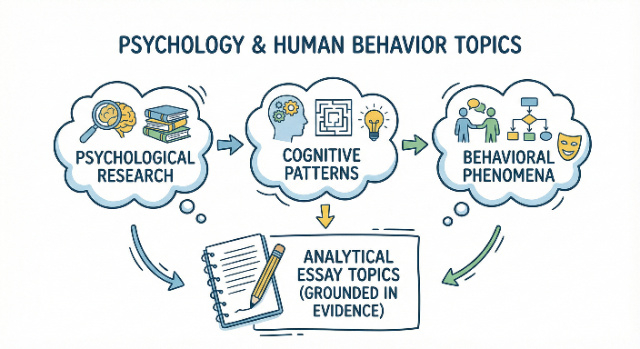
Introduction: Finding Your Perfect Topic
Choosing the right topic makes the difference between an essay you'll enjoy writing and one you'll struggle through. A strong topic gives you enough material to analyze deeply while maintaining your interest through hours of research and drafting.
Understanding what makes a topic analyzable requires grasping the fundamental distinction between analysis and summary—a concept covered comprehensively in our analytical essay writing guide that teaches the 'So What?' technique for transforming observations into genuine insights.
This guide provides 150+ analytical essay topics organized by subject, grade level, and difficulty. You'll find topics for literature, film, history, science, and more. Each category includes difficulty ratings so you can choose appropriately challenging topics for your level.
What This Guide Offers:
You'll discover topics across all major academic subjects with clear difficulty ratings from easy to advanced. Sample thesis statements show you how to turn topics into analytical claims. Research starting points tell you where to find sources for each subject area. Interactive tools help you evaluate whether your topic idea will work. Topic development worksheets guide you from a broad interest to a specific focus.
Most importantly, you'll learn the difference between topics that work and topics that don't, saving you from choosing something too broad, too simple, or impossible to research.
For comprehensive context about all analytical essay types—from literary analysis to process analysis to rhetorical analysis—and when to use each approach, consult our complete analytical essay guide before diving into specific topic selection.
How to Use This Topic Collection:
Browse categories matching your assignment subject. Start with your grade level to find appropriately challenging topics. Use difficulty ratings to match topics to your skill level and available time. Read sample thesis statements to see how topics become arguments. Apply evaluation criteria to topics you're considering.
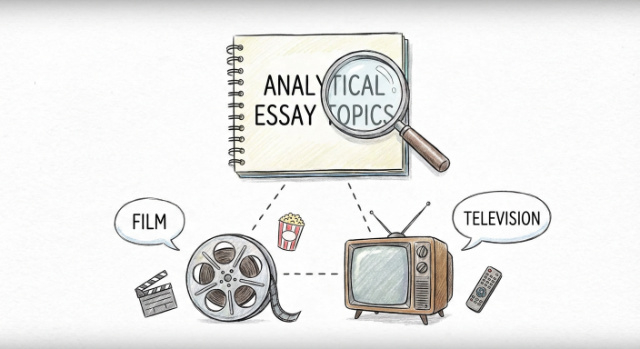
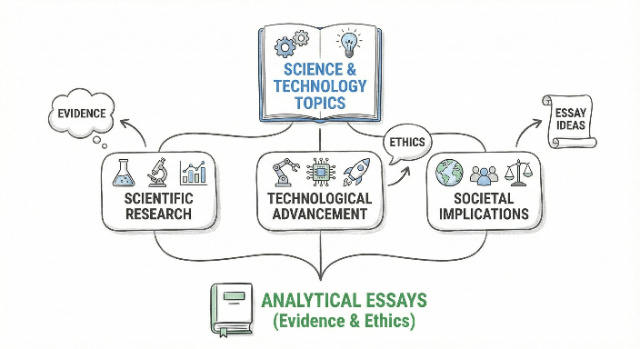
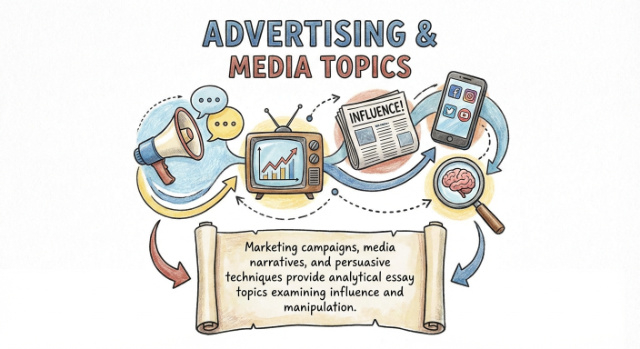
If you're writing about literature, start with the Literature & English section. For analysis of speeches or advertisements, check Rhetoric & Media. History students should explore the Historical Events and Social Issues categories. Science students will find topics in the Sciences & Technology section.
For detailed guidance on turning your chosen topic into a complete analytical essay, follow our comprehensive step-by-step analytical essay writing guide that walks you through the entire seven-step process from thesis development through final revision, including evidence collection strategies and the three-pass revision system.
How to Choose Your Analytical Essay Topic
The Topic Selection Process
Successful topic selection follows a systematic process rather than picking randomly from a list. Spend fifteen to thirty minutes on this process before committing to avoid choosing something that won't work.
Step 1: Brainstorm Broadly (5 minutes)
Write down everything that interests you without filtering. Include books you've enjoyed, films that intrigued you, historical events you find fascinating, issues you care about, and questions you have about your coursework. Don't evaluate yet—just capture possibilities.
Consider what you've studied recently that raised questions. Think about texts where you disagreed with common interpretations. Remember assignments where you wanted to explore something more deeply but ran out of space.
Step 2: Apply Assignment Constraints (5 minutes)
Review your assignment requirements carefully. Note page length or word count limits. Check if specific types of sources are required. Verify whether you need scholarly sources or can use primary sources only. Confirm your deadline to ensure adequate research time.
Note any subject restrictions or requirements. Some assignments specify historical periods, literary movements, or thematic focuses. Eliminate topics that don't fit these parameters before investing more time.
Step 3: Run the STAR Test (10 minutes)
Apply these four criteria to the remaining topic ideas:
S - Specific: Can you narrow it to one focused aspect? Broad topics stay superficial. "Shakespeare" is too broad. "Poison imagery in Hamlet" is specific enough for deep analysis.
T - Testable: Can you find evidence to support the analysis? Check quickly whether sources exist. Search your library database. Verify you can access the primary text. Ensure scholarly sources are available if required.
A - Analyzable: Is there depth to explore beyond obvious facts? Can you ask HOW and WHY questions? Does the topic allow interpretation rather than just summary? Will you examine meaning, not just report information?
R - Reasonable: Can you handle it within your page limit and deadline? A five-page paper can't cover "all themes in War and Peace." Match scope to length. Consider the research time available.

Step 4: Interest Test (5 minutes)
Ask yourself honestly: Can I spend ten or more hours thinking about this topic? Do I have questions I want to answer through analysis? Will this teach me something valuable? Does it connect to my broader interests?
If you feel excited about exploring the topic, that enthusiasm will sustain you through challenging research and revision. If a topic seems boring now, it will feel unbearable after hours of work.
Step 5: Research Viability Check (5 minutes)
Before fully committing, do a quick source check. Search your library's database for the topic. Verify that scholarly articles exist if you need them. Confirm you can access primary materials. Check that sources are recent enough if currency matters.
Once you've identified a promising topic using the STAR test, seeing how that topic translates into actual essays helps validate your choice. Browse our collection of complete analytical essay examples with annotations showing how successful students transformed similar topics into A-grade work, from thesis construction through evidence integration.
You Deserve Better Than a C
Get the Essay — and the Grade — You Actually Want
No AI. No templates. Just essays that get results
Literature & English Topics
Poetry Analysis Topics
EASY (High School 9-10):
"Imagery in Robert Frost's 'The Road Not Taken'"
Difficulty: Easy | Word Count: 800-1,000 | Sources Needed: 3-5
Analyze how Frost uses natural imagery to explore choice and consequence. Examine the roads, woods, and paths as symbols. Consider whether the poem celebrates individuality or satirizes how we create false narratives about our choices.
Sample Thesis: "While commonly read as celebrating individuality, Frost's 'The Road Not Taken' actually satirizes our tendency to create false narratives of significance around arbitrary choices, as evidenced by the speaker's admission that the paths were 'really about the same.'"
Research Starting Point: Search your library database for "Robert Frost Road Not Taken analysis" or check poetry interpretation databases. Start with Frost's letters about the poem's meaning.
"Symbolism in Edgar Allan Poe's 'The Raven'"
Difficulty: Easy | Word Count: 800-1,000 | Sources Needed: 3-5
Want to see how professional writers analyze poetry with this level of depth? Our annotated poetry analysis examples demonstrate exactly how to move from identifying symbols to interpreting their significance, with line-by-line explanations of effective analytical techniques.
Examine how Poe uses the raven as a symbol throughout the poem. Analyze what the bird represents at different points. Consider how the repetition of "Nevermore" creates meaning. Explore the relationship between the raven and the speaker's grief.
"Theme of Death in Emily Dickinson's Poetry"
Difficulty: Easy | Word Count: 1,000-1,200 | Sources Needed: 5-7
Compare how Dickinson treats death across three to four poems. Examine whether she personifies death similarly or differently. Analyze her use of metaphor to describe dying. Consider what her poems reveal about 19th-century attitudes toward mortality.
Deadlines Don't Wait. Neither Do We
Get a Custom Essay in as Little as 3 Hours
100% human-written. On-time delivery guaranteed
MEDIUM (High School 11-12 / College Freshman):
"Tone Evolution in T.S. Eliot's 'The Love Song of J. Alfred Prufrock'"
Difficulty: Medium | Word Count: 1,200-1,500 | Sources Needed: 7-10
Trace how Eliot's tone shifts throughout the poem from questioning to resignation. Analyze specific passages where tone changes. Examine how enjambment and punctuation contribute to tonal shifts. Consider what these shifts reveal about the speaker's psychological state.
Sample Thesis: "Eliot's 'Prufrock' demonstrates modernist alienation through systematic tonal devolution from anxious questioning in the opening stanzas to defeated resignation in the conclusion, with each shift marked by changing metaphorical language that moves from possibility to paralysis."
"Function of Repetition in Sylvia Plath's 'Daddy'"
Difficulty: Medium | Word Count: 1,200-1,500 | Sources Needed: 7-10
Analyze how Plath uses repetition of sounds, words, and phrases. Examine the repeated "oo" sounds throughout. Consider how repetition creates psychological effects. Explore whether repetition suggests trauma, rage, or both.
"Modernist Techniques in Ezra Pound's Imagist Poetry"
Difficulty: Medium | Word Count: 1,500-1,800 | Sources Needed: 8-12
Examine how Pound implements imagist principles in specific poems. Analyze his "direct treatment of the thing" and economy of language. Compare his work to traditional poetry to show innovation. Consider how imagism influenced 20th-century poetry.
HARD (College Junior/Senior / Graduate):
"Intertextuality Between Classical Mythology and H.D.'s Imagist Poetry"
Difficulty: Hard | Word Count: 2,000-2,500 | Sources Needed: 12-15
Analyze how H.D. rewrites classical myths through the imagist technique. Examine specific mythological references and their transformations. Consider feminist implications of her mythological revisions. Explore how imagist brevity changes mythological narratives.
"Postcolonial Resistance in Caribbean Poetry"
Difficulty: Hard | Word Count: 2,000-2,500 | Sources Needed: 12-15
Apply postcolonial theory to analyze how Caribbean poets resist colonial discourse. Examine language choices, particularly creole versus standard English. Analyze how form challenges colonial literary traditions. Consider the nation-building functions of poetry.
"Form and Meaning Relationship in Experimental Poetry"
Difficulty: Hard | Word Count: 2,000-3,000 | Sources Needed: 15-20
Examine how experimental poets use visual arrangement, unconventional syntax, and fragmentation to create meaning. Analyze specific formal innovations. Consider whether form creates meaning or obscures it. Explore theoretical frameworks for reading experimental work.
Novel Analysis Topics
EASY (High School 9-10):
"Symbolism of the Conch in Lord of the Flies"
Difficulty: Easy | Word Count: 800-1,000 | Sources Needed: 3-5
Analyze how Golding uses the conch shell as a symbol throughout the novel. Trace its significance from discovery to destruction. Examine what the conch represents about civilization and authority. Consider how its fate mirrors the boys' descent into savagery.
"Character Development in To Kill a Mockingbird"
Difficulty: Easy | Word Count: 800-1,000 | Sources Needed: 3-5
Examine how Scout matures from childhood innocence to moral awareness. Analyze specific moments that trigger her development. Consider what she learns from Atticus, Calpurnia, and Boo Radley. Explore how her growth relates to the novel's themes about prejudice and justice.
"Themes of Power and Corruption in Animal Farm"
Difficulty: Easy | Word Count: 1,000-1,200 | Sources Needed: 5-7
Analyze how Orwell shows power corrupting the pigs' idealism. Trace specific moments when revolutionary principles are abandoned. Examine propaganda techniques used to maintain control. Consider what the novel reveals about political revolutions generally.
MEDIUM (High School 11-12 / College):
"Narrative Structure in Toni Morrison's Beloved"
Difficulty: Medium | Word Count: 1,500-2,000 | Sources Needed: 8-10
Analyze Morrison's non-linear narrative structure. Examine how fragmented chronology mirrors trauma. Consider why certain events are revealed gradually rather than chronologically. Explore how structure itself becomes meaningful rather than just containing meaning.
Sample Thesis: "Morrison's fragmented narrative structure in Beloved doesn't just represent trauma but enacts it, forcing readers to experience the disorientation and recursive patterns that characterize post-traumatic memory, making form inseparable from content."
That Essay Won't Write Itself
But Our Writers Will Write It For You
No AI shortcuts. Real writers. Real results.
"Colonial Discourse in Joseph Conrad's Heart of Darkness"
Difficulty: Medium | Word Count: 1,500-2,000 | Sources Needed: 8-12
Note the distinction: analyzing colonial discourse interprets how Conrad represents colonialism, while critically evaluating whether the novel successfully critiques or inadvertently reinforces racism requires judgment criteria. If your assignment asks you to evaluate effectiveness or judge quality rather than just interpret meaning, you'll need critical analysis approaches rather than standard analytical techniques.
Examine how Conrad represents Africa and Africans. Analyze whether the novel critiques colonialism or participates in racist discourse. Consider Marlow as an unreliable narrator. Explore critical debates about whether the novel is anti-colonial or colonial in its assumptions.
"Unreliable Narration in The Catcher in the Rye"
Difficulty: Medium | Word Count: 1,200-1,500 | Sources Needed: 7-10
Analyze how Holden's narration reveals more than he intends. Identify moments where his account seems unreliable. Examine what he misses or misinterprets. Consider what unreliability reveals about his psychological state and adolescent perspective.
HARD (College Upper Level):
"Metalepsis in Postmodern Fiction"
Difficulty: Hard | Word Count: 2,500-3,000 | Sources Needed: 15-20
Analyze boundary-crossing between narrative levels in postmodern novels. Examine how authors violate narrative frames. Consider theoretical implications of metaleptic moments. Explore what metalepsis reveals about fiction's relationship to reality.
"Phenomenology of Consciousness in Stream-of-Consciousness Novels"
Difficulty: Hard | Word Count: 2,500-3,000 | Sources Needed: 15-20
Apply phenomenological philosophy to analyze how stream-of-consciousness technique represents consciousness. Examine specific passages modeling thought processes. Consider whether technique accurately represents mental experience. Explore theoretical debates about consciousness representation in literature.
"Capitalism and Marriage Plots in 19th-Century Novels"
Difficulty: Hard | Word Count: 2,500-3,000 | Sources Needed: 15-20
Analyze how 19th-century marriage plots reflect economic relationships. Examine how courtship functions as economic negotiation. Consider what marriages reveal about property, class, and gender. Explore how narrative form itself is shaped by capitalist ideology.
Film & Media Topics
EASY (High School 9-12):
"Symbolism in The Shawshank Redemption"
Difficulty: Easy | Word Count: 1,000-1,200 | Sources Needed: 5-7
Analyze symbolic elements throughout the film, including the poster, the rock hammer, and the birds. Examine what each symbol represents about freedom versus imprisonment. Consider how symbolism develops across the film's timeline.
"Character Arcs in The Breakfast Club"
Difficulty: Easy | Word Count: 1,000-1,200 | Sources Needed: 5-7
Wondering how to analyze character development in film effectively? Review our complete film analysis examples that demonstrate how to trace character arcs, support claims with specific scenes, and interpret changes rather than just describing them.
Trace how each character changes during detention. Analyze what causes their transformations. Examine whether changes seem realistic or idealized. Consider what the film suggests about identity and social roles.
"Exploring Identity in Get Out"
Difficulty: Easy | Word Count: 1,200-1,500 | Sources Needed: 7-10
Analyze how Peele explores racial identity through horror conventions. Examine the Sunken Place as a metaphor. Consider what the film reveals about microaggressions and liberal racism. Explore how genre expectations are subverted for social commentary.
MEDIUM (College):
"Cinematography Techniques in Blade Runner 2049"
Difficulty: Medium | Word Count: 1,500-2,000 | Sources Needed: 8-12
Analyze Roger Deakins' cinematography choices. Examine the use of color, particularly orange and blue palettes. Consider how wide shots create isolation. Explore how visual composition reinforces themes about humanity and connection.
Sample Thesis: "Blade Runner 2049's systematic use of wide-angle shots emphasizing character isolation within vast architectural spaces visualizes the film's exploration of posthuman loneliness, suggesting consciousness is defined by solitude rather than connection."
Research Starting Point: Search film studies databases for "Blade Runner 2049 cinematography" or "Roger Deakins visual composition." Check American Cinematographer magazine articles.
"Narrative Structure in Pulp Fiction"
Difficulty: Medium | Word Count: 1,500-2,000 | Sources Needed: 8-12
Analyze Tarantino's non-linear narrative. Examine how story order affects meaning. Consider what viewers gain or lose through fragmented chronology. Explore whether structure serves thematic purposes or displays technical virtuosity.
"The Male Gaze in Classic Hollywood Cinema"
Difficulty: Medium | Word Count: 1,500-2,000 | Sources Needed: 10-15
Apply Laura Mulvey's theory to analyze how classical Hollywood films position women as objects of male viewing pleasure. Examine camera angles, editing patterns, and narrative structure. Consider specific films demonstrating or challenging the male gaze.
HARD (College Upper Level):
"Brechtian Alienation Techniques in Contemporary Film"
Difficulty: Hard | Word Count: 2,000-2,500 | Sources Needed: 12-15
Analyze how contemporary filmmakers use Brechtian distancing effects. Examine specific techniques breaking the fourth wall or disrupting realism. Consider whether alienation achieves Brecht's political goals in the film context. Explore theoretical debates about alienation versus immersion.
"CGI and Photorealism in Modern Cinema"
Difficulty: Hard | Word Count: 2,000-2,500 | Sources Needed: 12-15
Examine the relationship between CGI technology and cinematic realism. Analyze whether photorealistic CGI enhances or undermines the film's reality effect. Consider philosophical questions about authenticity and simulation. Explore how audiences perceive increasingly seamless digital effects.
"Transmedia Storytelling in the Marvel Cinematic Universe"
Difficulty: Hard | Word Count: 2,500-3,000 | Sources Needed: 15-20
Analyze how the MCU creates narrative across multiple films and platforms. Examine how individual films function both independently and as franchise components. Consider implications for authorship, narrative closure, and audience engagement. Explore economic and creative tensions in transmedia franchises.

History & Social Sciences Topics
Historical Events Analysis
EASY (High School):
"Causes of the American Civil War"
Difficulty: Easy | Word Count: 1,000-1,200 | Sources Needed: 5-7
Analyze multiple causes, including slavery, states' rights debates, and economic differences. Examine which factors were most significant. Consider how causes are interconnected. Explore whether war was inevitable or could have been avoided.
"Effects of the Industrial Revolution on Family Structure"
Difficulty: Easy | Word Count: 1,000-1,200 | Sources Needed: 5-7
Examine how industrialization changed family roles and dynamics. Analyze the shift from agrarian to urban family structures. Consider the effects on women's work and children's roles. Explore the social consequences of factory labor.
"Factors Leading to World War I"
Difficulty: Easy | Word Count: 1,200-1,500 | Sources Needed: 7-10
Analyze alliances, militarism, imperialism, and nationalism as contributing factors. Examine immediate versus underlying causes. Consider whether specific events triggered inevitable conflict. Explore how factors are interconnected to create war conditions.
MEDIUM (High School 11-12 / College):
"Propaganda Techniques in World War II"
Difficulty: Medium | Word Count: 1,500-2,000 | Sources Needed: 10-12
Analyze propaganda posters, films, and radio from multiple nations. Examine common persuasive techniques used. Consider how propaganda shaped public opinion. Compare different nations' approaches. Explore ethical questions about government manipulation of information during wartime.
"Economic Factors in the French Revolution"
Difficulty: Medium | Word Count: 1,500-2,000 | Sources Needed: 10-12
Examine fiscal crisis, taxation inequality, and food shortages as revolutionary causes. Analyze how economic problems intersect with political grievances. Consider whether revolution could have been prevented through economic reform. Explore relationships between economic and ideological causes.
Sample Thesis: "The French Revolution resulted from the volatile interaction of fiscal bankruptcy undermining state authority, agrarian failure radicalizing peasants, and Enlightenment ideology providing revolutionary language—each necessary but insufficient alone to spark revolution."
"Technology and Warfare Evolution"
Difficulty: Medium | Word Count: 1,500-2,000 | Sources Needed: 10-12
Analyze how technological innovations changed military strategy and tactics. Examine specific technologies like machine guns, tanks, or aircraft. Consider the social and political consequences of military technology. Explore whether technology drives strategy or vice versa.
HARD (College Upper Level):
"Historiographical Debates About Cold War Origins"
Difficulty: Hard | Word Count: 2,500-3,000 | Sources Needed: 15-20
Analyze how historians' interpretations of Cold War origins have changed over time. Examine orthodox, revisionist, and post-revisionist schools. Consider how access to new sources changed interpretations. Explore how contemporary politics influences historical interpretation.
"Role of Contingency in Historical Turning Points"
Difficulty: Hard | Word Count: 2,500-3,000 | Sources Needed: 15-20
Examine specific historical moments where different decisions could have changed outcomes. Analyze tension between determinism and contingency in historical explanation. Consider methodological questions about counterfactual analysis. Explore theoretical debates about structure versus agency.
"Counterfactual Analysis in Historical Interpretation"
Difficulty: Hard | Word Count: 2,500-3,000 | Sources Needed: 15-20
Analyze the role of "what if" questions in historical understanding. Examine specific counterfactual scenarios and their plausibility. Consider methodological critiques of counterfactual reasoning. Explore what counterfactuals reveal about historical causation and inevitability.
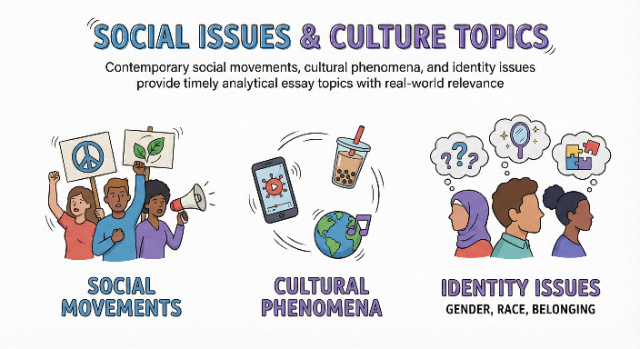
Social Issues Analysis
EASY (High School):
"Social Media Effects on Communication"
Difficulty: Easy | Word Count: 1,000-1,200 | Sources Needed: 7-10
Analyze how platforms like Instagram and TikTok change how people communicate. Examine both positive and negative effects. Consider differences across age groups. Explore whether social media enhances or diminishes genuine connection.
"Causes of Income Inequality"
Difficulty: Easy | Word Count: 1,000-1,200 | Sources Needed: 7-10
Examine economic factors contributing to wealth gaps. Analyze education, automation, and globalization as causes. Consider policy solutions proposed by different perspectives. Explore the social consequences of increasing inequality.
"Climate Change Denial: Psychological and Political Factors"
Difficulty: Easy | Word Count: 1,200-1,500 | Sources Needed: 8-12
Analyze why people reject scientific consensus on climate change. Examine psychological factors like motivated reasoning. Consider political and economic interests. Explore how identity and worldview shape beliefs about scientific evidence.
MEDIUM (College):
"Education and Social Mobility Relationship"
Difficulty: Medium | Word Count: 1,500-2,000 | Sources Needed: 12-15
Analyze whether education effectively promotes social mobility. Examine barriers to educational access. Consider how education reproduces rather than challenges class structures. Explore whether educational reform can address inequality or whether broader economic change is needed.
"Structural Factors in Systemic Racism"
Difficulty: Medium | Word Count: 1,500-2,000 | Sources Needed: 12-15
Examine how racism operates through institutions rather than just individual prejudice. Analyze specific systems like criminal justice, housing, or education. Consider how policies with neutral language create racial disparities. Explore solutions addressing structural rather than just attitudinal racism.
"Sociology of Conspiracy Theories"
Difficulty: Medium | Word Count: 1,500-2,000 | Sources Needed: 12-15
Analyze social and psychological factors that make conspiracy theories appealing. Examine how social media accelerates conspiracy spread. Consider what conspiracy thinking reveals about trust in institutions. Explore whether conspiracy theories serve psychological or social functions.
HARD (College Upper Level):
"Bourdieu's Cultural Capital in Contemporary Society"
Difficulty: Hard | Word Count: 2,500-3,000 | Sources Needed: 15-20
Apply Bourdieu's theory of cultural capital to analyze how class reproduces itself through cultural rather than just economic means. Examine specific examples of cultural capital functioning in education, the workplace, or social settings. Consider whether the theory requires updating for contemporary digital culture.
"Intersectionality in Feminist Movements"
Difficulty: Hard | Word Count: 2,500-3,000 | Sources Needed: 15-20
Analyze how race, class, gender, and sexuality intersect to shape experience and oppression. Examine tensions within feminist movements over inclusion and priorities. Consider how intersectional analysis changes political strategies. Explore theoretical debates about identity and solidarity.
"Neoliberalism's Impact on Democratic Institutions"
Difficulty: Hard | Word Count: 2,500-3,000 | Sources Needed: 15-20
Analyze how neoliberal economic policies affect democratic participation and governance. Examine privatization, deregulation, and market logics' effects on public goods. Consider whether neoliberalism and democracy are compatible or contradictory. Explore theoretical debates about the relationship between capitalism and democracy.
That Essay Won't Write Itself
But Our Writers Will Write It For You
No AI shortcuts. Real writers. Real results.
Sciences & Technology Topics
EASY (High School):
"Process of Photosynthesis"
Difficulty: Easy | Word Count: 800-1,000 | Sources Needed: 5-7
Analyze how plants convert light energy to chemical energy. Examine each stage of the process. Explain how stages connect and depend on each other. Consider what would happen if specific steps failed.
"Effects of Pollution on Ecosystems"
Difficulty: Easy | Word Count: 1,000-1,200 | Sources Needed: 7-10
Examine how different types of pollution affect ecosystem health. Analyze specific examples of polluted environments. Consider both short-term and long-term effects. Explore whether ecosystem recovery is possible after pollution ends.
"Scientific Method in Experimental Design"
Difficulty: Easy | Word Count: 1,000-1,200 | Sources Needed: 5-7
Analyze how the scientific method ensures reliable results. Examine each step from hypothesis through conclusion. Consider why controls and replication matter. Explore what makes experiments valid and reliable.
MEDIUM (High School 11-12 / College):
"Ethical Implications of CRISPR Gene Editing"
Difficulty: Medium | Word Count: 1,500-2,000 | Sources Needed: 10-12
Analyze ethical questions raised by gene editing technology. Examine potential benefits and risks. Consider who should decide about genetic modifications. Explore differences between therapeutic and enhancement editing.
Research Starting Point: Search science databases for "CRISPR ethics" or bioethics journals. Check Nature and Science magazines for articles on gene editing policy.
"Gut Microbiome and Mental Health Relationship"
Difficulty: Medium | Word Count: 1,500-2,000 | Sources Needed: 10-12
Examine research on gut bacteria's effects on mood and cognition. Analyze proposed mechanisms connecting the gut and the brain. Consider what evidence supports and challenges the gut-brain axis theory. Explore implications for mental health treatment.
"Vaccine Effectiveness Mechanisms"
Difficulty: Medium | Word Count: 1,500-2,000 | Sources Needed: 10-12
Analyze how vaccines produce immunity. Examine different vaccine types and their mechanisms. Consider why some vaccines require boosters while others provide lasting immunity. Explore what makes vaccines effective against specific diseases.
HARD (College Upper Level):
"Paradigm Shifts in Scientific Revolutions"
Difficulty: Hard | Word Count: 2,500-3,000 | Sources Needed: 15-20
Apply Thomas Kuhn's theory to analyze specific scientific revolutions. Examine how paradigm shifts occur. Consider whether science progresses linearly or through revolutionary breaks. Explore philosophical questions about scientific truth and change.
"Research Funding Sources and Bias"
Difficulty: Hard | Word Count: 2,500-3,000 | Sources Needed: 15-20
Analyze how funding sources influence research questions and conclusions. Examine specific cases where financial interests may have shaped results. Consider structural factors creating bias beyond individual corruption. Explore solutions ensuring scientific integrity while maintaining funding.
"Quantum Mechanics and Determinism"
Difficulty: Hard | Word Count: 2,500-3,000 | Sources Needed: 15-20
Examine how quantum mechanics challenges deterministic physics. Analyze the philosophical implications of uncertainty and observation effects. Consider different interpretations of quantum mechanics. Explore what quantum physics reveals about reality's fundamental nature.
Business & Economics Topics
EASY (High School):
"Supply and Demand Factors"
Difficulty: Easy | Word Count: 1,000-1,200 | Sources Needed: 5-7
Analyze factors affecting supply and demand for specific products. Examine how price changes affect quantity demanded and supplied. Consider real-world examples of supply and demand shifts. Explore market equilibrium concepts.
"Minimum Wage Increase Effects"
Difficulty: Easy | Word Count: 1,000-1,200 | Sources Needed: 7-10
Examine arguments for and against minimum wage increases. Analyze evidence about employment effects. Consider impacts on different types of businesses and workers. Explore whether minimum wage achieves anti-poverty goals.
"2008 Financial Crisis Causes"
Difficulty: Easy | Word Count: 1,200-1,500 | Sources Needed: 8-10
Analyze factors leading to the financial crisis including subprime mortgages, deregulation, and credit default swaps. Examine how problems in housing markets spread throughout the economy. Consider whether crisis was preventable and what regulations might prevent future crises.
MEDIUM (College):
"Amazon's Retail Market Disruption"
Difficulty: Medium | Word Count: 1,500-2,000 | Sources Needed: 10-12
Analyze how Amazon changed retail business models. Examine specific innovations like recommendation algorithms and two-day shipping. Consider effects on traditional retailers and employment. Explore whether Amazon's market dominance raises antitrust concerns.
"Gig Economy Impact on Labor Relations"
Difficulty: Medium | Word Count: 1,500-2,000 | Sources Needed: 10-12
Examine how platforms like Uber and TaskRabbit change employment relationships. Analyze whether gig work increases flexibility or precarity. Consider regulatory questions about worker classification. Explore what the gig economy reveals about the changing nature of work.
"Cryptocurrency Challenge to Traditional Banking"
Difficulty: Medium | Word Count: 1,500-2,000 | Sources Needed: 10-12
Analyze how blockchain technology could disrupt financial systems. Examine specific cryptocurrencies and their mechanisms. Consider whether crypto can function as currency or remains a speculative asset. Explore regulatory challenges and responses.
HARD (College Upper Level):
"Behavioral Economics in Consumer Decision-Making"
Difficulty: Hard | Word Count: 2,500-3,000 | Sources Needed: 15-20
Analyze how cognitive biases affect economic choices. Examine specific behavioral economics concepts like loss aversion and anchoring. Consider policy implications of behavioral insights. Explore tensions between behavioral economics and traditional rational choice models.
"Market Failures in Healthcare Systems"
Difficulty: Hard | Word Count: 2,500-3,000 | Sources Needed: 15-20
Examine why healthcare markets don't function like typical markets. Analyze specific market failures like information asymmetry and moral hazard. Consider different healthcare system models internationally. Explore whether market-based or government-run systems better address healthcare's unique economic characteristics.
"Globalization and Inequality Relationship"
Difficulty: Hard | Word Count: 2,500-3,000 | Sources Needed: 15-20
Analyze how global trade affects income distribution within and between nations. Examine evidence about whether globalization increases or decreases inequality. Consider how measurement challenges affect conclusions. Explore policy responses to globalization's distributional effects.
Still Struggling With That Essay?
Submit With Total Confidence
No AI ever. Just real academics who know what graders want
Topic Development Worksheets
From Interest to Topic
Transform broad interests into focused analytical topics using this systematic process.
Step 1: Identify Your Interest Area
What general subject interests you? Write it down without worrying about specificity yet.
Example: "I'm interested in social media."
Step 2: Narrow to a Specific Aspect
What specific aspect of that broad subject intrigues you most?
Example: "How social media affects teenagers specifically"
Step 3: Formulate a Question
What specific question do you want to answer about this aspect?
Example: "How does Instagram's algorithm affect teen mental health?"
Step 4: Make It More Specific
Can you narrow this further to something analyzable in your page limit?
Example: Instead of "all effects," focus on "how the algorithm specifically amplifies anxiety through social comparison."
Step 5: Final Refined Topic
Your topic should now be specific, focused, and analyzable.
Final Topic: "How Instagram's Algorithm Amplifies Teen Anxiety Through Social Comparison Mechanisms"
Step 6: Run STAR Test
Check your refined topic:
- Specific enough for deep analysis?
- Testable with available evidence?
- Analyzable (goes beyond factual)?
- Reasonable for page limit?
If yes to all four, proceed. If no to any, revise before continuing.
Topic to Thesis
Transform your topic into an analytical thesis statement.
Your Topic: [Write your refined topic here]
What Interests You About It: [Explain what you find compelling]
Your Initial Claim: [What do you think your analysis will reveal?]
Evidence You Can Use:
1. [First piece of evidence]
2. [Second piece of evidence]
3. [Third piece of evidence]
What This Evidence Reveals: [Significance of your evidence]
Your Refined Thesis: [Combine topic + analytical verb + interpretation + significance]
For detailed guidance on developing strong analytical thesis statements, follow our comprehensive analytical essay writing guide, which provides the thesis formula, evolution process showing how to refine weak theses into strong ones, and the self-evaluation test ensuring your thesis passes all criteria before you begin drafting.
Sample Thesis Statements
Seeing how topics become thesis statements helps you develop your own analytical claims.
1. Literature Example: Romeo and Juliet
Weak Thesis:
"Romeo and Juliet is about love and death."
Problem: Too obvious. Everyone knows this. No analytical claim.
Better Thesis:
"Shakespeare's Romeo and Juliet explores how passion can be destructive."
Problem: Better, but still generic. What about passion is destructive? How does Shakespeare show this?
Strong Thesis:
"Through systematic use of light imagery associated with violence, Shakespeare's Romeo and Juliet suggests that intense passion, while beautiful, inevitably leads to destruction, making the lovers' brightness the very thing that dooms them."
Why it works:
- Specific technique identified (light imagery).
- Clear interpretation (passion causes destruction).
- Explains the mechanism (brightness = doom).
- Indicates significance (inevitability of destruction).
2. Film Example: The Matrix
Weak Thesis:
"The Matrix is about reality versus illusion."
Problem: Surface observation. No analysis.
Better Thesis:
"The Matrix uses visual effects to explore philosophical questions about reality."
Problem: Still vague. What philosophical questions? How do visual effects explore them?
Strong Thesis:
"The Matrix employs a green-tinted color palette in the Matrix world versus a blue-tinged real world to visualize Baudrillard's concept of hyperreality, suggesting simulated experience has become more 'real' than physical existence in contemporary technological society."
Why it works:
- Specific visual technique (color palette).
- Theoretical framework (Baudrillard).
- Clear interpretation (simulation exceeds reality).
- Contemporary relevance (technological society).
Your GPA Doesn't Have to Suffer
Expert Writers. Original Essays. Guaranteed Results
Trusted by 50,000+ students. Zero AI. Zero plagiarism.
3. History Example: French Revolution
Weak Thesis:
"The French Revolution had many causes."
Problem: Factual statement. No analysis.
Better Thesis:
"Economic problems, political corruption, and Enlightenment ideas caused the French Revolution."
Problem: List without interpretation. How did these interact?
Strong Thesis:
"The French Revolution resulted from the volatile interaction of fiscal bankruptcy undermining state authority, agrarian failure radicalizing peasants, and Enlightenment ideology providing revolutionary language—each necessary but insufficient alone to spark revolution."
Why it works:
- Multiple causes identified.
- Explains their interaction.
- Analytical claim about necessity and sufficiency.
- Goes beyond simple listing to interpret relationships.
These thesis examples show the transformation from weak to strong, but seeing complete essays built around strong theses demonstrates how thesis statements function throughout entire papers. Explore our collection of annotated analytical essays to see how successful thesis statements guide entire arguments from introduction through conclusion.
Common Topic Mistakes
Mistake #1: Too Broad
- Weak: "Social Media"
- Problem: Covers too much territory for focused analysis
- Strong: "How Instagram's Algorithm Amplifies Teen Anxiety"
- Why it works: Specific platform, clear mechanism, focused effect
Mistake #2: Not Analyzable
- Weak: "My Favorite Book"
- Problem: Based on preference without an analytical framework
- Strong: "Symbolism of Eyes in The Great Gatsby"
- Why it works: Specific technique to examine, requires interpretation
Mistake #3: No Depth
- Weak: "Plot Summary of Hamlet"
- Problem: Summary, not analysis
- Strong: "Function of Hamlet's Delay in Shakespeare's Tragedy"
- Why it works: Examines technique and its purpose, requires interpretation
Mistake #4: Outdated
- Weak: "MySpace's Impact on Social Media"
- Problem: Historical platform with limited current relevance
- Strong: "TikTok's Algorithm and Attention Span Changes"
- Why it works: Current platform, relevant contemporary issue
Mistake #5: Too Obscure
- Weak: Topic with no available sources
- Problem: Can't research effectively
- Strong: Topic with scholarly conversation you can engage with
- Why it works: Sources exist, you can join ongoing analysis
Mistake #6: Wrong Assignment Type
- Weak: Argumentative topic for analytical assignment
- Problem: Different essay types require different approaches
- Strong: Interpretive/analytical topic asking HOW or WHY
- Why it works: Matches assignment requirements for analysis
Avoiding these mistakes from the start requires understanding the fundamental analytical process. Learn the seven-step systematic approach for analytical essays that ensures you choose analyzable topics, develop strong theses, and avoid summary-heavy drafts that earn C grades instead of A grades.
Next Steps: Turn Your Topic Into an Essay
You've found your topic—now transform it into a complete analytical essay.
Immediate Actions
- Use the topic evaluation tool to verify your choice passes all criteria before investing research time.
- Complete the topic development worksheet to move from broad interest to specific analytical focus.
- Develop your thesis using our formula: Subject + Analytical Verb + Interpretation + Significance.
- Start research using the starting points provided for your subject area. Verify sources exist before fully committing.
- Create your outline, organizing evidence and analysis into a logical paragraph structure.

Continue Your Analytical Essay Journey
Follow our comprehensive analytical essay writing guide covering all seven steps from thesis development through final revision, including the analysis-deepening techniques that separate A-grade from B-grade work and the three-pass revision system ensuring polished final drafts.
To See Topics in Action: Explore our collection of analytical essay examples with line-by-line annotations showing how successful students turned topics like yours into A-grade essays, from strong thesis construction through sophisticated evidence integration and analysis.
For Evaluative Writing: If your assignment requires judging quality, effectiveness, or validity rather than just interpreting meaning, consult our specialized critical analysis essay writing guide with evaluation frameworks, criteria development strategies, and judgment techniques.
For a Comprehensive Overview: Return to our main analytical essay guide for complete context about all analytical essay types, purposes, and when to use each analytical approach across different academic disciplines.
Try Us Risk-Free — Your First Essay Is On Us
New here? Get up to 2 pages free. No payment. No commitment. Just quality you can trust.
- 100% original, plagiarism-free content
- Written by degree-holding experts
- On-time delivery, even for tight deadlines
- Unlimited revisions until you're satisfied
No credit card required. No strings attached.
Claim My Free Essay