Introduction
"The only end of writing is to enable the readers better to enjoy life, or better to endure it."
Samuel Johnson's observation about writing applies perfectly to book reviews themselves—they help readers decide how to spend their precious reading time wisely.
Book reviews surround us in contemporary reading culture. Open any newspaper's book section, visit Goodreads or Amazon, browse academic journals, check literary blogs—reviews guide millions of reading decisions daily. Some reviews analyze literature's contribution to ongoing scholarly conversations. Others simply tell friends whether a thriller delivers enough twists to justify the price.
What separates reviews from reports comes down to judgment versus summary. Book reports demonstrate that you read and understood the content through factual description. Book reviews demonstrate that you evaluated the content critically through supported judgments about quality. The shift from "what happens" to "how well it works" marks the difference.
Professional contexts value review writing skills beyond literature classes. Publishers need reviewers to assess manuscripts. Journalists write reviews informing public discourse. Marketing professionals evaluate competitive books. Academics analyze scholarly contributions. The analytical thinking reviews develop transfers across fields.
This comprehensive guide covers everything you need for effective book review writing. You'll understand what distinguishes reviews from reports and why that matters. You'll learn essential components every review requires, regardless of level or purpose. You'll discover evaluation criteria for different genres and book types.
Whether you're writing your first middle school review or polishing a college-level literary analysis, this resource provides practical guidance and concrete examples. The goal isn't just completing assignments—it's developing critical thinking skills that serve you throughout academic and professional life. Let's transform you into a confident, effective book reviewer.
Can't Analyze Your Book Critically?
Let Experts Handle the Analysis and Evaluation for You
Transform your reading into insightful, well-supported critical reviews that impress your teachers.
Understanding Book Reviews
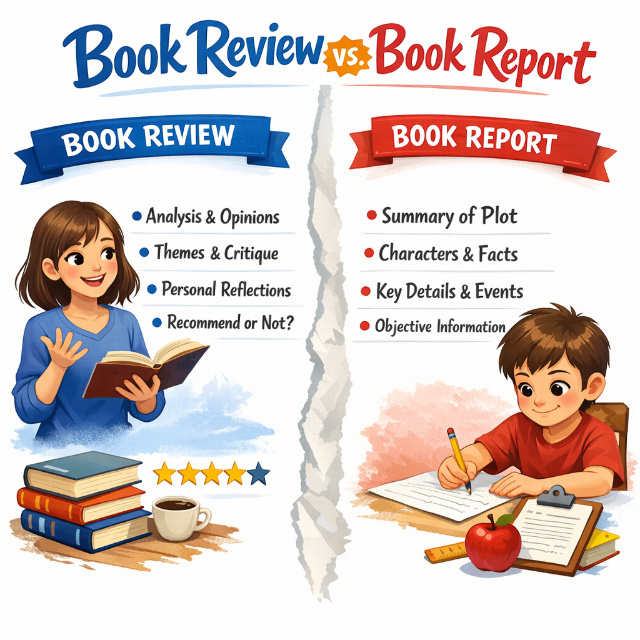
Book Review vs. Book Report
Book reports and book reviews serve fundamentally different purposes, though students often confuse them. Understanding this distinction is crucial for academic success and developing proper analytical skills.
Book reports demonstrate comprehension through an objective summary. You describe what happens in the book without evaluating its quality. The focus stays factual: plot events, character actions, setting details, and themes are presented. Your job is to show that you read and understood the content.
Reports answer: "What happens in this book?"
They prove reading comprehension. The tone remains neutral and descriptive throughout. You're not asked for opinions about quality or effectiveness.
Book reviews demonstrate critical thinking through subjective evaluation. You judge how well the book works and whether it's worth reading.
The focus shifts analytically: assessing strengths, identifying weaknesses, and evaluating effectiveness. Your job is forming and defending judgments about quality.
Reviews answer: "Is this book good, and why or why not?"
They prove analytical ability. The tone becomes evaluative and opinionated. Personal judgment based on evidence is required, not optional.
The practical difference appears clearly in writing.
A report states: "The book describes climate change causes and effects through scientific research and case studies." A review states: "The book effectively explains climate change through compelling real-world examples, though repetitive sections in chapters 4-6 weaken its overall impact."
Reports focus on what the author says or does. Reviews focus on how well the author says or does it. Reports describe characters; reviews evaluate whether characters feel believable and complex. Reports summarize plot; reviews assess whether pacing and structure work effectively.
Academic contexts increasingly emphasize reviews over reports as students advance. Elementary assignments often request reports to build comprehension skills. Middle school introduces review elements, developing critical thinking. High school and college predominantly assign reviews demanding sophisticated analysis.
The skills differ significantly in value. Report writing demonstrates you can understand and summarize—important but basic. Review writing demonstrates you can evaluate using criteria, support judgments with evidence, and construct analytical arguments—advanced skills applicable across disciplines and careers.
When assignments say "book review," provide evaluation and judgment. When they say "book report," stick to an objective summary. Missing this distinction costs students grades when they summarize instead of evaluating.
For comprehensive guidance on structuring your review appropriately, explore our book review format guide with templates for all education levels
Types of Book Reviews
Book reviews take various forms depending on purpose, audience, and context. Understanding these types helps you write appropriately for your specific situation and requirements.

1. Academic Reviews appear in scholarly journals and academic publications. These reviews analyze books' contributions to specific fields of study. Reviewers apply theoretical frameworks and scholarly perspectives to evaluate significance.
The audience consists of specialists and researchers in the field. Academic reviews typically run 1,000-2,500+ words with extensive analysis. Citations and references to other scholarship are standard. The tone remains formal and objective.
Academic reviewers assess whether books advance knowledge, challenge existing theories, fill gaps in research, or open new scholarly conversations. The focus stays on intellectual contribution rather than general readability.
2. Professional Reviews appear in newspapers, literary magazines, and general-interest publications. These reviews inform educated general audiences about new releases and notable books.
The audience includes avid readers without specialized expertise. Professional reviews typically run 500-1,000 words, balancing a thorough critique with accessibility. The writing stays clear and engaging while maintaining analytical depth.
Professional reviewers evaluate quality, significance, and readability for general audiences. They consider whether books succeed as literature, inform important conversations, or provide valuable perspectives. Comparison to similar works helps readers contextualize new releases.
3. Consumer Reviews appear on platforms like Goodreads, Amazon, and personal blogs. These reviews share personal opinions, helping fellow readers make purchasing decisions.
The audience consists of general readers seeking recommendations. Consumer reviews typically run 100-500 words with star ratings. The tone becomes conversational and personal, emphasizing subjective responses.
Consumer reviewers prioritize entertainment value, emotional impact, and personal preferences. They answer whether books deliver the expected experiences for their genres. Recommendations focus on "you'll like this if you like that" guidance.
4. Student Reviews appear as academic assignments from middle school through graduate programs. These reviews demonstrate critical thinking abilities and analytical writing skills.
The audience is typically your instructor evaluating your analytical development. Student reviews range from 500 words (middle school) to 1,500+ words (college). Structure follows assignment requirements with emphasis on evidence-based evaluation.
Student reviewers balance demonstrating comprehension with showcasing critical analysis. Success depends on supporting judgments with textual evidence while maintaining an appropriate academic tone and organization.
Each review type requires different approaches, but core principles remain constant: evaluate quality fairly, support judgments with evidence, consider intended audiences, and provide clear recommendations with reasoning. Understanding your review's type and purpose guides appropriate choices in tone, depth, organization, and focus.
Any Book, Any Genre
Expert Reviews for Fiction, Non-Fiction, Classics—Every Type of Book
From Shakespeare to modern YA novels—our literary experts have read it and can review it brilliantly.
Core Purpose
Book reviews serve multiple essential purposes across academic, professional, and reading communities. Understanding these purposes helps you write reviews that genuinely contribute value rather than simply fulfilling assignment requirements.
The primary purpose is to help potential readers decide whether to invest time reading a book. Time is precious, and reading choices are abundant. Effective reviews provide the evaluative information readers need for informed decisions.
Your review answers critical questions readers face: Does this book deliver what it promises? Will it satisfy readers seeking this genre or topic? How does it compare to similar books? Who specifically would benefit from reading it?
Another crucial purpose is evaluating books' effectiveness at achieving their goals. Fiction aims to entertain, move, or provoke thought through storytelling. Non-fiction aims to inform, persuade, or teach through explanation and argument.
Your review assesses how well books accomplish their intended purposes. You examine whether novels create compelling characters and engaging plots. You analyze whether non-fiction presents clear arguments supported by solid evidence. Success depends on the author's stated or implied goals.
Book reviews also assess contributions to genres, fields, or literary conversations. Every book enters existing contexts. Novels join genre traditions with established conventions. Non-fiction addresses ongoing scholarly or public debates.
Your review positions books within these larger contexts. You explain what makes this mystery novel distinctive in a crowded genre. You evaluate how this history book advances or challenges current understanding of its topic.
In academic contexts, reviews demonstrate critical thinking skills. Instructors assign reviews to develop your ability to evaluate using specific criteria, construct evidence-based arguments, and articulate judgments clearly.
Your review showcases analytical rather than just comprehension skills. You prove you can move beyond understanding what books say to evaluating how well they say it. This critical thinking transfers across disciplines and contexts.
Reviews engage you in literary and scholarly conversations. Reading and writing reviews connect you to broader communities discussing books, ideas, and cultural productions.
Your review contributes your perspective to ongoing conversations about literature, knowledge, and culture. You join readers, writers, scholars, and critics in evaluating books' value and significance.
Finally, review writing develops essential analytical and evaluative skills applicable far beyond literature. Learning to assess quality using criteria, support judgments with evidence, and communicate evaluations clearly serves you in countless professional contexts.
Whether evaluating job candidates, assessing project proposals, analyzing market research, or reviewing competing products, the skills you develop writing book reviews transfer directly. Critical evaluation is fundamental to professional and intellectual life.
Understanding these purposes helps you write reviews that matter. You're not just completing assignments—you're helping readers, evaluating books fairly, contributing to conversations, and developing transferable skills. That broader purpose should motivate and guide your review writing.
Too Much Summary, Not Enough Evaluation?
Get Reviews with Perfect 20-80 Summary-Evaluation Balance
Stop writing book reports disguised as reviews—get true critical evaluation that demonstrates analytical thinking.
Essential Components
Every effective book review includes specific components working together to inform and persuade readers. Understanding these essential elements helps you craft reviews that successfully evaluate books while providing useful guidance. For comprehensive examples showing these components in action, see our book review examples with annotated review samples across education levels.

1. Brief Summary
Summaries provide necessary context without dominating reviews. The key principle: keep summaries to approximately 20% of your total review length. The remaining 80% should focus on evaluation and analysis.
Your summary covers only major plot points or main arguments. For fiction, include genre, setting, main characters, and central conflict without revealing how it resolves. For non-fiction, include the author's main thesis, key arguments, and organizational approach.
Think of summaries as providing just enough context for readers to understand your evaluation. If you're critiquing character development, readers need to know who the main characters are. If you're assessing argument quality, readers need to understand the central claim.
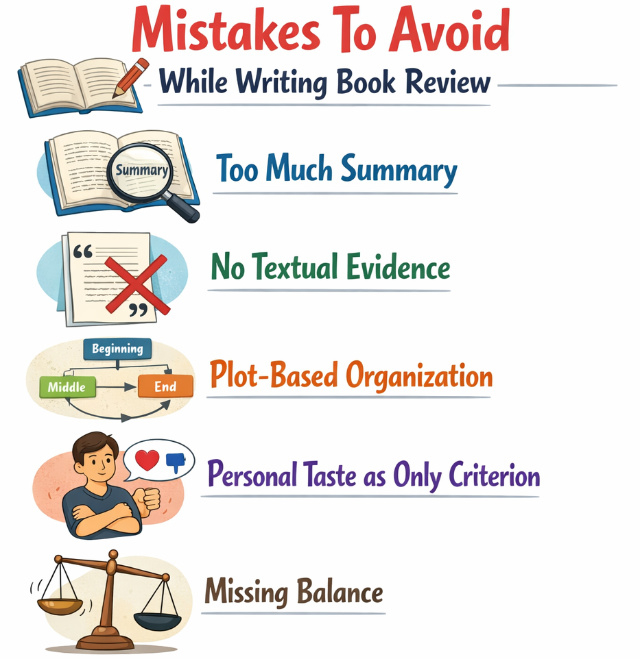
Avoid the common trap of turning reviews into extended plot summaries. Readers can find plot summaries everywhere online. They're reading your review for evaluation and judgment, not retelling.
Keep asking yourself: "Is this detail necessary for understanding my evaluation?"
For fiction reviews, respect readers who haven't read the book yet. Avoid major spoilers unless your analysis absolutely requires discussing endings or crucial plot twists. When spoilers are unavoidable for academic analysis, clearly warn readers beforehand.
For non-fiction reviews, summarize main arguments without evaluating them yet. Save your assessment of argument quality for the evaluation section. The summary establishes what the author claims; the evaluation judges how well they support those claims.
Include essential bibliographic information early: author's name, book title, publication date, and relevant context (like whether this is the author's first novel or a follow-up to previous work). This information helps readers understand the book's background.
Strong summaries feel efficient. Every sentence provides necessary context. Nothing feels redundant or excessive. Readers finish summaries understanding what the book is about and are ready to hear your evaluation.
2. Critical Evaluation
Evaluation forms the heart of every book review, comprising 60-70% of your total length. This section demonstrates your critical thinking by assessing the book's strengths, weaknesses, and overall effectiveness using specific criteria.
What to Evaluate in Fiction:
Plot deserves careful assessment.
- Evaluate pacing—does the story move too slowly, too quickly, or just right?
- Assess structure—does the organization enhance or confuse the narrative?
- Consider predictability versus surprise.
- Examine originality—does the plot feel fresh or formulaic?
Characters require thorough analysis.
- Evaluate development—do characters grow and change believably?
- Assess complexity—do characters feel three-dimensional or flat?
- Consider consistency—do characters' actions match their established personalities?
- Examine relationships—do interactions feel authentic?
Writing style significantly impacts the reading experience.
- Evaluate prose quality—is the writing clear, elegant, awkward, or pretentious?
- Assess voice—does the narrative voice suit the story?
- Consider dialogue—does it sound natural?
- Examine descriptive passages—do they enhance or bog down the narrative?
Themes deserve thoughtful analysis.
- Evaluate depth—does the book explore themes meaningfully or superficially?
- Assess relevance—do themes resonate with contemporary concerns?
- Consider originality—does the book offer fresh perspectives on familiar themes?
Setting and world-building matter especially in certain genres.
- Evaluate vividness—can you picture the world clearly?
- Assess consistency—does the world follow its own rules?
- Consider historical accuracy when relevant.
- Examine how setting enhances plot and themes.
Emotional impact reveals much about fiction's success.
- Evaluate engagement—does the book hold your attention?
- Assess emotional resonance—does it move you appropriately?
- Consider whether emotional responses feel earned or manipulated.
Need Better Evaluation Skills?
Learn to Evaluate Books Like a Professional Critic
Use professionally written reviews as learning tools to master evaluation and critical assessment.
What to Evaluate in Non-Fiction:
Argument quality forms the foundation.
- Evaluate clarity—is the main thesis obvious and well-articulated?
- Assess logic—do conclusions follow from premises?
- Consider persuasiveness—does the author convince you?
- Examine whether arguments address potential counterarguments.
Evidence quality determines argument strength.
- Evaluate sources—are they credible, current, and sufficient?
- Assess research depth—does the author demonstrate comprehensive knowledge?
- Consider whether evidence actually supports claims.
- Examine how the author uses examples and case studies.
Organization affects comprehension significantly.
- Evaluate structure—does the book's organization make sense?
- Assess flow—do chapters and sections connect logically?
- Consider accessibility—can general readers follow complex arguments?
- Examine whether organizational choices enhance understanding.
Writing quality matters even in non-fiction.
- Evaluate clarity—is the writing accessible without being simplistic?
- Assess engagement—does the author maintain interest despite complex topics?
- Consider tone appropriateness.
- Examine whether jargon is necessary or excessive.
Author credibility deserves consideration.
- Evaluate expertise—does the author have relevant credentials and experience?
- Assess bias—does the author acknowledge potential biases or present claims as objective?
- Consider whether the author engages fairly with opposing views.
Practical value applies to many non-fiction books.
- Evaluate applicability—can readers actually use this information?
- Assess usefulness—does the book deliver promised benefits?
- Consider whether the advice is realistic and actionable.
Contribution to the field matters for academic and professional books.
- Evaluate originality—does the book offer new insights?
- Assess significance—does it advance understanding in important ways?
- Consider whether the book fills genuine gaps.
How to Evaluate Effectively:
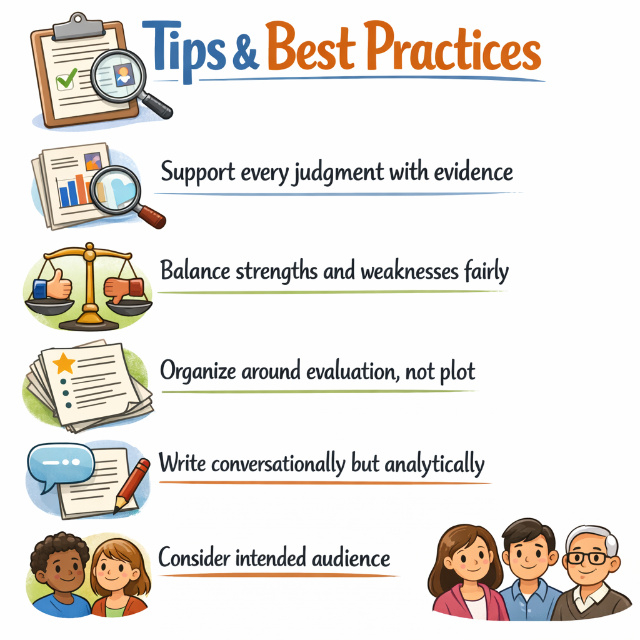
Support every judgment with specific textual evidence. Don't just claim "the characters felt flat"—explain which characters and why, with examples. Don't simply state "the argument was unconvincing"—explain which parts failed and why, with specific references.
Balance strengths and weaknesses fairly. Even books you love have flaws; even books you dislike have merits. Credible reviews acknowledge both. Aim for identifying 3-4 specific strengths and 2-3 specific weaknesses, all supported with evidence.
Compare to similar works when relevant. Context helps readers understand what makes this book distinctive, superior, or inferior.
Reference comparable books thoughtfully: "Unlike typical dystopian novels, this one focuses on environmental collapse rather than totalitarian governments."
Consider intended audiences explicitly. Books succeed or fail partly based on how well they serve target readers. A young adult novel shouldn't be criticized for not appealing to adult literary fiction readers. A scholarly text shouldn't be faulted for not being accessible to general audiences.
Assess whether authors achieve their stated or implied goals. If an author aims to write a light beach read, evaluate it as that, not as literary fiction. If a non-fiction author promises practical advice, judge whether the advice is actually practical.
For detailed guidance on developing your critical evaluation, explore our comprehensive book review writing guide with evaluation strategies
Affordable Academic Support
Professional Book Review Help Starting at Just $9.99/Page
Quality critical analysis that fits your student budget—with first-order discounts available!
3. Recommendation & Rating
Recommendations offer clear guidance, enabling readers to determine whether to read the book. This section synthesizes your evaluation into actionable advice supported by reasoning.
Specify who would enjoy this book. Go beyond vague statements like "readers who enjoy this genre."
Provide specific guidance: "Readers who loved The Night Circus's magical atmosphere will appreciate this novel's similar lyrical prose and mysterious carnival setting."
Identify who might not enjoy the book equally, specifically. "Readers preferring fast-paced thrillers should know this literary mystery prioritizes character development over plot momentum."
This honesty helps readers with different preferences avoid disappointment.
Provide your overall assessment with clear reasoning. Don't simply state "I recommend this book."
Explain why: "Despite pacing issues in the middle section, the novel's emotionally resonant character relationships and beautifully crafted prose make it worth reading."
Justify ratings if your assignment or platform requires them. A five-star rating needs explanation just as much as a two-star rating.
"This book earns five stars for its innovative narrative structure, exceptional prose, and profound exploration of grief, though readers seeking conventional storytelling may disagree."
Compare to similar titles when useful for recommendations.
"Fans of Educated and The Glass Castle will find this memoir equally compelling, though its focus on immigration rather than rural poverty offers a fresh perspective on resilience."
State your final judgment clearly and confidently. After thorough evaluation, readers deserve a clear answer: should they read this book or not? Your reasoned judgment, supported by all previous evaluations, guides their decision.
Avoid hedging excessively. Phrases like "I think maybe some readers might possibly enjoy this book" undermine your credibility. You've done the work of reading and evaluating—trust your analysis and state your judgment clearly.
4. Personal Response (Optional)
Some assignments request personal connections beyond critical evaluation. This section explores how the book affected you individually, though it remains secondary to objective analysis.
Explain what resonated with you specifically. "The protagonist's struggle with perfectionism mirrored my own experiences with academic pressure" creates a meaningful personal connection without abandoning critical distance.
Describe how the book affected your thinking or perspective. "This book challenged my assumptions about urban poverty, revealing complexities I'd oversimplified," demonstrates genuine engagement.
Note emotional reactions and explain their causes. "The ending devastated me because the author had built such genuine sympathy for the character throughout." This connects emotion to craft.
Connect to your own experiences and interests thoughtfully. "As someone interested in environmental science, I appreciated the author's accessible explanation of climate feedback loops," shows relevant personal context.
Balance personal response with critical analysis carefully. Personal reactions inform but don't replace objective evaluation. You might love a book personally while recognizing its objective weaknesses, or vice versa.
Don't let personal taste completely override objective quality assessment.
"I generally dislike fantasy novels, but I recognize this one demonstrates exceptional world-building, consistent magic systems, and complex characters fantasy fans would appreciate."
Remember that personal response sections should enhance, not replace, critical evaluation. Your personal connection adds dimension to your review, but your analytical assessment remains primary.
Trusted by 10,000+ Students
See Why Students Choose 5StarEssays for Book Review Help
Real students, real results, real A+ grades. Join our community of successful literary analysts.
Evaluation Criteria by Genre
Different genres require different evaluation criteria. Understanding genre-specific standards helps you assess books fairly and insightfully.
1. Fiction Reviews
Fiction succeeds through storytelling craft. Your evaluation should address how effectively the author uses narrative elements to engage readers and convey meaning.
Plot Structure and Pacing:
Assess whether the story's structure serves its purpose. Does the pacing maintain engagement? Do events unfold logically? Does the structure enhance suspense, character development, or thematic exploration? Consider whether the plot feels original or derivative.
Character Development and Believability:
Evaluate whether characters feel like real people with consistent personalities, complex motivations, and authentic growth. Do they behave believably given their backgrounds? Do supporting characters serve purposes beyond advancing the plot? Are relationships portrayed convincingly?
Dialogue Quality and Authenticity:
Assess whether characters speak distinctively and naturally. Does dialogue reveal character and advance plot efficiently? Does it sound like real speech or artificial exposition? Do characters from different backgrounds speak appropriately?
Setting and World-Building:
Evaluate how vividly the author creates the story's world. Can you picture locations clearly? For historical fiction, is the period rendered accurately? For speculative fiction, are the world's rules consistent and believable?
Writing Style and Prose Quality:
Assess the author's command of language. Is the prose clear, elegant, or clunky? Does the narrative voice suit the story? Are descriptive passages effective or excessive? Does the writing style enhance or distract from the story?
Theme Exploration and Depth:
Evaluate how thoughtfully the book explores its themes. Does it offer genuine insights or superficial treatment? Are themes integrated naturally or heavy-handedly? Does the book give readers meaningful ideas to contemplate?
Originality and Creativity:
Consider what makes this book distinctive. Does it offer fresh perspectives on familiar stories? Does it subvert genre conventions interestingly or follow them predictably? What makes it stand out from similar books?
Emotional Engagement:
Assess whether the book affects readers emotionally. Do you care what happens to characters? Does the story create appropriate emotional responses? Are emotional moments earned through story development or manipulative?
Genre Conventions:
Evaluate how well the book meets or subverts genre expectations. Does this mystery provide satisfying clues and a logical resolution? Does this romance deliver the expected emotional journey? Does this literary fiction prioritize character over plot appropriately?
2. Non-Fiction Reviews
Non-fiction succeeds through clear communication of ideas, solid research, and effective argument. Your evaluation should address intellectual quality and practical value.
Thesis Clarity and Strength:
Assess whether the author's main argument is clear, specific, and significant. Can you state the thesis in one sentence? Does it claim something meaningful and debatable rather than obvious?
Argument Logic and Structure:
Evaluate whether conclusions follow logically from evidence. Does the author build arguments systematically? Are there logical fallacies or unsupported leaps? Does the structure support the argument effectively?
Evidence Quality and Sufficiency:
Assess the strength of supporting evidence. Are sources credible and current? Is the research comprehensive or limited? Does evidence actually support claims? Are statistics used appropriately? Are examples representative or cherry-picked?
Research Depth and Breadth:
Evaluate whether the author demonstrates thorough knowledge. Does the book cover the topic comprehensively? Are important perspectives missing? Does the author engage with existing scholarship appropriately?
Author Credibility and Expertise:
Consider whether the author has relevant credentials and experience. Does expertise show through? Are potential biases acknowledged? Does the author engage fairly with opposing views?
Organization and Accessibility:
Assess whether the book is well-structured and understandable. Can general readers follow complex arguments? Is the organization logical? Do chapters build effectively? Are transitions smooth?
Writing Clarity and Engagement:
Evaluate whether the author communicates ideas clearly without unnecessary jargon. Does the writing maintain interest despite potentially dry material? Is the tone appropriate for the intended audience?
Practical Applicability:
For how-to and self-help books, assess whether the advice is actionable and realistic. Can readers actually implement recommendations? Are suggestions grounded in research or anecdotal?
Contribution and Originality:
Evaluate what new insights the book offers. Does it advance understanding significantly? Does it synthesize existing knowledge usefully? Does it fill gaps in public or scholarly knowledge?
Struggling with Character Analysis?
Get Reviews with Deep Character Development Assessment
Move beyond "I liked the character" to sophisticated evaluation of development, motivation, and complexity.
3. Biography/Memoir Reviews
Biographies and memoirs blend narrative and information, requiring evaluation of both storytelling and factual quality.
Subject Selection and Significance:
Assess whether the subject merits a book-length treatment. Why is this person's life story important or interesting? What makes their experiences worth sharing?
Research Thoroughness (Biography):
For biographies, evaluate the depth and quality of research. Does the author use primary sources? Is the documentation thorough? Are claims supported by evidence? Does the author acknowledge gaps in knowledge?
Honesty and Introspection (Memoir):
For memoirs, assess the author's self-examination. Does the author present themselves honestly, including flaws? Is reflection genuine or self-serving? Does the author show growth and understanding?
Narrative Structure and Pacing:
Evaluate how effectively the author structures the life story. Does chronological organization work, or would thematic organization be better? Does pacing maintain interest throughout?
Context and Historical Accuracy:
Assess how well the author situates the subject in broader historical and cultural contexts. For biographies, is historical detail accurate? Does the author explain relevant contexts for contemporary readers?
Writing Quality and Readability:
Evaluate whether the writing brings the subject to life engagingly. Does the narrative flow smoothly? Are scenes vivid? Does the author balance showing and telling effectively?
Insight into Subject's Impact:
Consider whether the book helps readers understand the subject's significance. What light does it shed on the subject's achievements, struggles, or influence? Does it reveal something new about familiar figures?
Balance Between Facts and Storytelling:
Assess whether the author balances factual accuracy with narrative engagement. Does the book read like a story while remaining truthful? Are speculative passages clearly marked?
Understanding these genre-specific criteria helps you evaluate books fairly using appropriate standards. Apply criteria relevant to each book's genre and purpose rather than using one-size-fits-all standards.
Writing Process
Effective book reviews result from systematic processes, not just reading and writing. Follow these steps for thorough, well-supported reviews that demonstrate critical thinking. For detailed guidance on each step, see our comprehensive book review writing guide.
Pre-Reading Preparation
Preparation before reading enhances your critical evaluation abilities. Taking time to research context and set expectations helps you assess books more thoughtfully.
Research the author's background and credentials. Understanding an author's expertise, previous works, and perspectives helps you evaluate credibility and approach. A debut novelist writes differently from an established literary author.
Understand the book's publication context. When was it published? What cultural or historical moment does it reflect or address? How was it received initially? This context informs your evaluation significantly.
Note the book's genre and conventions. Different genres have different standards and expectations. Understanding fantasy conventions helps you evaluate whether a fantasy novel succeeds on its genre's terms.
Review your assignment requirements carefully if writing for a class. Note length requirements, formatting expectations, required components, and evaluation criteria. Understanding expectations prevents missing requirements later.
Set appropriate evaluation criteria based on genre and purpose. Know what standards you'll apply before reading. This preparation helps you read critically rather than just consuming content.
Learn While You Get Help
Understand Book Reviews Better Through Expert-Written Examples
It's not just about this assignment—develop lasting critical thinking skills for future success.
Active Reading for Review
Reading for review differs from reading for pleasure. You're gathering evidence and forming judgments simultaneously, requiring systematic attention and note-taking.
Take notes on strengths and weaknesses as you read. Don't wait until finishing to form opinions. Mark passages demonstrating excellent or poor writing. Note when pacing drags or characters feel inconsistent.
Mark specific passages to quote as evidence. Collect page numbers for examples supporting your eventual claims. You'll need textual evidence throughout your review, so gather it while reading.
Note your emotional reactions and analyze why they occur. If a scene moves you, what techniques created that response? If you feel bored, what causes the pacing problem? Understanding your reactions helps you evaluate craft.
Compare mentally to similar books you've read. How does this mystery compare to others in the genre? How does this author's style differ from comparable writers? Context helps you assess originality and quality.
Consider the intended audience throughout. Would target readers find this engaging? Does the author serve the intended audience well? Books should be judged partly on how well they satisfy their target readers.
Track recurring issues or patterns. If dialogue feels stilted repeatedly, that's a significant weakness. If every chapter builds suspense effectively, that's a notable strength. Patterns matter more than isolated moments.
Question the author's choices actively. Why did the author structure the book this way? What effect do stylistic choices create? Critical reading means constantly asking, "Why did the author do this, and does it work?"
Drafting Strategy
Strong drafts begin with clear organization based on evaluation points rather than plot chronology. Structure your review around arguments, not summaries.
Start by articulating your evaluation points—your thesis about the book's quality. What are your main judgments? List 3-4 major strengths and 2-3 significant weaknesses you'll discuss.
Organize by themes or criteria, not chronologically. Don't retell the story from beginning to end. Instead, structure around evaluation topics: character development, then writing style, then thematic depth.
Balance positive and negative assessments fairly. Even books you loved have flaws; even books you disliked have merits. Credible reviews acknowledge both sides.
Support all claims with specific examples from the text. Every judgment needs evidence. Don't just state "the dialogue felt unnatural"—provide an example and explain what makes it ineffective.
Keep the summary brief and focused on providing context. Place a concise summary early, establishing just enough background for readers to understand your evaluation. Then move into analysis.
Develop the evaluation thoroughly since it's your review's core purpose. Spend most of your words explaining what works, what doesn't, and why, with evidence supporting every claim.
End with a clear recommendation based on your evaluation. Your conclusion should synthesize your assessment and provide specific guidance about who should read this book.
Structure your review effectively using our book review format templates for different education levels and review types
Multiple Book Reviews This Semester?
Save Big with Our Multi-Review Package Discounts
Smart students plan ahead—get all your book reviews done right and save up to 30%!
Revision Focus
Revision transforms adequate drafts into strong reviews by refining arguments, improving evidence, and polishing writing.
Check your summary-evaluation balance first. Measure roughly—does the summary consume only 15-25% of your total length? If summary dominates, cut aggressively and expand evaluation.
Verify that all claims have supporting evidence. Read through, looking specifically for unsupported judgments. Every statement about quality needs textual examples or reasoning explaining your assessment.
Remove plot spoilers from fiction reviews unless they're essential for analysis. Check whether you've revealed ending twists or major surprises unnecessarily. If spoilers are unavoidable, add clear warnings.
Ensure your critique feels fair and balanced. Read through, checking for excessive negativity or uncritical praise. Have you acknowledged this book's strengths even while criticizing weaknesses, and vice versa?
Strengthen weak arguments by adding more specific evidence or clearer reasoning. Where do claims feel vague or unsupported? What examples would strengthen those points?
Polish writing quality for clarity and flow. Read aloud, listening for awkward phrasing, unclear sentences, or repetitive language. Strong writing enhances your credibility.
Proofread thoroughly for grammar, punctuation, and spelling. Errors undermine otherwise strong analysis. Use spell-check, but also read carefully for errors it misses.
Check that internal links appear naturally throughout your review, not clustered at the end. Links should integrate smoothly where relevant topics arise.
Resource Hub
This complete book review guide provides foundations, but additional resources offer deeper support for specific needs. Access these comprehensive materials for examples, formats, and detailed strategies.
Complete Examples Collection
Study real book reviews to see effective techniques in action. Examples demonstrate principles better than explanations alone.
Visit our book review examples collection featuring:
15+ Annotated Reviews Across Education Levels: See complete reviews from elementary through college with annotations identifying effective techniques, strong evidence use, and evaluation approaches. Learn by studying successful models.
Fiction, Non-Fiction, and Biography Samples: Examples span genres, showing how evaluation criteria differ by type. See how reviewers assess novels, memoirs, academic books, and biographies using appropriate standards.
Before/After Revision Comparisons: Study drafts alongside revised versions, understanding exactly what improvements strengthen reviews. See how adding evidence, balancing evaluation, and cutting excessive summary transforms adequate into excellent.
Genre-Specific Review Models: Find examples matching your book's genre. Fantasy, mystery, historical fiction, self-help, history, science writing—see how effective reviewers handle each type's unique characteristics.
Critique of Each Example's Effectiveness: Don't just read examples—understand why they work. Annotations explain what makes each review successful and what techniques you can apply to your own writing.
Examples show rather than tell, making abstract principles concrete through demonstration. Studying multiple examples across levels and genres builds your understanding of effective review writing.
Structured Format Guide
Organization matters tremendously for review clarity and effectiveness. Templates ensure you include all essential components appropriately structured.
Explore our book review format guide, including:
Templates for All Education Levels: Get age-appropriate formats from elementary simplicity through college sophistication. Each template matches typical requirements and expectations for its level.
Academic vs. Consumer Review Formats: Understand how scholarly reviews differ from Goodreads-style personal reviews. Different contexts require different approaches—learn when to use each format.
Paragraph-by-Paragraph Breakdowns: See exactly what content belongs in each section. Introduction paragraphs, summary sections, evaluation paragraphs, recommendations—detailed guidance for every part.
Organizational Strategies: Learn whether to organize chronologically, thematically, or by evaluation criteria. Different books and purposes call for different structures—understand your options.
Citation Guidelines by Style: Master MLA, APA, and Chicago citation formats for book reviews. See examples of properly formatted citations for books, articles, and other sources you might reference.
Format templates provide scaffolding, especially helpful when starting. You're not staring at blank pages, wondering what comes next—you have structures guiding your organization.
Step-by-Step Writing Guide
Comprehensive guidance covers every stage from preparation through final revision. Detailed strategies help you develop reviews systematically.
Use our complete book review writing guide covering:
Pre-Reading Preparation Strategies: Learn what research and planning enhance critical reading. Discover how investigating authors, understanding genres, and setting evaluation criteria before reading improves your analytical abilities.
Note-Taking Systems for Reviews: Master techniques for capturing evidence while reading. Learn what to mark, how to organize notes, and how to ensure you're gathering material supporting eventual evaluation.
Evaluation Criteria by Genre: Understand specific standards for fiction, non-fiction, biography, and specialized genres. Learn what separates excellent from adequate in each type.
Drafting Techniques: Discover strategies for organizing reviews around evaluation rather than summary, developing arguments with
evidence, and maintaining an appropriate balance between components.
Revision Strategies: Learn systematic approaches to strengthening drafts. Understand what to check, what to cut, what to expand, and how to polish reviews for maximum effectiveness.
The writing guide provides depth beyond this overview, offering practical techniques and detailed examples for every stage. It's your complete companion throughout the review writing process.
Downloadable Resources
These resources support you throughout the process, from initial reading through final revision. Download what helps your specific needs and workflow.
Transform Your Reading into Sophisticated Critical Analysis
Move beyond summary to true evaluation—the analysis teachers want to see
- Deep Literary Analysis Expert evaluation of themes, symbolism, character development, and style
- Evidence-Based Arguments Every claim supported with specific quotes and textual examples
- Balanced Critique Fair assessment of both strengths and weaknesses with reasoning
- A+ Quality Guaranteed Insightful analysis that demonstrates sophisticated critical thinking
Stop writing summaries disguised as reviews. Get true critical evaluation that showcases analytical excellence.
Get Expert Analysis