Standard Book Review Format: 5 Part Structure
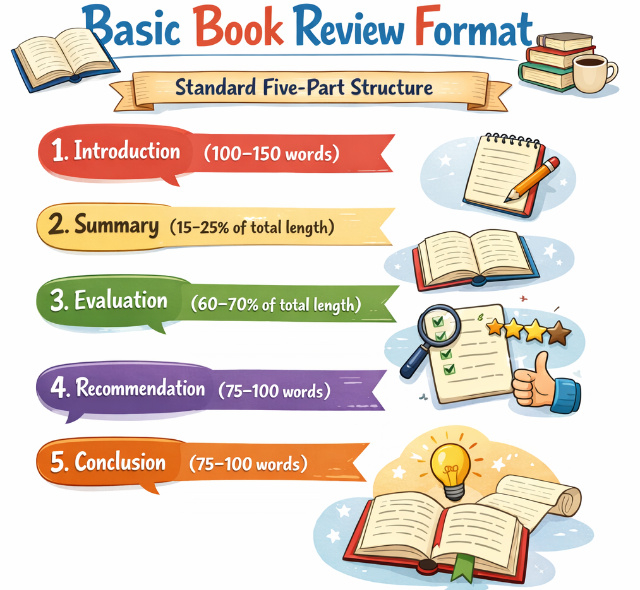
The 5 Part Book Review Format Structure
1. Introduction (100 to 150 words)
- Hook (1-2 sentences)
- Bibliographic information (1 sentence)
- Brief context (1-2 sentences)
- Thesis statement (1-2 sentences)
2. Summary (15-25% of total length)
- Genre and setting (fiction)
- Main characters and situation
- Central conflict or thesis
- NO excessive detail or spoilers
3. Evaluation (60-70% of total length)
- Organized by criteria, not plot
- Specific claims with textual evidence
- Balance strengths and weaknesses
- Multiple paragraphs covering different aspects
4. Recommendation (75 to 100 words)
- Specific target audience
- Who wouldn't enjoy
- Overall assessment with reasoning
- Comparative context
5. Conclusion (75 to 100 words)
- Synthesis without repetition
- Reinforced judgment
- Memorable ending
PANIC OVER YOUR BOOK REVIEW?
Breathe easy. We handle the critical thinking, you get the credit.
- Emergency 12-hour delivery available
- Custom-built to your professor's prompts
- Impeccable sourcing from scholarly critiques
- 24/7 Support
From panic to peace of mind. Fast, discreet, and effective.
Get Started NowBook Review Format Templates by Grade Level: Elementary to College
Elementary Book Review Format Template (Grades 3 to 5)
Format: 300 to 500 words total
Introduction (50 to 75 words)
Title: [Book Title] by [Author]
|
Summary (75 to 100 words)
The story follows [main character], who [situation]. [He/She]
lives in [setting]. The main problem is [conflict]. [Brief
additional context without spoilers.] |
What I Liked (100 to 150 words)
I enjoyed [element 1] because [reason]. My favorite part was
[scene] because [explanation].

I also liked [element 2] because [reason].

The book made me feel [emotion] when [situation]. |
What Could Be Better (50 to 75 words)
I think [element] could have been better because [reason].
Sometimes [specific issue] made it [difficult/confusing]. |
Recommendation (50 to 75 words)
I recommend this book for kids in [grades] who enjoy [type of
stories]. It's perfect for readers who [preference]. I believe
this book is [great/good] because [final reason]. |
Middle School Book Review Format Template (Grades 6 to 8)
Format: 500 to 800 words total
Introduction (100 to 125 words)
- [Engaging hook, question, quote, or bold claim]
- [Author]'s "[Title]" [brief genre and premise]. Published in
[year], this [genre] explores [themes] through [approach]. - [Thesis statement previewing evaluation: "While the novel
succeeds in X and Y, weaknesses in Z prevent it from..."]
Summary (100 to 150 words)
- Genre specification
- Setting (time, place)
- Main character with basic traits
- Central conflict. NO spoilers
Evaluation Paragraph 1: Major Strength (125 to 175 words)
- Topic sentence stating strength
- Explanation of what you mean
- Specific textual evidence with examples
- Analysis of why it works
- Connection to overall quality
Evaluation Paragraph 2: Additional Strength (125 to 175 words)
- Different strength than paragraph 1
- Evidence and explanation
Evaluation Paragraph 3: Weaknesses (100 to 150 words)
- Topic sentence identifying issues
- Specific instances with analysis
- Fair explanation of problems
- Contextualize significance, minor or major?
Recommendation (75 to 100 words)
- Overall assessment with reasoning
- Target audience specification
- Comparison to similar books
- Who would/wouldn't enjoy and why
Conclusion (75 to 100 words)
- Synthesis of evaluation points
- Final judgment
- Memorable ending thought
High School Book Review Format Template (Grades 9 to 12)
Format: 800 to1,200 words total
Introduction (125-150 words)
- Sophisticated hook - provocative question, literary quote, cultural observation.
- Complete bibliographic information with context: Author's background, publication significance, genre positioning.
- Nuanced thesis with multiple evaluation dimensions.
Summary (150-200 words)
- Genre and literary context
- Setting significance
- Character complexity notes
- Central conflicts/themes
- Narrative structure mention
- Minimal spoilers with warnings if necessary
Evaluation Paragraph 1: Literary Element (200-250 words)
- Claim about significant element - symbolism, characterization, theme
- Multiple specific instances with textual evidence
- Literary terminology appropriate to level
- Analysis of technique and effect
- Connection to thesis
Evaluation Paragraph 2: Craft Element (200-250 words)
- Different dimension - style, structure, voice
- Analysis of author's technique
- Evidence with page citations
- Effect on reader experience
Evaluation Paragraph 3: Additional Analysis (150-200 words)
- Another significant evaluation point
- Balanced assessment
- Supported claims
Evaluation Paragraph 4: Limitations (125-175 words)
- Fair critique of genuine issues
- Specific instances
- Contextualized significance
- Maintained respectful tone
Recommendation (100-125 words)
- Sophisticated audience specification
- Literary comparisons
- Nuanced overall assessment
- Genre/thematic context
Conclusion (100-125 words)
- Synthesis showing argument development
- Broader literary significance
- Final judgment reinforcement
- Thought-provoking ending
College Book Review Format Template & Academic Standards
Format: 1000 to1500+ words total
Introduction (150 to 200 words)
- Sophisticated contextualizing hook
- Complete bibliographic details
- Theoretical/scholarly positioning
- Argument preview with nuance
Summary (200 to 250 words)
- Scholarly context and significance
- Methodological approach (non fiction)
- Narrative structure/technique (fiction)
- Thematic and theoretical concerns
- Target audience and contribution
Evaluation Section 1: Major Analytical Point (250 to 350 words)
- Sophisticated claim requiring development
- Theoretical framework application
- Multiple textual instances with analysis
- Engagement with scholarly perspectives
- Connection to critical conversations
Evaluation Section 2: Different Dimension (250 to 350 words)
- Alternative analytical angle
- Different evidence and argumentation
- Theoretical or comparative context
- Synthesis with previous section
Evaluation Section 3: Critical Assessment (200 to 250 words)
- Balanced critique acknowledging limits
- Scholarly fairness
- Contextualized significance
- Continued theoretical engagement
Recommendation (125 to 150 words)
- Scholarly audience specification
- Theoretical and methodological positioning
- Contribution assessment
- Comparative scholarly context
Conclusion (150 to 175 words)
- Argument synthesis
- Scholarly significance
- Broader theoretical implications
- Definitive judgment
Citation Requirements:
- Formal bibliography/works cited
- Proper citation style (MLA, APA, Chicago)
- Secondary source engagement when appropriate
Book Review Paragraph Format: Section by Section Guide
Book Review Introduction Format & Structure
Sentence 1-2: Hook
|
Sentence 3: Bibliographic Information
|
Sentence 4-5: Brief Context
|
Sentence 6-7: Thesis
|
Book Review Summary Format Guidelines
First Summary Paragraph:
- Genre specification and target audience
- Setting (time and place)
- Main character introduction with traits
- Central situation or conflict establishment
- Narrative perspective note
Second Summary Paragraph (if needed):
- Additional important characters
- Key developments (NO spoilers)
- Thematic focus
- Organizational approach (non fiction)
Length Control: If the summary exceeds 25%, cut aggressively. Ask: "Is this detail necessary for understanding my evaluation?" If no, delete.
Book Review Evaluation Format & Organization
Each Evaluation Paragraph:
1. Topic Sentence (Claim)
Template: "[Author]'s prose achieves remarkable lyrical quality
without sacrificing narrative clarity." |
2. Context/Explanation (1-2 sentences)
Template: "Throughout the novel, she balances beautiful metaphors
with straightforward storytelling, creating atmospheric passages
that enhance rather than obstruct plot momentum." |
3. Evidence (2-3 sentences)
Template: "Descriptions of Paris capture both beauty and loneliness:
'The city is a symphony, and Addie has learned every movement,
but she cannot find the melody' (89). This metaphor conveys her
isolation within crowds while demonstrating [Author]'s gift for
memorable imagery." |
4. Analysis (2-3 sentences)
Template: "The musical metaphor works because it suggests both
artistry and absence Addie experiences beauty but lacks connection.
[Author] uses such figurative language throughout without lapsing
into purple prose, maintaining readability while crafting genuinely
poetic moments." |
5. Connection (1 sentence)
Template: "This prose quality elevates the novel above typical
fantasy into literary territory, though other elements don't
achieve similar excellence." |
Book Review Recommendation Format
Sentence 1-2: Overall Assessment
Template: "Despite [weaknesses], '[Title]' succeeds as [genre]
exploring [themes]." |
Sentence 3-4: Who Would Enjoy
Template: "Readers who appreciated '[Similar Book]' or '[Another
Book]' will find this [adjective]. Fans prioritizing [quality]
over [other quality] will particularly enjoy it." |
Sentence 5-6: Who Wouldn't Enjoy
Template: "However, readers seeking [expectation] should know
this [book type] emphasizes [actual focus] over [expected focus]." |
Sentence 7-8: Comparative Context
Template: "[Author]'s approach here differs from [other work]
[comparison]. Readers preferring [style] may find this [reaction]." |
Sentence 9: Final Recommendation
Template: "For [audience description] valuing [qualities], this
novel offers substantial rewards despite its flaws." |
BEAT THE CURVE.
Don't just submit another summary. Submit a standout book critique.
- Original angles and unique thesis statements
- Analysis that surprises and impresses
- Professional polish that outshines peers
- 100% Originality Report
Be memorable. Be exceptional. Be at the top of the pile.
Order NowBook Review Formatting Requirements: MLA, APA & Chicago
Book Review Citation Format for MLA (Literature & Humanities)
In text: (Author Page) Example: "Fitzgerald describes the green light (21)." Works Cited: Fitzgerald, F. Scott. The Great Gatsby. Scribner, 1925. |
Book Review Citation Format for APA (Social Sciences)
In text: (Author, Year, p. Page) Example: "Fitzgerald describes the green light (1925, p. 21)." References: Fitzgerald, F. S. (1925). The Great Gatsby. Scribner. |
Book Review Citation Format for Chicago (History)
| Footnote: ¹F. Scott Fitzgerald, The Great Gatsby (New York: Scribner, 1925), 21. Bibliography: Fitzgerald, F. Scott. The Great Gatsby. New York: Scribner, 1925. |
Visual Formatting for Book Review
Standard Academic Structure:
- Font: Times New Roman 12pt (or Arial/Calibri 11pt)
- Margins: 1 inch all sides
- Spacing: Double spaced (academic) / Single spaced (consumer)
- Alignment: Left aligned
- Indentation: First line 0.5 inches OR blank line between paragraphs
Header Information (MLA):
- Your Name
- Instructor Name
- Course Name
- Date
Title Formatting:
- Centered on first page
- Title case capitalization
- NOT bolded, italicized, or underlined
- Book titles within italicized: Review of The Great Gatsby
Page Numbers:
- Upper right corner
- Include last name (MLA style)
Book Review Title Formatting Rules
Italicize:
- Book titles: The Great Gatsby
- Magazine titles: The New Yorker
- Long poems: Paradise Lost
- Plays: Hamlet
Use Quotation Marks:
- Short story titles: "The Lottery"
- Article titles: "How to Write Reviews"
- Short poems: "The Road Not Taken"
- Chapter titles: "Chapter Three"
Still feeling unsure? Our APA Citation Guide and MLA Citation Guide break down each format with clear examples, so you can cite any source confidently and avoid last minute formatting stress.
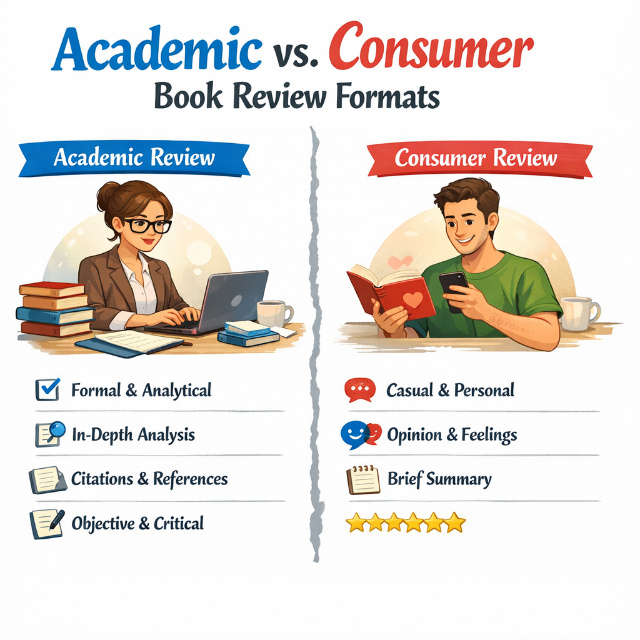
Academic vs Consumer Book Review Format Differences
Academic Book Review Format Requirements
Characteristics:
- Formal tone throughout
- Citation requirements (page numbers)
- Bibliography/works cited page
- Analytical depth with theoretical frameworks
- Evidence standards (specific quotes)
- Structured organization
- Length: 1,000 to 1,500+ words (college)
- Purpose: Demonstrate critical thinking
Template Structure:
- Introduction with scholarly context
- Summary with methodological notes
- Detailed evaluation with citations
- Recommendation for academic audience
- Conclusion with broader significance
- Works Cited/References page
Consumer Book Review Format Guidelines
Characteristics:
- Conversational tone
- No formal citations required
- Accessibility focus
- Personal response emphasis
- Practical guidance
- Star ratings often included
- Length: 300 to 800 words
- Purpose: Help readers make decisions
Template Structure:
- Personal hook opening
- Brief plot overview (spoiler free)
- What worked and what didn't
- Who would/wouldn't enjoy
- Star rating with justification
Book Review Format Comparison: Academic vs Consumer
| Element | Academic | Consumer |
|---|---|---|
| Tone | Formal, analytical | Conversational |
| Length | 1,000 to 1,500+ | 300 to 800 |
| Citations | Required + page numbers | Optional, informal |
| Bibliography | Required | Not needed |
| Personal Voice | Minimized | Encouraged |
| Analysis Depth | Comprehensive | Accessible |
| Audience | Instructors, scholars | General readers |
| Rating System | Rare | Common (stars) |
To study these structures in action, explore our Book Review Examples collection.
Book Review Format Length Guide by Grade Level
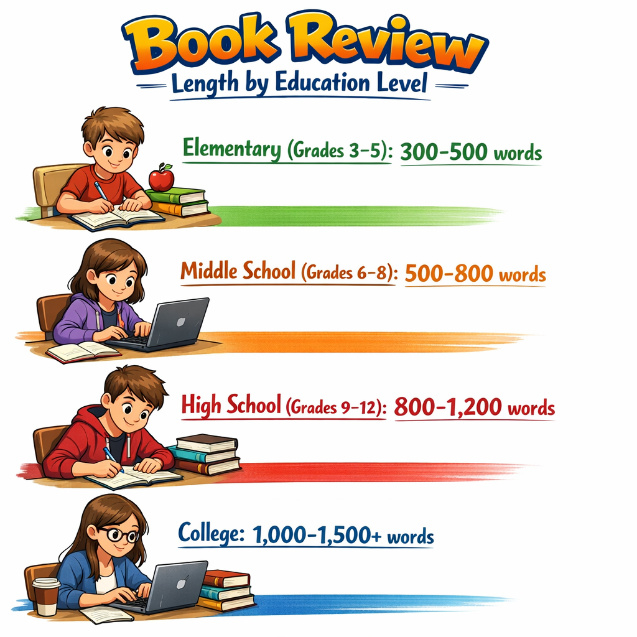
Elementary (Grades 3 to 5): 300 to 500 words
- Introduction: 50-75 words
- Summary: 75-100 words
- Evaluation: 150-250 words
- Recommendation: 50-75 words
Middle School (Grades 6 to 8): 500 to 800 words
- Introduction: 100-125 words
- Summary: 100-150 words
- Evaluation: 250-400 words
- Recommendation: 75-100 words
- Conclusion: 75-100 words
High School (Grades 9 to 12): 800-1,200 words
- Introduction: 125-150 words
- Summary: 150-200 words
- Evaluation: 400-700 words
- Recommendation: 100-125 words
- Conclusion: 100-125 words
College: 1,000 to1,500+ words
- Introduction: 150-200 words
- Summary: 200-250 words
- Evaluation: 500-900 words
- Recommendation: 125-150 words
- Conclusion: 150-175 words
Professional/Academic Journals: 1,500 to 2,500+ words
Always prioritize depth over length. Thorough analysis beats superficial coverage.
Common Book Review Format Mistakes to Avoid
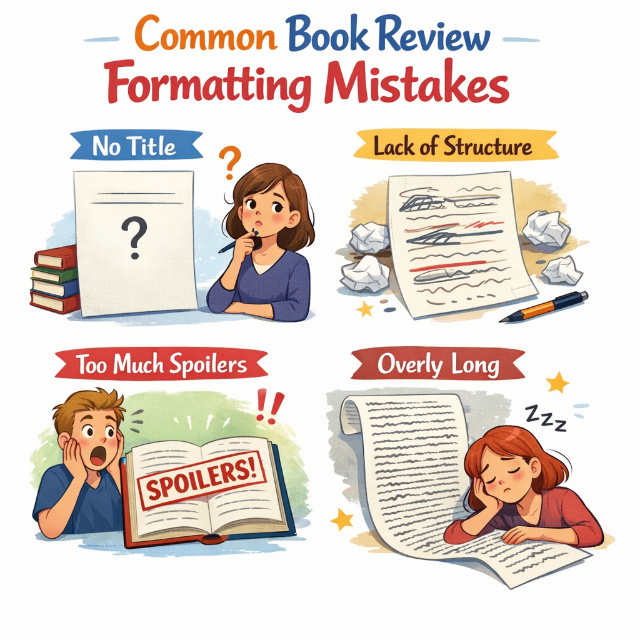
Avoid These Errors:
- Using decorative fonts (Comic Sans, Papyrus)
- Forgetting page numbers
- Inconsistent spacing
- Missing bibliography
- Incorrect title formatting (underline instead of italics)
- Wrong citation style
- Missing header information
- Single spacing academic reviews
- Forgetting to italicize book titles
- Inconsistent indentation
Instead, Do This:
- Use standard fonts (Times New Roman 12pt)
- Include page numbers on every page
- Double space academic reviews consistently
- Create a proper works cited/references page
- Italicize all book titles
- Follow the assigned citation style exactly
- Include all required header information
- Indent paragraphs consistently (0.5 inches)
- Proofread formatting before submission
Want formatting done right? Our trusted essay writing service ensure every citation, margin, and structure detail meets academic standards perfectly.
Free Book Review Format Templates PDF Download
Mastering Book Review Format: Key Takeaways
Format provides essential structure, ensuring your book reviews include all necessary components in appropriate proportions. Understanding standard templates from elementary through college, academic to consumer, helps you organize reviews effectively for any purpose.
The basic five part structure stays consistent, but sophistication, length, and requirements vary by education level. Templates aren't rigid formulas but flexible frameworks you adapt to specific books and assignments. They ensure appropriate summary evaluation balance (20% summary, 70% evaluation) while helping you allocate space effectively.
The organizational skills you develop from writing structured reviews transfer across academic and professional contexts. Learning to organize arguments logically, allocate space appropriately, and present information clearly serves you in countless situations. For complete writing process guidance, see our comprehensive Book Review guide.
Return to these templates whenever facing new review assignments. As skills develop, you'll internalize structures, making them feel natural rather than forced. Start your next review confident that you understand how to organize it effectively.
PERFECT REVIEW OR YOUR MONEY BACK.
Invest in your grade with complete, no-risk confidence.
- Ironclad satisfaction guarantee
- Work directly with your expert until it's perfect
- Full ownership and copyright transfer
- Trusted by Thousands of Students
The result you need, guaranteed. It’s that simple.
Order Today