What is a Thematic Statement?
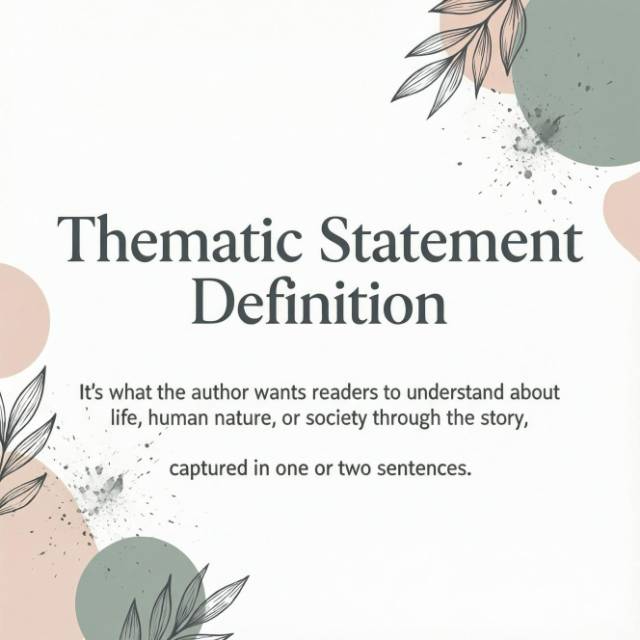
A thematic statement is a complete sentence that expresses the central message or deeper meaning of a literary work.
Think of it this way:
Theme (just a topic): "Love"
Thematic statement (complete message): "Love requires sacrifice and often means putting others' needs before your own desires"
The thematic statement takes the abstract concept (love) and makes a specific claim about it that the literary work demonstrates through plot, characters, and events.
The Three Key Elements
Every strong thematic statement contains these components:
1. The Theme/Topic
The central concept the work explores (love, power, identity, freedom, justice, etc.)
2. The Context
How the theme connects to the specific work or the conditions under which it operates
3. The Insight/Message
What the author reveals about that theme the takeaway about human experience, society, or life
Example breakdown:
"Power corrupts individuals by gradually eroding their moral boundaries and transforming their priorities from service to self interest."
|
Why Thematic Statements Matter
- For literary analysis:
They help you articulate the deeper meaning of a text beyond surface level plot summary - For essay writing:
A clear thematic statement guides your entire analysis and gives your essay focus - For understanding literature:
Identifying thematic statements deepens comprehension and reveals authorial intent - For your own writing:
Understanding how thematic statements work makes you a better storyteller
When teachers assign literary analysis essays, they're usually asking you to identify and prove a thematic statement, even if they use different terminology like "central message," "main idea," or "what the author is saying about..."
Turn Notes into Knowledge
Transform dense materials into digestible content with professional help.
- Completely original work
- Suited for all subjects and levels
- Tailored to your study needs
- Guaranteed punctual delivery
Save time and boost grades with expert academic assistance.
Order NowThematic Statement vs Theme vs Thesis vs Topic
These terms get confused constantly. Here's the clear breakdown.
Thematic Statement vs Theme
The most common confusion. Here's the difference:
| Theme | Thematic Statement |
|---|---|
| One or two words | Complete sentence |
| General topic/concept | Specific claim about that topic |
| What the story is about | What the story says about that topic |
| Examples: Love, power, freedom | Examples: "Love requires sacrifice," "Power corrupts" |
| Abstract and open to interpretation | Concrete and debatable |
Practical example:
If you're analyzing Animal Farm:
|
Think of it like this: Theme is the question the story asks. Thematic statement is the answer it provides.
Thematic Statement vs Thesis Statement
These terms sometimes overlap but serve different functions:
| Thematic Statement | Thesis Statement |
|---|---|
| Identifies the work's message | Makes an argument you'll prove |
| What the author is saying | What you are arguing |
| Universal and objective | Specific to your essay |
| Used in creative works | Used in analytical essays |
| Can be factual | Must be debatable |
Example to clarify:
Thematic statement about 1984: "Totalitarian governments maintain control by manipulating language, rewriting history, and eliminating privacy." Thesis statement for your essay about 1984: "Orwell's 1984 demonstrates that language manipulation is the most powerful tool of totalitarian control because it shapes thought itself, making rebellion literally unthinkable." See the difference? The thematic statement identifies what Orwell is saying. Your thesis statement argues how he says it or why a particular aspect matters most. |
When they overlap:
In thematic analysis essays, your thesis statement often IS a thematic statement because you're arguing what the work's central message is.
Thematic Statement vs Topic
Topics are the broadest category simple subjects without analysis.
| Topic | Thematic Statement |
|---|---|
| General subject matter | Specific message about that subject |
| No interpretation | Includes interpretation |
| "The essay is about climate change" | "Climate change demonstrates humanity's unwillingness to sacrifice immediate comfort for long term survival" |
| Starting point for discussion | Result of analytical thinking |
Quick test:
- If it's 1–2 words? Theme or topic
- If it's a phrase without a verb? Topic
- If it's a complete sentence making a claim? Thematic statement or thesis
How to Write a Thematic Statement: 7 Step Process
Follow this systematic approach to craft strong thematic statements for any literary work.
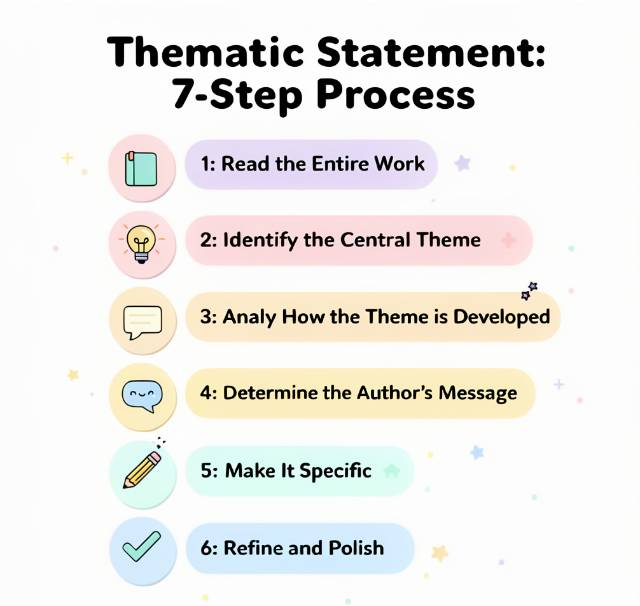
Step 1: Read the Entire Work Thoroughly
You can't write a thematic statement about a work you haven't finished or fully understood.
What to track while reading:
- Recurring ideas: What concepts appear repeatedly?
- Character arcs: How do characters change? What do they learn?
- Conflicts: What struggles drive the story?
- Resolution: How do conflicts resolve? What does the ending suggest?
- Symbolism and literary devices: What deeper meanings do symbols convey?
- Author's tone: What's the author's attitude toward the subject?
Active reading strategies:
- Take notes as you read, marking passages that seem important. Ask yourself: "Why did the author include this?" and "What is this showing me about the human experience?"
- Identify pivotal moments where characters make important choices or realizations. These often reveal the work's message.
- Pay attention to how the author positions readers to feel about events and characters.
Step 2: Identify the Central Theme
What is the work fundamentally about? Not the plot the underlying concept.
Common universal themes:
- Love (romantic, familial, platonic)
- Power and corruption
- Identity and self discovery
- Good vs. evil
- Coming of age
- Survival
- Justice vs. injustice
- Freedom vs. oppression
- Fate vs. free will
- Appearance vs. reality
- Individual vs. society
- Human nature
- Mortality and death
- Hope and resilience
How to identify the main theme:
- Look for what characters struggle with most fundamentally. What abstract concept drives their major decisions and conflicts?
- Consider what the work would lose if you removed this element. The true central theme is essential to the story's meaning.
- Note that works often have multiple themes. Choose the most prominent one or the one you'll analyze for your assignment.
Step 3: Analyze How the Theme is Developed
How does the author explore this theme throughout the work?
Questions to ask:
- What do characters say and do related to this theme?
- How does the plot demonstrate or challenge ideas about this theme?
- What symbols or motifs reinforce this theme?
- Does the author present multiple perspectives on this theme?
- How does the setting relate to the theme?
- What does the resolution suggest about this theme?
Example analysis for Lord of the Flies (theme: civilization vs. savagery):
| Characters gradually abandon civilized behavior (Ralph's leadership weakens). The conch shell symbolizes order and loses power as boys become savage. The island setting removes societal structures. Resolution shows savagery overtaking civilization. Multiple perspectives: Ralph tries maintaining civilization, Jack embraces savagery, Simon recognizes evil within humanity. |
Step 4: Determine the Author's Message
What conclusion does the work reach about the theme? What truth about human nature or society does it reveal?
This is the heart of your thematic statement.
Don't just describe what happens. Interpret what it means.
Describing: "In Animal Farm, the pigs take over and become like humans"
Interpreting: "Power corrupts even the most idealistic revolutionaries, transforming them into the very tyrants they overthrew"
Ask yourself:
- If the author could tell me one thing about [theme], what would it be?
- What lesson or insight does the work offer about [theme]?
- What does the ending reveal about the author's perspective?
- What warning, celebration, or observation is the author making?
Step 5: Write Your Initial Statement
Combine theme + insight into a complete sentence.
Use this basic structure:
"[Theme] demonstrates/reveals/shows that [specific insight about human nature/society/life]"
Or:
"[Specific insight] [relates to theme]"
Initial draft examples:
"Power corrupts people and turns them bad" These are weak but they're starting points. You'll refine them next. |
Step 6: Make It Specific and Universal
Strong thematic statements are paradoxically both specific and universal.
Make it specific:
Add details about how or why the theme operates
Vague: "Love is important"
Specific: "Love requires individuals to prioritize others' needs above their own desires, often demanding significant personal sacrifice"
Make it universal:
Use general terms that apply beyond the specific story
Too specific to the work: "Katniss learns that fighting the Capitol requires sacrifice"
Universal: "Rebellion against oppressive systems requires individuals to risk what they hold most dear"
Remove character names and specific plot details. Your thematic statement should apply to the human condition, not just the specific story.
Step 7: Refine and Polish
Review your statement against these quality criteria:
- Is it a complete sentence? Not a fragment or phrase
- Does it avoid clichés? "Life is a journey," "love conquers all," "honesty is the best policy" these are too generic and overused
- Does it avoid absolute terms? Unless you're certain, avoid "always," "never," "all," "everyone." Use "often," "can," "may," "sometimes" instead
- Is it debatable? Someone should be able to reasonably disagree or offer a different interpretation
- Does it reflect the work accurately? Make sure the story actually supports your statement
- Is it concise? One or two sentences maximum. If you need more, you're probably trying to address multiple themes
Thematic Statement Template & Formula
Use these formulas to structure your thematic statements effectively.
Basic Template
[Theme] + [reveals/demonstrates/shows that] + [specific insight about human nature/society/life]
Examples:
"Power reveals that even idealistic revolutionaries become corrupted when they gain control, transforming into the tyrants they once opposed."
"Identity demonstrates that true self-discovery requires rejecting societal expectations and embracing one's authentic nature, regardless of external pressure."
Advanced Template (Cause Effect)
[Theme] + [operates by] + [mechanism/process] + [resulting in] + [consequence]
Examples:
"Totalitarian control operates by manipulating language and erasing history, resulting in populations unable to conceive of resistance."
"Prejudice operates by reducing complex individuals to simplistic stereotypes, resulting in systemic injustice and dehumanization."
Conditional Template
[When condition], [theme] + [demonstrates/reveals] + [insight]
Examples:
"When individuals face survival threats, morality reveals itself as a social construct that erodes when civilization's structures disappear."
"When power goes unchecked, corruption demonstrates that absolute authority inevitably breeds abuse, regardless of initial intentions."
Thematic Statement Formula by Theme
Here are fill in the blank templates for common themes:
Identity:
"Identity is explored through [context/situation], showing that [insight about self-discovery/authenticity]."
Example: "Identity is explored through the protagonist's cultural displacement, showing that belonging requires balancing heritage with adaptation."
Love:
"Love is depicted through [specific manifestation], revealing that [insight about love's nature or requirements]."
Example: "Love is depicted through unconditional parental sacrifice, revealing that authentic love prioritizes the beloved's wellbeing over the lover's desires."
Power:
"Power [operates/corrupts/influences] by [mechanism], demonstrating that [insight about power's effects]."
Example: "Power corrupts by isolating leaders from consequences, demonstrating that authority without accountability breeds tyranny."
Freedom:
"Freedom [requires/costs/means] [specific requirement], showing that [insight about liberty's nature]."
Example: "Freedom requires constant vigilance against oppression, showing that liberty is maintained through active resistance, not passive hope."
Turn Confusing Data into Original Work
Our team ensures your assignments are plagiarism proof.
- Clear paraphrasing strategies
- Correct citation formats
- AI content ethically used
- 100% original and verified
Protect your grades and academic record with expert help.
Get Started NowThematic Statement Examples
Learn from strong examples across different themes and literary works.
Examples for "The Great Gatsby"
Theme: The American Dream "The American Dream promises opportunity and success to those who work hard, but The Great Gatsby reveals that this promise is an illusion for those born without wealth and privilege." "Pursuing the American Dream through material accumulation leads to spiritual emptiness and moral corruption rather than fulfillment." Theme: Love and Obsession "Romantic obsession blinds individuals to reality, transforming idealized love into destructive fantasy that prevents genuine connection." "The past cannot be recreated, and attempting to recapture lost love leads only to tragedy and disillusionment." |
Examples for "To Kill a Mockingbird"
Theme: Racial Injustice "Systemic racism persists not through explicit hatred alone but through communities' willingness to prioritize social order over justice." "Moral courage means standing against injustice even when the fight is already lost, because the act of resistance preserves human dignity." Theme: Loss of Innocence "Coming of age means confronting society's ugliness and choosing whether to become cynical or maintain moral integrity despite disillusionment." |
Examples for "1984"
Theme: Totalitarianism "Totalitarian governments maintain absolute control by manipulating language, rewriting history, and eliminating privacy, making rebellion literally unthinkable." "When authority controls information and language, truth becomes whatever those in power decree, destroying the foundation of resistance." |
Examples for "Animal Farm"
Theme: Power and Corruption "Revolutionary movements inevitably replicate the oppressive structures they oppose as leaders prioritize maintaining power over achieving original idealistic goals." "Power corrupts even the most well intentioned individuals by creating class distinctions and justifications for inequality." |
Examples for "The Hunger Games"
Theme: Media and Control "Spectacle and entertainment serve as tools of oppression, distracting populations from injustice while normalizing violence and suffering." "Survival in oppressive systems requires individuals to perform assigned roles while secretly maintaining autonomous identity." Theme: Sacrifice "Protecting those we love requires sacrificing personal safety and freedom, demonstrating that love's strength is measured by what we're willing to lose." |
Examples for "Lord of the Flies"
Theme: Civilization vs. Savagery "Civilization is a fragile veneer that collapses without societal structures, revealing humanity's inherent capacity for violence and chaos." "Evil exists within all humans, and only social constraints prevent its manifestation; remove those constraints, and savagery emerges." |
Examples for "Romeo and Juliet"
Theme: Love and Fate "Passionate love can transcend social divisions and family loyalty, but such defiance of social order often leads to tragedy." "Youthful passion, while genuine, lacks the wisdom necessary to navigate complex social realities, leading to impulsive decisions with fatal consequences." |
Examples for "The Crucible"
Theme: Integrity "Maintaining personal integrity in the face of corrupt authority requires individuals to accept death rather than compromise their principles." "Mass hysteria enables those seeking power to manipulate fear, transforming communities into instruments of oppression." |
Examples by Universal Themes
Identity: "True identity emerges through adversity and self reflection, not through conformity to external expectations." "Cultural identity requires balancing heritage with adaptation, accepting that belonging means carrying multiple identities simultaneously." Revenge: "Seeking revenge consumes the avenger more than it harms the target, transforming justified anger into self destructive obsession." Coming of Age: "Maturity requires accepting that life contains irresolvable complexity and moral ambiguity rather than clear heroes and villains." Isolation: "Social isolation strips away civilized behavior, revealing both humanity's capacity for cruelty and its desperate need for connection." Hope: "Hope persists even in the darkest circumstances because humans create meaning through connection and resistance, not through favorable conditions." |
By following the steps outlined, you can express the theme clearly. You can take help from our essay writing service to refine your ideas.
Thematic Statements: Common Mistakes to Avoid
Don't make these errors that weaken thematic statements.
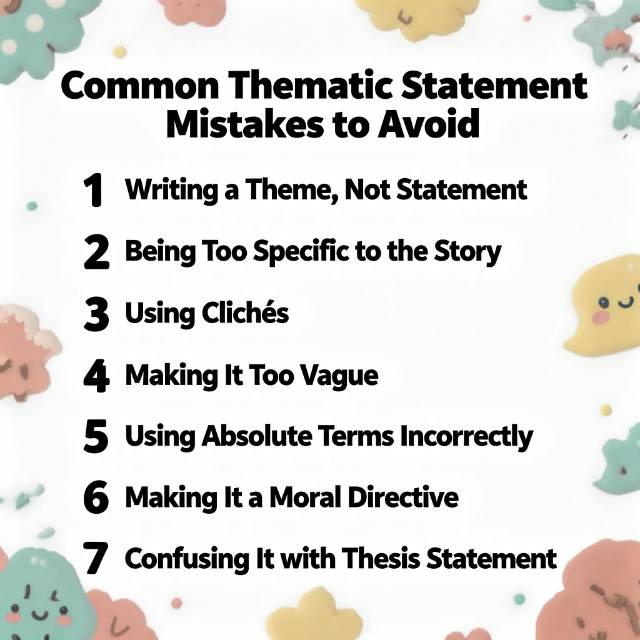
Mistake 1: Writing a Theme, Not a Statement
The problem:
Students write "love" or "the American Dream" and think they're done.
Why it's wrong:
These are topics/themes, not statements. A statement must be a complete sentence that makes a claim.
How to fix it:
Wrong: "Power" Wrong: "Coming of age" |
Mistake 2: Being Too Specific to the Story
The problem:
Including character names, specific plot points, or details unique to one work.
Why it's wrong:
Thematic statements should be universal truths about human experience that the specific story illustrates.
How to fix it:
Wrong: "Gatsby's love for Daisy shows that you can't recreate the past" Wrong: "Katniss learns that rebelling against the Capitol requires sacrifice" |
Mistake 3: Using Clichés
The problem:
Relying on overused phrases that lack originality or depth.
Common clichés to avoid:
- "Life is a journey, not a destination"
- "Love conquers all"
- "Honesty is the best policy"
- "What doesn't kill you makes you stronger"
- "Good always triumphs over evil"
How to fix it:
Be specific about how the theme operates in the work. Add nuance that reflects the story's complexity. Wrong: "Love conquers all" |
Mistake 4: Making It Too Vague
The problem:
Statements so general they could apply to any work or say nothing meaningful.
How to fix it:
Add specificity about the mechanism, condition, or consequence. Wrong: "War is bad" Wrong: "Family is important" |
Mistake 5: Using Absolute Terms Incorrectly
The problem:
Using "always," "never," "all," "everyone" when the work doesn't support such absolute claims.
How to fix it:
Use qualifiers like "often," "can," "may," "sometimes" unless you're genuinely certain. Wrong: "Power always corrupts everyone who has it" Right: "Power tends to corrupt those who hold it by creating distance from consequences and enabling abuse" |
Mistake 6: Making It a Moral Directive
The problem:
Telling readers what they "should" do rather than observing what the work reveals.
How to fix it:
Describe and analyze; don't prescribe and command. Wrong: "People should always tell the truth" Wrong: "You must stand up for what's right" |
Mistake 7: Confusing It with Your Thesis Statement
The problem:
Writing what you're arguing (thesis) instead of what the work is saying (thematic statement).
Remember:
Thematic statement = What the author is saying
Thesis statement = What you're arguing about the work
Example to clarify:
Thematic statement: "Social class determines access to justice, with wealth enabling escape from consequences while poverty ensures punishment." Thesis statement for your essay: "Fitzgerald uses contrasting treatment of Gatsby and Tom to demonstrate how social class determines access to justice in 1920s America." |
Get Stress Free Academic Help
Focus on learning while we handle your assignments
- Clear explanations of key points
- Original writing guaranteed
- Timely submission
- Supports essays, reports, and projects
Save time and boost grades with expert academic assistance.
Get Started NowReady to Write Strong Thematic Statements?
You now understand exactly what thematic statements are, how they differ from related concepts, and the complete process for writing them effectively.
Here's what you learned:
- Thematic statements are complete sentences expressing a work's central message
- They differ from themes (topics), thesis statements (your arguments), and plot summaries
- The 7 step process takes you from reading to polished statement
- Strong statements are specific yet universal, avoiding clichés and absolutes
- Common mistakes include being too vague, too specific, or not making complete claims
The key to mastering thematic statements? Practice. Every time you read, ask yourself: "What is this work saying about human nature, society, or life?" Turn that answer into a complete sentence, and you've got your thematic statement.
Start with works you know well. Write thematic statements for your favorite books, movies, or stories. The more you practice identifying and articulating themes, the easier it becomes.