What Is an Appendix?
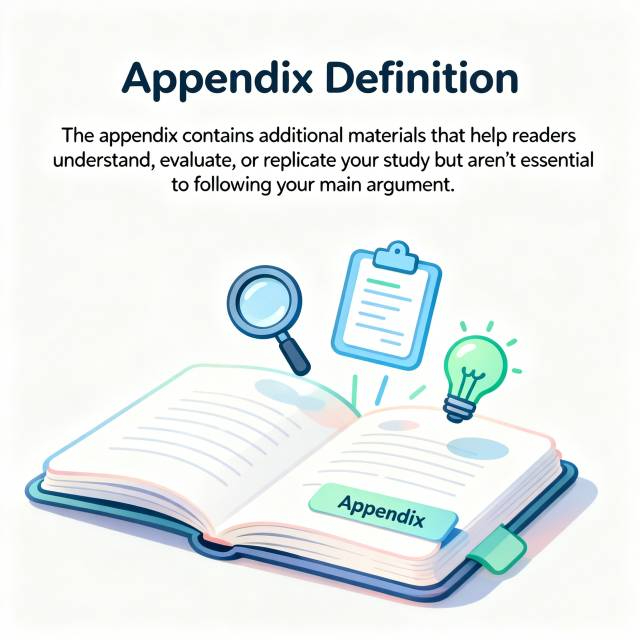
An appendix is supplementary material placed at the end of your paper (after the reference list) that supports your research but would disrupt the flow of your main argument if included in the body text.
The Key Principle
Include material in an appendix only if it helps readers understand, evaluate, or replicate your work.
If the material is:
- Essential to understanding your argument: Goes in main text
- Helpful for deeper understanding or verification: Goes in appendix
- Irrelevant to your argument: Don't include it at all
What an Appendix Is NOT
Understanding what appendices aren't prevents common confusion:
- NOT the same as a reference list/bibliography (references = works you cited; appendix = supplementary materials you created or collected)
- NOT a place to dump everything you researched (only include materials directly related to your paper)
- NOT required for every paper (many papers don't need appendices)
- NOT part of your main text (readers should be able to fully understand your paper without reading the appendix)
| An appendix is a collection of supporting materials organized separately from your main argument |
Turn Confusing Data into Original Work
Our team ensures your assignments are plagiarism proof.
- Clear paraphrasing strategies
- Correct citation formats
- AI content ethically used
- 100% original and verified
Protect your grades and academic record with expert help.
Get Started NowWhen to Use an Appendix
Not every paper needs an appendix. Use one when you have supplementary materials that meet these criteria:
You SHOULD Include an Appendix When:
1. You have raw data that supports your analysis
- Survey results (individual responses)
- Experimental data tables
- Statistical calculations
- Interview transcripts
2. Your research instruments need to be shown
- Complete questionnaires or surveys
- Interview protocols
- Testing materials
- Consent forms
3. You have detailed technical information
- Mathematical proofs
- Complex equations or formulas
- Detailed methodological descriptions
- Programming code
4. You have large visual materials
- Full size charts too large for main text
- Additional graphs showing supplementary findings
- Detailed diagrams
- Maps
5. You need to show exact wording of materials
- Complete copies of legal documents
- Full text of historical sources
- Lists of materials or stimuli
- Detailed protocols
You DON'T Need an Appendix When:
- The material is essential to your argument: Put it in main text instead
- You're just citing someone else's work: Put it in references, not appendix
- The information is brief enough to include in text: Keep it in the body
- It's not directly relevant to your study: Don't include it at all
| Quick test: Ask yourself, "If someone wanted to replicate my study or verify my findings, would they need this?" If yes, consider an appendix. |
What Goes in an Appendix (and What Doesn't)
Here's a comprehensive breakdown of appropriate appendix materials:
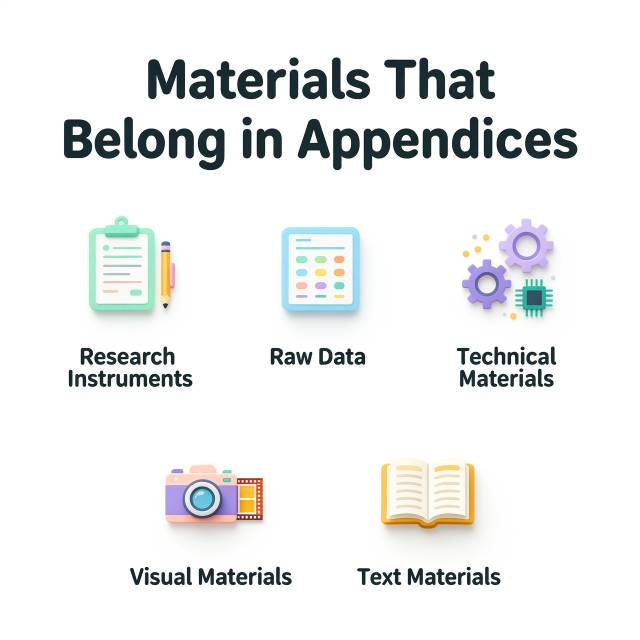
Materials That Belong in Appendices
Research Instruments:
- Complete questionnaires or surveys
- Interview questions and protocols
- Testing materials or assessments
- Observation checklists
- Consent forms
Raw Data:
- Individual participant responses
- Complete data sets
- Statistical calculations and output
- Experimental measurements
- Coding schemes
Technical Materials:
- Mathematical proofs
- Complex formulas and derivations
- Detailed methodological descriptions
- Programming code or algorithms
- Technical specifications
Visual Materials:
- Large tables or charts
- Additional graphs
- Detailed diagrams or schematics
- Maps
- Photographs (when supplementary)
Text Materials:
- Interview transcripts (full or representative samples)
- Complete text of short documents
- Lists (of stimuli, materials, etc.)
- Detailed protocols or procedures
Materials That DON'T Belong in Appendices
- Works by other authors: Goes in reference list, not appendix
- Brief data that fits in main text: Include in body of paper with your analysis
- Your literature review notes: Not relevant to final paper
- Draft versions of your paper: Never include
- Irrelevant materials: If it doesn't support your argument, don't include it
The "Would It Disrupt Flow?" Test
For any material, ask:
"If I put this in my main text, would it:
- Interrupt my argument?
- Bury my key points?
- Make readers lose track of my main ideas?
- Take up more than half a page of space?"
If YES to any = Consider an appendix
If NO to all = Keep it in main text
APA 7th Edition Appendix Format
APA (American Psychological Association) style is used primarily in psychology, education, and social sciences. Here are the complete formatting rules:
Placement and Order
Where appendices go (in this exact order):
- Title page
- Abstract (if required)
- Main body of paper
- References
- Appendices = Go here
- Tables (if not placed in text or appendices)
- Figures (if not placed in text or appendices)
Critical rule: Appendices always come after the reference list, never before.
Labeling Appendices
If you have ONE appendix:
- Label it simply Appendix (no letter needed)
- Example: Appendix at top of page
If you have MULTIPLE appendices:
- Label them Appendix A, Appendix B, Appendix C, etc.
- Order them by the sequence they're mentioned in your paper
First mentioned in text = Appendix A
Second mentioned = Appendix B
Formatting the label:
- Bold and centered at top of page
- Use title case
- Example: Appendix A
Title Requirements
Every appendix needs a descriptive title on the line below the label.
Format:
- Bold and centered
- Title case (capitalize major words)
- Describes the content clearly
Examples:
Appendix A Appendix B Appendix C |
Content Formatting
Standard text appendices:
- Use the same font and size as the main paper (typically Times New Roman, 12-point)
- Double space text
- Use standard 1 inch margins
- Indent the first line of paragraphs
Appendices with tables:
- Each table gets a number: Table A1, Table A2 (in Appendix A)
Or Table B1, Table B2 (in Appendix B) - Include table title in italics below the table number
- Left align tables (not centered)
Appendices with figures:
- Each figure gets a number: Figure A1, Figure A2 (in Appendix A)
- Include figure title in italics below the figure number
- Left align figures
Special Case: Appendix Contains Only One Table/Figure
If your entire appendix is just one table or one figure:
Replace the table/figure number with the appendix label.
Example:
Instead of: Appendix A Use: Appendix A The appendix label replaces the table/figure label when that's all the appendix contains. |
How to Reference Appendices in Text (APA)
Mention every appendix at least once in your paper's main text.
Format options:
- "Participants completed a demographic questionnaire (see Appendix A)."
- "The complete interview protocol is provided in Appendix B."
- "For the full statistical output, see Appendix C."
- "As shown in Appendix D, response rates varied significantly..."
Key rules:
- Use parentheses OR integrate naturally into sentence
- Capitalize Appendix when referring to it
- Use the label (A, B, C), not the title
Copyright Attribution in Appendices
If you didn't create the appendix content (e.g., you're reproducing someone else's survey or figure):
Include a copyright note below the material.
For reprinted material:
Note. From "Title of Source," by A. Author, Year, Journal Name, Volume(Issue), p. XX (DOI or URL). Copyright Year by Copyright Holder. Reprinted with permission.
For adapted material:
Note. Adapted from "Title of Source," by A. Author, Year, Journal Name, Volume(Issue), p. XX (DOI or URL). Copyright Year by Copyright Holder. Adapted with permission.
Important: You must also include the full reference in your reference list.
If you want to learn about APA citation style, visit our complete APA citation guide.
Get Stress Free Academic Help
Focus on learning while we handle your assignments
- Clear explanations of key points
- Original writing guaranteed
- Timely submission
- Supports essays, reports, and projects
Save time and boost grades with expert academic assistance.
Get Started NowMLA Format for Appendices
MLA (Modern Language Association) style is used primarily in humanities English, literature, languages, and philosophy.
MLA Appendix Basics
Placement:
After the Works Cited page (MLA's version of reference list)
Labeling:
- Appendix (singular) or Appendix A, Appendix B (multiple)
- Centered at top of page
- Not bold or italicized in MLA
Title:
- On next line, centered
- Not bold or italicized
Example:
| Appendix A Complete Survey Questions |
Referencing Appendices in MLA
In text:
- "The complete questionnaire appears in Appendix A."
- "For detailed results, see Appendix B."
If you want to learn about MLA citation style, visit our complete MLA citation guide.
MLA Format Differences from APA
| Element | APA 7th | MLA 9th |
|---|---|---|
| Label format | Bold, title case | Plain text, title case |
| Title format | Bold, title case | Plain text, title case |
| Spacing | Double spaced | Double spaced |
| Placement | After References | After Works Cited |
| Tables/figures | Numbered (Table A1) | May use the Appendix label directly |
MLA uses the same reference pattern as APA, which mentions the appendix by label, not title. For a comparison between the two, browse our MLA vs APA format.
Chicago Style Appendix Format
Chicago style (used in history, some humanities, and publishing) offers two systems: Notes Bibliography and Author Date. Appendix formatting is similar for both.
Chicago Appendix Basics
Placement:
- After the reference list/bibliography
- Before any endnotes (if using notes system)
Labeling:
- Appendix or Appendix A, Appendix B
- Centered at top of page
- Not bold (Chicago uses plain text)
Title:
- Next line, centered
- Not bold
Chicago Format Notes
Chicago is more flexible than APA or MLA:
- Allows more variation in formatting
- Often follows publisher's house style
- Check specific requirements if writing for publication
Standard Chicago Appendix
Appendix A [Content here, following standard Chicago formatting] |
Learn about different citation styles in our complete citation style guide.
How to Create Multi Item Appendices
When your appendix contains multiple tables, figures, or sections, follow these organization rules:
Multiple Items in One Appendix
If Appendix A contains 3 tables:
Appendix A Table A1 [Table content] Table A2 [Table content] Table A3 [Table content] |
Key points:
- All tables stay within Appendix A
- Number sequentially: A1, A2, A3
- Each table gets descriptive italic title
Combining Text and Visuals
If your appendix includes both text and a table:
Appendix B This appendix contains the complete interview protocol used in the study, followed by demographic data for all participants. Interview Questions How long have you been teaching? Table B1 [Table showing age, gender, experience, etc.] |
Format:
- Text comes first
- Tables/figures follow
- Everything labeled with the appendix letter
Common Appendix Formatting Mistakes
These errors cost students points on every paper. Avoid them:
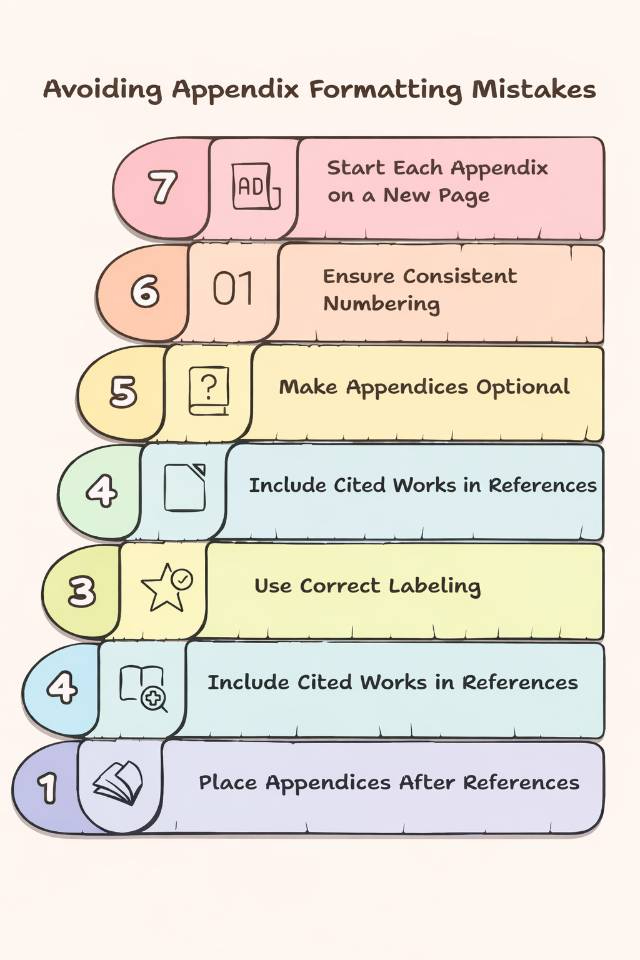
Mistake 1: Placing Appendices Before References
Wrong order: Title page, Body, Appendices, References
Correct order: Title page, Body, References, Appendices
Why it matters: Every style guide specifies references come first, then appendices. Reversing this signals you don't know basic formatting.
Mistake 2: Including Appendix Without Mentioning It in Text
Wrong: Including Appendix C but never referring to it in your paper
Right: Mentioning every appendix at least once:
"See Appendix C for complete data"
Rule: If you don't reference it in your paper, don't include it as an appendix.
Mistake 3: Wrong Labeling Format
Wrong:
"Appendix 1" or "Appendix One" (wrong use of letters, not numbers)
"Appendix: Survey Questions" (wrong title goes on next line)
Not bold in APA (wrong APA requires bold)
Right: Correct APA format: Appendix A |
Mistake 4: Including Cited Works in Appendix Instead of References
Wrong: Putting a journal article you cited in an appendix
Right: Journal articles you cited go in References; materials YOU created go in appendices
Remember: Appendix = your materials. References = others' works you cited.
Mistake 5: Making the Appendix Required Reading
Wrong: Putting essential information only in the appendix
Right: Main paper should be complete without appendix; appendix provides supplementary detail
Test: Can readers understand your argument without reading the appendix? If no, that information belongs in your main text.
Mistake 6: Inconsistent Numbering
Wrong:
Appendix A has Table 1, Table 2 (missing the letter)
Jumping from Table A1 to Table A3 (skipping A2)
Right: Appendix A has Table A1, Table A2, Table A3 in order
Mistake 7: Not Starting Each Appendix on a New Page
Wrong: Appendix B starting immediately after Appendix A on the same page
Right: Each appendix begins on its own page
APA rule: Every appendix starts on a fresh page, just like chapters.
Tips for Writing an Appendix
Here are some tips that help you write the perfect appendix without difficulty.
- Add all appendices at the document’s start in the table of contents.
- Add information that is too detailed for the main body of your paper.
- Add in-text citation if you refer to a source in the appendix.
- When more than one appendix writes either appendix A, appendix 1
- Use the proper format for MLA, Chicago, and an APA paper.
- Always refer to the appendix to the main text.
- Review and revise it before submitting.
- No gap between the numbering when you move from main text to appendix.
- In MLA style, the appendix appears before the Work Cited page.
- You can also add handwritten notes and analyses in your appendix.
- Avoid writing two appendices that deal with the same thing.
- The content in the appendix is easy to see and understand. It should not take a large amount of time or be too complex for the readers.
- Get help from examples and samples.
Now, you know how to write an appendix. But if you still feel unsure, fill out the order form today and get assistance from our reliable essay writing service to ensure your work stands out.
Appendix Writing Free Downloadables
A well written example always helps the students in their writing phase. Thus, for your help, we compiled some great examples.
Turn Notes into Knowledge
Transform dense materials into digestible content with professional help.
- Completely original work
- Suited for all subjects and levels
- Tailored to your study needs
- Guaranteed punctual delivery
Save time and boost grades with expert academic assistance.
Order NowConclusion: Appendices Done Right
Appendices are simple once you understand the rules: they contain supplementary materials you created, come after references, follow specific formatting for your style guide, and are mentioned in your main text.
The essentials:
- Only include materials that support but don't belong in main text
- Place appendices after references, never before
- Label correctly (Appendix or Appendix A, B, C)
- Format labels and titles bold/centered (APA) or plain/centered (MLA/Chicago)
- Number tables/figures with appendix letter (Table A1)
- Reference every appendix at least once in main text
- Start each appendix on a new page
Remember: Your main paper should be complete without the appendix. Appendices provide transparency, verification, and depth, but readers shouldn't need them to understand your argument.
Now format those appendices correctly and never lose points for formatting again.