What Is an Opinion Essay?
An opinion essay is a formal piece of writing where you state your position on a debatable issue and support it with reasons, evidence, and logical arguments.
Simple definition:
You take a clear stand on a controversial topic, explain why you hold that view, and persuade readers that your position is reasonable and well founded.
The Three Essential Elements
|
What Makes a Good Opinion Essay?
Strong opinion essays share these qualities:
- Definitive stance: Clear from the start where you stand
- Logical reasoning: Uses “because” statements that make sense
- Evidence based: Facts, statistics, examples, expert opinions
- Fair representation: Acknowledges opposing views honestly
- Persuasive tone: Confident but not arrogant or dismissive
Bad Opinion Essay Example
School uniforms are good because I think they help students. Some people disagree but they’re wrong.
Good Opinion Essay Example
School uniforms should be mandatory in public schools because research from the National Association of Elementary School Principals demonstrates that schools with uniform policies report 63% fewer disciplinary incidents. While critics argue uniforms restrict self expression, this concern overlooks that students express themselves primarily through behavior, relationships, and academic work, none of which uniforms constrain.
See the difference? Specific, evidence based, and addresses opposition.
Why Write Opinion Essays?
- For school: Teachers assess your ability to form and defend positions
- For tests: Standardized tests often include opinion writing
- For college: Application essays frequently ask for your views
- For life: Every professional argument proposal, recommendation, and advocacy uses opinion essay skills
There’s no single purpose opinion writing is foundational to academic and professional success.
Need it Written Today? Ready to Hand it Off?
Our expert writers create hundreds of essays daily:
- Custom research on any topic
- Expert writers across all subjects
- Plagiarism-free guarantee
- Rush delivery available
Join 73,000+ students who've trusted us
Order NowOpinion Essay vs Other Essay Types
Feature | Opinion Essay | |
Primary goal | State your view | Presents the strongest position |
Tone | Personal, persuasive | Objective, formal |
Point of view | Personal stake acknowledged | Personal views hidden |
First person | Can use first person | Avoids first person |
Emphasis | Persuasion | Logical proof |
Core approach | Acknowledges subjectivity | Presents position as objective truth |
Key difference:
Opinion essays acknowledge subjectivity (“This is my view and here’s why it’s valid”). Argumentative essays present claims as objective truth (“This is correct based on evidence”).
Opinion Essay vs Persuasive Essay
Feature | Opinion Essay | |
Purpose | Explains and defends your view | Actively tries to change minds |
Focus | Why I believe this | Why you should believe this |
Tone | Academic | Can be emotional or rhetorical |
Note:
In practice, many teachers use these terms interchangeably. Always check your assignment instructions.
Opinion Essay vs Personal Essay
Feature | Opinion Essay | |
Subject | An external issue | Your personal experience |
Style | Formal, academic | Narrative, reflective |
Evidence | Logic, facts, sources | Personal stories |
Focus | Argument | Reflection |
Key difference:
Personal essays explore your life; opinion essays explore your views on external issues.
How to Choose Your Position for Opinion Essay
Not every topic works for opinion essays. Here’s how to find ones worth arguing.
The “Debatable” Test
Ask: Do reasonable, intelligent people disagree about this? Good (debatable): Bad (not debatable): |
Strong Opinion Essay Topics Have:
- Two (or more) defensible sides: Not obvious right/wrong
- Available evidence: You can find facts, statistics, expert opinions
- Real world relevance: Affects actual people or situations
- Clear stakeholders: Identifiable groups with competing interests
- Complexity: Nuance, not simple yes/no
Avoid These Topic Traps:
Purely subjective preferences: “Pizza is better than tacos” Moral absolutes: “Murder is wrong” Settled science: “Is climate change real?” Overly broad: “Technology is good or bad” Purely personal: “Should I major in biology?” |
How to Write an Opinion Essay: Step by Step
Follow this process to turn your opinion into a structured, persuasive essay.
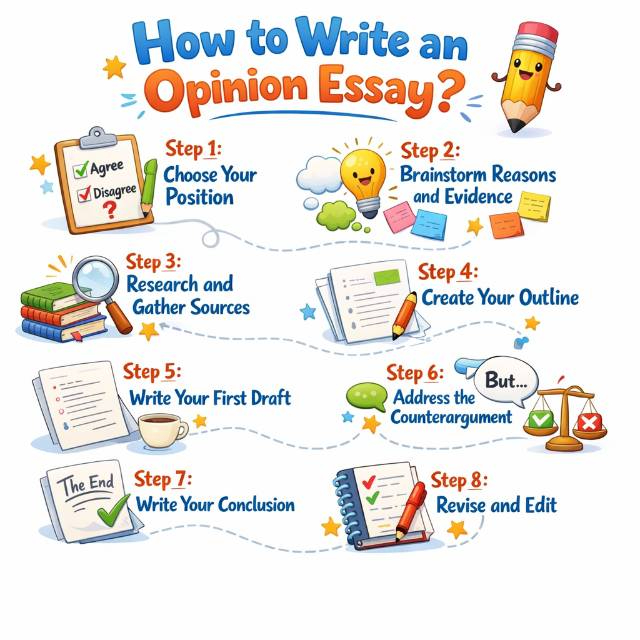
Step 1: Choose Your Position
Select a topic where you can take a clear stand.
Decision process:
- List 3–5 debatable topics you care about
- Research briefly: Does evidence exist to support multiple views?
- Check your genuine view: what do you actually believe?
- Assess defensibility: can you find 3+ strong reasons for your position?
Pro tip: You don’t have to write about what you truly believe. Sometimes the “harder” position makes a better essay because it forces stronger reasoning.
Step 2: Brainstorm Reasons and Evidence
Before outlining, generate all possible support for your position.
Create three lists:
Reasons (WHY you hold this view):
Evidence (PROOF for each reason):
Counter reasoning (arguments AGAINST your view):
|
Step 3: Research and Gather Sources
Don’t rely on what you already know. Find actual evidence.
Where to find credible evidence:
- Academic sources: Google Scholar, JSTOR, university databases
- News sources: Major newspapers, news magazines (check multiple sources)
- Government data: Census, CDC, Department of Education, etc.
- Research organizations: Pew Research, Gallup, think tanks
- Expert testimony: Quotes from recognized authorities
What NOT to use:
- Random blogs
- Social media opinions
- Wikipedia (use it to find sources, don’t cite it)
- Heavily biased sources without acknowledging bias
Step 4: Create Your Outline
Organize your argument logically before writing.
Standard opinion essay outline:
I. Introduction
Hook (get attention)
Background (context on the issue)
Thesis statement (your position + main reasons)
II. Body Paragraph 1: First Reason
Topic sentence
Evidence
Explanation
III. Body Paragraph 2: Second Reason
Topic sentence
Evidence
Explanation
IV. Body Paragraph 3: Third Reason
Topic sentence
Evidence
Explanation
V. Counterargument & Refutation
Acknowledge the strongest opposing view
Explain why your position still stands
VI. Conclusion
Restate thesis
Summarize main points
Call to action or broader implication
O[inion Essay Example Outline
Topic: Should high schools require financial literacy courses?
I. Introduction
Hook: 63% of Americans can’t pass a basic financial literacy test
Background: Most states don’t require personal finance education
Thesis: High schools should mandate financial literacy courses because graduates need practical money skills, early education prevents costly mistakes, and schools exist to prepare students for real life
II. Reason 1: Practical necessity
Evidence: Average college graduate has $30K debt, most don’t understand loan terms
Evidence: 40% of Americans can’t cover a $400 emergency
Explanation: Life requires financial decisions; school should prepare students
III. Reason 2: Prevention
Evidence: Study showing early education reduces bankruptcy rates
Evidence: Countries with mandatory financial education have higher savings rates
Explanation: Teaching before mistakes prevents lifetime consequences
IV. Reason 3: School’s purpose
Evidence: Education mission statements emphasize “real-world preparation”
Explanation: Financial decisions affect all other life areas
Explanation: If we teach calculus “for logical thinking,” we can teach finance for practical application
V. Counterargument
Address: “Already too much required, where’s the room?”
Refutation: Replace less practical electives or integrate into existing math courses
VI. Conclusion
Restate thesis
Summarize reasons
Call to action: Advocate at school board meetings
Step 5: Write Your First Draft
Now, actually write the essay, following your outline.
Introduction writing tips: hook strategies:
- Startling statistic
- Relevant anecdote
- Provocative question
- Bold statement
Thesis statement formula:
[Position] because [Reason 1], [Reason 2], and [Reason 3].
Step 6: Address the Counterargument
Don’t ignore opposing views; address them directly.
Counterargument structure:
- Acknowledge: state the opposing view fairly
- Concede: admit valid points (if any)
- Refute: explain why your position still stands
Step 7: Write Your Conclusion
What to include:
- Restated thesis (in different words)
- Brief summary of main reasons
- Broader implications or call to action
- Final memorable statement
What NOT to do:
- Introduce new evidence
- Copy the introduction
- Use “In conclusion, I believe…”
- Hedge your position
Step 8: Revise and Edit
First pass: Argument check:
- Is your thesis clear?
- Does each body paragraph support it?
- Is evidence specific and credible?
- Is the strongest counterargument addressed?
Second pass: Clarity check:
- Smooth transitions
- Clear topic sentences
- Explained evidence
- Logical flow
Third pass: Polish:
- Grammar and spelling
- Concision
- Sentence variety
- Correct citations
- Proper formatting
Opinion Essay Structure
Opinion Essay Introduction (10–15% of the Essay)
Purpose: Present the issue and state your position clearly.
What to include:
- Hook that grabs attention
- Brief background on the issue
- Thesis statement with your position and main reasons
Length guidelines:
- 500-word essay: 50–75 words (1 paragraph)
- 1,000-word essay: 100–150 words (1 paragraph)
- 1,500-word essay: 150–225 words (1–2 paragraphs)
Example introduction:
| “Sixty-three percent of Americans failed a basic financial literacy test, according to the National Financial Educators Council. Yet despite this alarming statistic, only seven states require high school students to take a standalone personal finance course before graduation. This gap between knowledge and necessity creates generations of adults making uninformed financial decisions with lifelong consequences. High schools should mandate financial literacy courses because graduates immediately face consequential money decisions, early education prevents costly long term mistakes, and preparing students for real life is education’s fundamental purpose.” |
Opinion Essay Body Paragraphs (60–70% of the Essay)
Each body paragraph focuses on one reason supporting your thesis.
TREE Structure (Use in Each Paragraph)
T = Topic Sentence: State the reason clearly
Example:
“Schools should require financial literacy because graduates immediately face consequential financial decisions.”
R = Reasoning: Explain why this reason matters
Example:
“Within months of graduation, 18-year-olds sign student loan agreements, open credit card accounts, and make housing decisions, all with decade long financial implications.”
E = Evidence: Provide specific proof
Example:
“According to the Consumer Financial Protection Bureau, the average college graduate carries $30,000 in student debt, yet only 17% fully understand their loan terms, interest rates, and repayment options.”
E = Explanation: Connect the evidence back to your position
Example:
“This disconnect between real world demands and educational preparation creates a generation making uninformed decisions that affect them for decades. If schools can justify teaching calculus for logical thinking,’ they can certainly justify teaching students to understand the loans that will affect them for the next twenty years.”
Typical body structure:
|
Opinion Essay Counterargument Paragraph (10–15% of the Essay)
Purpose: Address the strongest opposing view and explain why your position still stands.
What to include:
- Fair statement of the opposing viewpoint
- Acknowledgment of valid concerns
- Explanation of why your position remains stronger
Example counterargument paragraph:
“Critics of mandatory financial literacy courses raise a legitimate concern: school curricula are already overpacked, and adding requirements means removing other content or extending already long school days. The National Council of Teachers of Mathematics argues that students barely have time to meet current graduation requirements. This concern deserves consideration students are indeed managing substantial academic loads. However, this argument assumes current curricula are perfectly optimized for student success. In reality, many requirements offer limited practical value to most students. A senior taking pre-calculus for a third time because graduation requires four years of math might benefit far more from a semester of personal finance. The choice isn’t whether to add financial literacy on top of everything else; it’s whether to replace less practical requirements with immediately applicable life skills. Given that students will use budgeting, credit, and tax knowledge far more frequently than calculus derivatives, prioritizing practical financial education isn’t adding burden; it’s reallocating time more effectively.” |
Opinion Essay Conclusion (10–15% of the Essay)
Purpose: Reinforce your position and leave a lasting impression.
What to include:
- Restated thesis (in new words)
- Brief summary of main reasons
- Broader implications or significance
- Strong closing statement
What NOT to include:
- New evidence or arguments
- Exact repetition of the introduction
- Hedging language (“but that’s just my opinion”)
- Weak endings (“In conclusion, I believe…”)
Example conclusion:
| “The case for mandatory financial literacy education rests on practical necessity, preventive benefits, and education’s fundamental mission. Students graduate into a world demanding immediate financial decisions, early education prevents costly long term mistakes, and real world preparation justifies schooling’s existence. While curriculum space remains limited, the question isn’t whether we can afford to teach practical money skills it’s whether we can afford to keep graduating students who don’t understand interest rates, credit scores, or budgets. Every unprepared graduate enters adulthood at a preventable disadvantage. Schools have both the opportunity and the obligation to eliminate that disadvantage.” |
Supporting Your Opinion with Evidence
Types of Evidence That Work
1. Statistical Data
- Quantitative proof of patterns or trends
- Must cite a credible source
- Example: “63% of Americans fail basic financial literacy tests (NFEC, 2023).”
2. Expert Testimony
- Quotes or findings from authorities
- Must establish the expert’s credentials
- Example: “Dr. Jane Smith, professor of economics at Harvard, argues…”
3. Research Studies
- Peer reviewed findings
- Demonstrate causation or correlation
- Example: “A 2022 longitudinal study in the Journal of Financial Education found…”
4. Real World Examples
- Case studies or specific instances
- Make abstract concepts concrete
- Example: “In Finland, where financial literacy is mandatory, personal bankruptcy rates are 70% lower than in the U.S.”
5. Historical Evidence
- Shows how similar situations played out before
- Demonstrates patterns or consequences
- Example: “When Tennessee made financial literacy mandatory in 2017, student loan default rates dropped 15% within three years.”
6. Logical Reasoning
- “If X, then Y” arguments
- Connect premises to conclusions
- Example: “If education’s purpose is real world preparation, and all adults manage money, then financial education is logically necessary.”
How Much Evidence Per Reason?
- Minimum: 1–2 pieces of specific evidence per reason
- Better: 2–3 pieces from different types (e.g., statistics + expert testimony + real world examples)
Example Paragraph with Multiple Evidence Types
Financial literacy education prevents costly long-term mistakes by establishing good habits before errors compound. [Statistical] According to a 2023 FINRA study, adults who received financial education before age 18 maintain 34% higher credit scores and carry 28% less high-interest debt than those without early education. [Expert testimony] As Dr. Maria Rodriguez, behavioral economist at Stanford, explains, “Financial habits form during the first five years of independence. Education before that window closes prevents decades of correction.” [Real-world example] This pattern appears at the state level: Tennessee implemented mandatory financial literacy in 2017, and within three years, bankruptcy filings among 25–34-year-olds dropped 15% compared to neighboring states without the requirement. Together, these data points demonstrate that early financial education creates lasting positive outcomes.
Struggling With Examples or Structure?
Our professional writers specialize in illustration essays that demonstrate concepts with strong, specific evidence.
- Zero plagiarism, 100% original
- Academic tone and detailed analysis
- Expert editing and formatting
- Confidential and reliable
Get a clear, example-driven essay that impresses your professor.
Order NowCiting Your Sources in an Opinion Essay
In-Text Citation Formats
MLA format: APA format: Chicago format: |
Always Include
- Author or organization name
- Year (for APA and Chicago)
- Page number (if quoting directly)
- Full citation in the Works Cited or References page
Addressing Counterarguments in an Opinion Essay
Why Address Opposition?
Three reasons:
- Shows you’re fair: You’ve considered other views.
- Strengthens your position: Addressing weaknesses makes your argument more complete.
- Prevents easy dismissal: If you ignore obvious objections, readers dismiss your entire argument.
How to Find Strong Counterarguments?
Ask yourself:
- What would someone who disagrees say?
- What are the practical obstacles to my position?
- What evidence contradicts my view?
- What are the costs or downsides of what I’m proposing?
Research opposing views:
- Google your topic + “arguments against”
- Read opinion pieces from the other side
- Find think tanks or organizations opposing your position
- Look for scholarly articles presenting alternative views
The Three-Part Response Structure for Opinion Essays
1. Acknowledge: State the opposing view fairly
Don’t create a straw man. Present the opposition’s strongest argument, not the weakest.
Weak: “Some people think financial literacy isn’t important.”
Strong: “Critics argue that mandating financial literacy courses creates curriculum crowding, forcing schools to cut other valuable subjects or extend school days beyond current capacity.”
2. Concede: Admit valid points (if any)
You don’t have to concede anything, but often the opposition has legitimate concerns.
“This concern has merit. Schools do face real constraints on time and resources, and adding requirements inevitably means difficult choices about what to remove or reduce.”
3. Refute: Explain why your position still stands
Show why your argument remains stronger despite valid concerns.
Refutation strategies:
- Outweigh: “While [opposing concern] is valid, [your benefit] is more important.”
- Alternative solution: “This problem can be solved by [practical solution].”
- Question the premise: “This assumes [assumption], but actually [reality].”
- Comparison: “This same argument was made against [previous change], which proved valuable.”
Example Full Counterargument Paragraph
Acknowledge:
Opponents of mandatory financial literacy courses argue that schools already struggle with curriculum crowding, and adding another requirement means cutting existing subjects or extending school days. The American Federation of Teachers notes that educators feel pressured to cover expanding content, while students report stress from heavy academic loads.
Concede:
These concerns deserve consideration. Schools do face real constraints, and decisions about curriculum inevitably involve tradeoffs. Time and resources are finite.
Refute:
However, this argument assumes that current curricula are optimally designed for student success. In reality, most states require four years of mathematics, including advanced courses like pre-calculus, regardless of students’ future plans. Yet only 5% of adults use advanced math in their careers, while 100% manage personal finances. The question isn’t whether to add financial literacy on top of everything else, but whether to replace marginally useful requirements with universally applicable life skills. A student taking personal finance instead of repeating Algebra II would graduate better prepared for adult life, not less.
Common Mistakes of Opinion Essay to Avoid
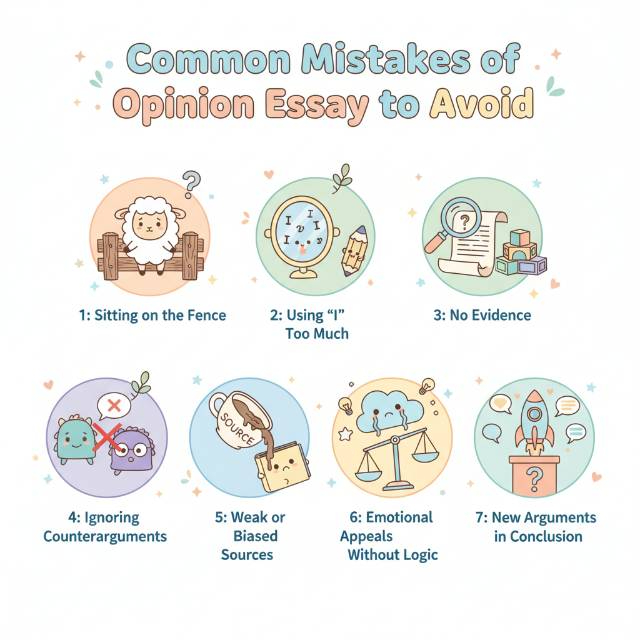
Mistake 1: Sitting on the Fence
The problem:
“Both sides make good points, so it’s hard to say who’s right.”
This isn’t an opinion essay, it’s avoidance.
The fix:
Take a clear position. You can acknowledge complexity while still arguing for one side.
Mistake 2: Using “I” Too Much
The problem:
“I think that schools should require financial literacy. I believe this because I feel that money is important. In my opinion, students need these skills.”
While opinion essays allow first person, overuse weakens your argument.
The fix:
Use “I” in your thesis, then focus on evidence and reasoning. The argument should stand on its own merits.
Better:
“Schools should require financial literacy because evidence demonstrates students lack these skills, early education prevents costly mistakes, and real world preparation is education’s purpose.”
Mistake 3: No Evidence
The problem:
“Schools should teach financial literacy because it’s important and students need it for life.”
Generic claims without specific proof.
The fix:
Every reason needs specific evidence, such as statistics, expert testimony, research studies, or real world examples.
Mistake 4: Ignoring Counterarguments
The problem:
Only presenting your side and never acknowledging opposing views.
This makes your argument seem one sided and uninformed.
The fix:
Dedicate one paragraph to the strongest opposing argument and explain why your position still stands.
Mistake 5: Weak or Biased Sources
The problem:
“According to SaveOurSchools.com (an advocacy site), financial literacy is the most important class schools could teach.”
Using obviously biased sources or no sources at all.
The fix:
Use credible sources: academic research, government data, major news outlets, and recognized experts.
Mistake 6: Emotional Appeals Without Logic
The problem:
“It’s absolutely terrible that students don’t learn about money! Everyone knows this is a huge problem that’s destroying our society!”
Strong emotion with no reasoning or evidence.
The fix:
Use emotion strategically, but build your argument on logic and evidence first.
Mistake 7: New Arguments in the Conclusion
The problem:
Introducing new evidence or reasons in your final paragraph.
Conclusions should synthesize, not surprise.
The fix:
Only restate and reinforce arguments already developed in the body.
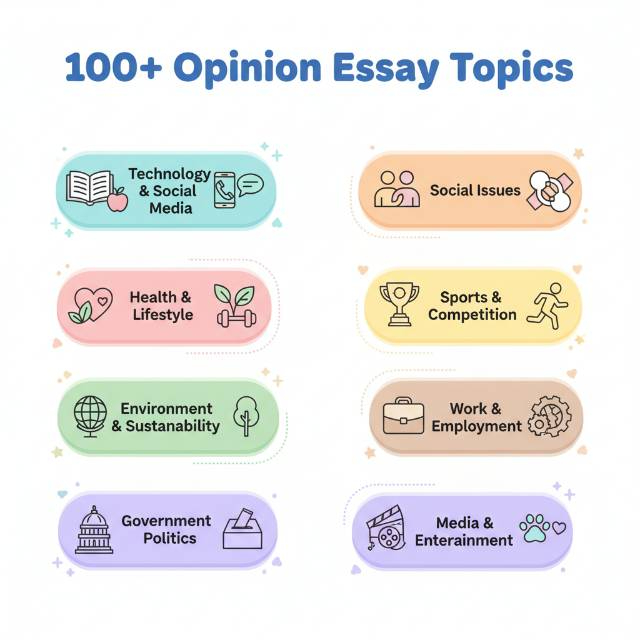
100+ Opinion Essay Topics
Stuck finding a topic? These prompts, organized by category, will spark ideas.
Education
- Should schools ban smartphones during the school day?
- Should college be tuition free?
- Should cursive writing still be taught?
- Should schools eliminate letter grades?
- Should standardized testing determine graduation?
- Should schools require financial literacy courses?
- Should homework be banned?
- Should schools start later for teenagers?
- Should physical education be mandatory?
- Should schools teach only practical skills?
Technology & Social Media
- Should social media have minimum age requirements?
- Should schools ban AI writing tools like ChatGPT?
- Should there be a "right to disconnect" from work emails?
- Should companies be allowed to track online behavior?
- Should there be legal limits on screen time for children?
- Should social media platforms be liable for user content?
- Should facial recognition be banned in public spaces?
- Should internet access be considered a human right?
- Should children under 16 be allowed on social media?
- Should phone manufacturers limit addictive features?
Health & Lifestyle
- Should junk food be banned in schools?
- Should organ donation be opt out instead of opt in?
- Should healthcare be a universal right?
- Should sugary drinks be taxed?
- Should smoking be illegal?
- Should mental health days be allowed like sick days?
- Should fast food restaurants display calorie counts?
- Should alternative medicine be covered by insurance?
- Should school lunch be free for all students?
- Should energy drinks have age restrictions?
Environment & Sustainability
- Should plastic bags be banned?
- Should individuals be required to recycle?
- Should meat consumption be reduced to fight climate change?
- Should governments subsidize electric vehicles?
- Should nuclear power be embraced or phased out?
- Should companies be required to use sustainable packaging?
- Should flying be taxed more to discourage travel?
- Should cities ban gas powered lawn equipment?
- Should single use plastics be outlawed?
- Should fast fashion be regulated?
Government & Politics
- Should voting be mandatory?
- Should the voting age be lowered to 16?
- Should political campaign donations be capped?
- Should term limits exist for all elected positions?
- Should the electoral college be abolished?
- Should felons who've served time be allowed to vote?
- Should lobbying be illegal?
- Should politicians' tax returns be public?
- Should there be age limits for elected officials?
- Should Supreme Court justices have term limits?
Social Issues
- Should paid parental leave be mandatory?
- Should the minimum wage be raised?
- Should affirmative action policies continue?
- Should public transportation be free?
- Should housing be guaranteed as a right?
- Should reparations be paid for historical injustices?
- Should hate speech be legally restricted?
- Should protests that block traffic be allowed?
- Should the death penalty be abolished?
- Should drug possession be decriminalized?
Sports & Competition
- Should college athletes be paid?
- Should youth sports be less competitive?
- Should transgender athletes compete in their identified gender category?
- Should performance enhancing drugs be allowed in professional sports?
- Should contact sports like football be banned for children?
- Should schools eliminate competitive sports tryouts?
- Should esports be considered real sports?
- Should professional sports leagues have salary caps?
- Should cheerleading be recognized as a sport?
- Should boxing be banned due to health risks?
Work & Employment
- Should the 40 hour work week be reduced?
- Should remote work be a legal right?
- Should all workers be guaranteed paid vacation?
- Should unpaid internships be illegal?
- Should companies be required to offer flex time?
- Should AI be allowed to replace human workers?
- Should gig workers be classified as employees?
- Should companies have mandatory diversity quotas?
- Should workplace surveillance be limited?
- Should job applications exclude degree requirements?
Media & Entertainment
- Should violent video games be banned for children?
- Should streaming services require parental content warnings?
- Should paparazzi laws be stricter?
- Should reality TV shows be more regulated?
- Should news organizations fact check before publishing?
- Should celebrities' children's images be protected?
- Should deep fake technology be illegal?
- Should social media "influencing" be regulated like advertising?
- Should entertainment content have age verification?
- Should documentaries be held to journalistic standards?
Animals & Ethics
- Should zoos exist?
- Should animal testing be banned?
- Should exotic pets be illegal?
- Should factory farming be outlawed?
- Should hunting be banned?
- Should circuses be allowed to use animals?
- Should marine mammals be kept in captivity?
- Should puppy mills be criminalized?
- Should breed specific dog legislation exist?
- Should horseback riding be considered animal cruelty?
Opinion Essay Examples
Example 1: High School Level (800 words)
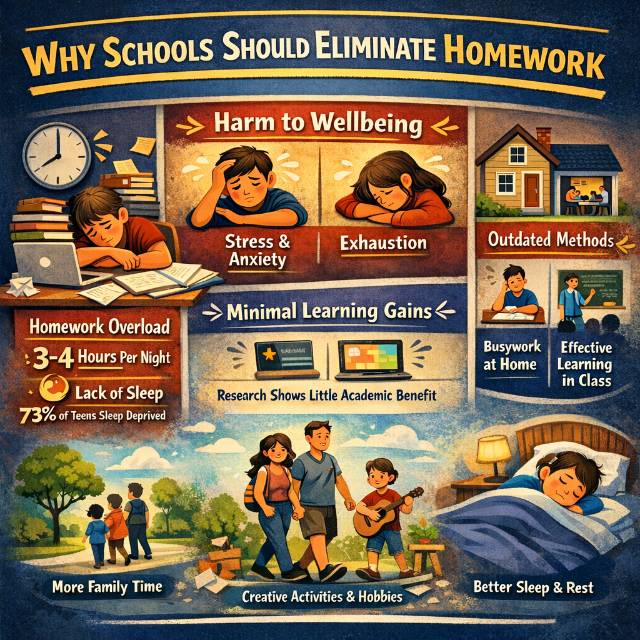
Title: Why Schools Should Eliminate Homework
Homework has been a cornerstone of education for generations, but that doesn't mean it should remain one. Every evening, millions of students spend hours completing assignments that research increasingly suggests provide minimal educational benefit while causing significant stress. Schools should eliminate or dramatically reduce homework because current loads harm student wellbeing, fail to improve learning outcomes, and reflect outdated educational assumptions about how people learn best.
First, excessive homework damages student mental and physical health. The American Psychological Association reports that high school students average 3-4 hours of homework nightly on top of 7-8 hours of school and extracurricular activities. This leaves insufficient time for sleep, with the CDC finding that 73% of high school students don't get the recommended 8-10 hours nightly. Dr. Denise Pope, senior lecturer at Stanford Graduate School of Education, states: "We're seeing kids who are stressed, disengaged, and not developing the skills and knowledge they should be developing from their education." When students report headaches, anxiety, and exhaustion as routine aspects of school life, the system needs reevaluation.
Beyond health concerns, research fails to demonstrate that homework significantly improves learning for most students. A comprehensive 2006 meta-analysis by Duke University professor Harris Cooper found only minimal correlation between homework and academic achievement in elementary school, with modest benefits emerging only in middle and high school, and those benefits plateauing after two hours nightly. Countries like Finland, which assign minimal homework, consistently outperform homework heavy nations like the United States in international assessments. This suggests that time spent on homework doesn't directly translate to educational success.
Most importantly, traditional homework reflects outdated assumptions about learning. The model assumes students need repetitive practice at home to master material introduced at school. However, modern learning science demonstrates that people learn most effectively through active engagement, immediate feedback, and application in varied contexts, all better achieved in classrooms with teacher support than during isolated home practice. When students struggle with homework, they either waste time reinforcing misconceptions or need parental help, creating educational inequality favoring families with resources and availability to provide assistance.
Critics argue that homework teaches responsibility, time management, and self-discipline skills students need for college and careers. These concerns deserve consideration, as developing independent work skills matters. However, this argument assumes homework is the only way to build these abilities. In reality, students can develop responsibility through long-term projects completed during school hours, through extracurricular commitments, and through the general expectation of coming to class prepared. Moreover, the "college preparation" argument overlooks that college professors assign work assuming students have available time—whereas high school students must balance homework across six or seven classes simultaneously, a situation college students don't face.
The evidence is clear: homework in its current form harms students while providing minimal educational benefit. Rather than reflexively assigning nightly work because "that's how school has always worked," educators should focus on maximizing learning during school hours through engaging instruction and meaningful in-class practice. Students' evenings should be available for sleep, family time, hobbies, and the unstructured exploration that fosters creativity and wellbeing. Schools exist to support student development, not consume their every waking hour.
Example 2: College Level (1,200 words)
Title: Universal Healthcare as Economic Necessity
[showing opening paragraphs]
The United States spends more on healthcare than any nation $4.3 trillion annually, approximately 18% of GDP while achieving worse health outcomes than peer nations spending half as much. This paradox stems from our fragmented, profit-driven system that prioritizes shareholder returns over patient care. The United States should implement universal, single-payer healthcare not primarily as a moral imperative, though that argument has merit, but as an economic necessity. Universal healthcare would reduce overall costs through administrative efficiency, improve economic productivity by ensuring a healthy workforce, and eliminate the inefficient practice of using emergency rooms as primary care facilities for the uninsured.
Administrative efficiency represents the most immediate cost-saving mechanism. The current multi-payer system generates extraordinary bureaucratic overhead: healthcare providers must navigate dozens of insurance plans, each with different coverage rules, billing codes, and authorization requirements. This complexity forces hospitals and clinics to employ armies of billing specialists, costing an estimated $265 billion annually, according to the Journal of the American Medical Association. Dr. David Himmelstein, professor at the CUNY School of Public Health, calculated that administrative costs consume 25-30% of US healthcare spending, compared to 16-18% in Canada and 12-15% in the UK's fully socialized system. Consolidating coverage under a single payer would eliminate this redundancy, redirecting billions toward actual care rather than paperwork processing.
Beyond administrative savings, universal coverage would boost economic productivity through a healthier workforce. The Commonwealth Fund estimates that 45,000 Americans die annually from lack of health insurance, with thousands more suffering preventable complications from delayed care. When workers avoid medical treatment due to cost concerns, as 43% of insured Americans report doing, minor conditions worsen into serious illnesses requiring expensive intervention. This pattern creates workforce disruptions through absenteeism and "presenteeism" (working while ill), costing employers $530 billion annuall,y according to the Integrated Benefits Institute. Nations with universal healthcare see higher workforce participation rates among working age adults, as healthcare access isn't tied to employment status. Workers can transition between jobs, pursue entrepreneurship, or work part-time without losing coverage, increasing labor market fluidity and innovation.
[For Practice: Continues with body paragraphs on emergency room utilization, counterarguments about costs and quality, and conclusion]
Final Takeaway
An opinion essay isn’t just about what you think; it’s about how well you can justify it. When you take a clear position, support it with credible evidence, and address opposing views fairly, your writing becomes persuasive, academic, and effective. Choose a stance you can defend, structure your ideas logically, and let evidence, not emotion alone, do the heavy lifting. When done right, a strong opinion essay doesn’t just state a view; it convinces readers it’s worth taking seriously.
From Outline to A+ Essay
Our writers deliver polished essays researched, structured, and ready to submit.
- 100% human-written
- Delivered on time, every time
- Unlimited revisions
- Based on YOUR experiences
Send your outline. We'll turn it into a finished essay.
Get Started Now