What Is a Persuasive Essay?
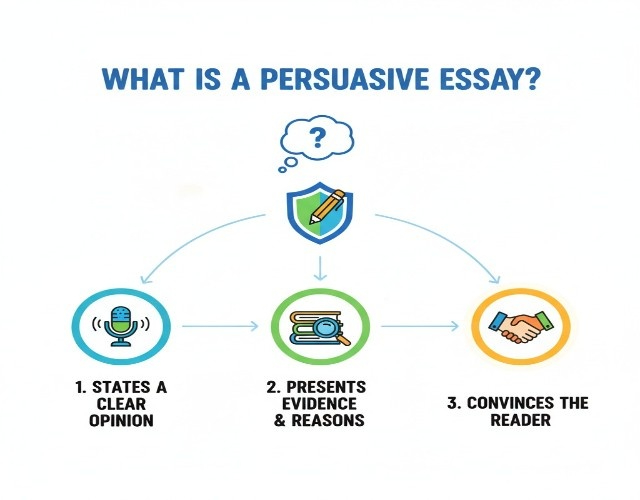
A persuasive essay is your chance to change someone's mind. You pick a position on an issue, build your case with evidence and logic, then convince your reader you're right.
What makes it different from other essays:
- Informative essay: "Here are the facts about climate change."
- Persuasive essay: "Here's why we must act on climate change NOW."
The key difference? You're not just explaining, you're arguing for a specific position.
The Three Pillars of Persuasion
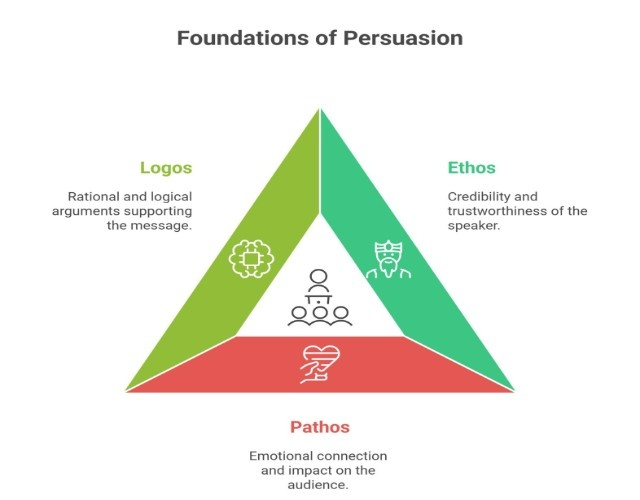
- Ethos (credibility): Why should they trust you?
- Pathos (emotion): How does this affect them?
- Logos (logic): What's the rational argument?
Your job is to balance all three. Too much emotion without facts? Weak. Too many facts without heart? Boring. Get the mix right, and you'll change minds.
Types of Persuasive Essays
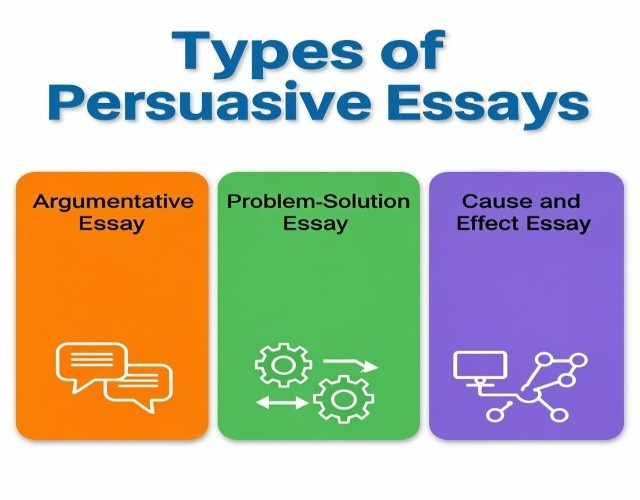
Persuasive writing comes in different forms. Here's where to learn about each:
1. Argumentative Essay
| Makes a claim and defends it. For more details, refer to our Argumentative Essay Guide Note: Understanding the difference between a persuasive vs argumentative essay helps writers choose the right approach, whether they want to influence feelings and beliefs or prove a claim through logic and data. |
2. Problem Solution Essay
| Identifies an issue and proposes fixes. |
3. Cause and Effect Essay
| Shows relationships to persuade. For additional information, visit our Cause and Effect Guide |
DEADLINE BREATHING DOWN YOUR NECK?
Our writers deliver polished, persuasive essays, researched, argued, and ready to submit.
- Written by degree-holding experts
- Delivered on time, every time
- Unlimited revisions
- 100% human-written
No AI. Just real writers, real results.
Order NowHow to Write a Persuasive Essay (Step by Step)
Writing a persuasive essay doesn't have to be overwhelming. Here's the process, broken into manageable steps.
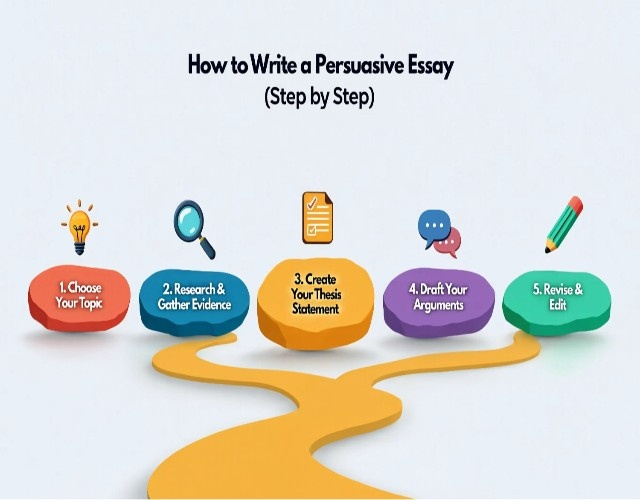
Step 1: Understand Your Assignment
Before you write a word, know what you're being asked to do.
Questions to ask:
|
Pro tip: If the prompt says "discuss both sides," you still need to pick one and argue for it. Don't sit on the fence.
Step 2: Choose Your Position
Pick the side you can argue most convincingly, not necessarily what you personally believe.
How to choose:
|
Need topic ideas? See our persuasive essay topics for inspiration.
Step 3: Research and Gather Evidence
You need ammunition. Facts, statistics, expert opinions, and real world examples.
Types of evidence that work:
|
|
|
|
How much evidence? Plan for 2 to 3 solid pieces of evidence per body paragraph.
Step 4: Address the Counterargument
The strongest persuasive essays acknowledge the other side, then tear it down.
The formula:
1. State the opposing view fairly.
2. Acknowledge any valid points.
3. Explain why your position is still stronger
Step 5: Create Your Thesis Statement
Your thesis is your entire argument in one sentence.
| Weak thesis: "This essay will discuss whether schools should ban smartphones." |
| Strong thesis: "Schools should ban smartphones during class hours because they reduce academic performance, increase cyberbullying, and create unhealthy social dynamics." |
The formula: [Position] because [Reason 1], [Reason 2], and [Reason 3].
Step 6: Organizing Your Essay
Map out your argument before you write.
Basic structure:
|
For a detailed template, grab our persuasive essay outline and fill in the blanks.
Step 7: Write and Revise
First draft: Get your ideas down. Don't worry about perfection.
Revision checklist:
- Does every paragraph support your thesis?
- Is your evidence credible and cited correctly?
- Did you address counterarguments?
- Does your conclusion reinforce your position without just repeating?
Read it out loud. If you stumble, your reader will too.
How to Start a Persuasive Essay
Your intro either hooks the reader or loses them. Here's how to start strong.
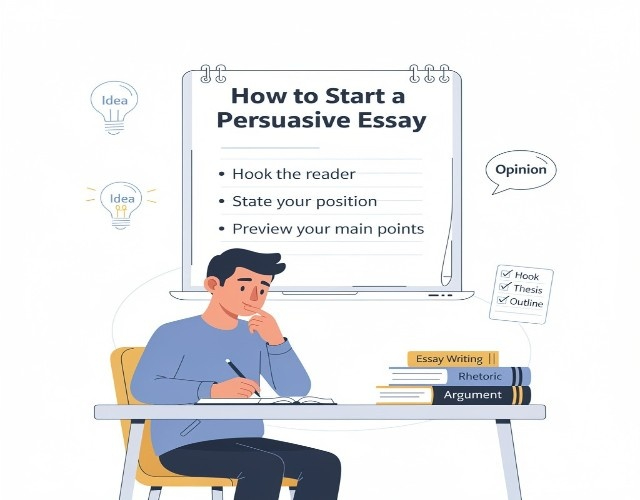
Opening strategies that work:
Surprising statistic: "Every 11 minutes, a teen dies in a drunk driving accident."
Provocative question: "What if your vote didn't matter at all?"
Bold statement: "We're raising the most anxious generation in history, and smartphones are to blame."
Scenario: "Picture this: You're 18, working full-time, but still can't afford rent."
What your intro must include:
Hook (1 to 2 sentences): Grab attention |
Context (2 to 3 sentences): Background info |
Thesis (1 sentence): Your argument. |
Common mistakes to avoid:
|
To better understand how effective arguments are built, explore our persuasive essay examples.
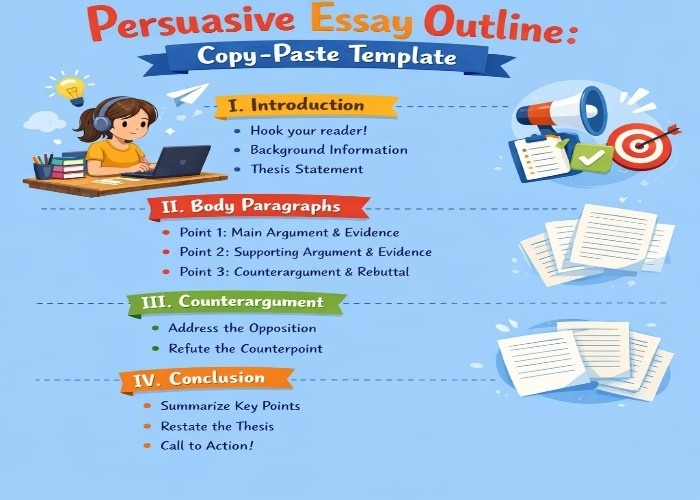
Persuasive Essay Structural Framework
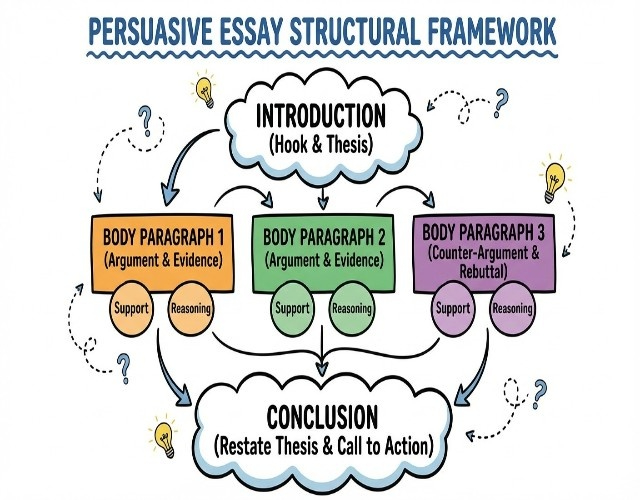
Every persuasive essay follows the same basic structure. Here's what each part does.
1. Persuasive Essay Introduction (10 to 15% of essay)
Purpose: Hook the reader, establish credibility, state your position
Components:
|
Word count guide: 150 to 200 words for a 1,500 word essay
2. Persuasive Essay Body Paragraphs (70 to 80% of essay)
Purpose: Present and defend your arguments
PEEL structure per paragraph:
| Point: Topic sentence (your claim) |
| Evidence: Facts, stats, examples |
| Explanation: How evidence support your point |
| Link: Connect back to thesis |
How many paragraphs? Usually, 3 to 4 main arguments, plus 1 counterargument paragraph.
3. Persuasive Essay Counterargument Paragraph (10 to 15% of essay)
Purpose: Address opposing views, strengthen your position
What to include:
|
Placement: Usually before your conclusion, after your main arguments.
4. Persuasive Writing Conclusion (10 to 15% of essay)
Purpose: Reinforce your argument, leave a lasting impression
Components:
|
Word count guide: 150 to 200 words for a 1,500 word essay
Want a ready to use template with exact formatting? Grab our persuasive essay outline and fill in the blanks.
STILL STARING AT A BLANK PAGE?
Thousands of students trust us to deliver perfect persuasive essays that get the grades they deserve.
- Custom-written from scratch for every order
- Matched with a writer in your subject area
- Delivered on time, every time
- Full confidentiality guaranteed
100% human-written. Satisfaction guaranteed.
Order NowHow to Write a Conclusion for a Persuasive Essay
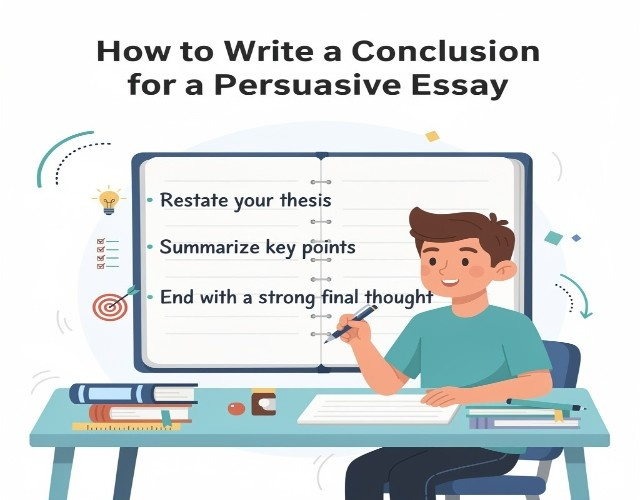
Your conclusion is your final chance to drive your argument home.
What a strong convincing essay conclusion does:
|
The Formula:
- Reframe thesis (1 sentence): "The evidence overwhelmingly supports implementing universal healthcare."
- Summarize key points (2 to 3 sentences): "As demonstrated, universal healthcare reduces costs, improves outcomes, and ensures equity. Countries with these systems show better health metrics at lower expenses."
- End with broader significance (1 to 2 sentences): "The question isn't whether we can afford universal healthcare, it's whether we can afford not to."
What NOT to do:
|
Example comparison:
| Weak: "In conclusion, I think homework is bad because it's stressful. These are the reasons why." |
| Strong: "Excessive homework undermines learning, damages student wellbeing, and widens the achievement gap. If education aims to nurture lifelong learners, we must prioritize quality over quantity." |
Persuasive Essay Tip: Don’t just argue your side, show that you understand the opposing viewpoint and then explain why it’s weaker, incomplete, or less logical. This strengthens your credibility and makes your argument more convincing.
Writing Tips & Techniques for Persuasive Essays
Mastering the steps of writing a persuasive essay can help you influence your readers effectively, from choosing a topic to crafting compelling arguments and a strong conclusion.
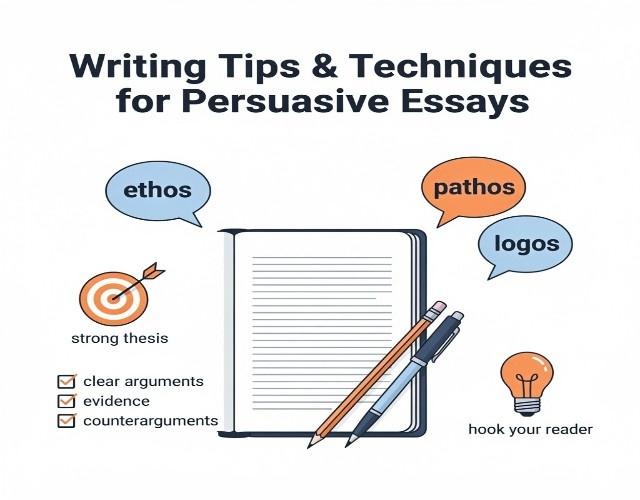
1. Start with a Strong, Arguable Thesis
Your thesis should take a clear stance that someone could reasonably disagree with; there’s nothing to persuade.
2. Know Your Audience
Effective persuasion depends on who you're trying to convince. Tailor your tone, examples, and appeals to their interests, values, and level of knowledge.
3. Use Logical Structure (Logos)
Strong persuasive essays follow a logical flow: claim, evidence, and explanation. Every point needs credible support to stand on its own.
4. Appeal to Emotion Wisely (Pathos)
Emotion makes arguments memorable. Use personal stories, relatable examples, or vivid scenarios to help readers care about the issue.
5. Establish Credibility (Ethos)
Show readers that you understand the topic. Use reputable sources, acknowledge complexity, and avoid exaggeration or bias.
6. Anticipate Counterarguments
Address the opposing viewpoint directly, then explain why your stance is stronger. This builds trust and showcases critical thinking.
7. Use Clear, Direct Language
Persuasion works best with concise sentences and purposeful word choice. Avoid vague statements or unnecessary jargon.
8. Support Claims With Evidence, Not Assumptions
Opinions alone aren’t enough; persuasive essays rely on proof. Statistics, expert testimony, research findings, and real-world examples make arguments harder to dismiss.
9. Use Rhetorical Techniques
Tools like analogies, rhetorical questions, contrasts, and strategic repetition can make arguments more compelling and memorable.
Common Persuasive Writing Mistakes to Avoid
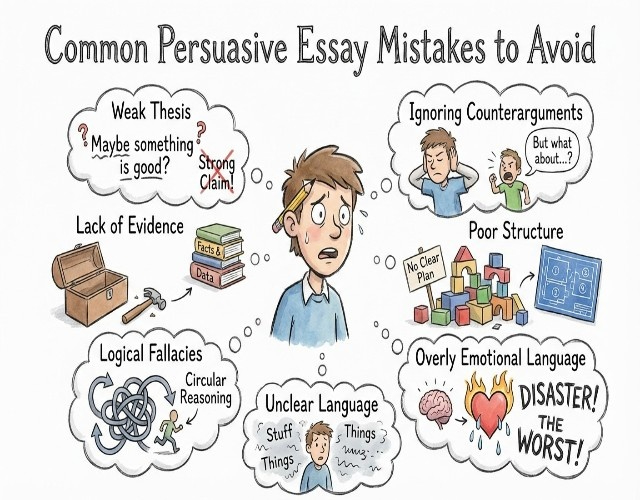
1. Weak or missing thesis: Your entire essay should support one clear argument. If your thesis is vague, your essay will be too.
2. Ignoring the other side: Addressing counterarguments makes your position stronger, not weaker.
3. Using unreliable sources: Random blogs and biased websites hurt your credibility. Stick to peer-reviewed studies, reputable news outlets, and expert sources.
4. Too much emotion, not enough logic: Passion is good. But you need facts to back it up.
5. Burying your best argument: Lead with strength. Don't save your best evidence for paragraph 5.
6. Forgetting your audience: A persuasive essay for your teacher differs from one for the general public. Adjust your tone and evidence accordingly.
Need extra help? Our professional essay writing service offers persuasive essay assistance from writers who’ve handled thousands of topics and formats.
Persuasive Essay Free Downloadable Resources
Your Essay. Done Right. Delivered on Time.
Tell us what you need, our experts handle the research, writing, and formatting.
- Original work with zero plagiarism
- Fast turnaround
- Expert writers across all subjects
- Free revisions included
No AI shortcuts. Just expert-level quality.
Order NowBottom Line
A persuasive essay is your opportunity to influence your readers’ opinions, not just present information. Unlike a regular essay that explains or describes, a persuasive essay requires you to take a firm stance and convince your audience why your perspective is valid.
The first step is to develop a clear, focused thesis. Next, support your thesis with strong, credible evidence. Use facts, statistics, expert opinions, examples, or real-life experiences to back up your points. Evidence makes your argument persuasive and shows readers that your position is well-founded. Don’t forget to acknowledge the opposing side and explain why your perspective still holds more weight. This not only shows that you’ve thought critically about the issue but also strengthens your overall argument.
Finally, always answer the “so what?” question. Explain why your argument matters, how it affects the reader, society, or the issue at hand. Persuasion isn’t just about presenting facts; it’s about making readers understand the importance of your viewpoint.
Whether you write it yourself or get help, the key is turning in something that actually persuades. Good luck.