Rhetorical Analysis Essay Example #1 (Speech)
Rhetorical Analysis Essay Example: Martin Luther King Jr.'s "I Have a Dream"
Here's a complete rhetorical analysis essay example examining MLK's iconic speech. Notice how each paragraph analyzes specific rhetorical strategies and their effects on the audience.
The Rhetoric of Hope: How King Transformed Protest into Vision
On August 28, 1963, Martin Luther King Jr. delivered "I Have a Dream" to over 250,000 civil rights marchers at the Lincoln Memorial. What could have been another protest speech became an enduring piece of American oratory through King's masterful use of anaphora, biblical allusions, and appeals to shared American values. Through these rhetorical strategies, King transformed a political demand into a moral vision that transcended his immediate audience and moment.
King's most powerful rhetorical device is his use of anaphora, the repetition of "I have a dream" at the beginning of eight consecutive clauses. This repetition creates a rhythmic momentum that builds emotional intensity with each iteration. "I have a dream that one day this nation will rise up... I have a dream that my four little children... I have a dream that one day even the state of Mississippi..." The phrase functions like a refrain in a song, making the speech memorable while the varying content of each dream creates a mounting sense of possibility. This anaphoric structure doesn't just state King's vision; it makes audiences feel the accumulating weight of injustice and the expanding scope of hope simultaneously.
Biblical allusions throughout the speech establish King's ethos while grounding his radical demands in moral authority, which his audience cannot easily dismiss. When he declares "justice rolls down like waters and righteousness like a mighty stream," King quotes the prophet Amos, positioning himself not as a political agitator but as a prophetic voice calling America to its moral duty. Similarly, references to "every valley shall be exalted" invoke Isaiah's vision of divine transformation. These biblical echoes serve a dual purpose: they establish King's credibility as a moral leader while making opposition to civil rights seem not just politically wrong but spiritually bankrupt. For his religious audience in 1963, these allusions carry the weight of divine mandate.
Finally, King strategically invokes America's founding documents, the Declaration of Independence and the Constitution, to frame civil rights not as a new demand but as an unfulfilled promise. He opens by referencing Lincoln's Emancipation Proclamation, delivered "five score years ago" (echoing Lincoln's Gettysburg Address), then describes segregation as a failure to honor the "promissory note" of equality that America signed in its founding. This rhetorical move is brilliant: it positions civil rights activists as patriots claiming their rightful inheritance rather than radicals demanding something new. King transforms the question from "Should we give them rights?" to "When will America finally honor its own promises?" This reframing makes opposition seem un-American, aligning his cause with the nation's highest ideals.
King's rhetorical choices in "I Have a Dream" proved devastatingly effective. The speech galvanized the civil rights movement, influenced the passage of the Civil Rights Act, and remains culturally resonant six decades later. Its power lies not in the novelty of its arguments but in how King wove repetition, religious authority, and patriotic appeals into a vision so compelling that opposition became morally untenable. In an era of political polarization, King's speech reminds us that the most enduring rhetoric doesn't just state positions, it creates shared visions that make justice feel both possible and inevitable.
What Makes This Rhetorical Analysis Example Work
- Clear thesis: States King's main strategies (anaphora, biblical allusions, patriotic appeals) and their effect
- Focused body paragraphs: Each paragraph analyzes ONE rhetorical strategy in depth
- Evidence with analysis: Quotes specific phrases, then explains HOW and WHY they work
- Rhetorical situation: Addresses audience, occasion, and purpose throughout
- Evaluation: Conclusion assesses effectiveness, not just description
- Avoids summary: Never just retells what King said, always analyzes HOW he said it
Like What You See? We Can Write Yours
Our writers deliver polished rhetorical analysis essays researched, analyzed, structured, and ready to submit.
- 100% human written analysis
- Delivered on time, every time
- Unlimited revisions
- Custome essays, fast
Your topic. Your requirements. Our expertise.
Order NowRhetorical Analysis Essay Example #2 (Advertisement)
Rhetorical Analysis Example: Nike's "Just Do It" Campaign
This rhetorical analysis example examines how Nike uses visual rhetoric, celebrity ethos, and inspirational messaging to position its brand. Watch how it analyzes both verbal and visual elements.
Selling Rebellion: The Rhetorical Strategy Behind Nike's "Just Do It"
When Nike launched its "Just Do It" campaign in 1988, it wasn't just selling shoes; it was selling an identity. Through a strategic combination of celebrity ethos, inspirational pathos, and minimalist messaging, Nike transformed athletic wear from functional equipment into a symbol of personal empowerment and rebellion against limits. This rhetorical approach made Nike the dominant athletic brand and created a campaign that has endured for over three decades.
Nike's primary rhetorical strategy is building ethos through celebrity association. By featuring iconic athletes like Michael Jordan, Serena Williams, and Colin Kaepernick, Nike borrows their credibility and cultural cachet. These aren't just any athletes; Nike specifically chooses figures who embody overcoming adversity or challenging the status quo. Michael Jordan was cut from his high school basketball team; Serena Williams faced racism and sexism throughout her career; Colin Kaepernick sacrificed his NFL career for social justice. Each athlete's story reinforces Nike's message that greatness requires pushing past obstacles. When Jordan tells viewers to "Just Do It," his ethos as someone who literally did it, becoming arguably the greatest basketball player ever despite early rejection, makes the command feel less like corporate messaging and more like hard won wisdom.
The campaign's pathos operates through inspirational messaging that taps into universal desires for achievement and self actualization. The tagline "Just Do It" is rhetorically brilliant in its simplicity: three words that simultaneously acknowledge fear ("just" implies hesitation), demand action ("do"), and minimize excuses ("it" = whatever you're avoiding). This minimalist phrasing creates an imperative that feels both attainable and challenging. Nike's ads typically show athletes in moments of intense effort, drenched in sweat, faces contorted in exertion, bodies pushed to limits. These images don't glamorize athleticism; they make struggle look heroic. The emotional appeal isn't "you'll look good in our shoes" but "you have untapped potential, and all that stands between you and greatness is action." This reframes Nike products as tools of self transformation rather than mere clothing.
Nike's visual rhetoric complements its verbal messaging through a stark, minimalist design that puts focus entirely on the athlete and the swoosh logo. Most ads feature dark or neutral backgrounds with dramatic lighting that isolates the athlete's form, creating an almost mythic quality. The famous swoosh appears small, often in a corner, confident enough not to dominate the frame because the brand association is already established. This minimalism serves a rhetorical purpose: it positions Nike as understated confidence rather than flashy showmanship. The message isn't "look at our brand" but "look at what you could become." By making their branding secondary to the human story, Nike paradoxically strengthens brand loyalty; they're selling not shoes but a version of yourself.
Nike's rhetorical strategy has proven extraordinarily effective, transforming the company from a running shoe manufacturer into a global lifestyle brand worth over $150 billion. The campaign works because it shifts the product from functional (shoes) to aspirational (identity). When consumers buy Nike, they're not purchasing athletic wear; they're buying into a narrative of personal empowerment and the courage to "just do it." This rhetorical reframing of consumption as self actualization demonstrates how effective rhetoric can create not just customers but believers in a brand's mythology.
What Makes This Analysis Work
- Analyzes visual rhetoric: Doesn't just focus on words, examines imagery, design, and logo placement
- Connects strategy to purpose: Explains WHY Nike makes these choices
- Evaluates effectiveness: Discusses the campaign's real world impact
- Audience awareness: Considers how appeals land with Nike's target demographic
- No plot summary: Never just describes what's in the ads, always analyzes how rhetoric functions
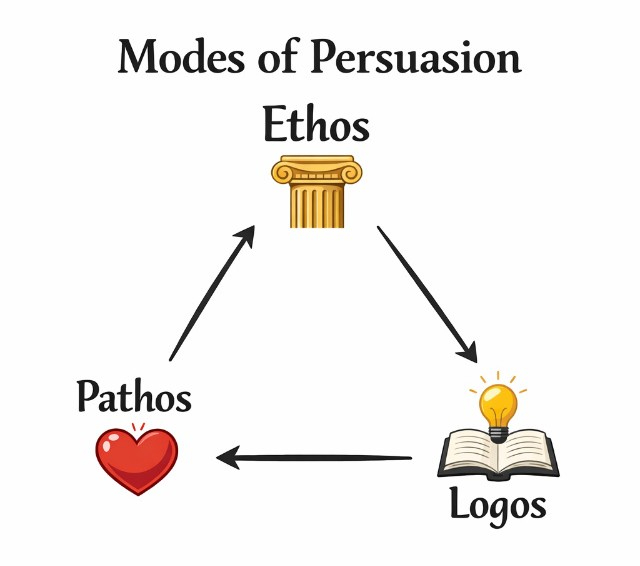
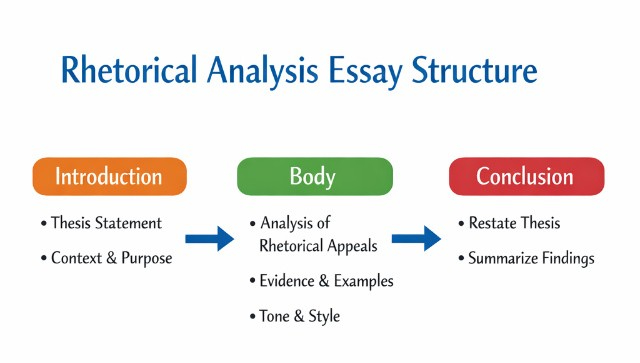
Need to know how to structure an essay? We have made a rhetorical analysis essay outline just for that.
Rhetorical Analysis Essay Example #3 (Article)
Article Analysis Essay Example: Op Ed Rhetoric
Analyzing a written argument? This article analysis essay example examines how a New York Times op ed uses logical appeals, counter argument, and tone to build credibility while making a controversial claim.
The Rhetoric of Reasonable Controversy: How Op Eds Persuade Through Moderation
David Brooks's 2024 New York Times op ed "Why College Rankings Are Destroying Higher Education" employs a rhetorically sophisticated strategy: he advances a controversial thesis while maintaining such careful tone and logical structure that disagreement feels unreasonable. Through strategic concession, statistical evidence, and a measured tone that avoids hyperbole, Brooks constructs an argument that appears balanced even as it fundamentally questions a multi billion dollar industry. This rhetorical approach demonstrates how ethos and logos can work in concert to make radical claims feel moderate.
Brooks establishes ethos immediately through strategic concession, acknowledging legitimate counterarguments before dismantling them. He opens by admitting "College rankings serve a real purpose" and noting their value for students seeking basic information. This concession performs important rhetorical work: it positions Brooks as fair minded rather than dogmatic, someone who has considered opposing views seriously. Only after establishing this balanced ethos does he pivot to his critique: "But the way rankings currently function has created perverse incentives that undermine education itself." This structure, conceding minor points, then attacking the larger premise, makes his argument feel measured rather than polemic. Readers who might initially defend rankings find themselves nodding along with his concessions before realizing they've been led to question the entire enterprise.
Brooks's use of logos centers on accumulating specific examples of how rankings distort institutional behavior, creating a pattern that feels inevitable rather than cherry picked. He doesn't just claim rankings cause problems, he catalogs them methodically: universities gaming metrics by manipulating class sizes, rejecting qualified applicants to appear more selective, spending lavishly on amenities rather than teaching, and discouraging students from pursuing low paying public service careers because it hurts post graduation salary metrics. Each example functions as evidence in an accumulating case. The rhetorical power lies not in any single example but in the mounting sense that the entire system has become corrupted by a measurement tool. This cataloging approach mirrors legal argumentation, building a preponderance of evidence that makes the conclusion feel inescapable.
Most striking is Brooks's tone, which remains measured and analytical even when making dramatic claims. He never uses inflammatory language; he doesn't claim rankings are "evil" or accuse administrators of malice. Instead, he employs the passive voice and institutional language: "incentives become misaligned," "priorities get distorted," "educational mission takes a back seat." This rhetorical choice is crucial. By treating the problem as systemic rather than personal, Brooks avoids triggering defensive reactions from administrators or ranking organizations. The calm tone creates an impression of objectivity; this isn't an angry diatribe but a reasonable analysis that happens to reach damning conclusions. This measured rhetoric makes his argument more persuasive to moderate readers who might dismiss emotional appeals.
Brooks's rhetorical strategy in this op ed reveals how effective argumentation often works through tone and structure rather than evidence alone. By conceding minor points, accumulating specific examples, and maintaining measured language, he makes a controversial argument feel like common sense. The piece succeeds not because it presents new information, education scholars have critiqued rankings for years, but because its rhetoric makes the critique accessible and reasonable to a mainstream audience. For students learning rhetorical analysis, Brooks's op ed demonstrates that the most effective arguments often disguise their persuasive intent behind a veneer of balanced, logical analysis.
What Makes This Analysis Work
- Analyzes rhetorical moves: Identifies specific strategies like "strategic concession"
- Explains audience effect: Shows HOW these choices influence readers
- Addresses tone: Doesn't just say the tone is "calm," explains why that tone matters rhetorically
- Connects to purpose: Every strategy ties back to Brooks's persuasive goal
- Sophisticated analysis: Goes beyond basic ethos/pathos/logos identification
Not sure what to write about. Have a look at our rhetorical analysis essay topics for some options.
Visual Rhetoric Analysis Essay Example
Rhetorical Analysis Example: Political Campaign Poster
This visual rhetoric example analyzes how a political poster uses color, imagery, and text placement to make rhetorical arguments without extensive verbal content.
Obama's "Hope" Poster: Visual Rhetoric as Political Movement
Shepard Fairey's 2008 "Hope" poster featuring Barack Obama became one of the most iconic images in American political history, demonstrating how visual rhetoric can distill complex political messaging into a single, powerful image. Through strategic use of color, upward gaze, and minimalist text, Fairey created visual rhetoric that communicated Obama's campaign themes, change, optimism, forward looking vision, more effectively than thousands of words of policy proposals. This poster exemplifies how visual elements function as rhetorical appeals.
The poster's color palette, red, beige, and blue against stark white, serves multiple rhetorical functions simultaneously. Most obviously, the red white blue combination evokes the American flag, visually tying Obama to patriotic imagery and national identity. This color choice counters dog whistle suggestions that Obama was somehow "un-American" or "other." The stylized, posterized treatment flattens the colors into bold, simplified planes, creating a graphic quality that references both Soviet era propaganda posters and street art aesthetics. This duality is rhetorically strategic: the propaganda poster allusion suggests bold political change and grassroots mobilization, while the street art style positions Obama as authentic and outside establishment politics. For young voters, the design communicated "This candidate is different" before any policy discussion occurred.
Obama's upward gaze serves as perhaps the poster's most powerful rhetorical element. He doesn't look at the viewer but gazes upward and slightly to the left, his jaw set with determination. This pose communicates vision, literally looking toward the future rather than at present circumstances. The upward angle also creates an aspirational quality; viewers literally look up at Obama in the image, positioning him as a leader to follow rather than a peer. The serious, contemplative expression avoids the glad handing politician's smile, instead suggesting thoughtfulness and determination. This visual rhetoric aligns perfectly with Obama's campaign message about hope and change; he's not looking at what is but envisioning what could be.
The word "HOPE" appears at the bottom in bold capitals, functioning as both label and command. The choice of "hope" over "change" (another version of the poster existed) is rhetorically significant; hope is emotional and forward looking rather than critical of the present. The text doesn't explain what to hope for or why; it simply declares hope as a value and political stance. This open endedness allows viewers to project their own aspirations onto the image. The text's placement below Obama's face creates a visual hierarchy: Obama himself embodies the hope, with the word serving as caption rather than primary message. This design choice makes the rhetoric more powerful because it shows rather than tells.
Fairey's poster succeeded beyond any campaign's normal propaganda precisely because its visual rhetoric worked independently of Obama's actual policies or speeches. The image became so iconic that it was reproduced, parodied, and adapted countless times, demonstrating its rhetorical power. For students learning about visual rhetoric, this poster reveals how color, composition, gaze, and text placement all function as rhetorical choices that argue for an idea, in this case, a vision of political possibility, without extensive verbal argumentation.
What Makes This Analysis Work
- Analyzes visual elements as rhetoric: Treats color, gaze, and composition as persuasive choices
- Explains multiple meanings: Shows how single elements (color) serve multiple rhetorical purposes
- Addresses audience: Considers how different viewers might interpret visual rhetoric
- Historical context: Mentions the "propaganda poster" reference and what it communicates
- Evaluates impact: Discusses the poster's actual cultural influence
AP Lang Rhetorical Analysis Essay Example
AP Lang Rhetorical Analysis Essay Example (40 Minute Format)
This AP Lang rhetorical analysis essay example demonstrates how to write a strong analysis in the exam's time constraint. Notice the focused thesis and efficient paragraph structure.
[Prompt: Analyze the rhetorical choices Sojourner Truth makes in "Ain't I a Woman?" to convey her message about women's rights and racial equality.]
In her 1851 speech "Ain't I a Woman?" delivered at the Women's Rights Convention in Akron, Ohio, Sojourner Truth challenges both gender and racial hierarchies through strategic use of rhetorical questions, personal narrative, and deliberate simplicity of language. As a Black woman and formerly enslaved person, Truth occupies a unique rhetorical position: excluded from both white women's femininity and from full human recognition by racist systems. Through her rhetorical choices, Truth doesn't just argue for inclusion; she exposes the contradictions in arguments against women's rights while asserting her own humanity through lived experience.
Truth's repeated rhetorical question "Ain't I a woman?" functions as both challenge and proof. Each time she poses this question, she has just described physical capabilities that supposedly define manhood: "I have ploughed and planted, and gathered into barns... and ain't I a woman?" The repetition creates a drumbeat rhythm that accumulates force with each iteration, while the question format forces the audience to confront their own logic. If physical strength and hard work define who deserves rights, then Truth qualifies. If delicacy and protection define womanhood, then Black women have been systematically excluded from that category. The rhetorical question doesn't ask for information; it demands acknowledgment of a reality the audience has been avoiding.
Truth's use of personal narrative as evidence challenges abstract philosophical arguments with lived reality. Rather than citing authorities or appealing to biblical or legal precedents, Truth grounds her argument in her own body and experience: "I have borne thirteen children, and seen most all sold off to slavery." This specific detail, thirteen children, most sold, carries more rhetorical weight than any statistic could. The personal becomes political as Truth transforms her individual suffering into evidence of systemic oppression. This rhetorical strategy is particularly effective because it's irrefutable; no one can argue with her lived experience. By making herself the primary evidence, Truth also establishes ethos through authenticity rather than formal credentials.
Finally, Truth's deliberately simple, direct language creates accessibility while undermining pretentious arguments against women's rights. She speaks in the vernacular of the enslaved rather than the elevated rhetoric typical of 19th century political speech: "That man over there says that women need to be helped into carriages... Nobody ever helps me into carriages." This plain speaking serves multiple rhetorical purposes: it makes her argument accessible to a wider audience, it positions her as authentic rather than performative, and it exposes the absurdity of arguments for women's "delicacy" by contrasting them with her reality. The simplicity is itself a rhetorical choice that makes elite arguments look ridiculous by comparison.
Truth's rhetorical strategy in "Ain't I a Woman?" demonstrates how marginalized speakers can use their outsider position as rhetorical strength. By grounding her argument in personal experience, using repetitive rhetorical questions that demand response, and employing deliberately simple language that cuts through elaborate justifications for oppression, Truth created one of the most powerful speeches in American history. Her rhetoric succeeds precisely because it refuses to play by the rules of formal debate, instead insisting that lived reality counts as evidence and that questions demanding acknowledgment can be more powerful than arguments demanding acceptance.
Need One for a Different Topic?
Our writers deliver polished rhetorical analysis essays, researched, analyzed, structured, and ready to submit.
- Custome essays, fast
- Delivered on time, every time
- Unlimited revisions
- 100% human written analysis
Any topic. Any deadline. Same quality.
Get Expert HelpWhat Makes This AP Lang Example Work
- Clear, arguable thesis: States specific strategies and their purpose in the first paragraph
- Organization by strategy: Each body paragraph focuses on ONE rhetorical choice
- Evidence integrated: Quotes are brief and immediately analyzed
- Sophistication: Shows nuanced understanding of how strategies work together
- Efficient writing: Every sentence serves the argument, no filler
- Addresses rhetorical situation: Acknowledges Truth's unique position as speaker
- Time appropriate: Could be written in 40 minutes with proper planning
Rhetorical Analysis Essay, Introduction Examples
Rhetorical Analysis Essay Introduction Examples
Struggling with your intro? Here are 3 strong rhetorical analysis essay introduction examples with annotations showing what makes them work.
EXAMPLE 1: Hook with Historical Significance
On December 8, 1941, the day after Japan attacked Pearl Harbor, Franklin D. Roosevelt delivered a speech to Congress that would define a generation. In just six and a half minutes, FDR transformed American isolationism into committed resolve through strategic use of parallel structure, concrete imagery, and appeals to national unity. [Context] His famous characterization of December 7th as "a date which will live in infamy" demonstrated masterful word choice, selecting "infamy" rather than "tragedy" to emphasize moral outrage over victimhood. [Specific technique] Through these rhetorical choices, FDR accomplished what seemed impossible: uniting a divided nation for total war within minutes of beginning his speech. [Thesis statement]
Why it works:
- Opens with dramatic historical moment that establishes stakes
- Provides rhetorical situation (occasion, audience, purpose)
- Thesis identifies specific strategies (parallel structure, imagery, unity appeals)
- Shows how strategies connect to effect (uniting the nation)
EXAMPLE 2: Hook with Rhetorical Question
What makes some advertisements fade from memory while others become cultural touchstones? [Hook] Apple's 1984 Super Bowl commercial, directed by Ridley Scott, aired exactly once yet remains one of the most iconic ads in history. [Context] Through dystopian imagery borrowed from George Orwell, the positioning of Apple as a rebel force, and the promise that "1984 won't be like 1984," the commercial established Apple's brand identity for decades to come. [Thesis] The ad's enduring impact demonstrates how visual rhetoric and cultural references can communicate brand values more effectively than product features. [Significance]
Why it works:
- Rhetorical question creates immediate engagement
- Provides specific context about the text being analyzed
- Thesis identifies key strategies (dystopian imagery, rebel positioning, cultural reference)
- Addresses effectiveness (why it still matters)
EXAMPLE 3: Hook with Surprising Fact
Sojourner Truth's "Ain't I a Woman?" speech was delivered without notes, to a hostile audience, by a woman who had been enslaved for nearly 30 years. [Hook] Yet these apparent disadvantages became rhetorical strengths as Truth used personal narrative, rhetorical questions, and deliberately simple language to expose contradictions in arguments against women's rights. [Thesis] Speaking at the 1851 Women's Rights Convention in Akron, Ohio, Truth transformed her outsider position into rhetorical authority, demonstrating how marginalized speakers can leverage their lived experience as irrefutable evidence. [Significance]
Why it works:
- Specific details create vivid picture of rhetorical situation
- Identifies the "surprising strength" paradox that drives the analysis
- Thesis names strategies (personal narrative, rhetorical questions, simple language)
- Explains broader significance of the rhetorical choices
| Key Takeaway: Every strong introduction needs: Hook then Context then Thesis (identifying strategies + their effect) |
Short Rhetorical Analysis Essay Example
Short Rhetorical Analysis Essay Example (500 Words)
Need a shorter example? Here's a complete 500 word short rhetorical analysis essay example you can use as a model.
The Rhetoric of Simplicity: Steve Jobs's iPhone Announcement
On January 9, 2007, Steve Jobs introduced the iPhone with a presentation that has been studied in business schools ever since. What made his announcement so effective wasn't the product itself but the rhetorical strategies Jobs employed: building suspense through a three part reveal, using contrast to highlight innovation, and maintaining simplicity in language and visuals. These choices transformed a product launch into a cultural moment.
Jobs's decision to announce the iPhone through a three part misdirection, "an iPod, a phone, and an internet communicator," masterfully builds suspense and emphasizes the device's revolutionary nature. He displays three separate images on screen as if Apple is launching three products, letting the audience applaud after each revelation. Only then does he declare "these are not three separate devices, this is one device," as the three images merge into a single iPhone. This theatrical structure serves important rhetorical purposes: it controls the information flow, building tension before the reveal, and it emphasizes the iPhone's innovation by initially making audiences think in terms of separate devices before reconceptualizing them as unified. The staging transforms a product announcement into a performance with dramatic payoff.
Jobs employs contrast throughout to highlight the iPhone's innovation, particularly in his critique of existing smartphones. He shows slides of contemporary devices, BlackBerry, Palm, Motorola Q, with their physical keyboards and styluses, deliberately highlighting their complexity and clunkiness. "Nobody wants a stylus," he declares, showing these devices as problems to be solved rather than merely competitors to surpass. This rhetorical move frames the iPhone not as another phone but as the solution to smartphones' fundamental design flaws. By making audiences see the problems with existing devices, Jobs makes the iPhone's touchscreen interface feel inevitable rather than risky.
Most striking is Jobs's consistent use of simple, conversational language and minimalist visuals, which create an impression of confidence and accessibility. His slides contain almost no text, just large images of the device or simple phrases like "Breakthrough Internet Communicator." He doesn't cite technical specifications or speeds; instead, he says things like "it works like magic" and "it's really easy." This simplicity serves multiple rhetorical functions: it makes the technology seem accessible rather than intimidating to non technical audiences, it positions Apple as confident enough not to overwhelm with stats, and it keeps focus on user experience rather than engineering. Jobs's rhetoric suggests that innovation shouldn't require explanation, it should be self evident.
Jobs's rhetorical strategy at the iPhone announcement reveals why Apple product launches became cultural events: he understood that effective rhetoric transforms information delivery into narrative experience. By building suspense, using contrast to highlight innovation, and maintaining radical simplicity in language and design, Jobs made audiences feel they were witnessing history rather than just learning about a product. This rhetorical approach sold not just phones but a vision of technology's future, simple, integrated, and revolutionary.
Why This Short Example Works
- Focused thesis: One sentence identifying three clear strategies
- Efficient paragraphs: Each body paragraph analyzes one strategy thoroughly
- No filler: Every sentence serves the argument
- Clear organization: Intro, 3 strategies, Conclusion with evaluation
- Specific evidence: Uses precise examples despite limited space
Rhetorical Analysis Examples by Academic Level
1. Rhetorical Analysis Essay Examples by Academic Level
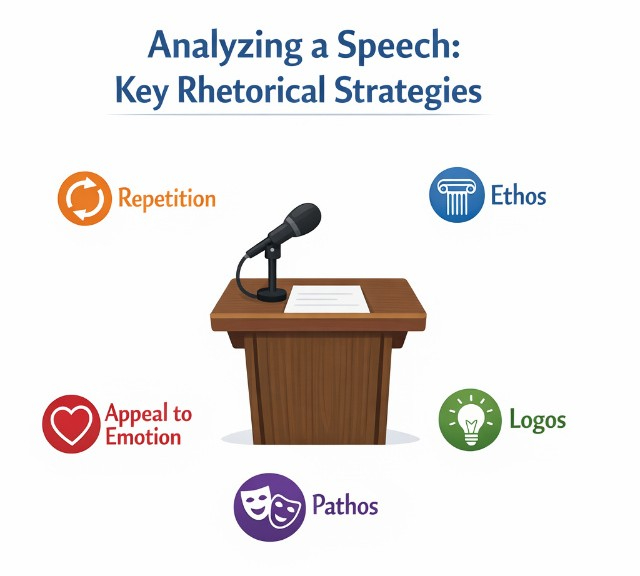
Different academic levels require different sophistication in analysis.
Rhetorical Analysis Essay Examples for High School
Characteristics of high school examples:
- Clear identification of ethos, pathos, and logos
- Focus on obvious rhetorical devices (repetition, metaphor, rhetorical questions)
- Direct connection between technique and effect
- 750-1,000 words typically
Best examples for high school:
- MLK's "I Have a Dream" (anaphora, pathos)
- Nike "Just Do It" campaign (ethos through celebrity)
- Obama "Hope" poster (visual rhetoric basics)
Key skills demonstrated:
- Identify rhetorical appeals correctly
- Explain how specific techniques work
- Connect strategies to audience and purpose
- Use evidence from the text
2. Rhetorical Analysis Essay Example College
Characteristics of college examples:
- Sophisticated understanding of rhetorical situation
- Analysis of subtle techniques (tone, syntax, strategic concession)
- Discussion of how strategies work together
- Evaluation of effectiveness with nuance
- 1,200-1,500 words typically
Best examples for college:
- David Brooks op ed analysis (tone, concession strategy)
- Sojourner Truth "Ain't I a Woman?" (marginalized speaker rhetoric)
- Visual rhetoric analysis with cultural context
Key skills demonstrated:
- Analyze rhetorical situation comprehensively
- Identify and explain sophisticated techniques
- Discuss interplay between multiple strategies
- Evaluate effectiveness with nuance
- Connect to broader rhetorical theory
Want someone to write your rhetorical analysis essay for you? Our trusted essay writing service creates custom essays from scratch, same quality as these examples, but for YOUR assignment.
Download Rhetorical Analysis Essay Examples (PDF)
Ready for One With Your Name on It?
Our writers deliver polished rhetorical analysis essays, researched, analyzed, structured, and ready to submit.
- Your A+ Essay Awaits
- Unlimited revisions
- 100% human written analysis
- Delivered on time, every time
Same quality. Your topic. Your deadline.
Get Started NowBottom Line
The best way to write a great rhetorical analysis is to study great rhetorical analyses. Use these rhetorical analysis essay examples as models, steal the structure, adapt the techniques, and make it your own. Check out our rhetorical analysis essay guide for more information. And if you need backup, you know where to find us.