Here's a plug and play rhetorical analysis essay outline you can copy right now. Fill in the brackets with your rhetorical strategies, evidence, and analysis, and you've got a roadmap for dissecting any speech, article, or text. No more staring at a blank page wondering how to organize your rhetorical analysis.
Rhetorical Analysis Essay Outline Template
Copy this rhetorical analysis outline and replace the bracketed text with your content.
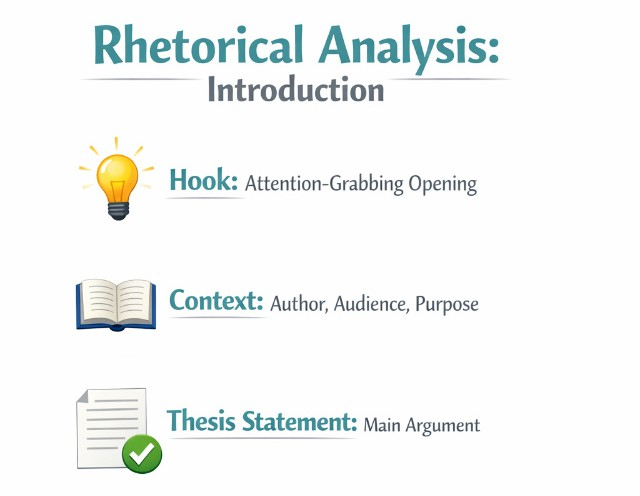
I. INTRODUCTION - Hook: [Your attention grabbing opening, introduce the text/speech you're analyzing]
- Context: [Author/speaker name, title of work, date, audience, and purpose in 2-3 sentences]
- Thesis: [Your argument about HOW the author uses rhetorical strategies to achieve their purpose]
II. BODY PARAGRAPH 1: First Rhetorical Strategy - Topic sentence: [Name the first rhetorical strategy and its purpose]
- Evidence: [Specific quote, example, or technique from the text]
- Analysis: [Explain HOW this strategy affects the audience and WHY it's effective for the author's purpose]
- Transition: [Bridge to next strategy]
III. BODY PARAGRAPH 2: Second Rhetorical Strategy - Topic sentence: [Name the second rhetorical strategy and its purpose]
- Evidence: [Specific quote, example, or technique from the text]
- Analysis: [Explain HOW this strategy works on the audience and connects to the author's goal]
- Transition: [Bridge to next strategy]
IV. BODY PARAGRAPH 3: Third Rhetorical Strategy - Topic sentence: [Name the third rhetorical strategy and its purpose]
- Evidence: [Specific quote, example, or technique from the text]
- Analysis: [Explain HOW this strategy reinforces the author's message]
- Transition: [Bridge to conclusion]
V. CONCLUSION - Restate thesis: [Rephrase your argument about the author's rhetorical effectiveness, don't copy]
- Summarize: [Brief recap of the three main strategies you analyzed]
- So what?: [Why these strategies matter / how effective the author was overall]
|
Got Your Outline But No Time to Write?
Our writers deliver polished rhetorical analysis essays: researched, structured, and ready to submit.
- From outline to A+ essay
- Unlimited revisions
- Delivered on time, every time
- 100% human written
Send your outline. We'll turn it into a finished essay.
Order Now
Rhetorical Analysis Essay Outline Structure Explained
Not sure how much space to give each section? Here's the standard breakdown for a rhetorical analysis outline.
Introduction (10-15% of your essay) What to include: - Hook that introduces the text/speech
- Context about author, audience, occasion, purpose (SOAPS)
- Thesis stating your argument about the author's rhetorical effectiveness
Length: - Approximately 50-75 words for a 500 word essay
- 2-3 sentences before your thesis
Body Paragraphs (70-80% of your essay) What to include: - Usually 3 paragraphs for standard rhetorical analysis format
- Each focuses on ONE rhetorical strategy (ethos, pathos, logos, or a specific device)
- Follow: Strategy, Evidence, Analysis of Effect, Link
Length: - 150-200 words each for a 500 word essay
- One strategy per paragraph keeps analysis focused
Common organization: - Paragraph 1: Ethos (credibility/authority)
- Paragraph 2: Pathos (emotional appeals)
- Paragraph 3: Logos (logical reasoning)
Or organize by most to least impactful strategy. Conclusion (10-15% of your essay) What to include: - Reframe your thesis (don't copy paste)
- Quick summary of how the strategies work together
- Evaluate overall effectiveness of the author's rhetoric
Length: - Approximately 50-75 words for a 500 word essay
|
Rhetorical Analysis Essay Format (By Length)
Depending on your assignment length, you may need to adjust the number of strategies you analyze.
Short Essay (500-750 words)
- 3 body paragraphs
- 1 rhetorical strategy per paragraph
- 1-2 pieces of evidence per strategy
- Use the basic rhetorical analysis template above
Medium Essay (1,000-1,500 words)
- 4-5 body paragraphs
- Can analyze more strategies OR go deeper into 3 main ones
- 2-3 pieces of evidence per paragraph
- Add discussion of rhetorical situation (context, audience, purpose)
AP Lang Rhetorical Analysis (Full Essay)
- Follow AP Lang rhetorical analysis outline format
- 4-5 paragraphs total
- Introduction with clear thesis
- 2-3 body paragraphs analyzing strategies
- Brief conclusion
- 40 minutes = prioritize analysis over length
Research Paper (2,000+ words)
- 6-8 body paragraphs
- Analyze full range of strategies
- Include historical/cultural context
- Discuss multiple texts if comparative analysis
- Add counterarguments or alternative interpretations
Rhetorical Analysis Paragraph Structure (TEAR Method)
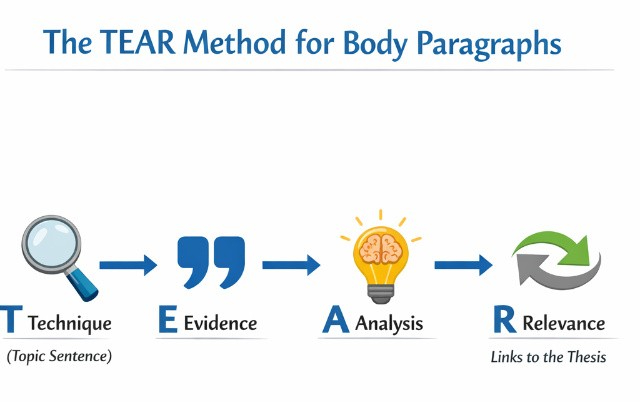
Each body paragraph in your rhetorical analysis outline follows the same structure. Here's the TEAR method expanded:
T: Technique (Topic Sentence) "[Name the specific rhetorical strategy and what the author is trying to achieve]" Example: "King establishes his credibility through appeals to ethos, positioning himself as both a religious leader and a fellow American." E: Evidence (Support) "[Insert your quote or specific example of this technique from the text]" Example: "As King writes, 'I have the honor of serving as president of the Southern Christian Leadership Conference...'" A: Analysis (Effect) "[Explain HOW this technique affects the audience and WHY it's effective for the author's purpose. This is where YOUR analysis shows, don't skip it.]" Example: "By highlighting his leadership role, King establishes authority to speak on civil rights while the religious reference appeals to the clergymen's shared values, making his argument harder to dismiss." R: Relevance (Link) "[Connect back to thesis OR bridge to the next paragraph's strategy]" Example: "This ethical foundation allows King to then appeal directly to his audience's emotions." |
Rhetorical Analysis Outline Example (Filled In)
Here's what the rhetorical analysis essay template looks like with actual content, analyzing MLK's "Letter from Birmingham Jail":
I. INTRODUCTION - Hook: In 1963, from a Birmingham jail cell, Dr. Martin Luther King Jr. penned one of the most powerful defenses of civil disobedience in American history.
- Context: "Letter from Birmingham Jail" responds to eight white clergymen who criticized King's tactics. Writing to a religious and educated audience, King defends nonviolent protest and explains why African Americans cannot wait for gradual change.
- Thesis: King masterfully employs ethos, pathos, and logos to transform his audience from critics to allies, demonstrating that immediate action for civil rights is both morally justified and practically necessary.
II. BODY PARAGRAPH 1: Ethos - Topic: King establishes credibility through religious and civic authority
- Evidence: "I have the honor of serving as president of the Southern Christian Leadership Conference... Just as the prophets of the eighth century B.C..."
- Analysis: By positioning himself as both organizational leader and prophetic voice, King claims authority his religious audience must respect. The biblical comparison elevates civil rights work from political activism to moral imperative, making opposition harder to justify on religious grounds.
- Transition: This ethical foundation allows King to then appeal directly to his audience's emotions.
III. BODY PARAGRAPH 2: Pathos - A. Topic: King uses emotional appeals to make injustice visceral and immediate
- Evidence: "When you have seen vicious mobs lynch your mothers and fathers... when you see the vast majority of your twenty million Negro brothers smothering in an airtight cage of poverty..."
- Analysis: The second person "you" forces readers to inhabit Black experience, while the catalogue of injustices accumulates emotional weight. The "airtight cage" metaphor makes systemic oppression tangible, not abstract statistics but suffocation.
- Transition: Beyond emotional appeal, King also constructs logical arguments for immediate action.
IV. BODY PARAGRAPH 3: Logos - A. Topic: King uses logical reasoning to dismantle the "wait" argument
- Evidence: "We have waited for more than 340 years for our constitutional and God given rights... justice too long delayed is justice denied."
- Analysis: The 340 year timeframe exposes the absurdity of calling for more patience. King then applies deductive reasoning: delayed justice = denied justice, therefore waiting = accepting injustice. This logical structure leaves no middle ground.
- Transition: Together, these strategies create an irrefutable case.
V. CONCLUSION - Restate thesis: Through strategic deployment of ethos, pathos, and logos, King transforms justified resistance into the only moral choice available
- Summarize: His religious authority, emotional power, and logical reasoning work together to shift his audience from critics to potential allies
- So what?: The letter succeeds because King doesn't just defend civil rights, he makes opposition to them morally and intellectually untenable.
|
NOTE: This is a FILLED IN OUTLINE ONLY, not a full essay. Full essay examples live on the Examples page.
Want someone to write you rhetorical analysis essay for you? Our reliable essay writing service will handle the outline AND the analysis, you just tell us your text and requirements.
Downloadable Outlines for Rhetorical Essay
Want the Whole Thing Done?
Our writers deliver polished rhetorical analysis essays; researched, structured, and ready to submit.
- Delivered on time, every time
- Unlimited revisions
- 100% human written
- Finished essay
Bottom Line
Now you've got a rhetorical analysis essay structure. Fill in the blanks with your strategies and evidence, and you're halfway there. The hard part is the analysis itself, explaining not just what strategies the author uses, but HOW they work and WHY they're effective. That why we have created rhetorical analysis essay guide just for you. Good luck, and don't forget we're here if you need backup.