What is a Summary?
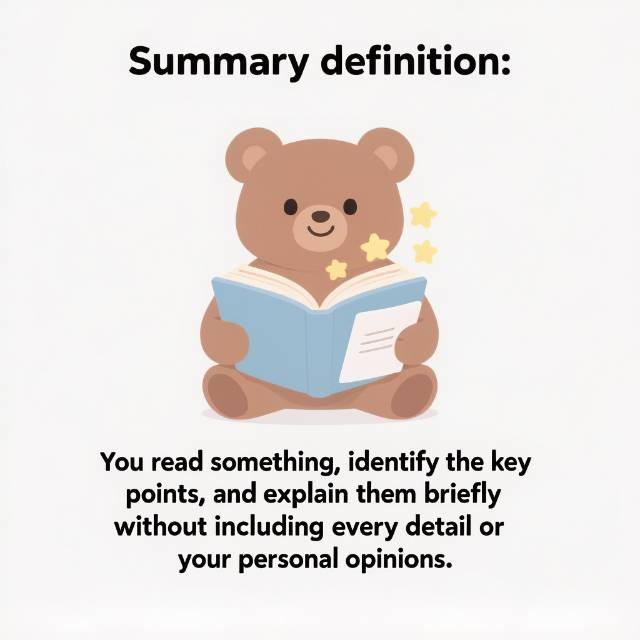
A summary is a condensed version of a longer text that captures only the main ideas, written entirely in your own words.
The Three Essential Elements
Brevity:
Significantly shorter than the original (typically 1/4 to 1/3 the length)
Accuracy:
Captures the author's main ideas faithfully without distortion
Your own words:
Completely rewritten, not copied sentences with a few words changed
What Makes a Good Summary?
Strong summaries share these qualities:
- Captures the thesis or main argument: The central idea is crystal clear
- Includes only essential supporting points: Major evidence, not every minor detail
- Maintains objectivity: No personal opinions, reactions, or analysis
- Uses original phrasing: Completely reworded except for necessary technical terms
- Follows logical order: Usually mirrors the source's structure
Bad summary: Good summary: See the difference? Specific, clear, objective. |
Why Write Summaries?
People write summaries for many reasons:
- For school: Demonstrate comprehension, synthesize research, complete reading assignments
- For work: Create executive summaries, brief reports, condense lengthy documents
- For research: Summarize sources in literature reviews, annotated bibliographies
- For yourself: Process complex information, study for exams, organize research
- For others: Explain technical content to non experts, save readers' time
Need a Clear, Accurate Summary? We’ve Got You.
Let expert writers handle your assignments while you focus on learning.
- Written by real academic experts
- Plagiarism-free guarantee
- Deadlines always met
- No AI
Join thousands of satisfied students
Get Started NowSummary vs. Other Writing Types
Confused about summary, analysis, and paraphrase? Here's the breakdown.
Summary vs. Analysis
Aspect | Summary | Analysis |
Purpose | Restates what the author said | Evaluates how and why |
Tone | Objective, factual | Includes your interpretation |
Evaluation | No evaluation | Critiques strengths/weaknesses |
Length | Shorter than original | Can be longer than original |
Summary vs. Paraphrase
Aspect | Summary | Paraphrase |
Scope | Condenses entire text | Rewrites specific passage |
Content | Only main points | All details preserved |
Length | Much shorter | Same length as original |
Both are valid use summaries when you need brevity, and paraphrases when you need to clarify or restate something at full length.
The 5 Main Types of Summaries
Not all summaries serve the same purpose. Knowing your options helps you write appropriately.
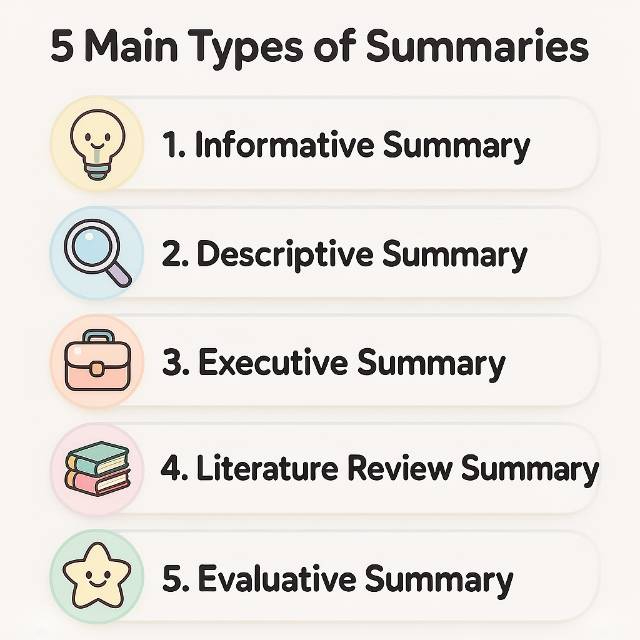
1. Informative Summary
Condenses content neutrally. Most common type for school assignments.
Length: 1/4 to 1/3 of original
Purpose: Demonstrate comprehension
Best for: Book reports, article summaries, research paper literature reviews
2. Descriptive Summary (Abstract)
Brief overview that describes what the text covers without going into detail.
Length: 100–250 words typically
Purpose: Help readers decide if they should read the full text
Best for: Academic papers, journal articles, conference presentations
3. Executive Summary
Business focused summary highlighting key findings and recommendations.
Length: 1–2 pages for reports of any length
Purpose: Enable decision makers to grasp essentials quickly
Best for: Business reports, proposals, research findings for non experts
4. Literature Review Summary
Condenses multiple sources to show themes and gaps in research.
Length: Varies (often 1–3 paragraphs per source)
Purpose: Synthesize existing research
Best for: Research papers, thesis chapters, grant proposals
5. Evaluative Summary
Includes both summary and brief evaluation of the work's quality or relevance.
Length: Slightly longer than pure summary
Purpose: Inform and assess simultaneously
Best for: Annotated bibliographies, book reviews, some academic assignments
Which Type Should You Write?
Check your assignment requirements:
- Says "summarize the article": Informative summary
- Says "abstract": Descriptive summary
- Says "executive summary": Business format
- Says "annotated bibliography": Evaluative summary
Consider your audience:
- Professor grading comprehension: Informative
- Busy executive: Executive summary
- Fellow researchers: Literature review summary
When in doubt, ask your instructor or use an informative summary; it's the standard.
How to Write a Summary: Step by Step
Writing a summary follows a clear process. Don't skip steps; each makes the next easier.
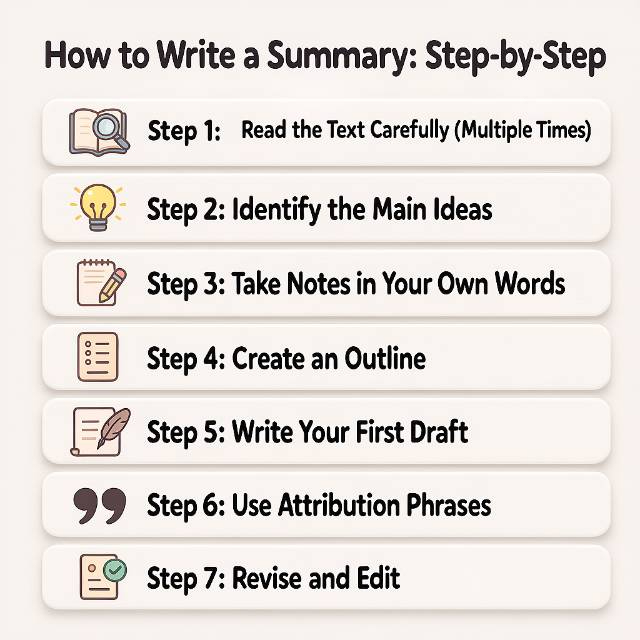
Step 1: Read the Text Carefully (Multiple Times)
First reading: Get the big picture:
- Read start to finish without stopping
- Don't take notes yet
- Focus on overall meaning and main argument
What to identify:
- What is the author trying to prove or explain?
- What's the thesis statement or central claim?
- What type of text is this? (argument, explanation, narrative, analysis)
Second reading: Dig deeper:
- Read again, this time with a highlighter or pen
- Mark main points and key supporting evidence
- Note section headings, topic sentences, conclusions
Step 2: Identify the Main Ideas
Look for thesis statements:
- Often in the introduction or conclusion
- Clearly states the author's main argument or purpose
Find topic sentences:
- Usually the first or last sentence of each paragraph
- States what that paragraph is about
Recognize supporting evidence:
- Statistics, examples, studies that back up main points
- You'll include major evidence, skip minor details
Ask yourself:
- If I could only tell someone 3 things from this text, what would they be?
- What can't be removed without losing the author's meaning?
Step 3: Take Notes in Your Own Words
As you read, create notes that restate key points.
Good note taking:
- Write in complete sentences (easier to use later)
- Use your own words (forces you to understand, not just copy)
- Note page numbers (in case you need to reference later)
Example notes from an article about sleep:
Bad notes (copied): Good notes (your words): |
Warning: Avoid the highlighter trap. Highlighting doesn't equal understanding. Force yourself to rewrite concepts in your own language.
Step 4: Create an Outline
Organize your notes into a logical structure before writing.
Basic Summary Outline:
I. Introduction
Author's name and text title
Publication info (if relevant)
Thesis/main argument
II. Body (Main Points)
First major point + key support
Second major point + key support
Third major point + key support
III. Conclusion
Restate main argument/findings
Overall significance (if appropriate)
Filled Example Outline for Article Summary:
I. Introduction
Author: Dr. Sarah Johnson
Article: "The Hidden Costs of Social Media"
Thesis: Excessive social media use correlates with increased anxiety and decreased productivity
II. Body
Point 1: Studies show 3+ hours daily linked to 60% higher anxiety
Point 2: Average worker loses 2.5 hours to social media distractions
Point 3: Comparison effects from curated content harm self-esteem
III. Conclusion
Moderation and awareness are key to healthy use
Step 5: Write Your First Draft
Now, actually write the summary.
Opening sentence format: [Author's full name], in [his/her/their] [type of text] "[Title]," [published in Publication, Year], argues/claims/explains that [main thesis]. Example: Body paragraphs:
Closing:
|
Step 6: Use Attribution Phrases
Throughout your summary, remind readers you're summarizing someone else's work.
Attribution phrases to use:
- "According to [Author]..."
- "[Author] argues that..."
- "The article demonstrates..."
- "[Author] claims..."
- "The study reveals..."
- "[Author] concludes..."
Why this matters:
Without attribution, your summary can look like plagiarism even if you rewrote everything. These phrases signal you're representing another's ideas.
Step 7: Revise and Edit
First pass: Content check:
- Does it capture the thesis accurately?
- Are all major points included?
- Did you leave out minor details?
- Is anything unclear?
Second pass: Wording check:
- Is everything in your own words?
- Did you avoid copying sentence structures?
- Are quotes used sparingly (if at all)?
- Does it flow smoothly?
Final pass: Technical check:
- Correct spelling and grammar
- Proper citation format (if required)
- Right length (check assignment requirements)
- Author's name spelled correctly
Turn Complex Readings into Clear Summaries Without any Stress.
Experience Stress Free Academic Writing
- Expert help across all subjects
- Original, human written content
- Clear, accurate summaries
- Guaranteed on time delivery
Get professional academic help trusted by thousands of students.
Order NowSummary Writing Techniques
These techniques help you write stronger, clearer summaries.
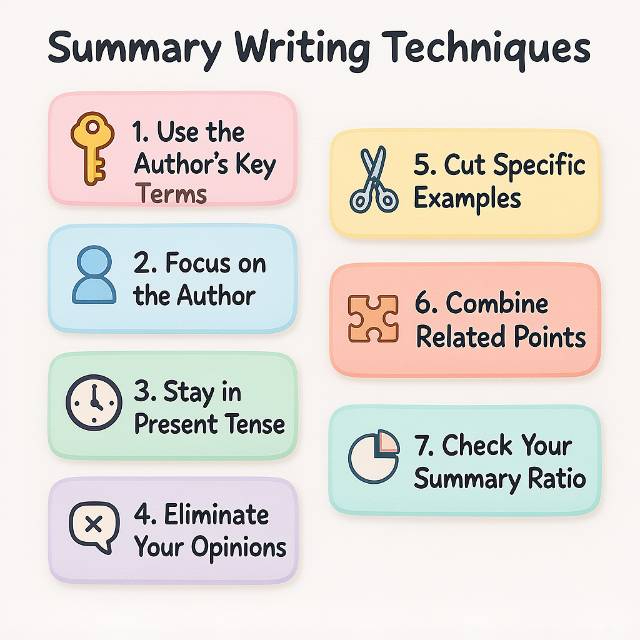
1. Use the Author's Key Terms
While you rewrite in your own words, keep important technical terms or specific phrases.
Why: Changing specialized terminology can distort meaning.
Example: Article about "cognitive dissonance":
- Don't say: "mental disagreement with yourself"
- Do say: "cognitive dissonance"
When to keep original phrasing:
- Technical terms (photosynthesis, GDP, cognitive dissonance)
- Specific concepts coined by the author
- Proper nouns (names, places, organizations)
Everything else? Rewrite completely.
2. Focus on the Author, Not the Topic
Your summary is about what the author said, not about the general topic.
Topic focused (weak): Author focused (strong): See the difference? The second attribute claims by the author and specifies their evidence. |
3. Stay in Present Tense
Use the present tense when describing what the author does in the text.
Examples:
- "Johnson argues..."
- "The study demonstrates..."
- "Rodriguez concludes..."
Not:
- "Johnson argued..."
- "The study demonstrated..."
Exception:
Past tense for the historical events the author discusses.
| "Johnson explains that the Industrial Revolution began in the 18th century and transformed manufacturing." (Past tense for historical events, but "explains" stays present.) |
4. Eliminate Your Opinions
No reactions, evaluations, or personal thoughts.
Opinion free (correct): Includes opinion (wrong): Words like "compelling," "convincing," and "well designed" are your evaluations, not appropriate in a pure summary. |
5. Cut Specific Examples (Usually)
Include the general principle, skip the detailed example unless it's essential.
Original text: Summary: You don't need the fox and stick insect examples unless they're central to the argument. |
6. Combine Related Points
Don't mirror every paragraph of the original. Group related ideas together.
If the original has:
- Paragraph 1: Social media causes anxiety
- Paragraph 2: Instagram is particularly harmful
- Paragraph 3: Facebook also shows negative effects
- Paragraph 4: TikTok usage correlates with attention issues
Your summary says:
"The author demonstrates that various social media platforms, particularly Instagram, Facebook, and TikTok, correlate with increased anxiety and reduced attention spans."
One sentence covers four paragraphs. That's efficiency.
7. Check Your Summary Ratio
General rule: Your summary should be 25–33% of the original length.
Quick calculation:
- 1,000-word article: 250–330 word summary
- 10-page paper: 2.5–3 page summary
- 300-page book: 75–100 page summary (or much shorter for assignment purposes)
If your summary is:
- Too long: You're including too many details. Focus only on main points.
- Too short: You might be missing key supporting arguments. Reread for major evidence.
Common Mistakes of Summary Writing to Avoid
Every writer makes these mistakes. Here's how to catch them.
Mistake 1: Copying Sentences
The problem:
Changing a few words but keeping the sentence structure is still plagiarism.
Original:
"Despite widespread public concern about climate change, meaningful policy action remains frustratingly limited due to political polarization and economic interests."
Plagiarism (just swapping words):
"Even though there's a lot of public worry about climate change, real policy steps stay frustratingly restricted because of political division and economic concerns."
Proper summary (completely rewritten):
"The author notes that political divisions and economic pressures have prevented significant climate policy despite public support."
How to avoid it:
|
Mistake 2: Including Too Many Details
The problem:
Summarizing every paragraph equally instead of focusing on main ideas.
Too detailed:
"First, the author discusses the history of coffee cultivation. Then she explains three harvesting methods. Next, she describes the roasting process in detail, including temperature ranges. She also covers grinding techniques. Finally, she provides brewing instructions for five methods."
Appropriately condensed:
"The author traces coffee production from cultivation through brewing, emphasizing that each stage, harvesting, roasting, grinding, and brewing method significantly affects flavor."
How to avoid it:
|
Mistake 3: Adding Your Opinion
The problem:
Inserting your reactions, evaluations, or additional information.
Contains opinion:
"The author brilliantly argues that homework should be limited. This is absolutely correct, as students today are overwhelmed with responsibilities."
Pure summary:
"The author argues that homework should be limited, citing research on student stress levels and diminishing academic returns beyond one hour per night."
How to avoid it:
|
Mistake 4: Misrepresenting the Author
The problem:
Changing the author's meaning, even accidentally.
Original meaning:
"While social media can facilitate connections, excessive use correlates with increased loneliness and depression."
Misrepresentation:
"The author claims social media causes depression."
Accurate representation:
"The author notes a correlation between excessive social media use and increased depression, while acknowledging that moderate use can support social connection."
How to avoid it:
|
Mistake 5: Forgetting Attribution
The problem:
Writing as if the ideas are facts or your own thoughts.
No attribution:
"Childhood poverty has long term effects on educational outcomes. Students from low income families score lower on standardized tests. Early intervention programs can reduce achievement gaps."
Proper attribution:
"According to Rodriguez, childhood poverty significantly impacts educational outcomes, with students from low income backgrounds scoring substantially lower on standardized tests. The author argues that early intervention programs can help reduce these achievement gaps."
How to avoid it:
|
Mistake 6: Wrong Length
The problem:
Writing a summary that's way too long or too short for the assignment.
How to check:
How to fix:
|
Mistake 7: Summarizing Chronologically When It Doesn't Make Sense
The problem:
Following the source's order even when reorganizing would be clearer.
Most of the time:
Mirror the source's structure (it's usually logical).
Sometimes:
Reorganize for clarity.
Example: Article that presents:
- Problem description
- Historical context
- Current situation
- Proposed solutions
- More historical context
Your summary might be reorganized:
- Problem and current situation (combined)
- Historical context (combined into one section)
- Proposed solutions
Use your judgment. If the source is well organized, follow it. If it's scattered, you can reorganize for clarity.
Whether it’s a short summary, a research paper, or a full essay, our professional essay writing service can deliver exactly what you need, quickly and reliably.
Summary Examples for Each Type
Seeing summaries in action helps you understand what works.
Example 1: Article Summary (Short Form)
Original Article Length: 1,200 words
Summary Length: 300 words
In "The Cost of Convenience: How Fast Fashion Harms Workers and the Environment," journalist Maria Chen examines the hidden consequences of cheap clothing. Published in The Atlantic in September 2024, Chen's article argues that the fast fashion industry's business model depends on worker exploitation and environmental destruction that consumers rarely see.
Chen begins by outlining the industry's scale: Americans now purchase 60% more clothing than in 2000 but keep each item half as long. This demand drives production to countries with minimal labor protections and environmental regulations. The author presents evidence from factory inspections in Bangladesh and Vietnam, revealing workers earning below minimum wage in unsafe conditions while producing garments that will retail for 50 times their labor cost.
The environmental impact proves equally severe. Chen cites research from the Ellen MacArthur Foundation demonstrating that fashion production accounts for 10% of global carbon emissions and represents the second largest consumer of the world's water supply. Most alarming, the author notes, is that 85% of all textiles end up in landfills annually roughly one garbage truck of textiles per second.
Chen proposes several solutions: extended producer responsibility laws requiring brands to fund recycling programs, mandatory supply chain transparency, and consumer shifts toward buying fewer, higher quality items. She concludes that sustainable fashion need not be expensive if consumers change their relationship with clothing from disposable to durable.
The article effectively combines investigative reporting with environmental research to demonstrate that fast fashion's true cost far exceeds its retail price, suggesting that industry reform will require both regulatory pressure and consumer behavior change.
What Makes This Summary Strong
|
Example 2: Book Summary (Chapter Level)
Original: Chapter 3 of Thinking, Fast and Slow by Daniel Kahneman (approx. 25 pages)
Summary Length: 200 words
In Chapter 3 of Thinking, Fast and Slow, psychologist Daniel Kahneman introduces the concepts of System 1 and System 2 thinking, which form the foundation for his analysis of human cognition. System 1, Kahneman explains, operates automatically and quickly with little effort or voluntary control. Examples include detecting hostility in a voice, completing the phrase "bread and...," or driving on an empty road.
System 2, in contrast, allocates attention to effortful mental activities requiring computation and conscious choice. This system activates when solving complex problems, comparing products, or parking in a narrow space. Kahneman emphasizes that System 2 believes itself to be the protagonist of consciousness, making deliberate choices and maintaining self control. However, most actions and judgments actually originate from System 1, with System 2 only becoming engaged when System 1 encounters difficulty.
The author demonstrates through examples that System 1 continuously generates suggestions impressions, intuitions, intentions which System 2 endorses as beliefs and voluntary actions when all proceeds smoothly. This relationship, Kahneman argues, explains both the efficiency and the systematic errors in human thinking, setting up his later exploration of cognitive biases.
What Makes This Summary Strong
|
Example 3: Executive Summary (Business Report)
Original Report Length: 45 pages
Summary Length: 500 words
Executive Summary: Q4 2024 Market Analysis Report
This report analyzes our company's market position in the sustainable packaging sector for Q4 2024, evaluates competitor strategies, and provides recommendations for 2025 market expansion.
Key Findings:
Market Growth: The sustainable packaging market grew 23% in Q4 2024, exceeding our projected 18% growth rate. Our company captured 12% market share, ranking third behind EcoPackage (19%) and GreenWrap Solutions (15%). Consumer demand for compostable materials specifically increased 41% year over year, representing our strongest growth segment.
Competitive Landscape: Two major developments shifted the competitive environment. First, EcoPackage's acquisition of BioPack Technologies in October expanded their product line into industrial scale composting solutions, directly competing with our core offerings. Second, emerging competitor PlantBase Packaging secured $50M Series B funding and aggressively priced products 15-20% below market rates to gain market share.
Customer Feedback: Survey data from 1,200 clients revealed that while 89% rated our product quality as "excellent," only 62% rated our responsiveness to custom requests as satisfactory. Lead times for custom orders averaged 6.2 weeks compared to industry average of 4.1 weeks, representing our primary competitive weakness.
Revenue Performance: Q4 revenue reached $32.4M, a 15% increase over Q3 but below our $34M target. The shortfall resulted primarily from delayed enterprise contract closures and price concessions in response to PlantBase's competitive pricing. However, profit margins remained stable at 28% due to improved manufacturing efficiency.
Recommendations:
Accelerate Custom Orders: Invest $2.5M in production line modifications to reduce custom order lead times to 3.5 weeks, addressing our primary customer complaint and differentiating from low cost competitors competing primarily on price.
Develop Industrial Composting Line: Launch industrial scale solutions by Q2 2025 to directly compete with EcoPackage's expanded offerings. Projected development cost of $8M with break even expected in 18 months.
Strategic Pricing Response: Rather than matching PlantBase's low prices, emphasize quality and service differentiation through enhanced marketing. Maintain current pricing on core products while introducing a budget line for price sensitive segments.
Enterprise Sales Focus: Assign dedicated account managers to the 15 largest enterprise prospects, as converting just three would add $12M in annual recurring revenue.
Conclusion:
Despite increased competition, strong market growth and our established quality reputation position us well for 2025 expansion. The recommended investments, totaling $10.5M, would address our primary weakness (custom order speed) while capturing emerging opportunities (industrial composting). Implementation of these recommendations could increase market share to 15% by end of 2025.
What Makes This Executive Summary Strong
|
Example 4: Literature Review Summary (Academic)
Original: Three journal articles about sleep deprivation
Summary Length: 150 words
Current research demonstrates consistent negative effects of sleep deprivation on cognitive performance, though mechanisms remain debated. Walker and Stickgold (2019) found that even partial sleep restriction (6 hours vs. 8 hours) significantly impaired memory consolidation and creative problem solving in college students, with effects accumulating over consecutive nights. Examining physiological mechanisms, Chen et al. (2021) identified that sleep deprivation reduces synaptic plasticity in the hippocampus, potentially explaining memory deficits observed in behavioral studies.
However, Rodriguez and Kim (2023) challenged the generalizability of laboratory findings, noting that controlled sleep studies typically involve acute, severe restriction that may not reflect real world partial sleep loss. Their naturalistic study found more modest effects in working adults who self regulate sleep.
These studies collectively support sleep's importance for cognitive function while highlighting methodological differences between laboratory and naturalistic research designs. Future research should examine chronic partial sleep restriction under real world conditions to better inform public health recommendations.
What Makes This Literature Review Summary Strong
|
Example 5: Abstract (Descriptive Summary)
For: Your own research paper
Length: 200 words
This study examines the relationship between student engagement strategies and academic performance in large undergraduate lecture courses. Despite growing enrollment in entry level STEM courses, traditional lecture based instruction often results in high failure rates and decreased student motivation. This research compares three pedagogical approaches: traditional lecture, lecture with integrated active learning exercises, and flipped classroom model across six sections of introductory biology (n=847 students).
Data collection included pre/post content knowledge assessments, attendance tracking, course grades, and student perception surveys. Analysis revealed that sections incorporating active learning strategies showed significantly higher exam scores (p<0.001) and lower withdrawal rates compared to traditional lecture sections. The flipped classroom model produced the highest gains but required substantially more instructor preparation time and student resistance was initially high.
These findings suggest that even modest integration of active learning techniques improves student outcomes in large STEM courses without requiring complete course redesign. However, implementation requires institutional support for instructor training and recognition that student adjustment periods may initially produce negative course evaluations. Recommendations for faculty and administrators are discussed.
Clear Writing Starts Here. Get Expert Help
From summaries to full papers, get expert academic help
- Expert writers
- 100% original work
- On time delivery guaranteed
- No AI, ever
Join 50,000+ students who trust us for clear, accurate, and original academic work.
Order NowBottom Line: Key Takeaways
- A strong summary prioritizes the author’s ideas, not your opinions or background knowledge.
- Effective summaries clearly state the thesis and include only the most important supporting points.
- Different contexts require different summaries, informative, executive, literature review, and abstracts, each follow distinct conventions.
- Objectivity is essential: summaries report, not evaluate.
- Proper attribution prevents plagiarism and clarifies whose ideas are being presented.
- Brevity matters, but clarity matters more than details, not meaning.
- Well structured summaries allow readers to understand the core message without reading the full text.
In short, a good summary is accurate, concise, clearly attributed, and tailored to its purpose and audience.