What is an Analytical Essay?
Here's the thing nobody explains clearly: an analytical essay isn't a book report. You're not retelling what happened, you're explaining HOW it works and WHY it matters.
Think of it like detective work. When you summarize Romeo and Juliet, you just report: two teenagers from feuding families fall in love and die. When you analyze it, you investigate WHY Shakespeare uses light and dark imagery, WHAT that reveals about fate versus free will, and HOW those techniques create meaning.
It examines a subject by breaking it down into components, interpreting patterns and relationships, and explaining significance through evidence-based arguments. Unlike summaries that retell information, analysis explores mechanisms, causes, and deeper meaning, answering "how does it work?" and "why does it matter?" rather than just "what happened?"
Summary answers "what happened?" while analysis answers "how does it work?" and "why does it matter?"
Analysis vs. Summary: The Critical Difference
| Summary | Analysis |
|---|---|
| Retells what happened | Examines why it happened |
| Lists events | Interprets significance |
| Describes surface details | Explores deeper meaning |
| "The character died." | "The character's death symbolizes..." |
| Reports WHAT | Explains HOW and WHY |
| Objective retelling | Interpretive examination |
| No argument needed | Requires thesis and proof |
Example in Practice:
A summary of The Great Gatsby's green light might state: "Gatsby stares at a green light across the bay. The light is at Daisy's dock. He reaches toward it." This simply reports what happens in the text.
An analytical approach examines how the green light functions: "Fitzgerald's green light symbolizes unattainable dreams, with its position permanently distant across the water suggesting that Gatsby's vision of recapturing the past is impossible. The color green connects American ideals of progress and prosperity with this impossibility, revealing Fitzgerald's critique of the American Dream as seductive but illusory."
See the difference? Analysis digs deeper.
Key Characteristics of Analytical Essay:
Analytical essays share several defining features that distinguish them from other academic writing.
- Clear Thesis Statement: They present a thesis that makes an analytical claim, not just stating a fact or offering an opinion, but proposing an interpretation that requires proof. This thesis guides the entire essay, with every paragraph connecting back to support the central claim.
- Evidence-Based Arguments: It relies on evidence drawn directly from the source material being analyzed. Whether examining a novel, speech, historical document, or scientific study, your claims must be supported by specific examples, quotes, data, or observations. You can't simply assert that Shakespeare uses bird imagery to symbolize freedom; you must show where this imagery appears, explain how it functions, and demonstrate why your interpretation is valid.
- Deep Examination: Analysis moves beyond surface-level observation to explore mechanisms, causes, effects, patterns, and significance. When you encounter a metaphor in a poem, analysis doesn't stop at identifying it as a metaphor. Analysis explains what is being compared, examines how that comparison creates meaning, considers why the poet chose this particular metaphor, and explores what it reveals about the poem's larger themes.
- Logical Organization: It maintains an organization that connects ideas systematically. Each paragraph should have a clear focus, and paragraphs should flow in an order that builds your argument progressively.
- Critical Thinking: Finally, it demonstrates a sophisticated understanding. This means acknowledging complexity, considering alternative interpretations, recognizing patterns across the text, and offering insights that go beyond obvious observations.
READY TO GET STARTED?
Skip the stress. Our professional writers handle everything so you can submit with confidence
- 100% original, plagiarism-free content
- Written by degree-holding experts
- On-time delivery, even for tight deadlines
- Custom research for YOUR topic
No AI. Just real writers, real results
Order NowThe Myths About Analytical Essays
Let's clear up some myths that nobody bothers explaining:
Common Myth | What Students Think | What Your Teacher Actually Expects |
“This is just a fancy book report.” | Retell the plot and summarize events | Explain what the text means and how the author creates meaning, not what happens. |
“I can never use ‘I’ in academic writing.” | First person is always forbidden | Using “I” depends on the assignment; acceptable in personal responses, usually avoided in formal literary analysis. |
“Longer essays get better grades.” | More words = higher marks | Concise, focused analysis (e.g., 800 strong words) beats long summaries with no insight. |
“There’s only one right answer.” | Find the teacher’s hidden interpretation | Multiple interpretations are valid if supported by strong textual evidence |
“Analysis is just my opinion.” | Personal feelings count as analysis | Analysis requires evidence and reasoning, not likes or dislikes |
Types of Analytical Essays (Which One Are You Writing?)
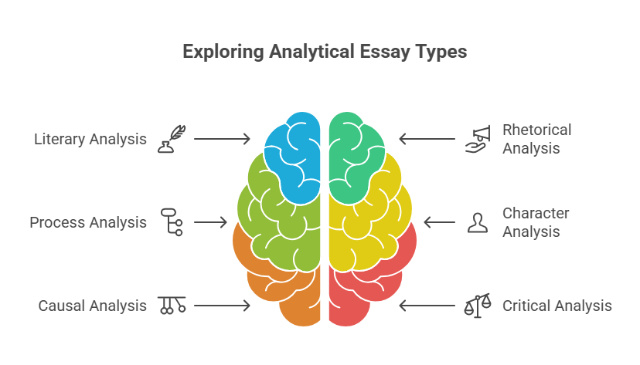
Your assignment probably says something vague like "write an analytical essay about..." without specifying WHICH kind. Here's how to figure it out by looking at the verbs in your prompt:
1. Literary Analysis
It examines books, poems, plays, and stories by exploring themes, characters, symbols, and authorial techniques. Instead of summarizing a poem by Emily Dickinson, you analyze how devices like personification shape meaning. Visit the literary analysis guide to understand how to examine themes, symbols, and author techniques step by step.
2. Rhetorical Analysis
It studies how texts persuade by using ethos, pathos, and logos, such as evaluating credibility, emotion, and logic in Martin Luther King Jr.’s Letter from Birmingham Jail. For a deeper breakdown of persuasive strategies, explore our rhetorical analysis guide with real-world examples.
3. Process Analysis
It explains how something works by breaking it into steps and showing cause-and-effect, as in outlining the stages of photosynthesis. If you need help explaining how something works, check out the complete process analysis guide.
4. Character Analysis
It focuses on motivations, development, and relationships, tracing growth in figures like Elizabeth Bennet. Learn how to analyze motivations and character development by visiting our detailed character analysis guide.
5. Causal Analysis
It investigates why events occur by linking factors and outcomes, such as the forces behind the French Revolution.
6. Critical Analysis
It evaluates overall quality by weighing strengths, weaknesses, and effectiveness. Our critical analysis guide explains how to evaluate strengths, weaknesses, and overall effectiveness.
Still not sure? Check your assignment prompt for the verbs above, or just ask your instructor.
How to Write an Analytical Essay: 7 Steps
Okay, you know WHAT an analytical essay is and WHICH type you're writing. Now let's get you actually writing one.
Step 1: Choose a Specific, Analyzable Stance
Your topic needs sufficient depth for interpretation, available evidence to support your analysis, genuine personal interest to sustain engagement, and appropriate scope for your page limit.
Test whether a topic is analyzable:
- Can I explain how this works and why it matters?
- Does evidence exist to support my interpretations?
- Is there enough complexity to sustain analysis?
Poor topics: Too broad ("Shakespeare's plays")
Strong topics: Specific ("The function of poison imagery in Hamlet")
Struggling to find a topic? Browse our Analytical Essay Topics organized by subject, grade level, and difficulty, each with sample thesis statements.
Step 2: Develop a Clear Thesis Statement
Your thesis should make a specific, debatable claim about what your analysis reveals.
Formula: [Subject] + [Analytical Action] + [Your Interpretation] + [Significance]
Weak thesis statements make obvious claims ("Shakespeare uses imagery")
Strong thesis statements make arguable interpretations, use analytical verbs like "reveals," "demonstrates," "suggests," or "exposes," and indicate WHY it matters
Step 3: Gather Compelling Evidence
Collect more evidence than you think you'll need; aim for 15-20 pieces minimum.
What to collect:
- Direct quotes from your source with exact page numbers.
- Specific examples, details, and patterns.
- Evidence that appears throughout the text, not just in one location.
- Related examples grouped together.
Evidence should come primarily from the text you're analyzing. For complex topics, add 3-5 scholarly sources for context.
Step 4: Create a Logical Flow
Spend 15 minutes organizing your thoughts; it saves hours of confused drafting later.
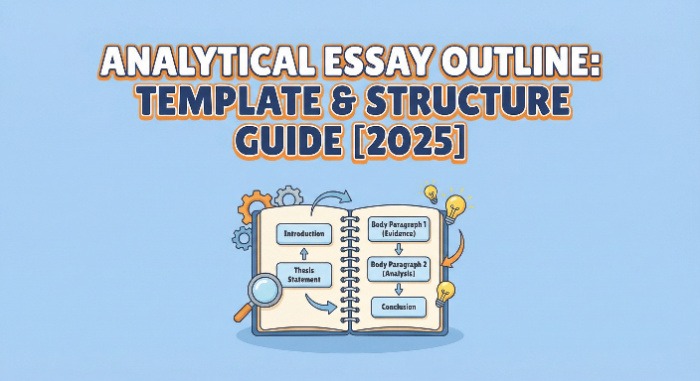
1. Introduction: Hook + Context + Thesis 2. Body Paragraphs: Topic sentence + Evidence + Analysis + Link to thesis 3. Conclusion: Synthesize findings + Broader significance Each body paragraph should follow the TEAL structure:
|
Need a detailed structure breakdown? Our Analytical Essay Outline provides percentage guides, blank templates, paragraph structure explanations, and format variations for different essay lengths.
Step 5: Write with Analysis, Not Summary
As you draft, constantly ask: Am I explaining how and why, or am I just describing what?
Critical rules:
- After every piece of evidence, add 2-3 sentences analyzing its significance.
- Use analytical language: "this demonstrates," "this reveals," "this suggests".
- Never drop in a quote without explaining why it matters and how it supports your thesis.
Write through without stopping. Don't edit as you go, just get your analysis onto the page. You'll polish it later.
Step 6: Deepen Your Analysis (The "So What?" Test)
This step separates A-grades from C-grades. After every claim, ask "So what?" until you reach genuine insight;
Claim: The author uses dark imagery.
So what? It creates a foreboding atmosphere.
So what? It prepares readers for the tragic ending.
So what? It shows the author sees tragedy as inevitable, not accidental.
See how each "So what?" drives deeper? That's the level of analysis you need.
Step 7: Revise in Three Passes
Pass 1 - Big Picture: Does your thesis match your conclusion? Are paragraphs in logical order? Is the analysis deep enough or just descriptive?
Pass 2 - Paragraph Level: Does each paragraph have a clear topic sentence? Is every quote followed by analysis? Are transitions smooth?
Pass 3 - Sentence Level: Fix grammar, spelling, punctuation. Verify all citations are correct. Read aloud to catch awkwardness.
Download our Three-Pass Revision Checklist to systematically improve your essay.
How to Start an Analytical Essay
Your introduction is make-or-break. Most students lose their reader in the first paragraph by opening with generic statements like "Throughout history..." or "In today's society..."
Don't do that.
A strong analytical essay introduction accomplishes three things in 4-6 sentences: hooks the reader, provides necessary context, and states your thesis. Here's how to nail each part.
Four Opening Strategies That Actually Work:
- Start with a surprising fact or insight: "While most readers see Gatsby's green light as a symbol of hope, Fitzgerald systematically associates it with violence and death throughout the novel."
- Open with a thought-provoking question: "Why does Shakespeare give his most eloquent speeches to villains like Iago and Edmund?"
- Begin with a relevant quote from the text: "When Hamlet declares 'Something is rotten in the state of Denmark,' he's diagnosing more than political corruption."
- Set the scene with specific context: "Published in 1925 during the height of Prohibition, The Great Gatsby captures a specific historical moment when Americans were questioning whether prosperity equals happiness."
What to Include in Your Introduction:
Your intro should follow this structure:
- Hook (1-2 sentences)
- Context (2-3 sentences)
- Thesis statement (1 clear sentence)
Want to see this in action? Check out our analytical essay examples to see how strong introductions hook readers immediately.
FEELING OVERWHELMED?
Don't worry, we are here to help you out
- Expert writers handle everything
- Deep analysis, not plot summary
- Any citation format (MLA, APA, Chicago)
- Unlimited revisions included.
No AI. No recycled papers. 100% original or your money back.
Order NowAnalytical Essay Structure
This essay follows the same basic architecture, and understanding these proportions will help you allocate your writing time and space effectively.
Here's how your essay should break down:
1. Introduction: 10-15% of Total Length
What goes here: Hook, necessary context (not plot summary), and your thesis statement. That's it.
2. Body Paragraphs: 70-80% of Total Length
Typically 3-5 body paragraphs for most essays. Each paragraph should focus on ONE analytical point that supports your thesis.
Each body paragraph should follow the TEAL structure:
- Topic Sentence
- Evidence
- Analysis
- Link
3. Conclusion: 10-15% of Total Length
What goes here: Restate your thesis (don't copy-paste it, reframe it), briefly summarize your main analytical insights, and end with the "so what?"
Quick Reference: Word Count Breakdown
| Essay Length | Intro | Body | Conclusion |
|---|---|---|---|
| 1,000 words | 100-150 | 700-800 | 100-150 |
| 1,500 words | 150-225 | 1,050-1,200 | 150-225 |
| 2,000 words | 200-300 | 1,400-1,600 | 200-300 |
Need a ready-to-use template? Download our analytical essay outline with percentage breakdowns, word count guidance, and fillable templates you can use right now.
How to Write a Conclusion for an Analytical Essay
Your conclusion isn't just a summary. If you're just repeating what you already said, you're wasting valuable space and ending your essay on a weak note.
A strong analytical conclusion does three things: reframes your thesis, synthesizes your main insights, and explains broader significance.
The Three-Part Formula:
- Reframe Your Thesis (1 sentence)
- Synthesize Key Insights (2-3 sentences)
- Broader Significance (1-2 sentences)
Answer the "so what?" question. Why does your analysis matter beyond this specific text? What larger understanding does it contribute to?
What NOT to Do:
1. Never introduce brand new evidence or claims in your conclusion. If it's important enough to mention, it should have been in a body paragraph.
2. Don't start with "In conclusion..." or "To conclude..." Your reader knows it's the conclusion because it's at the end.
3. Don't apologize or undermine your analysis with phrases like "This essay has attempted to show..." Either you showed it or you didn't. Be confident in your analysis.
Common Analytical Essay Mistakes to Avoid
Mistake #1: Too Much Plot Summary
Your professor has already read the book. They don't need a retelling. If more than 20% of your essay is a summary, you're doing it wrong. Every time you summarize, immediately follow with analysis explaining WHY that moment matters.
Mistake #2: Dropping Quotes Without Explanation
Never write: "The author says 'quote here' (45)." Then move on. Always follow every quote with 2-3 sentences explaining what it proves and why it's significant. The quote is evidence that YOUR analysis is the argument.
Mistake #3: Stating the Obvious
"Shakespeare's Romeo and Juliet is about love." Yeah, everyone knows. Push deeper. What KIND of love? How does Shakespeare complicate our understanding of love? What does the play reveal about love's relationship to violence, fate, or youth?
Mistake #4: Weak Thesis Statements
"This essay will analyze symbolism in The Great Gatsby." That's not a thesis, it's an announcement. Your thesis should make a specific, arguable claim: "Fitzgerald's color symbolism reveals the moral emptiness beneath Jazz Age glamour, with yellow representing false gold and green symbolizing unattainable dreams."
Mistake #5: No Connection Between Paragraphs
Each body paragraph should build on the previous one. If you can rearrange paragraphs in any order without affecting meaning, your organization needs work. Use transitions that show logical connections: "This pattern intensifies in Chapter 3..." or "While this technique succeeds here, it fails when..."
Analytical Essay Pro Tips That Actually Work
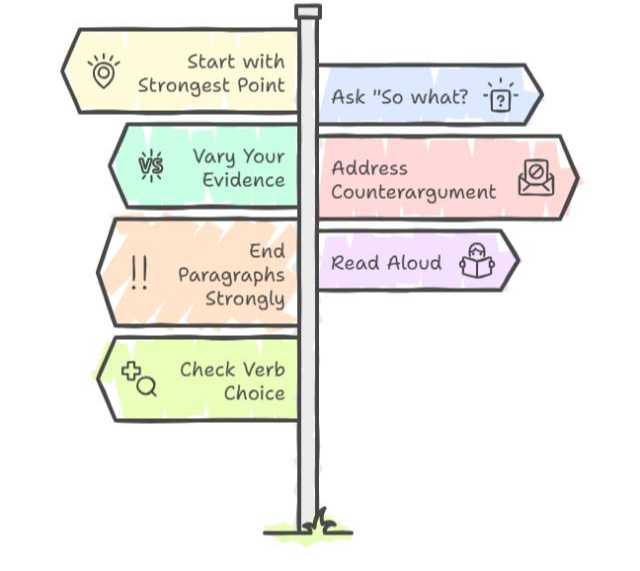
Tip #1: Lead with Your Strongest Point
Put your most compelling analytical claim in Body Paragraph 1. Hook your reader immediately with your best insight, then build from there.
Tip #2: Use the "So What?" Test Ruthlessly
After every claim, ask, "So what? Why does this matter?" If you can't answer, cut it or dig deeper until you find significance worth discussing.
Tip #3: Vary Your Evidence
Don't pull all quotes from Chapter 1. Show patterns across the entire text. If you claim something is "systematic" or "recurring," prove it with examples from the beginning, middle, and end.
Tip #4: Address the Counterargument
Acknowledge alternative interpretations: "While some critics read this as X, the evidence better supports Y because..." This shows sophisticated thinking and strengthens your argument.
Tip #5: End Paragraphs Strongly
The last sentence of each body paragraph should either connect back to your thesis or set up your next point. Never end with a quote; always end with YOUR analysis.
Tip #6: Read Your Essay Aloud
Seriously. Reading aloud catches awkward phrasing, repetitive words, and unclear ideas that your eyes skip when reading silently. If you stumble while reading, your professor will too.
Tip #7: Check Your Verb Choice
Weak: "The author uses imagery."
Strong: "The author's imagery reveals..."
Replace descriptive verbs (uses, has, shows) with analytical verbs (reveals, demonstrates, suggests, exposes, complicates).
What A-Grade Analytical Essays Have in Common
- Every top-scoring analytical essay includes:
- Specific, arguable thesis making a non-obvious claim
- Every paragraph focused on ONE analytical point
- Evidence from throughout the text, not just one section
- Analysis explaining HOW evidence supports claims and WHY it matters
- Sophisticated vocabulary (not thesaurus abuse, but precise word choice)
- Smooth transitions showing logical connections
- A conclusion that synthesizes insights rather than repeating the introduction
- Zero plot summary without accompanying analysis
Still struggling? Our essay writing service creates A-grade essays that demonstrate these principles, written by experts who know exactly what professors want.
Essential Analytical Essay's Free Resources
Thesis Statement Builder Worksheet
Step-by-step formula for creating sophisticated analytical thesis statements. Includes examples for each type of analytical essay, identifies common mistakes, and provides practice exercises with an answer key.
Grading Rubric Checklist
Explains precisely what teachers look for when evaluating analytical essays. The self-assessment tool allows you to score your own work before submission using the same criteria instructors use. Identifies common weaknesses and provides specific improvement suggestions.
Analysis Deepening Guide
Teaches you how to transform a summary into an analysis using the "So What?" questioning technique. Includes extensive lists of analytical vocabulary, before-and-after examples, and strategies for moving beyond obvious observations to genuine insights.
Revision Checklist
Three-pass revision system that systematically improves your essay. First pass focuses on structure and ideas. The second pass examines paragraph and sentence-level issues. The third pass addresses fine details, including grammar, spelling, word choice, and citation format.
HAND IT OFF TO THE EXPERTS
Thousands of students trust us to deliver essays that get the grades they deserve.
- Zero plagiarism, 100% original
- PhD-level analytical thinking
- Delivered on time, every time
- Full confidentiality guaranteed
Join 50,000+ satisfied students.
Order NowBottom Line
Analytical essays aren't as scary as they seem. Break them down into steps:
- Choose a specific topic
- Develop a clear thesis
- Gather strong evidence
- Explain HOW and WHY (not just WHAT)
- Revise systematically
The skills you build writing analytical essays, critical thinking, evidence-based reasoning, and clear communication work for every essay you'll ever write and every job you'll ever have.

-19758.jpg)