What is a Literary Analysis Essay?
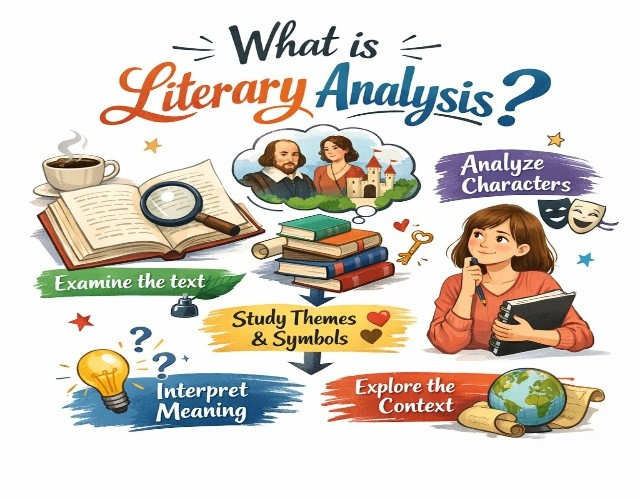
A literary analysis essay interprets literature by examining the author's techniques and choices. You're not describing what happens, you're explaining what it means and how the author created that meaning through deliberate craft decisions.
The Core Distinction:
| Summary (What Happens) | Analysis (What It Means) |
|---|---|
| Romeo and Juliet fall in love and die | Shakespeare uses light/dark imagery to foreshadow their fate, showing how pure love cannot survive in a violent world |
| Gatsby throws lavish parties at his mansion | Fitzgerald depicts parties as hollow spectacles, proving wealth cannot buy genuine connection, symbolizing the American Dream's emptiness |
| Scout narrates events in Maycomb | Lee uses Scout's naive perspective to expose adult prejudice that readers recognize, but she doesn't, forcing us to confront our own biases |
When is Literary Analysis Essay Used?
It is a common feature in academic settings, from high school through graduate programs, but the skills acquired transfer beyond education. You use analytical thinking when evaluating arguments in news articles, understanding persuasive techniques in advertising, or recognizing narrative patterns in films.
English courses require literature analysis to develop critical thinking, the ability to look beneath surface information and identify underlying patterns, meanings, and techniques.
Why Analyze Literature?
Analysis teaches you to read like a writer. You stop asking "what happens next?" and start asking "why did the author structure it this way?" or "how does this symbol reinforce the theme?" These skills make you a more sophisticated reader who notices craft, not just story.
Literature analysis also teaches you to support interpretations with evidence, construct logical arguments, and communicate complex ideas clearly, skills valuable in any career requiring critical thinking and persuasive communication.
Key Characteristics of Strong Textual Analysis:
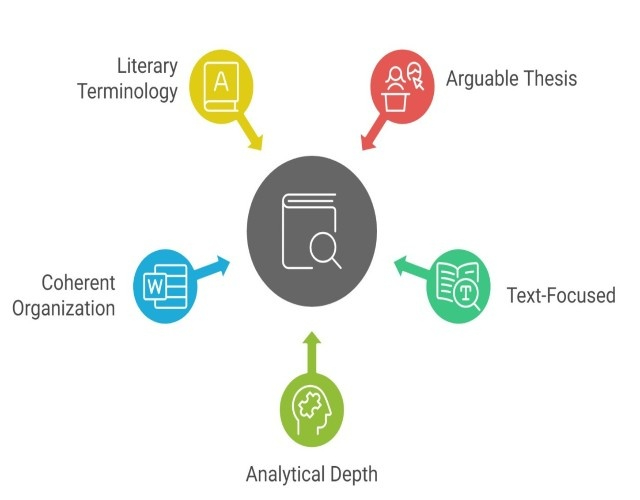
- Arguable thesis: Makes a claim others could debate, not stating obvious facts
- Text focused: Proves points with specific quotations and examples from the work
- Analytical depth: Explains HOW evidence supports arguments, not just presenting quotes
- Coherent organization: Each paragraph advances the thesis logically
- Literary terminology: Uses precise vocabulary to discuss techniques (symbolism, irony, foreshadowing).
For character-specific analysis techniques covering development, motivation, and relationships, refer to our Character Analysis Guide, which includes specialized frameworks for analyzing protagonist arcs, antagonist motivations, and symbolic character functions.
NEED EXPERT HELP WITH YOUR ANALYSIS?
Skip the stress. Our professional writers handle everything, so you can submit with confidence.
- 100% original, plagiarism-free content
- PhD literature specialists analyze any text
- Deep interpretation backed by textual evidence
- Delivered on deadline with free revisions
No AI. Just real writers, real results.
Order NowHow to Write a Literary Analysis Essay?
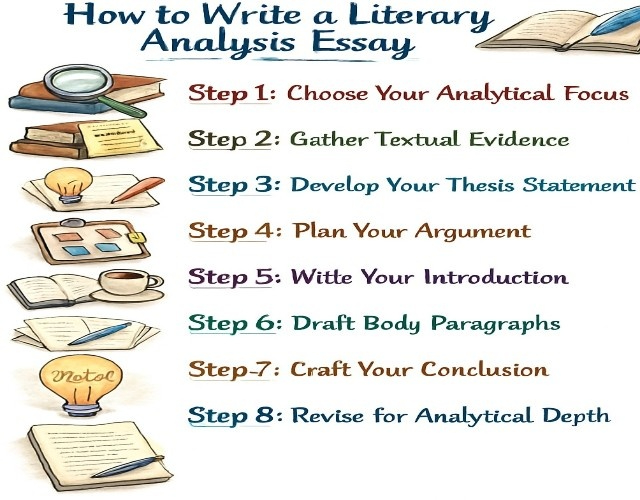
Step 1: Choose Your Analytical Focus
Understanding the types of literary analysis essays helps students structure their essays and analyze texts deeply. Decide WHAT you'll analyze before gathering evidence. Pick one or two related elements with sufficient textual support:
- Character Analysis: Examine how authors develop characters through description, actions, dialogue, thoughts, and relationships. Analyze character motivations, transformations, or symbolic functions.
- Symbol Analysis: Track recurring objects, images, or elements representing abstract ideas. Explain what symbols mean and how their meaning evolves through the text.
- Theme Analysis: Identify the author's central message about human experience. Show how multiple elements (character, symbol, structure) work together to convey the theme.
- Narrative Form Analysis: Examine how narrative organization creates meaning. Analyze why the author chose a specific point of view, chronology, or chapter organization.
- Literary Device Analysis: Focus on how specific techniques create effects. Track patterns of irony, foreshadowing, metaphor, or imagery.
Trying to analyze everything creates shallow essays. Going deep on 1-2 related elements with thorough evidence produces a stronger analysis. Need help selecting the right angle for your assigned text? Browse our Literary analysis essay topics, organized by book title and difficulty level.
Step 2: Gather Textual Evidence
Read the text (or relevant sections) with your analytical focus in mind. Active reading means marking passages, not passively consuming words.
A. Mark Every Relevant Passage:
- Highlight quotations related to your focus.
- Use sticky notes for quick reference.
- Write margin observations about significance.
- Record page numbers immediately (critical for citations).
B. Collect More Evidence Than Needed: It's easier to cut evidence during drafting than hunt for quotations while writing. Aim for 10 to 15 potential quotations, even if you'll only use 6 to 8 in your final essay.
C. Look for Patterns: Strong analysis identifies patterns proving deliberate authorial choices, not coincidences.
Ask yourself:
|
Document patterns in a chart: first column for quotations, second for page numbers, third for your observations about meaning. This organization makes the next steps much faster.
Step 3: Develop Your Thesis Statement
Your thesis makes a specific, debatable claim about HOW or WHY the author uses an element to create meaning.
Weak Thesis Patterns:
- "Shakespeare uses imagery in Romeo and Juliet." (States obvious fact, not interpretation).
- "The Great Gatsby is about the American Dream." (Too vague, no claim about meaning).
- "Symbolism is important in Beloved." (Generic, could apply to any text)
Strong Thesis Patterns:
- "Shakespeare's contrasting light/dark imagery emphasizes how the lovers' pure relationship opposes the violent feud, foreshadowing their inevitable tragic deaths." (Specific technique + specific effect + how it creates meaning).
- "Fitzgerald uses Gatsby's parties as hollow spectacles filled with strangers to demonstrate how material wealth corrupts the American Dream and cannot purchase genuine human connection." (What author does + how + why it matters).
- "Morrison employs fragmented, non linear narrative to mirror how trauma survivors experience memory, not as orderly chronology but as intrusive flashbacks triggered by present stimuli." (Technique + parallel between form and content + larger meaning)
Thesis Formula: Your interpretation + How the author creates it + Why it matters.
Your thesis should preview your main points. If you discuss three types of evidence, your thesis can mention all three, giving readers a roadmap while helping you stay organized during writing.
Step 4: Plan Your Argument
Organize evidence into logical body paragraphs BEFORE drafting. Each paragraph proves ONE point supporting your thesis.
Create Detailed Plan:
Under each paragraph heading, list: Specific point you'll prove.
|
|
Choose Organizational Pattern:
- Chronological: Follow text order when analyzing character development or how symbol meaning evolves.
- Thematic: Group related points together regardless of text order.
- Climactic: Arrange from weakest to strongest evidence, building to the most convincing argument
This preparation makes drafting 3x faster because you know exactly what to write in each section instead of staring at blank pages.
For detailed frameworks showing exactly how to organize each section with percentage breakdowns and word count targets, see our Literary analysis outline for standard, comparative, and character-focused approaches.
Step 5: Introduction Development: (How to Start a Literary Analysis Paper)
Your intro does three things in order:
- Hook (1 to 2 sentences): Start with something interesting: a surprising observation, a thought provoking question, unexpected connection.
| Avoid generic openings like "Throughout history, literature has..." or "In today's society..." |
- Context (2 to 3 sentences): Provide necessary background: full title, author's full name, brief relevant context (publication date, genre, or historical background if relevant to analysis).
- Thesis (Final sentence): State your main argument clearly. This tells readers exactly what your essay will prove.
- Strong Introduction Pattern: "The best villains believe they're heroes.
In Shakespeare's Macbeth, Lady Macbeth sees her ambition as strength and manipulation as a necessary action. Shakespeare uses Lady Macbeth's self-justifying soliloquies and eventual psychological breakdown to demonstrate how unchecked ambition corrupts moral judgment and destroys the ambitious from within." |
Keep introductions concise: 3-5 sentences for high school essays, 5-7 sentences for college essays. Get readers to your argument quickly.
Step 6: Draft Body Paragraphs
Each body paragraph needs a clear topic sentence stating what this paragraph will prove. Then provide your evidence, typically 1 to 2 quotations, properly cited with page numbers in parentheses.
Here's the critical part most students miss: your analysis must be longer than your evidence. If you quote two lines of poetry, you should write at least four to six lines explaining what those lines mean and how they support your argument. Analysis explains the significance of evidence. It answers "so what?" and "how does this prove my point?"
Step 7: Craft Your Conclusion
Students often struggle with how to write a conclusion for a textual analysis essay, but these strategies make it easier. Synthesize your analysis, don't just restate your introduction. Explain broader significance: What does your interpretation reveal about the text, author, or human experience?
Answer the "So What?" Question: Why does your analysis matter? What should readers understand now that they didn't before? How does your interpretation help us understand the text more deeply?
Strong conclusions often:
|
Avoid These Conclusion Mistakes:
|
Step 8: Revise for Analytical Depth
First drafts contain too much summary and too little analysis. During revision, strengthen your analytical thinking.
- Check Analysis to Evidence Ratio: Highlight all analysis sentences in each paragraph. If evidence outweighs analysis, expand your explanations. Add sentences digging deeper into why evidence matters and what it reveals about the author's technique and meaning.
- Verify Every Quotation is Explained: Check every quotation. Did you fully explain it? Students often drop in quotations, assuming meaning is obvious, but effective analysis always explains how evidence supports the argument. Never let evidence speak for itself.
- Confirm All Citations are Correct: Make sure quotations are accurate, including punctuation and line breaks for poetry. Confirm page numbers are present for every quotation: (45) or (Author 45). Place period AFTER citation: "Quote" (45).
- Read Thesis and Topic Sentences in Sequence: Ignore everything else and read just your thesis and all topic sentences. Do they flow logically? Does each topic sentence clearly advance your thesis? This quick check reveals organizational problems.
- Cut Plot Summary: If any paragraph primarily describes events rather than analyzing meaning, revise it. Every paragraph should explain significance, not sequence.
Key Tip: Students can improve their writing by studying literary analysis essay examples that illustrate strong thesis statements and textual evidence
Framework for Analyzing Literary Texts
Strong literary analysis follows clear organizational patterns that help readers track your argument from introduction through conclusion.
1. Introduction Format
Begin with a hook that captures the reader’s interest, followed by context that briefly introduces the text and situates the discussion, and conclude with a thesis that clearly presents your central argument without using arrows or symbols.
2. Body Paragraph Formula
- Topic Sentence: States what this paragraph proves. Should be a mini argument, not an announcement.
- Evidence: Quotation(s) from text with page citations: "Quote text here" (45). Choose quotations proving your specific point.
- Analysis: Explains HOW evidence supports your point. This section should be 2 to 3x longer than your evidence. Never let quotations speak for themselves; always explain what they mean and how they prove your argument.
To see exactly how effective writers structure body paragraphs with proper ratios, check our Literary analysis essay examples showing introduction through conclusion with annotations.
- Link: Connects paragraph back to thesis, transitions to next point.
3. Proper Citation Format
Always include page numbers for quotations: (Author Page#) or just (Page#) if the author is already mentioned in the sentence.
| For plays: (Act.Scene.Line) = (1.5.43-45) For poems: (Line numbers) = (12-14) For prose: (Page#) = (180) Place period AFTER citation, not after quotation: "Quote text here" (180). For more information on citations, refer to our citation styles guide. |
4. Conclusion Requirements
Synthesize analysis and explain broader significance. Don't restate the introduction; show what your interpretation reveals about literature, human nature, or the author's craft. Answer "Why does this matter?"
Remember! creating a literary analysis essay outline helps organize your ideas and ensures a logical flow in your writing
Tips & Best Practices for Strong Literature Analysis

1. Focus Your Analysis
Don't try analyzing everything, character, theme, symbolism, and structure simultaneously. Pick 1 to 2 elements and examine them thoroughly. Depth beats breadth in literary analysis. One well developed symbol analysis outperforms a shallow attempt to discuss five different elements.
2. Avoid Plot Summary
If you're describing events chronologically, you're summarizing. Analysis explains significance, not sequence. Every paragraph should answer "What does this mean?" not "What happens next?" Test: if you can write the paragraph without reading the text (just knowing the plot), you're summarizing.
3. Let Evidence Drive Arguments
Build a thesis from patterns you observe in the text, not from what you want to prove. If evidence doesn't support your claim, change your claim; don't ignore contradictory evidence. Honest analysis acknowledges textual complexity.
4. Quote Strategically
Use quotations to prove specific points, not to decorate your essay. Every quotation needs 2 to 3 sentences of analysis explaining its significance. If you can't analyze a quotation deeply, it doesn't belong in your essay.
5. Analyze Word Choice
Don't just quote lines; examine why the author chose specific words. "Gatsby stretched out his arms toward the dark water, which emphasizes yearning, distance, and impossibility through physical gesture."
6. Connect to Theme
Every body paragraph should relate to your thesis. If a paragraph doesn't advance your main argument, cut it or revise to connect. Each paragraph should move your overall interpretation forward. Need help organizing your argument logically?
7. Read Like a Writer
Ask: Why did the author make this choice? What effect does it create? How does this contribute to the overall meaning? These questions reveal what to analyze. Train yourself to notice craft, not just story.
8. Use Literary Terminology
Identify techniques precisely, don't say "the author uses words effectively." Say "the author uses a metaphor to compare X to Y, suggesting..." Specific terminology demonstrates analytical sophistication.
9. Maintain Present Tense
Discuss literature in the present tense: "Shakespeare reveals," not "Shakespeare revealed." Literary analysis convention treats texts as living documents that exist in an eternal present.
10. Trust Your Interpretation
If you support your reading with evidence, it's valid. Literary analysis isn't about finding one "correct" answer; texts support multiple interpretations. What matters is building a logical argument backed by textual proof.
Pro Tip: Choosing the right literary analysis essay topics can make your essay more interesting and easier to write
Why Struggle When Experts Can Write an Excellent Literary Analysis?
Tell us what you need, our experts handle the research, writing, and formatting.
- Custom-written from scratch for every order
- Matched with a writer in your subject area
- Delivered on time, every time
- Full confidentiality guaranteed
No AI shortcuts. Just expert-level quality.
Order NowCommon Mistakes That Weaken Literary Analysis Essay
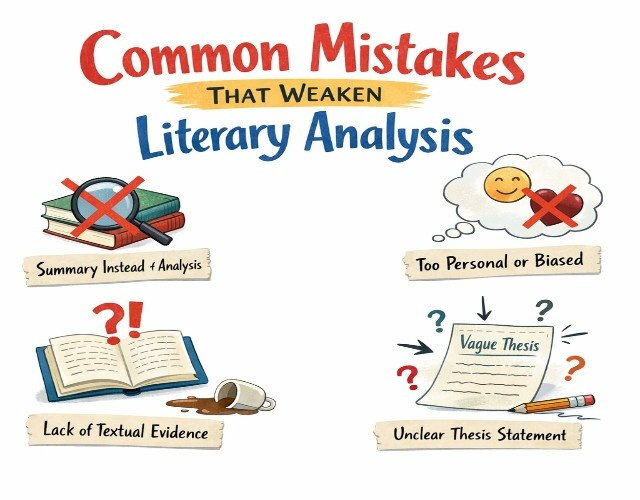
Mistake 1: Writing Plot Summary Instead of Analysis
- Incorrect: "Romeo kills Tybalt after Tybalt kills Mercutio, then Romeo gets banished from Verona by the Prince."
- Correct: "Romeo's impulsive decision to kill Tybalt demonstrates how the feud's violence corrupts even those who oppose it, forcing Romeo to choose between honor culture and love."
- Fix: After each paragraph, ask "So what?" If you only described events without explaining significance, add analysis. Convert the summary into an interpretation.
Mistake 2: Weak or Missing Thesis Statements
- Incorrect: "The author uses symbolism throughout the novel." (States fact, makes no argument).
- Correct: "Morrison's water imagery represents both freedom and trauma, showing how escape and suffering are inseparably linked in slavery's legacy." (Makes specific interpretive claim).
- Fix: Make specific claims about HOW the author uses techniques and WHY it matters. Answer "so what?" in your thesis.
Mistake 3: Dropped Quotations
- Never insert quotations without explanation. Evidence doesn't speak for itself. Readers need you to explain how quotations support arguments.
- Fix: After EVERY quotation, write 2 to 3 sentences analyzing what it means and how it proves your point. Use phrases like "This demonstrates..." to signal analytical explanation.
Mistake 4: Ignoring Historical and Cultural Context
- Understanding when/where texts were written explains authorial choices. A 1920s novel about women's independence means something different than a 2020s novel on the same topic.
- Fix: Research basic context, publication date, historical events, and cultural attitudes. Include 1 to 2 sentences when relevant to your analysis. Context illuminates meaning.
Mistake 5: Confusing Theme with Subject
- Incorrect: "The theme is love." (That's the subject/topic).
- Correct: "Obsessive love destroys both lover and beloved, leaving neither fulfilled." (That's the theme, what the author says about love).
- Fix: State themes as complete sentences expressing the author's message about a topic. Themes are arguments, not labels. Struggling to identify themes in your assigned text?
Mistake 6: Missing or Incorrect Citations
- Every quotation needs a page number. Missing citations damage credibility and risk plagiarism accusations, even if unintentional.
- Fix: Use parenthetical citations after all quotations: (Page#). Proofread every quotation against the original text to ensure accuracy, including punctuation and spelling.
20 Literary Devices to Analyze
Understanding literary devices helps you identify WHAT to analyze and gives you vocabulary to discuss the author's craft.
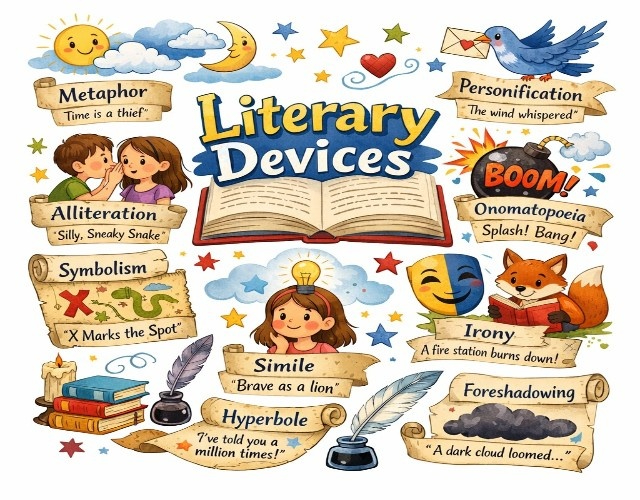
Core Devices
1. Symbolism: Object/person representing a larger abstract idea
- For instance: Green light in Gatsby symbolizes unreachable dreams
2. Foreshadowing: Hints about future events
- For instance: Romeo's premonition before the Capulet party
3. Imagery: Descriptive language appealing to the five senses
- For instance: Poe's decaying house creates an atmosphere of doom
4. Irony: Contrast between expectation and reality
- Dramatic: readers know what characters don't
- Situational: outcomes contradict expectations
- Verbal: saying the opposite of what's meant
5. Metaphor: Direct comparison without "like/as"
- For instance: "All the world's a stage."
6. Theme: Central idea the author explores (abstract concept)
- For instance: Racial injustice in To Kill a Mockingbird
7. Characterization: Methods revealing character traits
- Through description, actions, dialogue, thoughts, and others' reactions
8. Allusion: Reference to another text/event
- For instance: "He met his Waterloo" (Napoleon's defeat)
9. Tone: Author's attitude toward subject
- Can be serious, humorous, ironic, melancholic
10. Point of View: Perspective telling the story
- First person (I/we), second person (you), third person (he/she/they)
Advanced Devices
11. Motif: Recurring element reinforcing theme
- For instance: Eyes/vision throughout Gatsby
12. Conflict: Struggle driving plot
- Character vs. character, nature, society, self
13. Setting: Time/place affecting characters and symbolizing ideas
- For instance: Valley of Ashes represents moral decay
14. Juxtaposition: Contrasting elements highlight differences
- For instance, Wealth vs. poverty in A Tale of Two Cities highlights
15. Paradox: Contradictory statement revealing truth
- For instance: "War is peace" in 1984
16. Personification: Human qualities to non to human things
- For instance: "Wind whispered through trees."
17. Alliteration: Repeated initial consonant sounds
- For instance: "Peter Piper picked"
18. Hyperbole: Deliberate exaggeration for emphasis
- For instance: "I've told you a million times."
19. Understatement: Representing something as less important (ironic effect)
- For instance: Calling a hurricane "a bit of bad weather."
20. Diction: Word choice revealing character/tone
- Formal, informal, colloquial, slang
- For instance: Holden's colloquial diction in Catcher in the Rye
When analyzing devices, always explain WHY the author used it and HOW it creates meaning. Simply identifying ("The author uses metaphor") isn't analysis. Explaining what it accomplishes ("The garden metaphor represents carefully controlled emotions, showing how she cultivates outward appearance while suppressing true feelings") is analysis.
| Remember! Understanding the structure of a text is crucial for successful literary essay writing. |
Struggling with evidence integration or achieving sufficient analytical depth? Our trusted essay writing service writers break down complex texts, identify patterns you missed, and build arguments showing how literary techniques create meaning.
Conclusion
Literary analysis essay goes beyond summarizing events to explain how authors use deliberate techniques to create meaning. By focusing on craft choices such as symbolism, structure, and characterization, readers uncover deeper messages about human experience and society.
A strong analysis relies on an arguable thesis, well chosen evidence, and a clear explanation showing how that evidence supports the argument. These skills not only deepen understanding of literature but also strengthen critical thinking and communication beyond the classroom.
READY FOR EXPERT LITERARY ANALYSIS?
Stop gambling with your grades. Our professionals deliver custom papers that professors actually want to read.
- 100% human-written by PhD literature specialists
- Deep textual interpretation backed by evidence
- On-time delivery with unlimited revisions guaranteed
- Full confidentiality guaranteed
No AI ever. Just real academics who know what graders want.
Order Now

-19577.jpg)