What is Plagiarism?
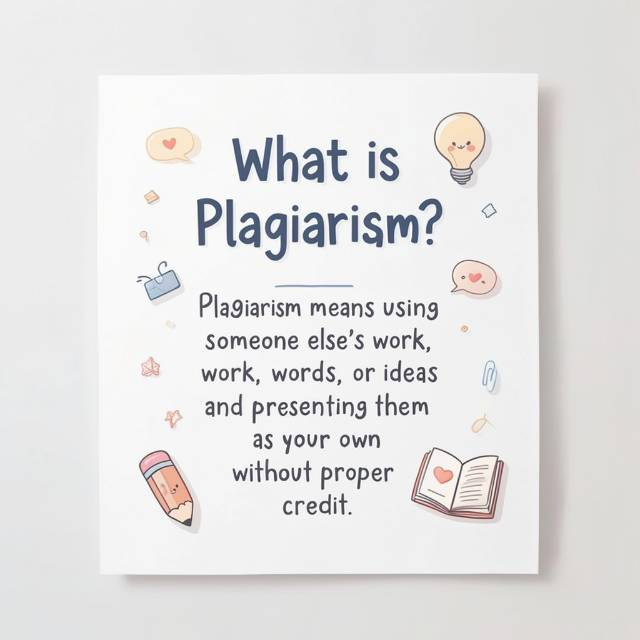
In academic writing, plagiarism occurs when you:
- Copy text from sources without quotation marks
- Paraphrase too closely to the original wording
- Use someone's ideas without citing them
- Reuse your own previous work without permission (self plagiarism)
- Have someone else write your paper (contract cheating)
The simple test: If you learned it from a source, you must cite it. Even when you rewrite in your own words.
Why Plagiarism Is Serious
Academic institutions treat plagiarism as academic dishonesty equivalent to cheating on an exam.
Real consequences in 2025:
- 90% of courses: Automatic failure on the assignment or entire course
- Academic probation: Prevents scholarship eligibility, graduate school admission
- Suspension/Expulsion: For severe or repeated cases
- Permanent record: Follows you to job applications, professional schools
- Reputation damage: Lost trust with professors, peer judgment
Universities increased plagiarism penalties post 2020 when online learning made cheating easier. They're now less lenient even for "unintentional" cases.
What Plagiarism Is NOT
Understanding what doesn't count as plagiarism helps you avoid unnecessary anxiety:
- Common knowledge doesn't need citation: "The Earth revolves around the Sun," "World War II ended in 1945," "Photosynthesis converts sunlight to energy"
- Your original ideas don't need citation: Your own analysis, opinions, arguments, interpretations as long as they're genuinely yours
- Properly cited quotes and paraphrases: When you cite correctly, you're not plagiarizing you're doing academic writing correctly
When in doubt about whether something is common knowledge: Cite it. You cannot overcite in academic writing.
Avoid Plagiarism with Expert Guidance
Ensure every assignment is original and correctly cited.
- Accurate paraphrasing help
- Proper citation formatting
- AI checked content
- 100% plagiarism free work
Maintain academic integrity while getting reliable support.
Get Started Now8 Types of Plagiarism You Must Know
Knowing the types of plagiarism helps you recognize and avoid them. Some are obvious. Others catch students completely off guard.
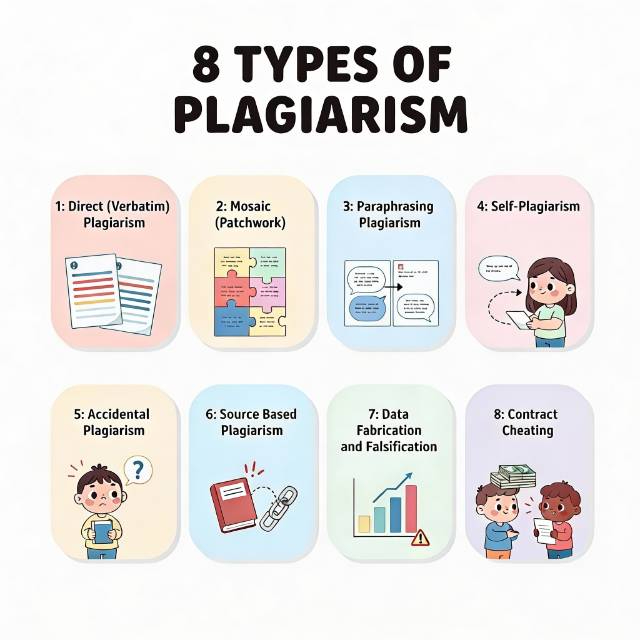
Type 1: Direct (Verbatim) Plagiarism
What it is: Copying text word for word from a source without quotation marks or citation.
Example:
- Source text: "Climate change represents the most significant threat to global food security in the 21st century."
- Direct plagiarism: Climate change represents the most significant threat to global food security in the 21st century. (no quotes, no citation)
Why students do it: Running out of time, thinking no one will notice, planning to "fix it later" and forgetting
How to avoid it:
- Use quotation marks around ANY exact language from sources
- Include intext citation immediately
- Keep direct quotes under 15% of your paper
| Severity: This is the most serious form of plagiarism because it demonstrates a clear intent to deceive. Penalties typically include automatic failure. |
Type 2: Mosaic (Patchwork) Plagiarism
What it is: Copying phrases and passages from multiple sources and piecing them together to create "new" text. Also called "patchwork plagiarism."
Example:
- Original sources:
- Source A: "Social media algorithms exploit psychological vulnerabilities"
- Source B: "Creating addictive behavior patterns in adolescent users"
- Source C: "correlate with increases in anxiety symptoms"
- Mosaic plagiarism: Social media algorithms exploit psychological vulnerabilities, creating addictive behavior patterns in adolescent users that correlate with increases in anxiety symptoms. (stitched together from three sources, no citations)
Why students do it: Trying to avoid direct plagiarism by mixing sources, thinking this makes it "original"
How to avoid it:
- Read sources, close them, then write in your own words
- If you must use specific phrases, use quotation marks
- Cite every source that contributed ideas
| Severity: Moderate to severe. Professors can detect this easily with plagiarism checkers that show multiple source matches. |
Type 3: Paraphrasing Plagiarism
What it is: Rewording someone's ideas without changing the sentence structure enough, or paraphrasing without citation.
Example:
- Original: "The implementation of universal basic income could fundamentally restructure labor markets by decoupling survival from employment."
- Bad paraphrase: Implementing a universal basic income might fundamentally change labor markets by separating survival from work. (too similar structure, no citation)
- Good paraphrase: Universal basic income programs may transform how people relate to employment, since citizens would no longer need jobs purely for financial survival (Author, 2024). (different structure + citation)
Why students do it: Believing that changing some words makes it "their own," not understanding what proper paraphrasing requires
How to avoid it:
- Change both wording AND sentence structure
- Always cite paraphrased content
- Read our paraphrasing guide below for exact techniques
| Severity: Moderate. Often classified as "unintentional," but still results in failing grades. |
Type 4: Self Plagiarism
What it is: Reusing your own previous work (from another class or assignment) without permission or acknowledgment.
Example:
- Writing an essay about climate change in Biology 101
- Submitting the same essay (or large portions) for Environmental Science 201
Why students do it: Thinking "it's my own work, so it can't be plagiarism," trying to save time, believing teachers won't notice
How to avoid it:
- Never reuse entire papers from previous classes
- If building on previous work, get explicit permission from both professors
- Cite your previous work if referencing it
- Write fresh content for each assignment
| Severity: Moderate. Many students don't realize this is plagiarism, but universities treat it as academic dishonesty. |
Exception: Cumulative projects (like thesis chapters) where building on previous work is expected and permitted.
Type 5: Accidental Plagiarism
What it is: Unintentionally failing to cite sources, misquoting, or incorrectly paraphrasing due to carelessness or misunderstanding.
Examples:
- Forgetting to add citations you planned to include
- Losing track of which notes came from sources vs. your own ideas
- Incorrectly formatting citations so they don't match sources
- Taking notes verbatim, then forgetting they're direct quotes
Why students do it: Poor note taking, procrastination, not understanding citation requirements, and genuine mistakes
How to avoid it:
- Add citations as you write, not later
- Use clear note taking systems that distinguish source material from your ideas
- Double check every citation before submitting
- Give yourself time to review and verify sources
| Severity: Variable. Universities penalize accidental plagiarism the same as intentional plagiarism; ignorance is not an excuse. |
Type 6: Source Based Plagiarism
What it is: Citing sources incorrectly, inventing sources that don't exist, or citing secondary sources as if you read the primary source.
Examples:
- Invented citations: Making up author names or publication years
- Incorrect attribution: Citing the wrong source for information
- Secondary sourcing: Reading Smith cited in Jones, but citing Smith directly without reading Smith's original work
Why students do it: Trying to meet required source counts, losing track of sources, copying citations from other papers without verification
How to avoid it:
- Only cite sources you've actually read
- When using secondary sources, cite them correctly: "Smith (as cited in Jones, 2024)"
- Keep organized records of all sources as you research
- Verify every citation exists and is accurate
| Severity: Moderate to severe. Fabricating sources is considered research misconduct. |
Type 7: Data Fabrication and Falsification
What it is: Creating fake data or research findings, or altering/omitting data to create misleading impressions.
Examples:
- Inventing survey results you didn't actually collect
- Changing experimental data to match your hypothesis
- Cherry picking data while omitting contradictory findings
- Making up interview quotes
Why students do it: Experiments failed, couldn't collect enough data, results don't support thesis, deadline pressure
How to avoid it:
- Report actual findings even when they don't match expectations
- Acknowledge limitations in data collection
- Ask professors for extensions if you can't collect sufficient data
- Never, ever fabricate data; this is research fraud
| Severity: Extremely severe. This is the most serious academic integrity violation. In medical and scientific fields, it can cost lives. |
Type 8: Contract Cheating (Having Someone Else Write Your Paper)
What it is: Submitting work written by someone else, whether purchased from essay mills, written by friends/family, or generated by AI as your own.
Examples:
- Buying papers from essay writing websites
- Having roommates or tutors write your assignments
- Submitting AI generated content (ChatGPT, Claude, etc.) without disclosure
Why students do it: Severe time pressure, feeling incapable of completing work, high stakes assignments
How to avoid it:
- Start assignments early to avoid panic
- Get legitimate help from writing centers, professors, and tutors
- Use AI as a research assistant, not a writer
- If using professional services, use them ethically (see our guide below)
| Severity: Most severe. Universities call this an "especially egregious form" warranting expulsion. |
2025 Update: AI generated content without disclosure now falls under contract cheating at most institutions.
7 Proven Strategies to Avoid Plagiarism
These strategies prevent 95% of plagiarism cases when implemented consistently.
Strategy 1: Start Early and Plan Your Time
Why it matters: 78% of plagiarism cases involve time pressure. Students who start assignments with less than 48 hours remaining are 4x more likely to plagiarize than those who start a week early.
How to implement:
- Start research 7-10 days before deadline (minimum)
- Create timeline: Research (2 days), Outline (1 day), Draft (2-3 days), Revise (1-2 days)
- Build in buffer time for unexpected problems
- If you realize you're short on time, request an extension rather than plagiarizing
Reality check: "I'll just copy now and fix citations later" NEVER works. You either forget, run out of time, or can't find sources again.
Strategy 2: Take Organized Notes That Separate Sources from Your Ideas
Why it matters: Most accidental plagiarism stems from poor note taking. Students lose track of what came from sources vs. their own thinking.
How to implement:
Use a three column, note taking system:
| Source Info | Exact Quotes (with page #) | My Ideas/Analysis |
|---|---|---|
| Smith, 2024, p. 45 | "Climate change accelerates at unprecedented rates" | This supports my argument about urgency |
Alternative: Color code your notes
- Yellow highlight = direct quotes (needs quotation marks)
- Blue highlight = paraphrased ideas (needs citation)
- Green highlight = my original ideas (no citation needed)
Critical rule: Record full citation information IMMEDIATELY when taking notes. Don't leave it for later, you'll forget the source.
Strategy 3: Master the Art of Proper Paraphrasing
Why it matters: Bad paraphrasing is the #1 cause of unintentional plagiarism. Students think changing a few words is enough. It's not.
The right way to paraphrase:
- Read the passage 2-3 times until you understand it
- Close the source, don't look at it
- Write the idea in your own words from memory
- Check against the original. Did you accidentally copy structure or phrases?
- Add citation
Example walkthrough:
- Original text: "Universal basic income programs fundamentally challenge the traditional relationship between labor and livelihood by guaranteeing subsistence independent of employment status."
- BAD paraphrase (too close): Universal basic income challenges the traditional relationship between work and survival by guaranteeing basic income independent of employment.
- GOOD paraphrase (different structure + wording): By providing all citizens with unconditional financial support, UBI systems disrupt conventional assumptions that survival depends on holding a job (Author, 2024).
Key difference: Good paraphrasing changes vocabulary, sentence structure, and often the order of ideas while preserving the meaning.
Strategy 4: Cite Everything That Needs Citation
| The golden rule: When in doubt, cite. You CANNOT overcite in academic writing. |
What ALWAYS needs citation:
- Direct quotes (even single unique phrases)
- Paraphrased ideas from sources
- Statistics, data, research findings
- Others' theories, arguments, or interpretations
- Specific facts that aren't common knowledge
- Images, charts, graphs from other sources
What DOESN'T need citation:
- Common knowledge (historical dates, basic science facts)
- Your original ideas, analysis, and arguments
- Your own research data that you collected
Critical mistake to avoid: Thinking that paraphrased content doesn't need citation. It does. You cite both quotes AND paraphrases.
The "Wikipedia test": If you found it in three+ general reference sources (encyclopedias, basic textbooks), it's probably common knowledge. Otherwise, cite it.
Strategy 5: Use Quotation Marks Correctly
Why it matters: Using someone's exact words without quotation marks = plagiarism, even if you cite the source.
The rules:
- ANY exact wording from a source needs quotation marks (even 2-3 words if distinctive)
- Place quotation marks BEFORE the first word and AFTER the last word
- Include citation immediately after closing quotation mark
- Keep direct quotes under 15% of your total paper
Examples:
Wrong: According to Smith (2024), climate change accelerates at unprecedented rates.
(This is the author's exact phrase, needs quotes)
Right: According to Smith (2024), "climate change accelerates at unprecedented rates."
For longer quotes (40+ words in APA, 4+ lines in MLA):
- Use block quote format (indented, no quotation marks)
- Still cite the source
When to quote vs. paraphrase:
- Quote: Unique phrasing, expert testimony, definitions, something so well said you can't improve it
- Paraphrase: Everything else (paraphrase is preferred in most academic writing)
Strategy 6: Use Citation Management Tools
Why it matters: Manually tracking sources is error prone. 42% of citation errors stem from missing or incorrect bibliographic information.
Best tools for 2025:
Zotero (Free)
Browser extension captures source info automatically
Organizes sources by project
Generates citations in any format
Best for: Students managing 10+ sources
Mendeley (Free)
PDF annotation + citation management combined
Good for research heavy projects
Best for: Graduate students, thesis writing
EasyBib/Citation Machine (Free with limitations)
Quick citation generation
Less robust than Zotero/Mendeley
Best for: Short papers, high school students
RefWorks (University subscriptions)
Often provided free through university libraries
Integration with databases
Best for: If your school provides it
Pro tip: Start using citation tools from day one of your research, not when writing your bibliography. Trying to recreate citations later = missing information and errors.
Strategy 7: Run Plagiarism Checks Before Submitting
Why it matters: Catching plagiarism yourself gives you a chance to fix it. Professors catching it means consequences.
How to implement:
- Run checks 48 hours before deadline (gives time to fix issues)
- Address any matches over 1-2% (especially exact matches)
- Recheck after making corrections
- Keep plagiarism reports as proof of originality
Get Perfect Citations & Paraphrasing Effortlessly
Trusted by students for plagiarism free writing.
- Safe, effective paraphrasing
- Properly cited research papers
- AI content ethically used
- Timely submission support
Stay confident in your work and avoid accidental plagiarism.
Order NowHow to Paraphrase Correctly (Step by Step)
Paraphrasing is a skill. Here's the exact process that works:
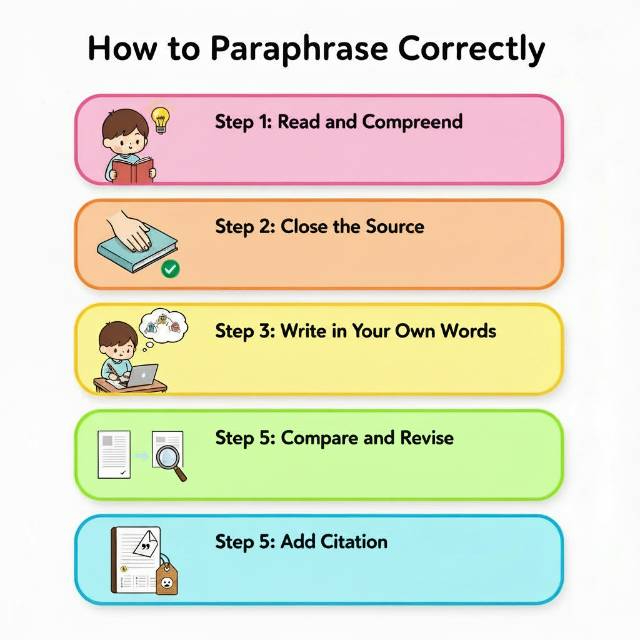
The 5 Step Paraphrasing Process
Step 1: Read and Comprehend
- Read the passage 2-3 times
- Look up unfamiliar words
- Identify the main idea
Step 2: Close the Source
- Don't look at the original while writing
- Work purely from understanding and memory
Step 3: Write in Your Own Words
- Explain the idea as if teaching it to a friend
- Use your natural vocabulary and sentence structure
- Don't just swap synonyms, completely restructure
Step 4: Compare and Revise
- Check against the original
- Did you accidentally copy phrases or structure?
- If too similar, revise further
Step 5: Add Citation
- Include intext citation immediately
- Paraphrases ALWAYS need citations
Paraphrasing Techniques
Technique 1: Change Sentence Structure
- Original: "Although exercise provides numerous health benefits, many Americans fail to meet recommended activity levels due to time constraints and sedentary lifestyles."
- Paraphrased: "Time limitations and desk bound routines prevent most Americans from achieving adequate physical activity, despite exercise's well documented health advantages" (Author, 2024).
Technique 2: Use Synonyms (But Not Just Synonyms)
Original vocabulary = Your vocabulary:
- "numerous" = "many" or "multiple"
- "health benefits" = "wellness advantages" or "positive health effects"
- "fail to meet" = "don't achieve" or "fall short of"
BUT: Don't just replace words. Change the structure too.
Technique 3: Break Long Sentences Into Shorter Ones (or Vice Versa)
Original (one sentence): "Climate scientists warn that rising temperatures will exacerbate existing water scarcity problems, forcing millions to migrate from affected regions within the next three decades."
Paraphrased (multiple sentences): "Global warming intensifies drought conditions in already water scarce areas. This environmental pressure may displace millions of people by the 2050s, according to climate researchers" (Author, 2024).
Technique 4: Combine Information from Multiple Sources
When you synthesize ideas from several sources into one sentence, cite all sources:
"Research consistently demonstrates that meditation reduces cortisol levels (Smith, 2023), improves focus (Jones, 2024), and enhances emotional regulation (Chen, 2024)."
What NOT to Do When Paraphrasing
- Thesaurus plagiarism: Just swapping words for synonyms while keeping sentence structure
- Spin text: Using paraphrasing software that creates awkward, unnatural language
- Close paraphrase: Keeping most of the original phrasing with minor changes
- No citation: Paraphrasing without citing the source
Citation Rules That Prevent Plagiarism
Understanding when and how to cite prevents most plagiarism issues.
When to Cite: The Complete List
You MUST cite:
- Direct quotes (word for word text)
- Paraphrased ideas (ideas in your words)
- Statistics and data (percentages, numbers, research findings)
- Others' theories or arguments
- Others' specific examples or case studies
- Visual elements (charts, graphs, images from sources)
- Definitions from specialized sources
- Historical interpretations or analysis
You DON'T cite:
- Common knowledge (broadly known facts)
- Your original ideas (analysis, arguments you developed)
- Your research data (surveys/experiments you conducted)
- Widely known dates or events (WWII ended in 1945)
Gray area, When in doubt, cite it:
- Facts that seem specialized to your field
- Anything you had to look up to verify
- Information that would surprise a general reader
How to Cite: Format Basics
Your citation format depends on your academic discipline:
MLA (Modern Language Association)
- Used in: English, literature, humanities
- Intext: (Author Page#) = (Smith 45)
- Works Cited: Author last name, first name. "Title." Publication.
APA (American Psychological Association)
- Used in: Psychology, social sciences, education
- Intext: (Author, Year) = (Smith, 2024)
- References: Author, A. A. (Year). Title. Publisher.
Chicago/Turabian
- Used in: History, some humanities
- Intext: Footnotes or (Author Year), depending on style
- Bibliography: Author Last, First. Title. Publisher, Year.
For complete citation guides: See our comprehensive citation guide with examples in each format.
Common Citation Mistakes That Cause Plagiarism
Mistake 1: Citing the quote but not the paraphrase
Wrong:
Research shows that 78% of students procrastinate (Smith, 2024). This tendency correlates with lower grades and increased stress.
The second sentence paraphrases Smith's idea but has no citation.
Right:
Research shows that 78% of students procrastinate (Smith, 2024). This tendency correlates with lower grades and increased stress (Smith, 2024).
Mistake 2: One citation at the end of a paragraph covering multiple sources
Each idea needs its own citation, not one citation covering a whole paragraph.
Mistake 3: Using secondary sources without acknowledging it
If you read about Smith's research in Jones's article but didn't read Smith directly:
Wrong: (Smith, 2020)
Right: (Smith, as cited in Jones, 2024)
Plagiarism Checker Tools: What Actually Works
Not all plagiarism checkers are created equal. Here's what actually detects plagiarism effectively in 2025.
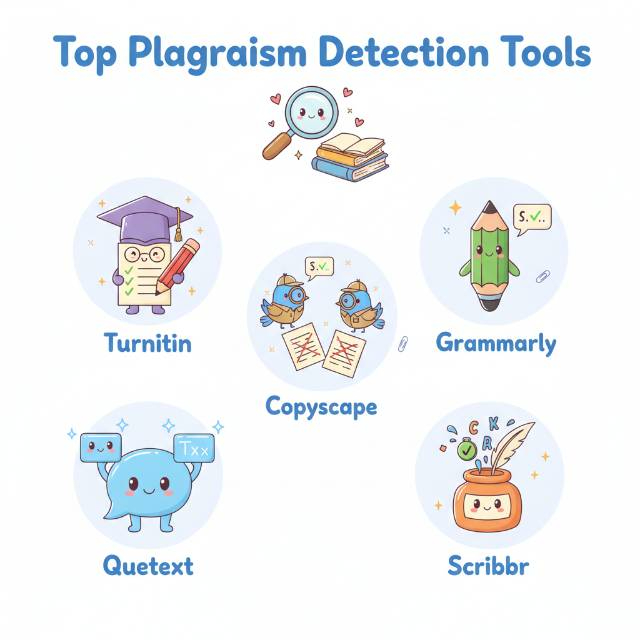
Top Plagiarism Detection Tools
| Tool | Accuracy | Database Size | Cost | Best For |
|---|---|---|---|---|
| Turnitin | Highest (95%+) | 70+ billion pages | Institutional | University submissions |
| Grammarly | High (85-90%) | Large | $12-30/month | Self checking |
| Copyscape | Medium-High (80-85%) | Web only | Pay per check | Web content |
| Quetext | Medium (75-80%) | Medium | Free-$10/month | Budget option |
| Scribbr | High (85-90%) | Large | $19.95/check | One time checks |
1. Turnitin (What Professors Use)
Pros:
- Most comprehensive database (includes student papers, journals, web)
- 95%+ accuracy in detecting matches
- Gold standard used by universities
- Detects paraphrasing plagiarism better than competitors
Cons:
- Not available to individuals (institutions only)
- Can't check your own work before submitting
How professors use it:
- Upload student papers
- Get similarity reports showing % match
- Anything over 15-20% warrants investigation
- Color coded to show which sources matched
| Your strategy: Assume your professor WILL use Turnitin. Write accordingly. |
2. Grammarly Plagiarism Checker
Pros:
- Available to individuals ($30/month premium)
- Checks against web sources and databases
- Integrated with writing feedback
- User friendly interface
Cons:
- Smaller database than Turnitin
- May miss some academic sources
- Monthly subscription cost
| Best for: Self checking before submission to catch obvious issues. |
3. Free Options (Limited But Useful)
Quetext Free Plan:
- 500 words per check
- Basic web source checking
- Good for checking specific paragraphs you're worried about
SmallSEOTools:
- Completely free
- Very limited database
- Only catches exact matches from web
- Use only for quick, rough checks
| Reality: Free tools catch maybe 50-60% of what Turnitin catches. Better than nothing, but don't rely on them completely. |
How to Use Plagiarism Checkers Effectively
Do this:
- Check 48+ hours before deadline (gives time to fix issues)
- Review every flagged passage
- Determine if matches are: properly cited quotes, common phrases, or actual plagiarism
- Fix any uncited content
- Recheck after corrections
Don't do this:
- Wait until last minute to check
- Ignore matches under 1% (they still count if uncited)
- Assume 0% similarity means it's perfect (may have missed AI content or paraphrasing issues)
To learn more about plagiarism tools visit our page about best AI plagiarism checkers for students.
AI and Plagiarism in 2025
ChatGPT, Claude, and other AI writing tools created new plagiarism questions. Here's what you need to know.
Is Using AI Plagiarism?
The answer depends on how you use it:
Allowed (at most schools):
- Brainstorming ideas and outlines
- Understanding difficult concepts
- Checking grammar and clarity
- Generating research questions
- Creating study guides
Considered plagiarism/cheating:
- Having AI write paragraphs you submit as your own
- Using AI generated content without disclosure
- Editing AI output minimally and claiming it as your work
- Using AI to complete assignments intended to demonstrate your learning
2025 policy trends: Most universities now require disclosure when AI tools are used to assist with assignments. Check your syllabus; some professors allow AI with acknowledgment, others ban it entirely.
How Professors Detect AI Writing
AI detection tools in 2025:
- Turnitin AI detector (integrated with plagiarism checker)
- GPTZero (specifically designed for AI detection)
- Originality.AI (high accuracy)
What they detect:
- Patterns consistent with AI generated text
- Lack of personal voice/experience
- Generic phrasing and structures
- Suspiciously perfect grammar with shallow ideas
| Accuracy: About 80-85% accurate. False positives occur, but obvious AI usage is easily caught. |
How to Use AI Ethically
Safe AI uses:
1. Research assistant
- "Explain the concept of supply and demand in simple terms"
- "What are the main arguments in the climate change debate?"
2. Brainstorming partner
"Help me think of 10 angles for an essay about social media"
3. Outline generator
"Create an outline for an essay arguing that social media harms teen mental health"
4. Editor
"Improve the clarity of this paragraph I wrote: [your paragraph]"
Unsafe AI uses:
- Generating entire paragraphs to copy
- Writing your thesis statement
- Creating your analysis or arguments
- Doing your thinking for you
The principle: AI can help you learn and organize, but the actual writing and thinking must be yours.
Proper AI Disclosure
If you used AI and your professor allows it with disclosure, add this note:
| "I used ChatGPT to [specific use: brainstorm ideas, create an initial outline, check grammar] for this assignment. All analysis and writing is my own." |
Never claim AI written content as your own. That's contract cheating, not plagiarism, but equally serious.
What to Do If You Accidentally Plagiarize
Realized you plagiarized before submitting? Here's exactly what to do.
If You Haven't Submitted Yet
Immediate steps:
- Don't panic, you caught it in time
- Identify every plagiarized section
- Fix each one by either properly quoting with citation, paraphrasing correctly with citation, or removing it entirely
- Run plagiarism check again
- Submit with confidence
Time saving priority:
- If the deadline is hours away: Add citations to everything (turn direct plagiarism into properly cited quotes)
- If you have time: Paraphrase properly and cite
If You Already Submitted and Caught It Yourself
Option 1: Email the professor immediately (before they grade it)
*"Professor [Name],
I've realized I made citation errors in my [assignment name] that I submitted on [date]. I want to resubmit a corrected version before you begin grading. May I submit a revised draft?
I understand if there's a late penalty, but I want to ensure my work meets academic integrity standards.
[Your name]"*
Why this works: Professors appreciate students who self identify mistakes before being caught. You'll likely face late penalties but avoid plagiarism charges.
Option 2: Accept the grade and learn for next time
If it's minor (a few missing citations) and the professor hasn't flagged it, you may get away with it, but don't rely on this. Fix your process for future assignments.
Struggling with citations or paraphrasing? Our professional essay writing service can help ensure every assignment is 100% original and properly referenced.
If Professor Accused You of Plagiarism
Do:
- Read your school's academic integrity policy immediately
- Gather evidence (your notes, drafts, sources)
- Meet with the professor to understand specific accusations
- Apologize if you made mistakes (even accidental ones)
- Accept consequences gracefully if you did plagiarize
- Request an appeal if you believe the accusation is incorrect
Don't:
- Lie or make excuses
- Claim "I didn't know" (not a valid defense)
- Argue aggressively
- Miss deadlines for academic integrity hearings
| Reality: If you actually plagiarized, accept responsibility. Fighting it rarely works and may increase penalties. Learn from the experience. |
Turn Confusing Data into Original Work
Our team ensures your assignments are plagiarism proof.
- Clear paraphrasing strategies
- Correct citation formats
- AI content ethically used
- 100% original and verified
Protect your grades and academic record with expert help.
Get Started NowConclusion: Protect Your Academic Future
Plagiarism isn't worth it. Ever.
The 15 minutes you "save" by copying can cost you:
- Failing grades that tank your GPA
- Academic probation that kills scholarship eligibility
- Permanent records that follow you to graduate school
- Expulsion that ends your academic career
- Lost trust in professors who could have written recommendations
But here's the good news: You now know exactly how to avoid plagiarism in every situation.
The essentials:
- Start early (time pressure causes plagiarism)
- Take organized notes (separate sources from your ideas)
- Paraphrase correctly (close source, write from memory)
- Cite everything that needs citation (when in doubt, cite)
- Use quotation marks for exact wording
- Run plagiarism checks before submitting
- Understand AI rules at your institution
Remember: Proper citation isn't about making writing harder; it's about building credibility, giving credit, and protecting your academic integrity.
Your future is worth the extra effort of doing it right.