Introduction: Why Outlining Matters for Literary Analysis
Most students skip outlining and jump straight to drafting. This approach wastes time and produces disorganized essays because you're trying to organize your thoughts and write simultaneously. Your brain can't do both tasks effectively at once. Outlining separates these tasks: first organize, then write. This separation makes drafting faster and results clearer.
Outlining forces you to test your thesis before investing hours in drafting. If you can't find three body paragraphs' worth of evidence supporting your thesis, you discover this during outlining when you can easily adjust your argument. Finding this problem after writing three pages means major revision work. Outlining also reveals logical gaps—if paragraph two doesn't connect to paragraph one, you see this in outline form and can fix organization before drafting.
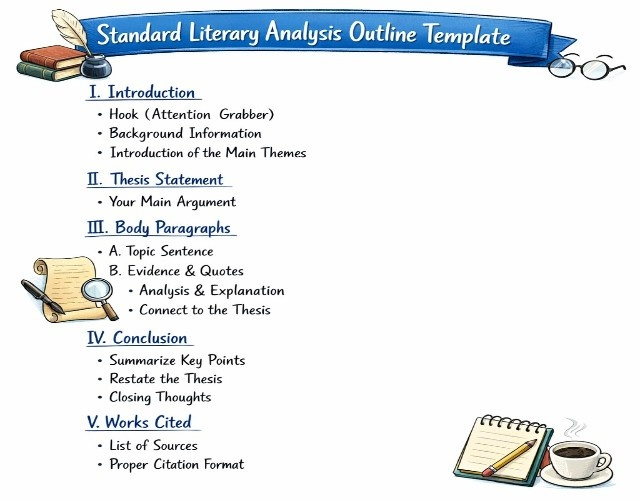
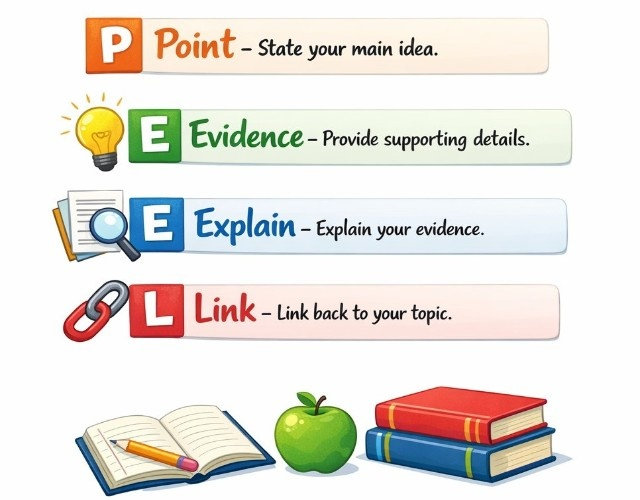
Literary analysis outlines differ from general essay outlines because you must map evidence placement precisely. You can't just write "body paragraph about theme." You need: topic sentence making specific claim, quotation with page number, analysis explaining how quotation proves claim, and connection back to thesis. This specificity prevents the common mistake of writing paragraphs that summarize plot rather than analyze meaning.
These five templates provide proven structures. Don't start from scratch—choose the template matching your assignment and fill in your specific content. After outlining, drafting becomes straightforward because you simply expand your outline into complete sentences and paragraphs. For examples or completed essays, see our annotated literary analysis guide.
Template 1: Basic 5-Paragraph Outline (High School)
Best For: High school essays (grades 9-11), first-time literary analysis, 500-1,000 word essays, simple thesis with three supporting points
Time to Complete: 20-30 minutes
Skill Level Required: Beginning
Typical Grade Range: B to A- with strong execution
I. INTRODUCTION (3-5 sentences)
- Hook: [Interesting observation, question, or surprising fact about the text]
- Context: [Title by Author + brief relevant background]
- Example: In William Shakespeare's Romeo and Juliet (1597), two young lovers...
- Thesis Statement: [Author] uses [literary element] to [show/demonstrate/reveal] [specific interpretation/theme]
- Example: Shakespeare uses light and dark imagery throughout the play to emphasize how the lovers' pure relationship exists in opposition to the violent feud, ultimately foreshadowing their tragic deaths.
II. BODY PARAGRAPH 1
- Topic Sentence: [First main point supporting thesis]
- Example: Shakespeare establishes the connection between light imagery and doomed love from Romeo's first sight of Juliet.
- Evidence: [Quotation + page/line number]
- Example: "O, she doth teach the torches to burn bright!" (1.5.43)
- Analysis (2-4 sentences): [Explain what quotation means and how it proves your point]
- What does this evidence show?
- How does it support your topic sentence?
- What technique is the author using?
- Connection: [Link back to thesis - how does this paragraph advance your argument?]
III. BODY PARAGRAPH 2
- Topic Sentence: [Second main point supporting thesis]
- Evidence: [Quotation + page/line number]
- Analysis (2-4 sentences): [Explain significance and connection to thesis
- Connection: [Link to thesis and transition to next paragraph]
IV. BODY PARAGRAPH 3
- Topic Sentence: [Third main point supporting thesis]
- Evidence: [Quotation + page/line number]
- Analysis (2-4 sentences): [Explain significance and connection to thesis]
- Connection: [Link to thesis]
V. CONCLUSION (3-5 sentences)
- Restate Thesis: [Reword your main argument without copying exactly]
- Summary: [Briefly recap your three main points]
- Significance: [Why does your analysis matter? What does it reveal about the text or human experience?]
- Example: By connecting pure love to light that cannot survive in darkness, Shakespeare suggests that innocence cannot endure in violent environments.
When to Use This Template:
- Your assignment requires 3-5 paragraphs
- Your thesis has three clear supporting points
- You're writing your first literary analysis essay
- Your teacher requires traditional 5-paragraph structure
- You have 500-1,000 words to work with
Common Mistake to Avoid: Don't just list three quotations without analysis. Each body paragraph needs 2-4 sentences explaining how the evidence proves your point. Your analysis must be longer than your evidence.
Template 2: Advanced Analytical Outline (College)
Best For: College essays (grades 12+), complex arguments, 1,200-2,500 word essays, sophisticated analysis requiring 4-6 body paragraphs
Time to Complete: 40-60 minutes
Skill Level Required: Intermediate to Advanced
Typical Grade Range: A- to A+ with strong execution
I. INTRODUCTION (5-8 sentences)
- Hook: [Sophisticated opening - counterintuitive claim, critical question, or unexpected connection]
- Context: [Title, author, publication date, genre, relevant historical/cultural background]
- Critical Conversation: [Acknowledge what scholars/readers typically say about this text]
- Example: While most readers focus on Gatsby's romantic obsession, the novel's structure reveals deeper critique...
- Thesis: [Complex, specific argument that advances interpretation beyond obvious]
- Include: How + What + Why
- Example: Fitzgerald employs fragmented chronology and unreliable narration not merely to create suspense but to demonstrate how nostalgia distorts memory, making the American Dream fundamentally unreachable because it exists only in reconstructed past
- Include: How + What + Why
II. BODY PARAGRAPH 1: Establishing Foundation
- Topic Sentence: [Establish foundational concept your argument builds on]
- Primary Evidence: [2-3 quotations showing pattern or establishing baseline]
- Quote 1 + citation
- Quote 2 + citation
- Extended Analysis (4-6 sentences):
- Close reading of specific word choices
- Explain technique author uses
- Connect to larger pattern in text
- Address potential counterinterpretation
- Transition: [Bridge to next paragraph's complication or development]
III. BODY PARAGRAPH 2: Complicating/Developing
- Topic Sentence: [Build on or complicate paragraph 1]
- Evidence: [Quotations showing development, change, or complication]
- Analysis (4-6 sentences):
- Show how this evidence adds complexity
- Examine author's craft choices
- Connect to thesis's larger argument
- Transition: [Lead to next layer of argument]
IV. BODY PARAGRAPH 3: Alternative Interpretation (Optional but Recommended)
- Topic Sentence: [Acknowledge competing interpretation]
- Example: Some readers interpret this symbol as hopeful rather than futile...
- Evidence: [Quotations that could support alternative reading]
- Analysis: [Explain why this interpretation exists, then show why your reading is more comprehensive or better supported]
- Fair representation of alternative view
- Explanation of its limitations
- How your interpretation accounts for more textual evidence
- Transition: [Return to strengthening your argument]
V. BODY PARAGRAPH 4-6: Deepening Analysis
- [Repeat structure from paragraphs 1-2, developing additional supporting points]
- Each paragraph should:
- Make one clear point advancing thesis
- Provide 1-2 pieces of evidence
- Analyze thoroughly (4-6 sentences)
- Build logically on previous paragraphs
VI. CONCLUSION (5-7 sentences)
- Synthesis: [Bring together your analysis without simply restating]
- Implications: [What does your reading reveal that we didn't see before?]
- Broader Significance: [Connect to larger questions about literature, human experience, or cultural values]
- Example: Ultimately, Fitzgerald's fractured narrative suggests that American identity itself is constructed from selective memory and willful forgetting...
- Final Insight: [Leave readers with new way of understanding the text]
When to Use This Template:
- College-level assignments requiring depth and sophistication
- Complex arguments that need 4-6 supporting points
- Essays requiring engagement with literary criticism
- Assignments asking for original interpretation
- 1,200+ word essays where you can develop ideas fully
Common Mistake to Avoid: Don't add complexity for its own sake. Every paragraph should clearly advance your thesis. If you can't explain how a paragraph supports your argument, cut it or revise your thesis.
Template 3: Comparative Analysis Outline (Two Texts)
Best For: Assignments comparing two texts, thematic analysis across works, identifying patterns in author's style, genre studies
Time to Complete: 45-60 minutes
Skill Level Required: Intermediate
Typical Grade Range: B+ to A with strong execution
I. INTRODUCTION (5-7 sentences)
- Hook: [Interesting connection or surprising difference between the texts]
- Context: [Introduce both texts with relevant background]
- Text 1: [Title by Author + context]
- Text 2: [Title by Author + context]
- Comparison Frame: [Explain why comparing these texts is meaningful]
- Example: While both novels explore isolation, their treatments reveal different cultural assumptions about individualism...
- Thesis: [Argument about what comparison reveals]
- Format: While [Text 1] [does X], [Text 2] [does Y], and this difference reveals [larger insight about theme/literature/culture]
II. BODY PARAGRAPH 1: Similarities (Establishing Common Ground)
- Topic Sentence: [What both texts do similarly]
- Evidence from Text 1: [Quotation + citation]
- Evidence from Text 2: [Quotation + citation]
- Analysis (3-5 sentences):
- Explain the similarity
- Why both authors make this choice
- What this shared approach reveals
- Transition: [Move from similarity to meaningful difference]
III. BODY PARAGRAPH 2: Key Difference 1
- Topic Sentence: [First major difference between texts]
- Text 1 Approach:
- Evidence: [Quotation + citation]
- Analysis: [Explain Text 1's approach and effect]
- Text 2 Approach:
- Evidence: [Quotation + citation]
- Analysis: [Explain Text 2's approach and effect]
- Synthesis: [What does this difference reveal? How does it support your thesis?]
IV. BODY PARAGRAPH 3: Key Difference 2
- [Same structure as Body Paragraph 2]
V. BODY PARAGRAPH 4: Key Difference 3 (Optional)
- [Same structure as Body Paragraph 2]
VI. CONCLUSION (4-6 sentences)
- Synthesis: [What does comparing these texts ultimately reveal?]
- Larger Pattern: [Connect to broader literary, cultural, or historical patterns]
- Example: These different approaches to alienation reflect their cultures' values—British emphasis on class versus American focus on individualism...
- Significance: [Why this comparison matters beyond these two texts]
When to Use This Template:
- Assignment explicitly requires comparing two texts
- You notice meaningful patterns across two works
- Analyzing how different authors/periods treat same theme
- Studying author's development across two works
- Genre comparison (how two Gothic novels differ)
Common Mistake to Avoid: Don't write one paragraph about Text 1, then one about Text 2, then struggle to connect them. Use point-by-point comparison where each paragraph discusses both texts together, emphasizing similarities and differences directly.
You've Done Enough. Let Us Finish It
Get an A-Worthy Essay Without the All-Nighter
No AI. No recycled papers. 100% original or your money back.
Template 4: AP Literature Timed Essay Outline (40 Minutes)
Best For: AP Literature exam, timed essay situations, 600-800 word essays written under time pressure
Time to Complete: 5-7 minutes (maximum)
Skill Level Required: Intermediate
Typical Grade Range: 5-9 on AP scale (depending on execution)
PLANNING TIME: 5-7 MINUTES MAXIMUM
Quick Pre-Write:
- Circle/underline key words in prompt
- Choose your position/interpretation (don't overthink)
- List 3-4 pieces of evidence with page/line numbers
- Write one-sentence thesis
I. INTRODUCTION (2-3 sentences only - DO NOT OVERWRITE)
- Answer the prompt directly in sentence 1
- Example: In Shakespeare's Sonnet 73, the speaker uses three distinct aging metaphors to create urgency before the final turn toward love.
- Thesis: [One clear sentence stating your interpretation]
II. BODY PARAGRAPH 1 (strongest evidence first)
- Topic Sentence: [Make your strongest point first]
- Evidence: [Quote + citation - keep it brief, 1-2 lines maximum]
- Analysis (2-3 sentences only):
- What does this show?
- How does it prove your point?
- Quick Connection: [One sentence linking to thesis]
III. BODY PARAGRAPH 2
- [Same structure - second strongest evidence]
IV. BODY PARAGRAPH 3
- [Same structure - third strongest evidence]
V. CONCLUSION (1-2 sentences maximum)
- Restate thesis in different words OR
- State one implication of your analysis
- DO NOT: Summarize all three paragraphs, introduce new evidence, or apologize
- TIME BREAKDOWN:
- Reading prompt + text: 5-7 minutes
- Planning/outlining: 5-7 minutes
- Writing: 25-28 minutes
- Proofreading: 2-3 minutes
When to Use This Template:
- AP Literature and Composition exam (any essay type)
- Timed essay exams in any literature course
- Any situation with strict time limits (under 60 minutes)
- Practice essays preparing for timed situations
Critical Time-Saving Strategies:
- Write thesis in your outline - copy it directly into essay
- Choose evidence you remember clearly (don't waste time flipping pages)
- If stuck between two interpretations, choose the one with more obvious evidence
- Skip conclusion if running out of time - body paragraphs matter more
- Don't try to be clever or original - be clear and correct
Common Mistake to Avoid: Don't spend 15 minutes on a beautiful introduction. AP readers care about analysis in body paragraphs. Get to your argument fast and spend time on evidence and analysis, not elaborate hooks.
Template 5: Research-Based Literary Analysis Outline
Best For: Research papers, essays requiring secondary sources, advanced college courses, 2,000+ word essays
Time to Complete: 60-90 minutes
Skill Level Required: Advanced
Typical Grade Range: A- to A+ with strong execution
I. INTRODUCTION (6-10 sentences)
- Hook: [Engage with critical conversation or pose interpretive question]
- Context: [Text information + scholarly context]
- Primary text: [Title, author, date, genre]
- Current scholarly conversation: [What have critics said?]
- Gap/Problem: [What's missing from current scholarship or what question remains?]
- Example: While scholars have examined symbolism extensively, they've overlooked how narrative structure itself creates meaning...
- Thesis: [Your original argument that fills the gap]
- Must: Advance beyond existing scholarship while acknowledging it
II. LITERATURE REVIEW / CRITICAL CONTEXT (Optional separate section or integrated)
- Topic Sentence: [Summarize current scholarly positions]
- Scholarly Source 1: [Author's name + paraphrased argument]
- Example: Johnson argues that Fitzgerald critiques capitalism through Gatsby's parties (45).
- Scholarly Source 2: [Author's name + paraphrased argument]
- Your Position: [Explain how your argument differs, complicates, or extends theirs]
III. BODY PARAGRAPH 1: Your First Main Point
- Topic Sentence: [Clear claim supporting your thesis]
- Primary Evidence: [Quotation from literary text + citation]
- Your Analysis (3-4 sentences):
- Close reading of textual evidence
- Explanation of how it supports your point
- Secondary Source Support: [Scholar who supports your reading or whose idea you're building on]
- Example: As Smith notes, Morrison's fragmented structure "mirrors traumatic memory" (78).
- Synthesis: [Combine your analysis with scholarly insight - show how they work together]
- Transition: [Lead to next point]
IV. BODY PARAGRAPHS 2-5: Developing Your Argument
- [Same structure as Paragraph 1]
- Each paragraph should:
- Start with primary textual evidence (the literature)
- Add your analysis (your interpretation)
- Incorporate secondary sources (scholarly support)
- Synthesize all three elements RATIO: 60% your analysis, 30% primary text, 10% secondary sources
V. ADDRESSING COUNTERARGUMENTS (One paragraph)
- Topic Sentence: [State the strongest objection to your argument]
- Evidence: [Textual evidence that seems to contradict your reading OR scholarly source with competing interpretation]
- Response: [Explain why this objection isn't fatal to your argument]
- Options:
- Your interpretation accounts for this evidence too
- This reading overlooks other important evidence
- Both interpretations can coexist
- Transition: [Return to strengthening your argument]
VI. CONCLUSION (6-8 sentences)
- Synthesis: [Bring together your argument's main points]
- Contribution: [How does your reading advance scholarly understanding?]
- Implications: [What further questions does your analysis raise?]
- Broader Significance: [Connect to larger questions about literature, culture, or critical approaches]
When to Use This Template:
- Research papers requiring scholarly sources
- Assignments asking you to engage with literary criticism
- Graduate-level literary analysis
- Essays where you must position your argument within scholarly conversation
- 2,000+ word papers with bibliography requirements
Source Integration Rules:
- Never let secondary sources dominate - your analysis of primary text is most important
- Introduce every scholarly source: "According to Smith," not just (Smith 45)
- Explain what secondary sources contribute to your argument
- Use sources to support, complicate, or provide context - not to replace your thinking
Common Mistake to Avoid: Don't string together quotations from scholars without your own analysis. Your argument should drive the essay, using sources as support, not the other way around.
Which Template Should You Use? Decision Matrix
Choose your template based on these factors:
| Factor | Basic 5-Paragraph | Advanced Analytical | Comparative | AP Timed | Research-Based |
|---|---|---|---|---|---|
| Education Level | Grades 9-11 | Grades 12+ | Grades 10+ | Grades 11-12 | College+ |
| Time Available | 2-3 hours | 4-6 hours | 4-6 hours | 40 minutes | 8-12 hours |
| Word Count | 500-1,000 | 1,200-2,500 | 1,000-2,000 | 600-800 | 2,000+ |
| Number of Texts | 1 | 1 | 2 | 1 | 1 (+ sources) |
| Complexity Level | Simple thesis, 3 points | Complex argument | Comparison-based | Clear, focused | Original research |
| Sources Required | None | Optional | None | None | 5+ scholarly |
| Best For | First literary analysis | Sophisticated interpretation | Finding patterns | Exam conditions | Academic papers |
Deadlines Don't Wait. Neither Do We Get a Custom Essay in as Little as 3 Hours 100% human-written. On-time delivery guaranteed
Quick Decision Guide:
If your assignment says... ? Use this template:
- "3-5 paragraphs" means a Basic 5-Paragraph structure
- "Advanced analysis" or "complex interpretation" means Advanced Analytical
- "Compare two texts" means Comparative
- You have 40-60 minutes means AP Timed
- "Include scholarly sources" means Research-Based
When uncertain, start with Basic 5-Paragraph and expand to Advanced if you have more evidence than three paragraphs can hold.
7 Common Outlining Mistakes That Waste Time
Mistake 1: Outlining Too Vaguely
Weak outline: "Body paragraph about symbolism"
Strong outline:
- Topic sentence: The green light symbolizes Gatsby's impossible dream
- Evidence: 'Gatsby believed in the green light' (180).
- Analysis: Explain how 'recedes before us' shows futility."
Vague outlines don't save time because you still have to figure out specifics while drafting. Be concrete: write your exact topic sentence, note which quotations you'll use with page numbers, and bullet-point what analysis you'll provide.
Mistake 2: Outlining Too Rigidly
Outlines guide drafting but shouldn't imprison you. If you discover better evidence while writing, use it. If paragraph two flows better before paragraph one, reorder them. Outlines prevent disorganization but allow flexibility. The goal is clear thinking, not obedience to initial plan.
Mistake 3: Skipping Evidence in Outline
Don't write "add quote here" in your outline. Find the quotation now and write it in your outline with the page number. This forces you to test whether evidence actually exists supporting your thesis. Discovering during drafting that you can't find supporting evidence means major revision. Find this problem during outlining when adjustment is easy.
Mistake 4: Not Planning Analysis
After each piece of evidence in your outline, write 1-2 sentences sketching what analysis you'll provide. Don't just list quotations. Note what each quotation proves and how it connects to your thesis. This planning prevents the common mistake of dropping quotations without explanation.
Mistake 5: Ignoring Paragraph Length
Look at your outline's body paragraphs. Do they have roughly equal amounts of content? If paragraph one has three quotations and extensive analysis while paragraph two has one quotation, you have an organization problem. Rebalance before drafting. Body paragraphs should be relatively similar in length and development.
Mistake 6: Missing Transitions
Note transition ideas in your outline between paragraphs. How does paragraph two connect to paragraph one? How do you move from analysis to conclusion? Planning transitions during outlining prevents choppy essays where paragraphs feel disconnected. Write quick transition notes: "Connect symbolism to character development" or "Show how structure reinforces theme."
Mistake 7: Outlining Without Assignment Requirements
Read your assignment rubric before outlining. Does it require specific number of paragraphs? Particular types of evidence? Engagement with secondary sources? Incorporation of context? Build these requirements into your outline rather than trying to add them during revision. Outline to the assignment, not to a generic essay format.
For examples showing how these outlines translate into complete essays with proper transitions, evidence integration, and analysis depth, see our annotated literary analysis examples guide. When you're ready to fill in your outline with specific content, browse our 200+ literary analysis topics organized by book and difficulty for thesis-ready ideas.

Conclusion: From Outline to Finished Essay
These five templates provide proven structures for every literary analysis situation. Choose the template matching your assignment requirements, fill in your specific content, and you'll have a clear roadmap for drafting. Outlining transforms literary analysis from overwhelming to manageable by breaking the task into concrete steps.
Remember that outlining is planning, not drafting. Your outline doesn't need beautiful sentences or polished transitions. It needs clear organization showing what argument you're making, what evidence supports it, what analysis explains that evidence, and how everything connects to your thesis. If your outline achieves this clarity, drafting becomes straightforward expansion of the plan you've created.
Use these templates repeatedly and you'll internalize the structures, eventually outlining without explicit templates. But until that mastery develops, return to these frameworks. They represent thousands of successful literary analysis essays distilled into efficient organizational systems. Don't reinvent structures that already work.
Ready to start your literary analysis essay? Download these templates and begin with clear organization. For guidance on the complete writing process including thesis development, evidence selection, and revision strategies, review our comprehensive literary analysis essay guide.
Effective literary analysis begins with clear organization. These outlines provide that foundation.
Get a Custom Essay Written by Experts
Skip the stress. Our professional writers handle everything — so you can submit with confidence
- 100% original, plagiarism-free content
- Written by degree-holding experts
- On-time delivery, even for tight deadlines
- Unlimited revisions until you're satisfied
No AI. Just real writers, real results
Get Expert Help Now