The Basic Analytical Essay Outline Template
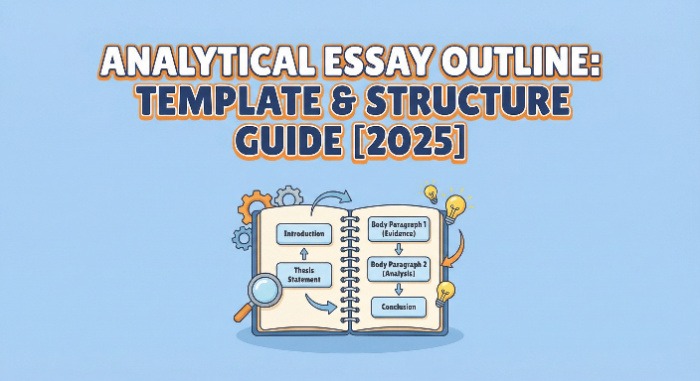
Use this analytical essay template for any analytical essay outline. Just fill in the brackets with your content:
I. INTRODUCTION (10-15% of essay)
- Hook [Attention-grabbing opening - question, quote, surprising fact]
- Context [Brief background - what readers need to know] [Introduce the text/subject you're analyzing]
- Thesis Statement [Your main analytical claim - what you'll prove]
II. BODY PARAGRAPH 1 (25-30% of essay)
- Topic Sentence [First analytical point supporting your thesis]
- Evidence #1 [Quote, example, or data from source] [Page number or citation]
- Analysis [Explain HOW this evidence proves your point] [Explain WHY it matters]
- Evidence #2 [Additional support for same point]
- Analysis [Interpret this second piece of evidence]
- Link [Connect back to thesis]
III. BODY PARAGRAPH 2 (25-30% of essay)
- Topic Sentence [Second analytical point]
- Evidence + Analysis [Follow same structure as Paragraph 1]
- Transition [Bridge to next paragraph]
IV. BODY PARAGRAPH 3 (25-30% of essay)
- Topic Sentence [Third analytical point]
- Evidence + Analysis [Follow same structure]
- Link [Transition toward conclusion]
V. CONCLUSION (10-15% of essay)
- Restate Thesis [Rephrase your main claim - don't copy/paste]
- Synthesis [Show how your three points work together]
- Broader Significance [Why your analysis matters beyond this specific text]
- Final Thought [Memorable closing insight]
This template shows the Analytical Essay Structure. Browse our Analytical Essay Examples for fully written samples.
READY TO GET YOUR ESSAY DONE?
Professional Essay Writing: Done Right, Every Time
- Expert writers handle structure, research, and analysis
- Perfect organization every time
- Delivered on deadline
- Custom-written to your exact instructions
Free revisions until you're satisfied.
Order NowAnalytical Essay Structure Breakdown: Percentage & Word Count Guide
Here's exactly how to allocate your essay's length across sections. Most students mess this up by spending too much time on the introduction and not enough on the analysis.
How To Start Analytical Essay (10-15% of Total)
Purpose: Set up your analysis without excessive background.
What to include:
What NOT to include:
Word count by essay length:
|
Common mistake: Students write 300-word introductions for 1,000-word essays, leaving no space for actual analysis. Keep it tight.
Haven't decided a topic yet? See our analytical essay topics guide to get inspired and choose the perfect subject from more than 240 titles across diverse genres.
Body Paragraph Structure (70-80% of Total)
Purpose: Present evidence and analyze it to prove your thesis.
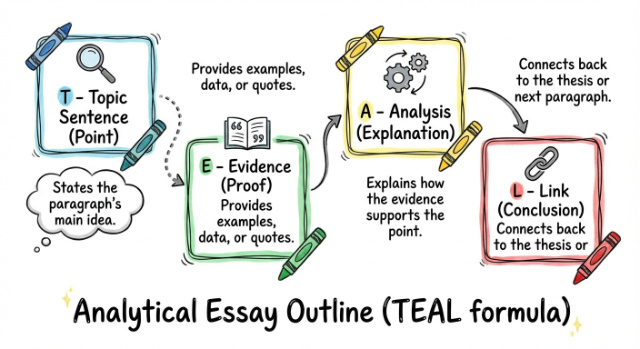
Each analytical body paragraph should follow TEAL structure:
T = Topic Sentence (1 sentence)
E = Evidence (2-3 pieces per paragraph)
A = Analysis (2-3 sentences per piece of evidence)
L = Link (1 sentence)
Paragraph length by essay length:
|
Critical ratio: Analysis should be TWICE as long as evidence. If you have 3 sentences of quotes, you need 6 sentences of analysis.
How To Write Analytical Essay Conclusion (10-15% of Total)
Purpose: Synthesize your analysis and discuss broader significance.
What to include:
What NOT to include:
Word count by essay length:
|
Analytical Essay Template Variations by Length
Same analytical essay structure, different depth. Here's how you can adjust the template for different assignment lengths:
High School Analytical Essay Format (500-1,000 words)
Structure:
Adjustments:
Total: 525-825 words (gives you buffer for 500-1,000 range) |
College Level Analytical Essay Format (1,000-2,000 words)
Structure:
Adjustments:
Total: 1,050-1,800 words |
Advanced/Graduate Level Analytical Essay Format (2,000+ words)
Structure:
Adjustments:
Total: 2,100-3,350 words |
Pro tip: Always aim for the middle of your assigned range. If the assignment says "1,000-1,500 words," target 1,250. This gives you room to cut or add during revision.
OVERWHELMED BY THE STRUCTURE?
Let Experts Turn Confusing Requirements Into Clear, Structured Essays
- We handle outlining, organizing, and writing
- Perfect paragraph structure guaranteed
- Any format, any deadline
- Quality-checked before delivery
Unlimited revisions included.
Get Your EssayParagraph Structure (TEAL Method) For Analytical Essay Outline
Here's the paragraph template you should memorize. This works for EVERY body paragraph while composing an analytical essay outline.
TEAL Paragraph (Annotated)
Topic Sentence:
Shakespeare's poison imagery in Hamlet systematically reveals how corruption spreads invisibly through Denmark's court.
Evidence #1:
The ghost describes his murder: "thy uncle stole...the whole ear of Denmark" with poison poured "in the porches of my ears" (1.5.36-37).
Analysis:
The poison entering through the ear, an invisible, insidious path, mirrors how moral corruption spreads through whispered lies and secrets rather than open violence. The phrase "whole ear of Denmark" extends the metaphor beyond one murder to suggest the entire kingdom has been infected through deceptive communication. Shakespeare positions poison as the weapon of secrecy and betrayal, not honor.
Evidence #2:
Hamlet later reflects that "something is rotten in the state of Denmark" (1.4.90), using disease imagery that parallels poisoning.
Analysis:
The "rotten" metaphor reinforces corruption as organic decay spreading from within, like poison in the body, rather than external attack. This imagery recurs throughout the play, linking political corruption to bodily contamination and suggesting that Denmark's problems cannot be fixed through external action alone.
Link:
This pattern of poison-as-invisible-corruption intensifies as characters like Claudius continue using verbal manipulation and hidden schemes, ultimately demonstrating that moral decay operates through deception rather than direct confrontation.
Filled-In Analytical Essay Template
This section shows a template FILLED IN with content. For complete essays, see Analytical Essay Examples.
Topic: Symbolism in The Great Gatsby
I. INTRODUCTION
- Hook: "The green light at the end of Daisy's dock has become one of American literature's most recognized symbols, but what does it actually mean?"
- Context: F. Scott Fitzgerald's 1925 novel The Great Gatsby uses color symbolism to critique the American Dream. Published during the Jazz Age, the novel examines wealth, class, and disillusionment.
- Thesis: Fitzgerald's systematic use of green and yellow color symbolism reveals the corruption of the American Dream, with green representing unattainable ideals and yellow representing false gold that masks moral emptiness.
II. BODY PARAGRAPH 1: Green as Unattainable Aspiration
- Topic: Green light symbolizes Gatsby's impossible dream
- Evidence: "Gatsby believed in the green light, the orgastic future that year by year recedes before us" (180)
- Analysis: [Explain how the distant green light represents dreams that remain forever out of reach]
- Evidence: Green appears in connection with Daisy throughout
- Analysis: [Interpret the connection between green and Gatsby's idealized vision of Daisy]
- Link: This unattainability theme connects to yellow's false promise
III. BODY PARAGRAPH 2: Yellow as Corruption and False Gold
- Topic: Yellow represents wealth without substance
- Evidence: Gatsby's yellow car, "death car" that kills Myrtle
- Analysis: [Explain how yellow is false gold, not pure gold]
- Evidence: Daisy's name is a yellow-centered flower
- Analysis: [Connect Daisy to false gold symbolism]
- Link: Together, green and yellow reveal Fitzgerald's critique
IV. BODY PARAGRAPH 3: The Intersection of Green and Yellow
- Topic: When green and yellow intersect, dreams die
- Evidence: The eyes of Doctor T.J. Eckleburg
- Analysis: [Examine how the faded advertisement combines colors]
- Evidence: Final scene with green light
- Analysis: [Show how color symbolism culminates]
- Link: This pattern exposes the American Dream as corrupted
V. CONCLUSION
- Restate: Fitzgerald uses green and yellow to show how American dreams of success are both unattainable and morally compromised
- Synthesis: Green represents the ideals we chase, yellow the corrupted means we use, and their intersection reveals tragedy
- Significance: This critique remains relevant to modern American materialism and the pursuit of wealth over meaning
- Final: The green light still beckons, but Fitzgerald warns us it will always recede, year by year, just beyond our reach.
Prefer to skip the outlining? Our reliable essay writing service handles the planning, structure, and writing, delivered on time with unlimited revisions.
Downloadable Resources for Analytical Essay Outline
Bottom Line
You now have everything you need to develop an analytical essay outline. This guide provides you with:
- Blank template you can copy immediately
- Structure breakdown with exact percentages
- TEAL paragraph method explained
- Format variations for any analytical essay outline
- Filled example showing it in action
Next steps:
- Copy the blank template
- Fill in your thesis and three main points
- Plug in your evidence under each point
- Follow TEAL structure for each paragraph
- Check percentage targets before drafting
Understanding the structure? See our Analytical Essay Writing Guide for step by step instructions.
NEED THE WHOLE ESSAY WRITTEN?
From Blank Page to Final Draft: Handled by Subject Experts
- Expert writers create custom outlines AND complete essays
- Perfect structure, deep analysis
- 100% original, on-time delivery
- Any subject, any academic level
Join 50,000+ satisfied students.
Place Your Order
-19758.jpg)