What is an Annotated Bibliography?
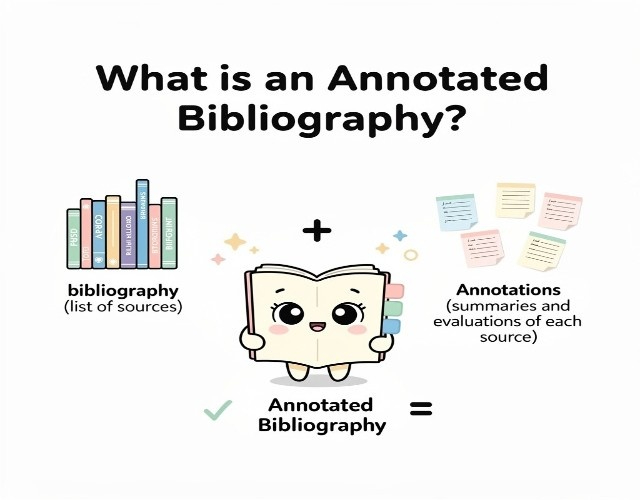
An annotated bibliography is a list of sources (books, articles, websites) where each citation includes a brief descriptive and evaluative paragraph, the annotation.
Unlike a standard bibliography or works cited page that just lists sources, an annotated bibliography requires you to:
- Cite the source in proper format (MLA, APA, Chicago, etc.)
- Summarize what the source is about.
- Evaluate the source's credibility, relevance, and usefulness.
- Reflect on how it fits into your research.
The Three Essential Annotated Bibliography Components
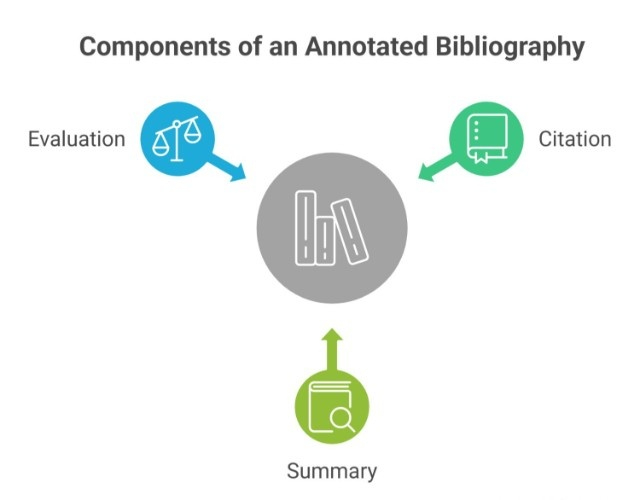
1. Citation: The source is formatted in the required citation style (MLA, APA, Chicago)
2. Summary: Brief overview of the source's main argument, findings, or content (2 to 4 sentences)
3. Evaluation: Assessment of the source's credibility, strengths, weaknesses, and relevance to your research (2 to 4 sentences)
Why Do Professors Assign Annotated Bibliographies?
Instructors assign annotated bibliographies for several legitimate academic reasons:
- To ensure quality research: Writing annotations forces you to actually read and understand sources instead of just grabbing citations.
- To develop critical thinking: Evaluating sources requires you to judge credibility, bias, methodology, and relevance.
- To prepare for larger projects: Annotated bibliographies are often precursors to research papers, helping you organize your thinking before drafting.
- To demonstrate research skills: They show you can find appropriate academic sources and engage with them critically.
- To build a research foundation: Creating an annotated bibliography helps you identify patterns, gaps, and connections across sources.
The assignment might feel tedious, but it serves a real purpose in the research process.
What Makes a Good Annotated Bibliography?
Strong annotated bibliographies share these qualities:
|
Bad annotation: "This article talks about climate change. It was published in 2020. It's a good source."
Good annotation: "Henderson's 2020 study examines climate change's impact on coastal communities using survey data from 500 residents. The article provides strong empirical evidence for economic displacement but focuses exclusively on US contexts, limiting global applicability. This source offers essential quantitative data for my project's economic impact section."
See the difference? Good annotations are specific, analytical, and clearly connected to your research needs.
Annotated Bibliography vs. Other Assignments
Confused about how annotated bibliographies differ from similar assignments? Here's the breakdown.
Annotated Bibliography vs. Works Cited / References Page
| Feature | Works Cited / References Page | Annotated Bibliography |
|---|---|---|
| What it Lists | Sources actually cited in the paper | Sources you're considering or have consulted |
| Content Includes | Citation only (no summary/evaluation) | Citation plus summary and evaluation |
| Assignment Role | Appears at the end of a completed paper | Stands alone as its own assignment |
| Purpose | Give credit + allow readers to locate sources | Show research process + critical engagement |
| Scope | Finalized sources | Potential + research-stage sources |
Example: If you write a research paper about social media's impact on mental health, your works cited page lists the 10 sources you quoted. Your annotated bibliography might include 20 sources you evaluated, including the 10 you used and 10 you considered but didn't cite.
Annotated Bibliography vs. Literature Review
| Feature | Literature Review | Annotated Bibliography |
|---|---|---|
| Format | Essay with intro, body, conclusion | List of individual entries |
| Organization | By themes or concepts | Alphabetically by author |
| Source Treatment | Integrates multiple sources together | Discusses each source separately |
| Purpose | Synthesize research + show how sources relate | Summarize + evaluate sources individually |
| Analysis Level | High: compares, contrasts, and connects | Moderate: summary + evaluation only |
| Writing Style | Narrative and analytical | List based, non narrative |
| Synthesis | Present: weaves sources into a story | Not present: no connections drawn |
Think of it this way: A literature review weaves sources together into a story about what research says. An annotated bibliography evaluates sources individually without synthesis.
For complete guidance on literature reviews, see our literature review guide.
Annotated Bibliography vs. Abstract
| Feature | Abstract | Annotated Bibliography |
|---|---|---|
| Word Count | 150 to 250 words (single summary) | 100 to 150 words per entry |
| Focus | Summarizes your own paper | Summarizes/evaluates other sources |
| Placement | Beginning of a completed paper | Stand-alone assignment or prep work |
| Purpose | Helps readers decide whether to read the paper | Helps you decide which sources to use |
| Content Includes | Argument, methods, findings | Summary + evaluation of published research |
| Scope | One cohesive summary | Multiple separate entries |
An abstract summarizes what you wrote. An annotated bibliography summarizes and evaluates what others wrote.
Types of Annotations
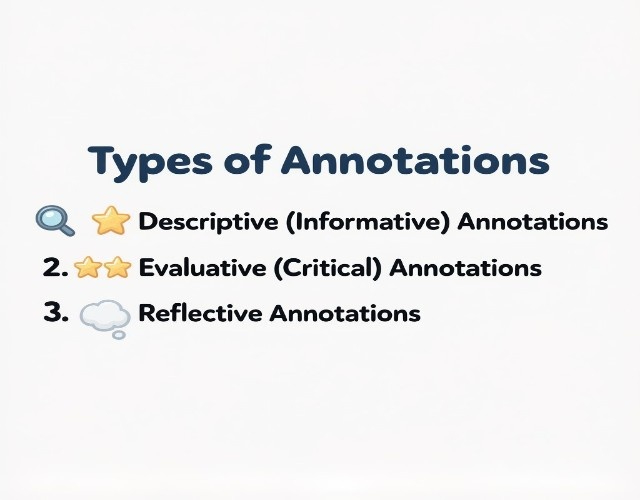
Not all annotations serve the same purpose. Understanding the three main types helps you write what your assignment requires.
1. Descriptive (Informative) Annotations
- What they do: Summarize the source's content without offering evaluation or opinion.
- When to use them: When your assignment asks you to demonstrate you've read and understood sources, but doesn't require critical analysis.
- What they include
1. The author's main argument or thesis.
2. Key topics covered.
3. Research methods used (if applicable)
4. Main findings or conclusions. - What they DON'T include
1. Your opinion about source quality.
2. Evaluation of credibility.
3. Assessment of usefulness.
Example
Smith, John. "The Impact of Social Media on Teenage Mental Health." Journal of Adolescent Psychology, vol. 45, no. 3, 2023, pp. 234-256. This article examines the relationship between social media usage and mental health outcomes in teenagers aged 13 to 18. Smith surveys 500 high school students about their social media habits and mental health symptoms. The study finds that teenagers who spend more than 3 hours daily on social media report higher rates of anxiety and depression. The article also explores which platforms (Instagram, TikTok, Snapchat) correlate most strongly with negative mental health outcomes. Smith concludes that while social media use is associated with mental health concerns, the relationship is complex and influenced by factors like usage type and individual vulnerability. |
Notice: This annotation explains what the source says but doesn't evaluate whether it's credible, well-researched, or useful.
2. Evaluative (Critical) Annotations
- What they do: Both summarize AND critically evaluate the source.
- When to use them: When your assignment asks you to assess source quality, credibility, and usefulness (the most common type).
- What they include
1. Everything from descriptive annotations.
2. Assessment of the author's credentials and authority.
3. Evaluation of research methods and evidence quality.
4. Identification of biases or limitations.
5. Judgment about the source's credibility and value
Example
Smith, John. "The Impact of Social Media on Teenage Mental Health." Journal of Adolescent Psychology, vol. 45, no. 3, 2023, pp. 234-256. This article examines the relationship between social media usage and mental health outcomes in teenagers aged 13 to 18 through a survey of 500 high school students. Smith finds that teens using social media more than 3 hours daily report higher anxiety and depression rates. The study's strength lies in its large sample size and use of validated mental health assessment tools. However, the self-reported data may be unreliable, and the correlational design cannot establish causation. Teenagers with existing mental health issues may simply use social media more. The article appears in a peer-reviewed journal, and Smith's background as a clinical psychologist lends credibility. Despite methodological limitations, this source provides valuable quantitative data about social media patterns and mental health correlations relevant to my research. |
Notice: This annotation includes everything the descriptive version had, PLUS evaluation of methods, limitations, and usefulness.
3. Reflective Annotations
- What they do: Explain how the source fits into YOUR specific research project.
- When to use them: When your assignment asks you to connect sources to your research question or thesis.
- What they include
1. Everything from evaluative annotations.
2. Explanation of how the source relates to your research.
3. Discussion of which aspects you'll use in your paper.
4. Reflection on how it compares to other sources.
5. Identification of what questions it helps you answer
Example
Smith, John. "The Impact of Social Media on Teenage Mental Health." Journal of Adolescent Psychology, vol. 45, no. 3, 2023, pp. 234-256. This article examines the relationship between social media usage and mental health through a survey of 500 teenagers. Smith finds correlations between heavy social media use (3+ hours daily) and increased anxiety and depression. The research methods are solid, using validated assessment tools, though the correlational design limits causal claims. This source will be central to my project's section on quantitative evidence of social media's mental health effects. I'll use Smith's data on platform specific impacts to argue that Instagram and TikTok pose greater risks than other platforms. However, I'll need to supplement this with qualitative research to understand why these platforms affect mental health differently. Smith's findings directly support my thesis that social media's impact varies by platform design and usage patterns. |
Notice: This annotation explains what the source says, evaluates its quality, AND explicitly connects it to the writer's research project.
How to Choose Which Type to Write
Read your assignment carefully.
The instructions usually specify
|
REMEMBER! When in doubt, write evaluative annotations. They're the most common type and demonstrate higher level thinking than purely descriptive entries.
How to Write an Annotated Bibliography (7 Steps)
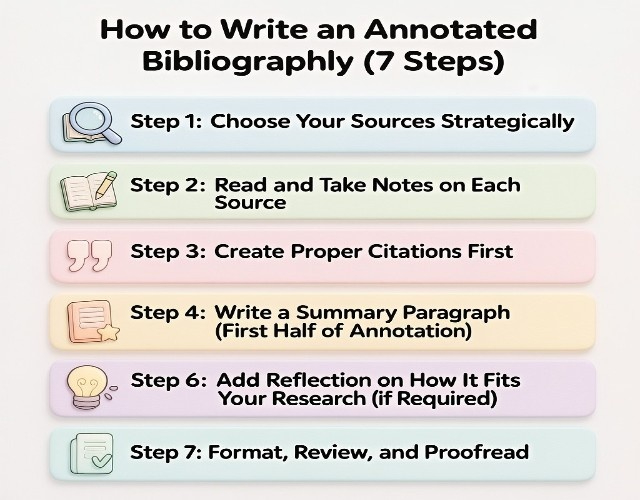
Follow this process to create a strong annotated bibliography efficiently.
Step 1: Choose Your Sources Strategically
Don't just grab the first 10 Google results. Select sources that:
- Are credible and academic: Peer-reviewed journal articles, books from university presses, government reports, reputable news sources.
- Are recent (usually): Unless you're doing historical research, prioritize sources from the last 5 to 10 years.
- Represent diverse perspectives: Include sources that agree, disagree, and offer different angles on your topic.
- Match your research needs: Each source should actually help answer your research question.
- How many sources? Check your assignment requirements. Typical ranges
1. Undergraduate papers: 8-15 sources.
2. Graduate papers: 15-30 sources.
3. Major theses: 30-50+ sources. - Where to find quality sources: Good sources for an annotated bibliography include your library’s academic databases (JSTOR, EBSCOhost, ProQuest), Google Scholar for peer-reviewed articles, your library’s physical collection, and specialized databases in your field.
Pro tip: Use the "snowball method" when you find one excellent source; check its bibliography for additional relevant sources.
Step 2: Read and Take Notes on Each Source
You can't write a good annotation without actually reading the source.
- For articles: Read the abstract first, then the introduction and conclusion, then skim the body.
- For books: Read the introduction, conclusion, and relevant chapters; you usually don't need to read every page.
- As you read, note: When reading a source for an annotated bibliography, note the author’s main argument or thesis (in your own words), the key evidence or examples, the research methods if it’s a study, any limitations or weaknesses, how the source relates to others you’ve read, and which specific parts you might cite in your paper.
Save time: Create a simple template for taking notes. For each source record: main argument, key evidence, author credentials, publication info, relevance to your project, and notable quotes with page numbers.
Step 3: Create Proper Citations First
Before writing annotations, format the citation for each source correctly.
Why citations come first
- Annotations hang below citations, you need the citation formatted before adding your paragraph.
- It's easier to format all citations at once than switch between formatting and writing.
- You can catch citation errors before moving to annotation writing
Use citation tools carefully
- Tools like EasyBib, Citation Machine, or Zotero help, but aren't perfect.
- Always double check generated citations against official style guides.
- Pay special attention to capitalization, punctuation, and italics.
For proper citation formatting rules, see our citation styles guide
Step 4: Write a Summary Paragraph (First Half of Annotation)
Start each annotation with 2-4 sentences summarizing the source.
What to include in your summary
- The author's main argument or thesis
- Key topics covered
- Research methods (if it's a study)
- Main findings or conclusions
What NOT to include
- Minor details or examples.
- Your opinion (save that for the evaluation section)
- Information not central to the source's main points
Step 5: Write an Evaluation (Second Half of Annotation)
After summarizing, evaluate the source's quality and usefulness.
Questions to answer in your evaluation:
1. About the author
- What are their credentials? Are they an expert in this field?
- Do they have potential biases? (e.g., works for an oil company writing about climate change)
2. About the research
- Is the evidence convincing? What type of evidence do they use?
- Are the methods appropriate? (For studies: sample size, research design, etc.)
- What are the limitations? What does the source NOT address?
3. About the source itself
- Where was it published? Is it peer-reviewed or from a reputable publisher?
- When was it published? Is it still current?
- Who is the intended audience? Academic, general public, professionals?
4. About usefulness
- How does this source help your research?
- What specific aspects will you use?
- How does it compare to other sources you've read?
Evaluation language examples:
Instead of: "This is a good source." Write: "The article's large sample size (n=500) and longitudinal design strengthen its conclusions about long-term effects."
Instead of: "The author is credible." Write: "As a professor of sociology with 15 years of researching social movements, Patterson brings substantial expertise to this analysis."
Instead of: "This will be useful." Write: "This source provides essential historical context for my project's section on policy development in the 1990s."
Step 6: Add Reflection on How It Fits Your Research (If Required)
If your assignment requires reflective annotations, add 1 to 2 sentences explaining how this source fits your specific project.
What to address
- Which section of your paper will use this source?
- What question does it help you answer?
- How does it relate to your thesis or argument?
- Does it support, contradict, or complicate other sources you've read?
Example reflection sentences:
"I'll use this source primarily for my literature review section to demonstrate the range of perspectives on universal basic income."
"This article directly supports my argument that social media algorithms amplify political polarization, providing quantitative evidence I lack in other sources."
"While Henderson's research contradicts Martinez's findings, this disagreement will strengthen my paper by allowing me to explore why different methodologies produce different results."
Step 7: Format, Review, and Proofread
After writing all annotations, review the complete bibliography.
1. Formatting checklist
- Sources organized alphabetically by author's last name.
- Hanging indent for citations (first line flush left, subsequent lines indented).
- Annotations single-spaced, with space between entries.
- Consistent citation style throughout (all MLA, all APA, or all Chicago, don't mix).
- Page numbers included if specified in assignment
2. Content checklist
- Every annotation includes summary AND evaluation (unless assignment only requires description).
- Each annotation is roughly the same length (100-150 words typically).
- Sources actually relate to your research topic.
- Writing is clear and concise, no fluff or filler
3. Proofreading tips
- Read each annotation aloud, you'll catch awkward phrasing - Check that verbs are in the past tense when describing research ("Smith analyzed", not "Smith analyzes").
- Verify that every citation is formatted correctly.
- Have someone else read it if possible; fresh eyes catch errors.
Annotated Bibliography Format Guide (MLA, APA, Chicago)
Annotated bibliography formatting varies significantly by style. Here's what you need to know for each.
MLA Format (9th Edition)
1. Citation format: Follow MLA guidelines, author, title (in quotation marks for articles, italics for books), container (journal/website), publication info, location (page numbers or URL).
2. Organization: Alphabetical by author's last name (or title if no author)
3. Spacing:
- Double-space throughout (citations AND annotations)
- Hanging indent for citations (0.5 inches)
- Continue annotation with the same hanging indent
4. Annotation placement: Starts on the line immediately after the citation
Example
Smith, John. "The Impact of Social Media on Teenage Mental Health." Journal of Adolescent Psychology, vol. 45, no. 3, 2023, pp. 234-256. This article examines the relationship between social media usage and mental health outcomes in teenagers aged 13 to 18. Smith surveys 500 high school students about their social media habits and mental health symptoms. The study's strength lies in its large sample size and use of validated assessment tools. Despite methodological limitations, this source provides valuable quantitative data about social media patterns relevant to my research
Key MLA Rules
For complete MLA guidelines with more examples, see our MLA annotated bibliography guide. |
APA Format (7th Edition)
1. Citation format: Follow APA guidelines, Author, A. A. (Year). Title of article. Title of Periodical, volume(issue), pages. DOI or URL
2. Organization: Alphabetical by author's last name
3. Spacing
- Double space throughout.
- Hanging indent for citations (0.5 inches).
- Annotation single spaced OR double spaced (check with instructor)
4. Annotation placement: Starts on line after citation, indented to align with hanging indent
Example
Smith, J. (2023). The impact of social media on teenage mental health. Journal of Adolescent Psychology, 45(3), 234-256. https://doi.org/10.1234/jap.2023.45678
This article examines the relationship between social media usage and mental health outcomes in teenagers aged 13-18 using survey data from 500 high school students. Smith finds that teenagers who spend more than 3 hours daily on social media report higher rates of anxiety and depression. The study provides strong quantitative evidence though the correlational design limits causal claims. This source offers essential data for my project's section on social media's psychological effects on adolescents.
Key APA Rules
For complete APA guidelines with more examples, see our APA annotated bibliography guide. |
Chicago Format (17th Edition)
1. Citation format: Follow Chicago Notes Bibliography style (most common for annotated bibliographies) or Author-Date style
2. Organization: Alphabetical by author's last name
3. Spacing
- Single-space within entries
- Double-space between entries
- Hanging indent for citations (0.5 inches)
4. Annotation placement: Starts on line after citation, single spaced, indented to align with hanging indent
Example (Notes Bibliography)
Smith, John. "The Impact of Social Media on Teenage Mental Health." Journal of Adolescent Psychology 45, no. 3 (2023): 234-256. This article examines the relationship between social media usage and mental health outcomes in teenagers aged 13 to 18. Smith surveys 500 high school students and finds correlations between heavy social media use and increased anxiety. The research methods are solid, using validated assessment tools, though the correlational design limits causal claims. This source provides valuable quantitative data for my research on social media's psychological effects.
Key Chicago Rules
|
Quick Format Comparison
| Element | MLA | APA | Chicago |
|---|---|---|---|
| Title | Works Cited | References | Bibliography |
| Spacing | Double throughout | Double (or single for annotations) | Single within, double between |
| Article titles | "In Quotation Marks" | Sentence case only | Sentence case only |
| Journal titles | Italics, Title Case | Italics, Title Case | Italics, Title Case |
| Page numbers | Include in citation | Include in citation | Include in citation |
Common Annotated Bibliography Mistakes to Avoid
Even experienced students make these errors. Here's how to avoid them.
Mistake #1: Writing Summaries Without Evaluation
The problem: Students write annotations that only summarize what the source says without evaluating quality or usefulness.
Why it's wrong: Unless your assignment specifically asks for descriptive-only annotations, you need to demonstrate critical thinking by evaluating sources.
Bad example: "This article talks about climate change. It discusses causes and effects. The author provides examples and data."
Good example: "This article argues that carbon pricing reduces emissions more effectively than voluntary corporate initiatives, using data from EU carbon markets. While the economic analysis is thorough, the study ignores political feasibility. This source will support my argument about market-based climate solutions."
How to avoid: After summarizing, always ask: Is this source credible? What are its strengths and weaknesses? How will I use it?
Mistake #2: Using Direct Quotes Instead of Paraphrasing
The problem: Students copy sentences from abstracts or articles directly into annotations.
Why it's wrong: Annotations should demonstrate that YOU understood the source by putting information in your own words.
Bad example: "According to the author, 'Social media use among teenagers has increased dramatically in recent years, leading to concerns about mental health impacts' (Smith 234)."
Good example: "Smith examines how rising teenage social media use correlates with increased mental health concerns."
How to avoid: Read the source, close it, then write the summary from memory. This forces you to use your own words and focus on main ideas.
Mistake #3: Writing Annotations That Are Too Long or Too Short
The problem: Annotations that are 50 words are too brief; annotations that are 300 words are too detailed.
Why it's wrong: Too brief = you're not demonstrating engagement. Too long = you're including unnecessary detail or repeating yourself.
The right length: 100-150 words (roughly 4-6 sentences) for most undergraduate assignments
Structure that hits the right length: - 2-3 sentences summarizing main points - 2-3 sentences evaluating quality and usefulness - 1 sentence (optional) connecting to your research
Mistake #4: Including Personal Opinions Inappropriately
The problem: Students write things like "I really enjoyed this article" or "This was boring to read."
Why it's wrong: Academic annotations focus on the source's quality and relevance, not your emotional response.
Bad example: "I found this article very interesting and easy to understand."
Good example: "This article's accessible language makes complex research findings understandable for non-specialist audiences while maintaining academic rigor."
How to avoid: Instead of "I think/feel/believe," use "The author argues," "The evidence suggests," or "This source demonstrates."
Mistake #5: Not Following Citation Format Correctly
The problem: Inconsistent citation formatting, mixing styles, or making formatting errors.
Why it's wrong: Citation accuracy is a key part of the assignment. Errors suggest carelessness or lack of attention to detail.
Common formatting mistakes: - Mixing MLA and APA formats - Forgetting hanging indents - Incorrect capitalization in titles - Missing DOIs or URLs when required - Wrong spacing between entries
How to avoid: - Use ONE citation style throughout (check assignment requirements) - Consult official style guides (Purdue OWL is excellent) - Double-check every citation before submitting
Mistake #6: Not Organizing Sources Alphabetically
The problem: Students list sources in the order they found them or used them.
Why it's wrong: Bibliographies are ALWAYS organized alphabetically by author's last name (or title if no author).
How to avoid: After writing all annotations, reorganize them alphabetically before submitting. This is an easy check that students often forget.
Mistake #7: Using Unreliable or Inappropriate Sources
The problem: Students include Wikipedia, personal blogs, or clearly biased sources.
Why it's wrong: Annotated bibliographies demonstrate research skills. Low-quality sources suggest you don't know how to find credible academic materials.
Sources to avoid: - Wikipedia (use its sources instead) - Personal blogs or opinion sites - Sources without clear authors or publication dates - Non-academic websites without credentials - Extremely outdated sources (unless doing historical research)
How to avoid: Stick to peer-reviewed journals, academic books, reputable news sources (NYT, WSJ, The Atlantic), and government/research organization reports.