Students often struggle selecting descriptive essay topics, either choosing overly generic subjects everyone describes identically (beach, sunset, pet) or overly abstract concepts lacking sensory description potential (love, freedom, justice). The challenge lies in finding subjects rich in sensory detail, personally meaningful, and appropriately scoped for assignment requirements.
Generic topics produce generic essays. When fifty students describe "the beach," readers encounter nearly identical descriptions of waves, sand, and seagulls with minimal distinction between essays. When students choose abstract concepts like "happiness," they struggle to create concrete sensory descriptions because emotions cannot be directly seen, heard, smelled, tasted, or touched.
This guide provides 100+ proven topics organized strategically to help you find perfect subjects. Topics are sorted by subject type (people, places, experiences, objects), allowing browsing within categories matching interests or assignment requirements. Within each category, topics are organized by education level, ensuring age-appropriate complexity and accessibility.
Beyond topic lists, you'll find selection criteria for evaluating potential subjects, topic development strategies showing how to narrow broad subjects and find unique angles on common ones, and red flags indicating topics to avoid, subjects resisting vivid description, or lacking sensory engagement.
Strategic approach beats random selection. Don't grab the first topic that sounds interesting. Evaluate potential topics against selection criteria before committing. Consider which subjects you've personally experienced, allowing authentic detail. Test topics by brainstorming sensory details—if you struggle generating specific sensory observations during testing, choose different topics.
After selecting strong topics here, transform them into effective descriptions using our comprehensive Descriptive essay writing guide with detailed techniques and processes. Study descriptive essay examples showing how successful essays develop topics into vivid descriptions. Return to our main descriptive essay guide for a complete fundamentals overview.
Topic Selection Criteria
Observable/Experienceable
Strong topics must be directly observable through the senses or personally experienceable. You need firsthand sensory data on what something looks, sounds, smells, tastes, and feels like from direct contact or observation.
Topics requiring purely research-based description lack authentic sensory detail. Historical events you didn't witness, places you've never visited, people you've never met, force you to imagine or research others' descriptions rather than drawing from rich sensory memory. Exception: objects you can physically observe and examine even without a personal history attached.
Choose subjects you've directly experienced, allowing description from memory's sensory store rather than imagination based on secondhand accounts. Personal observation provides specific details that research cannot match, the exact shade of paint on childhood bedroom walls, the particular creaking sound of grandmother's porch steps, the distinctive smell of father's workshop.
Firsthand experience enables authentic detail, distinguishing your description from generic versions others might write about similar subjects. Your grandmother's kitchen differs from others' grandmothers' kitchens through specific, unique details that only direct observation reveals.
Rich Sensory Potential
Evaluate topics by how many senses they engage and how richly each sense applies. Ideal topics naturally involve multiple senses abundantly: bustling farmers market engages sight (colorful produce displays), sound (vendors calling prices, crowd chatter), smell (fresh bread, ripe fruit, flowers), taste (sample offerings), and touch (fruit textures, crowding, temperatures).
Topics are limited to primarily one sense work but require more creative effort. Photographs or paintings engage sight dominantly; you must work harder incorporating sound (rustling paper, gallery echoes), smell (old photo albums' musty scent), touch (paper texture, frame edges), and even metaphorical taste or sound suggested by visual content.
Abstract concepts (love, freedom, justice) lack direct sensory engagement entirely; they cannot be seen, heard, smelled, tasted, or touched directly. These make poor descriptive essay choices because description requires sensory evidence.
When an assignment specifies abstract topics, find concrete manifestations: instead of describing "courage" (abstract), describe a courageous person's observable actions and physical characteristics demonstrating courage through sensory details.
Choose topics bursting with sensory possibilities across multiple senses. Test potential topics by listing specific sensory details. If you easily generate 20+ concrete observations across 3-4 senses, the topic offers rich potential. Difficult brainstorming warns of weak sensory engagement.
Sensory Checklist: Test Your Descriptive Essay Topic
| Sensory Test | Questions to Ask | What a “Yes” Means | Score (0-5) |
|---|---|---|---|
| Sight | Can you visualize colors, shapes, movement, lighting, or setting details? | Topic offers strong visual imagery. | |
| Sound | Can you recall specific sounds connected to this topic? (voices, noises, ambience?) | Helps create vivid auditory description. | |
| Smell | Are there noticeable scents associated with the topic? | Adds depth and emotional memory. | |
| Taste | Does the topic involve flavors (food, environment, memories)? | Enhances sensory richness and atmosphere. | |
| Touch | Can you describe textures, temperature, or physical sensations tied to it? | Makes descriptions immersive and physical. | |
| Emotion | Does the topic evoke clear feelings or memories? | Adds meaning and personal connection. | |
| Detail Density | Can you list at least 10 specific details from memory? | Ensures the topic is rich enough for a full essay. | |
| Uniqueness | Can you describe it in a way that shows a personal angle or viewpoint? | Prevents cliché and makes the essay original. | |
| Scene Potential | Can this topic be written like a small “movie scene”? | Allows strong descriptive narrative flow. |
Personal Connection
Topics you care about, have experienced personally, or find fascinating generate authentic, vivid descriptions impossible with subjects you find boring or unfamiliar.
Describing your childhood bedroom creates a detailed sensory memory-based description of exact wallpaper pattern, specific creaking floorboard location, and particular afternoon light angle, impossible when describing generic bedrooms you've never inhabited. Personal investment shows in writing quality immediately.
Enthusiasm for subjects creates an engaging description. When you genuinely care about topics, finding vivid details comes naturally rather than feeling like forced work. Conversely, forced description of uninteresting subjects produces flat, lifeless prose that readers sense immediately.
When assignments allow choice, select subjects that matter to you personally, places you love, people who influenced you, experiences that changed you, and objects with significance. Personal connection doesn't require drama or tragedy; everyday subjects described with genuine interest often surpass supposedly "important" topics approached without enthusiasm.
Exception: professional writing requires describing unfamiliar subjects competently. But academic descriptive essays benefit enormously from personal connection, enabling rich, authentic detail from direct experience rather than research or imagination.
Readers connect more with writing that feels genuine. Topics tied to emotion, memory, or experience spark stronger descriptions and natural imagery.
For topic ideas matching your interests, browse our organized categories below, or explore annotated descriptive essay examples showing how writers develop various subjects effectively.
Specific vs. Abstract
Concrete specific subjects create vivid descriptions, while abstract, vague concepts resist sensory description.
"My mother's garden" (specific, concrete) allows detailed sensory description: particular flowers (crimson roses, purple lavender, yellow marigolds), their distinct scents (rose perfume, lavender's calming aroma), textures (velvety petals, thorny stems), sounds (bees humming, wind rustling leaves), tastes (fresh tomatoes, mint leaves, strawberries).
"Beauty" (abstract concept) cannot be directly observed through the senses. You can describe beautiful things, but not beauty itself—the concept lacks physical form, sound, smell, taste, or texture. Similarly, "courage," "freedom," "justice," and "love" remain abstract without concrete manifestations.
When facing abstract assignment topics, find concrete manifestations. Instead of describing "courage" abstractly, describe a courageous person's observable actions, facial expressions, and physical characteristics demonstrating courage through accumulated sensory details. Instead of "freedom," describe a concrete moment experiencing freedom—windows down on the highway, wind streaming through the car, open road stretching endlessly ahead.
Test topics by asking: "Can I touch, see, hear, smell, or taste this directly?" If no, either find a concrete manifestation or choose different topics. Descriptive essays require sensory evidence—abstract concepts resist this fundamental requirement.
Appropriate Scope
Match topic breadth to assignment length. Too broad requires superficial treatment of too many aspects. Too narrow leaves insufficient content for the required length.
"My house" (too broad for 500 words): dozens of rooms, features, details requiring superficial mention rather than vivid description. "My bedroom's reading corner" (appropriately focused for 500 words): a specific area allowing detailed sensory description within length constraints.
"The beach" (vague, enormous scope, generic). "The tide pool I explored last summer" (specific, manageable, personal). "My father" (entire person, life story). "My father's hands while he works" (focused aspect revealing character through detailed observation).
Test scope by outlining: Can you identify 3-5 focused aspects describable in rich detail within the word limit? If the subject requires superficial treatment of too many aspects, a narrow focus. If the subject is exhausted in one paragraph, broaden slightly or choose different topics.
Specific moments often work better than general experiences. "Saturday morning at the diner" (specific time, focused experience) beats "my favorite restaurant" (general, requiring coverage of multiple visits, features, aspects). Focused topics enable depth over breadth, vivid, detailed description rather than surface-level surveys.
What's Your Essay Stress Costing You?
Sleep Better. Score Higher. Let Us Write It.
No AI. No excuses. Just results you can count on.
Topics by Subject Type
People Topics (25+ Ideas)
Family Members:
- Your parent or grandparent at their workplace.
- Sibling in their element (playing sport, performing a hobby, with friends).
- Relative during a holiday celebration or a family gathering.
- Family member's hands revealing life story through physical details.
- Grandparent telling stories from their youth.
- Parent cooking or working on a favorite project.
- Baby sibling discovering something new.
- Teenage sibling preparing for a significant event.
- Family member in a characteristic morning or evening routine.
Influential Figures:
- Teacher who changed your perspective.
- Coach during practice or a game.
- Mentor in their professional environment.
- Friend during characteristic activity.
- Neighbor with a distinctive personality or habits.
- Coworker or classmate with memorable traits.
- Counselor or advisor during the meeting.
- Music or art teacher during the lesson.
Strangers Worth Noticing:
- Barista at your regular coffee shop.
- An e person feeding birds in the park.
- A street performer or musician in a public space.
- Security guard, janitor, or often-overlooked worker.
- Passenger on public transportation.
- Person at their most authentic moment.
- Vendor at farmers market or street fair.
- Artist painting or creating in public.
Character Study Approaches:
- Focus on physical characteristics revealing personality.
- Describe characteristic gestures, mannerisms, and habits.
- Capture voice, laugh, way of moving.
- Show a person through their possessions or space.
- Describe a person in a natural element or a favorite activity
Tips: Choose people you've observed extensively, allowing detailed description beyond generic traits. Focus on what makes them distinctive, unique characteristics that set them apart. Show personality through observable details rather than stating traits. Gain permission if describing real people by name, or use pseudonyms respecting privacy.
Study how professional writers describe people effectively in our annotated descriptive essay examples collection with technique identification.
Place Topics (35+ Ideas)
Home Spaces:
- Your childhood bedroom preserved or changed.
- Kitchen during holiday meal preparation.
- Attic or basement holding family history.
- Porch or patio at a particular time of day.
- Backyard garden through seasons.
- Garage workshop or storage space.
- Reading nook or personal retreat space.
- Bathroom during morning routine.
- Dining room during family dinner.
- Basement recreation room.
Natural Settings:
- Forest trail in a specific season.
- Beach at sunrise or sunset (find a unique angle).
- Mountain summit or hiking overlook.
- Desert landscape's colors and textures.
- Lake or river at a particular moment.
- Garden or park at peak bloom.
- Storm approaching or passing through the landscape.
- Canyon or valley from a specific vantage point.
- Wetlands or marsh ecosystem.
- Meadow in spring bloom.
Urban Environments:
- Favorite neighborhood coffee shop or diner.
- Crowded subway car during rush hour.
- Street corner at night.
- Farmer's market or street fair.
- Library's oldest or newest section.
- Museum's particular exhibition.
- Rooftop with city view.
- Alley or hidden urban space.
- Historic building's interior.
- Busy intersection's sensory chaos.
- Bookstore's atmosphere.
- Shopping mall during the holiday season
School/Work Locations:
- Classroom during a specific activity.
- School cafeteria at lunchtime.
- Empty auditorium or gymnasium.
- Laboratory or art studio.
- Teacher's classroom reflecting personality.
- Locker room atmosphere.
- Office space revealing the occupant's character.
- Library study area during finals
Special Locations:
- Concert venue during performance.
- Hospital waiting room.
- Airport terminal early morning.
- Train or bus station.
- Religious space during service or empty.
- Sports arena during a game.
- Theater before performance.
- Restaurant kitchen during dinner rush.
Memory Places:
- Place from childhood revisited as an adult.
- Location of significant event.
- Somewhere you felt completely safe.
- Place you discovered accidentally.
- Space always triggers a specific emotion
Tips: Visit or revisit the location if possible for fresh observation. Choose a specific time of day or year when the place has a distinctive character. Consider unusual perspectives (from inside looking out, from above, from a specific vantage point). Use spatial organization to naturally guide readers through space. Layer sounds, smells, visual details, textures, and atmospheric qualities.
Experience/Event Topics (30+ Ideas)
Everyday Moments:
- Morning ritual or routine with sensory focus.
- Cooking or baking a specific dish.
- Walking a dog in the neighborhood.
- Coffee shop writing or studying session.
- Weekend morning laziness.
- Rainy day activities.
- Garden planting or harvesting.
- Car wash or vehicle maintenance.
- Laundromat atmosphere and people.
- Getting lost and finding a way.
- Shopping at the farmers' market.
- Riding a bike through the neighborhood.
- Watching sunrise or sunset from a specific location
Special Events:
- Family celebration or holiday gathering.
- Graduation ceremony.
- Wedding or formal dance.
- Concert or live performance.
- Sporting event (participating or attending).
- First day at new school or job.
- Award ceremony or recognition event.
- Birthday party (yours or others').
- Cultural celebration or festival.
- Religious ceremony or service.
- School play or musical performance.
Memorable Experiences:
- Learning to drive, swim, or a new skill.
- First time trying something intimidating.
- Getting caught in unexpected weather.
- Exploring abandoned buildings or new places.
- Visiting a relative or friend in a distant location.
- Hospital or medical experience.
- Travel delay or unexpected adventure.
- Volunteering or community service experience.
- Job interview or important meeting.
- Power outage or unusual occurrence.
- First performance or presentation.
- Camping trip or outdoor adventure.
Sensory Immersions:
- Farmer's market shopping.
- Attending religious service.
- Visiting an amusement park.
- Swimming underwater.
- Hiking in fog or rain.
- Stargazing on a clear night.
- Rush hour commute.
- Cooking an elaborate meal.
Topics that mix feelings (nostalgia + sadness, comfort + fear, excitement + anxiety) help writers create more complex and memorable essays.
Tips: Choose specific moments rather than general experiences. Focus on sensory richness: what you saw, heard, smelled, tasted, and touched. Balance action description with sensory detail emphasis. Consider organizing chronologically while emphasizing sensory impressions over plot progression. Find universal moments (first day nervousness, celebration joy) given personal treatment through specific details.
For detailed guidance on organizing experience descriptions, visit our comprehensive descriptive essay writing guide with structural templates and examples.
You've Done Enough. Let Us Finish It
Get an A-Worthy Essay Without the All-Nighter
No AI. No recycled papers. 100% original or your money back.
Object Topics (25+ Ideas)
Meaningful Possessions:
- Inherited item (jewelry, tool, book, furniture).
- Childhood toy preserved into adulthood.
- Gift with significance beyond monetary value.
- Handmade item from a loved one.
- Worn object revealing history through damage.
- Musical instrument with personal history.
- Athletic equipment with memories.
- Clothing item with a story.
- Photograph or artwork with meaning.
- Letters or cards saved over the years.
- Journal or diary from the past.
- Award or trophy representing achievement.
Everyday Objects:
- Kitchen tool used daily, revealing routine.
- Technology device (phone, laptop, headphones).
- Furniture piece anchoring the room.
- Plant cared for over time.
- Book read repeatedly.
- Vehicle (car, bicycle, skateboard).
- Backpack or bag revealing the owner.
- Keys and what they open.
- Wallet or purse contents.
- Favorite mug or cup.
- Watch or clock with significance.
Found Objects:
- Something discovered accidentally.
- Natural object (stone, shell, flower, feather).
- Antique from thrift store or estate sale.
- Street art or graffiti.
- Architectural detail noticed.
- Discarded object suggesting a story.
Tips: Choose objects you can physically observe, allowing touch, smell, and close visual inspection. Consider the object's history, significance, and sensory qualities. Describe beyond appearance—weight, texture, temperature, smell, and sounds it makes. Show the object's significance through description rather than stating importance explicitly. Consider organization: outside to inside, top to bottom, or sensory type (sight, then touch, then smell).
Topics by Education Level
Middle School Topics (Ages 10-14)
Simple concrete subjects requiring no specialized knowledge, accessible to younger writers developing descriptive skills.
People:
- Best friend or close family member.
- Favorite teacher or coach.
- Pet with a distinctive personality.
- Sibling during typical activity.
- Parent at work or a hobby.
- Grandparent sharing stories.
- Neighbor you know well.
Places:
- Your bedroom or special space at home.
- Favorite outdoor play area or park.
- School cafeteria or classroom.
- Friend's house you visit often.
- Local hangout spot (ice cream shop, arcade, library).
- Backyard, treehouse, or secret spot.
- Playground or recreation area.
Experiences:
- Birthday celebration or holiday.
- First day at new school.
- Learning new skills (swimming, riding a bike, sports).
- Family vacation memorable moment.
- School field trip.
- Weather event (snowstorm, thunderstorm).
- Playing a favorite game or sport.
- Cooking with a family member.
- Sleepover at a friend's house.
Objects:
- Favorite toy or game.
- Meaningful gift received.
- Pet's favorite toy or bed.
- Sports equipment used regularly.
- Collection started (cards, rocks, stickers).
- Book read many times.
- Stuffed animal from childhood.
TRY BEFORE YOU BUY
Free Essay. Zero Risk. Real Experts.
Zero risk. 100% human-written. Guaranteed.
High School Topics (Ages 14-18)
More sophisticated subjects allow nuanced descriptions and complex observations appropriate for developing writers.
People:
- Family member during a challenging time.
- Mentor outside family circle.
- Athlete or artist practicing their craft.
- Teacher's classroom reveals teaching style.
- Friend group's dynamic during activity.
- Person overcoming difficulty.
- Elderly relative with an interesting history.
- Someone who influenced your perspective.
Places:
- Workplace during shift.
- Nature location during a specific season.
- Urban setting at an unusual time.
- School location outside class (auditorium empty, field after game).
- Place holding personal significance.
- Historic building or landmark.
- Coffee shop or study location.
- Locker room before the game.
Experiences:
- First job or volunteer work.
- Performance, competition, or presentation.
- Cultural event or celebration.
- Travel experience reveals the difference.
- Challenging personal moment.
- Coming-of-age experience.
- Discovering passion or interest.
- Driver's license test or first solo drive.
- College visit or tour.
Objects:
- Inherited item connecting generations.
- Technology revealing culture or time period.
- Art or music that influenced you.
- Vehicle (first car, favorite bike).
- Object representing achievement.
- Something handmade by you or for you.
- Instrument you play.
College Topics (Ages 18+)
Complex subjects, allowing abstract concepts made concrete through sensory detail, require sophisticated observation and analysis.
People:
- Study of a stranger reveals broader truth.
- Professional in their element.
- Person from a different culture or generation.
- Character study revealing psychology through observable details.
- Composite portrait of a particular type.
- Person at a transitional moment.
- Mentor in a professional field.
- Someone challenging your assumptions.
Places:
- Liminal space (waiting room, airport, border crossing).
- Place revealing socioeconomic reality.
- Urban space at night.
- Location during a historical or cultural event.
- Place transformed by time or circumstance.
- Intersection of nature and urban development.
- Workplace revealing professional culture.
- Space triggering memory or reflection.
Experiences:
- Moment of realization or change.
- Cultural immersion experience.
- Confronting personal fear or limit.
- Witnessing something unexpected.
- Participating in community or activism.
- Professional or academic milestone.
- Experience revealing cultural assumptions.
- First time living independently.
Objects:
- Object as cultural artifact.
- Technology revealing societal shift.
- Object representing personal identity.
- Found object suggesting narrative.
- Object at the intersection of personal and historical.
- Something ordinary revealing extraordinary through description.
- Tool or instrument central to craft.
Find examples at your education level in our descriptive essay writing examples collection, showing appropriate complexity and technique application.
Developing Your Topic
Narrowing Broad Topics
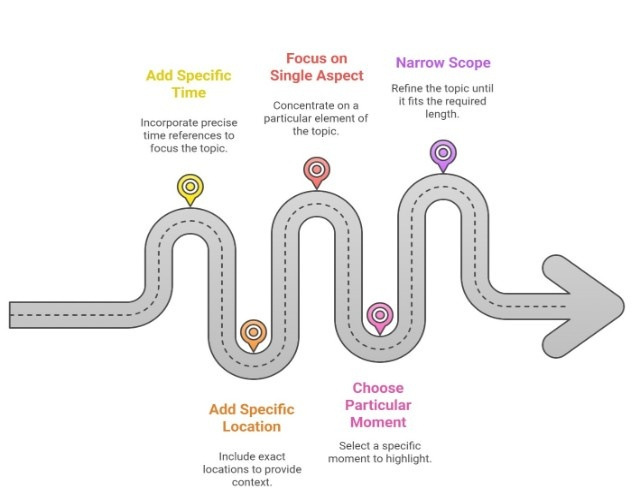
Transform overly broad topics into focused, manageable subjects appropriate for assignment length.
Too Broad: "My house" (requires superficial treatment of the entire building).
Appropriately Focused: "My grandmother's kitchen on Sunday mornings" (specific room, specific time, focused experience).
Too Broad: "The beach" (generic, everyone's version identical).
Appropriately Focused: "Tide pools at Cannon Beach during low tide" (specific location, specific time, unique angle).
Too Broad: "My mother" (entire person, life, characteristics).
Appropriately Focused: "My mother's hands while she gardens" (focused physical detail revealing character).
Process for narrowing:
- Add specific time: "during," "at," "when," "on Sunday mornings".
- Add specific location: "in," "at," "near," "the kitchen".
- Focus on a single aspect: "hands," "voice," "morning routine".
- Choose particular moment: "Sunday morning," "after rain," "at sunset," "during dinner preparation".
- Narrow scope until manageable for the required length.
Finding Unique Angles
Transform overdone topics through fresh perspectives, making generic subjects specific and interesting.
Generic: "My bedroom" (everyone has one, descriptions similar).
Unique Angle: "My bedroom wall: a collage revealing four years' evolution" (focused on specific element revealing development)
Generic: "Summer vacation" (broad, generic experiences)
Unique Angle: "The vinyl bench seats of our family station wagon during the August road trip" (specific sensory memory)
Generic: "My dog" (predictable pet description)
Unique Angle: "My elderly dog's morning ritual revealing his gradual aging" (focused observation, emotional depth).
Checklist: How to Narrow Broad Descriptive Essay Topics
| Narrowing Step | Checklist Questions | Goal | ?/? |
|---|---|---|---|
| 1. Identify Why the Topic Is Broad |
| Helps recognize topics that lack focus. | |
| 2. Find a Smaller Location / Moment Within the Topic |
| Turns huge topics into manageable scenes. | |
| 3. Check Sensory Potential |
| Ensures the topic can support vivid description. | |
| 4. Evaluate Emotional Connection |
| Makes the writing authentic and memorable. | |
| 5. Ensure the Scope Fits Assignment Length |
| Helps match topic size to essay length. | |
| 6. Test Uniqueness |
| Prevents cliché or generic descriptions. | |
| 7. Final Decision Check |
| Confirms you’ve chosen the strongest narrowed topic. |
Testing Topic Potential
Before committing to topics, test their descriptive potential through systematic brainstorming.
Brainstorm sensory details systematically:
- Sight: List 10 specific visual details (colors using precise names, shapes, sizes, lighting quality, movement, textures visible).
- Sound: List 5+ specific sounds (volume, pitch, source, quality, rhythm).
- Smell: List 3+ specific scents (comparisons to familiar smells, intensity, pleasantness).
- Touch: List 5+ textures, temperatures, weights, physical sensations.
- Taste: If applicable, list 3+ specific flavors, intensities, combinations
Evaluation: If you struggle generating details for multiple senses during this test, choose different topics. Easy brainstorming with 20+ concrete details across 3-4 senses suggests topics rich in sensory potential. Difficult brainstorming warns of challenging topics lacking vivid description possibilities.
Apply this brainstorming directly to essay drafting using techniques fromour step-by-step descriptive essay writing guide with comprehensive pre-writing processes.
Remember! Strong descriptive essays read like small movies.
Topics with physical space, movement, and atmosphere make scene construction easier.
Topics to Avoid
Overly Abstract Concepts
Abstract concepts lack the sensory engagement fundamental to descriptive essays. Love, hate, fear, happiness, freedom, justice, and courage cannot be directly observed through the senses—they resist description, requiring concrete sensory details.
When assignments specify abstract topics, find concrete manifestations. Instead of describing "courage" abstractly, describe a courageous person's observable actions, physical characteristics, and facial expressions demonstrating courage through accumulated sensory evidence. Instead of "freedom," describe a concrete moment of experiencing freedom with sensory details.
Generic Overdone Subjects
Certain subjects appear so frequently in student essays that standing out becomes nearly impossible. Unless you find genuinely fresh angles, avoid: sunset/sunrise (everyone describes identically), beach/mountain/forest without a specific location or unique moment, "my pet" without distinctive characteristics, "my best friend" without specific telling details, generic holidays without specific family tradition angles.
These topics aren't inherently bad but require extra effort to find unique perspectives, distinguishing your description from hundreds of similar versions.
Topics Lacking Sensory Potential
Some subjects resist sensory description fundamentally. Historical events you didn't witness (rely on research, not observation). Places you've never visited (secondhand descriptions lack authenticity). People you've never met or observed (imagination replaces direct sensory data). Purely intellectual concepts without physical manifestations. Abstract art requires interpretation over description.
Choose topics you can observe directly, providing firsthand sensory evidence rather than researched or imagined details.
Inappropriate Scope
Avoid topics too broad, requiring superficial treatment:
- "My childhood" (years of experiences).
- "New York City" (enormous scope).
- High school" (entire institution and experience).
Also, avoid topics too narrow, exhausting content quickly:
- "My pencil" (minimal sensory variety."
- "One minute of silence" (insufficient scope).
Find middle ground: specific enough for detailed treatment within length constraints, broad enough for sufficient content meeting requirements.
Conclusion
Choosing strong descriptive essay topics determines success before writing begins. The 100+ topics provided here offer starting points across subject types and education levels. Remember selection criteria: observable/experienceable, sensory-rich, personal connection, specific over abstract, appropriately scoped.
Test potential topics by brainstorming sensory details—easy generation with 20+ concrete observations across multiple senses suggests strong topics, difficult brainstorming warns of weak choices. Consider which topics you've personally experienced, enabling authentic detail. Find unique angles on common subjects, avoiding generic descriptions everyone produces. Narrow broad topics to a manageable, specific focus.
Transform your chosen topic into a vivid description using our step-by-step descriptive essay writing guide with a detailed process from brainstorming through final revision. Study descriptive essay examples showing how successful essays develop topics into engaging descriptions. Return to our comprehensive descriptive essay writing guide for a complete fundamentals overview.
Strong topics practically write themselves; your challenge is selecting them, not writing about them. With 100+ options here, plus selection strategies provided, you can find perfect topics for any descriptive essay assignment. Trust personal experience, choose subjects rich in sensory detail, find unique angles, and approach descriptive writing with curiosity about the sensory world around you.
Try Us Risk-Free — Your First Essay Is On Us
New here? Get up to 2 pages free. No payment. No commitment. Just quality you can trust.
- 100% original, plagiarism-free content
- Written by degree-holding experts
- On-time delivery, even for tight deadlines
- Unlimited revisions until you're satisfied
No credit card required. No strings attached.
Claim My Free Essay