Learning descriptive writing becomes dramatically easier when studying real examples showing successful techniques in action rather than just reading about abstract principles in isolation. The theoretical understanding of "show, don't tell" remains vague until you see telling sentences transformed into showing paragraphs with specific sensory evidence.
Sensory language descriptions make sense abstractly but crystallize when you read how writers layer sight, sound, smell, taste, and touch to create immersive experiences. Dominant impression sounds straightforward as a concept, but becomes clear when you see how every detail in successful essays reinforces central feelings without contradiction.
This collection provides 15+ descriptive essay examples spanning education levels and subject types. Each example demonstrates effective techniques with annotations explaining what works and why. You'll see complete essays showing technique integration, examples organized by subject type (people, places, experiences, objects), examples sorted by education level showing appropriate complexity, before-and-after comparisons demonstrating revision improvement, and analysis of what makes each example effective. After studying examples here, find your perfect subject in our collection of 100+ descriptive essay topics organized by type and difficulty.
Study examples actively, not passively—identify techniques, note patterns, practice replicating successful strategies in your own writing. For step-by-step guidance on implementing these observed techniques, explore our comprehensive descriptive essay writing guide with detailed process instructions from brainstorming through final revision.
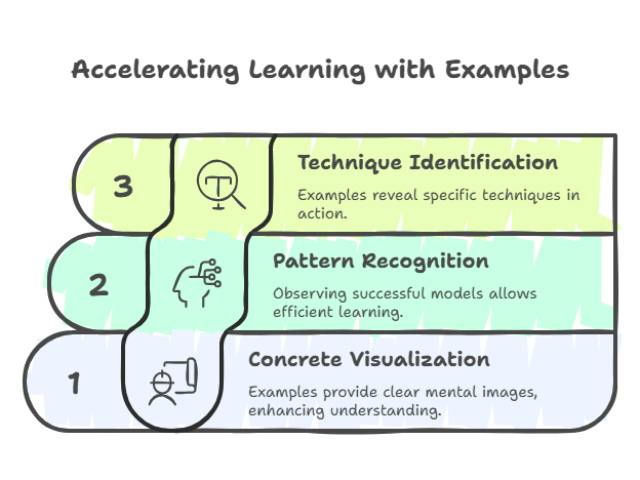
Why Examples Accelerate Learning
Concrete Visualization
Reading "use sensory language" provides direction but no clear picture of execution. The instruction remains abstract without concrete demonstration showing what sensory language actually looks like in practice.
Seeing actual sensory language in context shows exactly how to engage senses: "Thunder rumbled overhead as rain hammered the tin roof, each drop's metallic ping punctuating the storm's bass growl." This sentence demonstrates auditory description concretely—you can analyze it, understand why it works, and replicate the pattern.
Examples transform vague concepts into concrete models you can study and adapt. Instead of wondering "How do I describe sounds?" you see multiple examples demonstrating sound description across different contexts, revealing patterns you can apply to your own subjects.
Visual learners especially benefit from seeing techniques rather than reading about them. The concrete demonstration clarifies abstract instruction instantly—one strong example often communicates more effectively than paragraphs of explanation.
Pattern Recognition
Human brains learn through pattern recognition—observing successful models and replicating structures works more efficiently than inventing approaches from scratch through trial and error.
After studying 3-5 strong examples, patterns emerge naturally. You notice how introductions establish dominant impressions, how body paragraphs layer 3-5 sensory details systematically, how conclusions reinforce without repeating, and how transitions maintain smooth flow between ideas.
These patterns become templates you adapt to your own subjects. You're not copying content but replicating successful structural and technical approaches. If examples consistently use spatial organization for place descriptions, you understand that's an effective method worth adopting.
Pattern learning proves faster than experimentation. Rather than struggling through multiple failed attempts, discovering what works, you learn from others' successful approaches, accelerating your skill development significantly.
Technique Identification
Examples reveal specific techniques in action that might otherwise remain abstract concepts. You see similes comparing canyon walls to painted canvas, personification giving wind human characteristics, specific color names (crimson, azure, amber) replacing generic ones (red, blue, yellow).
You observe show-versus-tell execution: instead of stating "she was nervous," the writer shows "her hands trembled, shuffling note cards repeatedly." This concrete demonstration clarifies the technique better than definitions or explanations alone.
Annotations highlight what might otherwise go unnoticed. Marginal notes identify techniques, explain why they work, and point out patterns worth replicating. This guided analysis builds metacognitive awareness of effective descriptive writing.
Understanding WHY techniques work enables conscious application rather than accidental success. You're not just mimicking good writing—you're understanding the principles, making it effective, allowing you to adapt techniques strategically to any subject.
For more examples demonstrating these patterns, visit our comprehensive writing guide with extensive sample descriptions and technique breakdowns.
Try Before You Buy
Get Up to 2 Pages Written Free
Zero risk. 100% human-written. Guaranteed
Complete Annotated Example
"My Grandmother's Kitchen"
[INTRODUCTION - Establishing Dominant Impression]
Every Saturday morning, I return to my grandmother's kitchen, drawn by forces stronger than habit or obligation. This room embodies warmth and tradition, a sanctuary where time slows, and worries dissolve in the steam rising from simmering pots.
[Annotation: Thesis establishes dominant impression - "warmth and tradition" - that all subsequent details will reinforce]
[BODY PARAGRAPH 1 - Entrance/First Impressions - Spatial Organization]
The threshold creaks familiarly underfoot, announcing arrivals as it has for forty years. Immediately, yeasty aromas envelope you—bread rising on the counter, its surface smooth and taut like a balloon ready to burst. Morning light streams through lace curtains, casting intricate shadows that dance across worn linoleum, its pattern faded from decades of footsteps.
[Annotations: SOUND - "creaks" (specific verb). SMELL - "yeasty aromas" (specific scent). SIGHT - "lace curtains," "intricate shadows," "worn linoleum." TOUCH - "smooth and taut" (tactile comparison). SIMILE - "like a balloon ready to burst." SPATIAL - Begins at entrance, moves inward.]
[BODY PARAGRAPH 2 - Counter Area - Layering Multiple Senses]
The counter sprawls across one wall, its surface scarred from countless chopping sessions. Flour dusts everything like fresh snow—the rolling pin's wooden handle, the ceramic mixing bowl with its hairline crack, even the windowsill where herbs grow in mismatched pots. Basil's pungent sweetness mingles with rosemary's pine-sharp scent. My fingers trail across the counter's cool surface, catching on familiar grooves where knives have bitten too deep.
[Annotations: SIGHT - "flour dusts...like fresh snow" (simile), "hairline crack," "mismatched pots." SMELL - "basil's pungent sweetness," "rosemary's pine-sharp scent" (specific descriptions). TOUCH - "cool surface," "grooves where knives have bitten" (personification). SHOW NOT TELL - Shows age/use through physical details rather than stating "old counter."]
[BODY PARAGRAPH 3 - Stove Area - Center of Activity]
The stove anchors the room—a cast-iron beast perpetually radiating heat that makes nearby chairs warm even in January. Blue flames dance beneath blackened kettles. Water bubbles in rhythmic percussion. Tomato sauce simmers, releasing basil and garlic perfume that promises Sunday dinner delights. Steam rises in translucent columns, warming my face, making my eyeglasses fog.
[Annotations: METAPHOR - "cast-iron beast" (gives stove personality/presence). SIGHT - "blue flames," "blackened kettles," "translucent columns." SOUND - "bubbles in rhythmic percussion." SMELL - "basil and garlic perfume." TOUCH/TEMPERATURE - "radiating heat," "warm," "warming my face." PERSONIFICATION - "promises Sunday dinner delights."]
[BODY PARAGRAPH 4 - Table - Heart of Gathering]
The table occupies the kitchen's heart, its oak surface smooth from decades of elbows and hands. Six mismatched chairs surround it—each with stories in its scratches and stains. A crocheted tablecloth, yellowed with age, protects the wood during meals. Here, morning coffee steams in chipped mugs while conversation flows as freely as the brew. Cookies cool on wire racks, their edges golden-brown, their centers still soft enough to leave fingerprints.
[Annotations: SIGHT - "oak surface," "mismatched chairs," "yellowed...crocheted tablecloth," "golden-brown" edges. TOUCH - "smooth from decades," "soft enough to leave fingerprints." TASTE - Implied through "cookies," "coffee." SHOW NOT TELL - Shows table's importance through gathering details rather than stating "important place." DOMINANT IMPRESSION - Details of use and wear reinforce warmth/tradition theme.]
[BODY PARAGRAPH 5 - Window Area - Connection to Outside World]
Beyond the table, the window frames a view of the backyard garden—tomato plants staked in neat rows, their leaves rustling in the morning breeze. Sunlight warms the windowsill where grandmother's hands have rested countless times, watching seasons change. The glass bears fingerprints—small ones from grandchildren, larger ones from adults. Each smudge tells a story of someone who stood here, looking out or looking in.
[Annotations: SIGHT - "tomato plants," "neat rows." SOUND - "leaves rustling." TOUCH - "sunlight warms." SHOW NOT TELL - Shows family presence through fingerprints rather than stating "family gathers here." DOMINANT IMPRESSION - Window details reinforce warmth through family connection evidence.]
[CONCLUSION - Reinforcing Without Repeating]
The warmth radiating from this kitchen isn't merely temperature—it's the heat of family bonds, tradition simmering across decades, love baked into every surface. Years from now, wherever I am, the scent of rising bread will transport me instantly back to this room, this feeling, this sanctuary that shaped who I've become.
[Annotations: SYNTHESIS - Reinforces dominant impression (warmth/tradition) without repeating exact details. METAPHORICAL LANGUAGE - "love baked into every surface." REFLECTION - Addresses significance. FINAL IMAGE - "scent of rising bread will transport me" (memorable sensory detail). EMOTIONAL RESOLUTION - Provides closure through reflection on lasting impact.]
Analysis After Example
This example demonstrates how effective descriptive essays work through integrated technique application.
- Dominant impression (warmth/tradition) established in thesis, reinforced throughout every paragraph. No contradictory details undermine the unified feeling—everything from worn surfaces to mismatched furniture to lingering aromas supports the central theme.
- Multiple senses engaged: Sight dominates (colors, shapes, lighting) but is supported by sound (creaking, bubbling, rustling), smell (yeasty bread, basil, garlic), touch (smooth surfaces, warm temperatures, flour texture), and taste (implied through cookies, coffee).
- Show versus tell throughout: Rather than stating "Grandma was kind" or "the kitchen was welcoming," the writer shows kindness through observable actions and a welcoming atmosphere through accumulated sensory details. Readers draw conclusions from evidence rather than accepting stated claims.
- Spatial organization guides readers through the kitchen systematically—entrance, counter, stove, table, window. This methodical progression prevents confusion about spatial relationships while building a complete mental picture.
- Specific language creates vivid images: "Yeasty aroma" not "good smell," "crimson tomatoes" not "red vegetables," "cast-iron beast" not "old stove," "blue flames dance" not "fire burns." Precise vocabulary and strong verbs eliminate vague, forgettable descriptions.
- Figurative language enhances: Flour "like fresh snow," stove as "cast-iron beast," steam in "translucent columns," fingerprints that "tell stories." These comparisons and personifications make the description vivid without overwhelming concrete sensory observation.
One Click Away From Stress-Free
Let Experts Handle Your Essay Tonight
Human writers only. Original work always. Guaranteed.
Examples by Subject Type
Person Description Example
"My Eccentric Uncle" (Excerpt)
Uncle Martin's weathered hands told stories—callused fingertips from guitar strings, ink stains from endless writing, and the crooked pinky finger broken during his South American backpacking adventure twenty years prior. His laugh erupted suddenly, a barking sound followed by wheezing that shook his entire frame and made his wire-rimmed glasses slide down his nose.
The perpetual coffee smell clung to his vintage flannel shirts, mixing with Old Spice aftershave from the 1970s that he bought in bulk decades ago. When excited, words tumbled out rapidly, hands gesticulating wildly, silver rings catching lamplight as they traced emphatic patterns in the air. He'd pause mid-sentence to scribble notes on whatever paper was handy—napkins, receipts, the margins of newspapers—his handwriting cramped and slanting left like trees bent by constant wind.
What makes it work: Specific physical details create complete picture without stating "he was eccentric." Sensory details beyond sight include smell (coffee, aftershave) and sound (laugh, rapid speech). Personality emerges through observable traits—the scribbling, gesticulating, distinctive laugh—rather than stated qualities. Show-versus-tell executed consistently.
Place Description Example
"The Abandoned Library" (Excerpt)
Dust particles danced in light streaming through broken windows, illuminating rows of decaying shelves that leaned like drunken sentries. Pages yellowed and brittle carpeted the floor beneath gaps where books once stood, their corners curled and edges mouse-gnawed.
Mildew's musty scent overwhelmed any remaining paper smell—thick, oppressive, coating the throat with each breath. Silence pressed down except for occasional wind whistling through cracks and pigeons cooing in the rafters, their sounds echoing in the cavernous space.
Peeling paint revealed multiple color layers—institutional green, then cream, then the original rich mahogany underneath. The circulation desk stood abandoned, its surface scarred with carved initials and coffee ring stains that told stories of librarians long departed.
What makes it work: Spatial organization moves systematically (windows = shelves = floor = ceiling = desk). Multiple senses engaged create an immersive atmosphere—sight, smell, sound, and implied touch. Specific details paint decay vividly through accumulated evidence rather than stating "the building was old." Figurative language (shelves "like drunken sentries") enhances without overwhelming concrete observation.
Experience Description Example
"First Open Mic Night" (Excerpt)
Stage lights blinded me, hot against my face like pressing too close to a campfire. My hands trembled, making the microphone rattle audibly in its stand—metal against metal, announcing my nervousness to everyone watching.
The audience blurred into darkness beyond the lights, but I heard coughs, rustling programs, whispered conversations that made my stomach clench tighter. My mouth tasted like copper pennies as I forced the first words out. They emerged shaky, barely audible above the blood pounding in my ears like distant drums.
Then muscle memory took over—fingers finding familiar chords on the guitar neck, voice steadying as the chorus approached, breathing synchronizing with the rhythm I'd practiced a hundred times in my bedroom. The transformation happened gradually, fear dissolving as the song carried me forward on its current.
What makes it work: Sensory details capture anxiety physically—taste (copper), sound (rattling microphone, blood pounding), sight (blinding lights), touch (hot lights, trembling hands). Chronological organization moves through the moment naturally while maintaining descriptive focus. Emotion conveyed through physical sensations and observable details rather than stated feelings like "I was nervous."
Object Description Example
"My Father's Watch" (Excerpt)
The watch's face bore hairline scratches from decades on my father's wrist—tiny lines catching light like spider silk. Roman numerals etched precisely at each hour mark, the metal slightly raised, tactile under fingertips. The second hand swept rather than ticked, its movement smooth and continuous, mesmerizing when watched closely.
Leather band worn smooth and darkened by skin oils, creased deeply where his wrist bent. Cool metal back against my palm when I held it, weight substantial but not heavy—maybe four ounces, solid and real. Ticking audible in quiet rooms—steady, mechanical, reliable as a heartbeat. Crystal is slightly convex, magnifying the time, collecting fingerprints that smudged its clarity.
Engraving on the back in careful script: "To James, For 30 Years, 1985." The words worn shallow from decades rubbing against wrist skin, but still readable, still permanent.
What makes it work: Multiple senses engaged—sight (scratches, roman numerals), touch (cool metal, substantial weight, smooth leather), sound (steady ticking). Specific visual details create a complete picture—hairline scratches "like spider silk," convex crystal, and worn engraving. Organization moves methodically around the object (face = band = back = engraving). Emotional significance emerges through description rather than explicit statement about importance.
Examples by Education Level
Middle School Example
"My Pet Dog" (Excerpt)
Max is a golden retriever with fur the color of honey. His ears feel soft like velvet when I pet them, and they flop down to his shoulders. He always smells like the outdoors, even right after his bath—a mixture of grass and dirt and something warm that's just him.
When he's happy, his tail wags so hard his whole back end wiggles. Sometimes he spins in circles before lying down, making three complete turns before finally settling. His bark is deep and loud, making windows rattle, but he also makes funny snorting sounds when he's excited about dinner or seeing me come home.
His brown eyes watch me constantly, especially when I'm eating dinner. They look sad and hopeful at the same time. His tongue is rough like sandpaper when he licks my face, leaving wet trails that smell like dog food.
Why appropriate: Simple, concrete subject (beloved pet) accessible to middle school writers. Basic sensory observations across multiple senses—sight, touch, smell, and sound. Clear descriptive purpose without complex organization. Age-appropriate vocabulary and straightforward comparisons ("soft like velvet," "rough like sandpaper"). Shows personality through observable behaviors rather than stated traits.
High School Example
"The Antique Bookstore" (Excerpt)
Stepping inside felt like entering a time capsule sealed decades ago. Leather and aged paper created an olfactory library of knowledge and neglect—musty but not unpleasant, rich with history's scent.
Narrow aisles twisted between floor-to-ceiling shelves that leaned precariously, their burden of books causing wood to bow like tired shoulders carrying impossible weight. Dust motes swirled like tiny galaxies in slanted afternoon light filtering through unwashed windows.
The wooden floor creaked warnings with each step, its voice aged and weary, announcing visitors to whatever ghosts haunted these forgotten stacks. First editions rested beside forgotten paperbacks, their spines faded rainbows of literary history. Gold lettering had worn to shadows on some covers, barely legible but still present, still stubborn.
The proprietor sat behind the counter—ancient as his inventory, absorbed in reading through glasses thick as bottle bottoms, oblivious to customers unless they approached directly.
Why appropriate: More sophisticated subject, allowing atmospheric description. Figurative language throughout—similes ("like time capsule," "like tiny galaxies"), personification (floor that "creaked warnings," shelves with "tired shoulders"), metaphor ("faded rainbows of literary history"). Complex vocabulary and nuanced observations. Sophisticated dominant impression (timelessness, history, neglect) maintained consistently. Spatial organization is more subtle than the elementary example.
College Example
"Liminal Spaces: The Hospital Waiting Room" (Excerpt)
Time moves differently in waiting rooms—simultaneously crawling and leaping, measured not by clocks but by opened doors and called names. Each second stretches thin while hours compress, creating temporal distortion that leaves you uncertain how long you've been sitting in these chairs designed to discourage comfort.
Fluorescent lights hum their sterile lullaby overhead, casting everything in flat, shadowless brightness that makes faces look exhausted regardless of actual fatigue. Coffee from the vending machine tastes like scorched resignation, bitter and barely warm, but everyone drinks it anyway—ritual more than refreshment.
Strangers share space without connection, each cocooned in private anxiety that broadcasts itself through unconscious tells. Legs bounce. Fingers drum. Pages turn without being read. The air conditioning's artificial chill contrasts with bodies radiating stress-heat, creating microclimate variations—cold hands, hot faces, tension-tight shoulders.
Magazines from six months ago offer an escape nobody takes. Everyone stares at doors, willing them to open with specific names. The receptionist's voice becomes an oracle—each announcement bringing hope to one family while deepening dread in others still waiting.
Why appropriate: Abstract concept (liminal space, temporal distortion) made concrete through sensory details and psychological observation. Sophisticated thematic development exploring waiting's unique characteristics. Advanced vocabulary and complex sentence structures. Metaphorical language seamlessly integrated ("oracle," "scorched resignation," "temporal distortion"). Observes both physical sensory details and emotional/psychological atmosphere. Demonstrates mature analysis of universal experience through specific observation.
Discover more education-level appropriate topics in our curated collection of 100+ descriptive essay ideas organized by difficulty and subject type.
Before/After Revision Examples
Vague to Specific
Before (Telling/Vague): The old house looked scary. It was dark inside and smelled bad. The windows were dirty, and some were broken. Nobody had lived there for a long time. Trees and bushes around it were overgrown. It made me feel uncomfortable.
After (Showing/Specific): Jagged glass teeth jutted from broken window frames. Vines strangled the porch railings, their tentacles creeping across warped floorboards that sagged in the middle. Inside, mildew and decay created a thick, choking atmosphere that coated the throat with each breath.
Shadows pressed against walls where wallpaper peeled in long, curling strips—once a floral pattern, now faded to ghostly outlines. Floorboards groaned under each tentative step, threatening collapse. The silence felt oppressive, broken only by wind whistling through cracks and the occasional skitter of unseen creatures.
What Changed: Generic adjectives ("scary," "dark," "bad," "uncomfortable") were replaced with specific visual and sensory details, creating unease through evidence. "Smelled bad" specified as "mildew and decay." Passive "looked" transformed into active verbs and vivid images. Show-versus-tell execution throughout—fear created through accumulated details rather than stated emotion.
Your GPA Doesn't Have to Suffer
Expert Writers. Original Essays. Guaranteed Results
Trusted by 50,000+ students. Zero AI. Zero plagiarism.
Telling to Showing
Before: My mother was kind and patient. She always made me feel better when I was sad. She was a great cook and kept a clean house. Everyone liked her because she was friendly and helpful.
After: Mother's hands moved gently when she brushed my hair, never pulling despite the tangles, taking extra time with particularly stubborn knots. She hummed while cooking, filling our kitchen with tomato and basil aromas that meant dinner soon and everything was right with the world.
Even after long work days, she'd settle beside me on the couch, asking about my day with full attention—no phone checking, no distraction, her brown eyes focused entirely on my face. Her laugh came easily, a warm sound that made strangers smile in grocery store aisles, made checkout clerks start conversations, made our house feel like the center of something good.
What Changed: Stated qualities ("kind," "patient," "great cook," "friendly," "helpful") shown through specific observable behaviors. Emotions are conveyed through concrete actions demonstrating character rather than adjectives claiming qualities. Vague praise ("made me feel better," "everyone liked her") was replaced with scenes and specific behaviors illustrating those claims through evidence.
Generic to Memorable
Before: The concert was loud and exciting. Lots of people were there. The band played great music. Everyone was having fun dancing and singing along. The lights were cool. It was an amazing experience I'll never forget.
After: Bass notes vibrated through my chest with each beat—physical percussion felt rather than just heard. Bodies pressed together in the standing-room section, creating humid warmth despite the December cold outside. Laser beams sliced through smoke machines' output, painting the crowd in pulsing reds and blues that synchronized with the rhythm.
When the chorus hit, thousands of voices merged with the band's, creating a wall of sound that drowned individual contribution in collective volume. Sweat and spilled beer created a sticky floor that grabbed at shoes. The guitar's screech before the final song made my ears ring for hours afterward, a reminder persisting long past the last note.
What Changed: Generic adjectives ("loud," "exciting," "great," "cool," "amazing") were replaced with specific sensory details, creating concrete pictures. Stated emotions ("having fun") are demonstrated through physical responses and observable behaviors. Memorable specifics replacing forgettable generalities—"bass notes vibrated through chest," "ears rang for hours," "sweat and spilled beer."
For revision techniques and checklists, visit our comprehensive descriptive essay writing guide with detailed improvement strategies.
Downloadable Resources
Analysis Guides:
Practice Materials:
Conclusion
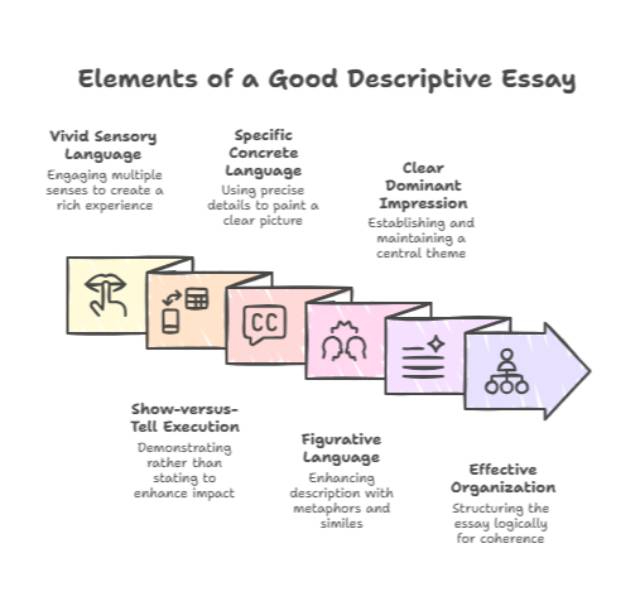
Learning descriptive writing accelerates dramatically through studying effective examples showing techniques in action. The examples provided here demonstrate principles you've learned: show-versus-tell execution, sensory language engaging multiple senses, figurative language enhancing description, dominant impressions unifying details, and effective organization guiding readers.
Study examples actively—identify techniques, note patterns, and analyze what creates effectiveness. Practice replicating successful strategies in your own writing. Return to examples during revision to verify your work demonstrates similar technique use. Master the complete process with our descriptive essay writing guide, providing step-by-step instructions from brainstorming through final revision.
Choose 3-5 examples matching your subject type and education level. Study them carefully, identifying specific techniques. Find your perfect subject among 100+ descriptive essay topics organized by type and difficulty. Outline your own essay using patterns observed. Draft using techniques you've learned. Revise by comparing your work to examples, ensuring similar technique density and sensory richness.
With these examples and resources, you have everything needed to write vivid, engaging descriptive essays that transport readers into your observations. Access our comprehensive descriptive essay guide for a complete overview of descriptive essay fundamentals.
50,000+ Students Trust Us. Now Try Us Free. Your first order is on us — up to 2 pages. See why students keep coming back. No payment required. No strings attached.