What is a Narrative Essay?
A narrative essay is your personal story written in essay format; it's storytelling with a purpose.
Simple definition: You share a specific experience from your life, but unlike just telling a friend what happened, you structure it with a clear beginning, middle, and end, and you explain what it meant to you.
The three key elements of a narrative essay:
- First person perspective: You write as "I," sharing your experience
- Story structure: Your essay follows a narrative arc with conflict and resolution
- Meaning: You don't just say what happened, you explain why it matters
Think of narration this way:
Journal entry: "Today I went to the beach. It was fun."
Narrative essay: "The summer I learned to surf, I discovered that falling off the board dozens of times taught me more about persistence than four years of high school ever did."
Why Write a Narrative Essay?
Students write narrative essays for many reasons:
For school: Teachers assign them to develop writing skills and self reflection
For college applications: Personal narratives show who you are beyond grades
For scholarships: Compelling stories make your application memorable
For yourself: Writing about experiences helps you process and understand them
There's no wrong reason to tell your story.
Still Struggling With Your Essay?
Skip the stress. Our professional writers handle everything, so you can submit with confidence.
- 100% original, plagiarism-free
- PhD literature specialists craft compelling narratives
- Vivid storytelling backed by proper structure
- Delivered on deadline with free revisions
No AI. Just real writers, real results.
Order NowSeven Types of Narrative Essays
Not all narrative essays tell stories the same way. Knowing the different types helps you choose the right approach for your assignment.
- Personal Narrative: Your own experience told from your perspective. The most common type for school assignments.
- Autobiographical Narrative: A significant period or event from your life that shaped who you are.
- Literacy Narrative: How have you developed as a reader, writer, or learner?
- Descriptive Narrative: Focuses heavily on sensory details while still telling a story.
- Digital Narrative: Story told through multiple media (text, images, video, audio).
- Fictional Narrative: Made up story that follows narrative structure (less common for academic assignments).
- Reflective Narrative: Focuses on how an experience changed your thinking or perspective.
Which Type of Narrative Essay Should You Choose?
Ask yourself:
What’s your assignment?
What story do you want to tell?
What’s your timeline?
|
Most assignments call for personal narratives. When in doubt, start there.
What Makes Narrative Essays Different?
Narrative Essay vs. Other Essay Types:
| Type | Purpose | Focus |
|---|---|---|
| Narrative Essay | Tell a story with meaning | Your personal experience |
| Descriptive Essay | Paint a picture with words | Sensory details of a subject |
| Expository Essay | Explain or inform | Facts and information |
| Argumentative Essay | Persuade the reader | Your position on an issue |
The key difference?
Narrative essays are stories. They have characters (you and others), plot (what happened), setting (where and when), and conflict (the challenge or change). Other essays explain or argue; narrative essays immerse the reader in an experience.
How to Write a Narrative Essay (Step by Step)
Writing a narrative essay doesn’t have to be overwhelming. Here’s the process, broken into manageable steps.
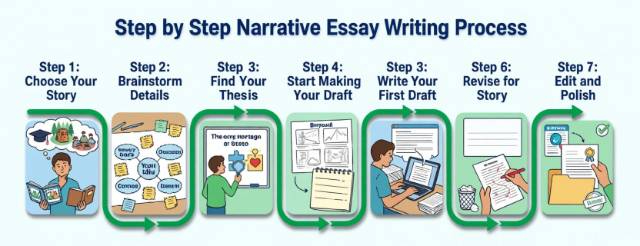
Step 1: Choose Your Story
Not every experience makes a good narrative essay. The best stories have:
|
Quick test: Can you explain your story in one sentence?
Good One: “The day I got lost in the woods taught me to stay calm under pressure.”
Too vague: "I learned a lot during my time at summer camp.”
Step 2: Brainstorm Details
Before you write, dump everything you remember onto paper.
Scene details:
Emotional details:
Dialogue:
|
Don’t organize yet, just collect. You’ll sort through it later.
Step 3: Find Your Thesis
Yes, narrative essays need a thesis, but it’s different from argumentative essays.
Your narrative thesis = the meaning of your story
Formula: [Experience] + [What I learned/how I changed] Weak: “I went to summer camp and had fun.” Strong: “Summer camp taught me that stepping outside my comfort zone leads to the most meaningful experiences.” |
Your thesis doesn’t need to be groundbreaking. It just needs to be true and specific to your experience.
Need help finding your angle? Our narrative essay topics page has 200+ topics organized by theme to spark ideas.
Step 4: Start Making Your Draft
Turn your brainstormed details into a structured plan.
Basic narrative structure:
|
Want a fill in the blank template? Download our narrative essay outline and structure your story in minutes.
Step 5: Write Your First Draft
Now you actually write. Make sure you;
Set realistic goals:
Balance showing and telling:
Keep momentum:
Include dialogue:
|
Step 6: Revise for Story
Big picture revision (first pass):
Content revision (second pass):
|
Step 7: Edit and Polish
Editing and proofreading are very important; don't even think to skip it.
Line editing (final pass):
Get feedback:
Final check:
|
How to Start a Narrative Essay
Your introduction either hooks the reader or loses them. Here's how to start strong.
The Opening Hook
You have one or two sentences to grab attention. Don't waste them.
Hook strategies that work:
- Start in the middle of action
- Use vivid sensory details
- Open with dialogue
- Begin with a surprising statement
What NOT to do
- Dictionary definitions ("Webster's Dictionary defines courage as...")
- Overly broad statements ("Since the beginning of time, humans have told stories...")
- Announcing your topic ("This essay is about the day I moved to America")
- Apologizing ("This may not be interesting, but...")
After the Hook: Context and Thesis
Your intro needs three elements:
Hook (1–2 sentences): Grab attention
Context (2–4 sentences): Set the scene, establish background
Thesis (1 sentence): State the meaning of your story
Narrative Essay Structure (Basics)
Every narrative essay follows the same basic story structure. Here's what each part does.
Section | Percentage of Essay | Purpose |
Introduction | 10–15% | Hook the reader and establish the stakes |
Rising Action | 30–40% | Build toward your main event |
Climax | 20–30% | The turning point. The moment everything changed. This is the heart of your essay. Develop it fully. |
Falling Action | 10–20% | Show the immediate aftermath |
Conclusion | 10–15% | Reflect on the meaning and tie it back to your thesis |
Want a ready to use template that maps all of this out? Download our narrative essay outline and fill in your story.
Essential Story Elements of a Narrative Essay
Great narrative essays share certain story elements. Here's how to incorporate each one.
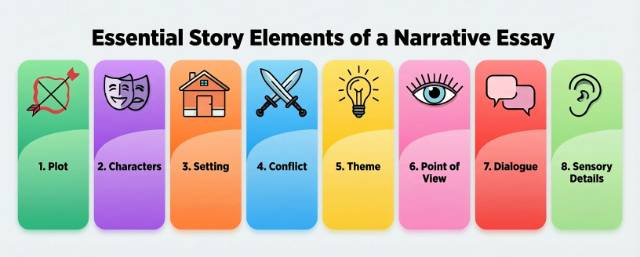
1. Plot
What it is: The sequence of events in your story
How to use it:
- Follow a clear beginning, middle, and end
- Build toward a climax (the most important moment)
- Include conflict or tension
- Show change or growth
Common mistake: Listing everything that happened chronologically without building tension Better approach: Focus on the key moments and develop them fully. Skip the boring parts. |
2. Characters
What it is: The people in your story (including you)
How to use it:
- Show characters through actions and dialogue
- Give key people distinct voices and personalities
- Include just enough detail to make them real
- Focus on characters essential to your story
Common mistake: Describing what people look like without showing who they are Better approach:
|
Need it Written Today? Ready to Hand it Off?
Our expert writers create hundreds of essays daily:
- Custom research on any topic
- Expert writers across all subjects
- Plagiarism-free guarantee
- Rush delivery available
Join 73,000+ students who've trusted us
Order Now3. Setting
What it is: Where and when your story takes place
How to use it:
- Establish time and place early
- Use sensory details (what you saw, heard, smelled)
- Show how the setting affected the experience
- Don't over describe just enough to ground readers
Common mistake: Generic descriptions that could be anywhere Better approach:
|
4. Conflict
What it is: The challenge, problem, or tension that drives your story
Types of conflict:
- Person vs. self (internal struggle)
- Person vs. person (disagreement, clash)
- Person vs. nature (survival, challenge)
- Person vs. society (rules, expectations)
How to use it:
- Establish what's at stake
- Build tension as the conflict develops
- Show how you dealt with it
- Explain what you learned
Common mistake: No real conflict, just "things happened." Better approach: Every good story needs something to overcome. What was hard? What went wrong? What did you fear? |
5. Theme
What it is: The deeper meaning or lesson of your story
Common themes in narrative essays:
- Growth and self discovery
- Overcoming fear
- Loss and grief
- Family and identity
- Failure and resilience
- Change and adaptation
How to use it:
- Don't state your theme directly ("This taught me to be brave")
- Show it through your story and reflection
- Connect specific moments to universal ideas
- Let readers draw their own conclusions
6. Point of View
What it is: The perspective from which you tell your story
For narrative essays: Almost always first person ("I")
How to use it:
- Stay in first person consistently
- Share your thoughts and feelings
- Let readers inside your head
- Don't tell others' thoughts you don't actually know them
Common mistake: Switching to third person or trying to be "objective" Better approach: Lean into first person. This is YOUR story tell it from your perspective. |
7. Dialogue
What it is: Conversations between characters
How to use it:
- Breaks up narration
- Reveals character and emotion
- Moves the story forward
- Makes scenes immediate and engaging
Format correctly:
- Use quotation marks
- New paragraph for each speaker
- Include tags ("she said," "he asked")
Common mistake: Stiff, formal dialogue that no one actually talks like Better approach: Write how people really speak, interruptions, fragments, natural rhythms |
8. Sensory Details
What it is: Details that appeal to the five senses
Why it matters: Sensory details make your story immersive. Instead of reading about an experience, readers feel like they're there.
The five senses:
- Sight: Colors, movement, light, expressions
- Sound: Dialogue, noise, music, silence
- Smell: Scents that trigger memory
- Touch: Texture, temperature, physical sensation
- Taste: Flavors, but also the taste of fear, copper of blood, salt of tears
How to use sensory details:
- Include at least 2–3 senses in important scenes
- Choose details that matter to your story
- Don't list everything, pick what's most vivid
Common mistake: All sight, no other senses Better approach: Ask yourself: In this moment, what else did I notice? What sounds were there? What did you smell? |
Want to see how professional writers craft engaging narrative essays? Check out our narrative essay examples with an analysis of what makes each essay work.
Writing Techniques for Narrative Essays
These techniques transform basic chronology into a compelling narrative.
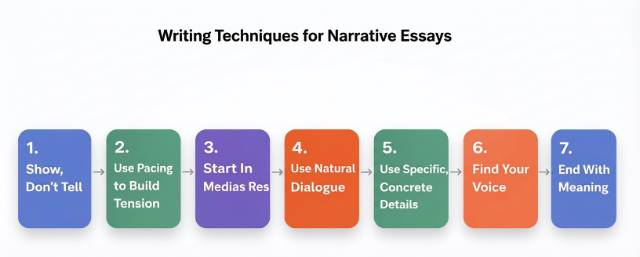
1. Show, Don't Tell
The number one rule of narrative writing.
Telling = stating facts
Showing = letting readers experience it
How to show instead of tell:
- Replace emotion words with physical reactions
- Use specific actions instead of general descriptions
- Include sensory details
- Let dialogue reveal feelings
2. Use Pacing to Build Tension
Pacing = how fast or slow your story moves
Fast pacing (for action, conflict, excitement):
- Short sentences
- Quick scene changes
- Minimal description
- The present tense can help
Slow pacing (for important moments, reflection, description):
- Longer sentences
- More sensory details
- Internal thoughts
- Expanded dialogue
Strategic pacing:
- Speed through less important moments: "The next week passed in a blur of exams and rehearsals."
- Slow down for your climax: Develop your most important scene with full sensory details
3. Start In Medias Res (In the Middle of Things)
Don't start at the actual beginning. Check where the interesting part begins. Start where the story gets interesting. Fill in the essential background later.
4. Use Natural Dialogue
Good dialogue sounds like real speech, not formal or stiff.
Tips for natural dialogue:
- Use contractions
- Include interruptions and fragments
- Match each character's voice
- Add dialogue tags and action beats
What not to include:
- Skip the boring pleasantries ("Hi, how are you?" "Fine, how are you?")
- Cut exposition disguised as dialogue ("As you know, I've been your best friend since third grade...")
- Avoid everyone talking the same way
5. Use Specific, Concrete Details
Vague = forgettable. Specific = memorable.
The difference: Specific details make your story real and unique. Generic descriptions could be anyone's story.
6. Find Your Voice
Voice = how your writing sounds. It should sound like YOU.
How to find your authentic voice:
- Write like you talk: If you'd never say "one must endeavor" in conversation, don't write it
- Be honest: Don't try to sound more mature or philosophical than you are. Readers can tell.
- Use your natural vocabulary: Big words aren't better. Clear words are better.
- Let your personality show:
If you're sarcastic, let it come through
If you're earnest, embrace it
If you're funny, include humor - Read your essay aloud: Does it sound like something you'd actually say? If not, revise.
7. End With Meaning, Not Summary
Your conclusion should give insight, not just recap events.
What makes a strong conclusion:
- Connects back to your thesis
- Offers deeper reflection than the introduction
- Explains what changed or what you understand now
- Leaves the reader with something to think about
- Avoids clichés ("This experience made me who I am today")
Common Challenges and Solutions of Narrative Essays
Every writer hits obstacles. Here's how to overcome them.
Challenge 1: "I Don't Have an Interesting Story"
The problem: You think your life is too boring for a narrative essay.
The truth: Interesting essays aren't about interesting events they're about interesting reflections. The small moments matter.
Solution:
Don't look for dramatic stories. Look for moments when:
- You learned something unexpected
- Your perspective changed
- You felt strong emotion
- Something surprised you
- You made a difficult choice
The key: Not the event itself, but what it meant to you.
Challenge 2: Writer's Block
The problem: You're stuck. The words won't come.
Solutions:
- Switch sections: Can't write the intro? Write the climax first. Write whichever part feels easiest.
- Free write for 10 minutes: Set a timer. Write anything related to your story without stopping. Don't edit. Just write.
- Talk it through: Tell someone your story out loud, then write down what you said. Spoken language is often clearer.
- Change your environment: New location = new perspective. Try a coffee shop, library, or park.
- Lower your standards: Give yourself permission to write badly. First drafts are supposed to be rough.
- Take a real break: If you've been staring at the screen for two hours, your brain needs rest. Come back tomorrow.
Challenge 3: "I Can't Remember Exact Details"
The problem: Your story happened years ago. You don't remember every detail.
Solutions:
- Interview people who were there: Family members, friends, teachers remember things you forgot
- Look at photos and documents: Visual triggers unlock memories
- Write what you do remember: Perfect memory isn't required. Use what you have.
- Be honest about uncertainty: "I can't remember if it was July or August, but I clearly remember the heat"
- Fill in reasonable details: You might not remember the exact color of the walls, but you know what kind of room it was. That's enough.
What matters most: Emotional truth, not factual perfection. How it felt is more important than the exact details.
Challenge 4: "My Essay Sounds Like a List of Events"
The problem: Your essay reads like: "First this happened. Then this happened. Then this happened."
Why it happens: You're telling instead of showing, and you're not including reflection.
Solutions:
- Slow down key moments: Develop your most important scenes with full sensory details and dialogue
- Cut or summarize less important parts: "The next week passed in a blur" = fine. You don't need to narrate every day.
- Add internal thoughts: Let readers into your head. What were you thinking at each moment?
- Include reflection throughout: Don't save all reflection for the conclusion. Weave it through your story.
Challenge 5: "I Don't Know How to End It"
The problem: You've told your story, but you don't know how to wrap it up.
Solutions:
- Connect back to your thesis: What meaning did you establish in your intro? Circle back to it with deeper insight.
- Explain the lasting impact: How did this experience change you? What do you still carry with you?
- Zoom out to universal significance: What might readers take from your story?
- Use a callback: Reference something specific from your opening. Creates satisfying closure.
What NOT to do:
- Don't just summarize what you already said
- Don't introduce new events
- Don't end with a cliché ("This made me the person I am today")
- Don't over explain the lesson
Challenge 6: "My Story Involves Sensitive Topics"
The problem: Your story includes difficult content, trauma, loss, family conflict, and mental health struggles.
How to approach it:
- Decide what to reveal: You're in control. Share what you're comfortable sharing.
- Write for your audience: Teacher reading it? College admissions? Public blog? Adjust accordingly.
- Focus on your experience and growth: Not on exposing others or seeking sympathy
- Be honest but not gratuitous: You can acknowledge pain without describing every traumatic detail
- Consider privacy: Change names if needed, Get permission for others' stories when possible
- It's okay to choose a different story: If a topic is too raw or too private, that's valid. Write about something else.
Challenge 7: "My Essay Is Too Long" (or Too Short)
Too long:
Solutions:
- Cut redundant sections
- Condense or remove less important events
- Tighten sentences (remove unnecessary words)
- Focus on one clear narrative thread
Too short:
Solutions:
- Develop your climax scene more fully
- Add sensory details throughout
- Expand dialogue
- Include more internal thoughts and reactions
- Add a scene that builds tension
Know the Structure But Can't Execute It? That takes practice. Our professional essay writing service specializes in narrative storytelling.
Free Downloadable PDFs for Narrative Essays
Get these resources to jumpstart your writing:
Master Planning Workbook: Complete pre-writing guide with brainstorming exercises, story selection framework, and planning tools.
Timeline Template: Organize your story chronologically and identify key moments.
Need Help Writing Your Narrative Essay?
We've helped thousands of students craft their narrative essays from scratch.
- Organize your memories into compelling narrative
- Write in your authentic voice
- Format professionally (MLA, APA, Chicago)
- Organize your memories into compelling narrative
Stop stressing. Start telling your story.
Get Started NowThe most important step? Starting.
Don't wait for perfect circumstances or complete clarity. Begin with small steps:
- Choose your story
- Create your timeline
- Write one paragraph about one moment
- Build from there
Your story matters. Your experiences and insights have value worth sharing.