Personal Narrative Example: Overcoming Fear
Here's a complete personal narrative about confronting a fear of public speaking. Notice how it uses specific sensory details and builds to a meaningful conclusion.
The Stage
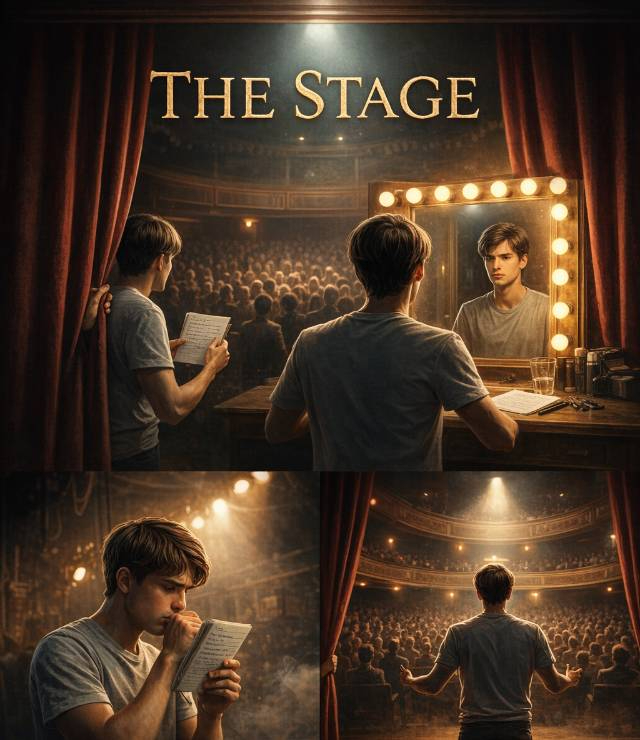
My hands shook as I clutched the index cards. Through the stage curtains, I could hear the auditorium filling voices, laughter, the screech of chairs against the floor. In thirty minutes, I'd be standing in front of 500 people delivering the valedictorian speech. The same person who'd faked sick to avoid presentations for four years.
"You're up after the principal's welcome," Ms. Rodriguez said, adjusting her headset. She smiled like this was no big deal, like I wasn't about to pass out.
I'd spent weeks writing this speech. Memorized every word. Practiced in front of my bedroom mirror until my parents begged me to stop. But standing here, listening to that crowd, every word had evaporated from my brain.
The principal's voice boomed through the speakers. "Welcome, graduates, families, and faculty..."
This was it. No backing out now.
I closed my eyes and remembered what my English teacher had told me after I'd finally admitted why I'd been skipping presentations:
"Fear doesn't go away. You just get better at walking through it."
The principal's speech ended. Applause. My cue.
I walked onto that stage, and the lights hit me like a physical force. Faces so many faces all looking at me. Waiting.
I opened my mouth. Nothing came out.
The silence stretched. Someone coughed. My vision started to tunnel.
Then I saw her Ms. Chen, my sophomore English teacher, in the third row. She caught my eye and nodded once. Just that. One nod.
I took a breath.
"Four years ago," I said, and my voice actually worked, "I walked into this school convinced I was invisible."
The words started flowing. Not because the fear disappeared, it didn't. My hands still shook. My voice still wavered on certain words. But I kept going anyway.
I told them about feeling unseen. About teachers who'd seen me anyway. About learning that growth doesn't mean becoming fearless, it means acting despite the fear.
When I finished, the applause was thunderous. But what I remember most is walking off that stage and realizing something fundamental had shifted. I'd proven to myself that I could do the thing I'd spent years convinced I couldn't.
That speech didn't cure my fear of public speaking. Even now, I get nervous before presentations. But I learned something more important: fear is just a feeling. It can't actually stop you unless you let it.
What Makes This Example Work
|
Struggling With Examples or Structure?
Our professional writers specialize in illustration essays that demonstrate concepts with strong, specific evidence.
- Zero plagiarism, 100% original
- Academic tone and detailed analysis
- Expert editing and formatting
- Confidential and reliable
Get a clear, example-driven essay that impresses your professor.
Order NowCollege Application Narrative Example
This narrative was written for a college application prompt about a challenge and how it shaped the applicant. Watch how it connects a specific moment to broader personal growth.
The Translation
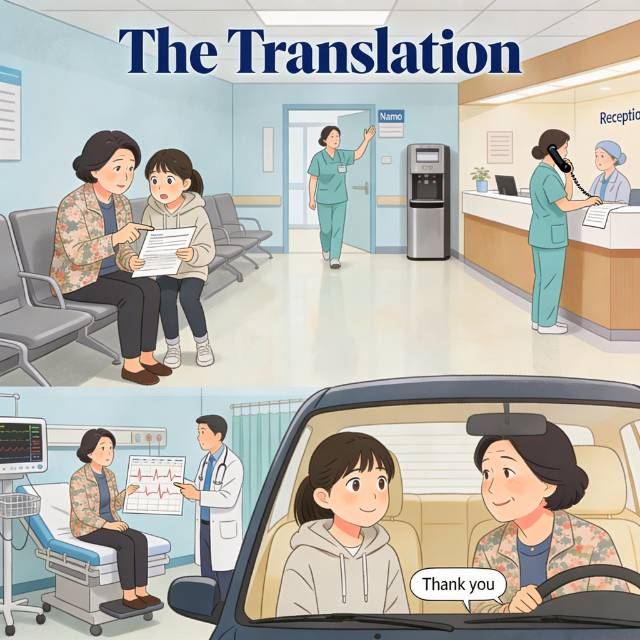
The hospital waiting room smelled like disinfectant and bad coffee. My mother sat beside me, filling out forms, pausing every few lines to ask me something in Korean.
"What does this mean?" She pointed to a question about her medical history.
I was fifteen. I'd been translating for my parents since I was eight at parent teacher conferences, at the DMV, during phone calls with customer service representatives who spoke too fast and got annoyed when my mother asked them to repeat themselves.
That day, though, was different.
"Mom," I said, "this is asking if you've ever had heart problems."
She shook her head and checked the "no" box. Kept filling out the form. Then paused again.
"Here," she said. "This part."
Have you experienced any of the following symptoms in the past year: chest pain, shortness of breath, irregular heartbeat...
I translated. She checked "no" to all of them.
Fifteen minutes later, a nurse called her name. I stood to follow, but the nurse held up a hand.
"Just the patient, please."
My mother looked at me, uncertain. I nodded. "I'll be right here."
She disappeared through the door.
I sat back down and stared at that form she'd handed to the receptionist. And that's when it hit me: I'd translated it wrong. The question wasn't asking about heart problems; it was asking about heart symptoms. And my mother had complained about chest pain for weeks. I'd heard her telling my aunt about it in Korean and dismissed it as stress.
I shot up, started toward the desk, then stopped.
What if I was wrong? What if I caused a panic over nothing? What if I embarrassed her?
But what if I wasn't wrong?
I went to the desk.
"Excuse me," I said to the receptionist. "The form my mother just turned in, she might have misunderstood one of the questions. She's been having chest pain."
The receptionist's expression changed. She picked up a phone.
Two hours later, after an EKG and a consultation with a cardiologist, my mother was being scheduled for tests. She'd been having angina, not heart attacks, but warning signs. Treatable, the doctor said, but only if caught early.
In the car, my mother didn't speak for a long time. Then:
"Thank you."
I'd translated thousands of words for my parents' forms, instructions, conversations with teachers, landlords, and doctors. But that was the day I learned that translation isn't just about converting words from one language to another. It's about understanding what's actually being communicated, what's being left unsaid, and when the literal translation might miss something critical.
It's also the day I realized I wanted to become a doctor. Not just to help people, but specifically to help people like my parents, immigrants who struggle to navigate a healthcare system that doesn't speak their language, literally or figuratively.
Being a translator taught me attention to detail, patience, and advocacy. These aren't just skills they're the foundation of the kind of doctor I want to be. The kind who listens to what patients aren't saying. The kind who makes sure nothing gets lost in translation.
What Makes This Example Work
|
Literacy Narrative Example
This literacy narrative explores how the author discovered reading as an escape. Notice how it connects early memories to a larger theme about the power of stories.
The Library Card
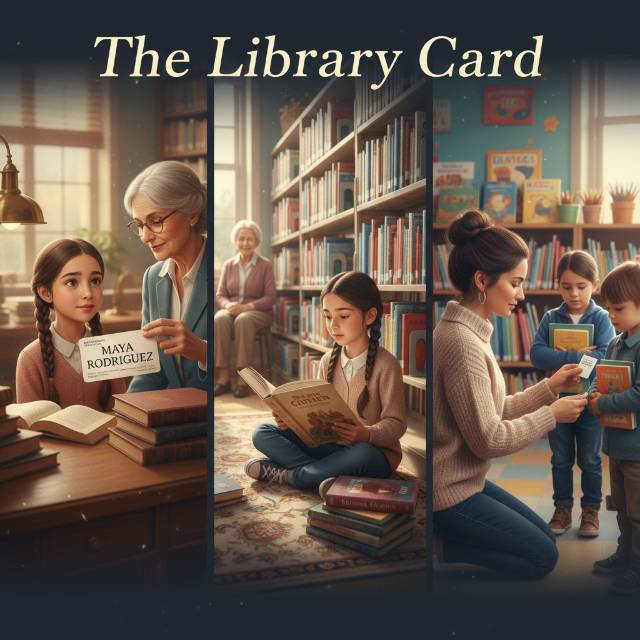
I was seven when I got my first library card. The librarian, Mrs. Patterson, printed my name on it in careful letters MAYA RODRIGUEZ and handed it to me like she was giving me a key to somewhere important.
"This," she said, "means you can check out any book in the children's section. Five at a time."
I stared at it. A plastic card with my name on it. Permission to take books home.
My parents fought a lot that year. I'd learned to disappear into my room, into the closet, sometimes just into the corner behind the couch. Making myself as small and quiet as possible until the yelling stopped.
But the library gave me a different way to disappear.
Every Thursday, my grandmother took me after school. I'd head straight for the fiction section, chapter books with worn covers and cracked spines that had been read by a hundred kids before me. I'd sit cross legged on the floor and read the first chapters until I found the ones that pulled me in so completely that everything else faded away.
The Boxcar Children are living on their own in the woods. Ramona Quimby is getting into trouble. Encyclopedia Brown solving mysteries.
These kids had problems, too. But theirs felt solvable. Clear. Contained within a certain number of pages that eventually led to a satisfying ending.
I'd check out my five books and read them all before next Thursday. Sometimes twice.
My grandmother noticed. She started taking me every Tuesday and Thursday. Then Monday, Wednesday, and Friday too. Mrs. Patterson stopped asking to see my card she recognized me on sight.
"You going to be a writer someday?" she asked once, re-shelving books nearby while I sat in my usual spot.
I'd never thought about it. I was just trying to survive second grade and my parents' marriage falling apart.
"Maybe," I said.
"Readers become writers," she said. "You're reading at a fifth grade level. You know that?"
I didn't know that. I just knew that books let me live other lives, try on other problems, exist somewhere other than my tiny house where my parents couldn't figure out how to be in the same room without screaming.
Twenty years later, I'm a teacher. I have a classroom library with over 300 books. When I notice a kid who always has their nose in a book, who reads during lunch and recess, who hoards books like treasure, I recognize them immediately.
I know what those books are doing. They're not just entertainment. They're escape hatches. Practice runs in different lives. Proof that stories can have endings that make sense.
And I make sure every single one of my students gets their own library card in the first week of school. Just like Mrs. Patterson did for me.
Because reading saved me. And maybe it's saving some of them, too.
What Makes This Example Work
|
Descriptive Narrative Example
This example emphasizes sensory details while still telling a story. Perfect for when your assignment asks for both narrative and descriptive elements.
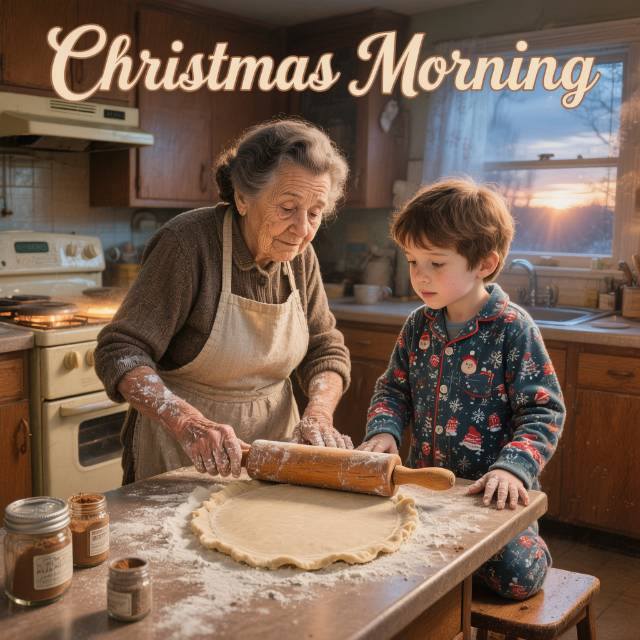
Christmas Morning
The kitchen smelled like cinnamon and nutmeg before dawn. I'd wake to that smell every Christmas morning at my grandmother's house, not to presents under the tree, but to her standing at the counter, flour dusting her dark forearms, rolling out pie dough.
"You're up," she'd say, not turning around. She always knew.
I'd pad across the cold linoleum in my socks and climb onto the stool she kept by the counter specifically for me. The kitchen was warm despite the winter morning, heat radiating from the ancient stove that she refused to replace even though it took twenty minutes to preheat.
"Wash your hands," she'd say. "Then you can help."
The dough felt smooth and cold under my palms. She'd taught me to roll from the center outward, turning the dough a quarter turn after each roll so it formed an even circle. The rolling pin was wooden, worn smooth from decades of use, and it left a faint coating of flour on everything: the counter, my hands, my pajamas.
"Like this?" I'd ask, rolling too hard and making the dough uneven.
"Gentler," she'd say, placing her hands over mine. "Let the pin do the work."
Her hands were always warm. Calloused at the fingertips from years of sewing, gardening, and cooking. She smelled like Pond's cold cream and coffee and whatever spices she'd been working with that mornin,g cloves.
We'd work in comfortable silence, broken only by her humming church hymns, usually, or sometimes old songs from when she was young that I didn't recognize. The kitchen would gradually fill with golden morning light, and my parents and aunts and uncles would start appearing, drawn by the smell and the warmth and the promise of her pies.
But those early morning hours were ours. Just us and the kitchen and the pies.
She died when I was sixteen. The kitchen in her house still smells like cinnamon when you walk in, even though no one's baked there in years. My aunt says it's soaked into the walls.
I have her rolling pin now. I've tried to make her pies I have her recipes, written in her careful handwriting on index cards stained with butter and vanilla extract. But they never taste quite right.
Maybe it's not just about the ingredients. Maybe it's about those cold linoleum floors and that terrible old stove and those warm hands guiding mine, teaching me that the best things require patience and a gentle touch.
I make pies anyway. Every Christmas morning. And for a few hours, standing in my kitchen with flour on my hands, I'm seven years old again.
What Makes This Example Work
|
Short Narrative Example (500 Words)
Need a shorter example? Here's a complete 500-word narrative essay you can use as a model for brief assignments.
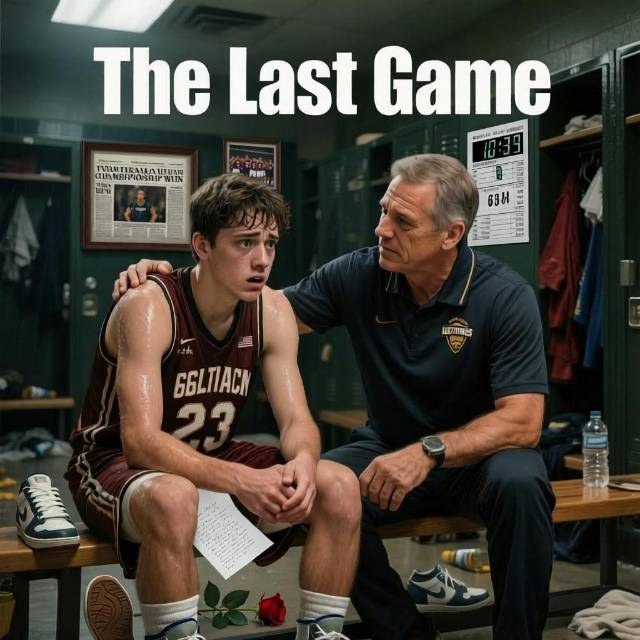
The Last Game
I knew it was over in the third quarter.
We were down by twenty, and Coach had benched most of the starters not as punishment, but because the game was already decided. I sat on the metal bench, still sweating through my jersey, and watched the seconds tick down on my high school basketball career.
Four years. Hundreds of practices. Early morning workouts and late night games and summers spent in the gym instead of at the beach. And it was ending on our home court with half the crowd already filing out because the outcome wasn't in question.
I'd always imagined my last game differently. A close score. A final shot. Something dramatic, at least.
Instead, it was just... over.
The buzzer sounded. We lined up to shake hands with the other team, and I went through the motions, good game, good game, good game, but I wasn't really there. I was thinking about freshman year tryouts, about making varsity as a sophomore, about the regional championship we'd lost by three points last season.
In the locker room, Coach gave a speech about pride and effort and how proud he was of us. My teammates were already talking about next year. I was graduating.
I sat there, still in my uniform, while the room gradually emptied. My mom was waiting outside to drive me home, but I wasn't ready to leave yet.
That's when Coach sat down next to me.
"Hell of a four years," he said.
I nodded. Didn't trust myself to speak.
"You know what you taught me?" he asked.
I looked at him, surprised. I taught him?
"You never missed a practice. Never complained about playing time. Never caused drama. Every kid on this team looked up to you, and half of them didn't even realize it." He stood up and patted my shoulder. "That matters more than points on a scoreboard."
I'd wanted my last game to be memorable. And it was just not the way I'd expected.
I learned something that night: endings rarely match the narrative we've built in our heads. They're usually messier, quieter, more anticlimactic. But that doesn't make them less meaningful.
Basketball taught me discipline, teamwork, and how to handle both victory and defeat. But that last game taught me something more important: success isn't always about the highlight reel. Sometimes it's about showing up, doing the work, and setting an example without even realizing you're doing it.
I still have my jersey. Number 23. It hangs in my dorm room now, a reminder that endings don't have to be perfect to matter.
What Makes This Example Work
|
Narrative Essay Introduction Examples
Struggling with your intro? Here are 3 strong openings with annotations showing what makes them work.
Example 1: Start with Action
[HOOK] The instructor's scream was the first sign that I'd hit the gas instead of the brake.
[CONTEXT] I was sixteen, taking my third driving lesson, and apparently about to fail it spectacularly. The car lurched forward. The instructor grabbed the wheel. My foot, frozen in panic, stayed pressed on the wrong pedal.
[THESIS] That disaster of a driving lesson taught me that failure isn't the opposite of success; it's part of the process.
| What works: Drops you into the action immediately, creates tension, establishes stakes, and ends with a clear thesis about what the story means. |
Example 2: Start with Sensory Detail
[HOOK] The smell of chlorine and sunscreen always brings me back to that summer the summer everything changed.
[CONTEXT] I was fourteen, spending July at my aunt's pool like I had every summer since I could remember. But this summer was different. Sarah moved in next door, and suddenly my predictable, comfortable routine felt suffocating.
[THESIS] That summer taught me that real friendship means being willing to step out of your comfort zone, even when it scares you.
| What works: Sensory detail triggers memory, establishes a routine, then disrupts it; thesis hints at growth without spoiling the story. |
Example 3: Start with Dialogue
[HOOK] "You're making a huge mistake," my father said as I loaded the last box into my car.
[CONTEXT] I was eighteen, about to drive six hours to start college at a school he'd never heard of, studying art instead of business like he'd wanted. We'd been arguing about this decision for months.
[THESIS] Leaving home that day taught me that sometimes disappointing people you love is part of becoming yourself.
| What works: Dialogue creates immediate conflict, establishes stakes, thesis acknowledges difficulty without being melodramatic. |
Key Takeaway
Every effective narrative intro needs: Hook? Context? Thesis
The hook grabs attention. The context sets the scene. The thesis states what it means. For a better understanding, check our free narrative essay outline templates.
Chosen Your Prompt But Staring at a Blank Page?
Our professional writers help daily:
- Transform your chosen topic into a memorable narrative
- Balance storytelling with meaningful reflection
- Use your authentic voice
- Plagiarism Free Content
Fast turnaround. Unlimited revisions. Zero AI.
Get Started NowNarrative Paragraph Examples
Body paragraphs are where your story unfolds. Here's a strong example with each part labeled.
Example 1: Using Dialogue and Action
[ACTION / SCENE SETTING] I found her sitting on the gym bleachers during lunch, headphones in, sketching in a notebook she slammed shut when she saw me approaching.
[DIALOGUE + CHARACTER REVEAL] "Can I sit?" I asked. She shrugged, which I interpreted as yes.
[INTERNAL THOUGHT] I had no idea what to say. We'd been best friends since fourth grade, and now, after one fight, we were strangers.
[DIALOGUE CONTINUES] "Look," I started, "I shouldn't have said that about""Don't," she cut me off. "Don't apologize if you meant it."
[INTERNAL REACTION] She was right. I had meant it.
[TURNING POINT] "You're right," I said. "I did mean it. But I said it the wrong way. I was angry, and I wanted to hurt you, and that's what I'm sorry for."
[RESULT] She didn't say anything for a long time. Then: "Okay." Not forgiveness, exactly. But a door was left open.
What makes this work:
|
Example 2: Using Sensory Details and Pacing
[SLOW PACING: IMPORTANT MOMENT] I stood at my grandmother's bedroom door, one hand on the doorknob, the other clutching the folder of medical papers.
[SENSORY] Through the door, I could hear the oxygen machine's rhythmic hiss, the sound that had become the soundtrack of her last six months.
[INTERNAL THOUGHT] I took a breath. Everything was about to change, and we both knew it.
[ACTION] I turned the knob.
[FAST PACING: AFTER REVELATION] Twenty minutes later, I was in my car, driving nowhere in particular. The hospice brochures sat in the passenger seat. Six months, the doctor had said. Maybe less.
What makes this work:
|
Narrative Essay Examples by Academic Level
Characteristics for High School Level
- 500–1,000 words typically
- Personal experiences from recent life
- Clear, straightforward structure
- Focus on a single moment or event
- Simpler vocabulary, direct writing style
What Teachers Look For:
|
Characteristics for College Level
- 1,000–1,500+ words typically
- More complex reflection
- Sophisticated vocabulary
- May use a non-linear structure
- Deeper analysis of meaning
- Often connects personal to universal
What Professors Look For:
|
Key Elements That Make Narrative Essay Examples Effective
Having great narrative writing skills is important. No matter what field you are in, there will be a time when you will have to explain some things. These narrative examples train you to present your point of view engagingly.
The following are the main elements that are present in all narrative essay examples. These are:
- Clear and described in detail.
- In the first-person narrative.
- Presented in chronological order.
- Includes dialogues and vivid sensory details.
- Have strong motifs and symbols.
- All are engaging.
Besides, a strong narrative essay topic will make it more engaging. It is important that you have a strong topic for your narrative. You can check out the narrative essay topics that we have made to help you choose and write a good essay.
Do you need help with your narrative essay? We provide the best essay writing service for students who want high-quality, original, and engaging papers.
Narrative Essay Samples: Free and Downloadable
Below are some PDF examples that you can download and save.
Still Unsure How to Write Your Own Essay?
Our professional writers help you move from examples to a polished final draft:
- Personalized topic development
- Clear structure and strong storytelling
- Reflection that admissions officers value
- 100% original, human-written essays
Get support that turns examples into success.
Order NowBottom Line
The best way to write a great narrative essay is to study great narrative essays. Use these narrative essay examples as models, steal the structure, adapt the techniques, and make it your own. And if you need further guidance, you can check our complete narrative essay guide. Check, learn, and start writing!