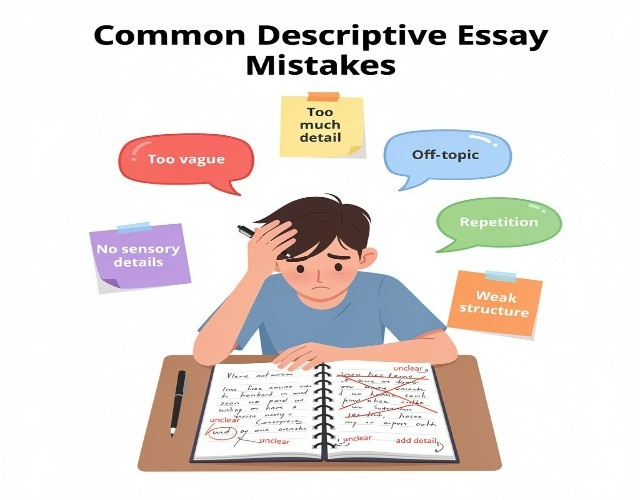
What Is a Descriptive Essay?
A descriptive essay paints vivid mental pictures using sensory details across all five senses. You're not just saying "the beach was beautiful", you're showing turquoise waves rolling onto white sand, their rhythmic crash harmonizing with seagulls overhead, salt spray stinging your lips.
Core Characteristics
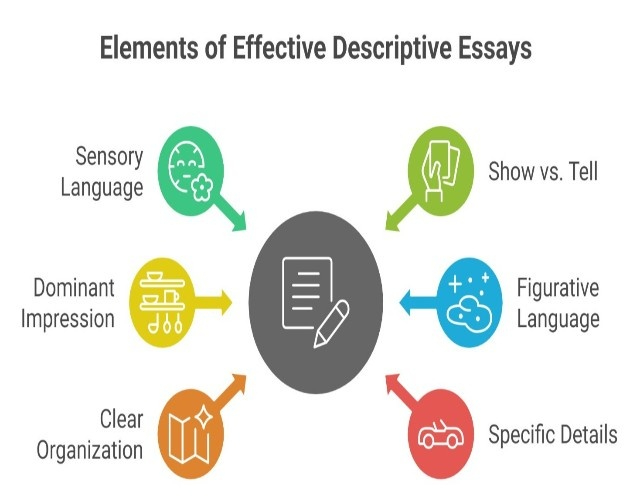
Six elements define effective descriptive essays:
1. Sensory Language: Engage all five senses, sight, sound, smell, taste, and touch, to create immersive experiences readers can feel.
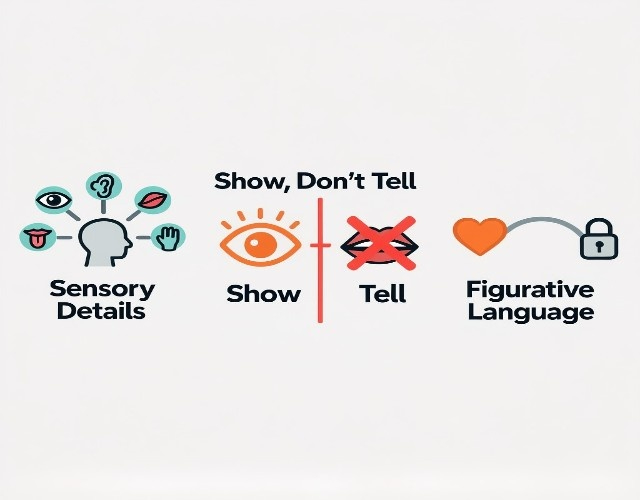
2. Show vs. Tell: Provide observable evidence rather than stating facts. Show "hands trembled as she shuffled note cards repeatedly" instead of telling "she was nervous."
3. Dominant Impression: Unify all details around one central feeling or mood. If describing grandmother's kitchen with "warmth and tradition" as your theme, every detail, from yeasty bread aroma to worn wooden spoons, supports that feeling.
4. Figurative Language: Use similes ("clouds drifted like cotton balls"), metaphors ("the city was a concrete jungle"), and personification ("wind whispered secrets") to enhance imagery.
5. Clear Organization: Structure descriptions spatially (left to right), sensorially (by sense), or chronologically (through time) so readers follow easily.
6. Specific Details: Replace vague words with precise ones. Not "red car" but "cherry-red convertible gleaming under streetlights." Not "loud noise" but "thunderous roar shaking windows."
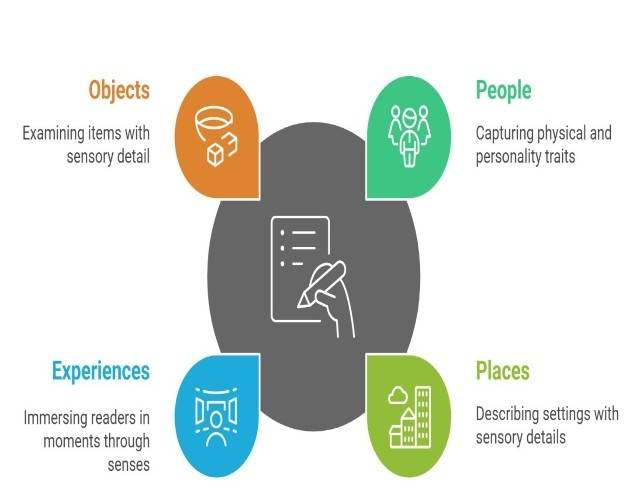
What You Can Describe

1. People: Capture physical appearance, mannerisms, voice, and behavior. Show personality through observable details, weathered hands with ink-stained fingertips, a laugh that erupts like barking, followed by wheezing, perpetual coffee smell clinging to flannel shirts.
2. Places: Transport readers into settings through atmosphere, physical details, and spatial relationships. Describe your childhood bedroom, a bustling intersection, a mountain summit, layering visual details with sounds, smells, and atmospheric qualities.
3. Experiences: Capture moments through sensory immersion. Your first day at a new school, a memorable concert, learning to swim, emphasis falls on what you saw, heard, smelled, tasted, and touched during that experience.
4. Objects: Examine meaningful items in sensory detail. Your father's watch, an inherited quilt, and a worn baseball glove describe visual appearance, tactile qualities, sounds, and even smells, revealing significance through physical characteristics.
Need help choosing? Browse descriptive essay topics organized by type and difficulty to find your perfect subject.
How to Write a Descriptive Essay
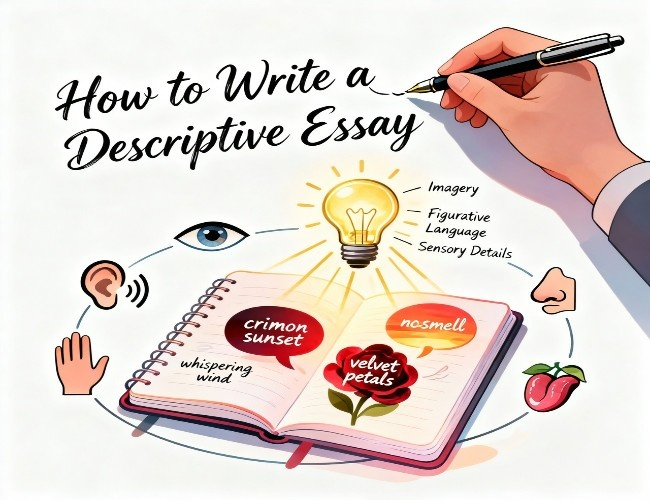
Step 1: Choose Your Subject
Pick something you've personally experienced with strong sensory memories. The best topics have:
- Observable details you've witnessed firsthand.
- Rich sensory potential engaging 3+ senses.
- Personal connection creating an authentic description.
- Specific focus is narrow enough for detailed treatment.
- Appropriate scope matching your word limit
Examples:
| Good: "My grandmother's Sunday kitchen". |
| Too broad: "My grandmother's entire house". |
| Good: "The moment I saw the ocean for the first time". |
| Too vague: "A beach I like". |
Step 2: Establish Dominant Impression
Decide the overall feeling your description should create: warmth and safety, vibrant chaos, peaceful isolation, foreboding decay. This becomes your thesis and guides every detail you include.
Thesis examples:
- "The library represented a sanctuary, quiet and timeless, where worlds opened within pages."
- "My grandmother's kitchen embodied warmth and tradition, a place where memories formed over simmering pots."
Step 3: Gather Sensory Details
List specific observations for each sense:
- Sight: Colors (crimson, azure, amber), lighting, movement, textures.
- Sound: Volume, quality, rhythm, source (hiss, clatter, murmur).
- Smell: Comparisons to familiar scents, intensity, pleasantness.
- Touch: Textures (rough, silky, sticky), temperature, weight.
- Taste: Sweet, sour, bitter, salty, umami combinations.
Write down everything you remember; you'll select the best details later.
Step 4: Choose Organization Method
- Spatial: Move through physical space (left to right, top to bottom, outside to inside). Best for places and objects.
- Sensory: Dedicate paragraphs to different senses. Best for experiences engaging multiple senses simultaneously.
- Chronological: Follow time progression while maintaining descriptive focus. Best for events or experiences unfolding over time.
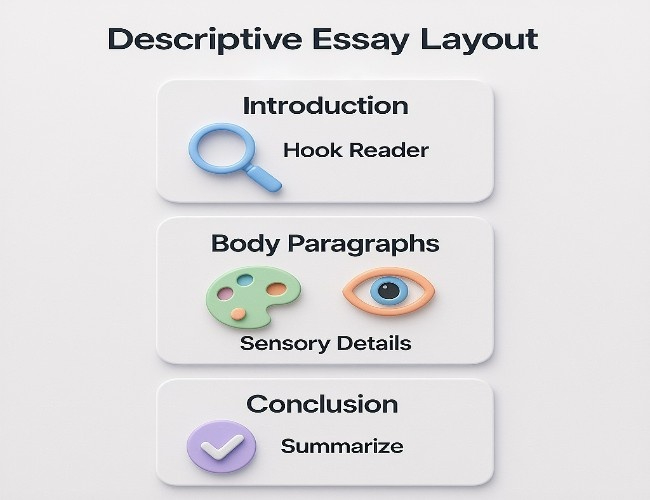
Step 5: Write Your Introduction
- Hook with immediate sensory detail: "Thunder rolled across the valley, each boom reverberating in my chest like a bass drum."
- Provide brief context: "Every Saturday morning for twenty years, I've returned to this diner."
- State your dominant impression (thesis): "The library represented a sanctuary, quiet and timeless, where worlds opened within pages and reality paused outside oak doors."
Step 6: Develop Body Paragraphs
Each paragraph should:
- Begin with topic sentence: "The stove anchored the kitchen, a cast-iron beast perpetually radiating warmth."
- Layer 3-5 sensory details: Engage multiple senses with specific observations.
Show, don't tell: Instead of "it was cozy," show "afternoon sunlight slanted through lace curtains, illuminating dust particles dancing above worn oak floorboards."
- Maintain dominant impression: Every detail reinforces your central theme.
Use transitions: Guide readers smoothly between ideas with spatial ("to the left"), temporal ("meanwhile"), or logical ("similarly") transitions.
Step 7: Write Your Conclusion
- Reinforce dominant impression without repeating: "The warmth radiating from that kitchen wasn't merely temperature, it was the heat of family, tradition, and love simmering across decades."
- Reflect on significance: "Years later, when I smell rising bread, I'm transported instantly to that kitchen, that time, that feeling of belonging."
- End with vivid final image: "Even now, I hear her humming while rolling dough, flour dusting her small hands like clouds of snow."
NO TIME TO WRITE IT ALL?
Let our writers handle the sensory details
- 100% human-written, zero AI
- Vivid description that transports readers
- Delivered on time, every time
- Written by degree-holding experts
Unlimited revisions. Real writers who know sensory language.
Order NowEssential Techniques
Master Show vs. Tell
The fundamental principle: provide observable evidence instead of stating facts.
| Telling: "The beach was beautiful." |
| Showing: "Turquoise waves rolled onto white sand, their rhythmic crash harmonizing with seagulls' cries. Sunlight glittered across water like scattered diamonds." |
Telling: "He was angry."
Showing: "His jaw clenched tight. Knuckles whitened as he gripped the steering wheel. Words came out clipped and sharp, each syllable bitten off."
Telling: "The restaurant was busy."
Showing: "Silverware clinked against plates as servers weaved between crowded tables. Conversation hummed beneath jazz piano melodies. The kitchen door swung open every few seconds, releasing garlic and butter aromas."
Practice this: For every statement, ask "What would someone SEE, HEAR, SMELL, TASTE, or TOUCH that shows this?"
Use Sensory Language
Sight—Be specific: - Not "red" but "crimson," "scarlet," "burgundy," "cherry" - Not "big" but "towering," "massive," "sprawling" - Describe lighting: "harsh fluorescent brightness" vs. "soft golden glow" - Show movement: "leaves fluttered" not "leaves moved"
Sound—Layer audio: - Volume: whisper, murmur, thunder, shriek - Quality: harsh, melodious, grating, soothing - Rhythm: steady drumming, irregular clicking, rhythmic pulse - Multiple sounds: "Beneath conversation's hum, dishes clinked in the distant kitchen while traffic rumbled outside"
Smell—Compare to familiar: - "Smelled like cinnamon and vanilla with underlying coffee notes" - "Metallic scent resembling old pennies" - Note intensity: faint, strong, overpowering - Connect to emotions: "The yeasty bread aroma triggered memories instantly"
Touch—Describe texture: - Rough: coarse, grainy, abrasive, scratchy - Smooth: silky, polished, sleek, satiny - Temperature: scorching, tepid, frigid, cool - Weight/pressure: "The backpack's weight pressed into shoulders"
Taste—Use categories: - Sweet: honeyed, sugary, syrupy - Sour: tart, acidic, tangy, sharp - Bitter: acrid, harsh, astringent - Salty: briny, savory, seasoned - Umami: rich, meaty, deeply flavored
Apply Figurative Language
Similes (using "like" or "as"): - "Clouds drifted like cotton balls on invisible currents" - "Her voice crackled like autumn leaves underfoot" - "The subway jerked forward like a mechanical bull"
Metaphors (implicit comparisons): - "The city was a concrete jungle, skyscrapers towering like steel trees" - "Her laugh was sunshine breaking through storm clouds" - "The library was a cathedral of knowledge"
Personification (human qualities to non-human things): - "The old house groaned under winter's weight" - "Wind whispered secrets through pine trees" - "Waves clawed at the shoreline, hungry and relentless"
Use sparingly but powerfully—one strong metaphor combined with specific sensory details beats multiple weak comparisons.
Introduction
Imagine standing in your grandmother's kitchen on a Sunday morning. You don't just remember it was "nice"—you smell cinnamon rolls baking, their sweet warmth filling the air. You hear the percolator bubbling rhythmically on the stove. You feel the worn wooden counter smooth under your hands, grooved from decades of rolling dough. You see flour dusting the air like snow, catching morning light streaming through windows. This is descriptive writing: capturing sensory experiences so vividly that readers feel transported into your observations.
Descriptive writing appears everywhere in effective communication. Novelists use it to create scenes that readers inhabit rather than merely read about. Travel writers capture destinations so vividly that readers feel they've visited without leaving home. Memoirists preserve moments with such sensory precision that memories become tangible. In academic contexts, descriptive essays develop your observation skills, sensory awareness, and precise language use—foundations for all advanced writing.
Professionally, descriptive writing skills translate across countless fields. Marketing copy engages customers through sensory language making products tangible. Technical documentation clarifies complex processes through precise description. Journalism brings stories alive with vivid scene-setting. Any creative field—from architecture to design to entertainment—requires communicating sensory visions clearly. The observation skills and language precision you develop writing descriptive essays transfer to all these contexts.
This comprehensive guide covers everything you need to master descriptive essays from fundamental principles through polished final drafts. You'll understand what makes descriptive essays unique, learn essential techniques for vivid description, follow step-by-step writing processes, discover resources for topics and examples, and access tools streamlining your work. Whether you're writing your first descriptive essay or refining advanced skills, you'll find practical strategies for creating engaging work that transports readers into your sensory observations.
We'll explore the core characteristics distinguishing descriptive essays from other formats, essential techniques including show-versus-tell mastery and sensory language, structural approaches for organizing descriptions effectively, strategies for choosing strong topics rich in sensory potential, learning from annotated examples demonstrating successful techniques, and accessing downloadable resources including templates, checklists, and example collections.
Understanding Descriptive Essays
Core Characteristics
Descriptive essays share six fundamental characteristics that distinguish them from other writing formats and define what makes description effective.
| Characteristic | Key Points |
|---|---|
| Sensory Language | Engage all five senses for immersive description |
| Show vs. Tell | Provide observable evidence, let readers infer |
| Dominant Impression | Unify details around central feeling or mood |
| Figurative Language | Use similes, metaphors, personification to enhance imagery |
| Organization | Structure descriptions spatially, sensorially, or chronologically |
| Specific Details | Prefer concrete, precise details over vague abstractions |
Sensory language engaging all five senses forms the foundation of descriptive writing. Effective description doesn't just tell readers what something looks like—it engages sight, sound, smell, taste, and touch, creating multidimensional experiences.
When describing a farmers market, you don't merely state it's crowded and colorful. You describe the pyramid of crimson tomatoes glistening under morning sun (sight), vendors calling prices in overlapping voices (sound), mingled scents of fresh basil and ripe peaches (smell), smooth eggplant skin cool against your palm (touch), and the burst of strawberry sweetness when sampling fruit (taste).
The more senses you engage, the more immersive and memorable your description becomes.
Show versus tell as the fundamental principle separates amateur from accomplished descriptive writing. Telling states facts directly: "She was nervous." Showing provides observable evidence that readers can interpret: "Her hands trembled as she shuffled note cards repeatedly. Sweat beaded on her forehead despite the cool auditorium."
Showing creates mental pictures through sensory details; telling simply informs. When you show effectively, readers draw conclusions from evidence rather than accepting your statements on faith. This principle applies to every aspect of descriptive writing—emotions, character traits, atmospheric qualities, and physical appearances.
Dominant impression unifying details prevents your description from becoming a random catalog of disconnected observations. Every sensory detail you include should reinforce your central feeling, mood, or idea.
If describing a kitchen with "warmth and tradition" as your dominant impression, you include details supporting that theme: worn wooden spoons hanging by the stove, the yeasty aroma of rising bread, family photos clustered on the refrigerator, morning light making everything glow golden.
You omit or minimize contradictory details like cold stainless steel appliances, harsh fluorescent lighting, or chemical cleaning product smells that undermine the warmth you're establishing. Dominant impression provides the organizational principle guiding detail selection throughout your essay.
Figurative language, enhancing description includes similes, metaphors, and personification that create vivid comparisons, helping readers visualize your subject. Similes make explicit comparisons using "like" or "as": "Clouds drifted like cotton balls on invisible currents." Metaphors create implicit comparisons: "The city was a concrete jungle, skyscrapers towering like steel trees."
Personification gives human qualities to non-human things: "The old house groaned under winter's weight, its windows weeping condensation." These devices make abstract or unfamiliar subjects more concrete and relatable, though they should enhance rather than replace concrete sensory observation. One powerful metaphor combined with specific sensory details creates stronger impact than multiple metaphors without sensory grounding.
Spatial or sensory organization provides structure guiding readers through your description systematically rather than jumping chaotically between unrelated observations. Spatial organization moves methodically through physical space—left to right, top to bottom, near to far, outside to inside—particularly effective when describing places or objects where physical arrangement matters.
Sensory organization dedicates paragraphs or sections to different senses, layering impressions so readers experience subjects through multiple sensory lenses. Some descriptions use chronological organization for experiences unfolding over time, though maintaining descriptive focus rather than narrative emphasis. Clear organization prevents confusion and helps readers build complete mental pictures as they progress through your essay.
Specific concrete details over vague abstractions make the difference between forgettable and memorable description. Generic statements like "The car was red" or "The beach was beautiful" provide minimal sensory information. Specific details create vivid pictures: "The cherry-red convertible gleamed under streetlights, its chrome bumper reflecting passing headlights in rippling waves" or "Turquoise waves rolled onto white sand, their rhythmic crash harmonizing with seagulls' cries overhead."
Specificity applies to all sensory details—precise color names (crimson, azure, amber) instead of generic ones (red, blue, yellow), exact sounds (hiss, clatter, murmur) instead of vague noise, particular scents (cinnamon, diesel, wet concrete) instead of general smells.
Still Struggling With That Essay?
Submit With Total Confidence
No AI ever. Just real academics who know what graders want
Types of Descriptive Subjects
Descriptive essays typically focus on four subject categories, each requiring slightly different approaches while maintaining core descriptive principles.
| Subject Type | Key Points |
|---|---|
| People | Describe appearance, gestures, voice, behavior; show personality through sensory details |
| Places | Convey atmosphere, physical details, spatial relationships; unify with dominant impression |
| Experiences/Events | Focus on sensory immersion of moments; chronological organization optional; emphasize feelings over plot |
| Objects | Highlight visual, tactile, auditory, olfactory details; reveal significance through description, not explanation |
People descriptions capture physical appearance, mannerisms, and personality traits through observable details rather than stated qualities. Instead of writing "My uncle was eccentric," you describe his weathered hands with ink-stained fingertips from endless writing, the perpetual coffee smell clinging to vintage flannel shirts, and his laugh that erupted suddenly—a barking sound followed by wheezing that shook his entire frame.
Physical characteristics (distinctive features, body language, facial expressions), characteristic gestures (how someone moves, habitual actions), vocal qualities (pitch, volume, accent, verbal tics), clothing choices reflecting personality, and behavioral patterns all reveal character through showing rather than telling. The goal is making readers feel they've met the person through accumulated sensory observations rather than reading biographical facts.
See how effective writers bring people alive in our annotated descriptive essay examples with technique breakdowns.
Places descriptions use sensory language to transport readers into settings, making locations tangible through atmosphere, physical details, and spatial relationships. Whether describing your childhood bedroom, a bustling city intersection, or a mountain summit at sunrise, effective place descriptions engage multiple senses and use spatial organization guiding readers' mental visualization.
You might organize outside to inside (approaching a building), left to right across a landscape, near to far from a vantage point, or bottom to top examining architecture. Successful place descriptions layer visual details with sounds (traffic hum, wind through trees, crowd chatter), smells (exhaust fumes, pine needles, cooking food), tactile sensations (temperature, humidity, textures), and atmospheric qualities creating mood.
The dominant impression might be peaceful isolation, vibrant chaos, nostalgic warmth, or foreboding decay—whatever unified feeling your sensory details build toward. Learn how to select compelling place subjects from our descriptive essay topics organized by type and difficulty.
Experiences and events descriptions capture moments or occasions through sensory immersion, though maintaining descriptive rather than narrative focus. When describing your first day at a new school, a memorable concert, or learning to swim, emphasis falls on sensory richness of the experience rather than plot progression. What did you see, hear, smell, taste, touch during that experience?
Chronological organization often works naturally for experiences unfolding over time, but each temporal section emphasizes sensory details creating atmosphere. The challenge lies in balancing some action or event progression with dense sensory observation. You're not telling a story so much as describing what being in that moment felt like through accumulated sensory evidence.
Object descriptions focus on meaningful items described in sensory detail, often revealing significance through physical characteristics rather than explicit statements. When describing your father's watch, an inherited quilt, or a worn baseball glove, you examine it from multiple angles: visual appearance (colors, shapes, condition, design details), tactile qualities (weight, temperature, texture, how it feels in hands), sounds it makes if applicable (ticking, rustling, creaking), even smells (leather, age, associated scents).
Object descriptions often benefit from organization moving systematically around the object—outside to inside, top to bottom, most to least prominent feature. The object's meaning emerges through descriptive details suggesting history, use, and emotional significance rather than through statements like "this watch means everything to me."
Academic Purpose
Descriptive essays serve multiple educational purposes across grade levels, developing skills fundamental to advanced writing and critical thinking:
Testing observational skills and attention to detail requires students to look closely at subjects rather than settling for superficial impressions. Effective description demands noticing small particulars—not just "a tree" but the specific pattern of bark, the shape of leaves, the way branches curve. This careful observation transfers to all analytical work requiring close reading, data analysis, or careful examination of evidence.
Developing vocabulary and language precision pushes students beyond generic adjectives toward specific sensory language. Instead of "good" or "nice," descriptive writing requires finding exact words capturing particular qualities: "succulent," "crisp," "melodious," "acrid." This vocabulary development enhances all writing and communication by providing precise tools for clear expression.
Teaching showing through details rather than telling through statements establishes foundation for all advanced writing. Whether crafting literary analysis showing textual evidence, constructing scientific arguments showing experimental results, or building historical arguments showing primary source evidence, the show-versus-tell principle applies. Readers trust demonstrated evidence over unsupported claims.
Preparing for advanced writing requiring vivid description establishes techniques students use throughout education and careers. Research papers need clear description of methodology. Literary analysis requires precise description of textual elements. Professional reports demand accurate description of observations, processes, or conditions.
Creative writing depends entirely on descriptive skill. The techniques learned in descriptive essays—sensory language, figurative devices, precise vocabulary, show-versus-tell—transfer to all these contexts.
Building foundation for creative writing, journalism, and professional communication extends descriptive skills beyond academics. Journalists describe scenes and subjects vividly. Marketing professionals create sensory appeal for products. Technical writers describe processes and equipment precisely.
Teachers explain concepts through descriptive examples. Any career requiring clear communication benefits from descriptive writing skills developed through academic practice.
Common across grade levels with increasing sophistication, descriptive essay assignments begin in elementary school with simple object or place descriptions, progress through middle and high school with more complex subjects and advanced techniques, and continue through college with sophisticated subjects requiring nuanced observation and original figurative language.
You've Done Enough. Let Us Finish It
Get an A-Worthy Essay Without the All-Nighter
No AI. No recycled papers. 100% original or your money back.
Essential Descriptive Techniques
Show vs Tell Mastery
The fundamental principle separating effective from weak descriptive writing is showing through observable evidence rather than telling through statements. This distinction appears simple theoretically but requires conscious practice to execute consistently.
The Fundamental Principle:
Telling states facts directly, asking readers to accept your assessment: "She was nervous." Readers must trust your judgment without experiencing evidence firsthand. Showing provides observable sensory evidence allowing readers to draw conclusions independently: "Her hands trembled as she shuffled the note cards repeatedly.
Beads of sweat formed on her forehead despite the cool auditorium. When called to the podium, her voice emerged shaky and barely audible." Readers observe the evidence and conclude nervousness themselves, creating more engaging and convincing description.
Telling works like a lecture—the writer informs readers what to think. Showing works like a film—readers observe scenes and form impressions from accumulated details. Showing creates immersive experiences; telling provides information at distance. The difference appears in every aspect of descriptive writing: emotions, character traits, atmospheric qualities, physical appearances.
Practice Examples:
Telling: "The beach was beautiful" Showing: "Turquoise waves rolled gently onto white sand, their rhythmic crash harmonizing with seagulls' cries overhead. Sunlight glittered across the water's surface like scattered diamonds."
Telling: "He was angry" Showing: "His jaw clenched tight. Knuckles whitened as he gripped the steering wheel. Words came out clipped and sharp, each syllable bitten off."
Telling: "The restaurant was busy" Showing: "Silverware clinked against plates as servers weaved between crowded tables. Conversation hummed beneath jazz piano melodies drifting from the corner. The kitchen door swung open every few seconds, releasing garlic and butter aromas with each waiter's passage."
Telling: "The old house was creepy" Showing: "Wind moaned through cracked windows. Floorboards groaned under each tentative step, threatening collapse. Shadows pressed against walls where wallpaper peeled in long, curling strips. Dust and decay hung thick in motionless air."
Telling: "She was kind and generous" Showing: "She remembered everyone's coffee order without asking. Her hand found my shoulder at exactly the moment I needed steadying. When speaking to the nervous intern, she lowered her voice to a gentle register and slowed her normally rapid pace."
See these principles demonstrated in annotated descriptive essay examples with highlighted techniques showing exactly how effective writers execute show-versus-tell throughout complete essays.
Sensory Language Guide
Engaging all five senses creates immersive description that readers experience rather than merely understand intellectually. Each sense requires different vocabulary and observation strategies:
Sight—Visual Language:
Vision provides most descriptive detail since humans rely heavily on sight, but effective visual description requires specificity beyond generic color and shape names.
Move beyond generic colors toward specific shades: not "red" but "crimson," "scarlet," "burgundy," "rust," or "cherry." Not "blue" but "azure," "cobalt," "turquoise," "navy," or "cerulean." Not "green" but "emerald," "lime," "sage," "forest," or "mint." Specific color names create vivid mental pictures while generic ones remain vague.
Describe lighting and shadows: "Harsh fluorescent lights hummed overhead, casting everything in unflattering brightness." "Afternoon sunlight slanted through dusty windows, illuminating floating particles." "Shadows pooled in corners where firelight couldn't reach, creating pockets of darkness."
Capture movement and action: "Leaves fluttered in the breeze" not "leaves moved." "Crowds surged toward the exits" not "people walked out." "Smoke curled upward from the candle" not "smoke rose." Action verbs create dynamic visual images.
Show textures visually: "Weathered boards, paint peeling in long strips." "Polished marble reflecting overhead lights in rippling patterns." "Fabric's intricate pattern of interwoven gold and crimson threads."
Sound—Auditory Language:
Sound descriptions require noting volume, quality, rhythm, and source, building sonic landscapes through layered auditory details.
Specify volume and quality: Quiet sounds include whisper, murmur, rustle, trickle, sigh, hum. Medium sounds include chatter, patter, buzz, click, clatter, tap. Loud sounds include roar, thunder, blare, shriek, crash, boom, screech.
Identify clear sources: "Cash register's electronic beep punctuating transactions." "Children's laughter echoing from distant playground." "Steam hissing from the espresso machine's valve." Knowing where sounds originate helps readers build complete mental scenes.
Describe rhythms and patterns: "Rhythmic drumming of rain on the tin roof." "Irregular clicking of keyboard typing." "Steady heartbeat pulse of bass from car stereo." Rhythmic patterns create atmosphere and mood.
Use onomatopoeia when appropriate: Crash, bang, whoosh, sizzle, thud, creak, gurgle, buzz, snap, pop. Sound-imitating words create immediate auditory impressions.
Layer multiple sounds: "Beneath the conversation's hum, dishes clinked in the distant kitchen while traffic rumbled outside." Describing foreground, middle, and background sounds creates realistic sonic environments where multiple things happen simultaneously.
For comprehensive sensory language techniques with practice exercises, visit our descriptive essay writing guide with detailed vocabulary and examples for each sense.
Smell—Olfactory Language:
Since English has limited smell vocabulary, effective olfactory description relies heavily on comparisons to familiar scents and noting intensity and pleasantness.
Use comparisons to familiar scents: "Smelled like cinnamon and vanilla with underlying coffee notes." "Metallic scent resembling old pennies." "Fresh-cut grass mixed with gasoline from the nearby mower." "Musty odor like wet cardboard in basements."
Describe intensity levels: Faint, subtle, mild, strong, overpowering, overwhelming, pervasive, lingering. Intensity affects how prominently smells figure in overall sensory experience.
Note pleasantness: Pleasant smells might be fragrant, sweet, fresh, aromatic, perfumed. Unpleasant smells might be acrid, musty, rancid, pungent, stale, fetid. Not all strong smells are unpleasant—freshly brewed coffee is strong but pleasant.
Connect to emotional associations: "The yeasty bread aroma triggered memories of grandmother's kitchen instantly." Smells often connect powerfully to memories and emotions, adding layers to description.
Deadlines Don't Wait. Neither Do We
Get a Custom Essay in as Little as 3 Hours
100% human-written. On-time delivery guaranteed
Touch—Tactile Language:
Tactile descriptions communicate textures, temperatures, weights, and physical sensations, often overlooked but crucial for complete sensory immersion.
Describe texture variations: Rough surfaces might be coarse, grainy, abrasive, scratchy, bumpy. Smooth surfaces might be silky, polished, slippery, sleek, satiny. Soft things might be plush, downy, cushioned, yielding, spongy. Hard things might be solid, rigid, unyielding, firm, stony.
Note temperatures precisely: Hot descriptions include scorching, warm, tepid, toasty, blazing. Cold descriptions include frigid, cool, icy, chilly, frosty, arctic. Temperature dramatically affects how subjects feel physically.
Communicate weight and pressure: Heavy, substantial, weightless, crushing, gentle, oppressive, light. "The backpack's weight pressed into shoulders." "The blanket felt weightless, barely noticeable."
Include physical sensations: "Rough sandpaper texture scraping against fingertips." "Cool metal surface conducting warmth away from palms." "Sticky residue clinging to hands despite washing."
Taste—Gustatory Language:
Taste descriptions apply primarily to food and drink but occasionally to other contexts when relevant. Taste vocabulary builds from five basic categories:
Sweet flavors: honeyed, sugary, candy-like, syrupy, saccharine, dessert-sweet. "The tea's honey sweetness with subtle floral notes."
Sour flavors: tart, acidic, tangy, sharp, citrusy, vinegary. "Lemon's mouth-puckering tartness."
Bitter flavors: acrid, harsh, astringent, medicinal. "Coffee's pleasant bitterness balanced by cream."
Salty flavors: briny, savory, seasoned, cured. "The ocean spray's salty tang on lips."
Umami flavors: savory, meaty, rich, deeply flavored. "The broth's rich umami depth."
Describe combinations and complexity: "Sweet with bitter undertones." "Salty and sour creating complex balance." Most foods combine multiple taste categories.
Note aftertastes and lingering sensations: "Left lingering cinnamon warmth coating the tongue." "Metallic aftertaste like old pennies." Aftertaste extends taste experience beyond initial contact.
Figurative Language
Figurative language enhances description through comparisons, human qualities attributed to non-human subjects, and creative exaggeration, making abstract or unfamiliar subjects more concrete and relatable.
Similes:
Similes create explicit comparisons using "like" or "as," connecting unfamiliar subjects to familiar experiences.
Examples: "Clouds drifted like cotton balls on invisible currents." "Her voice crackled like autumn leaves underfoot." "The subway car jerked forward like a mechanical bull testing riders." "His hands moved over the piano keys as gracefully as water flowing downstream."
Creating original similes: Avoid clichés like "white as snow," "quiet as a mouse," "strong as an ox"—these comparisons appear so frequently they've lost impact. Find unexpected but apt comparisons: "wrinkles deep as canyons," "smile sharp as broken glass," "silence thick as wool." Match what you're describing (tenor) with what you're comparing it to (vehicle) in meaningful ways that illuminate rather than confuse.
Metaphors:
Metaphors create implicit comparisons without "like" or "as," treating one thing as if it were another for descriptive impact.
Examples: "The city was a concrete jungle, skyscrapers towering like steel trees blocking natural sunlight." "Her laugh was sunshine breaking through storm clouds." "The library was a cathedral of knowledge, silence its sacred requirement." "His anger was a volcano, pressure building invisibly until inevitable eruption."
Extended metaphors develop comparisons across multiple sentences: "The house had been a ship once, carrying us through calm seas and storms. Now it sat landlocked, weathered hull creaking in wind, windows like portholes revealing memories of past voyages."
Personification:
Personification gives human characteristics to non-human things—objects, animals, abstract concepts, natural phenomena—creating atmosphere and enhancing emotional connection.
Examples: "The old house groaned under winter's weight, joints aching with age." "Wind whispered secrets through pine trees." "The city never sleeps, its pulse beating through subway tunnels and all-night diners." "Waves clawed at the shoreline, hungry and relentless."
Effective use: "Fog crept through streets on cat feet" (creates atmosphere). "Darkness pressed against windows, patient and watchful" (enhances emotion). "Flowers nodded greeting in the morning breeze" (brings scenes alive).
Other Devices:
Hyperbole uses exaggeration for emphasis—use sparingly: "Her smile could light the darkest room." "The line for coffee stretched to the next county."
Alliteration repeats consonant sounds: "Silent shadows stretched across silver snow."
Assonance repeats vowel sounds: "The cold stone road rolled on alone."
Descriptive Essay Structure
| Section | Key Points / Tips |
|---|---|
| Introduction | Hook with sensory detail, brief context, dominant impression, optional preview |
| Body | Organize spatially, by senses, or chronologically; topic sentence; 3–5 sensory details; maintain impression; smooth transitions |
| Spatial | Guide through space (left?right, top?bottom); use spatial transitions |
| Sensory | Dedicate paragraphs to senses; layer impressions; emphasize richness |
| Chronological | Follow event sequence; focus on sensory details, not plot |
| Conclusion | Reinforce impression; reflect significance; end with vivid image; emotional closure |
Introduction Components
Effective introductions accomplish multiple goals: engaging readers immediately through sensory details, establishing context for your subject, stating your dominant impression, and previewing organizational approach.
Hook—Vivid Opening:
Begin with immediate sensory immersion rather than general statements or background information. Drop readers directly into a sensory moment:
"Thunder rolled across the valley, each boom reverberating in my chest like a bass drum."
"The kitchen smelled like Saturday—cinnamon rolls and strong coffee mingling with morning sunlight streaming through lace curtains."
"Her hands moved across the piano keys, callused fingertips coaxing melody from ivory and ebony in patterns learned across decades."
Sensory hooks engage readers immediately, creating curiosity about what you're describing while demonstrating your descriptive skill from the opening sentence.
Context—Brief Background:
After hooking readers, provide brief context establishing your subject without extensive explanation. One or two sentences suffice:
"Every Saturday morning for twenty years, I've returned to this diner, sliding into the same cracked vinyl booth."
"My grandfather's workshop occupied the garage's far corner, a cluttered domain of tools and sawdust and unfinished projects."
Context orients readers without overwhelming them with background information or disrupting sensory immersion established in your hook.
Thesis—Dominant Impression:
Your thesis statement establishes the central feeling, mood, or idea unifying your description. It tells readers what overall impression your sensory details will create:
"The library represented a sanctuary, quiet and timeless, where worlds opened within pages and reality paused outside oak doors."
"My grandmother's kitchen embodied warmth and tradition, a place where family gathered and memories formed over simmering pots and rising bread."
The thesis doesn't need to be a single sentence, but should clearly establish your dominant impression early so readers understand the unified feeling your details build toward.
Preview (Optional):
Sometimes briefly previewing your organizational approach helps readers follow complex descriptions, though this isn't always necessary. "From the entrance's worn threshold to the window overlooking the backyard, every corner held memories" previews spatial organization.
Imagine Submitting Without the Panic
Your Essay. Written by Pros. Delivered on Time
100% original. 100% human. Satisfaction guaranteed
Body Paragraph Organization
Three organizational methods serve different descriptive purposes. Choose based on your subject type and what creates clearest reader understanding:
Option 1—Spatial Organization:
Spatial organization guides readers through physical space systematically: left to right, top to bottom, near to far, outside to inside, clockwise around a space. This method works best for places, objects, and scenes where physical arrangement matters and readers benefit from methodical visualization.
Example spatial outline for describing a kitchen: - Paragraph 1: Entrance and doorway (first impressions) - Paragraph 2: Counter and sink area (work surfaces, appliances) - Paragraph 3: Stove and cooking area (heat, activity, smells) - Paragraph 4: Table (central gathering space) - Paragraph 5: Window area (light, view, atmosphere)
Spatial transitions include: "To the left..." "Above..." "In the far corner..." "Across the room..." "Beyond the..." "Turning toward..." These phrases guide readers' mental eyes through space.
Advantages: Prevents confusion about spatial relationships, creates systematic visualization, feels natural for physical spaces and objects.
Option 2—Sensory Organization:
Sensory organization dedicates paragraphs or sections to different senses or groups related sensory impressions. This works well for experiences, complex subjects, or situations where multiple sensory impressions layer simultaneously rather than existing in separate spatial zones.
Example sensory outline for describing a farmers market:
- Paragraph 1: Visual chaos (colors, movements, displays, crowds)
- Paragraph 2: Auditory assault (vendors calling, conversations, music)
- Paragraph 3: Olfactory mix (produce, flowers, food, spices)
- Paragraph 4: Tactile experiences (textures of produce, crowding, temperatures)
- Paragraph 5: Synthesis of impressions
Alternatively, you might group senses thematically: visual and spatial details together, then auditory and olfactory combined, then tactile and gustatory.
Advantages: Layers impressions naturally, emphasizes sensory richness, works for subjects where spatial organization doesn't apply clearly.
Option 3—Chronological Organization:
Chronological organization follows temporal progression, particularly useful for experiences or events unfolding over time. However, maintain descriptive focus—emphasize sensory details of each moment rather than plot progression.
- Example chronological outline for first-time experience:
- Paragraph 1: Anticipation and approach (before beginning)
- Paragraph 2: Initial moments (first impressions, immediate sensations)
- Paragraph 3: Middle phase (sustained experience, developing impressions)
- Paragraph 4: Climactic moment (peak intensity)
- Paragraph 5: Aftermath (lingering sensations, final impressions)
Chronological organization suits events, but remember you're writing description, not narration. Each temporal section emphasizes sensory richness rather than story progression.
Each Body Paragraph Should:
Begin with a topic sentence establishing the paragraph's focus: "The stove anchored the kitchen, a cast-iron beast perpetually radiating warmth."
Layer 3-5 specific sensory details from multiple senses: sight, sound, smell, touch, and taste when applicable. Dense sensory observation creates immersive description.
Maintain your dominant impression—every detail should reinforce your central theme. Contradictory details confuse readers and weaken unity.
Use transitions for smooth flow between sentences and between paragraphs. Spatial transitions ("to the right," "above"), temporal transitions ("meanwhile," "then"), and logical transitions ("similarly," "in contrast") maintain coherence.
End by connecting to the next paragraph, preparing readers for the transition: "Beyond the stove's immediate heat, the table occupied the kitchen's heart."
Conclusion Strategy
Effective conclusions reinforce dominant impressions without simply repeating details already described, reflect on significance, and end memorably.
Avoid Simply Summarizing:
Don't merely restate what you've already described: "The kitchen was warm, filled with cooking smells, and family gathered there." This adds nothing new and bores readers who've just read your detailed description.
Instead, Reinforce Dominant Impression Freshly:
Without repeating exact details, strengthen your central feeling through synthesis: "The warmth radiating from that kitchen wasn't merely temperature—it was the heat of family, tradition, and love simmering across decades."
Reflect on Significance:
Why does this description matter? What makes this subject worth describing?
"Years later, when I smell rising bread, I'm transported instantly to that kitchen, that time, that feeling of belonging somewhere completely."
"The library offered what the world outside couldn't—permission to be still, to think deeply, to exist without constant noise and movement."
Provide Final Vivid Image:
End with a memorable sensory detail creating lasting impression:
"Even now, I hear her humming while rolling dough, flour dusting her small hands like clouds of snow."
"The mountain summit's silence remains with me—that profound quiet where only wind speaks."
Offer Emotional Resolution:
Provide closure without stating emotions directly—show them through details:
"The house sold years ago to strangers who likely remodeled everything, but that kitchen lives eternal in memory's preservation, unchanged and unchangeable."
Your Time Is Worth More Than This
Get Hours Back. Get a Better Essay
Zero AI. Zero plagiarism. Just expert-level writing.
Choosing Strong Topics
Topic selection determines essay success before writing begins. Strong topics practically write themselves through rich sensory potential and personal connection, while weak topics force strained observations lacking authenticity.

What Makes Topics Work
Effective descriptive essay topics share five essential characteristics:
Observable/Experienceable: Topics must be directly observable through senses or personally experienceable. You need firsthand sensory data—what something looks, sounds, smells, tastes, feels like. Topics requiring purely research-based description (historical events you didn't witness, places you've never visited, people you've never met) lack authentic sensory detail making description vivid. Choose subjects you've directly experienced, allowing description from memory's rich sensory store rather than imagination based on others' descriptions.
Rich Sensory Potential: Evaluate how many senses topics naturally engage and how richly. Ideal topics involve multiple senses: bustling farmers market (sight, sound, smell, taste, touch), grandmother's kitchen (all five senses), jazz concert (sight, sound, physical vibration). Topics limited to primarily one sense (photographs, paintings) work but require more creative effort engaging additional senses. Abstract concepts (love, freedom, justice) lack direct sensory engagement—they cannot be seen, heard, smelled, tasted, or touched directly—making them poor descriptive essay choices.
Personal Connection: Topics you care about, have experienced personally, or find fascinating generate authentic, vivid description. Describing your childhood bedroom creates detailed sensory memory-based description impossible when describing generic bedrooms you've never seen. Personal investment shows in writing quality—enthusiasm for subjects creates engaging description while forced description of uninteresting topics produces flat prose. When assignments allow choice, select subjects mattering to you personally.
Specific Rather Than Abstract: Concrete specific subjects create vivid description while abstract vague concepts resist sensory description. "My mother's garden" (specific, concrete) allows detailed sensory description—particular flowers, their colors, scents, textures, sounds of bees, taste of fresh tomatoes. "Beauty" (abstract) cannot be directly observed through senses—you can describe beautiful things but not beauty itself. When facing abstract assignment topics, find concrete manifestations: instead of describing "courage" (abstract), describe a courageous person's observable actions, expressions, physical characteristics demonstrating courage through sensory details.
Appropriate Scope: Match topic breadth to assignment length. "My house" (too broad for 500 words—dozens of rooms, features, details requiring superficial treatment). "My bedroom's reading corner" (appropriately focused for 500 words—specific area allowing detailed description). Test scope by outlining: Can you identify 3-5 focused aspects describable in rich detail within your word limit? If subject requires superficial treatment of too many aspects, narrow focus. Specific moments often work better than general experiences: "Saturday morning at the diner" beats "my favorite restaurant generally."
Topic Categories Preview
Descriptive essay subjects fall into four main categories:
People: Family members with distinctive traits, influential teachers or coaches, memorable characters from your life, strangers who made impressions. Focus on what makes them distinctive through observable details—physical appearance, mannerisms, voice, characteristic behaviors—rather than biographical facts.
Places: Childhood homes, favorite destinations, meaningful locations, contrasting settings between home and away, natural landscapes, urban environments, school or work locations. Choose specific places at particular times rather than generic locations: "the library's oldest reading room on Sunday mornings" rather than "libraries generally."
Experiences: First-time events, memorable celebrations, challenging moments, sensory-rich activities, everyday rituals given close attention, special occasions. Maintain descriptive focus on sensory richness rather than narrative story progression—what the experience felt like through senses, not just what happened chronologically.
Objects: Meaningful possessions revealing history through physical details, inherited items connecting generations, distinctive objects with stories, everyday items examined closely, collections or specialized equipment. Objects allow close physical observation even without personal history attached—you can describe borrowed objects, museum pieces, found items through direct sensory examination.
Find your perfect subject with 100+ descriptive essay topics organized by type and difficulty, including selection criteria helping you evaluate which subjects offer richest sensory potential and strongest personal connections for your specific assignment.
Learning From Examples

Why Study Examples
Studying successful descriptive essay examples accelerates skill development more effectively than reading technique explanations alone. Examples transform abstract principles into concrete demonstrations you can analyze and replicate.
Abstract Understanding Versus Concrete Demonstration:
Reading "use sensory language" provides direction but no clear picture of execution. Seeing actual sensory language in context shows exactly how to engage senses: "Thunder rumbled overhead as rain hammered the tin roof, each drop's metallic ping punctuating the storm's bass growl." Examples transform vague concepts into concrete models you can study and adapt to your own subjects.
Pattern Recognition:
Human brains learn through pattern recognition—observing successful models and replicating structures. After studying 3-5 strong examples, patterns emerge: how introductions establish dominant impressions, how body paragraphs layer details systematically, how conclusions reinforce without repeating, how transitions maintain flow between ideas. These patterns become templates you adapt rather than inventing structure from scratch through trial-and-error experimentation.
Technique Identification:
Examples reveal specific techniques in action: similes comparing canyon walls to painted canvas, personification giving wind human characteristics, specific color names (crimson, azure, amber) replacing generic ones (red, blue, yellow), show-versus-tell execution demonstrating nervousness through trembling hands rather than stating "she was nervous." Understanding WHY techniques work enables conscious application rather than accidental success, building metacognitive awareness of effective descriptive writing.
Try Before You Buy
Get Up to 2 Pages Written Free
Zero risk. 100% human-written. Guaranteed
What to Look For
When studying examples, analyze them actively rather than reading passively:
Dominant Impression: Identify how examples establish central feelings in thesis statements and maintain them throughout body paragraphs. Notice how every sensory detail reinforces rather than contradicts the unified impression. Strong examples demonstrate coherent focus while weak ones jump between contradictory moods or ideas.
Sensory Details: Highlight or underline sensory details by type—visual observations in one color, sounds in another, smells, textures, tastes in others. Count how many sensory details appear per paragraph. Effective examples layer 3-5 specific sensory observations per major point, engaging multiple senses rather than relying solely on sight.
Show vs Tell Moments: Circle instances where writers show through observable evidence rather than tell through stated facts. Notice the difference between "she was nervous" (telling) and "her hands trembled, shuffling note cards repeatedly" (showing). Mark moments where emotions, qualities, or characteristics emerge through accumulated sensory details rather than explicit statements.
Figurative Language: Identify similes (explicit comparisons using "like" or "as"), metaphors (implicit comparisons), and personification (human characteristics given to non-human subjects). Evaluate whether figurative language enhances description through original, apt comparisons or relies on clichéd phrases that add nothing. Strong examples use figurative language sparingly but powerfully.
Organizational Method: Diagram how examples structure body paragraphs. Do they use spatial organization moving through physical space systematically? Sensory organization dedicating paragraphs to different senses? Chronological organization following temporal progression? Understanding organizational choices helps you select appropriate methods for your own subjects.
Transitions: Mark transition phrases maintaining flow between sentences and paragraphs. Notice how spatial transitions ("to the left," "above"), temporal transitions ("meanwhile," "then"), and logical transitions ("similarly," "in contrast") guide readers smoothly through descriptions without confusion.
Specific Language: Circle precise, specific vocabulary—exact color names, particular sounds, distinctive textures, unique comparisons. Contrast these with any remaining vague, generic language. Strong examples use "crimson" not "red," "thundered" not "made noise," "acrid" not "bad smell."
Study annotated descriptive essay examples with highlighted techniques and marginal notes explaining exactly what makes each example effective. The collection includes complete essays demonstrating successful technique use across different subject types and education levels, before-and-after comparisons showing revision improvements, and analysis guides helping you recognize and replicate patterns in your own writing.
Example Types Available
Person descriptions across education levels show how to reveal character through physical details, mannerisms, voice, and behavior rather than stated traits. Examples demonstrate both familiar subjects (family members, friends) and interesting strangers, using varied organizational approaches.
Place descriptions with spatial organization guide readers through settings methodically—rooms, buildings, landscapes, urban environments. Examples show how to layer visual details with sounds, smells, and atmospheric qualities creating immersive locations rather than mere physical catalogs.
Event and experience descriptions using chronological flow maintain temporal coherence while emphasizing sensory richness at each moment. Examples demonstrate balancing some action or progression with dense descriptive observation, keeping essays descriptive rather than narrative.
Object descriptions with sensory layering show how to examine items from multiple angles—visual, tactile, auditory, even olfactory when relevant. Examples reveal how significance emerges through physical description rather than explicit statements about importance.
Before-and-after examples showing revisions demonstrate how to transform weak telling into strong showing, replace vague language with specific details, add sensory variety, and strengthen dominant impression. These comparisons make improvement concrete rather than abstract.
Conclusion
Mastering descriptive essays transforms you into a precise observer and vivid communicator. The techniques you've learned—show versus tell, sensory language across all five senses, figurative devices creating memorable comparisons, dominant impression unifying details—apply beyond academic assignments to professional writing, creative projects, and effective communication across countless contexts.
Research papers need clear description of methodology. Literary analysis requires precise description of textual elements. Professional reports demand accurate description of observations, processes, or conditions. Marketing creates sensory appeal for products. Journalism brings scenes and subjects alive. Teaching explains concepts through descriptive examples. Any career requiring clear communication benefits from descriptive writing skills developed through academic practice.
Descriptive writing develops with practice and attention to the sensory world around you. Your first descriptive essay may feel challenging as you consciously apply new techniques, but each subsequent essay strengthens observation skills and language precision. The progression from awkward initial attempts to natural, fluid description happens through persistent practice and willingness to revise.
Notice sensory details in daily life—how morning coffee smells different from afternoon coffee, how rain sounds on windows versus pavement, how old books feel compared to new ones, how sunlight changes throughout the day. These observations become your descriptive vocabulary, ready when you sit down to write. The more conscious attention you pay to sensory experiences outside writing, the richer your descriptive language becomes.
With the techniques and resources provided here, you have everything needed to write vivid, engaging descriptive essays that transport readers into your observations. The journey from telling to showing, from vague to specific, from generic to memorable requires patience and practice, but produces writing skills serving you throughout education and career. Begin with strong topic selection, apply techniques systematically, study successful examples, revise focusing on sensory richness, and trust that improvement comes through consistent effort.
HAND IT OFF TO THE EXPERTS Thousands of students trust us to deliver essays that get the grades they deserve. Join 50,000+ satisfied students.