The Role of Word Count in Academic Writing
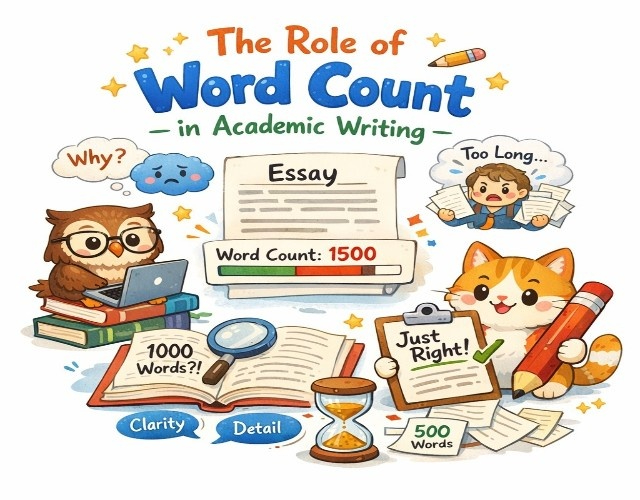
Word count requirements aren't arbitrary busywork.
Instructors set minimum lengths to ensure you:
- Explore topics with appropriate depth
- Support claims with sufficient evidence
- Demonstrate sustained analytical thinking
- Move beyond surface level observations
A 1,500 word essay requires more comprehensive research, examples, and development than a 500-word response. When you can't reach the required length naturally, it signals underdeveloped arguments or insufficient research.
The goal isn't making essays wordier, it's making them better. Every strategy below improves essay quality while adding length.
Need to Increase Your Essay Length Without Losing Quality?
Get expert help expanding essays the right way
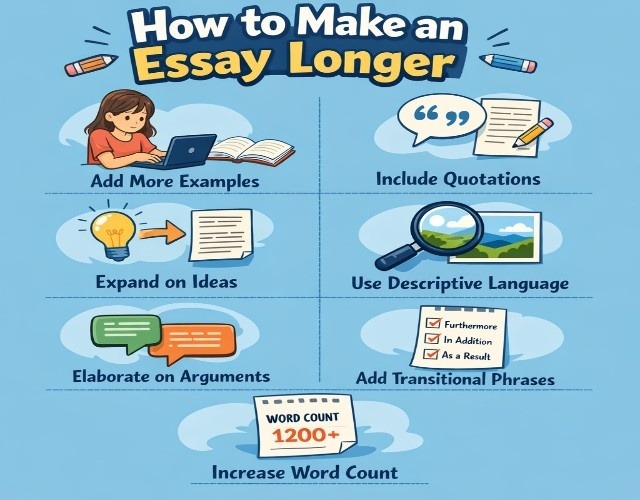
- Add relevant examples, evidence, and explanations
- Improve clarity while increasing word count naturally
- Strengthen arguments instead of using filler content
- Meet word count requirements without hurting grades
When your essay feels too short, our essay writing service helps you expand it with purpose and precision.
Order NowContent Based Strategies: Adding Substance in Essays
1. Conduct Deeper Research
Surface research produces surface essays.
Don't stop at the first 3 to 4 sources you find. Dig deeper to uncover additional evidence, newer studies, and fresh perspectives that strengthen your arguments.
How to implement
|
Example transformation
Basic (40 words): "Studies show exercise improves mental health. People who exercise regularly report less depression and anxiety."
Deep research (105 words): "A 2024 meta-analysis in the Journal of Clinical Psychiatry found that 30 minutes of moderate aerobic exercise five times weekly reduced depression symptoms by 42%, effectiveness comparable to SSRIs for mild to moderate cases (Johnson et al., 2024). Neuroimaging studies reveal that regular exercise increases hippocampal volume by 2% annually, directly counteracting brain shrinkage associated with depression (Martinez & Chen, 2024). The mechanism works through multiple pathways: increased endorphin production, improved sleep quality, and enhanced self-efficacy from achieving fitness goals."
Deep research naturally creates more substantial content. Browse our essay topics guide for research-friendly subjects.
2. Add 2 to 3 Examples Per Main Point
One example proves that something is possible. Multiple examples prove it's significant.
Don't rely on single pieces of evidence. Strengthen arguments with diverse examples from different contexts, time periods, or sources.
How to implement
|
Example transformation
Single example (35 words): "Remote work increases productivity. A Stanford study found employees completed 13% more tasks when working from home."
Multiple examples (110 words): "Remote work increases productivity across diverse industries. A 2024 Stanford study found customer service representatives completed 13% more calls when working remotely, primarily due to fewer interruptions (Bloom et al., 2024). Software developers at Microsoft reported 25% faster project completion when working from home, attributed to uninterrupted focus during peak cognitive hours (Chen, 2024). Even creative fields benefit; advertising agencies implementing hybrid models saw 18% increases in campaign output (Williams, 2024). This pattern holds across white-collar professions, demonstrating that productivity gains reflect fundamental advantages: environmental control, elimination of commute time, and ability to work during personal peak performance hours."
Multiple examples create comprehensive coverage while naturally expanding length.
3. Expand Explanations: Don't Just State, Analyze
Don't assume readers understand your reasoning.
After presenting evidence, explain WHY it matters and HOW it supports your thesis. This analysis separates strong essays from mediocre ones.
How to implement
- After making claims, ask "Why is this true?" and answer it
- Explain the significance of evidence
- Connect each point explicitly back to your thesis statement
- Anticipate reader questions
Example transformation
Underdeveloped (30 words): "Social media affects teenage mental health. Studies show increased anxiety and depression among heavy users."
Fully developed (140 words): "Social media platforms fundamentally affect teenage mental health through interconnected mechanisms. First, constant exposure to curated images creates unrealistic comparison standards. When teenagers view carefully edited photos showcasing seemingly perfect lives, they naturally compare themselves unfavorably, triggering inadequacy. This comparison effect damages adolescent identity formation most severely. Second, dopamine driven feedback loops from likes and comments create addictive patterns. Teenagers check phones an average of 96 times daily (Smith, 2024), disrupting sleep, face to face interaction, and academic focus. This digital dependency replaces healthier activities traditionally supporting adolescent mental health, outdoor recreation, and in-person socializing. Therefore, increased anxiety and depression among heavy users isn't merely correlational but causal, driven by fundamental changes in how teenagers experience social connection and self-evaluation."
Full explanation naturally creates length while strengthening arguments.
4. Integrate and Analyze Quotations Properly
Quotations shouldn't stand alone: introduce them, present them, then analyze them.
The three part structure
| 1. Introduce: Provide context about the source |
| 2. Quote: Present the quotation (keep it under 2 to 3 sentences) |
| 3. Analyze: Explain its relevance to your argument |
Example transformation
Poor integration (25 words): "Education is important. 'Education is the most powerful weapon which you can use to change the world' (Mandela, 1997)."
Proper integration (110 words): "Nelson Mandela, who experienced both educational deprivation and the empowerment knowledge provides, captured education's transformative potential: 'Education is the most powerful weapon which you can use to change the world' (Mandela, 1997, p. 45). Mandela's weapon metaphor deserves consideration. Unlike physical weapons that destroy, education equips individuals to dismantle unjust systems through understanding and informed action. His journey, from rural schoolboy to political prisoner to president, demonstrates this principle. Education enabled Mandela to articulate arguments against apartheid that resonated internationally and envision governance structures based on equality. Therefore, Mandela's assertion isn't rhetoric but a statement grounded in the lived experience of education's capacity to alter societies."
Proper quotation integration (intro + quote + analysis) naturally creates substantial content. Check our essay format guide for citation styles.
5. Address Counterarguments
Acknowledging opposing viewpoints demonstrates critical thinking while naturally expanding essays.
How to implement
|
Example transformation
Without counterargument (60 words): "Schools should start later because teenagers need more sleep. Their biological clocks make them naturally tired at night and alert in the morning. Later start times would improve academic performance and reduce car accidents among teen drivers."
With counterargument (150 words): "Schools should start later because teenagers need more sleep. Their biological clocks make them naturally tired at night and alert in the morning. Later start times would improve academic performance and reduce car accidents among teen drivers.
Critics argue that later school start times would inconvenience working parents needing to drop children off before work, potentially forcing families to choose between employment and children's education. Additionally, afternoon activities, sports, part-time jobs, homework would extend later, potentially defeating the purpose by simply shifting schedules. However, these concerns, while legitimate, are outweighed by health and safety benefits. Districts implementing later start times found families adapted through carpooling, older siblings supervising younger children, and before school care programs. Research shows that even when evening activities run later, teenagers still get more total sleep with later start times, suggesting biological benefit outweighs scheduling challenges."
Counterarguments add substantial, high-quality content naturally.
6. Use Transition Words Throughout
Transition words don't just connect paragraphs, they link sentences within paragraphs.
How to implement
|
Example transformation:
Without transitions (70 words): "Students benefit from regular exercise. Physical activity improves concentration and memory. Exercise reduces stress and anxiety. Schools should provide more movement opportunities during the school day."
With transitions (95 words): "Students benefit from regular exercise in multiple ways. Most notably, physical activity improves concentration and memory, making academic tasks easier. Furthermore, exercise serves as a natural stress reliever, reducing anxiety that interferes with learning. Consequently, schools should provide more movement opportunities during the school day. By incorporating brief activity breaks between lessons, administrators can leverage these cognitive and emotional benefits. As a result, students would return to academic work more focused and relaxed, ultimately improving educational outcomes."
Strategic transitions add approximately 20% length while improving flow.
7. Provide Background Context
Don't assume specialized knowledge.
Define terms, explain historical background, and describe relevant context readers might not know.
How to implement
|
Example transformation
Assumes knowledge (15 words): "CRISPR technology raises ethical concerns about genetic modification."
Provides context (125 words): "CRISPR-Cas9, a revolutionary gene-editing technology discovered in 2012, allows scientists to precisely alter DNA sequences with unprecedented accuracy. Unlike previous techniques that were time consuming and expensive, CRISPR operates like molecular scissors, cutting DNA at specific locations and enabling insertions, deletions, or replacements. This breakthrough has profound medical implications, potentially curing genetic diseases like sickle cell anemia and muscular dystrophy, but raises significant ethical concerns. The technology's accessibility means that not just elite institutions but potentially any equipped laboratory could perform genetic modifications, including controversial applications like editing human embryos to enhance traits rather than prevent disease. Therefore, CRISPR's extraordinary potential must be balanced against questions about regulating gene editing to prevent misuse while enabling beneficial medical applications."
Context naturally creates substantial content. Learn more in our guide on how to start an essay.
8. Spell Out Contractions and Numbers
In formal academic writing, contractions and numerical digits appear unprofessional.
How to implement
|
Example transformation
Informal (40 words): "Studies show 80% of students don't get enough sleep. They can't focus and won't perform well. About 5 hours isn't enough for teens who need 8-10 hours nightly."
Formal (50 words): "Studies show eighty percent of students do not get enough sleep. They cannot focus and will not perform well on tests. Approximately five hours is not enough for teenagers who need eight to ten hours nightly."
This adds 25% more words while improving formality.
Turn Short Essays Into Well Developed Papers
Professional essay support that adds depth, not fluff
- Thoughtful content expansion aligned with your topic
- Stronger introductions, body paragraphs, and conclusions
- Improved flow and transitions between ideas
- Academic safe techniques approved by instructors
Stop worrying about word count, let our essay writing experts help you build stronger, longer essays.
Order NowRevision Based Strategies for Essays
9. Revisit Your Introduction and Conclusion
After drafting body paragraphs, your understanding has evolved. Update your intro and conclusion accordingly.
How to implement
This often adds 100 to 200 words while improving coherence. |
10. Break Dense Paragraphs Into Focused Units
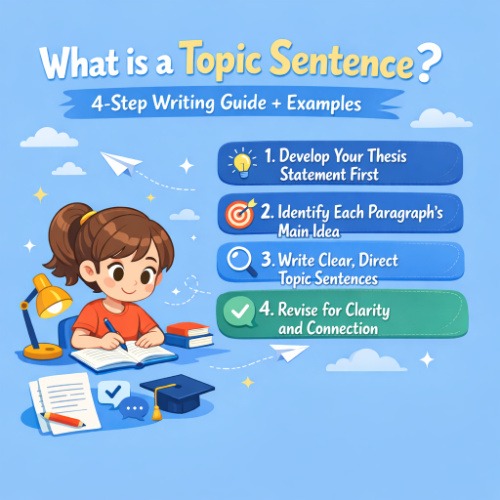
If paragraphs discuss 2 to 3 distinct ideas, separate them.
Each paragraph should focus on one topic sentence and fully develop that point.
How to implement
This reorganizes existing material more effectively, often revealing where additional development is needed. |
11. Review Your Essay Outline
Compare your finished draft to your original essay outline.
How to implement
If you didn't create an outline before drafting, make a "reverse outline" now by summarizing each paragraph. This reveals structural gaps. |
12. Add Descriptive Language (For Appropriate Essay Types)
For narrative and descriptive essays, vivid descriptions create immersive experiences.
How to implement
Note: This works for narrative essays and personal statements, less so for formal research papers. |
Struggling to find enough examples and evidence? Our professional essay writing service conducts thorough research to find 2 to 3 strong examples for each main point, creating naturally longer essays through substantive content rather than padding.
What NOT to Do in Essays: Avoid These Tactics
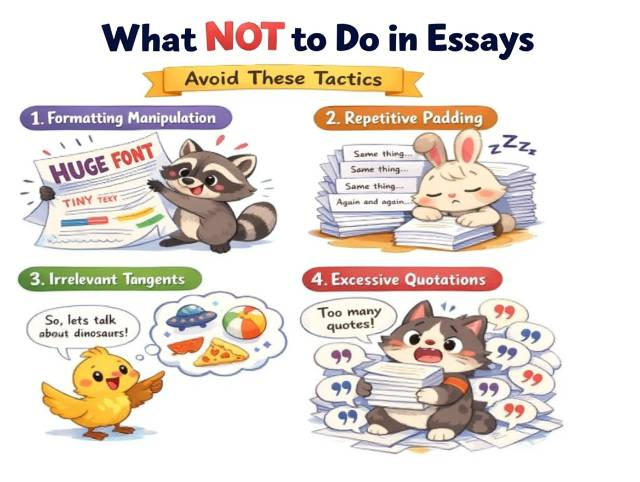
1. Formatting Manipulation
Never use these easily-detected tricks
|
Why they fail: Professors check formatting. Plagiarism software reveals these manipulations in document properties. Getting caught damages credibility and usually results in grade penalties.
2. Repetitive Padding
Don't say the same thing multiple times in different words.
Readers notice when you're rephrasing previous points rather than adding new information.
3. Irrelevant Tangents
Don't include off topic information just because it's interesting.
Every paragraph must support your thesis. Tangents confuse readers and weaken arguments despite adding length.
4. Excessive Quotations
If more than 20% of your essay is quoted material, you're not doing enough original thinking.
Quotations should support YOUR analysis, not replace it.
Struggling to Hit the Required Word Count?
Smart essay expansion strategies from academic experts
- Detailed explanations and supporting evidence added
- Topic-relevant content that boosts quality and length
- Proper structure maintained while expanding sections
- Fast, reliable help for urgent assignments
Meet your word limit with confidence, choose our essay writing service for meaningful essay expansion.
Order NowBottom Line
Meeting word count should come from fully developing your ideas, not from formatting tricks or repetitive filler. If you’re consistently under the required word count, it usually means your topic needs deeper research, stronger evidence, clearer explanations, or more detailed analysis. The strategies outlined above focus on adding substance, helping your essay grow naturally while improving quality.
Start with content driven improvements recommended in any effective essay writing guide: conduct more thorough research, include 2 to 3 relevant examples per key point, expand explanations with analysis, integrate quotations correctly, and address counterarguments where appropriate. These techniques help essays meet word count requirements while earning higher grades.
Avoid formatting manipulation. Instructors recognize these tactics immediately, and they undermine your credibility. Instead, focus on strengthening your arguments and analysis, when the writing improves, the word count follows naturally.



-20154.jpg)