Understanding Obesity Essays
An obesity essay examines weight related health issues through various analytical lenses, such as causes, effects, solutions, or arguments about policy and treatment approaches.
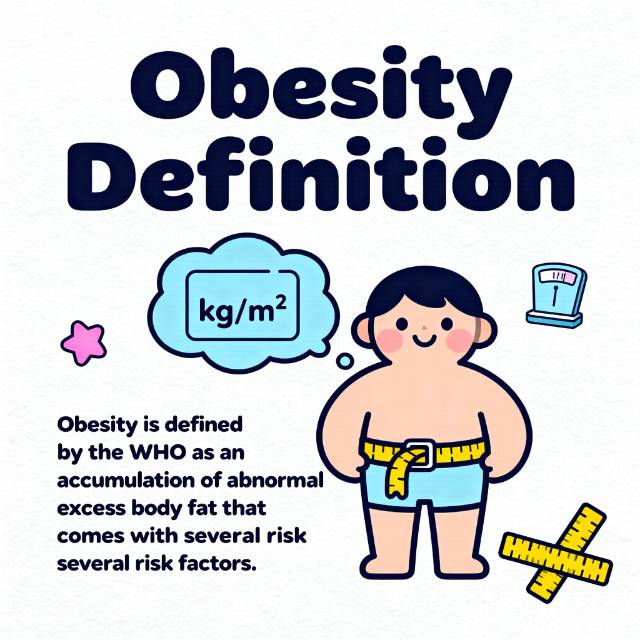
What makes it different from general health essays?
Obesity essays require you to navigate multiple interconnected factors: biological mechanisms, environmental influences, socioeconomic disparities, psychological components, and public policy implications. Unlike straightforward health topics, obesity demands nuanced analysis that acknowledges complexity without oversimplifying.
Current Context: Why This Topic Matters Now
The numbers tell a stark story:
- Global obesity has reached unprecedented levels. According to 2024 WHO data, adult obesity more than doubled from 6.6% in 1990 to 15.8% in 2022. Adolescent obesity quadrupled during the same period.
- In the United States, 40.3% of adults have obesity (CDC, 2023), with 23 states reporting rates above 35%. One in five American children (19.7%) has obesity, with significant disparities by race and income level.
- The economic burden is staggering. The Joint Economic Committee's 2024 report projects obesity related costs will reach $8.2–9.1 trillion over the next decade double previous estimates. Individuals with obesity incur $1,861–$2,505 more annually in medical costs.
Recent developments shape the conversation:
The FDA approved the first oral GLP-1 weight loss medication in December 2025, representing a significant treatment advancement. About 1 in 8 US adults (41 million) have used GLP-1 drugs like Ozempic or Wegovy. The WHO added these therapies to its Essential Medicines List and published treatment guidelines in December 2025.
| These current realities provide rich material for your essay while demanding careful, evidence based analysis. |
Need it Written Today? Ready to Hand it Off?
Our expert writers create hundreds of essays daily:
- Custom research on any topic
- Expert writers across all subjects
- Plagiarism-free guarantee
- Rush delivery available
Join 73,000+ students who've trusted us
Order NowTypes of Obesity Essays
Different assignments require different approaches. Here's what each type focuses on:
| Essay Type | Purpose | Key Features | Best For |
|---|---|---|---|
| Argumentative | Persuade readers about a position | Takes a clear stance, presents counter arguments, and uses strong evidence | Policy debates, treatment approaches |
| Cause and Effect | Analyze relationships | Examines multiple contributing factors or consequences | Understanding obesity's origins or impacts |
| Problem Solution | Propose remedies | Identifies specific problems, evaluates potential solutions | Public health initiatives, intervention strategies |
| Expository | Explain and inform | Presents balanced information without bias | Educational overviews, explaining mechanisms |
| Compare and Contrast | Examine similarities/differences | Analyzes different approaches, populations, or time periods | Treatment comparisons, regional differences |
| Narrative | Share personal experience | Uses storytelling to illustrate broader issues | Personal weight struggles, family experiences |
How to choose your type:
- Check your assignment requirements first. If your professor specifies "argumentative essay about obesity," that's your answer.
If you have flexibility, consider:
- What angle interests you most? Arguing for policy change vs. explaining biological mechanisms requires different approaches
- What evidence is available? Some angles have stronger research support than others
- What's your expertise level? Argumentative essays require more sophisticated analysis than expository
Most academic assignments call for argumentative or cause and effect essays. When in doubt, check with your instructor.
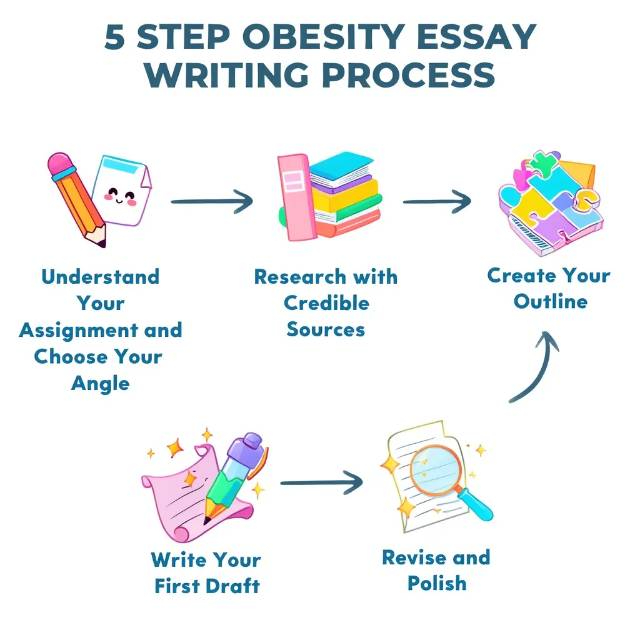
5 Step Obesity Essay Writing Process
Writing a strong obesity essay follows a systematic process. Don't skip steps each one makes the next easier.
Step 1: Understand Your Assignment and Choose Your Angle
Before researching anything, get crystal clear on what you're writing.
Assignment analysis questions:
- What type of essay is required? (Argumentative, cause-effect, etc.)
- What's the required length? (500 words = focused argument; 2,000+ words = comprehensive analysis)
- What citation style? (APA for health sciences, MLA for humanities, Chicago for some social sciences)
- Are there topic restrictions? (Some instructors want focus on specific populations or interventions)
- What's your audience? (Academic experts vs. general readers changes your approach)
Choosing your specific angle:
"Obesity" is too broad for any essay. You need a specific focus.
Too broad: "Obesity in America"
Focused: "How food deserts contribute to childhood obesity in low income urban neighborhoods"
Too broad: "Causes of obesity"
Focused: "The role of ultra processed foods in rising obesity rates: An examination of food industry practices"
Quick angle finder:
- What specific population? (Children, adults, elderly, specific demographic)
- What specific aspect? (Causes, effects, one particular cause, one particular effect)
- What specific context? (Geographic region, time period, setting)
- What specific argument or question? (Your unique take on the issue)
Step 2: Research with Credible Sources
Obesity research requires high quality, recent sources. Your argument is only as strong as your evidence.
Where to find credible sources:
Primary sources (best):
- CDC (Centers for Disease Control and Prevention): obesity statistics and reports
- WHO (World Health Organization): global data and guidelines
- NIH (National Institutes of Health): peer reviewed research
- Journal of the American Medical Association (JAMA)
- The Lancet and New England Journal of Medicine
- Academic databases: PubMed, Google Scholar, JSTOR
Credible secondary sources:
- Harvard T.H. Chan School of Public Health
- Mayo Clinic and Cleveland Clinic resources
- American Heart Association publications
- Obesity Action Coalition
- Government reports (USDA, Joint Economic Committee)
Sources to avoid:
- Personal blogs without credentials
- Commercial weight loss company websites
- Outdated sources (pre-2020 for statistics, though older foundational research is acceptable)
- Sources with clear commercial bias
- Non peer reviewed opinion pieces
Research strategy:
- Start broad, then narrow. Begin with overview sources (WHO fact sheets, CDC summaries) to understand the landscape, then dive into specific peer reviewed studies for your particular angle.
- Take detailed notes. Record: full citation information, specific statistics with page numbers, key quotes (mark these clearly), and how this source supports your argument.
- Look for recent data. For statistics and prevalence rates, prioritize 2022–2025 sources. The obesity landscape changes rapidly.
- Aim for 5–8 strong sources minimum for short essays (500–1,000 words), 10–15 sources for standard essays (1,500–2,500 words), and 15–20+ sources for comprehensive research papers (3,000+ words).
Step 3: Create Your Outline
Turn your research into a structured plan before writing.
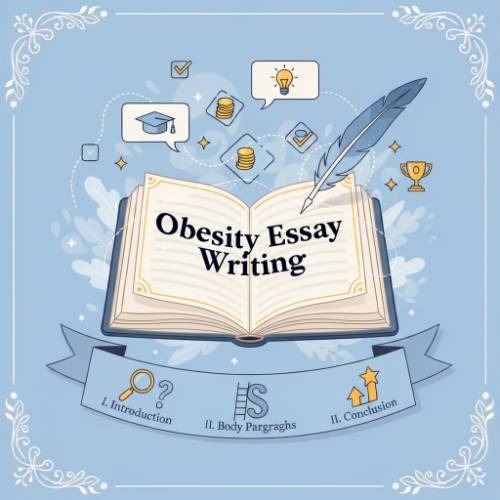
Basic obesity essay outline structure:
I. Introduction
A. Hook (compelling statistic, scenario, or question)
B. Background context (2–3 sentences)
C. Thesis statement (your main argument)
II. Body Paragraph 1: First Main Point
A. Topic sentence
B. Evidence (statistic, study, expert quote)
C. Analysis (explain why this evidence matters)
D. Connection to thesis
III. Body Paragraph 2: Second Main Point
A. Topic sentence
B. Evidence
C. Analysis
D. Connection to thesis
IV. Body Paragraph 3: Third Main Point
A. Topic sentence
B. Evidence
C. Analysis
D. Connection to thesis
V. Counter argument (for argumentative essays)
A. Present opposing view fairly
B. Refute with evidence
C. Reinforce your position
VI. Conclusion
A. Restate thesis (new wording)
B. Synthesize main points
C. Broader implications or call to action
D. Memorable closing
Example outline for cause and effect essay:
Topic: "How Food Marketing Influences Childhood Obesity Rates"
I. Introduction
Hook: "$2 billion spent annually marketing junk food to children"
Context: Rising childhood obesity rates parallel increased marketing
Thesis: "Aggressive food marketing to children significantly contributes to childhood obesity by shaping preferences, increasing consumption, and normalizing unhealthy eating patterns."
II. Body Paragraph 1: How marketing shapes food preferences
Topic: Marketing creates early brand loyalty and taste preferences
Evidence: Studies on advertising exposure and food choices
Analysis: Children can't distinguish persuasion from information
III. Body Paragraph 2: Marketing increases consumption
Topic: Exposure directly increases purchase requests and consumption
Evidence: Research on TV commercials and snack intake
Analysis: Immediate behavioral impact
IV. Body Paragraph 3: Marketing normalizes unhealthy eating
Topic: Repeated exposure makes junk food seem normal, healthy
Evidence: Content analysis of food ads vs. dietary guidelines
Analysis: Creates a distorted perception of healthy eating
V. Counter argument
Opposing view: Parental responsibility, not marketing
Refutation: Parents face overwhelming marketing influence; regulation needed
Evidence: Countries with advertising restrictions have lower childhood obesity
VI. Conclusion
Restate the thesis about marketing's significant role
Synthesize three mechanisms (preferences, consumption, normalization)
Call to action: Stricter advertising regulations
Close: "Protecting children's health requires limiting their exposure to marketing designed to undermine it"
Step 4: Write Your First Draft
Now you actually write. Here's how to do it effectively.
Start strong, don't overthink:
- Begin with whichever section feels easiest. You don't have to write your introduction first; many writers save it for last when they fully understand their argument.
- Set realistic daily goals. Aim for 300–500 words per writing session for steady progress without burnout.
- Don't edit as you write. Get your ideas down first. You'll polish later.
Balance evidence and analysis:
Your essay needs both facts and your interpretation of those facts.
Too much evidence, no analysis:
"40.3% of US adults have obesity (CDC, 2023). Obesity costs $1,861 more annually in medical expenses. 23 states have obesity rates above 35%."
Evidence with analysis:
"With 40.3% of US adults affected by obesity (CDC, 2023), the condition has reached crisis proportions. These aren't just numbers they represent individuals facing $1,861 in additional annual medical costs and reduced quality of life. The geographic concentration, with 23 states exceeding 35% rates, suggests environmental and policy factors beyond individual choice."
Follow the analysis formula:
Evidence + "This matters because..." + Connection to thesis
Use topic sentences effectively:
Every body paragraph needs a clear topic sentence that states the paragraph's main point and connects to your thesis.
Weak topic sentence: Strong topic sentence: |
Integrate sources smoothly:
Don't just drop in quotes. Introduce them, present them, explain them.
Awkward integration: Smooth integration: |
Step 5: Revise and Polish
First draft done? You're halfway there. Now make it excellent.
Big picture revision (first pass):
- Does your thesis actually match your essay? Sometimes your argument evolves as you write.
- Does each body paragraph clearly support your thesis? Cut anything that doesn't directly contribute.
- Is your evidence strong and recent? Weak or outdated sources undermine your credibility.
- Have you provided enough analysis? You should write more analysis than evidence.
- Does your essay flow logically? Each paragraph should connect naturally to the next.
Paragraph level revision (second pass):
- Does each paragraph have one clear main point? If you're addressing two different ideas, split them into two paragraphs.
- Do you have strong topic sentences? The first sentence should tell readers what the paragraph is about.
- Is your evidence specific? Replace vague statements with concrete data.
- Have you cited everything properly? Every fact, statistic, or idea from sources needs citation.
Sentence level editing (final pass):
- Cut unnecessary words. "Due to the fact that" becomes "because." "In order to" becomes "to."
- Vary sentence structure. Mix short, punchy sentences with longer, more complex ones.
- Eliminate weak verbs. "Is" and "are" should appear sparingly. "Contributes," "exacerbates," and "demonstrates" are stronger.
- Check grammar and spelling. Read aloud to catch errors your eyes skip when reading silently.
Get feedback:
Ask someone to read your essay and tell you:
- Where did you get confused?
- What's my main argument? (If they can't articulate it, your thesis isn't clear enough)
- What evidence was most convincing?
- What needed more explanation?
Essay Structure Components
Every section of your obesity essay serves a specific purpose. Here's how to write each one effectively.
The Introduction
Your introduction has three jobs: grab attention, provide context, and present your thesis.
Length:
8–12% of total essay (40–60 words for 500-word essay; 120–180 words for 1,500-word essay)
What to include:
Hook (1–2 sentences): Capture reader's attention immediately
Context (2–4 sentences): Provide necessary background without over-explaining
Thesis statement (1–2 sentences): State your main argument clearly
Introduction structure example:
Over the past three decades, global obesity rates have more than doubled, affecting over 1 billion people worldwide. [Hook with compelling statistic] See the full hook examples section below for 10+ attention grabbing opening strategies. |
Struggling With Examples or Structure?
Our professional writers specialize in illustration essays that demonstrate concepts with strong, specific evidence.
- Zero plagiarism, 100% original
- Academic tone and detailed analysis
- Expert editing and formatting
- Confidential and reliable
Get a clear, example-driven essay that impresses your professor.
Order NowBody Paragraphs
Body paragraphs are where you make your case. Each one should develop a single main point that supports your thesis.
Standard body paragraph structure:
- Topic sentence: State the paragraph's main point (connects to thesis)
- Evidence: Present facts, statistics, research findings, expert opinions
- Analysis: Explain what the evidence means and why it matters
- Connection: Link back to your thesis
Length:
150–250 words per paragraph, typically
Body paragraph example:
Ultra processed foods, engineered for maximum palatability and minimal nutritional value, represent the single largest dietary contributor to childhood obesity. [Topic sentence]
|
Key principles:
- Make one clear point per paragraph. If you're making two separate arguments, split into two paragraphs.
- Lead with your strongest evidence. Put your most compelling statistic or study first.
- Analyze more than you cite. Your interpretation matters more than just presenting facts.
- Use transitions between paragraphs. Connect each paragraph to the next:
"Beyond marketing's direct effects..."
"While ultra processed foods contribute significantly, environmental factors compound the problem..."
Counter Arguments (Argumentative Essays)
Strong argumentative essays address opposing viewpoints. This actually strengthens your position by showing you've considered alternatives.
Where to place counter arguments:
- Option 1: Dedicated paragraph before conclusion (most common)
- Option 2: Address counter arguments paragraph by paragraph as you go
- Option 3: Early in essay, then build your argument afterward
Counter argument structure:
- Present the opposing view fairly
Don't create a straw man. Represent the counter argument accurately. - Acknowledge any valid points
Conceding minor points makes you appear reasonable and strengthens your main argument. - Refute with evidence
Show why your position is stronger despite the counter argument's validity. - Reinforce your thesis
Circle back to why your argument prevails.
Counter argument example:
| Critics of public health interventions argue that obesity is primarily a matter of personal responsibility, and that government regulations on food marketing or sales represent overreach into individual freedom. [Present opposing view] This perspective holds some validity: individuals do make daily choices about what to eat and how much to exercise, and personal agency shouldn't be dismissed entirely. [Acknowledge valid points] However, this argument fails to account for the profound power imbalances between individuals particularly children and billion dollar marketing campaigns designed by behavioral psychologists specifically to override rational decision making. [Begin refutation] Research from countries that have implemented marketing restrictions demonstrates that individual choice operates within environmental contexts: Chile's 2016 regulations limiting junk food marketing to children correlated with a 25% reduction in sugary drink purchases and a measurable decrease in childhood obesity rates (Reyes et al., 2024). [Evidence supporting your position] The data is clear: when structural barriers to healthy choices are removed, "individual responsibility" becomes possible in ways it simply isn't within environments saturated with engineered hyperpalatable foods and predatory marketing. [Reinforce your argument] |
The Conclusion
Your conclusion does more than summarize. It elevates your argument to broader significance.
Length:
8–10% of total essay (40–50 words for 500-word essay; 120–150 words for 1,500-word essay)
What to include:
- Restate thesis (new wording): Remind readers of your main argument without copying your introduction
- Synthesize main points: Briefly recap your key arguments (don't introduce new evidence)
- Broader implications: Explain why your argument matters beyond the essay
- Call to action or future outlook: End with something memorable
What NOT to do:
- Start with "In conclusion..." (readers know it's the conclusion)
- Copy paste your thesis verbatim
- Introduce new evidence or arguments
- Apologize or undermine your argument ("This is just my opinion")
- End abruptly without broader context
Conclusion example:
| The obesity crisis cannot be solved by simply telling individuals to make better choices when the entire food environment is engineered to undermine those choices. [Restate thesis with new framing] From ultra processed foods designed for overconsumption to marketing campaigns that target children's developing brains to urban designs that eliminate opportunities for physical activity, structural factors overwhelm individual agency. [Synthesize main points] Addressing obesity requires the same public health approach that successfully reduced smoking rates: not by blaming smokers, but by regulating industry practices, limiting advertising, and creating environments that support healthy behaviors. [Broader implications] As obesity rates continue climbing and economic costs mount, the question isn't whether to implement structural solutions, it's whether we'll act before the crisis becomes irreversible. [Memorable closing with urgency] |
Detailed Essay Examples for Obesity Essay
Learn by seeing complete examples with analysis. Here are two full obesity essays demonstrating different approaches.
Example 1: Cause and Effect Essay
Title: How Food Deserts Create Obesity Disparities in Low Income Communities
Introduction
In South Los Angeles, residents travel an average of 15 miles to reach a full service grocery store, passing dozens of fast food restaurants and convenience stores along the way. This pattern repeats across America: low income neighborhoods systematically lack access to affordable fresh produce while concentrating businesses that sell primarily ultra processed, calorie dense foods. These food deserts areas where nutritious food is difficult to access contribute directly to the stark obesity disparities between wealthy and poor communities. Limited access to fresh produce, high concentration of fast food outlets, and reliance on convenience stores create an obesogenic environment where healthy eating is structurally difficult regardless of individual knowledge or motivation.
[Analysis: Strong hook with specific statistic, clear problem statement, thesis that previews three causes]
Body Paragraph 1: Limited Access to Fresh Produce
Food deserts virtually eliminate fresh produce as a realistic option for daily meals. The USDA defines food deserts as areas where at least 33% of residents live more than one mile from a supermarket in urban areas, or more than 10 miles in rural areas (Ver Ploeg et al., 2023). In these neighborhoods, a head of broccoli costs $2.50 at a distant grocery store but requires a 30 minute bus ride each direction, while a fast food burger costs $3 and sits two blocks away. This isn't a comparison of nutrition information it's a comparison of what's realistically achievable when you're working two jobs, caring for children, and don't own a car. Research confirms this behavioral reality: families living in food deserts consume 32% fewer servings of fruits and vegetables than families with nearby grocery access (Walker et al., 2024). The absence of affordable, accessible produce doesn't just make healthy eating harder it makes it structurally impractical for daily implementation.
[Analysis: Clear topic sentence, specific USDA definition with citation, concrete example comparing real costs and accessibility, research supporting behavioral impact, analysis connecting to structural barriers rather than individual choices]
Body Paragraph 2: Concentration of Fast Food Restaurants
Low income neighborhoods don't just lack grocery stores they're deliberately oversaturated with fast food restaurants. Research analyzing urban food environments found that predominantly Black neighborhoods contain 2.4 times more fast food restaurants per capita than predominantly white neighborhoods, even after controlling for population density (Feldman, 2023). This concentration isn't accidental; it reflects targeted marketing strategies by chains that identify low income areas as high profit zones. The result is an environment where fast food is the most convenient, affordable, and heavily advertised option. When every corner features golden arches or a Taco Bell, and walking to a grocery store requires 45 minutes, families rationally choose the accessible option even knowing it's less healthy. This creates a cycle: high fast food consumption leads to obesity, which leads to health problems, which reduce income and mobility, which further increases reliance on fast food.
[Analysis: Strong topic sentence framing the problem as active oversaturation, specific research with dramatic statistics on racial disparities, analysis of why this happens (targeted marketing), explanation of behavioral consequences, connection tothe cyclical nature of problem]
Body Paragraph 3: Reliance on Convenience Stores
When supermarkets are absent and transportation is limited, convenience stores become de facto food sources, but they stock primarily shelf stable processed foods designed for long shelf life, not nutrition. A study of 157 convenience stores in food deserts found that 73% devoted less than 10% of shelf space to fresh produce, while ultra processed snacks, sugary drinks, and candy occupied prime locations near registers (Chen & Ibrahim, 2024). The economics explain this pattern: fresh produce spoils quickly and offers low profit margins, while processed foods have months long shelf life and high markups. For families relying on convenience stores, this means daily diets built around chips, cookies, sugary drinks, and processed meat products items specifically engineered to be hyper palatable and calorie dense. The nutritional consequences are severe: regular convenience store shoppers consume 500-800 more calories daily than supermarket shoppers, mostly from these ultra processed sources (Thompson, 2024).
[Analysis: Topic sentence establishing convenience stores as problematic default option, specific research on what these stores actually stock, economic explanation for why, concrete impact on daily calorie intake with research citation]
Conclusion
Food deserts create obesity through structural barriers that make unhealthy eating the path of least resistance. When fresh produce requires traveling 15 miles while fast food sits on every corner, when convenience stores stock candy but not carrots, when time and transportation make healthy shopping nearly impossible obesity isn't a personal failing but a predictable outcome. Addressing obesity disparities requires addressing food deserts through policies that incentivize supermarkets in underserved areas, regulate fast food concentration, and support corner stores in stocking fresh produce. Until we fix the food environment, blaming individuals for obesity is like blaming people for getting wet while forcing them to stand in the rain.
[Analysis: Restates thesis with new framing, synthesizes three main points, proposes policy solutions, memorable closing metaphor]
Example 2: Argumentative Essay
Our professional essay writing service can help you develop strong arguments, integrate credible sources, and polish each section to meet academic standards.
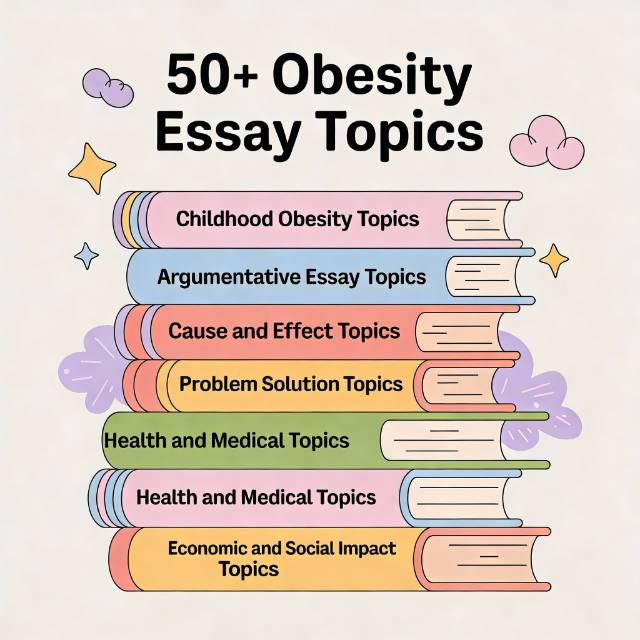
50+ Obesity Essay Topics
Need a specific topic? Here are 50+ organized by category and type.
Childhood Obesity Topics
- How school lunch programs contribute to childhood obesity rates
- The impact of screen time on childhood obesity
- Analyzing the relationship between childhood obesity and academic performance
- Should schools ban junk food sales on campus?
- How parental eating habits influence children's weight
- The role of physical education in preventing childhood obesity
- Examining socioeconomic factors in childhood obesity disparities
- Are children with obesity more likely to experience bullying?
- How food marketing to children drives obesity rates
- The long term health consequences of childhood obesity
Argumentative Essay Topics
- Should employers be allowed to charge higher insurance premiums for employees with obesity?
- Implementing sugar taxes to reduce obesity rates
- Should the government regulate portion sizes at restaurants?
- Banning junk food advertising during children's television programming
- Should obesity be classified as a disability under the ADA?
- Mandatory nutrition labels on restaurant menus
- Should health insurance cover weight loss surgery for all qualifying patients?
- Eliminating corn and soy subsidies that make junk food cheap
- Should schools require daily physical education for all students?
- Implementing warning labels on high sugar products like cigarette warnings
Cause and Effect Topics
- How food deserts contribute to obesity in urban communities
- The relationship between stress and weight gain
- How ultra processed foods affect metabolism and weight
- The impact of shift work on obesity risk
- How suburban sprawl contributes to rising obesity rates
- The role of gut microbiome in obesity development
- How poverty creates obesity through food insecurity
- The effects of maternal obesity on children's health
- How sleep deprivation leads to weight gain
- The relationship between depression and obesity
Problem Solution Topics
- Addressing obesity in rural communities with limited healthcare access
- Reducing obesity through urban design and walkable communities
- Improving obesity treatment access for underserved populations
- Creating sustainable weight loss approaches beyond dieting
- Addressing weight bias in healthcare settings
- Developing effective obesity prevention programs for schools
- Solutions for the obesity crisis in indigenous communities
- Creating culturally appropriate nutrition interventions
- Addressing obesity in older adults and elderly populations
- Developing workplace wellness programs that actually work
- Solutions for obesity during and after pregnancy
- Creating effective public health campaigns about obesity
- Addressing obesity in people with disabilities who face mobility challenges
- Developing effective obesity counseling approaches for primary care
Health and Medical Topics
- The relationship between obesity and Type 2 diabetes
- How obesity affects cardiovascular disease risk
- The link between obesity and certain cancers
- Examining obesity's impact on fertility and reproductive health
- How obesity complicates surgical procedures and recovery
- The relationship between obesity and sleep apnea
- Analyzing obesity's effects on joint health and mobility
- How obesity impacts mental health and quality of life
- Comparing bariatric surgery outcomes across different procedures
- The role of hormones in obesity and weight regulation
Economic and Social Impact Topics
- The economic burden of obesity on healthcare systems
- How obesity affects workplace productivity and absenteeism
- The social stigma surrounding obesity and its effects
- How obesity impacts healthcare costs for individuals
- The relationship between food industry profits and obesity rates
- Analyzing the economics of the diet industry
- How obesity affects social mobility and economic opportunity
- Examining weight bias in media representation