Compare Contrast essay analyzes relationships between two subjects by examining their similarities and differences. Effective comparison essays require subjects from the same category (two novels, two theories, two leaders) that exhibit both meaningful similarities and notable differences worth exploring.
Strong comparison writing contains clear thesis statements arguing positions rather than merely announcing topics, balanced analysis treating both subjects equally, extensive transition words guiding readers through comparisons, specific evidence supporting all claims, and synthesis conclusions drawing insights beyond surface observations.
The key to success lies in selecting comparable subjects carefully, organizing information logically using your chosen method, and analyzing relationships rather than just describing subjects separately.
What is a Compare and Contrast Essay?
A compare contrast essay examines two (or occasionally more) subjects by analyzing their similarities, differences, or both. Unlike essays that analyze a single subject in depth, these essays require you to understand multiple subjects simultaneously while identifying meaningful relationships between them.
These essays appear throughout your academic career, from middle school assignments comparing books to university-level papers contrasting complex theoretical frameworks. The fundamental challenge remains consistent: juggling multiple subjects while maintaining clear organization and analytical depth.
Essay Due Tomorrow? Organization Still Unclear?
Our expert writers create comparison essays daily:
- Organize complex comparisons into clear structures
- Balance analysis between subjects perfectly
- Use specific evidence effectively throughout
- Meet any deadline
Zero AI. Just clear, sophisticated comparison analysis.
Order NowWhy Professors Assign These Essays
These essays aren't academic busywork. They develop critical thinking skills that extend far beyond classroom assignments:
- Pattern recognition: Identifying similarities across different contexts
- Analytical thinking: Understanding how differences create meaning
- Organizational skills: Structuring complex information logically
- Synthesis ability: Drawing conclusions from multiple sources
When your history professor assigns an essay comparing the French and American Revolutions, she's testing whether you can analyze multiple events simultaneously, recognize patterns across different contexts, and articulate meaningful conclusions about revolutionary movements generally.
You'll discover proven organizational structures, explore detailed examples, access downloadable templates, and find hundreds of engaging compare and contrast essay topics.
Key Elements of Compare and Contrast Essays
Before diving into the writing process, understand the five elements that make these essays work:
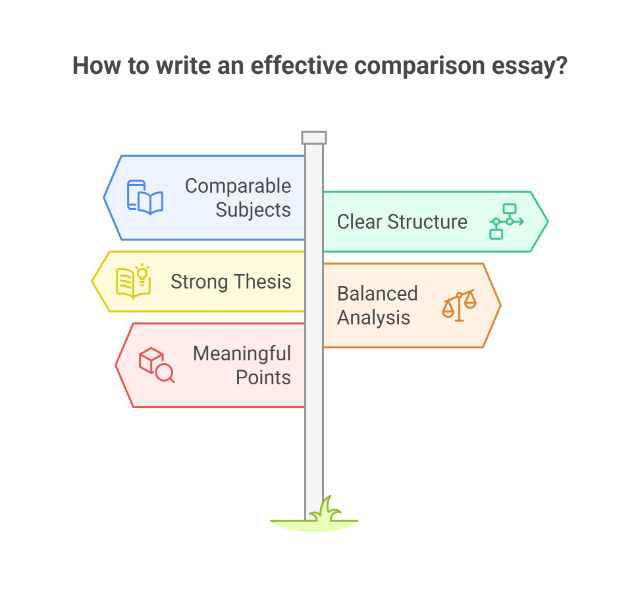
1. Comparable Subjects
Your subjects must belong to the same category. You can meaningfully compare two novels, two economic theories, two political leaders, or two energy sources because these pairs share categorical commonality.
Never compare completely unrelated subjects like "cats and communism" or "Shakespeare and smartphones." The lack of common ground produces meaningless analysis that frustrates readers and earns poor grades.
Good comparisons:
- The Great Gatsby and The Catcher in the Rye (both American novels exploring disillusionment)
- Keynesian and Austrian economics (competing economic theories)
- Solar and wind energy (renewable energy alternatives)
Poor comparisons:
- Basketball and climate change (unrelated categories)
- Ancient Rome and artificial intelligence (incomparable contexts)
2. Meaningful Similarities AND Differences
Subjects that are too similar lack interesting differences to analyze. Subjects that are too different lack sufficient common ground for meaningful comparison.
| The sweet spot: subjects with significant similarities providing a comparison basis, plus notable differences creating analytical opportunities. |
Review our compare and contrast essay examples, matching your assignment level to understand how successful writers balance subjects, structure analysis, and draw meaningful conclusions.
3. Clear Organizational Structure
You must choose between two proven methods:
Point-by-point method: Alternate between subjects for each comparison criterion
Block method: Discuss all aspects of Subject A, then all aspects of Subject B
Your structure guides readers through analysis and prevents confusion. We'll explore both methods in detail later.
4. Strong Compare and Contrast Essay Thesis Statement
Your thesis must identify both subjects, indicate whether you'll compare, contrast, or both, and preview your main points or overall argument.
Weak: "This essay will compare and contrast cats and dogs."
Strong: "While both cats and dogs provide companionship, dogs require significantly more owner engagement through training and exercise, making cats the more practical choice for busy professionals seeking low-maintenance pet ownership."
The strong thesis takes a position and previews the analytical framework.
5. Balanced Analysis
Each subject deserves equal attention and depth. Spending three paragraphs on Subject A and one paragraph on Subject B creates an imbalanced analysis that undermines your essay's credibility.
Maintain roughly equal word counts, evidence quality, and analytical depth for both subjects throughout your essay.
Types of Compare and Contrast Essays
Types focus on what the writer emphasizes rather than how the essay is organized:
Similarity-Focused Essay: Concentrates mainly on shared features to show common patterns, values, or functions between subjects.
Difference-Focused Essay: Highlights contrasts to reveal strengths, weaknesses, or unique characteristics.
Balanced Essay: Gives equal attention to both similarities and differences for a neutral, comprehensive analysis.
Lens Essay: Uses one subject as a framework to better understand or evaluate the other.
Evaluation-Based Essay: Compares subjects to judge effectiveness, usefulness, or quality based on set criteria.
These types help writers shape the purpose of a comparison and contrast essay, while organizational structures like block or point-by-point determine how the comparison is presented.
How to Write a Compare and Contrast Essay? Complete Writing Process
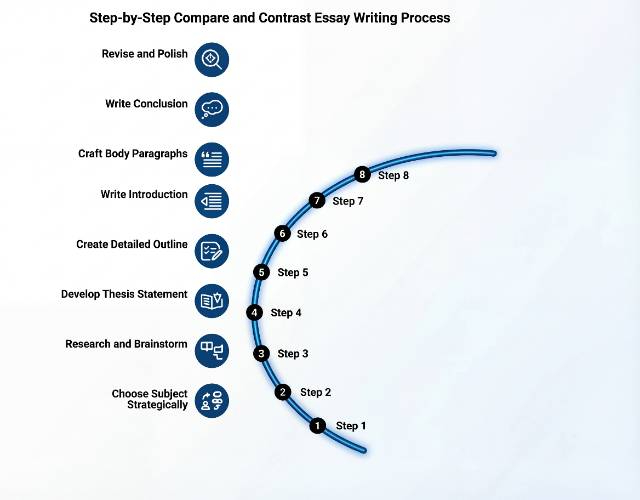
The following are the steps to writing a compare and contrast essay.
Step 1: Choose Your Subjects Strategically
Subject selection determines your essay's success before you write a single word. Follow these criteria:
Same category requirement: Both subjects must belong to the same category: two novels, two theories, two historical figures. This provides the foundation for meaningful comparison.
Meaningful connection: Look for subjects with significant similarities AND notable differences. Too similar lacks analytical depth. Too different lacks common ground.
Available information: Ensure sufficient credible sources exist for both subjects. Comparing a well-documented figure with an obscure one creates an imbalanced analysis.
Personal interest: Choose subjects that genuinely interest you. Forced interest shows in weak analysis. Authentic engagement produces stronger writing.
Assignment fit: Verify your subjects match assignment requirements regarding time period, subject area, or specific parameters.
Step 2: Research and Brainstorm Thoroughly
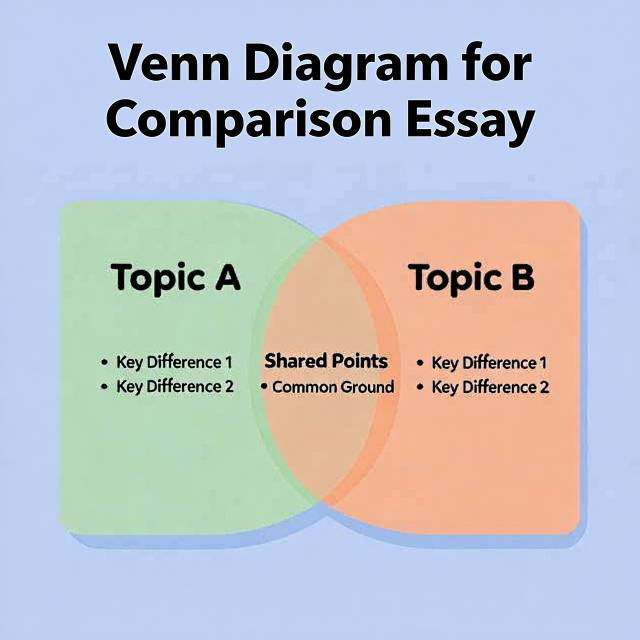
You cannot compare what you don't understand. Research both subjects equally before attempting to write. Create a Venn diagram similar to the visual below with two overlapping circles to visually organize similarities (in the overlap) and differences (in the separate sections).
Research Focus Areas:
- Basic facts and background
- Key characteristics or features
- Historical context or development
- Impact or significance
- Strengths and weaknesses
- Related theories or applications
Take detailed notes organized by potential comparison criteria. Look for surprising similarities or unexpected differences; these often become your most compelling analysis points.
Step 3: Develop a Strong Thesis Statement
Your thesis statement should accomplish three things:
- Identify both subjects clearly
- Indicate your approach (compare, contrast, or both)
- Preview your main argument or conclusion
Weak Thesis: "This essay will compare and contrast cats and dogs." (No argument)
Strong Thesis: "While both cats and dogs provide companionship, dogs require significantly more owner engagement through training, exercise, and socialization, making cats the more practical choice for busy professionals."
Notice how strong thesis statements take a position and provide analytical direction. They don't simply announce comparison topics; they argue something meaningful about the relationship between subjects.
Step 4: Compare and Contrast Essay Structure: Start Organizing
Never skip outlining. A detailed compare and contrast essay outline saves time during drafting, ensures balanced analysis, and prevents organizational problems.
Your outline should specify:
- Complete thesis statement
- Introduction, hook, and background information
- Each body paragraph's topic and supporting points
- Specific examples and evidence for each point
- Transition strategies between paragraphs
- Conclusion approach and final insights
Outlines help you visualize your essay's structure and identify weak points before investing time in full drafting. Spending 20-30 minutes on outlining it will save hours during revision.
Step 5: How to start a Compare and Contrast Essay: Compelling Introduction
Your introduction must accomplish four objectives:
1. Hook Your Reader Start with an attention-grabbing opening:
- Surprising statistic or fact
- Provocative question
- Brief anecdote or scenario
- Relevant quotation
- Common misconception
2. Provide Context: Offer necessary background information about your subjects and their relationship. Explain why comparing these subjects matters or what question your comparison will answer.
3. Present Your Thesis: State your thesis clearly, typically as the last sentence of your introduction. This placement provides a smooth transition into the body paragraphs.
4. Preview Your Approach Briefly indicate your organizational structure or main comparison criteria to prepare readers for what's coming.
Step 6: Craft Strong Body Paragraphs
Each body paragraph should follow this structure:
- Topic Sentence: Introduce the comparison point or criterion
- Subject A Analysis: Detailed examination with evidence
- Subject B Analysis: Parallel examination with evidence
- Comparison/Contrast: Explicit discussion of how subjects relate
- Transition: Bridge to next paragraph
Essential Elements:
- Use transition words extensively: "similarly," "in contrast," "whereas," "likewise," "however," "on the other hand," "conversely."
- Provide specific evidence: examples, quotations, statistics, expert opinions
- Analyze rather than just describe: explain WHY differences or similarities matter
- Maintain balance: devote approximately equal attention to both subjects
- Stay focused: each paragraph should address one clear comparison criterion
Step 7: How to Write a Conclusion for a Comparison Essay: Synthesis-Focused
Effective conclusions do more than summarize; they synthesize your analysis into meaningful insights.
Essential Components:
- Restate Thesis: Rephrase your main argument (never copy-paste)
- Synthesize Key Points: Weave together your main comparisons into a cohesive understanding
- Broader Implications: Explain what your comparison reveals beyond the immediate subjects
- Final Insight: End with a thought-provoking observation or call to reflection
Avoid:
- Introducing new comparison points
- Simply listing what you've already discussed
- Apologizing for limitations
- Generic phrases like "In conclusion" or "To sum up."
Step 8: Revise and Polish
Professional writing emerges through revision, not first drafts. Use this systematic approach:
Content Revision (First Pass):
- Does every paragraph support your thesis?
- Have you maintained a balanced analysis between subjects?
- Are comparison points meaningful rather than obvious?
- Have you provided sufficient evidence for each claim?
- Does your analysis explain WHY differences matter?
Organization Revision (Second Pass):
- Do paragraphs follow logical order?
- Have you used effective transitions?
- Does your chosen structure (point-by-point or block) work effectively?
- Can readers easily follow your comparison?
Sentence-Level Revision (Third Pass):
- Eliminate wordiness and redundancy
- Vary sentence structure for readability
- Strengthen weak verbs and vague language
- Ensure academic tone throughout
Proofreading (Final Pass):
- Check spelling, grammar, and punctuation
- Verify proper citation format
- Confirm formatting consistency
- Read aloud to catch awkward phrasing.
Still Overwhelmed? We're Here
Our professional writers specialize in comparison essays:
- Zero AI, 100% human-written analysis
- Use specific evidence effectively throughout
- Balance analysis between subjects perfectly
- Organize complex comparisons into logical structures
Thousands of students have trusted us with their most challenging essays. You can too.
Order NowEssential Transition Words for Compare Contrast Essays
Transition words guide readers through your comparison and signal relationships between ideas. Use these strategically:
Purpose | Transition Words & Phrases |
Showing Similarity | Similarly, Likewise, In the same way, Just as, Equally, Correspondingly, By the same token, In like manner |
Showing Difference | However, In contrast, On the other hand, Conversely, Nevertheless, Whereas, Unlike, On the contrary, Alternatively, Despite |
Adding Information | Furthermore, Moreover, Additionally, Also, Besides, In addition |
Emphasizing Points | Indeed, In fact, Certainly, Undoubtedly, Clearly |
Concluding | Therefore, Thus, Consequently, As a result, Ultimately |
Strategic transition use creates seamless flow between comparison points and helps readers understand relationships between subjects. This feels excessive, but these essays demand this level of explicit guidance. Readers should never wonder which subject you're discussing or what relationship you're highlighting.
Common Mistakes and How to Avoid Them
Learning what NOT to do is as important as learning proper techniques. Avoid these frequent errors:
Mistake #1: Choosing Incomparable Subjects
The problem: Selecting subjects from different categories or with insufficient common ground. It is like comparing Shakespeare's writing with modern social media communication. The subjects are too different for meaningful comparison; you'd spend the entire essay explaining basic differences rather than analyzing nuanced relationships.
The fix: Choose subjects from the same category with a clear basis for comparison. Ask: "Do these subjects serve similar functions, belong to the same genre, or address similar questions?"
Mistake #2: Listing Without Analyzing
The problem: Describing similarities and differences without explaining their significance.
The fix: After identifying each similarity or difference, analyze what it means. Why does the price difference matter? What does color choice reveal about design philosophy?
Mistake #3: Unbalanced Analysis
The problem: Spending significantly more time on one subject than the other.
The fix: Monitor word count and depth during drafting. Each subject deserves roughly equal attention. If you find yourself writing more about one subject, either cut the excess or add depth to the other.
Mistake #4: Weak or Missing Thesis
The problem: Announcing your topic rather than arguing a position.
Example: "This essay will compare and contrast renewable and fossil fuel energy sources."
The fix: Take a clear position. What's your conclusion about the comparison? "While both renewable and fossil fuel sources power modern society, renewable energy's environmental benefits and decreasing costs make it the superior long-term investment despite higher initial infrastructure expenses."
Mistake #5: Poor Transition Usage
The problem: Jumping between subjects without explicit guidance for readers.
The fix: Use explicit transitions constantly. "In contrast, Subject B..." "Similarly, Subject B also..." "Unlike Subject A, Subject B..." Make every relationship crystal clear.
Mistake #6: Forcing Subjects That Don't Fit
The problem: Trying to compare subjects that seemed interesting initially but lack a meaningful connection.
The fix: Recognize early when subjects aren't working. If you're struggling to find comparison points or everything feels forced, choose different subjects. Better to restart with comparable subjects than produce a weak essay on incomparable ones.
Best Practices for Comparison Writing
Beyond avoiding mistakes, follow these proven strategies for excellence:
1. Write Multiple Drafts
First drafts reveal organizational problems you can't see during planning. Second drafts fix those problems. Third drafts polish language.
According to writing research, students who complete 3+ revision cycles produce essays rated 40% higher than those who stop after one draft.
Plan time for:
Draft 1: Get ideas down Draft 2: Fix organization and balance Draft 3: Polish transitions and evidence Final draft: Proofread for technical errors |
2. Maintain Objective Analysis
Compare contrast essays analyze relationships, not advocate for one subject over another (unless your assignment specifically requires evaluation).
Present both subjects fairly, using equal evidence quality and analytical depth. Even if you personally prefer one subject, your essay should analyze both objectively before drawing supported conclusions.
3. Use Specific Evidence
General claims need specific support.
Weak: "Subject A is more efficient."
Strong: "Subject A converts 22% of input energy to usable output, compared to Subject B's 14% conversion rate."
Specific evidence, concrete data, direct quotations, and measurable comparisons strengthen every claim you make.
4. Synthesize, Don't Just Summarize
Your conclusion should go beyond restating points. Answer: "So what? What new understanding emerges from this comparison?"
Summary conclusion: "As shown, Subjects A and B differ in costs, efficiency, and environmental impact."
Synthesis conclusion: "These differences reveal a fundamental trade-off between immediate affordability and long-term sustainability, suggesting that optimal energy policy requires mixed approaches rather than exclusive commitment to either source."
Writing Different Essay Lengths (Comparison Table)
Education Level | Word Count Range | Focus & Writing Approach |
Middle School | 500–750 words | Simple comparisons using 2–3 clear criteria. Prioritize clarity over complexity. Block method works best. |
High School | 750–1,000 words | More developed analysis with 3–4 criteria. Either the block or the point-by-point method is effective. |
College | 1,000–1,500+ words | In-depth analysis with 4–5 criteria, strong thesis arguments, credible evidence, and nuanced synthesis. |
Comparison Essay Writing Tips
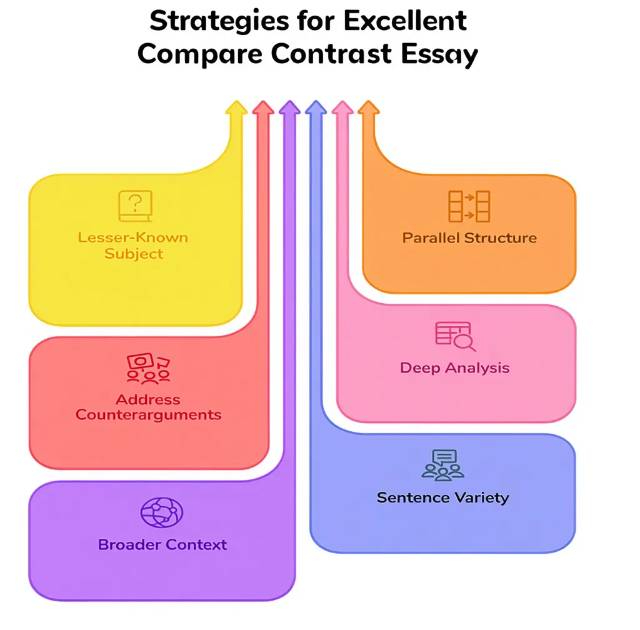
Take your essays from good to exceptional with these advanced strategies:
1. Start with a Lesser-Known Subject: When using the block method, discuss your less familiar subject first. This builds reader knowledge before tackling the more complex subject, improving comprehension.
2. Use Parallel Structure: Mirror your language structure when discussing comparable points: "Subject A achieves X through method Y, while Subject B achieves X through method Z." Parallel construction enhances clarity.
3. Address Counterarguments: If you're arguing that one subject is superior, acknowledge the other's strengths before explaining why your position prevails. This demonstrates thorough analysis and strengthens credibility.
4. Go Beyond Surface Features: The best essays explore underlying causes, implications, or principles rather than just observable characteristics. Ask "why" repeatedly to deepen your analysis.
5. Connect to Broader Context: Show how your comparison illuminates larger issues, theories, or questions beyond the immediate subjects. This demonstrates sophisticated thinking.
6. Vary Your Sentence Structure: Mix short and long sentences. Combine simple and complex structures. Variety maintains reader engagement and demonstrates writing sophistication.
7. Use Specific Examples: Replace vague references with concrete details: instead of "the novel uses symbolism," write "the green light symbolizing Gatsby's impossible dream appears in five critical scenes."
8. Maintain Academic Tone: Avoid casual language, contractions, and personal pronouns (unless specifically permitted). Keep tone professional while remaining engaging.
9. Cite Sources Properly: When incorporating outside information, always cite sources using your required citation style (MLA, APA, Chicago). Proper citation demonstrates academic integrity and strengthens credibility.
10. Read Examples in Your Subject Area: Study successful essays in your specific discipline. Literary comparisons differ from scientific comparisons; learn conventions for your field.
Take Your Comparison Essay From Good to Exceptional
Success in compare and contrast writing stems from three key elements: strategic subject selection that presents genuine analytical opportunities, thoughtful organizational structure that guides readers through the comparison clearly, and analytical depth that delves beyond surface observations to explore the underlying significance.
Remember these key principles:
- Choose subjects from the same category with meaningful similarities and differences
- Select an organizational method (point-by-point or block) suited to your subjects and assignment length
- Develop a thesis that argues something significant rather than merely announcing comparison topics
- Maintain a balanced analysis between subjects
- Use transitions extensively to guide readers
- Support all claims with specific evidence
- Synthesize insights in your conclusion rather than simply summarizing
Students who start 7-10 days before deadlines produce stronger essays than those who wait. Start today.
Struggling to balance multiple subjects while maintaining clear analysis? Our essay writing service specializes in crafting well-organized comparison essays that examine relationships thoughtfully, use specific evidence effectively, and draw meaningful conclusions.
Free Downloadable Resources and Templates
Accelerate your writing process with our comprehensive resource collection:
Still Unsure How to Write Your Own Essay?
Our professional writers help you move from examples to a polished final draft:
- Personalized topic development
- Clear structure and strong storytelling
- Reflection that admissions officers value
- 100% original, human-written essays
Get support that turns examples into success.
Order NowBottom Line
The most important step? Starting.
Don't wait for perfect circumstances or complete clarity. Begin with these actions:
- Choose comparable subjects from the same category
- Identify 3-5 meaningful comparison criteria
- Research both subjects thoroughly
- Select your organizational method deliberately
- Draft systematically following your chosen structure
Start your next comparison essay with confidence. You have everything you need to succeed.