Choose a Perfect Compare and Contrast Topic
The Five Essential Topic Selection Criteria
Before browsing interesting comparison topics, understand what makes these topics work. 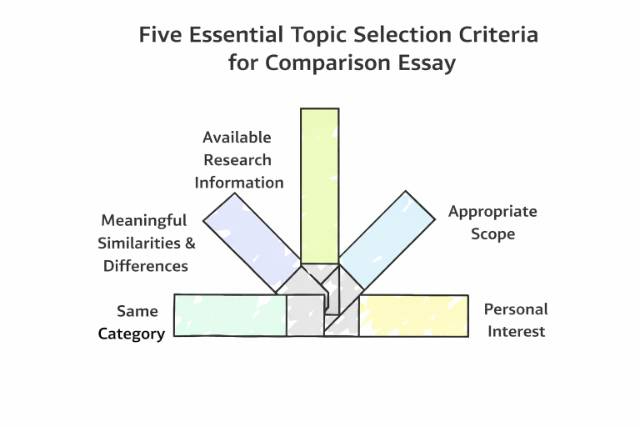
Evaluate every potential topic against these five criteria:
Same Category: Choose subjects that belong to the same category so comparisons feel logical and fair.
Meaningful Similarities & Differences: Ensure the subjects share enough similarities to compare and enough differences to analyze meaningfully.
Available Research Information: Select topics with sufficient credible sources to support evidence based comparisons.
Appropriate Scope: Avoid topics that are too broad or too narrow; the comparison should fit the essay length and depth required.
Personal Interest: Pick a topic you genuinely care about to maintain engagement and produce a more thoughtful, focused analysis.
Topic Selection Red Flags
Avoid topics showing these warning signs:
- Unrelated subjects lacking common ground
- Obvious comparisons yield no insights
- Subjects you know nothing about
- Overdone topics with no fresh angles
- Topics your instructor specifically prohibited
While keeping the above topic selection criteria and red flag, let's move on to our latest compare and contrast topics by categories.
Topic not selected yet? Deadline looming. Blank page staring back.
Our expert writers can help you out anytime:
- Ask your story to select a perfect topic
- Write in YOUR authentic voice (never generic)
- Use specific details
- Plagiarism Free
Zero AI. Just essays that actually get you accepted.
Order Now1. Literature & Books Comparison Topics

Comparison essay topics that compare classic novels, literary movements, character dynamics, or authorial styles:
- 1984 by George Orwell vs. Brave New World by Aldous Huxley
- Pride and Prejudice vs. Jane Eyre
- The Great Gatsby vs. The Catcher in the Rye
- Sherlock Holmes vs. Hercule Poirot as detective characters
- Romeo and Juliet vs. West Side Story
- Harry Potter series vs. The Lord of the Rings trilogy
- The Hunger Games vs. Battle Royale
- To Kill a Mockingbird vs. Go Set a Watchman
- Gothic literature vs. Romantic literature
- Frankenstein the novel vs. Frankenstein film adaptations
- Shakespeare's tragedies vs. Shakespeare's comedies
- The Odyssey vs. The Aeneid
- Modernist literature vs. Postmodernist literature
- American literature vs. British literature of the 19th century
- First-person narration vs. Third-person narration
- Wuthering Heights vs. Rebecca
- The Picture of Dorian Gray vs. Dr. Jekyll and Mr. Hyde
- The Handmaid's Tale book vs. TV adaptation
- Epic poetry vs. Lyric poetry
- Dystopian fiction vs. Utopian fiction
- Animal Farm vs. Lord of the Flies
- Stream of consciousness writing vs. Traditional narrative structure
- Crime and Punishment vs. The Brothers Karamazov
- Young adult fiction vs. Adult fiction
- Fahrenheit 451 vs. Modern Censorship Concerns
2. History & Historical Figures Comparison Topics
Compare contrast topics that compare historical periods, leaders, movements, or significant events:
- World War I vs. World War II
- The American Revolution vs. The French Revolution
- The Renaissance vs. The Enlightenment
- Ancient Rome vs. Ancient Greece
- Abraham Lincoln vs. George Washington as presidents
- The Cold War vs. Modern US-China tensions
- Martin Luther King Jr. vs. Malcolm X's approaches to civil rights
- The Industrial Revolution vs. The Digital Revolution
- Colonialism in Africa vs. Colonialism in Asia
- Julius Caesar vs. Alexander the Great as military leaders
- The Great Depression vs. The 2008 Financial Crisis
- Feudalism vs. Capitalism
- The Mongol Empire vs. The Roman Empire
- Napoleon Bonaparte vs. Adolf Hitler's military strategies
- The American Civil War vs. The Spanish Civil War
- Ancient Egyptian civilization vs. Mesopotamian civilization
- Winston Churchill vs. Franklin D. Roosevelt's leadership during WWII
- The Protestant Reformation vs. The Counter-Reformation
- Medieval Europe vs. Medieval Japan
- The British Empire vs. The Spanish Empire
- Slavery in the United States vs. Serfdom in Russia
- The Women's Suffrage Movement vs. Modern feminist movements
- The Space Race of the 1960s vs. Current Space Exploration
- The Black Plague vs. The COVID-19 pandemic
- The Silk Road vs. Modern Global Trade Routes
3. Science & Technology Comparison Topics

These are some good compare and contrast essay topics: compare scientific theories, technological innovations, or research methodologies:
- Theory of Evolution vs. Creationism
- Renewable energy vs. Fossil fuels
- Classical physics vs. Quantum physics
- DNA vs. RNA structure and function
- iPhone vs. Android smartphones
- Electric cars vs. Gasoline powered cars
- Artificial Intelligence vs. Human Intelligence
- Solar energy vs. Wind energy
- Space exploration by government agencies vs. Private companies
- Newton's laws of motion vs. Einstein's theory of relativity
- Climate change vs. Natural climate variation
- 3G technology vs. 5G technology
- Nuclear energy vs. Coal energy
- Vaccines vs. Natural immunity
- The human brain vs. Computer processors
- Genetic engineering vs. Traditional breeding methods
- Virtual Reality (VR) vs. Augmented Reality (AR)
- Organic farming vs. Conventional farming
- Asexual reproduction vs. Sexual reproduction
- Cloud computing vs. Local storage
- Mitosis vs. Meiosis
- Aerobic respiration vs. Anaerobic respiration
- The Scientific Method vs. Indigenous Knowledge Systems
- 3D printing vs. Traditional manufacturing
- Gene therapy vs. Traditional medicine
4. Education & Learning Compare Contrast Topics

Some easy compare and contrast essay topics: Compare educational systems, teaching methods, or learning environments:
- Online learning vs. Traditional classroom learning
- Public schools vs. Private schools
- Homeschooling vs. Traditional schooling
- College education vs. Vocational training
- Studying alone vs. Group study sessions
- Standardized testing vs. Project based assessment
- Montessori education vs. Traditional education
- American education system vs. Finnish education system
- Liberal arts education vs. STEM-focused education
- Learning a second language as a child vs. as an adult
- Rote memorization vs. Critical thinking approaches
- Community college vs. Four-year university
- Gap year vs. Going straight to college
- Lecture-based learning vs. Hands-on learning
- Single-sex schools vs. Co-educational schools
- Teacher-centered learning vs. Student-centered learning
- Grading systems: Letter grades vs. Pass/Fail
- Early childhood education vs. Elementary education priorities
- Free college education vs. Tuition-based systems
- School uniforms vs. Casual dress codes
- Year-round schooling vs. Traditional school calendar
- Special education inclusion vs. Separate special education programs
- Arts education vs. STEM education funding priorities
- Bilingual education vs. English-only instruction
- Academic competition vs. Collaborative learning environments
5. Social Issues & Culture Compare Contrast Topics
These are some controversial compare and contrast topics: Compare social movements, cultural practices, or societal structures:
- Eastern culture vs. Western culture
- Individualism vs. Collectivism
- Urban living vs. Rural living
- Traditional marriage vs. Modern partnerships
- Generation Z vs. Millennials
- Cancel culture vs. Free speech debates
- Social media activism vs. Traditional activism
- Nuclear family vs. Extended family structures
- American Dream vs. European lifestyle priorities
- Arranged marriages vs. Love marriages
- Fast food culture vs. Slow food movement
- Materialism vs. Minimalism
- Body positivity movement vs. Traditional beauty standards
- Immigration policies: Open borders vs. Strict regulations
- Gun control vs. Gun rights in America
- Traditional gender roles vs. Modern gender equality
- Capitalism vs. Socialism
- Religion vs. Secularism in Public Life
- Nationalism vs. Globalism
- Online privacy vs. Security concerns
- Work-life balance in the US vs. Europe
- Traditional media vs. Social media influence
- Cultural appropriation vs. Cultural appreciation
- Meritocracy vs. Affirmative Action Policies
- Consumerism vs. Sustainable Living
6. Arts & Entertainment Compare Contrast Topics

These are some fun compare and contrast topics that compare artistic movements, entertainment formats, or creative mediums:
- Classical music vs. Modern pop music
- Marvel Cinematic Universe vs. DC Extended Universe
- Reading books vs. Watching movies
- Theater performances vs. Film adaptations
- Impressionism vs. Expressionism in art
- Hip-hop vs. Rock music
- Digital art vs. Traditional painting
- Streaming services (Netflix, Hulu) vs. Cable television
- Video games vs. Board games
- Renaissance art vs. Baroque art
- Comedy films vs. Horror films
- Live concerts vs. recorded music
- Reality TV vs. Scripted Television
- Photography vs. Painting as art forms
- Animated films vs. Live-action films
- Social media influencers vs. Traditional celebrities
- Podcasts vs. Radio shows
- Indie films vs. Blockbuster movies
- Jazz vs. Blues music
- Sculpture vs. Installation art
- Stand-up comedy vs. Sketch comedy
- Broadway musicals vs. Opera
- Graphic novels vs. Traditional novels
- Dance as performance art vs. Dance as sport
- Documentary films vs. Historical fiction films
7. Health & Lifestyle Compare Contrast Topics

This compare and contrast topics list compares health practices, lifestyle choices, or wellness approaches:
- Vegetarian diet vs. Meat-based diet
- Western medicine vs. Alternative medicine
- Gym workouts vs. Home workouts
- Mental health vs. Physical health priorities
- Yoga vs. Pilates
- Fast food vs. Home-cooked meals
- Running vs. Swimming for cardio fitness
- Morning workouts vs. Evening workouts
- Organic food vs. Conventional food
- Intermittent fasting vs. Traditional meal schedules
- Preventive medicine vs. Reactive treatment
- High-intensity interval training (HIIT) vs. Steady-state cardio
- Coffee vs. Tea health benefits
- Meditation vs. Physical exercise for stress relief
- Sleep quality vs. Sleep quantity
- Plant-based protein vs. Animal protein
- Traditional therapy vs. Online therapy
- Bottled water vs. Tap water
- Weight training vs. Cardio for weight loss
- Natural remedies vs. Pharmaceutical drugs
- Keto diet vs. Mediterranean diet
- Team sports vs. Individual sports for fitness
- Indoor tanning vs. Sun tanning risks
- Processed foods vs. Whole foods
- Active lifestyle vs. Sedentary lifestyle health impacts
Topic Selected? Don't know how to proceed?
Tell us what you need, our experts will handle the research, writing, and formatting.
- Original work with zero plagiarism
- Fast turnaround
- Expert writers across all subjects
- Free AI and plagiarism reports
No AI shortcuts. Just expert-level quality.
Order Now8. Politics & Government Compare and Contrast Topics
These interesting comparison topics compare political systems, ideologies, or governance approaches:
- Democracy vs. Dictatorship
- Capitalism vs. Communism
- Federal government vs. State government powers
- Presidential system vs. Parliamentary system
- Two-party system vs. Multi-party system
- Liberal ideology vs. Conservative ideology
- Direct democracy vs. Representative democracy
- Monarchy vs. Republic
- Socialism vs. Capitalism
- United Nations vs. NATO as international organizations
- Right-wing politics vs. Left-wing politics
- Electoral College vs. Popular Vote Systems
- Supreme Court activism vs. Judicial restraint
- Progressive taxation vs. Flat tax systems
- Big government vs. Small government approaches
- Authoritarian leadership vs. Democratic leadership
- Political campaigns then (1960s) vs. now
- Lobbyists vs. Grassroots movements in politics
- Checks and balances vs. Parliamentary supremacy
- Isolationism vs. Interventionism in foreign policy
- Term limits vs. Unlimited terms for politicians
- Public funding of campaigns vs. Private donations
- Brexit vs. European Union membership benefits
- Political polarization in the US vs. Europe
- Executive orders vs. Legislative action
9. Business & Economics Compare and Contrast Topics

These unique comparison essay topics compare business models, economic theories, or financial systems:
- Entrepreneurship vs. Corporate employment
- Stock market investing vs. Real estate investing
- Remote work vs. Office-based work
- Small businesses vs. Large corporations
- Keynesian economics vs. Austrian economics
- Franchising vs. Starting an independent business
- Credit cards vs. Debit cards
- Renting vs. Buying a Home
- Traditional retail stores vs. E-commerce
- Gig economy vs. Traditional employment
- Minimum wage jobs vs. Living wage standards
- Marketing in the 1980s vs. Digital marketing today
- Monopolies vs. Perfect competition
- Supply-side economics vs. Demand-side economics
- Angel investors vs. Venture capitalists
- Traditional Banking vs. Cryptocurrency
- Customer service then vs. now
- Advertising on TV vs. Social media advertising
- Manufacturing in the US vs. Outsourcing overseas
- Family-owned businesses vs. publicly traded companies
- Profit maximization vs. Social responsibility in business
- Bull market vs. Bear market investing strategies
- Savings accounts vs. Investment accounts
- Free Trade vs. Protectionism
- Traditional resumes vs. LinkedIn profiles for job hunting
10. Environment & Nature Compare and Contrast Topics
These compare and contrast essay topics for high school to college: Compare environmental issues, ecosystems, or conservation approaches:
- Climate change causes: Human activity vs. Natural cycles
- Biodegradable plastics vs. Traditional plastics
- Deforestation vs. Reforestation efforts
- Endangered species conservation: Zoos vs. Natural habitats
- Ocean ecosystems vs. Freshwater ecosystems
- Tropical rainforests vs. Temperate forests
- Natural disasters: Hurricanes vs. Tornadoes
- Recycling vs. Waste Reduction Strategies
- Solar panels vs. Wind turbines for home energy
- Global warming effects: Arctic vs. Antarctic regions
- Agricultural runoff vs. Industrial pollution
- National parks vs. Wildlife reserves
- Predators vs. Prey in Ecosystem Balance
- Deserts vs. Tundras as extreme environments
- Natural evolution vs. Human-induced evolution
- Coral reefs vs. Kelp forests
- Invasive species vs. Native species
- Carbon footprint of plant-based diets vs. Meat-based diets
- Water conservation: Individual efforts vs. Industrial regulation
- Monoculture farming vs. Polyculture farming
- Natural pest control vs. Chemical pesticides
- Adaptation vs. Mitigation strategies for climate change
- Urban sprawl vs. Sustainable city planning
- Plastic bag bans vs. Plastic tax policies
- Wildlife photography vs. Wildlife documentaries for conservation awareness
After selecting your topic, don't forget to choose the right method and structure for your essay. For that, visit our compare and contrast essay outlines.
Educational-Level Comparison Table
Criteria | Middle School | High School | College |
Required Skills | Basic comparison, identifying similarities/differences | Critical thinking, structured analysis | Advanced reasoning, integration of scholarly sources |
Depth of Analysis | Surface-level observations | Moderate depth with evidence | High depth using theories, research, and interpretation |
Topic Complexity | Simple, familiar, everyday subjects | Historical, literary, and scientific topics with moderate depth | Abstract, theoretical, discipline-specific topics |
Example Topic Types | Books vs movies, pets, hobbies | Revolutions, literary genres, energy types | Philosophical theories, economic models, psychological frameworks |
Comparison Topics to Avoid
Some comparison essay topics create problems regardless of how well you write. Avoid:
1. Overdone Topics Without Fresh Angles:
- High school versus college (unless you have unique insight)
- Dogs versus cats (exhausted topic)
- City versus country living (clichéd comparison)
These topics can work with fresh analytical angles, but require significant originality to overcome reader fatigue. Learn from our compare and contrast essay examples about structure and writing techniques.
2. Subjects You Can't Research:
- Two obscure historical figures with limited sources
- Proprietary technologies with no public information
- Personal experiences only you know about (unless assignment allows)
3. Incomparable Subjects:
- Topics from completely different categories
- One concrete subject, one abstract concept
- One well-documented subject, one with no available information
4. Overly Controversial Topics Requiring Extreme Sensitivity:
- Religious texts (risks offending readers without careful handling)
- Sensitive political topics (extremely difficult to analyze fairly)
- Tragic historical events (requires exceptional care)
These aren't forbidden, but they demand sophisticated handling beyond most students' skill levels. Choose carefully.
GOT YOUR TOPIC? Our professional essay writing service can take it from here, research, writing, and formatting all handled.
Downloadable Compare and Contrast Topic Resources
Topic Development Tools:
See What Works But Not Sure How to Apply It?
Our expert writers craft comparison essays daily:
- Organize complex subjects into clear structures
- Balance analysis between subjects perfectly
- Use specific evidence throughout
- Plagiarism Free
Zero AI. Join thousands of satisfied students
Order NowBottom Line
Start your next compare and contrast essay with confidence, knowing you've chosen a topic with genuine analytical potential. Once you've selected your topic, transform it into a detailed analysis using our complete resource collection. Master the full writing process with our comprehensive compare and contrast essay guide. These integrated resources provide everything you need for essay success from topic selection through final revision. Strategic topic selection is half the battle; the right topic makes everything else easier.