What Is a Rhetorical Analysis Essay?
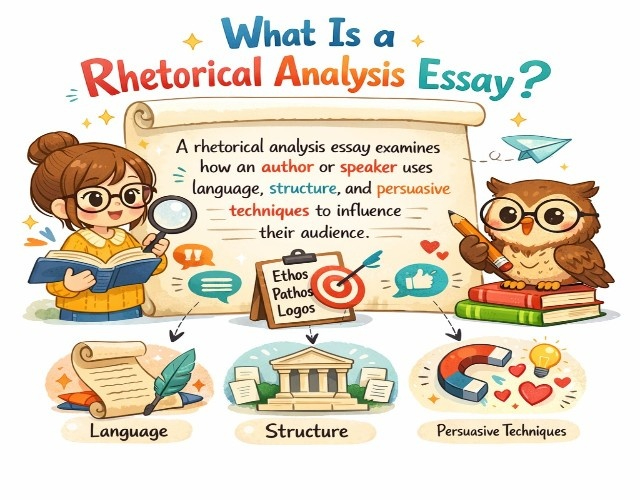
A rhetorical analysis essay examines how an author or speaker uses language, structure, and persuasive techniques to influence their audience. Unlike a summary (which tells what the text says) or an argument essay (where you take a position), rhetorical analysis focuses on the "how" and "why" behind the author's choices.
Key difference:
- Summary: "Martin Luther King Jr. argued for civil rights."
- Analysis: "King uses anaphora ('I have a dream...') to build emotional momentum, reinforcing his vision through repetition that makes the message memorable and moving."
What is a rhetorical analysis essay analyzing?
You're breaking down:
- The author's purpose: What are they trying to achieve? (Persuade? Inform? Inspire?)
- The audience: Who are they writing for? How does this shape their approach?
- Rhetorical strategies: What techniques do they use? (Appeals to emotion, logic, credibility)
- Effectiveness: Do these strategies work? Why or why not?
The rhetorical analysis meaning centers on understanding persuasion as a craft, examining the tools writers and speakers use to move audiences.
Key Elements of Rhetorical Analysis:
- A clear thesis about the author's rhetorical strategy
- Evidence from the text (quotes, examples, techniques)
- Analysis of how these strategies affect the audience
- Evaluation of effectiveness
What is analytical writing in this context?
Rhetorical analysis is a form of analytical writing where you dissect how communication works. You're not giving your opinion on the topic; you're explaining how the author builds their case and whether their techniques successfully achieve their purpose.
24/7 RHETORICAL ANALYSIS ESSAY HELP
Our writers deliver polished rhetorical analysis essays, researched, analyzed, structured, and ready to submit.
- 100% human written analysis
- Delivered on time, every time
- Unlimited revisions
- Written by degree holding experts
No AI. Just real writers, real results.
Order NowTypes of Rhetorical Analysis
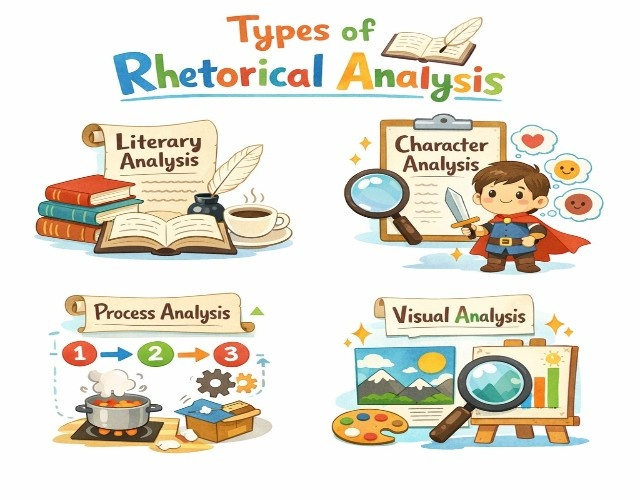
Rhetorical analysis essays can analyze different types of texts; here's where to learn about each:
- Literary Analysis: Analyzes literary texts and techniques.
- Character Analysis: Studies character development and representation.
- Process Analysis: Examines how-to instructions and procedures.
- Visual Analysis: Studies visual rhetoric in images and design.
The Rhetorical Triangle (Ethos, Pathos, Logos)
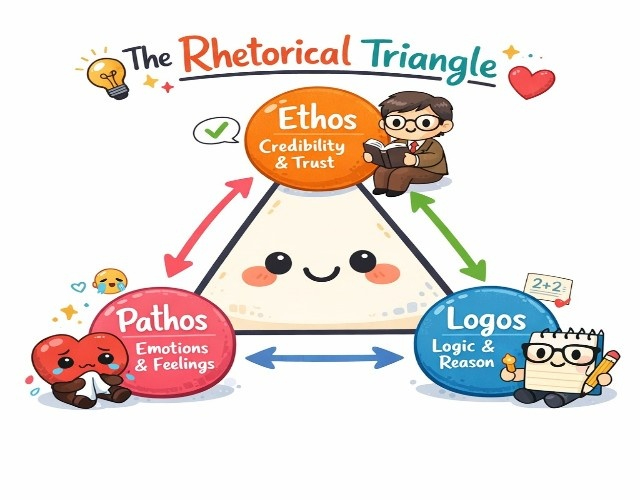
Before you can write a rhetorical analysis essay, you need to understand the three core appeals, often called the rhetorical triangle.
1. Ethos (Credibility/Authority)
Ethos refers to the author's credibility and character. How do they establish trust and authority?
Questions to ask
- What are the author's credentials or expertise?
- Do they cite credible sources?
- How do they present themselves? (Professional? Relatable? Authoritative?)
- Do they acknowledge counterarguments fairly?
For Instance: A doctor writing about vaccines has high ethos because of their medical expertise. They strengthen ethos by citing peer reviewed studies.
2. Pathos (Emotional Appeals)
Pathos appeals to the audience's emotions, fear, anger, joy, sympathy, and pride.
Questions to ask
- What emotions does the author evoke?
- What language creates emotional responses? (Vivid descriptions, loaded words, personal stories)
- Are there anecdotes or examples that tug at heartstrings?
- What imagery or metaphors create emotional impact?
For Instance: An animal shelter ad showing abandoned dogs with sad music uses pathos to evoke sympathy and motivate donations.
3. Logos (Logic/Reason)
Logos appeals to logic through facts, statistics, data, and rational arguments.
Questions to ask
- What evidence does the author provide? (Statistics, facts, expert testimony)
- Is the argument logically structured?
- Are there cause and effect relationships explained?
- Does the reasoning make sense?
For Instance: A climate change article citing temperature data, scientific studies, and projections uses logos to build a fact based argument.
The Rhetorical Triangle in Action
Effective rhetoric typically combines all three
- Ethos establishes "I'm trustworthy."
- Logos proves "This makes logical sense."
- Pathos motivates "You should care about this."
How to Write a Rhetorical Analysis Essay (Step by Step)
Writing a rhetorical analysis essay doesn't have to be overwhelming. Here's the process, broken into manageable steps.
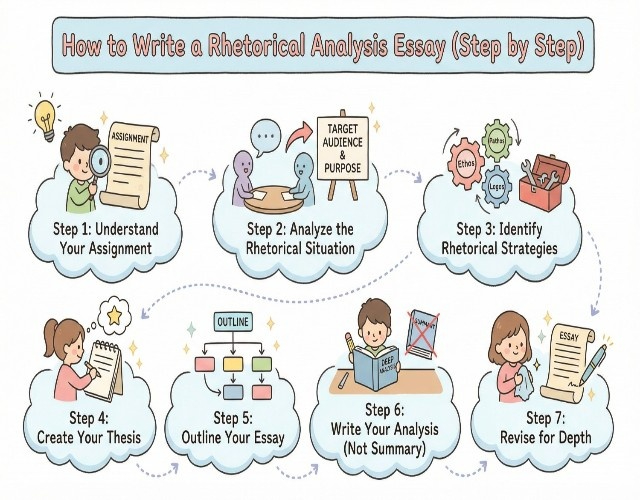
Step 1: Understand Your Rhetoric Assignment
Before analyzing, know what you're being asked to do.
Look for
- What text are you analyzing? (Speech, article, ad, video)
- What's the focus? (All rhetorical strategies or specific ones like ethos?)
- Length requirements? (Word count, page limit)
- Format requirements? (MLA, APA, citation style)
Questions to ask yourself
|
Step 2: Analyze the Rhetorical Situation (SOAPSTone)
Use the SOAPSTone framework to understand the text's context:
| S: Speaker: Who created this text? What's their background? |
| O: Occasion: What prompted this communication? Historical/social context? |
| A: Audience: Who is the intended audience? What are their beliefs/values? |
| P: Purpose: What does the author want to achieve? (Persuade, inform, inspire, call to action) |
| S: Subject: What is the topic or main idea? |
| Tone: What is the author's attitude? (Serious, sarcastic, passionate, objective) |
Step 3: Identify Rhetorical Strategies
Read the text closely and annotate rhetorical techniques.
Look for:
Rhetorical appeals:
- Where does the author use ethos, pathos, logos?
- Which appeals are strongest?
Rhetorical devices:
| Repetition/Anaphora: Repeating phrases for emphasis ("I have a dream...") |
| Metaphor/Analogy: Comparing concepts for clarity |
| Rhetorical Questions: Questions that don't need answers but make you think |
| Allusion: References to history, literature, culture |
| Imagery: Vivid sensory descriptions |
| Juxtaposition: Placing opposites side-by-side for contrast |
| Parallelism: Similar grammatical structures for rhythm |
Stylistic choices
- Diction: Word choice (formal vs. informal, technical vs. accessible)
- Syntax: Sentence structure (short and punchy vs. long and complex)
- Tone: Attitude conveyed through language
Need topic ideas? See our rhetorical analysis essay topics for inspiration across speeches, articles, and advertisements.
Step 4: Create Your Rhetoric Thesis
Your thesis should argue how and why the author's rhetorical strategies are effective (or not).
Formula: [Author] uses [strategy 1], [strategy 2], and [strategy 3] to [achieve purpose] for [audience].
Step 5: Organize Your Rhetorical Essay
Structure your analysis logically.
Basic structure
For a detailed template, grab our rhetorical analysis essay outline. |
Pro tip: Don't just list strategies chronologically; organize by type of appeal or by strength of argument.
Step 6: Write Your Analysis (Not Summary)
This is where students struggle most. You must analyze, not summarize.
- Don't write:
"King says he has a dream. Then he talks about freedom. Then he mentions different states."
This is a summary; you're just retelling. - Do write:
"King's anaphoric repetition of 'I have a dream' creates a rhythmic momentum that builds emotional intensity with each iteration, transforming abstract ideals into a visceral vision that audiences can almost see and feel."
This is analysis, you're explaining HOW and WHY the technique works.
Analysis formula
| 1. Identify the technique: "King uses anaphora..." 2. Quote/cite evidence: "...'I have a dream' repeated nine times..." 3. Explain effect: "...which builds emotional intensity..." 4. Connect to purpose: "...transforming his message into a memorable rallying cry for justice." |
Step 7: Revise for Depth
First drafts often describe what the author does without explaining why it matters.
Revision checklist:
- Does each body paragraph focus on ONE strategy?
- Do I explain WHY the author chose this technique?
- Do I analyze the EFFECT on the audience?
- Do I connect strategies to the author's overall purpose?
- Am I analyzing (not summarizing)?
- Do I evaluate effectiveness?
How to Start a Rhetorical Analysis Essay
Your introduction either hooks the reader or loses them. Here's how to start a strong rhetorical analysis essay strong.
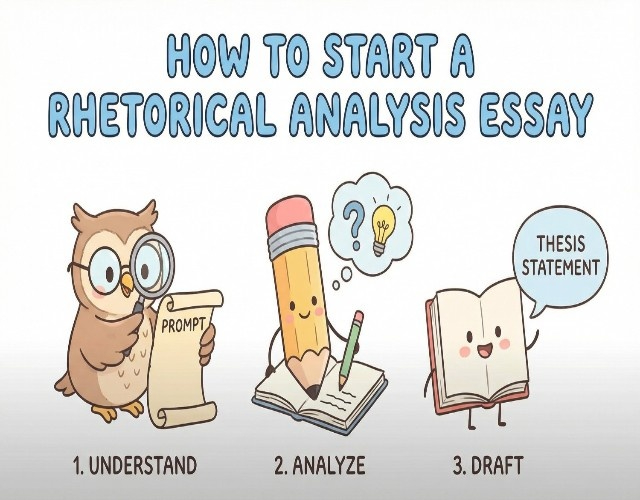
Opening strategies:
Start with the text's impact or significance:
"Martin Luther King Jr.'s 'I Have a Dream' speech remains one of the most powerful pieces of American oratory, not because of what it says, but because of how it says it."Open with a provocative question about rhetoric:
"What makes some speeches forgettable while others echo through history? The answer lies in rhetorical strategy."Begin with a relevant quote from the text:
"'I have a dream', four simple words, repeated eight times, that transformed a political speech into a cultural touchstone."Set the rhetorical context:
"In August 1963, as 250,000 people gathered at the Lincoln Memorial, Martin Luther King Jr. faced a rhetorical challenge: how to inspire a movement while speaking to a divided nation."
What to include in your intro:
Hook (1 to 2 sentences) |
Context (2 to 3 sentences) |
| Thesis statement (1 to 2 sentences) Your argument about the author's rhetorical strategies |
Common mistakes to avoid
- Starting with "In this essay, I will analyze..."
Too formulaic and unnecessary - Dictionary definitions of rhetoric
Boring and elementary - Too much plot summary before analysis
Get to your rhetorical argument quickly
See how the pros do it in our rhetorical analysis essay examples.
Need Help with Your Rhetorical Analysis Essay?
Expert Writing Support That Strengthens Your Analysis
- Get professional help identifying ethos, pathos, and logos with clarity and accuracy
- Receive a custom written rhetorical analysis essay tailored to your prompt and rubric
- Improve structure, argument flow, and evidence selection with expert level insights
- Save time and reduce stress while ensuring original, plagiarism free work
100% human written. Satisfaction guaranteed.
Order NowRhetorical Analysis Essay Structural Layout
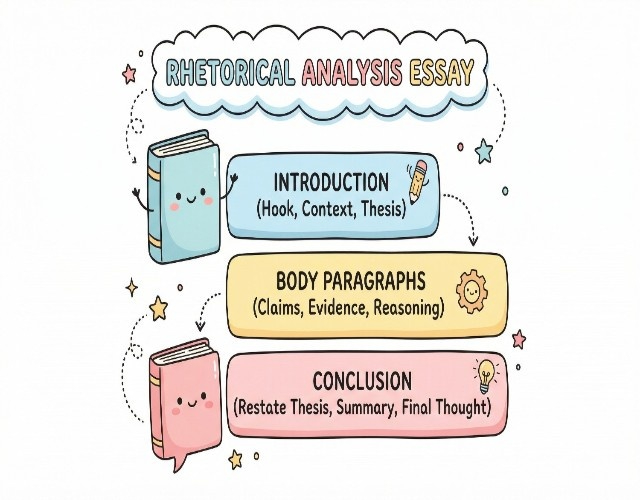
Every rhetorical analysis essay follows the same basic structure. Here's what each part does.
1. Introduction (10 to 15% of essay)
Purpose: Establish rhetorical situation and present your thesis
Components
| Hook: Engaging opening that establishes significance |
| Context: SOAPSTone elements (speaker, occasion, audience, purpose) |
| Thesis: Your argument about the author's rhetorical strategies |
Length: For a 1,000 word essay, aim for 100 to 150 words.
2. Body Paragraphs (70 to 80% of essay)
Purpose: Analyze specific rhetorical strategies with evidence
Each paragraph should: Focus on ONE rhetorical strategy or appeal and follow AXES structure
A : Assertion: Topic sentence about the strategy |
| X: EXample: Quote or evidence from text |
| E: Explanation: Analysis of HOW it works |
| S: Significance: WHY it matters for the author's purpose |
How many paragraphs?
- Minimum: 3 body paragraphs (one for each main strategy)
- Typical: 4 to 5 paragraphs for thorough analysis
- AP Lang exam: 2 to 3 paragraphs due to time constraints
Organization options:
Option 1: By appeal type
- Paragraph 1: Ethos
- Paragraph 2: Pathos
- Paragraph 3: Logos
Option 2: By rhetorical strategy
- Paragraph 1: Repetition/anaphora
- Paragraph 2: Metaphor and imagery
- Paragraph 3: Allusions
Option 3: Chronological
- Paragraph 1: Opening strategies
- Paragraph 2: Middle development
- Paragraph 3: Conclusion techniques
Conclusion (10 to 15% of essay)
Purpose: Synthesize analysis and evaluate effectiveness
What to include
Restate thesis (reframe, don't copy-paste)
| Synthesize main strategies and how they work together |
| Evaluate effectiveness: Did the author achieve their purpose? |
| Broader significance: Why does this rhetoric matter beyond the immediate context? |
What to avoid
- Introducing new evidence or strategies
- Starting with "In conclusion...".
- Just repeating your introduction
Want a ready to use template? Grab our rhetorical analysis essay outline and fill in the blanks.
How to Write a Conclusion for a Rhetorical Analysis Essay
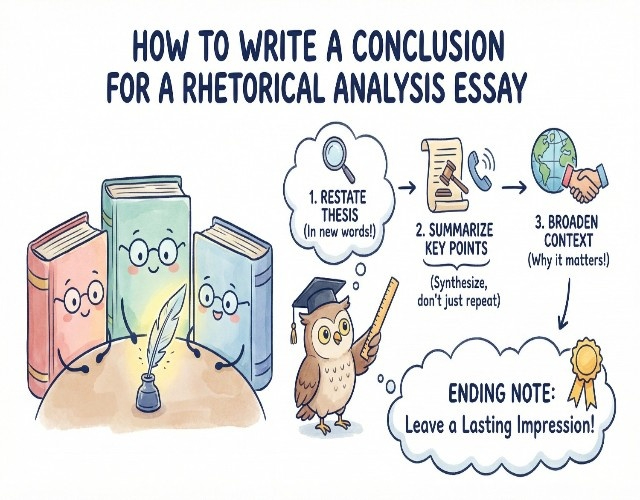
Your conclusion should synthesize your analysis without simply repeating your introduction. Start by restating your thesis in fresh language, and remind readers of your main argument about how the author uses rhetorical strategies (ethos, pathos, logos, etc.) to achieve their purpose. Then, briefly summarize the most significant rhetorical techniques you analyzed, emphasizing how they work together to persuade the audience.
Avoid introducing new analysis or evidence here; instead, zoom out to discuss the broader implications: Why does understanding these rhetorical choices matter? How effective was the author's overall approach? Does this text reveal anything important about persuasion, the issue being discussed, or the intended audience?
End with a final thought that provides closure, perhaps a reflection on the text's impact, relevance, or what it teaches us about effective communication. A strong conclusion leaves readers understanding not just what rhetorical strategies were used, but why they matter.
Writing Tips for a Strong Rhetorical Analysis Essay
Tip 1: Focus on HOW, Not Just WHAT
Don't just identify rhetorical devices, analyze their effect.
Always ask: How does this strategy help the author achieve their purpose? What effect does it have on the audience?
Tip 2: Analyze Rhetorical Choices, Not Content
Your job isn't to agree or disagree with the author, it's to examine their persuasive techniques.
Remember: You're analyzing how they argue, not whether they're right.
Tip 3: Use the Rhetorical Triangle
Connect every strategy to audience, purpose, and context.
For each technique you identify, explain:
- Audience: How does this appeal to the specific readers?
- Purpose: How does this advance the author's goal?
- Context: Why is this strategy appropriate for this situation/time period/medium?
Tip 4: Quote Strategically and Sparingly
Use short, precise quotes that demonstrate the strategy, don't quote entire paragraphs.
Use quotes to prove your point, not to fill space.
Tip 5: Discuss Multiple Strategies Working Together
Strong analyses show how rhetorical choices reinforce each other. Show synthesis, not just a checklist of devices.
Tip 6: Use Precise Rhetorical Vocabulary
Demonstrate knowledge of rhetorical terms, but define them if advanced.
Basic terms you should use:
Advanced terms (define when using):
|
Tip 7: Analyze Tone and Word Choice
Pay attention to connotation, not just denotation.
| Ask: Why this word instead of a synonym? What emotions or associations does it trigger? |
Tip 8: Consider What's NOT Said
Analyze omissions, silences, and what the author avoids addressing.
Strong rhetorical analysis notices:
|
Tip 9: Organize by Strategy or Chronologically
Choose the structure that best serves your analysis.
Option 1: By rhetorical appeal
- Paragraph on ethos strategies
- Paragraph on pathos strategies
- Paragraph on logos strategies
Option 2: Chronologically
- How the opening establishes credibility
- How the middle builds emotional connection
- How the conclusion reinforces logical argument
Option 3: By technique (most sophisticated)
- Paragraph on figurative language
- Paragraph on structural choices
- Paragraph on audience adaptation
Choose based on what best reveals the author's persuasive strategy.
Tip 10: Revise for Depth, Not Just Clarity
Ask deeper questions during revision.
First draft question: "Is this clear?"
Revision question: "Have I explained the significance of this strategy?"
Self check questions:
- Have I explained why this matters, not just what it is?
- Have I connected this strategy to the author's larger purpose?
- Have I considered the audience's likely response?
- Have I shown how strategies work together?
- Have I moved beyond obvious observations?
Stuck on your rhetorical analysis essay? Our professional essay writing service takes care of the analysis, thesis, and structure so you don’t have to.
Common Rhetorical Analysis Essay Mistakes (And How to Fix Them)
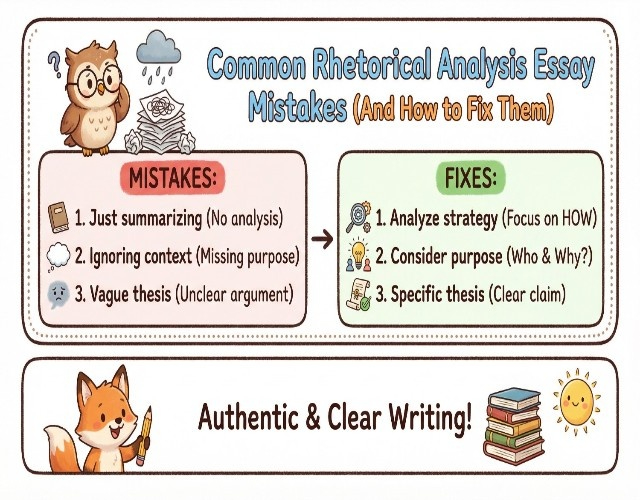
Mistake 1: Summarizing Instead of Analyzing
- What it looks like: "The author talks about climate change and provides statistics."
- Why it's wrong: You're describing what the text says, not how it persuades.
- Fix: Analyze the strategy. "The author uses statistical data to establish logos, making the argument appear scientifically credible to skeptical audiences."
Mistake 2: Stating the Obvious
- What it looks like: "The author uses emotional language to appeal to emotions."
- Why it's wrong: This is circular and doesn't show depth of analysis.
- Fix: Explain why and how it works. "The author's description of 'shivering children' evokes parental protective instincts, making middle-class readers feel personally responsible for addressing poverty."
Mistake 3: Agreeing or Disagreeing with the Argument
- What it looks like: "I think the author is right about gun control because..."
- Why it's wrong: Rhetorical analysis evaluates effectiveness, not whether you agree.
- Fix: Focus on the persuasive technique. "The author's use of personal anecdotes effectively appeals to pro regulation audiences but may alienate gun-rights advocates."
Mistake 4: Identifying Strategies Without Explaining Impact
- What it looks like: "The author uses metaphors, repetition, and rhetorical questions."
- Why it's wrong: Listing strategies isn't analysis; you must explain their effect.
- Fix: Connect strategy to purpose. "The repeated phrase 'we must act now' creates urgency, pressuring readers to support immediate policy change rather than delay."
Mistake 5: Ignoring Audience and Context
- What it looks like: Analyzing the text in a vacuum without considering who it's for.
- Why it's wrong: Rhetoric is about persuading a specific audience in a specific context.
- Fix: Always mention the audience. "While ethos appeals work for academic readers, the author's credentialing may not resonate with working-class audiences skeptical of experts."
Mistake 6: Weak or Missing Thesis
- What it looks like: "This essay will analyze the author's use of rhetoric."
- Why it's wrong: Too vague, doesn't state your argument about effectiveness.
- Fix: Make a claim. "Through strategic use of pathos and carefully selected statistics, the author effectively persuades moderate voters while alienating conservative audiences."
Mistake 7: Not Using Textual Evidence
- What it looks like: "The author uses lots of emotional appeals."
- Why it's wrong: Analysis requires specific examples from the text.
- Fix: Quote and cite. "The phrase 'our children's future hangs in the balance' (Smith 45) weaponizes parental anxiety to compel immediate action."
Mistake 8: Confusing Rhetorical Appeals
- What it looks like: Calling emotional language "logos" or statistics "pathos."
- Why it's wrong: Misidentifying strategies undermines your credibility.
- Fix: Learn the definitions:
Ethos = credibility/character Pathos = emotion Logos = logic/evidence |
Mistake 9: Writing in First Person Excessively
- What it looks like: "I think the author's metaphor is effective because I felt..."
- Why it's wrong: Focus should be on the text and audience, not your personal reaction.
- Fix: Use third person. "The metaphor effectively targets environmentally-conscious readers by..." (Use "I" sparingly, if at all.)
Mistake 10: Poor Organization
- What it looks like: Jumping randomly between ethos, pathos, and logos with no clear structure.
- Why it's wrong: Readers can't follow your analysis.
- Fix: Organize by:
Pick one and stick with it. |
Struggling to Break Down Rhetorical Strategies?
Get Professional Help That Turns Analysis into Strong Arguments
- Expert assistance in analyzing tone, audience, purpose, and rhetorical appeals
- Well structured essays that meet academic standards and grading rubrics
- In depth explanations that strengthen your critical thinking and writing skills
- On-time delivery with 100% original, citation ready content
Don’t let rhetorical analysis overwhelm you, partner with experienced academic writers who know how to turn complex texts into clear, high impact essays.
Order NowBottom Line
A rhetorical analysis essay is your chance to show you understand not just what an author says, but how they say it and why their techniques work. Focus on ethos, pathos, and logos. Analyze strategies, don't summarize. Always explain the effect on the audience and connect to the author's purpose.
Whether you write it yourself or get help, the key is producing an analysis that demonstrates critical thinking about how rhetoric shapes communication and persuasion.
Good luck with your rhetorical analysis!