Persuasive Speech Example: Social Media Regulation
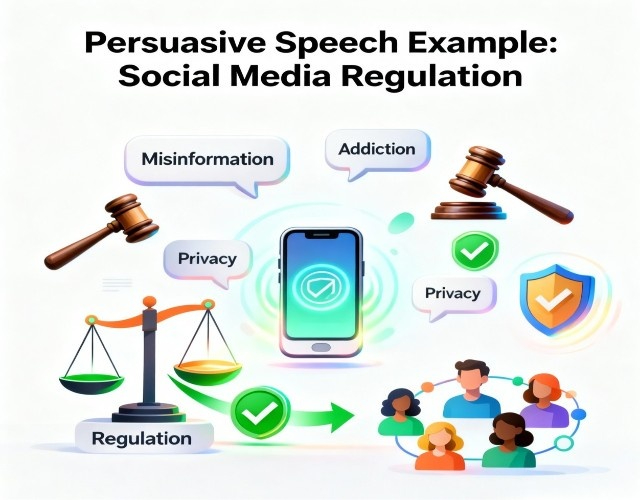
Topic: Why Social Media Companies Need Government Regulation
Length: 5 minutes (650 words)
Audience: College students
Why Social Media Companies Need Government Regulation
Do you remember what you were doing five minutes ago? If you're like 96% of people in this room, you were checking your phone. Not because you needed to. Not because someone called. But because you couldn't help it.
I'm here to tell you why that's not entirely your fault, and what we need to do about it.
Social media platforms have engineered their products to be addictive. They hire neuroscientists and behavioral psychologists specifically to keep you scrolling. Facebook's founding president Sean Parker, admitted in 2017 that they deliberately exploited "a vulnerability in human psychology." These aren't communication tools anymore, they're slot machines designed to hijack your attention.
The consequences are real. A 2023 study from Harvard Medical School found that teens who spend more than 3 hours daily on social media face double the risk of depression and anxiety. Instagram's own internal research, leaked by whistleblower Frances Haugen, showed that 32% of teen girls said the platform made them feel worse about their bodies. They knew. They didn't care. Profit came first.
Here's the problem: self-regulation has failed. For years, we've trusted these companies to police themselves. Mark Zuckerberg has apologized to Congress five times. Each time, nothing changed. In fact, things got worse. The Cambridge Analytica scandal exposed how 87 million users' data was harvested without consent to manipulate elections. TikTok's algorithm has been caught promoting dangerous challenges that have led to teen deaths. YouTube's recommendation system radicalized users by pushing increasingly extreme content.
Some people say regulation will stifle innovation. But that's nonsense. We regulate pharmaceutical companies, and medicine still innovates. We regulate the airline industry, and planes keep improving. We regulate food safety, and restaurants thrive. Regulation doesn't kill industries, it makes them accountable.
So what needs to happen? Three things:
First, ban manipulative design features. Infinite scroll, autoplay videos, and engagement-maximizing algorithms should be illegal for users under 18. Let kids use social media to connect with friends without the addiction mechanisms.
Second, require transparency in algorithms. Companies should disclose how their recommendation systems work and allow independent audits. If they're amplifying hate speech or misinformation to boost engagement, the public deserves to know.
Third, give users control over their data. You should own your information, not Mark Zuckerberg. Users should be able to see exactly what data is collected, how it's used, and have the right to delete it permanently.
Will these companies fight back? Absolutely. They'll spend millions lobbying against regulation. They'll claim it violates free speech, which is ironic since they already censor content constantly; they just want to do it without oversight. They'll say it's impossible to implement, even though the European Union already passed the Digital Services Act requiring exactly these protections.
The question isn't whether we can regulate social media. The question is: what are we waiting for? Every day we delay, more teens develop eating disorders from Instagram. More people fall into conspiracy theory rabbit holes on YouTube. More elections get manipulated through micro-targeted propaganda.
I'm not saying delete your apps tomorrow. I'm saying demand that the companies profiting from your attention be held to the same standards we apply to every other industry that affects public health.
The next time you mindlessly open Instagram, ask yourself: am I choosing this, or was I designed to do this? And then ask: shouldn't we do something about that?
Thank you.
What Makes This Persuasive Speech Example Work
|
A good, compelling speech example can help you understand how arguments are built and make it easier to choose a topic of your own. Want more ideas? Check our persuasive speech topics list for fresh, trending options.
Submit a Polished, Professional Speech
Our writers transform ideas into compelling arguments that actually persuade.
- 100% original, plagiarism free content
- Written by degree holding experts
- On time delivery, even for tight deadlines
- Unlimited revisions until you're satisfied
Free revisions. No plagiarism. Professional speechwriters.
Order NowInformative Speech Example: How Coffee Affects Your Brain
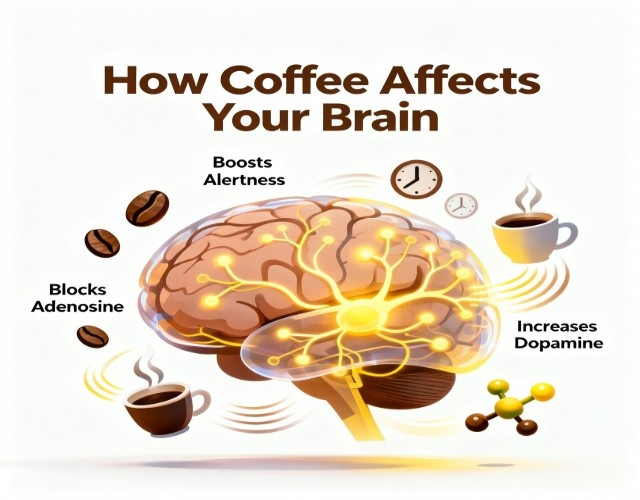
Topic: The Science of Caffeine
Length: 5 minutes (700 words)
Audience: General adult audience
How Coffee Affects Your Brain
Raise your hand if you've had coffee today. Keep your hand up if you've had more than one cup. Now keep it up, if you have no idea how caffeine actually works in your brain, you just know it helps.
Don't worry, you're not alone. Today I'm going to explain exactly what happens in your brain when you drink coffee, and why that afternoon crash is inevitable.
Let's start with what caffeine actually is. Caffeine is a chemical compound found naturally in coffee beans, tea leaves, and cocoa plants. When you drink coffee, caffeine enters your bloodstream within 15 minutes and reaches peak levels in about 45 minutes. But here's where it gets interesting.
Your brain produces a chemical called adenosine throughout the day. Adenosine builds up in your brain and makes you feel tired. It works like this: adenosine binds to receptors in your brain, slowing down neural activity and making you sleepy. Think of adenosine as your brain's sleep pressure gauge; the longer you're awake, the more adenosine accumulates.
Now here's the trick: caffeine molecules have almost the exact same shape as adenosine molecules. When you drink coffee, caffeine sneaks into your brain and occupies those adenosine receptors before adenosine can get there. It's like caffeine is sitting in adenosine's chair.
But, and this is crucial, caffeine doesn't actually reduce the adenosine in your brain. It just blocks the receptors. The adenosine is still there, building up, waiting. When the caffeine wears off after 5-6 hours, all that accumulated adenosine floods back to the receptors at once. That's why you crash. It's not the caffeine leaving; it's the adenosine tsunami that was held back, finally hitting you.
This is also why regular coffee drinkers need more caffeine to feel the same effect. Your brain responds to constant caffeine by creating more adenosine receptors. It's trying to compensate. So now you need more caffeine to block all those extra receptors. That's tolerance, and it develops in just 7 days of daily coffee consumption.
What about the energy boost? That's a different mechanism. When caffeine blocks adenosine, your brain thinks there's an emergency. Why else would the sleep signal be blocked? So it releases dopamine and adrenaline. Dopamine makes you feel good and focused. Adrenaline increases your heart rate and makes you alert. You feel energized, but it's actually your brain's stress response.
Here's something most people don't know: caffeine has a half life of 5 to 6 hours. Half-life means that if you have 200mg of caffeine at noon, about two cups of coffee, you still have 100mg in your system at 6 PM, and 50mg at midnight. That's why coffee at 3 PM can mess with your sleep even if you feel fine going to bed.
The sleep impact is significant. Studies from the American Academy of Sleep Medicine show that consuming caffeine even 6 hours before bedtime reduces total sleep time by more than one hour. You might fall asleep, but caffeine blocks deep sleep stages, so you wake up less rested.
So, should you quit coffee? Not necessarily. Moderate caffeine consumption, about 400mg daily, or four cups of coffee, is safe for most adults according to the FDA. Coffee also has antioxidants and has been linked to reduced risk of certain diseases.
However, understanding how it works helps you use it more effectively. Want to avoid the afternoon crash? Don't drink coffee first thing in the morning when cortisol is naturally high. Wait 90 minutes after waking. Want better sleep? Set a caffeine curfew, no coffee after 2 PM. And if you want to break tolerance, take a week off. It's miserable for 3 to 4 days, but then that single morning cup will actually work again.
Now you know: caffeine doesn't give you energy. It blocks the signal that tells you you're tired. It's not magic, it's brain chemistry. Use it wisely.
Thank you.
What Makes This Informative Speech Example Work
|
Pro Tip: Choosing the right informative speech topics can make your presentation more engaging and memorable.
Motivational Speech Example: Failure is Data
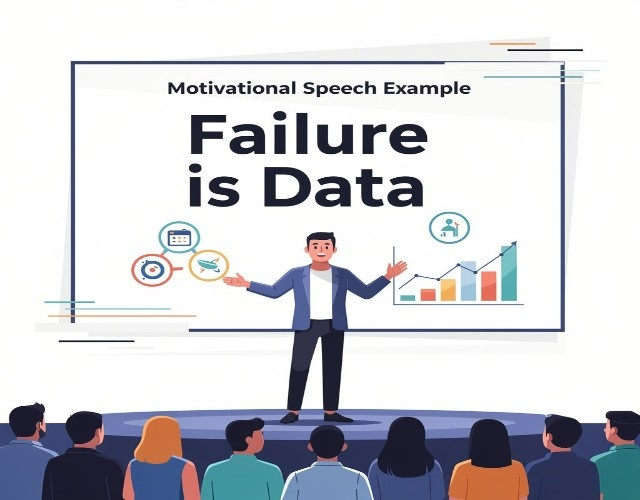
Topic: Reframing Failure
Length: 3 minutes (400 words)
Audience: High school students
Failure is Data
I failed my driver's test. Twice. The first time, I rolled through a stop sign. The second time, I parallel parked so badly that I actually hit the cone. I was humiliated. I thought I'd never drive.
Today, I want to talk about why failure is the best thing that ever happened to me.
Here's what nobody tells you about successful people: they failed constantly. Walt Disney was fired from a newspaper for "lacking imagination." Oprah was demoted from her first TV anchor job for being "unfit for television." Michael Jordan was cut from his high school basketball team. J.K. Rowling's first Harry Potter manuscript was rejected by 12 publishers.
The difference between them and everyone else? They treated failure as data, not death.
When I failed that driver's test the first time, I could have given up. Instead, I asked the instructor what I did wrong. He explained that I was nervous and rushing through intersections. That was useful information. I practiced stopping completely at every sign for two weeks. Then I failed again for different reasons, which meant I'd fixed the first problem.
That's the secret: every failure teaches you something success never could. Success tells you "keep doing what you're doing." Failure tells you exactly what to fix.
Think about how you learned to walk. You fell. Hundreds of times. Did you think "I'm terrible at this, I should give up"? No. You were a baby, you didn't have the vocabulary for self-doubt yet. You just got up and tried again because that's what learning looks like.
Somewhere between being a baby and being a teenager, we learned to be afraid of failure. We learned that getting something wrong means we're not smart enough, not talented enough, not good enough. That's garbage.
You know what failure actually means? It means you tried something hard. It means you're learning. It means you're not playing it safe.
So here's my challenge: fail at something this week. Try out for the team you think you'll get cut from. Raise your hand in class even when you're not sure of the answer. Ask someone to the dance who might say no. Fail small on purpose so you stop being terrified of it.
Because here's the truth: the only way to guarantee failure is to never try at all.
I passed my driver's test on the third attempt. And I'm a great driver now, precisely because I failed enough times to learn what not to do.
Your failures aren't holding you back. Your fear of failure is. Fix that, and everything changes.
Thank you.
What Makes This Motivational Speech Example Work
|
Reviewing a motivational speech example makes it easier to choose motivational speech topics that inspire your audience.
SPEECH DUE TOMORROW?
Professional writing assistance tailored to your needs
- Fast turnaround available
- Custom-written from scratch for every order
- Research and writing included
- Delivery tips provided
Rush orders welcome. Expert speechwriters standing by.
Order NowDemonstration Speech Example: The 5 Minute Productivity System
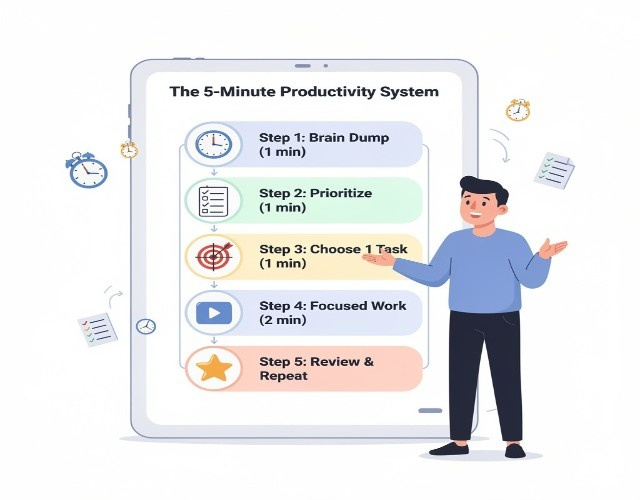
Topic: Time Management Technique
Length: 7 minutes (900 words)
Audience: College students
The 5 Minute Productivity System
How many of you have ever sat down to study and then realized three hours later that you've learned nothing? You read the same paragraph five times, checked your phone 47 times, and somehow ended up watching videos about how penguins survive winter?
I'm going to show you a technique that fixed this for me completely. It's called the Pomodoro Technique, and I'm going to teach you how to use it right now.
Here's what you need: a timer, a task, and the ability to ignore distractions for 25 minutes. That's it.
Step 1: Choose one specific task. Not "study for biology." That's too vague. Pick something concrete like "read chapter 7 and take notes on photosynthesis." Write it down. This is your focus for the next 25 minutes.
Step 2: Set a timer for 25 minutes. Use your phone, a kitchen timer, or a website like pomofocus.io. The timer is non-negotiable. Don't skip this step.
Step 3: Work on nothing else until the timer rings. This is the hard part. For the next 25 minutes, that one task is the only thing that exists. Your phone goes face down or in another room. No checking texts. No "quick" Instagram scroll. No "I'll just see if anyone emailed me." Those are lies you tell yourself. For 25 minutes, you are mono-focused.
Step 4: When the timer rings, stop immediately. Even if you're in the middle of a sentence. Even if you're "almost done." Stop. This is crucial because your brain needs to know the timer is trustworthy.
Step 5: Take a 5-minute break. Stand up. Walk around. Get water. Check your phone if you want, you earned it. But set another timer for 5 minutes. When it rings, break's over.
Step 6: Repeat. Do another 25 minute work session, then another 5 minute break. After four Pomodoros (that's four 25 minute sessions), take a longer 15 to 30 minute break.
Let me show you what this looks like in practice. Let's say I need to write an essay. Normally, I'd sit down and think, "Ugh, I need to write 5 pages." That's overwhelming, so I procrastinate. With Pomodoro, I think differently
First Pomodoro: Brainstorm and outline. Just 25 minutes. I can do anything for 25 minutes.
Second Pomodoro: Write introduction and first body paragraph. Clock's ticking.
Third Pomodoro: Second and third body paragraphs.
Fourth Pomodoro: Conclusion and editing.
Suddenly, that essay that felt impossible is done in 2 hours, and I actually focused the whole time.
Here's why this works: Your brain can't focus indefinitely. Studies show that concentration peaks around 25 minutes and then starts declining. The Pomodoro Technique works WITH your brain's natural attention span instead of fighting it. Those 5-minute breaks aren't wasted time, they're when your brain consolidates what you just learned.
The timer creates urgency. When you know you only have 25 minutes, you don't waste the first 10 checking Instagram. You get started immediately because the clock is running.
And breaking work into chunks makes it less intimidating. "Study for 4 hours" sounds horrible. "Do four Pomodoros" sounds doable.
Now, let me address the obvious question: What if I'm in the zone and don't want to stop? Here's the thing: if you ignore the timer when it rings, your brain stops trusting the system. Next time, when you're struggling and want to quit, your brain will remember "oh, the timer doesn't actually mean anything." Keep the deal with yourself. Stop when it rings.
Common mistakes to avoid: Don't check "just one text" during your 25 minutes, you'll break flow and waste 5 minutes getting back into focus. Don't pick tasks that require more than 4 Pomodoros; break them into smaller sub-tasks first. And don't skip breaks, they're not optional. Your brain needs rest to stay sharp.
Here's your challenge: Try this tomorrow. Pick one task, even something small like reading 10 pages or reviewing notes. Set a timer for 25 minutes. Put your phone on airplane mode. Work. When it rings, take your 5-minute break. That's it.
I guarantee two things will happen: One, you'll be amazed how much you accomplish in just 25 minutes of actual focus. Two, you'll realize how often you normally interrupt yourself. Once you see it, you can't unsee it.
Productivity isn't about working longer. It's about working smarter. And sometimes, smarter means just committing to 25 minutes at a time.
Try it. You might never study the old way again.
Thank you.
What Makes This Demonstration Speech Example Work
- Clear Step by Step Process: Numbered steps are easy to follow and remember.
- Shows Practical Application: Demonstrates technique with a real example (essay writing).
- Explains the "Why": Doesn't just say what to do, explains why it works.
- Addresses Objections: Anticipates questions ("What if I'm in the zone?").
- Common Mistakes Section: Helps avoid pitfalls.
- Specific Challenge: Gives the audience action to take immediately.
- Relatable Opening: Hook addresses shared frustration (procrastination)
Commemorative Speech Example: Honoring a Teacher
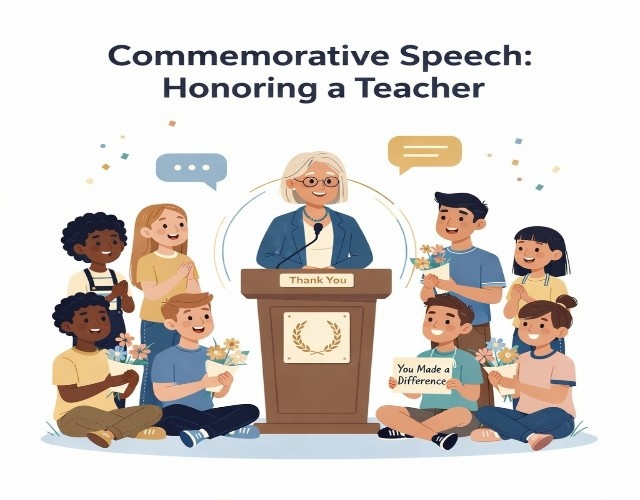
Topic: Tribute to Retiring Teacher
Length: 4 minutes (550 words)
Audience: School community
Honoring a Teacher
Mr. Richardson has a coffee mug on his desk that says, "I teach, therefore I drink coffee." We gave it to him five years ago as a joke. He's used it every single day since.
Today, as he retires after 32 years, I want to tell you what that mug represents, because it's not about coffee.
Mr. Richardson could have retired three years ago. The pension would have been the same. But he stayed because he said, "This class needs me." Then the next year: "this class needs me." And the year after that: "this class needs me."
Here's the thing about Mr. Richardson: he never taught subjects. He taught people.
I remember sophomore year, struggling with algebra. I failed the first test badly, 38%. I was ready to give up and take the class again next year. Mr. Richardson kept me after class and said, "You got 38% right. That's better than 0%. Tomorrow, let's aim for 40%."
He didn't say I was bad at math. He didn't ask why I didn't study harder. He just found the 38% that worked and built from there. By the end of the year, I passed with a B minus. It wasn't magic; it was Mr. Richardson refusing to let me disappear.
That's what he did. He saw the kids everyone else had written off. The ones who sat in the back. The ones who never raised their hands. The ones who were "just not good at math."
He learned our names on the first day. Not just our names, he learned what we cared about. He knew Jesse played guitar. He knew Aaliyah wanted to be an engineer. He knew Marcus had anxiety about presentations. And he structured his class around making each of us feel capable, not stupid.
On Fridays, he'd tell terrible math jokes. "Why was six afraid of seven? Because seven eight nine!" We'd groan. But we also showed up to class. And we listened. Because someone who tells bad jokes on purpose is someone who cares more about connection than looking cool.
Mr. Richardson never made a big deal about the extra hours. But we knew. He came in early every morning to help anyone who asked. He stayed late to grade papers, with actual feedback, not just a red X. He responded to panicked emails at 10 PM before tests. He showed up to our games, our concerts, our debates, even when we weren't his students anymore.
Thirty two years. That's roughly 6,400 students who sat in his classroom. Six thousand four hundred people who learned that they were capable. That someone believed in them. That math was hard, but it was harder.
Mr. Richardson, you always said teaching was about showing up every day and doing the work. So we wanted to show up today and say thank you. Thank you for seeing us. Thank you for staying. Thank you for believing that 38% was something to build on instead of something to give up on.
You taught us algebra, geometry, and calculus. But more importantly, you taught us that we mattered.
You can retire the coffee mug now. But you can't retire the impact. That stays with us forever.
Thank you for everything.
What Makes This Commemorative Speech Work
|
A commemorative speech example? shows how speakers honor people, places, or events, learn more in our commemorative speech guide.
Impromptu Speech Example: "If You Could Have Dinner with Anyone"
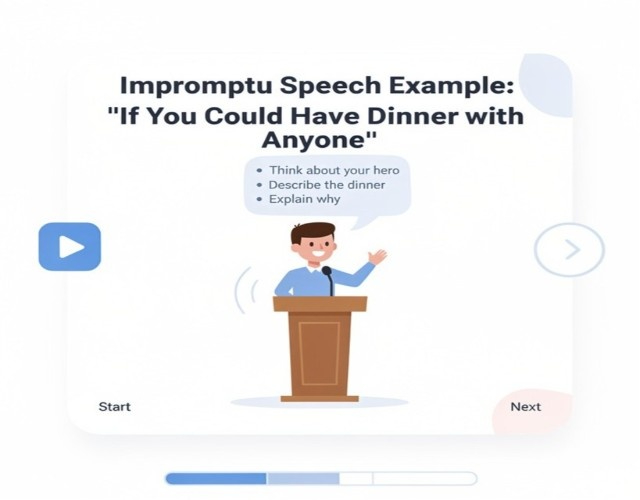
Topic: Hypothetical Question
Length: 2 minutes (300 words)
Given: 2 minutes to prepare
If You Could Have Dinner with Anyone
If I could have dinner with anyone, living or dead, I'd choose my grandmother.
I know that's not the exciting answer you wanted. You probably expected me to say Einstein or Shakespeare or Beyoncé. But here's why it's my grandmother.
She died when I was 12. At that age, you don't think to ask the important questions. I never asked her about her life before she was my grandmother. I never asked what it was like growing up in the 1940s, or what dreams she had before she had kids, or whether she was happy.
I just saw her as someone who made cookies and gave me money for good report cards.
Now I'm older, and I have questions. Like, did she really want six kids, or was that just what you did back then? What did she think when her daughter, my mom got divorced? Did she have regrets? What would she tell me about navigating life as a woman?
I think about how much I've changed between 12 and now. I'm a completely different person. And I wish she could see who I became. I wish I could tell her about college, about my major, about my plans. I wish I could thank her properly.
We always think we have more time with people. We assume there will be another Christmas, another birthday, another phone call. And then suddenly there isn't. And you realize you never asked the questions that mattered.
So if I could have dinner with anyone, I'd choose my grandmother. Not because she's famous or because she'd teach me some profound wisdom. But because I'd listen differently now. I'd ask better questions. And I'd tell her thank you while I still could.
That's my answer.
What Makes This Impromptu Speech Work
|
Key Tip: Reviewing an Impromptu Speech Example can make it easier to choose Impromptu Speech topics quickly and confidently.
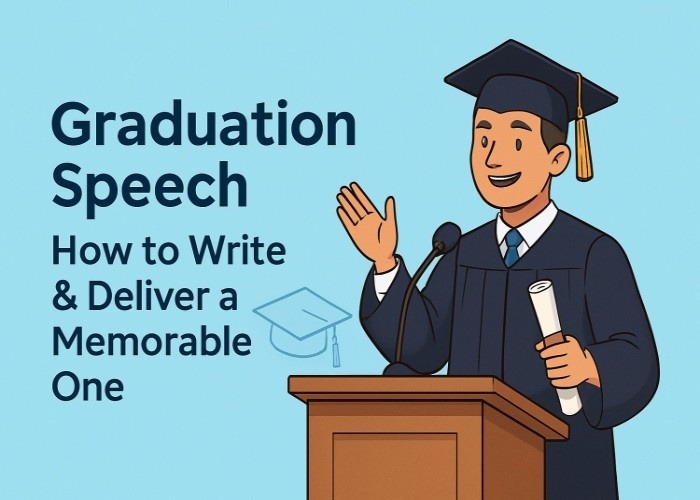
Graduation Speech Example: What Happens Next
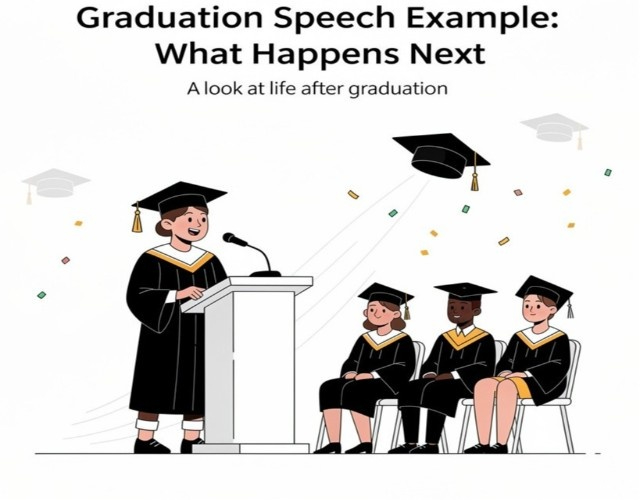
Topic: Commencement Address
Length: 5 minutes (700 words)
Audience: High school graduates
What Happens Next
Congratulations, Class of 2025. You did it. You survived Mr. Harrison's pop quizzes, the cafeteria's mystery meat Tuesdays, and four years of being told that high school would be "the best years of your life."
Spoiler alert: it won't be. And that's great news.
Everyone's going to tell you today that the future is bright, that you can be anything, that the world is yours. Those are nice things to say at graduations. They're also vague and not particularly helpful when you're standing at the edge of the next chapter with absolutely no idea what you're doing.
So instead, I want to tell you three things I wish someone had told me when I was sitting where you are.
First: You don't have to have it all figured out.
Our culture is obsessed with five-year plans and knowing your calling at 18. That's nonsense. Your brain isn't even fully developed until age 25, why would you be expected to choose your entire life path now?
Some of you know exactly what you want. You're going to med school, or you're starting a business, or you've already got a job lined up. That's fantastic. But for those of you who have no clue, and that's most of you, that's also fantastic. Not knowing is not failing. It's being honest.
You're going to try things and realize they're not for you. You'll change majors, switch careers, and discover new interests you didn't know existed. I started college planning to be a lawyer. Now I'm a marine biologist. Life is long. You have time to figure it out.
Second: Failure is not only okay, but it's also required.
This is the first generation that grew up with perfect Instagram highlight reels. You've been watching everyone else's edited best moments and comparing them to your behind-the-scenes struggles. So let me tell you something nobody posts: everyone is failing constantly.
Your favorite musician? Failed at dozens of songs that never got released. That entrepreneur you admire? Failed at three businesses before the successful one. The author whose book do you love? Got rejected 47 times before someone published it.
Failure doesn't mean you're not good enough. It means you're attempting hard things. And the only way to avoid failure entirely is to never try anything worth doing.
So fail. Fail often. Fail fast. Then get up and try something else.
Third: Be kind to people, including yourself.
The world can be harsh. You're entering adulthood during a time of political division, economic uncertainty, and climate anxiety. It's easy to become cynical or self-protective.
But here's what I've learned: kindness is not weakness. Empathy is not naivety. Caring about others doesn't make you less tough; it makes you more human.
Be the person who checks on the friend who's struggling. Be the coworker who helps the new person learn the job. Be the stranger who holds the door. Be the voice that stands up when someone's being treated unfairly.
And extend that same kindness to yourself. You're going to mess up. You're going to disappoint people sometimes, including yourself. When that happens, treat yourself like you'd treat a friend, with compassion, not cruelty.
The voice in your head that says you're not smart enough, not talented enough, not worthy enough? That voice is lying. Tell it to shut up and keep moving forward.
Class of 2025, you're not walking into the best years of your life today. You're walking into the unknown years. The uncertain years. The years where you get to figure out who you actually are instead of who everyone told you to be.
That's scary. It's also exciting.
Some of you will become exactly what you planned. Some of you will become something completely different. Either way, you'll become someone. And that's enough.
So go fail spectacularly. Go change your mind. Go be kind. Go do something hard. Go figure it out as you go.
We believe in you. Not because you have all the answers, but because you're willing to ask the questions.
Congratulations, graduates. Now go see what happens next.
What Makes This Graduation Speech Work
|
Need inspiration for your Graduation Speech? Check our Graduation Speech guide for structure, tone, and topic ideas.
Want a speech this compelling for YOUR audience? Our professional essay writing service specializes in speeches that connect emotionally and deliver your message powerfully.
Debate Opening Statement Example: School Uniforms
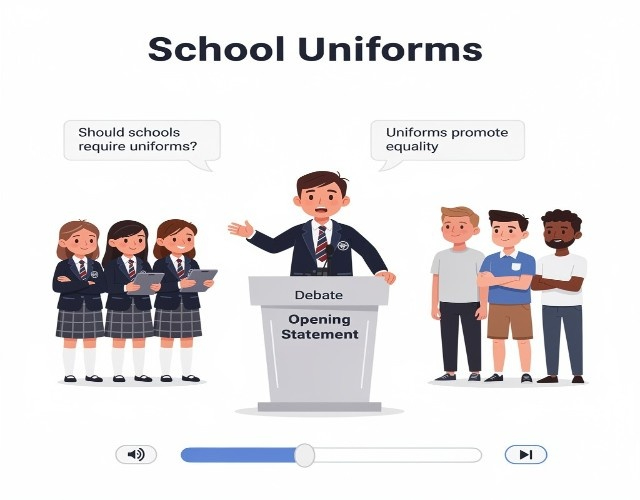
Topic: Should Public Schools Require Uniforms?
Position: Affirmative (Pro Uniform)
Length: 3 minutes (450 words)
Format: Lincoln Douglas Debate
School Uniforms
Good afternoon. Today's resolution is: Public schools should require students to wear uniforms. I stand firmly in affirmation.
Before I present my case, let me define key terms. "Public schools" refers to government-funded K-12 institutions. "Should" establishes a moral obligation, not merely permission. "Require" means mandatory, not optional. "Uniforms" means standardized dress code, not necessarily identical clothing.
My value for today's debate is equality of opportunity. The purpose of public education is to provide all students, regardless of socioeconomic background, an equal chance to learn and succeed. My criterion for achieving this value is minimizing non-academic distractions that create inequality.
I present three contentions:
Contention One: Uniforms reduce socioeconomic competition and bullying.
Students judge each other based on clothing brands and trends. This creates visible hierarchies where wealthy students signal status through expensive fashion while low-income students face ridicule for worn or outdated clothes.
A 2022 study from the University of Nevada covering 10,000 students found that schools implementing uniform policies saw 27% reduction in reported bullying incidents and 43% reduction in clothing-related discipline issues. When students dress uniformly, socioeconomic differences become less visible, creating more equal social dynamics.
Contention Two: Uniforms improve academic focus and school culture.
Clothing choices consume significant mental energy. Deciding what to wear, comparing outfits, and worrying about appearance distract from learning.
Research from the American Journal of Education shows that schools with uniforms report 12% higher standardized test scores and 17% improvement in attendance rates. When the pressure to dress impressively is removed, students redirect attention to academics. Additionally, uniforms create a sense of belonging and institutional pride, students represent their school, encouraging better behavior.
Contention Three: Uniforms simplify morning routines and reduce family stress.
Parents spend an average of $1,200 annually per child on school clothing according to Consumer Reports. This burden falls hardest on low-income families who struggle to afford trendy clothes. Uniform programs typically cost $200-300 per year, with many schools offering financial assistance.
Beyond cost, uniforms eliminate daily arguments about appropriate dress. Parents don't negotiate outfit choices, and students don't worry about fitting in. This reduces household stress and ensures students arrive at school on time, ready to learn.
My opponents will likely argue that uniforms restrict self-expression. However, self-expression remains available through hairstyles, accessories, extracurricular activities, art, music, and writing. Students spend only 6 to 7 hours daily in school, they have ample time outside school to express individuality through clothing.
Furthermore, learning to follow dress codes prepares students for professional environments where workplace attire is expected. Self-expression is valuable, but so is learning that certain contexts require certain behaviors.
In conclusion, school uniforms advance equality of opportunity by reducing socioeconomic competition, improving academic focus, and decreasing financial burden on families. When we prioritize learning over fashion, all students benefit.
I affirm the resolution. Thank you.
What Makes This Opening Statement Work
|
Do you like the baove example and now you are struggling to pick a winning idea? Explore our debate speech examples and debate topics guide to craft a powerful argument
NEED A SPEECH THAT ACTUALLY WORKS?
Thousands of students trust us to deliver speeches and essays that get the grades they deserve.
- Tailored to your specific audience
- Written by experienced speechwriters
- Guaranteed to meet your deadline
- Full confidentiality guaranteed
Professional quality. Student friendly prices. 100% satisfaction guaranteed.
Order NowThe Bottom Line
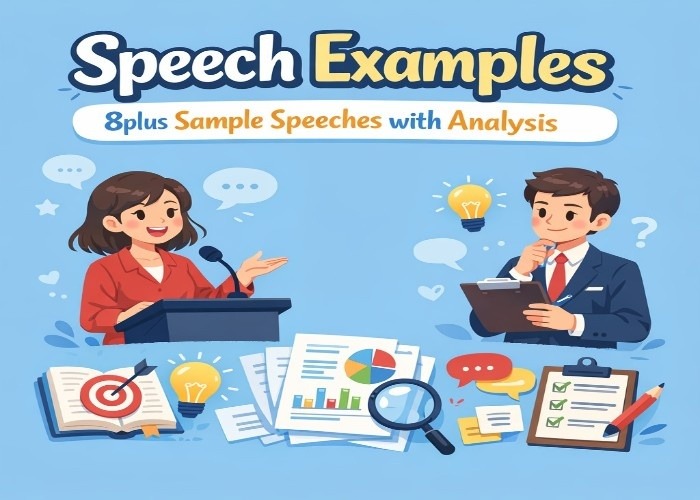
The best way to learn speech writing is by studying real examples. These 8 speeches show you what works: strong hooks, clear organization, solid evidence, and endings that stick. Use them as models, not templates, your speech needs your voice, your topic, and your unique perspective.
Want to dive deeper into speech writing fundamentals? Our complete Speech & Debate Guide walks you through the entire process from choosing topics to delivering with confidence.
Now you've seen what great speeches look like. Time to write yours.

-19982.jpg)