What You Need to Know About Speeches & Debate
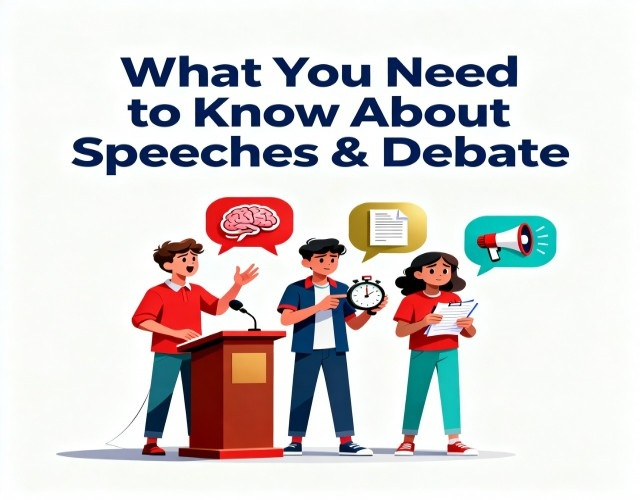
A speech is a structured presentation delivered to inform, persuade, entertain, or inspire an audience. Debate is competitive argumentation where two sides present opposing viewpoints with evidence and rebuttals. Both require preparation, clear organization, and effective delivery, but speeches are one way presentations while debates involve a direct clash with opponents.
- Key difference: In a presentation, you control the entire message and delivery. In a debate, you must respond to counterarguments in real time while defending your position.
- Most important thing: Your opening 30 seconds determines whether people listen or tune out. Start strong, make your purpose clear, and give them a reason to care.
SPEECH DUE TOMORROW?
Urgent deadline? No problem. Our writers work around the clock to deliver polished speeches fast
- Fast turnaround available
- Research and writing included
- Delivery tips provided
- Point 4
Rush orders welcome. Expert writers standing by.
Get Started NowWhat Is a Speech?
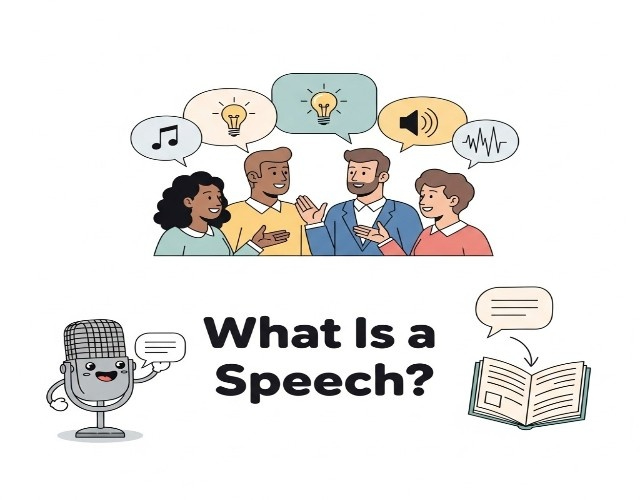
A speech is a formal presentation delivered to an audience with a specific purpose: to inform, persuade, entertain, or inspire. Unlike casual conversation, public speaking requires structure, preparation, and intentional delivery designed to achieve a clear goal.
Here's what makes speech different from just talking:
1. Purpose Driven: Every presentation has a clear objective. You're not just sharing information, you're trying to change minds, inspire action, or help people understand something new.
2. Structured: Effective communication follows a deliberate organization with introduction, body, and conclusion. This structure keeps your audience engaged and helps them follow your argument.
3. Audience Focused: Good presentations are written for a specific audience. What works for a college class won't work for a corporate board meeting or a wedding toast.
4. Rehearsed: Unlike impromptu remarks, formal presentations are practiced. You refine your wording, timing, and delivery until it flows naturally.
Key Characteristics of a Speech
|
Public speaking appears everywhere: in classrooms, competitions, conferences, ceremonies, political rallies, and social events. The format changes, but the core principle stays the same: connect with your audience to achieve a specific goal.
What Is Debate?
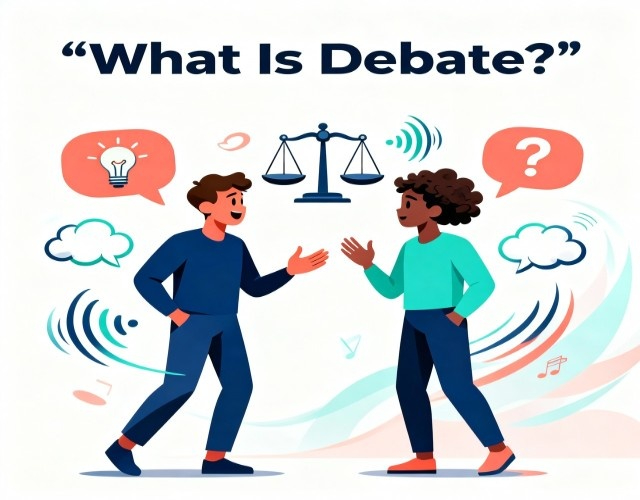
Debate is structured argumentation where two sides present opposing viewpoints on a specific topic. Unlike presentations that persuade through one perspective, competitive argumentation involves direct clash; you present your case while responding to counterarguments in real time.
Core Debate Elements
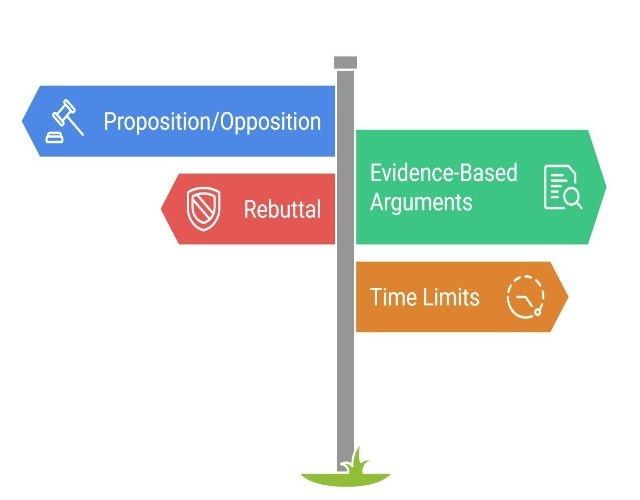
1. Proposition and Opposition: One side argues for a position (affirmative), the other argues against it (negative). Both sides must prepare arguments and anticipate what the other will say.
2. Evidence Based Arguments: Successful debating requires research. You can't just state opinions; you need facts, statistics, expert testimony, and logical reasoning to support your claims.
3. Rebuttal: This is what separates debate from two people giving presentations. You must directly address and dismantle your opponent's arguments while defending your own.
4. Time Limits: Most formats have strict time allocations for opening statements, rebuttals, and closing arguments. Learning to make your point concisely is essential.
Common Debate Formats
|
|
|
|
Why It Matters
| Competitive argumentation teaches critical thinking, research skills, and the ability to see multiple perspectives. It forces you to understand not just your position, but your opponent's position well enough to dismantle it. |
Key Difference
A presentation is a one-way message where you control everything. A debate is a two-way contest where you must adapt, respond, and think on your feet.
How to Write a Speech (Complete Step by Step Process)
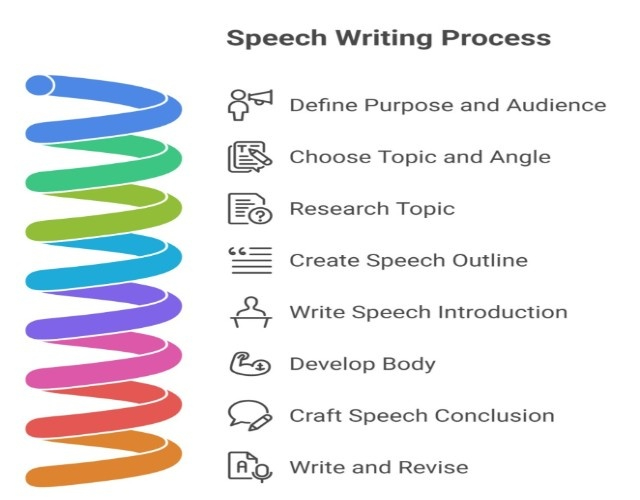
Writing for oral delivery isn't like writing an essay. You're writing for the ear, not the eye. People won't reread a sentence if they miss it; you get one shot to make your point land.
Step 1: Define Your Purpose and Audience
Before you write a single word, answer these questions:
What do you want your audience to think, feel, or do after hearing you present?
|
Who is your audience?
|
Your purpose and audience determine everything else, structure, tone, evidence, and delivery style.
Step 2: Choose Your Angle
Pick something you can speak about with genuine interest. Fake enthusiasm shows immediately. If you're assigned a broad topic, narrow it to a specific angle you can cover thoroughly.
|
Step 3: Research Your Topic
Even if you know your topic well, research adds credibility. You need evidence to support your claims:
Types of Evidence
- Statistics and data from recent sources.
- Expert opinions and testimonials.
- Real life examples and case studies.
- Historical facts and context.
- Personal anecdotes (use sparingly).
Research Tips
- Use credible sources: .edu, .gov, peer-reviewed journals.
- Take notes with full citations.
- Look for counterarguments too.
- Recent data is more credible than outdated statistics.
Step 4: Create Your Outline
Before writing full sentences, map out your structure. A solid outline keeps you organized and ensures every point connects to your main message.
1. Introduction
- Hook/Attention-grabber.
- Establish credibility.
- Preview main points.
- Thesis statement
2. Body
- Main Point 1 with supporting evidence.
- Main Point 2 with supporting evidence.
- Main Point 3 with supporting evidence.
- Smooth transitions between points.
3. Conclusion
- Summarize main points.
- Restate thesis.
- Call to action or memorable closing.
Tips: Stick to 2-4 main points. More gets overwhelming.
Step 5: Write Your Introduction
Your opening determines whether people listen or mentally check out. Make it count.
Four Elements of Strong Introductions
1. Hook (First 10-15 seconds)
Grab attention with
- Shocking statistic.
- Provocative question.
- Bold statement.
- Brief story.
- Relevant quote
2. Establish Credibility
- Tell them why you're qualified
3. Preview Your Main Points
- Give them a roadmap
- State your central message clearly
Step 6: Develop Your Body
This is where you prove your thesis. Each main point needs solid support.
For Each Main Point
|
Writing for the Ear
|
Step 7: Craft Your Conclusion
Never end with "That's all I have." Your conclusion should be as strong as your opening.
Three Part Conclusion
1. Signal the end: "As we've seen today..."
2. Summarize main points (no new information)
3. Strong closing: Call to action, memorable quote, or thought-provoking question
Step 8: Write and Revise
- First Draft: Get everything down without editing.
- Second Draft: Read aloud. Cut anything awkward. Add signposts ("First," "Next," "Finally").
- Third Draft: Time yourself. If over, cut ruthlessly. If under, add evidence (not fluff).
- Final Draft: Practice until you can deliver naturally without reading word for word.
How to Start a Speech and Debate?
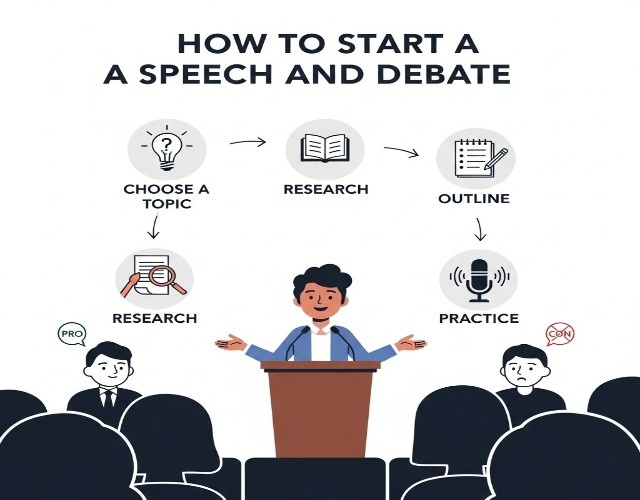
Your opening determines whether people listen or mentally check out. The first 30 seconds are critical.
Opening Strategies That Work
1. Start with a Shocking Statistic
"Every 60 seconds, 400 hours of video are uploaded to YouTube. That's more content than you could watch in a lifetime."
2. Ask a Provocative Question
"What would you do if you knew you couldn't fail?"
3. Tell a Brief Story
Open with a personal anecdote or relevant narrative that connects to your thesis.
4. Use a Powerful Quote
Choose quotes that genuinely relate to your topic, not generic inspirational sayings.
5. Make a Bold Statement
"Everything you know about productivity is wrong."
What to Include in Your Speech and Debate Opening
|
Common Speech and Debate Opening Mistakes to Avoid
- Starting with "Hi, my name is..." (save introductions for after your hook).
- Using dictionary definitions.
- Apologizing for nervousness.
- Long, meandering setup before getting to the point.
- Generic statements like "Throughout history..." or "In today's world..."
The Test: If your opening doesn't make someone curious, surprised, or emotionally invested in the first 30 seconds, rewrite it.
How to Write a Conclusion for Speech and Debate
Your conclusion is your last chance to make an impact. Never waste it with "That's all I have" or just trailing off.
The Three Part Conclusion Formula
1. Signal the End
Use a transition phrase that tells your audience you're wrapping up
- "As we've seen today..."
- "To bring this together..."
- "Looking at everything we've covered..."
2. Summarize Your Main Points
Briefly remind them of your key arguments, but don't introduce new information. Keep it concise
- "We explored three solutions: X, Y, and Z."
- "Remember these key takeaways: [point 1], [point 2], [point 3]."
3. End with Impact: Choose one of these closing techniques:
Call to Action: Tell them exactly what to do next
| "Start today by choosing one small change you can make." |
Memorable Quote: Use a quote that reinforces your message
"As Maya Angelou said, 'People will forget what you said, but they'll never forget how you made them feel.'" |
Circle Back to Opening: Return to your opening story or question
"Remember the question I asked at the start? Now you have the answer." |
Provocative Question: Leave them thinking
"So the question isn't whether we can change, it's whether we will." |
Vision of the Future: Paint a picture of what's possible
"Imagine a world where every student has access to this technology." |
Debate Specific Conclusions
In competitive formats, your conclusion should:
- Summarize why your side won the debate.
- Compare your arguments to your opponent's directly.
- Emphasize your strongest, most impactful points.
- Show why your impacts matter more than theirs.
What NOT to Do
- Introduce new arguments or evidence.
- Apologize or undermine your own points.
- Rush through or look relieved it's over.
- End abruptly without a clear closing statement.
- Say "In conclusion..." (use more natural transitions).
The Test: Your conclusion should feel like a satisfying ending, not an escape route. If you can't remember it without notes, it's not strong enough.
READY TO HAND IT OFF?
Skip the stress. Our professional writers handle everything, so you can submit with confidence.
- 100% original, human-written content
- Delivered on your deadline, every time
- Unlimited revisions until satisfied
- Speeches written by degree holding experts
Free revisions. No plagiarism. Professional writers.
Order NowTypes of Speeches
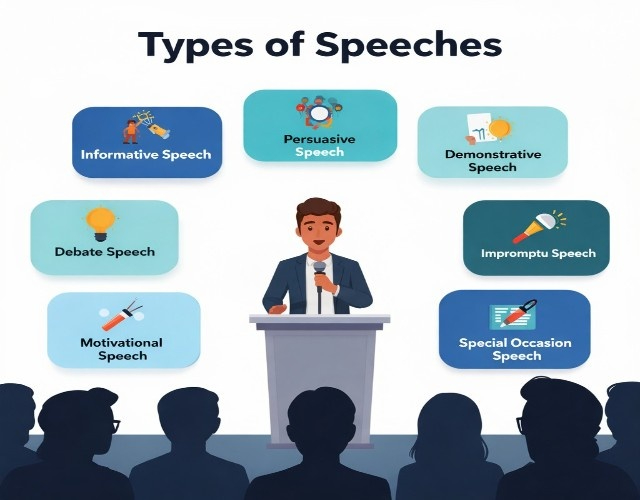
Different occasions require different formats. Here's what you need to know about each
| Type of Speech | Purpose / Description |
|---|---|
| Persuasive Speech | Designed to influence beliefs or inspire action by presenting strong arguments and evidence. |
| Informative Speech | Aims to educate the audience on topics, concepts, or events they may not fully understand. |
| Demonstration Speech | Teaches the audience how to perform a task through step by step instructions. |
| Impromptu Speech | Delivered with little to no preparation, relying on quick thinking and clarity. |
| Commemorative Speech | Honors or celebrates a person, milestone, event, or idea with respect and emotion. |
| Motivational Speech | Encourages the audience to shift mindset, build confidence, or take action toward goals. |
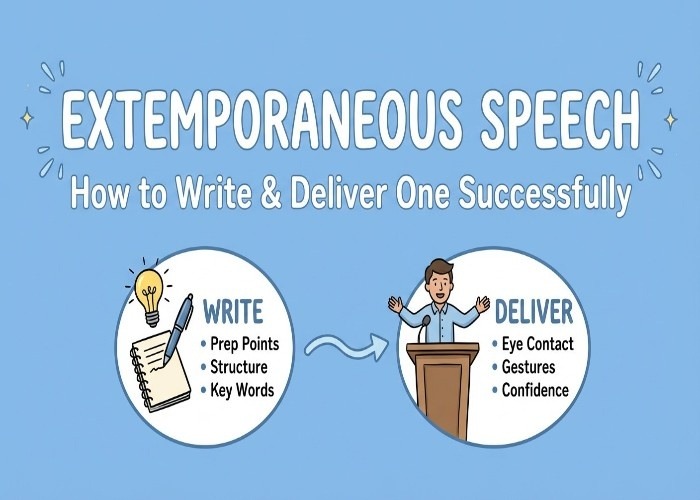
| Extemporaneous Speech | Presented using prepared notes or an outline, neither fully memorized nor read verbatim. |
| Graduation Speech | Celebrates achievements and inspires classmates during a commencement ceremony. |
Debate Fundamentals
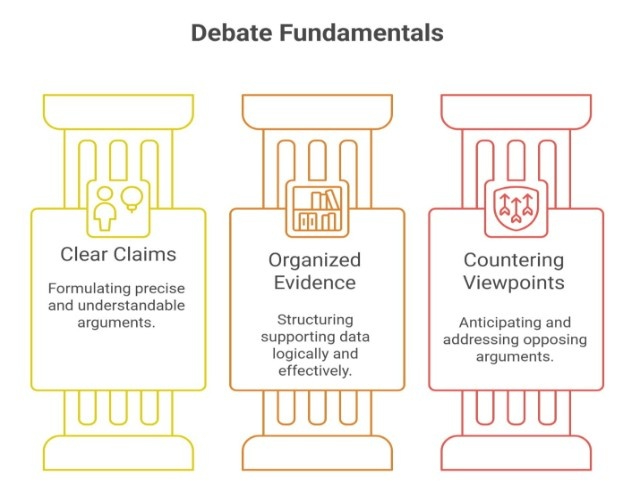
Competitive argumentation requires all the skills of public speaking plus the ability to think on your feet, respond to opponents, and defend your position under pressure.
A. Basic Debate Process
Most formats follow this general flow:
1. Opening Statements (Constructive Speeches)
- Affirmative presents their case (supporting the resolution).
- Negative presents their case (opposing the resolution).
- Each side lays out main arguments with evidence.
2. Rebuttal Period
- Each side responds to the opponent's arguments.
- Point out flaws in logic, evidence, or reasoning.
- Defend your own arguments against attacks.
3. Cross Examination (in some formats)
- Direct questioning of the opponent.
- Clarify their position.
- Expose weaknesses.
4. Closing Statements (Summary Speeches)
- Summarize why your side won.
- Compare arguments side by side.
- Emphasize the strongest points.
B. Building Strong Arguments
The Claim Warrant Impact Structure
| Claim: State your argument clearly "Social media companies should be regulated." |
| Warrant: Explain reasoning and provide evidence "Because current self-regulation has failed to protect user data, as evidenced by the Cambridge Analytica scandal." |
| Impact: Explain why this matters "This matters because unprotected personal data enables political manipulation and threatens democracy." |
C. Effective Rebuttal Strategies
The Four-Step Refutation:
|
D. Research for Debate
Debaters need extensive evidence because they must:
Prepare for Your Arguments
- Find multiple sources for each point.
- Have backup evidence if challenged.
- Understand potential counterarguments.
Anticipate Opponent's Arguments
- Research the opposite position thoroughly.
- Prepare responses to likely arguments.
- Identify logical fallacies they might use.
E. Common Fallacies to Avoid
1. Ad Hominem: Attacking the person instead of their argument
Incorrect: "My opponent is too young to understand." |
2. Straw Man: Misrepresenting the opponent's position
| Incorrect: "My opponent wants to ban all social media." Correct: Address what they actually argued |
3. False Dilemma: Presenting only two options when more exist
| Incorrect: "Either we regulate completely or let companies do whatever." Correct: Acknowledge nuanced middle ground solutions. |
4. Slippery Slope: Claiming one thing leads to extreme consequences
| Incorrect: "If we regulate Facebook, the government will control the internet." Correct: Explain specific, likely consequences with evidence |
Need controversial issues to practice? Our comprehensive collection of 250+ debate topics spans politics, education, technology, ethics, and social issues for all skill levels.
If you're new to public speaking, reviewing speech and debate examples can help you understand how experienced speakers structure arguments and transitions.
Speech and Debate Delivery Tips & Practice Techniques
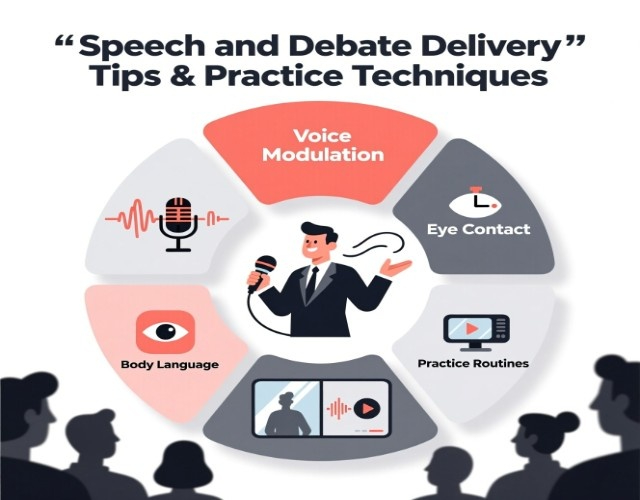
Even the best written content fails if delivery is poor. Here's how to present with confidence.
Practice Techniques That Work
1. Practice Out Loud (Not in Your Head)
Reading silently doesn't reveal where you'll stumble, which parts are awkward, or your actual pacing. Practice speaking at least 5 to 7 times.
2. Record Yourself
Use your phone to record video and audio
|
3. Practice with Your Notes
Get comfortable glancing down and finding your place. Mark where you'll look at notes vs. audience.
4. Simulate the Real Environment
Stand while practicing if you'll stand when presenting. Practice with any visuals or props. Set a timer.
5. Practice Beginning and End Extra
Memorize your first 30 seconds completely. Memorize your last 15 to 30 seconds. Never read your introduction or conclusion.
Body Language and Presence
Eye Contact
- Look at individuals, not over their heads.
- Hold eye contact 2-3 seconds before moving.
- Cover all sections of the room.
Gestures
- Use natural hand movements.
- Keep hands above waist, below shoulders.
- Avoid repetitive or nervous gestures.
- Match gestures to your words.
Posture
- Stand straight with shoulders back.
- Plant feet shoulder-width apart.
- Avoid swaying or shifting weight.
- Move purposefully, not randomly.
Facial Expressions
- Smile when appropriate.
- Show emotion matching your content.
- Avoid blank staring.
Voice Control
Volume: Speak loud enough that the back row hears easily |
| Pace: 130 to 150 words per minute for clarity. Slow down for important points. |
| Pitch: Vary your tone. Monotone loses attention. |
| Pauses: Use strategic silence for emphasis. Pause after important points. |
| Pronunciation: Enunciate clearly. Don't rush through words. |
Managing Nervousness
Before Your Speech:
|
During Your Speech:
|
Remember: slight nervousness is normal and expected
Still stuck or running out of time? Our reliable essay writing service handles everything from research to the final draft. You focus on delivery, we'll handle the writing.
Common Speech and Debate Mistakes
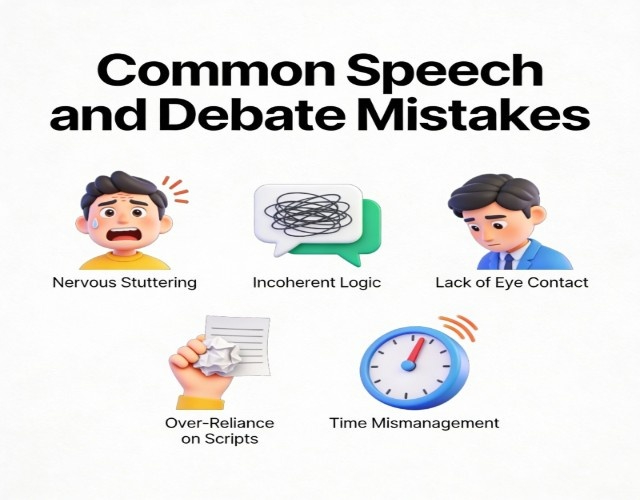
Learn from these frequent errors so you don't make them yourself.
A. Content Mistakes
1. Too Much Information 2. Starting with Apologies 3. Reading Word for Word 4. No Clear Thesis 5. Weak Conclusion |
B. Delivery Mistakes
1. Filler Words 2. Speaking Too Fast 3. No Eye Contact 4. Monotone Voice 5. Ignoring Time Limits |
C. Debate Specific Mistakes
1. Not Listening to Opponent 2. Weak Evidence 3. Ignoring the Resolution 4. Personal Attacks 5. Dropping Arguments |
NEED A SPEECH THAT ACTUALLY WORKS?
Professional writing assistance tailored to your needs
- Tailored to your specific audience
- Written by experienced professionals
- Guaranteed to meet your deadline
- Unlimited Revisions
Professional quality. Student-friendly prices. 100% satisfaction guaranteed.
Order NowThe Bottom Line
Writing and delivering speeches doesn't have to be overwhelming. Start with a clear purpose, organize your ideas into 2 to 4 main points, support them with solid evidence, and practice until it flows naturally.
Your opening grabs attention in 30 seconds. Your body proves your point with evidence. Your conclusion leaves a lasting impression. Practice out loud at least 5 to 7 times; what sounds good in your head often needs adjustment when spoken aloud.
For debate: Prepare both sides of the issue. Use the claim warrant impact structure. Master four step refutation: identify, challenge, prove, and conclude. Evidence beats opinion; back up every claim with facts.
Delivery matters as much as content. Make eye contact. Vary your voice. Control your pace at 130 to 150 words per minute. Record yourself practicing to catch filler words and nervous habits.
Know your time limits: A 5 minute speech is 650 to 750 words. Time yourself during every practice. Going over shows a lack of preparation.

-19982.jpg)