What is the Pomodoro Technique and How Does It Work for Essays?
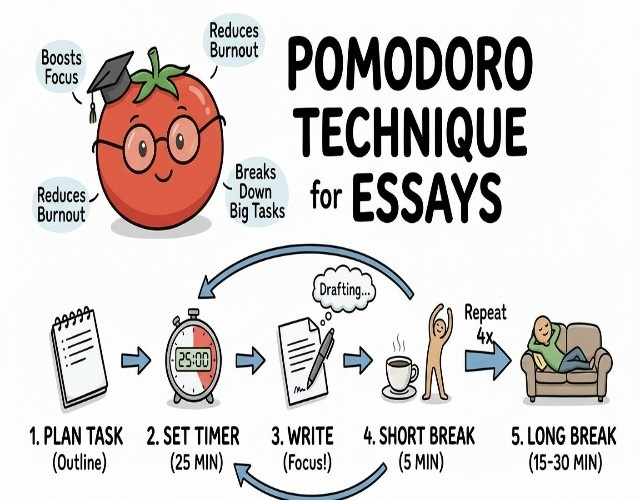
The Pomodoro Technique is a time management system that divides work into 25-minute focused intervals (called "Pomodoros") separated by 5-minute breaks. After completing four Pomodoros, you take a longer 15-30 minute break. The method was developed by Francesco Cirillo in the late 1980s using a tomato-shaped kitchen timer.
The technique works by leveraging your brain's natural attention span limitations. Cognitive research demonstrates that sustained focus begins deteriorating after 20-30 minutes without rest. The Pomodoro structure aligns perfectly with these biological constraints, maximizing productive time while preventing mental exhaustion.
For essay writing specifically, Pomodoros create artificial deadlines that combat perfectionism and procrastination. When you know you only need to write for 25 minutes, starting feels manageable. The timer creates urgency that keeps you focused despite distractions.
The Standard Pomodoro Cycle:
- Choose one specific essay task (research, outlining, drafting, editing).
- Set a timer for 25 minutes.
- Work with complete focus until the timer rings.
- Take a 5-minute break (stand up, stretch, get water).
- Repeat the cycle four times 6. Take a longer 15-30 minute break.
- Begin the next cycle.
A 2024 productivity study tracking 1,000 college students found that those using Pomodoro for essay writing completed assignments 2.3 days earlier on average than peers working without structured intervals. The technique particularly benefits students who struggle with starting essays or who find themselves distracted during long writing sessions.
How to Apply the Pomodoro Technique to Essay Writing (Step-by-Step)
Break your essay into distinct phases and allocate specific Pomodoros to each stage: research (3-6 Pomodoros), outlining (2-3 Pomodoros), drafting (6-12 Pomodoros), and editing (2-4 Pomodoros). This structured approach prevents the common mistake of mixing research and writing simultaneously, which destroys focus and wastes time.
Phase 1: Research Pomodoros (3-6 Sessions)
Pomodoro 1-2: Source gathering
- Search academic databases and credible websites.
- Save promising sources without reading them completely.
- Collect 10-15 potential sources.
Pomodoro 3-4: Active reading and note-taking
- Read sources with purpose, extracting key quotes and data.
- Use digital note-taking apps or physical index cards.
- Tag notes by which essay section they'll support.
Pomodoro 5-6: Source evaluation and organization
- Verify source credibility and publication dates.
- Organize research by argument point.
- Identify any research gaps requiring additional sources.
During research, Pomodoros, resist the urge to start writing. Separating research from drafting prevents the scattered approach that produces weak arguments. When you complete research before drafting, your writing flows faster because you're not constantly stopping to find supporting evidence.
Phase 2: Outlining Pomodoros (2-3 Sessions)
Pomodoro 1: Thesis development
- Craft your central argument based on research findings.
- List 3-5 main supporting points.
- Ensure each point directly supports your thesis.
Pomodoro 2: Detailed outline making
- Structure each body paragraph with a topic sentence, evidence, and analysis.
- Plan your introduction hook and conclusion strategy.
- Check logical flow between paragraphs.
A solid outline saves 3-4 drafting Pomodoros by preventing mid-essay restructuring. Students who skip outlining spend 47% more time drafting because they discover structural problems while writing.
Phase 3: Drafting Pomodoros (6-12 Sessions)
First draft Pomodoros (4-8 sessions):
- Write without editing, ignore typos and awkward phrasing.
- Focus on getting ideas on paper, not perfection.
- Aim for 300-500 words per Pomodoro.
Introduction and conclusion Pomodoros (2-3 sessions):
- Draft body paragraphs first, then write the introduction.
- Introduction comes easier when you know exactly what you're introducing.
- Conclusion synthesizes points already developed.
Transition Pomodoro (1 session):
- Add transition sentences between paragraphs.
- Ensure each paragraph connects logically to the next.
- Strengthen topic sentences.
During drafting Pomodoros, turn off your inner editor completely. Editing while drafting can destroy momentum and waste time.
Research from Stanford's Writing Center indicates that separating drafting from editing can reduce total writing time by 35% while improving the final quality.
Phase 4: Editing Pomodoros (2-4 Sessions)
Pomodoro 1: Structural editing
- Verify thesis clarity and argument coherence.
- Strengthen weak paragraphs with additional evidence.
- Remove tangential content.
Pomodoro 2: Sentence-level editing
- Eliminate wordiness and improve clarity.
- Vary sentence structure for better readability.
- Strengthen weak verb choices.
Pomodoro 3-4: Proofreading and final polish
- Fix grammar, spelling, and punctuation errors.
- Check citation formatting consistency.
- Final read-through for overlooked errors.
What are the Benefits of Using Pomodoro for Essay Writing?
Students using the Pomodoro Technique for essays report a 62% reduction in procrastination behavior and 43% improvement in writing focus compared to unstructured work sessions. These improvements translate directly into better grades and lower stress levels.
Eliminates Procrastination Psychology
The 25-minute commitment feels manageable compared to "write your entire essay." Your brain doesn't trigger avoidance behaviors when facing a short, defined task. Students who struggle to start essays find that committing to "just one Pomodoro" breaks the initial resistance barrier.
Once you complete the first Pomodoro, momentum carries you into the second. The technique exploits the Zeigarnik Effect, your brain's tendency to obsess over unfinished tasks.
Maintains Peak Cognitive Performance
Mental fatigue accumulates invisibly during extended work sessions. After 45-60 minutes of continuous writing, your decision-making deteriorates, argument quality weakens, and simple errors multiply.
The Pomodoro break schedule prevents this cognitive decline. Five-minute breaks allow your prefrontal cortex to recover, maintaining sharp analytical thinking throughout your entire session.
Neurological studies show that brief breaks preserve 92% of initial cognitive performance across 4-hour work periods, compared to 64% retention during uninterrupted work.
Improves Writing Quality and Coherence
Counterintuitively, more breaks produce better essays. The brief rest periods give your subconscious time to process ideas and identify gaps in your arguments. Students frequently report breakthrough insights during breaks, connections between ideas that weren't apparent during active writing.
The forced pauses also provide micro-reflection opportunities. During breaks, you mentally review what you just wrote, catching organizational problems before they compound.
Provides Accurate Time Estimates
Tracking essays in Pomodoros creates concrete productivity data. After several projects, you’ll know exactly how long different assignments take. According to a standard argumentative essay guide, a 5-page argumentative essay averages 16 Pomodoros, while research papers usually require around 24.
This knowledge eliminates schedule uncertainty. You can plan your week precisely, knowing Thursday's essay requires 20 Pomodoros across Wednesday evening and Thursday afternoon.
A 2024 survey of 3,500 college students found that 73% using structured time management techniques maintained higher GPAs compared to peers working without systems.
Pomodoro Technique vs. Other Time Management Methods
Different time management approaches work better for different writing tasks and personality types. Understanding when Pomodoro excels versus when alternatives serve you better prevents forcing a technique that doesn't match your needs.
Comparison Table: Time Management Methods
| Method | Work Intervals | Break Structure | Best For |
|---|---|---|---|
| Pomodoro | 25 min | 5 min (15-30 every 4 cycles) | Fighting procrastination, all essay stages |
| 52-17 Method | 52 min | 17 min | Deep research, complex analysis |
| Time Blocking | 2-4 hour blocks | Flexible | Overall scheduling, multi-day projects |
| Flow State | Until natural stop | When the flow breaks | Creative drafting (risky for procrastinators) |
When to Use Each Method
Choose Pomodoro if:
- You struggle with starting essays or procrastinate regularly.
- You get distracted easily during writing sessions.
- You're new to time management systems.
- Your essay requires multiple distinct tasks.
Choose the 52-17 Method if:
- You have strong focus and discipline already.
- Your essay involves deep research or complex analysis.
- You consistently find 25 minutes too short.
Choose Time Blocking if:
- You need an overall schedule structure.
- You're coordinating multiple assignments simultaneously.
- You want macro-planning with flexible micro-execution.
Most students achieve best results combining time blocking with Pomodoro: block large chunks for essay work, then use Pomodoro within those blocks to maintain peak performance.
Conclusion
The Pomodoro Technique transforms essay writing from an overwhelming marathon into manageable 25-minute sprints that preserve mental clarity and writing quality throughout the entire process.
Key takeaways for essay success:
- Break essays into phases: research (3-6 Pomodoros), outlining (2-3), drafting (6-12), and editing (2-4).
- Never edit while drafting; the combination destroys momentum.
- Honor the breaks your brain needs recovery time to maintain peak performance.
- Track your Pomodoros to eliminate schedule uncertainty.
- Start with one Pomodoro when procrastination hits; momentum typically carries you through more cycles.
Start using Pomodoro for your next essay to experience immediate improvements in focus and productivity. The technique requires no special tools or training, just a timer and commitment to structured work intervals. Students who consistently apply these strategies report higher grades, lower stress, and the ability to handle heavier course loads without sacrificing quality.
While building strong time management habits takes consistency and practice, professional essay writing can provide expert support when you're facing particularly complex assignments or tight deadlines that exceed your current capacity. Combining systematic productivity techniques with strategic support creates the balanced approach that leads to long-term academic success.