What is an Expository Essay?
An expository essay explains, describes, or informs readers about a specific topic using factual information and logical organization. You present evidence based information without including personal opinions, arguments, or attempts to persuade.
Think of yourself as a knowledgeable teacher explaining a concept to students unfamiliar with it. Your goal is clarity and comprehension after reading your essay, readers should understand your topic better than before.
Expository essays appear throughout your academic career. Middle school teachers assign them to test basic research and organization skills. High school instructors use them to assess critical thinking and source integration. College professors require them to evaluate analytical depth and scholarly writing ability.
Here's why that matters: Expository essays inform without taking sides. You explain what something is, how it works, or why it happens using neutral facts. Argumentative essays persuade readers to accept your position using evidence and reasoning you take a stance and defend it.
Key Characteristics of Expository Writing
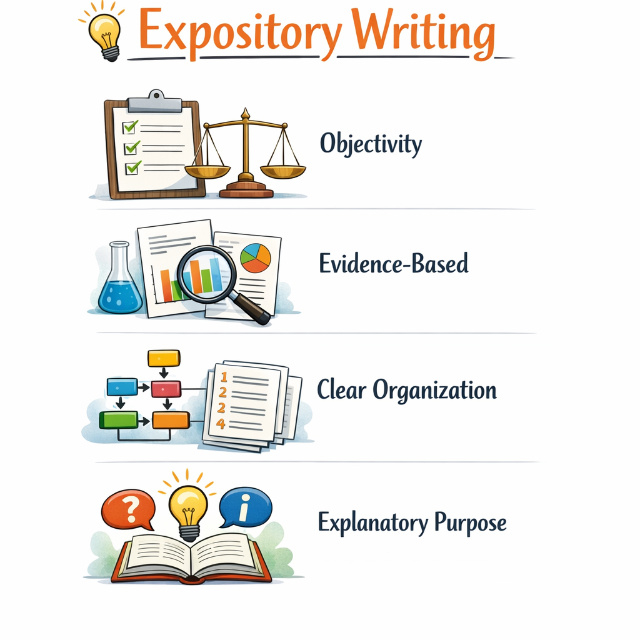
Expository writing follows four essential characteristics that distinguish it from other academic writing.
1. Objectivity
Expository essays present information without bias, personal opinion, or emotional language. You stick to verifiable facts, established research, and logical analysis. Avoid first person pronouns (I, me, my, we, our) and judgmental language.
Replace subjective statements with objective facts. Don't write "I think renewable energy is better." Write "Studies show renewable energy reduces carbon emissions by 45% compared to fossil fuels."
2. Evidence Based
Every claim requires support from credible sources. Use facts, statistics, expert opinions, research findings, and documented demonstrations. Citations demonstrate thorough research rather than assumptions.
Quality matters more than quantity. Three strong sources with specific data beat ten weak sources with vague claims. Academic databases, peer reviewed journals, government reports, and established news organizations provide reliable evidence.
3. Clear Organization
Expository essays follow logical structures that readers can easily follow. Each paragraph focuses on one main point. Smooth transitions connect ideas. Information flows in a sensible, chronological order for processes, by importance for explanations, or systematically for classifications.
Readers should never wonder where you're going or why you included specific information. Every sentence serves your thesis. Every paragraph advances your explanation.
4. Explanatory Purpose
Expository writing teaches readers something new. You explain concepts, describe processes, analyze relationships, or clarify confusing topics. Success depends on reader comprehension, not agreement.
After finishing your essay, readers should understand your topic better, not necessarily share your views about it. Focus on clarity over cleverness. Prioritize understanding over impressiveness.
CAN'T ORGANIZE YOUR EXPOSITORY ESSAY?
We build clear, logical frameworks that explain any topic perfectly.
- Rock-solid thesis statement crafted for you
- Evidence and examples integrated smoothly
- Logical flow with seamless transitions
- 24/7 Structural Support
Stop staring at a blank page. Start with a perfect outline.
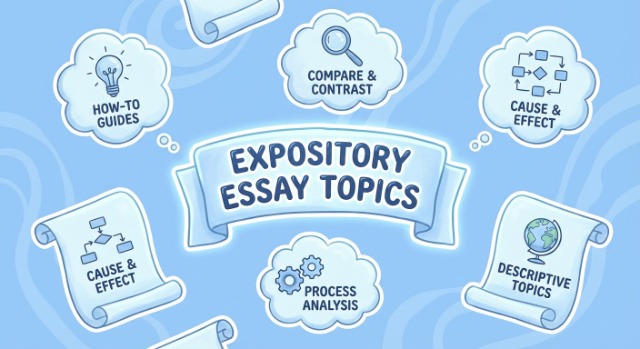
Get Started Now6 Types of Expository Essays: Complete Breakdown
Every expository essay fits one of six categories. Understanding these types helps you match your approach to assignment requirements.
| Type | Purpose & Key Characteristics | Common Topics |
|---|---|---|
| 1. Compare and Contrast | Examines the similarities and differences between two or more subjects to deepen understanding. Can be structured by discussing all similarities first, then all differences, or by alternating point by point. | Comparing two historical figures, contrasting political systems, examining different scientific theories. |
| 2. Cause and Effect | Explains why something happens (causes) and what results from it (effects), tracing logical relationships between events, actions, and outcomes. Focuses on evidence supported causal chains. | Explaining climate change causes, analyzing social media's effects on teenagers, discussing economic policy consequences. |
| 3. Process Analysis | Breaks down how something works or how to do something into clear, sequential steps. Uses chronological order and includes necessary background, materials, and potential pitfalls. | Explaining photosynthesis, describing the legislative process, outlining scientific research methods. |
| 4. Definition | Explores the meaning of a concept beyond a basic dictionary definition by examining its origins, characteristics, examples, and implications. Clarifies abstract or complex ideas. | Defining democracy, explaining artificial intelligence, exploring the concept of justice. |
| 5. Problem Solution | Identifies a significant problem, analyzes its scope and causes, and proposes one or more viable, evidence based solutions. Often addresses potential objections. | Addressing climate change, solving education inequality, and fixing healthcare system issues. |
| 6. Classification | Organizes a broad topic into logical categories or groups based on shared characteristics. Establishes clear criteria and ensures categories are distinct and comprehensive. | Types of government systems, categories of mental health disorders, and classifications of renewable energy sources. |
Expository vs Argumentative vs Narrative Essays: Key Differences
Don't mix these up. Understanding these differences keeps you from losing points on format confusion.
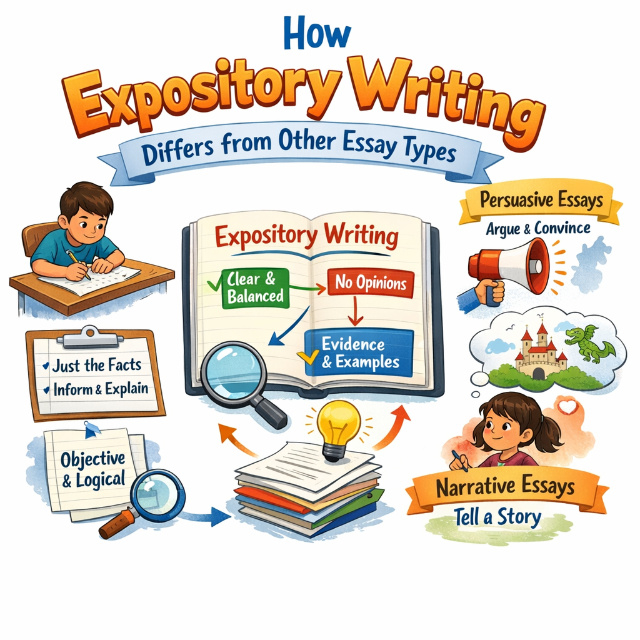
- Expository vs Argumentative: Expository essays teach readers new information through explanation and analysis. You never write "I think" or "I believe." Argumentative essays convince readers to accept your viewpoint using evidence and reasoning. You take a clear position and defend it. Look at the difference:
- Expository: "Electric vehicles reduce emissions through three mechanisms: zero tailpipe pollution, regenerative braking efficiency, and grid electricity's lower carbon intensity."
- Argumentative: "Cities should ban gas powered vehicles by 2030 because electric alternatives reduce emissions by 60%, improve air quality, and save consumers $1,200 annually in fuel costs."
- Expository vs Descriptive: Expository essays teach through explanation. Descriptive essays create vivid mental images using sensory details and figurative language. Descriptive writing focuses on how something looks, feels, or sounds rather than explaining its function.
- Expository vs Narrative: Expository essays present factual information in logical order. Narrative essays tell stories with characters, plot, and chronological events using personal "I" perspective. Expository writing maintains third person objectivity.
Match your approach to the assignment type. If you're explaining or teaching, you're writing expository. If you're arguing or persuading, it's argumentative. If you're painting pictures with words, it's descriptive. If you're telling a story, it's narrative.
How to Write an Expository Essay: Complete Process
Writing an expository essay involves five essential steps that build from topic selection through final revision.
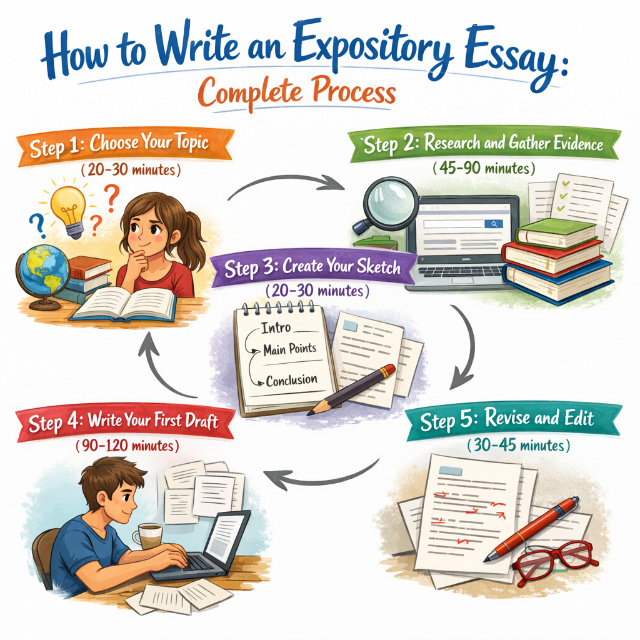
Step 1: Choose Your Expository Essay Topic (20-30 minutes)
Pick something specific enough to cover thoroughly but broad enough to find 3-5 solid sources. "Climate change" is too broad. "How electric vehicles reduce urban air pollution" works perfectly.
Test your topic with a quick Google Scholar search. If you find 10+ credible sources in 5 minutes, you're good. If sources are scarce, pick something else before wasting hours researching.
Can't decide what to write about? Explore our expository essay topics organized by grade level (middle school, high school, college) and essay type. Each category includes 20-30 topics with appropriate complexity for your academic level.
Step 2: Research and Gather Evidence (45-90 minutes)
Find credible sources with facts, statistics, and expert opinions. Take organized notes with citation information. You need at least 3 quality sources for most assignments.
Start with credible sources:
- Academic databases (JSTOR, Google Scholar)
- Government websites (.gov domains)
- Educational institutions (.edu domains)
- Established news organizations
- Peer reviewed journals
Look for recent sources published within the last 5 years unless writing about historical topics. A 2015 article about social media trends is outdated. A 2024 study provides current data.
Track these elements:
- Key facts and statistics
- Expert definitions and explanations
- Real world demonstrations and case studies
- Cause and effect relationships
- Process explanations
Set a timer for research. Students often spend 3 hours researching when 90 minutes would suffice. Once you have 3-5 solid sources with clear facts supporting each main point, stop researching and start outlining.
Step 3: Step 3: Create Your Expository Essay Sketch (20-30 minutes)
Map your thesis, main points, and supporting evidence before writing. This prevents organizational disasters later.
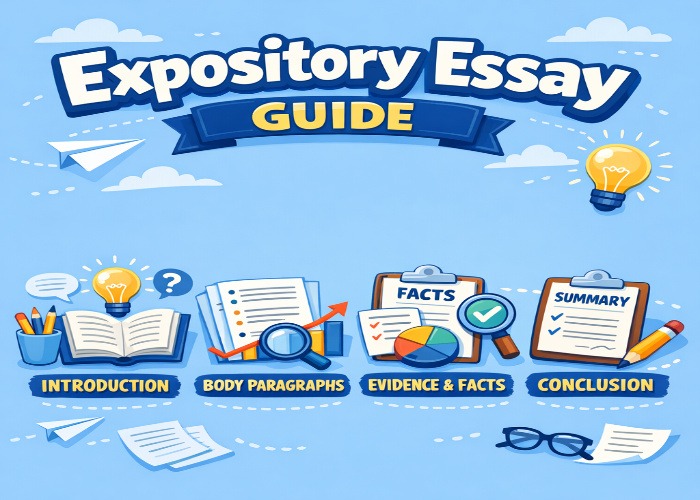
- Introduction
- Body Paragraphs (1, 2, 3,....)
- Conclusion
Need detailed templates? Check our expository essay outline guide with blank formats and filled samples.
Step 4: Write Your Expository Essay Draft (90-120 minutes)
Follow your outline to write complete paragraphs with clear topic sentences, evidence, and analysis. Don't worry about perfection yet just get ideas on paper.
A. Introduction paragraph structure.
- Hook options that work
- Background context (2-3 sentences)
- Thesis statement (1 sentence)
B. Body paragraph structure (TEES):
Each body paragraph covers one main point supporting your thesis using TEES structure:
- T Topic sentence
- E Evidence
- E Explanation
- S Summary/Transition
Aim for 6-8 sentences per body paragraph. Shorter paragraphs feel underdeveloped. Longer ones become difficult to follow.
Want to see this structure in action? Browse expository essay examples with annotated paragraphs across all types and grade levels.
C. Conclusion paragraph structure:
- Restate your thesis
- Summarize main points
- Final thought
Your conclusion should be 4-6 sentences total, matching your introduction length.
EXPOSITORY ESSAY DUE TOMORROW?
Get a clear, coherent, and complete essay delivered fast.
- Express 6 hour delivery option
- Fully researched and fact checked
- Meets all length and formatting requirements
- Last Minute Rescue Specialists
Beat the clock with a quality essay. Immediate start available.
Order NowStep 5: Revise and Edit (30-45 minutes)
Check for clarity, fix awkward sentences, verify citations, and eliminate unnecessary words. This step transforms rough drafts into polished essays.
Wait at least 2 hours between drafting and revising. Fresh eyes catch problems tired eyes miss.
Revision checklist:
Content check:
Organization check:
Clarity check:
Grammar and style check:
|
Read your essay aloud. Your ears catch awkward phrasing that your eyes miss. If you stumble while reading, your sentence needs revision.
Studies show revised essays score 28% higher than first drafts submitted without editing. The revision step separates good essays from great ones.
Expository Essay Writing Tips & Best Practices
These strategies improve clarity, organization, and overall essay quality.
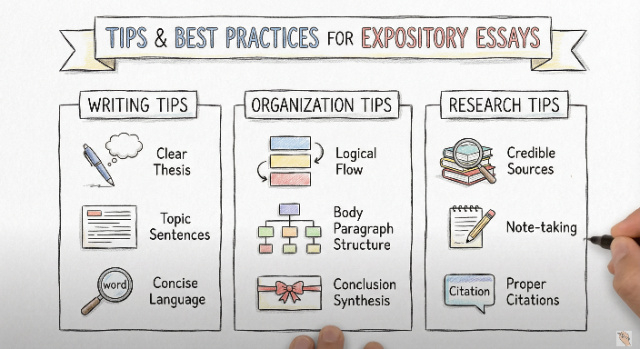
Expository Essay Writing Tips
- Stay objective: Avoid first person pronouns (I, me, my) and opinion language. Replace "I think recycling helps the environment" with "Research shows recycling reduces carbon emissions by 30%."
- Use specific evidence: Replace vague statements like "many experts agree" with concrete citations: "According to EPA research (2024), recycling programs reduce landfill waste by 35%."
- Vary sentence structure: Mix short punchy sentences with longer complex ones. Monotonous rhythm bores readers.
- Define technical terms: When using specialized vocabulary, briefly explain what it means. Don't assume knowledge.
- Use active voice: "The study found" beats "It was found by the study." Active voice creates clearer, more direct writing.
Expository Essay Organization Tips
- One point per paragraph: Never cram multiple main ideas into one paragraph. Split them for clarity.
- Use transitions: Connect paragraphs with words like "furthermore," "however," "consequently," "similarly." These signal relationships between ideas.
- Follow logical order: Organize chronologically for processes, by importance for explanations, or systematically for classifications.
- Maintain focus: Every sentence should relate clearly to your paragraph's topic sentence and your thesis. Delete tangents.
Expository Essay Research Tips
- Use recent sources: Look for materials published within the last 5 years unless writing about historical topics.
- Prioritize credible sources: Academic journals, government reports, and educational institutions provide more reliable information than random blogs.
- Take organized notes: Record source information (author, title, publication, date, page numbers) immediately. You'll need it for citations.
- Verify facts: Cross check important statistics or claims across multiple sources before including them.
Expository Essay's Common Mistakes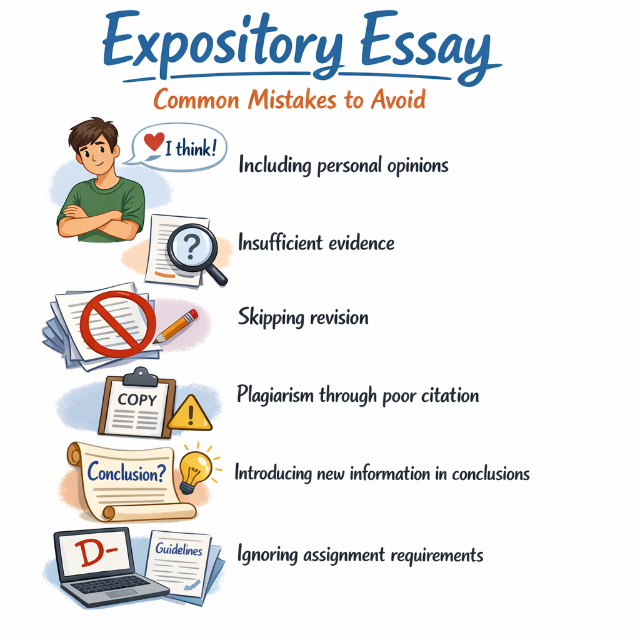
- Including personal opinions: Expository essays explain objectively. Save arguments and personal views for argumentative essays.
- Weak thesis statements: Vague statements like "This essay is about pollution" provide no direction. Be specific about what you'll explain.
- Poor paragraph organization: Random information dumping confuses readers. Use TEES structure (Topic, Evidence, Explanation, Summary) consistently.
- Insufficient evidence: Claims without supporting sources lack credibility. Aim for 2-3 pieces of evidence per body paragraph.
- Skipping revision: First drafts contain organizational problems and careless errors. Always revise before submitting.
- Plagiarism through poor citation: Every fact, statistic, quote, or paraphrased idea from sources requires citation. When uncertain, cite it.
- Introducing new information in conclusions: Conclusions summarize and synthesize existing information. New evidence confuses readers.
- Ignoring assignment requirements: Missing word counts, source requirements, or formatting guidelines costs easy points.
Expository Essay Requirements by Grade Level: Middle School to College
Expository essay requirements scale with academic level. Understanding these expectations helps you meet assignment standards appropriately.
Middle School Expository Essay Requirements (Grades 6-8)
|
High School Expository Essay Requirements (Grades 9-12)
|
College Expository Essay Requirements & Standards
|
Adjust your approach based on academic level. A middle school essay explaining photosynthesis differs dramatically from a college essay analyzing competing models of photosynthetic efficiency.
Still feeling stuck? Our trusted essay writing service handle everything from research to citations you just submit and relax.
Downloadable Resource
Key Takeaways: Mastering Expository Essays
You now have complete understanding of expository essays: their purpose, types, characteristics, and requirements across all academic levels.
Remember the key principles: maintain objectivity by avoiding personal opinions, support every claim with credible evidence, organize logically with clear transitions, and match your approach to assignment requirements and grade level expectations.
Start by identifying your essay type and reviewing requirements. Use our free resources to plan systematically. Follow the five step writing process from topic selection through revision. Avoid the common mistakes that cost students grades.
The difference between a B Grade essay and an A+ essay often comes down to following the process: students who outline before writing, use TEES structure for body paragraphs, and revise before submitting score significantly higher than those who skip these steps.

-19544.jpg)