-19993.jpg)
What Is a Process Analysis Essay?
A process analysis essay explains a process from start to finish. Unlike argumentative essays that make claims or descriptive essays that paint pictures, process analysis teaches readers how something works or guides them through completing a task.
Think of it as an instruction manual in essay form.
The purpose is simple: make a process crystal clear to your reader. You're either showing them how to do something themselves (directive) or helping them understand how something works (informational).
What Makes It Different?
- NOT argumentative: You're not debating or persuading.
- NOT descriptive: You're not just describing what something looks like.
- Instructional or Informational: You're teaching or explaining
Real world examples of process analysis include recipes, user manuals, how to guides, and educational explanations of natural or social processes. In academic settings, you might analyze biological processes, historical events, scientific methods, or technical procedures.
The key is chronological organization. Every step must follow the previous one in time order. Skip a step or jumble the sequence, and your reader gets lost.
DEADLINE APPROACHING?
Our writers deliver polished process analysis essays in as little as 6 hours, researched, structured, and ready to submit
- Expert writers with verified degrees
- 100% original, passes Turnitin
- Any topic, any deadline
- Plagiarism-free guarantee on every paper
Zero AI. Zero stress. Just results.
Order NowThe Two Types of Process Analysis Essays
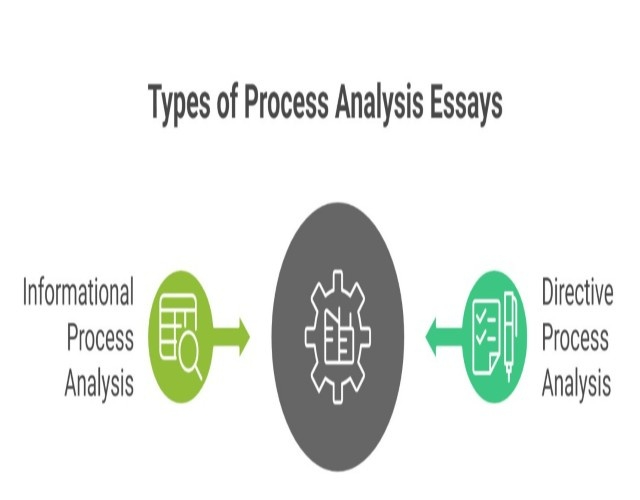
Understanding which type you're writing is crucial they have different purposes, tones, and structures.
1. Directive Process Analysis (How To)
Purpose: Instructs the reader to complete a task themselves
Directive essays are step by step instructions. Your reader follows your directions to achieve a specific result. These essays use second person (you) and imperative verbs (do this, add that, remove the other).
Tone: Direct, instructional, conversational. You're coaching someone through the process.
Key features
- Lists materials or prerequisites upfront.
- Uses "you" throughout.
- Gives commands: "Mix the ingredients," "Click the button".
- Includes warnings or tips where relevant.
2. Informational Process Analysis
Purpose: Explains how something works (the reader doesn't perform it)
Informational essays help readers understand a process without expecting them to do it. These essays use the third person (it, the process, one) and focus on explanation rather than instruction.
Tone: Educational, objective, explanatory. You're teaching about the process, not coaching through it.
Key features
- Focuses on understanding, not execution.
- Uses third person throughout.
- Explains "how it works" not "how to do it".
- May include scientific or technical details.
Quick Comparison
| Feature | Directive | Informational |
|---|---|---|
| Goal | Teach how to do | Explain how it works |
| Reader's role | Follows steps | Gains understanding |
| Tone | You, imperative | They/it, explanatory |
| Example | "How to bake bread." | "How bread rises." |
How to Write a Process Analysis Essay (Step by Step)
Writing a process analysis essay follows a clear structure. Here's the complete process broken into manageable steps.
Step 1: Understand Your Assignment
Before you write a single word, make sure you understand exactly what's required.
Key questions to answer
- Is this directive (how to) or informational (how it works)?
- Who is my audience, and what do they already know?
- What's the word count requirement?
- Are there specific formatting requirements (MLA, APA, Chicago)?
Your audience's knowledge level matters tremendously. Writing "How to Use Excel" for beginners requires a different depth than writing it for intermediate users. If your assignment doesn't specify, assume your audience is intelligent but unfamiliar with this specific process.
Step 2: Choose Your Process
Pick something you genuinely understand or can research thoroughly. Half-knowledge leads to incomplete essays.
Good process ideas
|
Avoid
|
Need inspiration? See our process analysis essay topics for ideas organized by subject and difficulty.
Step 3: Research and List All Steps
Even if you know the process well, write down every single step. What seems obvious to you might be unfamiliar to your reader.
How to map your process:
|
For directive essays, actually doing the process reveals gaps you'd otherwise miss. For informational essays, research multiple sources to ensure accuracy.
Step 4: Create Your Process Analysis Thesis Statement
Your thesis should do more than announce your topic; it should explain why this process matters and preview its main stages.
Formula: [Process] is important because [reason] and involves [key stages]
Examples:
|
|
Your thesis belongs at the end of your introduction and sets up the body paragraphs that follow.
Step 5: Organize Your Steps Chronologically
Process analysis demands a strict time order. Never jump around or say "remember to do X" after you've already described step Y that required X.
Organization tips:
|
For a directive essay on changing a tire:
| Paragraph 1: Preparation and safety. |
| Paragraph 2: Loosening lug nuts and jacking the car. |
| Paragraph 3: Removing the old tire and installing a new one. |
| Paragraph 4: Lowering the car and final tightening. |
Step 6: Write and Revise
Now write your full draft following your outline.
As you write
|
When revising, ask
|
Read your essay aloud. If you stumble or find something unclear, your reader will too.
Process Analysis Essay Structure
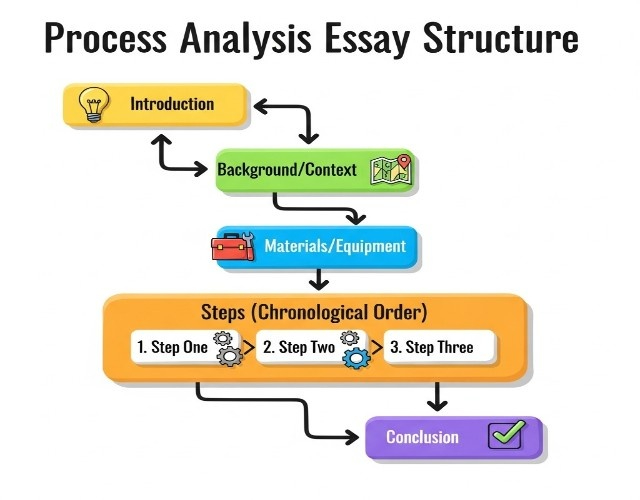
Every effective process analysis essay follows the same basic structure. Here's what each part does.
Introduction (10 to 15% of essay)
Your introduction sets up everything that follows. It must accomplish four things:
Hook: Grab attention and show why this process matters
- "Changing your car's oil saves hundreds in mechanic fees and extends engine life by years."
- "Most people abandon sourdough bread after their first failed attempt. Here's why, and how to succeed."
Background/Context: Brief relevant information (2-3 sentences)
- What is this process?
- Why does it matter?
- When or why would someone need to know this?
Thesis statement: Preview main stages and state significance
Materials list (directive only): If your essay is how-to, list what readers need before starting
Common mistakes to avoid
|
Body Paragraphs (70 to 80% of essay)
Each body paragraph covers one major stage of your process.
Structure for each paragraph:
|
Example paragraph structure (directive):
Topic sentence: "Before lifting the car, you must properly position the jack and loosen the lug nuts."
Steps: First, locate your car's jack points in the owner's manual. Place the jack securely under the designated point. Next, use the lug wrench to loosen each lug nut a quarter turn. Do this BEFORE jacking the car up. If you wait until the wheel is off the ground, it will spin freely, and you can't loosen them.
Transition to next paragraph: "Once the lug nuts are loosened, you're ready to lift the vehicle..."
Conclusion (10 to 15% of essay)
Your conclusion wraps up without repeating everything.
What to include
|
What NOT to do
- Introduce new steps or information.
- Start with "In conclusion..." (readers know it's the conclusion).
- Simply rewrite your introduction.
- Repeat every detail from the body paragraphs.
Example conclusion (directive):
"With these steps, preparation, jacking, tire replacement, and final tightening, you can safely change a tire in under 30 minutes. You'll save money on roadside assistance and gain confidence handling vehicle emergencies. Keep your spare tire inflated and jack accessible; you never know when you'll need them."
How to Start a Process Analysis Essay
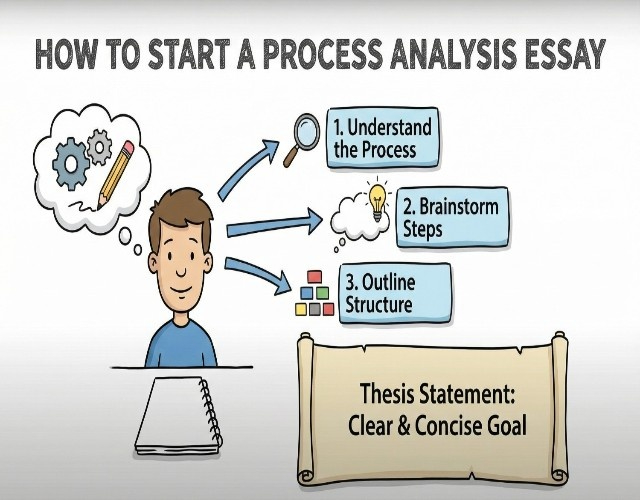
Your introduction makes or breaks reader engagement. Start strong using these strategies:
Opening Strategy 1: Start with the "Why"
Explain why this process matters before diving into the steps.
"Changing your car's oil every 5,000 miles saves hundreds in mechanic fees and extends engine life by years. Yet 73% of car owners pay mechanics for this simple 30 minute task. Here's how to do it yourself."
Opening Strategy 2: Address Common Frustrations
Show you understand the reader's pain point.
"Most people abandon sourdough bread after their first failed attempt, dense, gummy, or refuse to rise. The problem isn't your skills; it's understanding fermentation timing. Here's how the process actually works."
Opening Strategy 3: State Prerequisites Upfront
For directive essays, tell readers what they need before starting.
"Before attempting to replace your phone screen, gather these five tools: a heat gun, suction cup, plastic pry tools, tweezers, and replacement adhesive. Without the right tools, you risk permanent damage to your device."
What Your Introduction Must Include
No matter which opening strategy you choose, include:
|
Keep your introduction under 150 words. Get to the process quickly, readers came for instructions or explanation, not lengthy preambles.
NOT SURE YOUR PROCESS ANALYSIS ESSAY DRAFT IS RIGHT?
Our professional writers craft essays that impress professors and earn top marks.
- 100% human written
- Delivered on time
- Free revisions until perfect
- 24/7 support and direct writer communication
Trusted. Confidential. 100% human written.
Order NowProcess Analysis Essay Examples

Seeing strong examples is the fastest way to understand structure and tone. Here are three complete examples showing different approaches:
Example 1: Directive Process Analysis Essay
Title: How to Write an Effective Resume
Introduction:
Landing your first job starts with a resume that gets past the 6-second recruiter scan. Yet 75% of resumes never reach human eyes, filtered out by applicant tracking systems or weak formatting. Creating a professional resume requires strategic content organization, keyword optimization, and clean visual design. Here's how to craft one that opens doors.
Body Paragraph 1: Choosing the Right Format
Begin by selecting a resume format that matches your career stage. Chronological format works best if you have a consistent work history, list your experience starting with your most recent position, and work backward. Functional format highlights skills over work history, ideal for career changers or those with employment gaps. Combination format merges both approaches, showcasing skills while providing chronological work history. For entry-level candidates or those with under five years of experience, stick with chronological format; it's what recruiters expect and prefer.
Body Paragraph 2: Crafting Your Header and Summary
Place your name at the top in 18-20 point font, followed by your phone number, professional email address, and LinkedIn URL. Avoid including your full street address, city and state suffice in 2025. Next, write a 3 to 4 sentence professional summary that answers three questions: who you are, what you offer, and what you're seeking. For example: "Marketing graduate with internship experience in social media management and content creation. Increased Instagram engagement by 40% for local nonprofit. Seeking entry-level digital marketing role to apply data-driven strategy skills." This immediately tells recruiters your value proposition.
Body Paragraph 3: Detailing Your Experience
List each position with your job title, company name, location, and dates of employment. Under each role, include 3-5 bullet points describing accomplishments, not just duties. Start each bullet with a strong action verb, managed, created, increased, implemented, developed. Most importantly, quantify results whenever possible. Transform "Responsible for social media" into "Grew Twitter following from 500 to 3,200 followers in six months through daily engagement and strategic content planning." Numbers prove impact. If you lack professional experience, include relevant coursework, academic projects, volunteer work, or leadership roles in student organizations.
Body Paragraph 4: Adding Education and Skills
Place your education section after experience if you've been working for more than two years; before experience if you're a recent graduate. List your degree, major, school name, graduation date, and GPA if it's 3.5 or higher. Include relevant coursework only if it directly relates to the job you're targeting. Finally, create a skills section with 8 to 12 relevant abilities divided into categories: Technical Skills (specific software, tools, or platforms) and Additional Skills (languages, certifications, or relevant competencies). Match these skills to keywords found in the job description. Many companies use applicant tracking systems that scan for specific terms before a human ever sees your resume.
Conclusion:
With these four components, the right format, compelling header and summary, quantified experience, and targeted skills, you'll create a resume that survives automated screening and impresses recruiters. Remember to tailor each resume to the specific job description, save it as a PDF to preserve formatting, and keep it to one page unless you have over 10 years of experience. Your resume is your marketing document; invest time making it exceptional, and the interview invitations will follow.
Example 2: Informational Process Analysis Essay
Title: How the Human Immune System Fights Viral Infections
Introduction:
Every time a virus enters your body, an invisible war begins. Your immune system deploys a sophisticated defense strategy involving multiple cell types, chemical signals, and memory formation. Understanding how this process works, from initial detection to final elimination, reveals why some infections resolve in days while others persist for weeks. The immune response unfolds in three distinct phases: recognition, activation, and elimination.
Body Paragraph 1: Recognition and Innate Response
The moment a virus breaches your body's physical barriers (skin, mucous membranes), innate immune cells recognize it as foreign. Dendritic cells and macrophages patrol your tissues, constantly sampling their environment for molecular patterns that signal infection. When these cells detect viral proteins that don't match human cell patterns, they bind to the virus and begin producing inflammatory chemicals called cytokines. Cytokines serve as alarm signals, recruiting more immune cells to the infection site and causing the inflammation, fever, and fatigue you experience during illness. This innate response happens within hours of infection and provides immediate, non-specific defense while your body prepares a more targeted attack.
Body Paragraph 2: Adaptive Immune Activation
While innate immunity fights the initial infection, dendritic cells carry viral fragments to your lymph nodes, the command centers of your immune system. There, they present these fragments to T cells and B cells, your adaptive immune soldiers. T cells come in two varieties: helper T cells that coordinate the response and killer T cells that destroy infected cells. When a T cell encounters its matching viral fragment (each T cell recognizes only one specific invader), it becomes activated and begins rapidly multiplying. Similarly, B cells that recognize the virus start cloning themselves and transforming into plasma cells. This activation phase takes 4 to 7 days, which explains why you often feel worse several days into an infection; your adaptive immunity is ramping up to full power.
Body Paragraph 3: Elimination and Memory Formation
Once activated, your adaptive immune system launches its precision strike. Killer T cells circulate through your bloodstream and tissues, identifying and destroying any cell displaying viral proteins on its surface, essentially eliminating the virus's hiding places. Simultaneously, plasma B cells produce antibodies, Y-shaped proteins that bind to viruses in your bloodstream and mark them for destruction by other immune cells. Antibodies also prevent viruses from entering healthy cells by blocking their attachment points. As the viral load decreases, most activated immune cells die off, but some transform into memory cells that persist for years or even decades. These memory cells enable your immune system to respond faster if the same virus ever invades again, the biological basis of immunity. This is why you typically don't catch the exact same cold strain twice; your immune system remembers and eliminates it before symptoms develop.
Conclusion:
From recognition to elimination, the immune response demonstrates biological precision engineering. Innate immunity provides immediate non specific defense, adaptive immunity delivers targeted elimination, and memory cells ensure long lasting protection. This three-phase process typically resolves viral infections within 7 to 10 days for healthy individuals, though some viruses have evolved strategies to evade immune detection or persist in cells the immune system cannot easily access. Understanding this process explains why vaccines work (they create memory without causing disease), why immunocompromised individuals struggle with infections, and why your grandmother's advice to rest during illness is scientifically sound, your immune system requires significant energy to wage this microscopic war.
Example 3: Academic Process Analysis Essay (Directive)
Title: How to Conduct a Systematic Literature Review in Social Sciences
Introduction:
A systematic literature review differs fundamentally from a traditional research paper's literature section. Rather than selectively citing sources that support your argument, a systematic review follows a rigorous, replicable methodology to identify, evaluate, and synthesize all relevant research on a specific question. This approach minimizes bias and provides a comprehensive understanding of current knowledge in a field. Conducting a systematic review requires four essential phases: defining your research question, executing a comprehensive search strategy, critically appraising sources, and synthesizing findings. For graduate students and researchers, mastering this process is crucial for producing credible, publication-worthy scholarship.
Body Paragraph 1: Formulating a Focused Research Question
Begin by developing a precise, answerable research question using the PICO framework: Population, Intervention, Comparison, and Outcome. For example, instead of asking "Does social media affect mental health?" (too broad), ask "Among adolescents aged 13 to17 (Population), does Instagram use exceeding 3 hours daily (Intervention) compared to less than 1 hour daily (Comparison) correlate with increased anxiety symptoms (Outcome)?" This specificity guides your entire search strategy. Write your question down and have it reviewed by a faculty advisor or colleague before proceeding, changing your question mid-review invalidates your methodology. Document your question, including any definitions of key terms, in a protocol that will later be included in your methods section.
Body Paragraph 2: Designing and Executing Your Search Strategy
Develop a comprehensive search strategy across multiple academic databases. In social sciences, search at minimum PsycINFO, JSTOR, Web of Science, and Google Scholar. Create a Boolean search string using your key terms connected with AND/OR operators. For our example: "(Instagram OR "social media") AND (adolescent OR teen) AND (anxiety OR "mental health")." The asterisk () serves as a wildcard capturing variations like adolescent, adolescents, and adolescence. Run this search in each database and export all results to a reference management system like Zotero or Mendeley. Set date parameters based on your research needs, typically the past 10 to 15 years for most topics, though seminal older works can be included. Document exactly which databases you searched, what terms you used, how many results each yielded, and what date you conducted the search. This documentation is critical for replicability.
Body Paragraph 3: Screening and Selecting Relevant Sources
Now screen your results in two stages: title/abstract screening, then full-text review. Establish clear inclusion and exclusion criteria before you begin. Inclusion criteria might specify: peer-reviewed empirical studies, published in English, using quantitative or mixed methods, and sample sizes above 100 participants. Exclusion criteria might eliminate: opinion pieces, case studies, non-English publications, or studies focused on adults rather than adolescents. First, review titles and abstracts, eliminating obviously irrelevant sources. For our example, you might start with 847 database results and narrow to 156 after title/abstract screening. Next, obtain and read the full text of remaining articles, applying your criteria rigorously. Keep a screening log documenting how many sources you eliminated at each stage and why. This often reduces your pool to 30 to 50 highly relevant studies, quality matters more than quantity in systematic reviews.
Body Paragraph 4: Extracting Data and Synthesizing Findings
Create a data extraction spreadsheet to systematically record information from each included study: author, year, sample size, methodology, key findings, and limitations. This structured approach enables you to identify patterns, contradictions, and gaps in the literature. As you extract data, look for themes emerging across studies. Do certain methodological approaches yield different results? Are findings consistent across age groups or geographical regions? Organize your synthesis thematically rather than study by study, group sources that address similar aspects of your question. For our example, you might organize sections around: prevalence of Instagram use among adolescents, correlational studies linking use to anxiety, proposed mechanisms (social comparison, FOMO, sleep disruption), and moderating factors (parental oversight, self-esteem levels). Use a synthesis matrix to visualize how studies relate to each theme, making patterns and gaps immediately apparent.
Conclusion:
A systematic literature review requires methodological rigor that far exceeds traditional literature searches. By formulating a precise question, executing comprehensive searches, applying consistent selection criteria, and systematically synthesizing findings, you produce a credible foundation for future research or evidence based practice. This process typically requires 40 to 60 hours for a master's-level review and 80 to 120 hours for doctoral work, but the resulting comprehensive understanding of your research area justifies the investment. Your completed review should enable readers to understand not just what research exists, but what patterns, contradictions, and gaps define current knowledge, thereby identifying precisely where future research should focus.
What Makes These Process Analysis Essay Examples Effective
Example 1 (Resume Writing)
|
Example 2 (Immune System)
|
Example 3 (Literature Review)
|
The biggest mistake students make? Writing steps in the order they think about them, not the order someone needs to do them. Before you submit, hand your essay to someone unfamiliar with the process. If they can't follow it successfully, your chronology needs work. Our professional essay writing service catches these gaps before your professor does.
Common Process Analysis Essay Mistakes to Avoid
Learn from these frequent errors before you make them yourself.
1. Skipping "Obvious" Steps
What's obvious to you isn't to your reader. Include every step, even basic ones.
- Example mistake: "Add the eggs" without specifying how many, whether to crack them, or how to incorporate them.
- Fix: "Crack three eggs into a small bowl, then whisk them before adding to the mixture."
2. Wrong Chronological Order
Never say "remember to do X" after describing step Y that requires X first.
- Example mistake: Body paragraph 3 says, "Make sure you preheat the oven in step 1." If preheating matters, it belongs in step 1, not mentioned later.
- Fix: Test your sequence. Could someone follow your steps successfully in the order presented?
3. Vague Instructions
Precision matters, especially in directive essays.
| Vague: "Heat until done." Precise: "Bake at 350°F for 25 to 30 minutes until the top is golden brown and a toothpick inserted in the center comes out clean." |
| Vague: "Mix thoroughly." Precise: "Stir continuously for 2 to 3 minutes until no flour streaks remain and the batter is smooth." |
4. Missing Transitions
Transitions create flow between steps. Without them, your essay feels choppy.
Use these transitions
| Beginning: first, initially, to start, begin by. |
| Continuing: next, then, after that, following this. |
| Simultaneously: while, meanwhile, at the same time, simultaneously. |
| Ending: finally, lastly, to complete, in the end. |
5. No Thesis Statement
Don't just list steps, explain why this process matters.
|
6. Passive Voice in Directive Essays
Directive essays need an active, imperative voice.
| Passive: "The dough should be kneaded for 10 minutes." Active: "Knead the dough for 10 minutes." |
| Passive: "The mixture is then poured into the pan." Active: "Pour the mixture into the pan." |
7. Including Opinion in Informational Essays
Informational essays explain how processes work, saving evaluation for the conclusion.
|
WANT A PERFECT EXAMPLE TO FOLLOW?
Get a custom process analysis essay written specifically for your topic, use it as a model or submit it as-is.
- Matches your exact requirements
- Proper chronology and transitions
- Unlimited free revisions
- Fast delivery, even last-minute orders
100% human written. Guaranteed.
Order NowFinal Thoughts
Process analysis essays are about clarity and completeness. Whether you're teaching readers to complete a task or explaining how something works, your goal is the same: make the process crystal clear.
Focus on a thorough step by step organization, use strong chronological transitions, and never skip steps your reader needs to know. With the structure and examples in this guide, you have everything to write a strong process analysis essay or know when to get expert help.
Good luck with your essay.

-20017.jpg)