What is a Definition Essay?
A definition essay is academic writing that provides an extended, detailed explanation of what a term means, going far beyond the dictionary definition to explore the word's complexities, contexts, and significance.
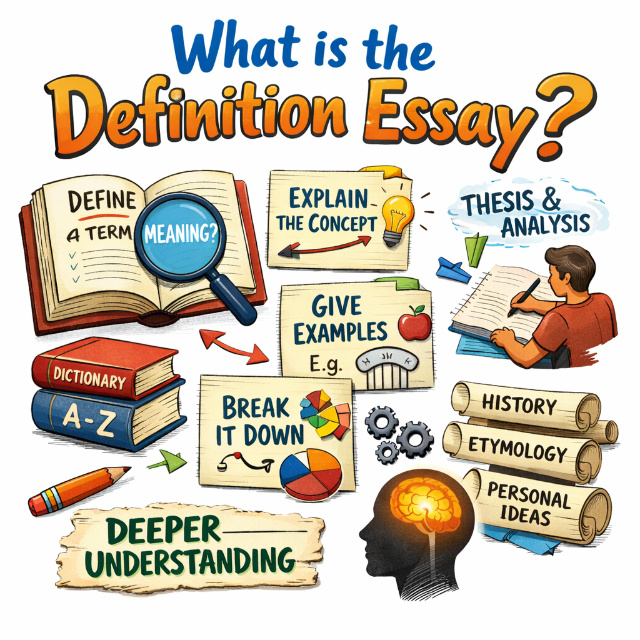
Simple definition: Definition essay = in depth analysis of a term's meaning through etymology, examples, comparisons, and personal or cultural interpretation
Unlike looking up a word in the dictionary, definition essays require you to:
|
The Three Essential Components
|
Purpose of Definition Essays
Instructors assign definition essays to develop critical thinking about language and meaning. The assignment teaches you to:
|
The goal isn't to prove your definition is "correct," it's to demonstrate thorough analysis and present a well supported, comprehensive understanding.
What Makes a Good Definition Essay?
Strong definition essays share these qualities:
|
See the difference? Good definitions explore complexity rather than stating the obvious.
NEED TO DEFINE "HOME," "SUCCESS," OR "LOVE"?
We help weave personal narrative with academic rigor for a powerful, reflective definition essay.
- Framing abstract concepts through personal experience
- Balancing subjective insight with objective analysis
- Creating an essay that is both authentic and academically sound
- Personalized Insight Service
Define the terms that define you.
Get Started NowTypes of Definition Essays
Different approaches work for different terms. Knowing the types helps you choose the right strategy.
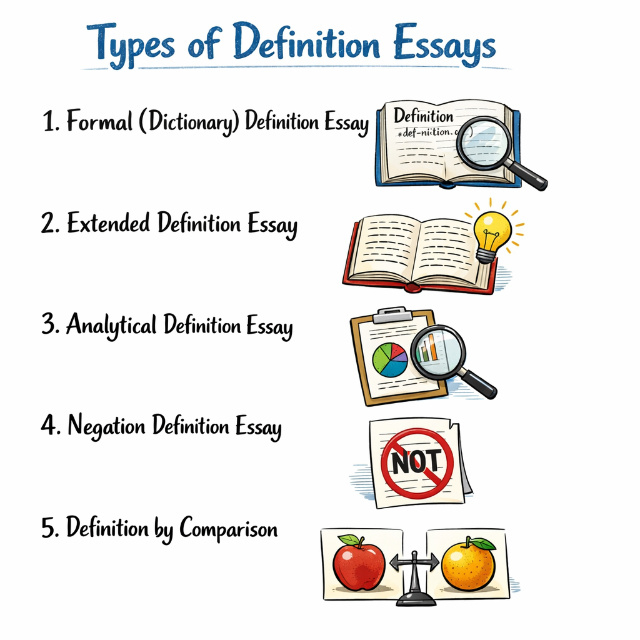
1. Formal (Dictionary) Definition Essay
What it is: Starts with a dictionary definition, then expands with analysis, examples, and context
When to use: For academic terms, technical concepts, or when the instructor specifically asks for a dictionary based approach
Structure:
- Introduction with dictionary definition
- Etymology section
- Analysis of each part of the definition
- Examples illustrating the definition
- Conclusion synthesizing understanding
2. Extended Definition Essay
What it is: Goes far beyond the dictionary definition to explore historical development, cultural variations, personal interpretations, and contextual meanings
When to use: For complex abstract concepts that mean different things to different people
Structure:
- Brief dictionary definition (starting point)
- Historical/etymological development
- Various cultural or contextual interpretations
- Analysis of how context changes meaning
- Your comprehensive understanding
3. Analytical Definition Essay
What it is: Breaks down the term into components and analyzes how each part contributes to the overall meaning
When to use: For compound concepts or terms with multiple dimensions
Structure:
- Introduction identifying components
- Analysis of each component separately
- Exploration of how components interact
- Synthesis showing complete meaning
4. Negation Definition Essay
What it is: Defines what the term IS by explaining what it ISN'T, clearing up misconceptions
When to use: For commonly misunderstood terms or concepts frequently confused with similar ideas
Structure:
- Common misconceptions about the term
- What the term doesn't mean (with examples)
- What the term actually means (by contrast)
- Clear correct definition
5. Definition by Comparison
What it is: Defines a term by comparing and contrasting it with related terms
When to use: When the best way to clarify meaning is to show how it relates to similar concepts
Structure:
- Introduction of related terms
- Similarities between concepts
- Key differences that distinguish terms
- A clear definition emerging from the comparison
Which Type Should You Choose?
Read your assignment carefully. If it specifies an approach ("extended definition" or "define by negation"), follow that requirement.
Consider your term:
- Technical/academic terms = Formal definition
- Abstract concepts with personal meaning = Extended definition
- Compound or multi dimensional terms = Analytical definition
- Commonly misunderstood terms = Negation definition
- Terms best understood through contrast = Definition by comparison
When in doubt: An extended definition works for most abstract terms and gives you flexibility to incorporate multiple approaches.
Definition Essay vs. Other Essay Types
Understanding how definition essays differ from similar assignments helps you know what instructors expect.
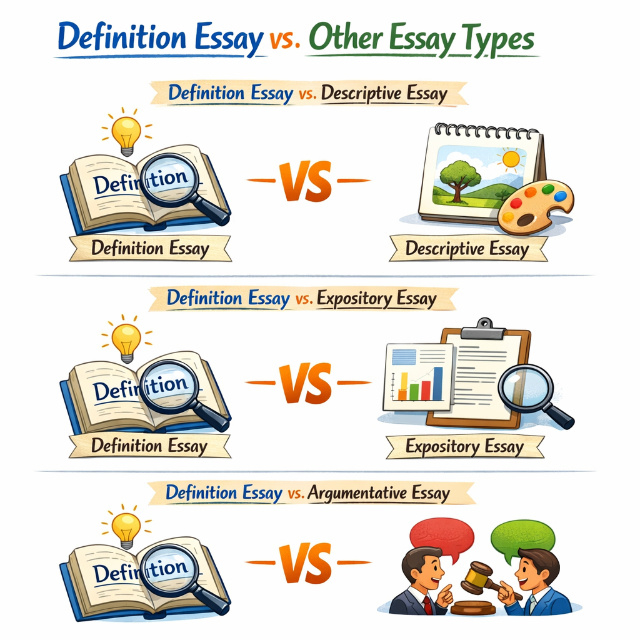
Definition Essay vs. Descriptive Essay
Definition Essay:
- Explains what a term MEANS
- Analyzes concept abstractly
- Uses examples to clarify meaning
- Focuses on understanding the term itself
Descriptive Essay:
- Shows what something IS LIKE
- Describes concrete sensory details
- Uses imagery to create mental pictures
- Focuses on the reader experiencing the subject
Example: A definition essay on "home" explores the concept's meanings of security, belonging, and identity. A descriptive essay on "home" paints a sensory picture of your childhood house, the creaky stairs, the smell of Sunday dinner, and afternoon light through kitchen windows.
Definition Essay vs. Expository Essay
Definition Essay:
- One specific type of expository essay
- Focuses exclusively on defining a term
- Explores multiple meanings and contexts
Expository Essay (general):
- A broad category including many types
- May explain processes, compare, and analyze causes
- Not limited to defining terms
| All definition essays are expository (they explain), but not all expository essays are definition essays. |
Definition Essay vs. Argumentative Essay
Definition Essay:
- Explains and analyzes the meaning
- Presents a comprehensive understanding
- Not trying to persuade readers of a position
Argumentative Essay:
- Takes a stance on a debatable issue
- Argues that one side is correct
- Aims to persuade through evidence and logic
| Difference: A definition essay on "freedom" explores what the term means in various contexts. An argumentative essay might argue that "freedom requires government protection of rights" or "freedom means minimal government interference," taking a debatable position. |
How to Write a Definition Essay (7 Steps)
Follow this process to write a strong definition essay efficiently.
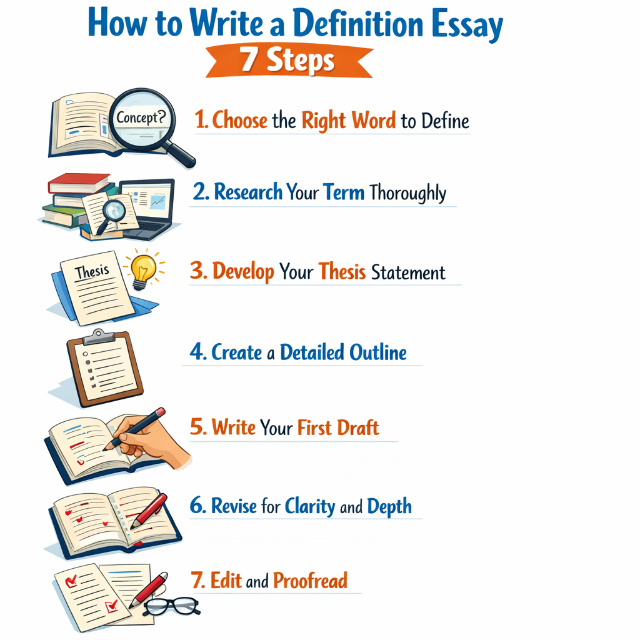
Step 1: Choose the Right Word to Define
Not every word makes a good definition essay topic. Choose strategically.
What makes a good definition essay word:
- Abstract rather than concrete: "Success" not "table," "courage" not "car"
- Complex meaning: Can be interpreted differently by different people
- Personal resonance: Something you have thoughts about or can research thoroughly
- Debatable to some degree: Room for different perspectives and interpretations
- Culturally significant: The term matters in society, academia, or specific contexts
What to avoid:
- Simple objects with obvious meanings: "Book," "phone," "tree," nothing to explore
- Technical jargon with one clear definition: "Mitosis," "byte," "isosceles triangle" dictionary suffices
- Terms too broad: "Life," "nature," "existence" can't cover comprehensively
- Terms too narrow: "Selfie stick," "pop socket" not enough depth
- Good definition essay words: Success, courage, love, freedom, justice, identity, family, beauty, intelligence, privilege, responsibility, happiness, maturity, integrity, leadership
| Quick test: Can you explain this term in different ways depending on who's asking? If yes, it's probably a good choice. |
Need more help with choosing a refined topic for definition essays? Visit our 150+ Definition Essay Topics list, organized by category and difficulty level
Step 2: Research Your Term Thoroughly
Before writing, gather comprehensive information.
Research what you need:
- Dictionary definitions: Start with Merriam-Webster, Oxford English Dictionary, and specialized dictionaries for your field
- Etymology: When did the word originate? How has its meaning evolved? Use Online Etymology Dictionary or Oxford English Dictionary
- Expert definitions: How do scholars in relevant fields define this term? Search Google Scholar for academic articles
- Cultural perspectives: Does the term mean something different in other cultures? Look for anthropological or cross cultural research
- Historical context: How was this term understood 50, 100, or 200 years ago?
- Current usage: How do people use this word today? What contexts change its meaning?
Sources to use:
- Academic databases (JSTOR, ProQuest, EBSCOhost)
- Online Etymology Dictionary
- Subject specific encyclopedias
- Scholarly books and articles
- Reputable news sources for contemporary usage
Take organized notes:
- Record full citation info for every source
- Separate dictionary definitions from scholarly interpretations
- Note quotes you might use (with page numbers)
- Track different meanings in different contexts
Step 3: Develop Your Thesis Statement
Your thesis presents your comprehensive definition of the main point of your essay.
Formula: [Term] is [core meaning] that [key characteristics/dimensions] + [significance/why it matters]
Examples:
Weak: "Success is achieving your goals"
Strong: "Success represents the alignment of achievement with personal values, requiring not just external accomplishment but internal satisfaction with one's choices and their impact"
Weak: "Courage means being brave"
Strong: "Courage is the deliberate choice to act despite fear when personal values demand action, distinguishing it from recklessness and elevating it beyond mere fearlessness"
Weak: "Family is people related by blood"
Strong: "Family extends beyond biological ties to encompass chosen relationships built on mutual support, shared history, and emotional commitment, making kinship a function of connection rather than genetics"
Your thesis should:
- Go beyond dictionary definition
- Present YOUR informed understanding
- Suggest the complexity you'll explore
- Be specific enough to guide your essay
Step 4: Create a Detailed Outline
Organize your research and ideas before drafting.
Standard definition essay outline:
I. Introduction
- Hook (question, scenario, or surprising statement)
- Brief context about why this term matters
- Dictionary definition (starting point)
- Thesis statement (your comprehensive definition)
II. Etymology and Historical Development
- Word origins
- How meaning evolved over time
- Historical uses that inform current meaning
III. Denotation (Literal Definition)
- Official dictionary definitions
- Technical or academic definitions
- What experts in the field say
IV. Connotation (Associated Meanings)
- Emotional associations
- Cultural interpretations
- Context dependent meanings
V. Analysis by Method (choose 1-3)
- Definition by example
- Definition by function
- Definition by comparison/contrast
- Definition by negation (what it's NOT)
- Definition by analysis (breaking into parts)
VI. Personal/Contemporary Interpretation
- What does this term mean today
- Your well-supported understanding
- How does your definition integrate various perspectives
VII. Conclusion
- Restate the thesis in new words
- Synthesize key insights
- Why understanding this term matters
Adjust sections based on your term and approach, but ensure logical flow from simple (dictionary) to complex (your analysis).
Step 5: Write Your First Draft
Now write, following your outline.
Introduction tips:
- Start with a hook:
- Question: "What separates courage from recklessness?"
- Scenario: "When Rosa Parks refused to give up her seat..."
- Surprising fact: "The word 'nice' originally meant 'foolish' in the 13th century"
- Bold statement: "Success ruins more lives than failure ever could"
- Provide context: Explain why defining this term matters
- Include dictionary definition: Show readers the starting point before you expand it
- Present your thesis: Your comprehensive definition that will guide the essay
Body paragraph tips:
- Each paragraph focuses on one aspect of your definition
- Use topic sentences that clearly state what aspect you're exploring
- Include specific examples: Concrete illustrations make abstract concepts clear
- Integrate sources smoothly: Don't just drop in quotes, introduce them and explain their relevance
- Analyze, don't just describe: Explain how examples or sources support your definition
Example body paragraph:
Understanding courage requires distinguishing it from fearlessness, a distinction neuroscience confirms. Fearless individuals, whether due to amygdala damage or genetic variation, simply don't experience fear responses (Adolphs & Tranel, 1999). Courage, by contrast, activates both fear centers and prefrontal control regions simultaneously, as the brain experiences threat while choosing to act anyway (Feldman et al., 2016). This neural difference explains why firefighter Sarah Martinez's decision to reenter a burning building to save a child exemplifies courage rather than fearlessness. "I was terrified," Martinez told reporters afterward, "but that child needed help." Her acknowledgment of fear while acting despite it demonstrates courage's defining characteristic: action taken because values demand it, not because fear is absent. Fearlessness requires no moral choice; courage does.
Notice: Topic sentence, research evidence, concrete example, analysis connecting it all. |
Conclusion tips:
- Restate your thesis in different words, incorporating insights from your analysis
- Synthesize key points: Bring together the various aspects you explored
- End with significance: Why does understanding this term matter?
- Don't:
- Introduce new information
- Just summarize what you already said
- End with a cliché ("In conclusion..." or "This makes me the person I am today")
Step 6: Revise for Clarity and Depth
First draft done? Now make it better.
Big picture revision:
- Does every paragraph support your thesis definition?
- Is the progression logical from simple to complex?
- Do you include enough examples to make abstract concepts concrete?
- Have you explored multiple perspectives, not just your opinion?
- Does your conclusion synthesize rather than just repeat?
Content revision:
- Add more specific examples where paragraphs feel abstract
- Develop analysis explain HOW examples support your definition
- Check that you've gone beyond dictionary definitions
- Ensure smooth transitions between different aspects of your definition
- Verify all sources are properly cited
Read it aloud: You'll catch awkward phrasing and unclear explanations.
Step 7: Edit and Proofread
Line editing:
- Strengthen weak verbs and vague language
- Vary sentence structure (mix short and long sentences)
- Cut unnecessary words and filler
- Ensure clear, concise expression
Final checks:
- Spelling and grammar errors fixed
- Citations formatted correctly in required style (MLA, APA, Chicago)
- Title is specific and engaging
- Formatting matches assignment requirements
- Word count meets requirements
| Get feedback: Ask someone to read it where did they get confused? What needed more explanation? |
Definition Essay Structure
Understanding standard structure helps you organize effectively.
Introduction (10 to 15% of essay)
Purpose: Introduce your term, provide context, present your thesis
What to include:
- Attention grabbing hook
- Context explaining why this term matters or is complex
- Brief dictionary definition (starting point)
- Your thesis statement (comprehensive definition)
Length:
- 500-word essay: 50-75 words (1 short paragraph)
- 1,000-word essay: 100-150 words (1 paragraph)
- 2,000-word essay: 200-300 words (1-2 paragraphs)
Example introduction:
"What separates courage from recklessness?" This question haunted me after watching a news report of a man diving into icy rapids to save a drowning child he succeeded but nearly died himself. Was this courage or dangerous impulsivity? Merriam Webster defines courage as "mental or moral strength to venture, persevere, and withstand danger, fear, or difficulty," but this clinical definition fails to capture the moral dimension that distinguishes courage from mere risk taking. Courage is the deliberate choice to act despite fear when personal values demand action, distinguishing it from recklessness through its foundation in moral reasoning rather than emotional impulse.
Etymology Section (5 to 10% of essay)
Purpose: Show how the word's origins inform current meaning
What to include:
- Original language and meaning
- How meaning evolved over time
- Why etymology matters for understanding current usage
Example:
The word "courage" traces to the Latin "cor," meaning heart, and entered English through Old French "corage" in the 13th century, originally referring to one's innermost feelings or temper. This heart centered etymology persists in phrases like "take heart" and reveals courage's connection to authentic self expression, acting from one's core values. The evolution from "heart" to "bravery" reflects cultural recognition that true courage requires acting from one's deepest convictions, not merely performing brave acts.
Body Sections: Multiple Approaches (60 to 70% of essay)
Your body develops your definition through various methods. Use 3-5 of these approaches depending on your term:
1. Denotation (Dictionary Definition Analysis)
Present and analyze official definitions:
Merriam-Webster defines courage as "mental or moral strength," emphasizing the psychological component. The Oxford English Dictionary adds "the ability to do something that frightens one," highlighting fear as a prerequisite. Psychology Today's expert definition incorporates "acting in accordance with one's values despite fear," introducing the moral dimension absent from pure dictionary definitions. These varying emphases, strength, fear acknowledgment, and values alignment reveal courage's complexity.
2. Connotation (Cultural and Emotional Associations)
Explore how culture and context shape meaning:
Cultural interpretations of courage vary dramatically. American individualism celebrates solitary acts of physical bravery, the lone hero charging into danger. Japanese culture, by contrast, often defines courage through "gaman," enduring difficulty with patience and dignity, emphasizing psychological fortitude over dramatic action. African Ubuntu philosophy frames courage communally, bravery expressed through protecting one's community rather than individual heroism. These cultural lenses reveal courage's malleability across social contexts.
3. Definition by Example
Use concrete examples to illustrate:
Rosa Parks demonstrated courage not through physical bravery but through moral conviction. When ordered to give up her seat, Parks later explained, "I had been pushed as far as I could stand to be pushed." Her refusal required courage; she knew arrest was certain, employment loss probable, and violence possible. Yet her values demanded she act. This exemplifies courage's defining characteristic: choosing values over safety when they conflict.
4. Definition by Negation (What It's NOT)
Clarify by distinguishing from similar concepts:
Courage is not fearlessness. Fearless individuals, whether due to brain injury affecting the amygdala or genetic variations in threat perception, simply don't experience fear. Test pilot Chuck Yeager, breaking the sound barrier, exemplified the fearlessness he felt, excitement, not terror. Courage, conversely, requires fear as a prerequisite. Cancer patient Maya Angelou's decision to undergo experimental treatment demonstrated courage precisely because she was terrified. Without fear, there's no courage, just an absence of normal threat response.
5. Definition by Function (What It Does)
Explain what the term accomplishes:
Courage serves essential functions in personal and social contexts. Individually, courage enables growth beyond comfort zones the shy person giving a speech, the abuse survivor leaving their partner. Socially, courage drives progress, civil rights activists risking violence, whistleblowers exposing corruption, and scientists challenging conventional wisdom. Functionally, courage transforms fear from barrier into catalyst, converting what prevents action into motivation for meaningful change.
6. Definition by Analysis (Breaking into Components)
Divide the term into parts and analyze each:
Courage comprises three essential components working together. First, awareness of danger or risk you must recognize a threat for courage to exist. Second, your brain and body must register that threat. Third, values driven action: you choose to act because something you value demands it. Remove any component and courage disappears. Awareness + fear + values driven action = courage.
Conclusion (10 to 15% of essay)
Purpose: Synthesize your comprehensive definition and explain its significance
What to include:
- Restate thesis in fresh language
- Synthesize key insights from your analysis
- Explain why understanding this term matters
- End with thought provoking final statement
Example conclusion:
Courage, then, is neither the absence of fear nor reckless disregard for consequences. It is the deliberate choice to act when values and safety conflict, distinguished from fearlessness by its acknowledgment of threat, from recklessness by its foundation in moral reasoning, and from mere risk taking by its values driven motivation. Understanding this distinction matters because we need courage to grow personally and advance socially, yet cultivating something you can't define is impossible. Recognizing that courage requires fear as a prerequisite paradoxically makes it more achievable: you need not eliminate fear, only choose values over comfort. In this sense, courage is perhaps the most democratic of virtues available to anyone willing to feel afraid and act anyway.
LOST IN THE DEFINITION ESSAY FORMAT?
We build the perfect scaffold: clear thesis, logical expansion, and powerful conclusion.
- Correct structure: introduction, background, criteria, examples
- Seamless use of negation, comparison, and classification
- Polished prose that meets all academic standards
- Structural Blueprint Service
A perfect structure is the foundation of an A+ essay.
Order NowWriting Techniques That Strengthen Definition Essays
These techniques elevate basic definitions into sophisticated analysis.
1. Use Multiple Definition Methods
Don't rely on just one approach. Strong definition essays combine several methods:
- Start with etymology
- Add dictionary definitions
- Provide examples
- Use negation to clarify
- Compare with related terms
- Analyze functions or components
Variety demonstrates thorough analysis and keeps readers engaged.
2. Include Specific, Concrete Examples
Abstract concepts need concrete illustration.
Vague: "Courage is important in many situations."
Specific: "When Malala Yousafzai continued advocating for girls' education after being shot by the Taliban, she demonstrated courage that inspired millions. Her choice to speak publicly despite death threats shows courage's defining feature: values compelling action despite mortal fear."
How to choose good examples:
- Historical figures or events readers recognize
- Personal experiences (if relevant and appropriate)
- Current events that illustrate your point
- Literary characters (if analyzing them adds insight)
- Research studies or psychological findings
3. Acknowledge Complexity and Multiple Perspectives
Avoid oversimplifying. Strong definitions recognize nuance.
Show you understand:
- The term means different things in different contexts
- Experts may disagree on precise definition
- Cultural backgrounds shape interpretation
- Personal experience influences understanding
Example:
While individualistic cultures define success through personal achievement, career advancement, financial wealth, and public recognition, collectivist cultures often frame success communally. In many Asian societies, success means fulfilling family obligations and contributing to group harmony, even if that requires sacrificing individual ambitions. Neither definition is "correct"; success is culturally constructed, its meaning inseparable from the values a society prioritizes.
4. Connect Etymology to Current Meaning
Show how word origins illuminate present usage.
Example:
"Nostalgia" derives from Greek "nostos" (homecoming) + "algos" (pain), literally "painful homecoming." This etymology reveals what casual usage misses: nostalgia isn't simply pleasant reminiscence but carries melancholy longing for a past you can't return to. Understanding this etymological pain helps explain why nostalgia is simultaneously comforting and sad, a bittersweet emotion that the word's origins accurately captured centuries before psychology studied it scientifically.
5. Use Comparison and Contrast
Define by showing how your term relates to similar concepts.
Comparison structures:
Similarities first, then differences:
Both empathy and sympathy involve responding to others' suffering, and both require recognizing another's emotional state. However, empathy means feeling WITH someone; your emotional state mirrors theirs. Sympathy means feeling FOR someone you recognize their pain but remain emotionally distinct. When your friend's dog dies, empathy leaves you tearful too; sympathy leaves you sad for them but not sharing their specific grief.
Venn diagram approach:
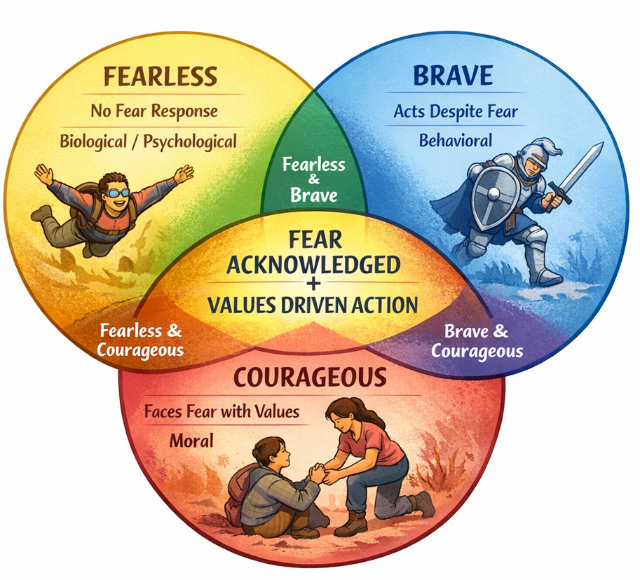
Courage, bravery, and fearlessness overlap but aren't synonymous. All three involve facing danger, but fearlessness requires no fear response, bravery may involve fear but doesn't require moral motivation, and courage specifically demands both fear acknowledgment and values driven action. Fearless is biological or psychological, brave is behavioral, and courageous is moral.
6. Integrate Expert Definitions and Research
Don't just rely on your opinion show scholarly perspective.
How to integrate sources:
Poor integration: "According to Smith (2020), happiness is subjective."
Strong integration: "Psychologist Sonja Lyubomirsky, who has studied well being for over three decades, distinguishes hedonic happiness (pleasure and satisfaction) from eudaimonic happiness (meaning and purpose), arguing that sustainable well being requires the latter (2020, p. 34). This research backed distinction challenges simplistic 'just be happy' advice by revealing that pursuing pleasure alone often produces dissatisfaction."
Why expert definitions matter:
- Demonstrate that you researched thoroughly
- Add credibility to your analysis
- Show engagement with scholarly conversation
- Provide evidence beyond personal opinion
7. Maintain Analytical Distance While Incorporating Personal Insight
Balance objectivity with personal understanding.
Avoid:
- Pure opinion without evidence: "I think courage is..."
- Emotional language: "I feel strongly that..."
- Irrelevant personal stories
Instead:
My understanding of integrity shifted after watching a colleague report financial irregularities that led to her own termination. She knew whistleblowing would cost her job, yet chose transparency over security. This experience illustrates integrity's costly nature and why it's rarer than we'd like: it often requires sacrificing self interest for principles, a transaction most people avoid. Personal experience thus confirms what research shows: integrity is aspirational precisely because it's difficult.
Personal insight works when it:
- Illustrates a point rather than being the point
- Connects to broader analysis
- Adds depth rather than replacing research
Definition Essay Examples
Studying complete examples helps you see how techniques work in practice.
Example 1: "Courage" (Extended Definition 500 words)
Hook with a question, dictionary definition, strong thesis
What separates courage from recklessness? Merriam Webster defines courage as "mental or moral strength to venture, persevere, and withstand danger," but this definition misses the crucial distinction between brave fools and genuinely courageous individuals. Courage is the deliberate choice to act despite fear when personal values demand action, distinguishing it from recklessness through moral foundation and from fearlessness by requiring acknowledged threat.
Etymology section
The word "courage" derives from Latin "cor" (heart), entering English through Old French "corage" in the 13th century. Originally meaning one's innermost feelings or temper, this heart centered etymology persists in phrases like "take heart" and reveals courage's connection to authentic values, acting from one's core beliefs rather than external pressure or impulsive emotion.
Definition by negation: what it's NOT
Courage is not fearlessness. Fearless individuals, whether due to amygdala damage or genetic variations, simply don't experience normal fear responses. Test pilot Chuck Yeager breaking the sound barrier exemplified fearlessness; he felt excitement, not terror. Courage, conversely, requires fear as a prerequisite. When Rosa Parks refused to give up her seat on that Montgomery bus, she experienced fear, arrest was certain, violence possible, yet her values demanded she act. Fearlessness needs no choice; courage does.
Definition by comparison: courage vs. recklessness
Distinguishing courage from recklessness requires examining motivation. Reckless acts stem from impulsive emotion, insufficient risk assessment, or thrill seeking. When teenagers jump off cliffs into unknown water depths, that's recklessness, emotion overriding judgment. Courage, by contrast, involves deliberate choice after assessing risks. When firefighter Sarah Martinez reentered a burning building to save a trapped child, she calculated risks and chose values over safety. "I was terrified," she told reporters, "but that child needed help." Her acknowledgment of fear while acting despite it demonstrates courage's defining characteristic.
Analysis with research
Neuroscience confirms this distinction. Fearless individuals show minimal amygdala activation when facing threats. Courageous individuals show both amygdala activation (fear) and prefrontal cortex activity (deliberate choice) simultaneously. The brain experiences threat while choosing action anyway precisely what moral courage demands.
Conclusion synthesis
Courage, then, is neither fearlessness nor recklessness but the deliberate choice to act when values and safety conflict. This definition matters because we need courage to grow personally and progress socially, yet cultivating something you can't define proves impossible. Recognizing that courage requires fear as a prerequisite paradoxically makes it more accessible: you need not eliminate fear, only choose values over comfort. In this sense, courage may be the most democratic of virtues available to anyone willing to feel afraid and act anyway.
Example 2: "Success" (Analytical Definition: Opening)
Dictionary definitions of success converge on "achieving desired outcomes," yet this proves inadequate upon closer examination. Success for a corporate CEO means quarterly profits; for a teacher, student growth; for a Buddhist monk, detachment from material desires. These contradictory goals, accumulation versus renunciation, can't all constitute success under a single definition. Success, properly understood, represents the alignment of achievement with personal values, requiring not just external accomplishment but internal satisfaction with one's choices, a definition explaining why high achievers often feel unsuccessful while seemingly ordinary lives radiate contentment...
[Essay continues with cultural perspectives on success, analysis of external vs. internal measures, discussion of how values shape success definition, examples of people who achieved conventional success yet felt unfulfilled, and synthesis of comprehensive understanding]
What Makes These Examples Strong
- Clear thesis statements that go beyond dictionary definitions
- Multiple definition methods (etymology, negation, comparison, analysis)
- Specific examples (Rosa Parks, Sarah Martinez, neuroscience research)
- Expert evidence integrated smoothly
- Logical organization from simple to complex
- Analytical depth exploring nuance and complexity
- Personal insight supported by evidence
Definition Essay Format & Templates
Proper formatting ensures your content shines.
Standard Format Requirements
Font & Spacing:
- Font: Times New Roman, 11-12 point
- Spacing: Double space throughout (unless instructor specifies otherwise)
- Margins: 1 inch on all sides
- Indentation: 0.5 inch first line of each paragraph
Page Elements:
- Header with your last name and page number (top right)
- Title centered, not bold or underlined
- Your name, instructor, course, date (top left first page for MLA)
Citation Style:
- MLA: Most common for English/humanities courses
- APA: Common for social sciences
- Chicago: Common for history courses
- Follow your assignment requirements exactly
Definition Essay Outline Template
Use this fill in template to structure your essay:
I. Introduction
   A. Hook: [Question, scenario, surprising fact, or bold statement]
   B. Context: [Why this term matters or is complex]
   C. Dictionary definition: [Official definition as starting point]
   D. Thesis: [Your comprehensive definition]

II. Etymology and Historical Development
   A. Word origins: [Language, original meaning]
   B. Evolution: [How meaning changed over time]
   C. Significance: [Why etymology matters for current understanding]

III. Denotation (Literal Definition)
   A. Dictionary definitions: [Multiple sources]
   B. Expert/academic definitions: [Scholarly perspective]
   C. Analysis: [What these reveal about the term]

IV. Connotation (Associated Meanings)
   A. Emotional associations: [Feelings the word evokes]
   B. Cultural interpretations: [How different cultures view it]
   C. Context dependent meanings: [How context changes meaning]

V. Analysis Method 1: [Definition by Example]
   A. Example 1: [Specific illustration]
   B. Example 2: [Another illustration]
   C. Analysis: [What examples reveal about meaning]

VI. Analysis Method 2: [Definition by Negation, Comparison, Function, or Analysis]
   A. Main point: [What you're exploring]
   B. Supporting evidence: [Examples, research, reasoning]
   C. Analysis: [How this clarifies definition]

VII. Synthesis: Your Comprehensive Understanding
   A. Integration: [How various perspectives combine]
   B. Your definition: [Your informed understanding]
   C. Significance: [Why this understanding matters]

VIII. Conclusion
   A. Thesis restatement: [In new words]
   B. Key insights synthesis: [Main takeaways]
   C. Significance: [Why understanding this term matters]
   D. Final thought: [Memorable closing]?
Sample Definition Essay Titles
Formula: [Term] + descriptive phrase
Examples:
- "Courage: Beyond Fearlessness to Moral Action"
- "Success: When Achievement Aligns with Values"
- "Family: Expanding Beyond Biological Bonds"
- "Freedom: Reconciling Liberty with Responsibility"
- "Intelligence: From IQ to Emotional and Social Competence"
Title tips:
- Include your term
- Suggest your main insight
- Keep it under 10 words
- Don't use "Definition of" (redundant, it's a definition essay)
- Capitalize major words
Common Definition Essay Mistakes to Avoid
Even strong writers make these errors. Here's how to avoid them.
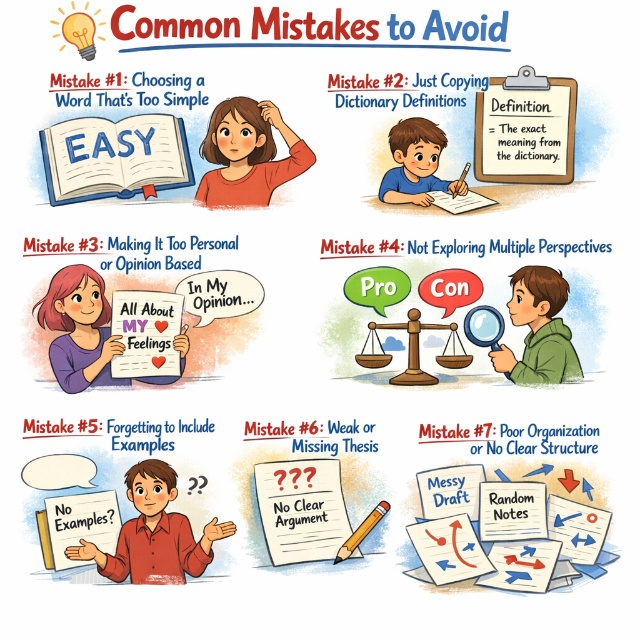
Mistake #1: Choosing a Word That's Too Simple
The problem: Defining a concrete object or term with an obvious meaning
Why it fails: Nothing to analyze beyond the dictionary definition
Examples of too simple words:
- Table, chair, car, phone, book
- Red, blue, green
- Walk, run, eat
- Technical terms with one clear meaning (byte, mitosis, photosynthesis)
Fix: Choose abstract concepts with multiple interpretations: courage, success, family, justice, love, freedom, integrity
Mistake #2: Just Copying Dictionary Definitions
The problem: Entire essay is stringing together definitions from various dictionaries
Why it fails: No original analysis or insight, you're not contributing to understanding
Bad approach:
Merriam Webster defines success as "favorable or desired outcome." Dictionary.com says "the accomplishment of an aim or purpose." Cambridge Dictionary states "the achieving of the results wanted or hoped for." These definitions show that success means achieving goals.
Good approach:
While dictionaries converge on "achieving desired outcomes," this definition proves inadequate upon analysis. Success for a corporate CEO means quarterly profits; for a teacher, student growth; for a monk, detachment from worldly desires. These contradictory goals, accumulation versus renunciation, can't all constitute success under a single definition, revealing that success is context dependent rather than universally definable.
Fix: Use dictionary definitions as starting points, then go beyond them through analysis, examples, and research.
Mistake #3: Making It Too Personal or Opinion Based
The problem: The essay is entirely about what the word means to you personally without evidence
Why it fails: Definition essays require research and analysis, not just personal reflection
Too personal:
To me, courage means doing scary things. I think everyone has their own courage. My courage is different from yours. Courage is personal.
Balanced:
While personal experience shapes how individuals recognize courage, what terrifies me may not frighten you; the core definition transcends subjective fear thresholds. Psychological research identifies courage through consistent markers: perceived threat, fear response, and values driven action, regardless of whether the threat is public speaking, physical danger, or social rejection (Rachman, 2010). Thus, courage maintains definitional consistency across personal variations in what triggers fear.
Fix: Include personal insight but support it with research, examples, and expert perspectives.
Mistake #4: Not Exploring Multiple Perspectives
The problem: Presenting only one interpretation without acknowledging others
Why it fails: Complex terms mean different things in different contexts, ignoring this oversimplifies
Single perspective: Freedom means the ability to do whatever you want without restrictions.
Multiple perspectives: Libertarian philosophy defines freedom as the absence of interference with negative liberty. Social justice advocates define freedom as access to opportunities, positive liberty requiring government support. Buddhist philosophy defines freedom as liberation from desire, internal rather than external. These competing frameworks reveal freedom's complexity: is it about external circumstances, internal states, or both?
Fix: Research how different cultures, time periods, experts, or contexts interpret your term differently.
Mistake #5: Forgetting to Include Examples
The problem: All abstract analysis without concrete illustration
Why it fails: Readers can't grasp abstract concepts without examples
Too abstract: Integrity means adhering to moral principles regardless of consequences. It requires consistency between values and actions. People with integrity make ethical choices even when difficult.
With examples: Integrity means adhering to moral principles regardless of consequences, as Edward Snowden demonstrated when leaking classified NSA documents. Snowden knew whistleblowing meant exile, legal prosecution, and permanent separation from his country, yet his values demanded exposing what he believed was unconstitutional surveillance. Whether you agree with his actions, Snowden exemplifies integrity's defining feature: values action alignment despite severe personal cost.
Fix: For every major claim about your term's meaning, include a specific example that illustrates it.
Mistake #6: Weak or Missing Thesis
The problem: No clear thesis statement, or thesis just restates dictionary definition
Why it fails: Thesis should present YOUR comprehensive definition after analysis
Weak theses:
"This essay will define courage"
"Courage means bravery"
"Courage is an important quality"
Strong theses:
- "Courage is the deliberate choice to act despite fear when personal values demand action, distinguishing it from recklessness through its foundation in moral reasoning and from fearlessness by its prerequisite acknowledgment of threat."
- "Success represents the alignment of achievement with personal values, requiring not just external accomplishment but internal satisfaction with one's choices and their impact, a definition that reveals why high achievers often feel unsuccessful while seemingly ordinary lives radiate contentment."
Fix: Develop a thesis that goes beyond the dictionary definition to present your comprehensive, nuanced understanding of the term.
Mistake #7: Poor Organization or No Clear Structure
The problem: The essay jumps randomly between ideas without logical flow
Why it fails: Readers can't follow your analysis or see how points connect
Disorganized:
- Paragraph 1: Etymology
- Paragraph 2: Personal story
- Paragraph 3: Dictionary definition
- Paragraph 4: Another personal story
- Paragraph 5: Expert opinion
- Paragraph 6: Random example
Organized:
- Introduction
- Etymology
- Dictionary Definition
- Analysis by Example
- Analysis by Negation
- Cultural Perspectives
- Synthesis and Personal Understanding
- Conclusion
Fix: Create a detailed outline before drafting and follow a logical progression from simple to complex.
Looking to get A grade definition essay written? Visit our legit essay writing service today.
Downloadable Templates for Definition Essays
PERFECT DEFINITION ESSAY OR YOUR MONEY BACK.
Invest in your grade with our ironclad quality and satisfaction guarantee.
- "A Grade or Revise" commitment
- Unlimited revisions until it meets your vision
- Direct writer communication for perfect alignment
- Risk Free Definition Service
Submit with 100% confidence.
Get Started NowBottom Line
Definition essays challenge you to think deeply about meaning, moving far beyond dictionary definitions to explore etymology, cultural contexts, multiple perspectives, and your own comprehensive understanding. The key is choosing an abstract, complex term; researching thoroughly; using multiple definition methods (etymology, examples, negation, comparison); and presenting a well supported analysis.
Most students struggle with depth; they summarize dictionary definitions without adding original insight. Strong definition essays demonstrate critical thinking by exploring what dictionaries don't explain: cultural variations, contextual changes, personal dimensions, and why understanding this term matters.