Commemorative Speeches: The Essentials
Commemorative speeches celebrate and honor people, events, ideas, or achievements through inspiring tributes delivered at graduations, funerals, award ceremonies, retirement parties, and special anniversaries.
Key purpose: Make your audience feel deeply about the subject you're honoring, whether that's gratitude, pride, hope, or inspiration.
Most important thing: Authenticity matters more than perfection. Your genuine emotion and specific details will move people far more than generic praise or polished clichés.
Characteristics of Effective Commemorative Speeches
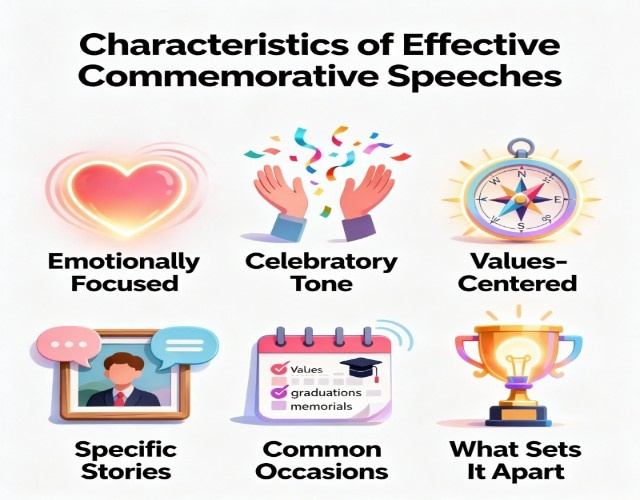
Successful tributes share these essential characteristics:
1. Emotionally Focused: These presentations aim to stir feelings, gratitude, pride, hope, reverence, and joy. You're not just sharing facts; you're creating an emotional experience.
2. Celebratory Tone: Even when honoring someone who has passed, the focus is on celebrating their life and legacy, not dwelling on loss.
3. Value Centered: Strong commemorative speeches highlight core values, courage, dedication, sacrifice, love, and innovation that your subject embodies.
4. Specific Stories: Generic praise falls flat. Powerful tributes use specific anecdotes and concrete details that bring your subject to life.
5. Common Occasions:
- Graduation ceremonies (honoring the graduating class or institution).
- Award presentations (recognizing achievement).
- Retirement celebrations (acknowledging career contributions).
- Memorial services and eulogies (celebrating a life).
- Anniversary events (marking milestones).
- Hall of Fame inductions (honoring excellence).
What Sets Commemorative Speech Apart: While informative speeches teach and persuasive speeches convince, commemorative speeches inspire. You're giving your audience a reason to care deeply about your subject.
NEED A HEARTFELT TRIBUTE WRITTEN?
Tell us what you need, our experts handle the research, writing, and formatting.
- Custom speeches for any occasion
- Captures the perfect emotional tone
- Delivered ready to present
- Full confidentiality guaranteed
Professional writers. Genuine emotion. Your deadline guaranteed.
Order NowWriting Your Commemorative Speech
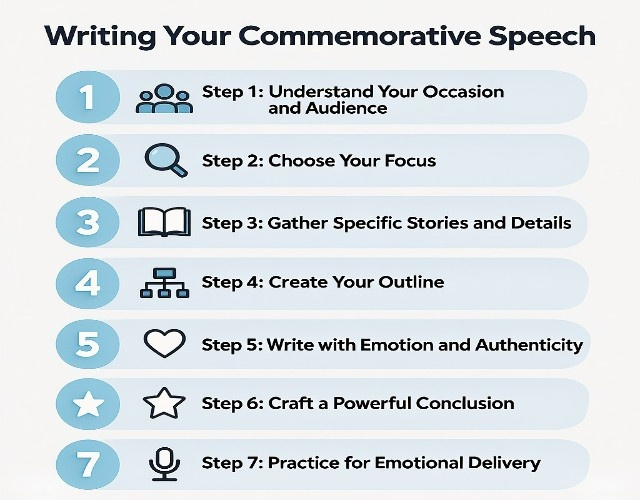
Writing a tribute that genuinely moves people requires balancing emotion with structure. Here's the step by step process.
Step 1: Understand Your Occasion and Audience
Before writing anything, clarify:
Your occasion:
|
Your audience:
|
Step 2: Choose Your Focus
Even when honoring someone well-known, you need a specific angle:
For a person:
|
For an event:
|
For an idea or value:
|
Step 3: Gather Specific Stories and Details
Generic praise sounds hollow. Collect:
Concrete anecdotes:
|
Meaningful details:
|
Quotes:
|
Step 4: Organize Your Commemorative Speech
Map out your tribute before writing full paragraphs. A solid structure keeps you focused and ensures emotional impact.
Introduction:
|
Body:
Connect each theme to broader values or lessons. |
Conclusion:
|
Tip: Limit yourself to 2 to 3 main themes. Trying to cover everything dilutes emotional impact.
Step 5: Write with Emotion and Authenticity
Commemorative speeches work when they feel genuine, not rehearsed.
Opening strategies:
|
Throughout your speech:
|
Avoid:
|
Step 6: Craft a Powerful Commemorative Speech Conclusion
Your ending should leave the audience inspired, not just informed.
Three-part conclusion:
1. Summarize their impact: "Dr. Martinez didn't just teach biology, she taught us to see wonder in everything from cells to ecosystems."
2. Call to action or reflection: "The best way to honor her memory is to approach our own work with that same curiosity and care."
3. Memorable closing:
|
Step 7: Practice for Emotional Delivery
Commemorative speeches require more emotional control than other presentation types.
Preparation tips:
|
Before writing your speech, it helps to look at speech and debate examples to see how others organize their ideas and build momentum.
Commemorative Speech Outline
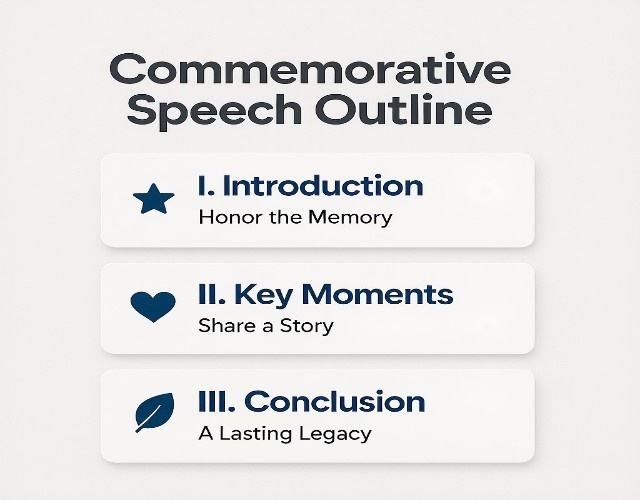
Every strong tribute follows this proven structure. Use this as your template:
Introduction (10 to 15% of speech)
1. Hook (15 to 30 seconds)
- Memorable story, quote, or observation.
- Captures attention immediately.
- Sets emotional tone.
2. Subject Introduction
- Clearly identify who/what you're honoring.
- Brief context (their role, achievement, or significance).
3. Credibility
- Establish your connection to the subject.
- Why you're qualified to give this tribute.
4. Thesis
- State your central message.
- Preview 2 to 3 main themes you'll explore
Body (70 to 80% of speech)
Theme 1: First Quality or Achievement
- State the quality/achievement clearly.
- Support with a specific story or example.
- Explain the impact or significance.
- Connect to broader values.
Transition
Theme 2: Second Quality or Achievement
- Same structure as Theme 1.
- Build on the previous theme.
- Deepen emotional engagement.
Transition
Theme 3: Third Quality or Achievement
- Bring themes together.
- Show cumulative impact.
- Prepare for conclusion.
Tips for the Body:
- Each theme should have at least one concrete story.
- Use dialogue when possible (what they actually said).
- Include sensory details (sights, sounds, emotions).
- Show, don't just tell (specific examples over abstractions).
Conclusion (10 to 15% of speech)
1. Summary
- Briefly recap your main themes.
- Reinforce central message.
- Don't introduce new information.
2. Impact Statement
- Articulate their legacy.
- Show their lasting influence.
- Connect to the audience's lives.
3. Call to Action or Reflection
- How can the audience honor this person/event?
- What should they remember or do?
- What values should they embrace?
4. Memorable Closing
- Final story, quote, or observation.
- Leave them inspired.
- Create an emotional peak.
Delivery Tips for Commemorative Speeches
Even a well-written tribute can fall flat without proper delivery. Here's how to present with impact:
1. Voice and Pacing
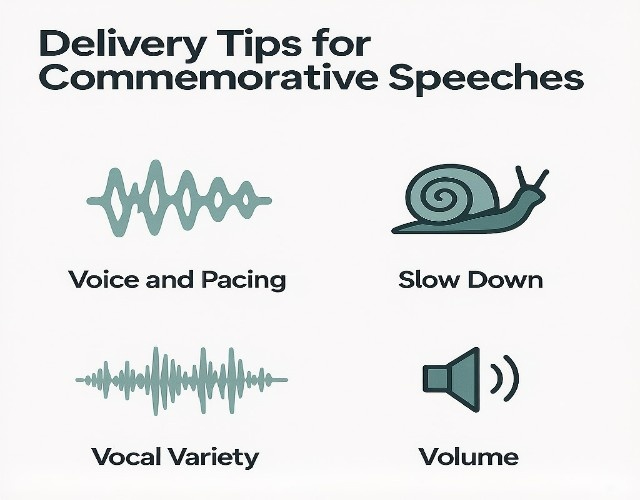
A. Slow Down:
- Commemorative speeches need slower pacing than other formats.
- Aim for 100-125 words per minute (vs. 130-150 for standard speeches).
- Pause after important statements to let them land.
- Silence is powerful; don't rush through emotion.
B. Vocal Variety:
- Vary your tone to match content.
- Lower your voice for solemn or intimate moments.
- Raise energy for celebratory sections.
- Use pauses for emphasis.
C. Volume:
- Speak loudly enough for the back row.
- But softer moments are acceptable if everyone can still hear.
- Build volume for your conclusion.
2. Managing Emotion

A. Before You Speak:
- Accept that emotion is appropriate and expected.
- Deep breathing exercises 5 minutes before.
- Have tissues and water at the podium.
- Know it's okay to pause if you tear up.
B. During Your Speech:
- If you feel tears coming, slow down and breathe.
- Pause, take a sip of water, then continue.
- The audience will wait; they understand.
- Genuine emotion makes your tribute more powerful.
- If completely overwhelmed, have a backup person ready.
What Not to Do:
- Don't apologize for being emotional.
- Don't try to hide authentic feelings.
- Don't rush through to "get it over with."
Body Language
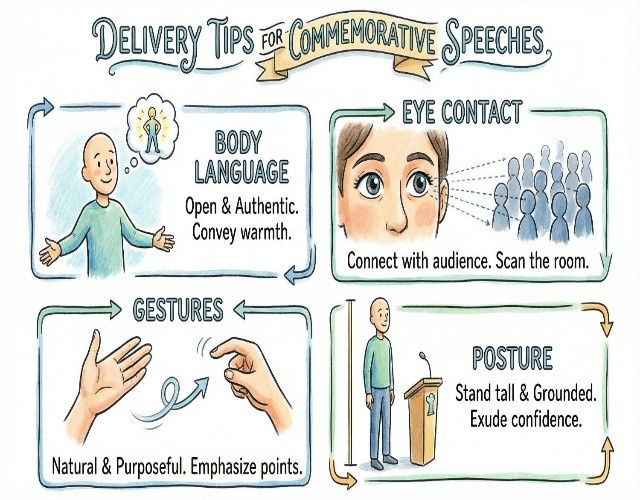
A. Eye Contact:
- Look at individuals, not over heads.
- Include all sections of the audience.
- If speaking about someone present, look at them occasionally.
- But don't stare at the bereaved during eulogies.
B. Gestures:
- Use natural hand movements.
- More restrained than persuasive speeches.
- Match gestures to emotional tone.
- Keep hands visible (not in pockets).
C. Posture:
- Stand with dignity and respect.
- Shoulders back but not rigid.
- Avoid swaying or fidgeting.
- Move purposefully if you move at all.
SPECIAL OCCASION COMING UP?
Our professional writers have helped thousands of students succeed, you're next.
- Graduation, memorial, or award speech
- Written by experienced speechwriters
- Captures authentic emotion
- Fast delivery, even last-minute orders
Rush delivery available. 100% satisfaction guaranteed.
Order NowChoosing the Right Commemorative Speech Topic

When assigned a commemorative speech in class, start by exploring different ideas you could include in your speech. Consider the following points while choosing potential topics:
1. Online Research
There is a list of commemorative speech topics available online. You can also find videos of previous commemorative speeches delivered at your school or by celebrities, etc.
2. Prepare Your Thoughts
Choosing a topic that connects to your own life and experiences helps make your commemorative speech feel more personal and meaningful.
To make your speech resonate, think about what you want the audience to understand about the person, event, or moment you’re highlighting. Consider which stories, memories, or qualities best communicate why this topic matters.
As you explore different ideas, focus on stories that you would enjoy hearing in a commemorative speech; these often make the strongest impact on listeners. If your speech centers on a person, select details that honor them respectfully. Share meaningful insights without offending them or anyone connected to the story.
3. Understand Your Audience
The most important ingredient that makes any piece of writing or speech work is the audience. It is they who decide whether or not the piece was worth it.
In order to ensure that you stay relevant to the audience, keep in mind their interests and personalities, and build your work around that. Also, if you are going to mention someone directly in your speech, you must be aware of the people who are going to be there.
4. Convey a Meaningful Message
A commemorative speech is a type of informative speech where the aim is to inform the listener about a particular topic. Although the main goal is to praise or commemorate something, your message must be clear and meaningful throughout the rest of the speech.
Commemorative Speech Topics
There are several different categories of commemorative speech ideas depending upon the event or occasion.
Here are some of our best suggested commemorative speech ideas that you can choose from:
- Paying tribute to a family member
- Paying tribute to an important personality, dead or alive (Martin Luther King, Barack Obama)
- Paying tribute to a big movement (Women's rights movement, the civil rights movement)
- Celebrating the values of a religion (Buddhist values)
- Speak on the importance of hope (NASA's Apollo 13 survival mission)
- Celebrate human courage, or a courageous act in a challenging situation, by policemen, firefighters, and veterans
- Selflessness of a teacher or parent, their dedication, and love
- An act of compromise that marked the start of you becoming a mature and evolved person
- Show respect to the greatest travelers that ever lived (Christopher Columbus, Vasco da Gama)
- Eulogy for a professor at your college
- Speak about your transformation, both spiritually and intellectually, after starting college
- The series of events that led to you and your classmates becoming a family
- A time you and your team won a match due to the support of the College
- Provide an example of loyalty by discussing war comrades
- What does freedom mean to you?
- Commemorate the lives lost on 9/11
- Celebrate the legalization of gay marriages
- Queen Elizabeth and her life
- Teamwork
- Respect
- Buying your first house
- Remembering your grandmother
- Women who changed the world for the better
- Father of the bride speech
- Maid of honor speech
- Best technology inventions
Want your commemorative speech professionally crafted AND practiced? Our reliable essay writing service creates custom tributes and provides personalized delivery coaching for your specific occasion.
Common Commemorative Speech Mistakes to Avoid
Learn from these frequent commemorative speech errors:
Content Mistakes
1. Too Generic 2. Making It About You 3. Listing Achievements 4. Avoiding Difficulty 5. Being Too Sad |
Delivery Mistakes
1. Reading Word for Word 2. Going Too Long 3. Inappropriate Humor 4. Rushing Through 5. Forgetting Your Audience |
READY TO HONOR SOMEONE SPECIAL?
Professional writing assistance tailored to your needs
- Custom commemorative speeches
- Perfect tone for any occasion
- Delivered on your timeline
- Unlimited revisions until you're satisfied
Professional quality. Heartfelt delivery. Your deadline met.
Order NowThe Bottom Line
Commemorative speeches honor what matters by making your audience feel deeply. Start with a specific focus, use concrete stories over generic praise, and let authentic emotion guide your delivery.
- Your structure: Hook with a memorable moment, explore 2-3 themes with specific examples, conclude with their lasting impact and a call to action. Practice slowly, 100 to 125 words per minute, and pause for emotional moments to land.
- Delivery matters: Speak from notes, not memory. Make eye contact. Let genuine emotion show. If tears come, pause and breathe; the audience will wait.
- Keep it focused: 5 to 10 minutes maximum. Deep exploration of 2 to 3 qualities beats surface level coverage of everything.
For more guidance on other presentation types, explore our complete speech and debate guide with techniques for every speaking occasion.
Now go honor someone who deserves it.


-19982.jpg)