Free 5 Paragraph Expository Essay Outline Template
Copy this template and replace bracketed items with your content:
I. INTRODUCTION
II. BODY PARAGRAPH 1
III. BODY PARAGRAPH 2
IV. BODY PARAGRAPH 3
V. CONCLUSION
|
YOUR OUTLINE IS LOGICAL. YOUR ESSAY WILL BE FLUID.
We rapidly flesh out your structure into a complete, submission-ready essay
- Fast track expansion to meet urgent deadlines
- Strict adherence to your provided outline
- Polished grammar and formatting on delivery
- Rapid Draft Service
Turn your skeleton into a full body, overnight.
Get Started NowExpository Essay Thesis Statement Formats: 3 Types
Your thesis drives your entire outline. Use these formats:
Three Point Expository Essay Thesis Format
|
Comparison Thesis Statement Format
|
Cause Effect Thesis Statement Format
|
Problem Solution Thesis Statement Format
|
Expository Essay Outline Structure: Section by Section Breakdown
Understanding what belongs in each section helps you fill the template effectively.
Expository Essay Introduction Outline (4-6 sentences)
Hook options:
Background context:
Thesis statement:
Percentage of total essay: 10-12% |
Body Paragraph Outline Template (6-8 sentences each)
Each body paragraph follows the TEES structure:
Topic Sentence (1 sentence):
Evidence (2-4 sentences):
Explanation (2-3 sentences):
Summary/Transition (1 sentence):
Percentage of total essay: 75-80% (divided across 3-5 paragraphs) |
Expository Essay Conclusion Outline (4-6 sentences)
Restate thesis (1-2 sentences):
Summarize main points (2-3 sentences):
Significance statement (1-2 sentences):
Percentage of total essay: 8-10% |
STUCK AFTER THE OUTLINE?
Bridge the gap between planning and writing with our expert execution.
- Overcoming the "first sentence" block
- Developing concise notes into full explanations
- Maintaining the logic and structure you designed
- Execution Support
Stop stalling at the plan. Start reading your draft.
Order NowExtended Expository Essay Outline Template: 1,500+ Words
For longer research papers requiring deeper analysis:
I. INTRODUCTION
- Hook: [attention grabbing opening]
- Background: [3-4 sentences of context]
- Problem/Question: [what you're addressing]
- Thesis: [specific, detailed statement]
II. BACKGROUND/CONTEXT SECTION
- Historical context: [relevant history]
- Current situation: [present state of topic]
- Key terms: [define specialized vocabulary]
III. BODY SECTION 1: [First Major Point]
- Topic sentence
- Sub point 1
- Evidence
- Analysis
- Sub point 2
- Evidence
- Analysis
- Summary and transition
IV. BODY SECTION 2: [Second Major Point]
- Topic sentence
- Sub point 1
- Evidence
- Analysis
- C. Sub point 2
- Evidence
- Analysis
- D. Summary and transition
V. BODY SECTION 3: [Third Major Point]
- Topic sentence
- Sub point 1
- Evidence
- Analysis
- Sub point 2
- Evidence
- Analysis
- Summary and transition
VI. IMPLICATIONS/SIGNIFICANCE SECTION
- Broader meaning: [what this reveals]
- Future considerations: [what comes next]
- Limitations: [what remains unknown]
VII. CONCLUSION
- Restate thesis
- Synthesize main findings
- Final thought on significance
Expository Essay Outline Formats by Length: 500-2,000+ Words
Adjust your outline structure based on required word count:
Short Expository Essay Outline: 500-750 Words
Structure:
- Introduction: 1 paragraph (80-100 words)
- Body: 3 paragraphs (300-450 words total)
- Conclusion: 1 paragraph (80-100 words)
Outline adjustments:
- 1-2 pieces of evidence per body paragraph
- Shorter background context (1-2 sentences)
- Concise explanations
Medium Expository Essay Outline: 1,000-1,500 Words
Structure:
- Introduction: 1 paragraph (120-150 words)
- Body: 4-5 paragraphs (700-1,000 words total)
- Conclusion: 1 paragraph (100-120 words)
Outline adjustments:
- 2-3 pieces of evidence per body paragraph
- More detailed background (2-3 sentences)
- Deeper analysis of evidence
Long Expository Essay Outline: 2,000+ Words
Structure:
- Introduction: 1-2 paragraphs (200-250 words)
- Background/Context: 1 paragraph (200-300 words)
- Body: 6-10 paragraphs (1,400-1,800 words total)
- Implications: 1 paragraph (150-200 words)
- Conclusion: 1 paragraph (150-200 words)
Outline adjustments:
- 3-4 pieces of evidence per section
- Sub sections within body paragraphs
- Dedicated sections for context and implications
- More sophisticated transitions
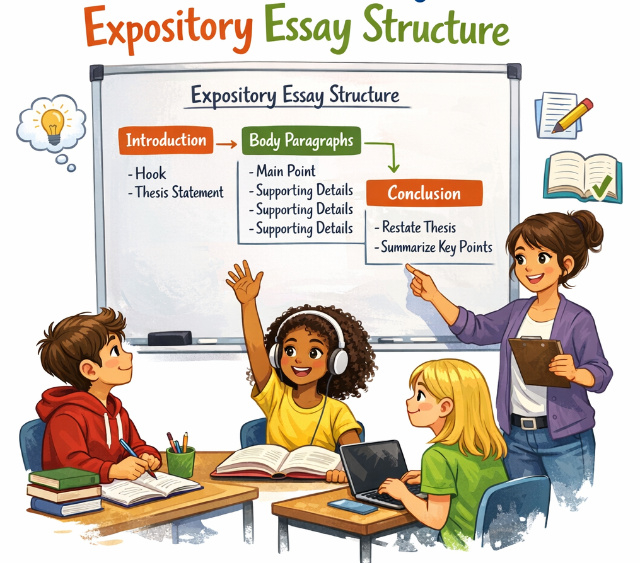
TEES Paragraph Structure Template for Expository Essays
Use this format for every body paragraph:
TEES Method
T Topic Sentence
|
E Evidence
|
E Explanation
|
S Summary/Transition
|
Complete Expository Essay Outline: Filled Template
Here's a completed outline showing the template in action:
Topic: How Social Media Affects Teen Sleep Patterns
I. INTRODUCTION
- Hook: 67% of teenagers check phones within 30 minutes of bedtime
- Background: Sleep critical for adolescent brain development. Teens need 8-10 hours. Most get 6-7.
- Thesis: Social media disrupts teen sleep through three mechanisms: blue light exposure, psychological stimulation, and FOMO driven bedtime delays.
II. BODY PARAGRAPH 1: Blue Light Effects
- Topic: Blue light from screens suppresses melatonin production
- Evidence #1: Harvard study, 2 hours of screen time delays sleep onset by 90 minutes (Johnson, 2023)
- Explanation: Melatonin regulates sleep wake cycles. Blue light tricks the brain into thinking it's daytime.
- Evidence #2: Teen brains are more sensitive to light than adult brains
- Explanation: Circadian rhythms already shift later in adolescence. Blue light compounds the natural tendency toward delayed sleep.
- Transition: Beyond physical light effects, content itself disrupts sleep preparation.
III. BODY PARAGRAPH 2: Psychological Stimulation
- Topic: Social media content activates brain's reward system
- Evidence #1: Dopamine spikes from likes/notifications make stopping difficult (Rosen, 2024)
- Explanation: Creates addictive scrolling. Brain stays alert seeking next reward.
- Evidence #2: Emotional content (arguments, drama) triggers stress responses
- Explanation: Elevated cortisol prevents relaxation needed for sleep
- Transition: The psychological pull combines with social pressures to delay bedtime.
IV. BODY PARAGRAPH 3: FOMO and Bedtime Delays
- Topic: Fear of Missing Out Drives Late Night Social Media Checking.
- Evidence #1: 43% of teens wake during the night to check notifications (CDC, 2023)
- Explanation: Teens worry about missing conversations, jokes, or social events
- Evidence #2: The average teen checks their phone 150 times daily, increasing at night
- Explanation: Sleep is sacrificed to maintain social connections and status
- Transition: These three mechanisms combine to create serious sleep deficits.
V. CONCLUSION
- Restate: Social media disrupts teen sleep via blue light, psychological activation, and FOMO
- Summarize: Physical light effects + addictive content + social pressure = insufficient sleep
- Significance: Sleep deprivation affects academic performance, mental health, and development. Digital wellness practices are essential.
Note: This shows outline structure, not a complete essay. Visit our expository essay examples and explore full length essays with sentences and paragraphs expanding each outline point.
Want the whole essay done right? Our professional essay writing service delivers A grade work with perfect structure every time.
Free Downloadable Expository Essay Outline Templates
All templates available as fillable PDFs:
Master Expository Essay Outline
You now have plug and play templates for every expository essay format. Download the templates matching your assignment, fill in the brackets with your content, and start writing with confidence.
The difference between organized, high scoring essays and disorganized drafts is 20 minutes of planning. Use these templates to work smarter, not harder.
FROM OUTLINE TO FINAL DRAFT: DONE.
Our experts provide you outline and a complete, polished expository essay.
- Full writing service based on your choice
- Expert research to support your points
- Final proofreading and plagiarism check
- Done For You Drafting
You planned it. We'll write it. Submit with confidence.
Get Started Now
-19544.jpg)