-20016.jpg)
What is a Colloquialism?
“A colloquialism can be defined as a linguistic expression, word, or phrase that is not formal or literary and is used in ordinary or familiar conversation.”
It deviates from formal standards of grammar and vocabulary, encompassing regional dialects, idioms, and slang.
What Makes Something a Colloquialism?
Colloquialisms are informal words or phrases used in everyday conversation. They're regional, casual, and often break standard grammar rules.
The test: Would you say it to friends but not write it in a formal paper? That's colloquialism.
Examples:
- "Gonna" instead of "going to"
- "Y'all" instead of "you all"
- "Ain't" instead of "am not/isn't"
What's NOT colloquialism:
- Slang (more specific to groups: "lit," "sus")
- Idioms (fixed expressions: "kick the bucket")
- Standard informal English ("Hello" vs "Greetings")
SOUNDING TOO FORMAL OR STIFF?
Our experts infuse your writing with authentic colloquialism to create a voice that connects and feels real.
- Natural, conversational tone tailored to your audience
- Strategic use of regionalisms and modern slang
- Balancing informality with clarity and purpose
- Authentic Voice Crafting
Don't just write, connect. Sound like a real person.
Get Started NowTypes of Colloquialisms
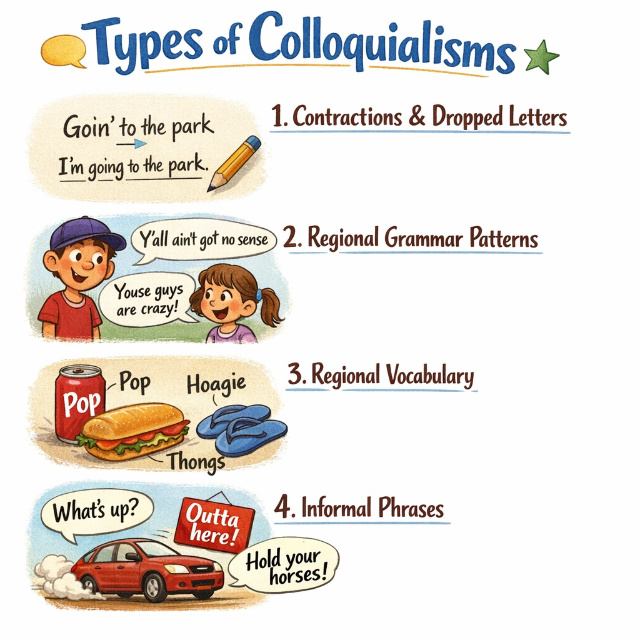
1. Contractions and Dropped Letters
Standard contractions (can't, won't) plus informal ones:
- "Gonna" = going to
- "Wanna" = want to
- "Shoulda" = should have
- "'Cause" = because
- "'Bout" = about
2. Regional Grammar Patterns
Nons tandard grammar that's consistent within regions:
- "I seen" = I saw (Appalachian)
- "We was" = We were (various regions)
- "Youse" = you (plural) (Philadelphia, Ireland)
- "Needs washed" = needs to be washed (Pennsylvania)
3. Regional Vocabulary
Words unique to specific areas:
- "Pop" vs "soda" vs "coke" (soft drink)
- "Sub" vs "hoagie" vs "grinder" (sandwich)
- "Bubbler" vs "water fountain" (Wisconsin vs elsewhere)
4. Informal Phrases
Casual expressions replacing formal language:
- "No biggie" = not a problem
- "My bad" = my mistake
- "Hang on" = wait a moment
- "What's up?" = how are you?
Colloquialism vs Related Terms
1. Colloquialism vs Slang
Colloquialism: Informal but widely understood
- "Gonna," "y'all," "ain't"
- Used across age groups
- Often regional
Slang: Very informal, group specific
- "Lit," "slay," "sus"
- Changes quickly
- Often youth focused
Key difference: Your grandparents understand colloquialisms but might not know current slang.
2. Colloquialism vs Idiom
Colloquialism: Informal words/phrases with literal meaning
- "Wanna go?" (want to go?)
- Meaning is clear from words
Idiom: Fixed expression with figurative meaning
- "Kick the bucket" (die)
- Meaning isn't literal
Key difference: Colloquialisms are informal versions of standard language; idioms are figurative.
3. Colloquialism vs Jargon
Colloquialism: Informal everyday language
- "Gonna," "kinda," "lots"
- Used in casual conversation
Jargon: Technical language for specific fields
- "ROI," "bandwidth," "actionable"
- Professional/specialized contexts
Key difference: Colloquialisms are casual; jargon is technical.
How to Write Colloquial Dialogue
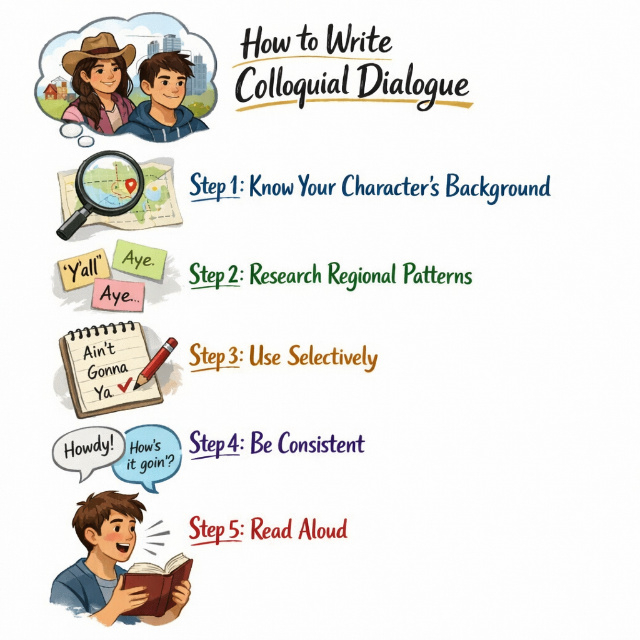
Step 1: Know Your Character's Background
Where are they from? What's their education? What's their age?
Step 2: Research Regional Patterns
Read literature from that region. Listen to speakers from that area.
Step 3: Use Selectively
Sprinkle colloquialisms, don't drown readers in them.
Step 4: Be Consistent
Character's speech patterns should remain stable.
Step 5: Read Aloud
Does it sound natural? If not, adjust.
Regional Colloquialism Examples
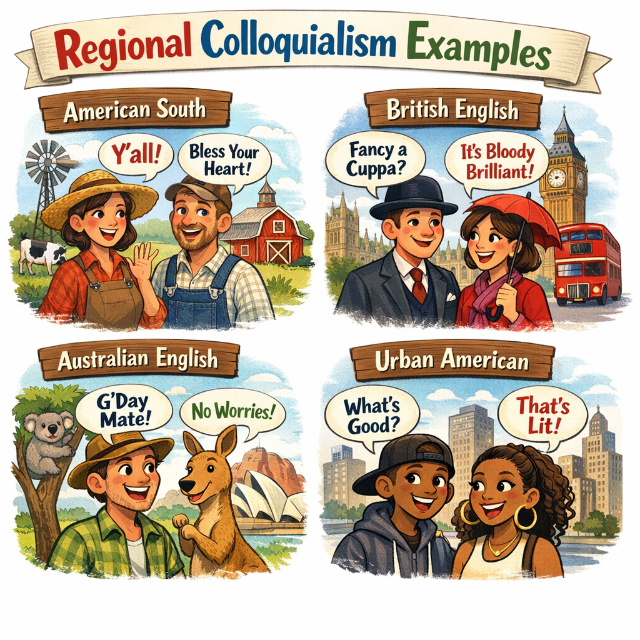
Different places have different informal expressions.
1. American South
Common colloquialisms:
- "Y'all" = you all (plural)
- "Fixin' to" = about to, getting ready to
- "Bless your heart" = expression of sympathy (or sarcastic criticism)
- "Might could" = might be able to
- "Carry" = drive or escort someone
Example in dialogue: "I'm fixin' to head to the store. Y'all need anything?"
2. British English
Common colloquialisms:
- "Mate" = friend
- "Chuffed" = pleased, delighted
- "Knackered" = exhausted
- "Bloke" = man, guy
- "Telly" = television
Example in dialogue: "I'm proper knackered, mate. Long day at work."
3. Australian English
Common colloquialisms:
- "G'day" = hello, good day
- "Arvo" = afternoon
- "Brekkie" = breakfast
- "Servo" = service station (gas station)
- "Fair dinkum" = genuine, really
Example in dialogue: "Meet you at the servo this arvo for brekkie?"
3. Urban American
Common colloquialisms:
- "Wanna" = want to
- "Gonna" = going to
- "Gotta" = got to, have to
- "Dunno" = don't know
- "Kinda" = kind of
Example in dialogue: "I dunno what I wanna do yet. Kinda tired."
MAKING YOUR CHARACTERS OR NARRATOR SOUND REAL?
We write dialogue and voice with perfect colloquialism to bring your fiction or memoir to life.
- Distinct, believable speech patterns for characters
- First person narration that feels genuine and engaging
- Avoiding clichés while using effective informal language
- Realistic Dialogue Service
Turn flat characters into living, breathing people.
Get Started NowColloquialism Examples in Literature
Writers use colloquialisms to create authentic dialogue and establish a setting.
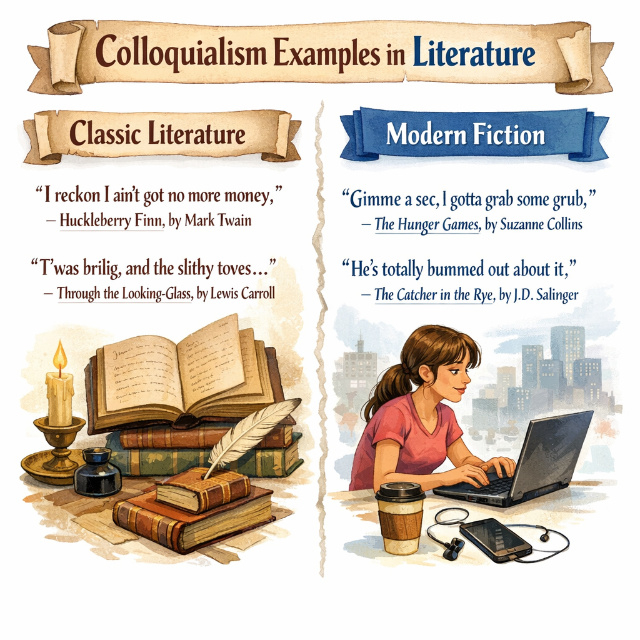
1. Classic Literature
Mark Twain, "The Adventures of Huckleberry Finn": "You don't know about me without you have read a book by the name of 'The Adventures of Tom Sawyer,' but that ain't no matter."
What's working:
- "ain't no" = double negative colloquialism
- "without" instead of "unless"
- Creates the authentic voice of an uneducated Southern boy
Harper Lee, "To Kill a Mockingbird": "I'm gonna tell him you said that."
What's working:
- gonna" = informal contraction
- Establishes Southern small town dialogue
- Makes child's character authentic
John Steinbeck, "Of Mice and Men": "I seen things out here. I wasn't drunk. I seen things."
What's working:
- "seen" instead of "saw"
- Non standard past tense (colloquial grammar)
- Reveals the character's education level and background
2. Modern Fiction
Alice Walker, "The Color Purple": "You better not never tell nobody but God."
What's working:
- Triple negative ("not never... nobody")
- Southern African American dialect
- Creates powerful authentic voice
Cormac McCarthy, "The Road": "Where are we going, Papa? / We're going south. / Okay."
What's working:
- Simple, conversational structure
- "Papa" (informal father term)
- Authentic child parent dialogue
When to Use Colloquialisms
In Creative Writing
- Dialogue: Makes characters sound real
- First person narration: Creates an authentic voice
- Establishing setting: Regional language shows place
Example: Southern character dialogue needs "y'all" and "fixin' to" for authenticity.
In Informal Writing
- Personal blogs: Conversational tone
- Social media: Casual communication
- Friendly emails: Relaxed correspondence
When NOT to Use Colloquialisms
- Academic essays: Formal tone required
- Business reports: Professional standards
- Technical writing: Clarity and precision needed
- Cover letters: Professional impression matters
Exception: Analyzing colloquialisms in literature, you'll quote them but not use them in your own analysis.
Common Mistakes with Colloquialisms
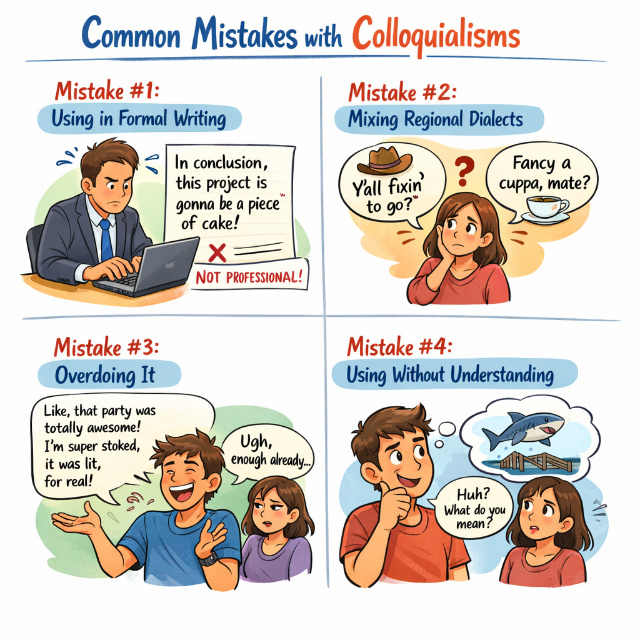
Mistake #1: Using in Formal Writing
Wrong: "The data shows that participants ain't responding well to the treatment."
Right: "The data shows that participants are not responding well to the treatment."
Rule: Academic writing = standard English only.
Mistake #2: Mixing Regional Dialects
Wrong: Character from Boston saying "y'all" and "G'day mate"
Right: Character from Boston saying "wicked good" and "pahk the cah"
Rule: Keep dialect consistent with character's background.
Mistake #3: Overdoing It
Wrong: "Y'all gonna wanna come 'round here 'bout noon, 'cause we're fixin' to have us some good ol' Southern cookin'."
Right: "Y'all should come by around noon. We're having a proper Southern meal."
Rule: Suggest dialect, don't overwhelm readers.
Mistake #4: Using Without Understanding
Don't use regional colloquialisms you don't understand. Research or avoid.
Wrong: Using "bless your heart," thinking it's always nice (can be a sarcastic insult)
Right: Understanding context before using regional expressions
Writing about how dialect creates voice? Our professional essay writing service provides analysis showing exactly how colloquialisms establish character and setting.
Downloadable Resource
Download this comprehensive colloquialism workbook to master the art of everyday language in writing and speech. This fillable guide provides identification exercises, creation templates, ethical guidelines, and practical applications across genres and contexts.
STUDYING VERNACULAR OR SOCIOLINGUISTICS?
Our specialists help you analyze and write about colloquial language with academic precision.
- Connecting informal speech to cultural, social, or historical context
- Academic papers on dialect, identity, and power in language
- Scholarly tone applied to the study of everyday speech
- Sociolinguistic Analysis Service
Bridge the gap between street talk and scholarly insight.
Get Started NowThe Bottom Line
Colloquialisms bring language to life. They capture how people actually speak, regional variations, informal contractions, and casual phrases that make dialogue authentic.
In creative writing, colloquialisms create voice and establish setting. In analysis, understanding them helps you explain how authors create authentic characters.
Know your context: colloquialisms work in casual conversation and creative dialogue, not in formal academic writing.
Want more language techniques? Explore our complete literary devices guide with examples.


-19964.jpg)
-20128.jpg)


-20008.jpg)