What Makes Something Personification?
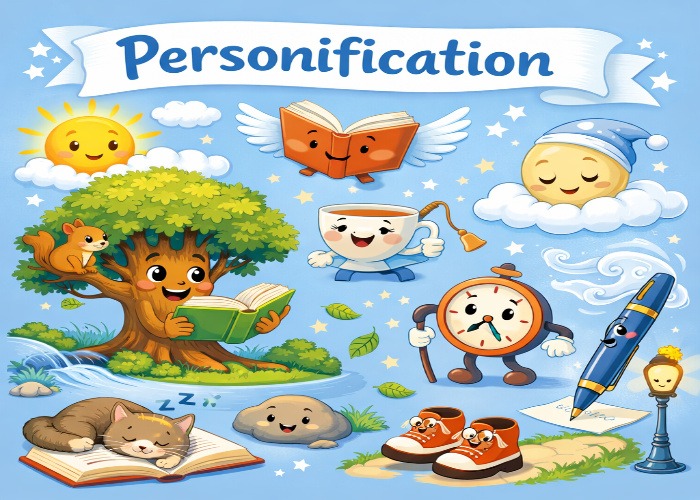
Personification gives human characteristics, emotions, actions, speech, and thoughts to non-human things. Animals, objects, ideas, or natural phenomena act like people.
The quick test: Does a non human thing do something only humans can do? That's personification.
Examples:
- "The wind whispered through the trees" (wind can't whisper)
- "Time marches on" (time can't march)
- "The sun smiled down on us" (sun can't smile)
What's NOT personification:
- Animals doing animal things ("The dog barked")
- Humans doing human things ("She smiled")
- Metaphor without human qualities ("Life is a journey")
Types of Personification
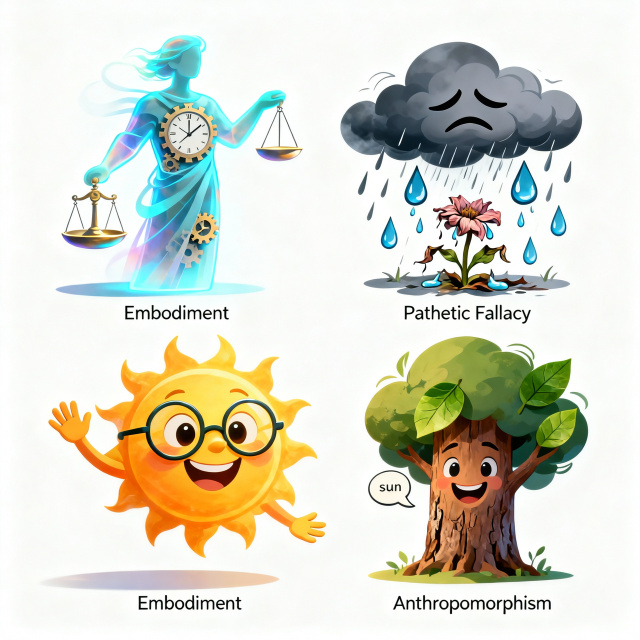
Embodiment
Abstract concepts become concrete beings.
Examples:
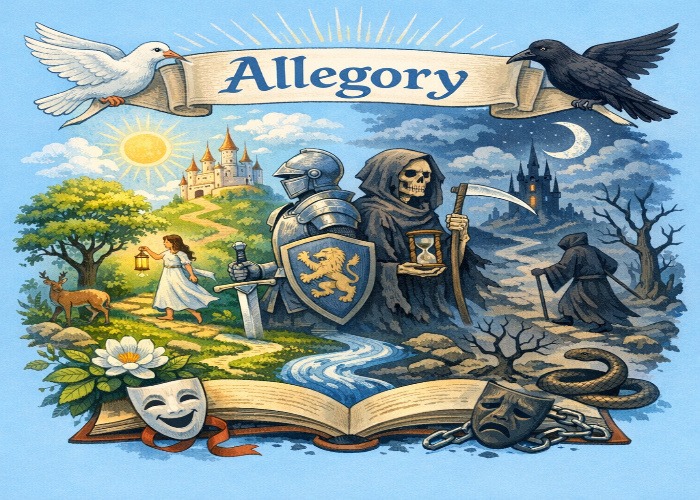
- Death as the Grim Reaper
- Justice as a blindfolded woman with scales
- Time as Father Time with scythe and hourglass
Why it works: Visualization through human form makes ideas graspable.
Pathetic Fallacy
Nature reflects human emotions (specific type of personification).
Examples:
- Storm during sad scenes
- Sunshine during happy moments
- Wilting flowers during grief
Example: "The sky wept as she delivered the eulogy."
Why it works: External world mirrors internal emotions, reinforcing mood.
Anthropomorphism
Giving complete human form and personality (extreme personification).
Examples:
- Mickey Mouse (mouse with human body, clothes, speech)
- Cars in "Cars" movie (vehicles with faces and personalities)
Difference from personification: Anthropomorphism creates human like beings; personification gives human qualities while maintaining original form.
WANT YOUR DESCRIPTIONS TO BREATHE WITH LIFE?
Our experts use personification to make settings, objects, and forces feel like living characters.
- Giving emotion and intention to the non human
- Creating immersive, memorable scenes in stories or essays
- Enhancing poetry and creative nonfiction with relatable imagery
- 24/7 Expert Support
Turn your world from a backdrop into a living participant.
Get Started NowPersonification Utilization Effectively
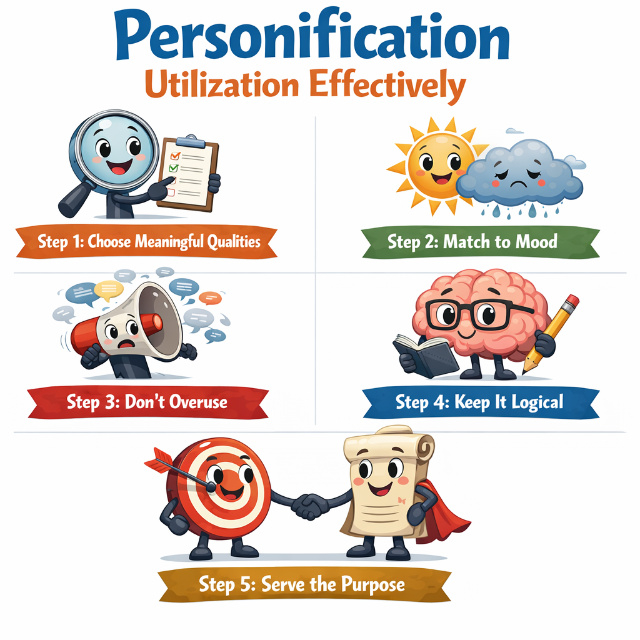
Step 1: Choose Meaningful Qualities
Don't personify randomly; make it meaningful.
Weak: "The tree stood there."
Strong: "The tree stood guard over the graves."
"Stood guard" suggests protection and loyalty, meaningful human qualities.
Step 2: Match to Mood
For peaceful scenes: Gentle human actions (whisper, sigh, rest)
For tense scenes: Aggressive actions (attack, threaten, loom)
Example: "The shadows crept closer" (tense) vs "The shadows stretched lazily" (peaceful)
Step 3: Don't Overuse
Too much personification becomes cartoonish.
Overdone: "The angry clouds glared while the furious wind shrieked and the spiteful rain attacked."
Balanced: "Storm clouds gathered overhead, and rain began to fall."
Use sparingly for maximum impact.
Step 4: Keep It Logical
Personification should fit the object's nature.
Illogical: "The rock sprinted away."
Logical: "The rock stood firm against the tide."
Rocks don't run, but they do resist the match personification to object characteristics.
Step 5: Serve the Purpose
Personification should enhance meaning, not just decorate.
Decorative: "The happy sun smiled."
Meaningful: "The indifferent sun blazed on, uncaring who suffered below."
The second reveals something about human experience of nature's indifference to suffering.
Personification vs Related Devices
Personification vs Anthropomorphism
Personification: Gives human qualities while keeping the original form
Anthropomorphism: Creates human like beings completely
Example:
- Personification: "The wind whispered" (wind stays wind)
- Anthropomorphism: A walking, talking wind character in human clothes
Personification vs Metaphor
Personification: Specifically gives human traits to non-human things
Metaphor: Any direct comparison (X IS Y)
Example:
- Personification: "Time marches on"
- Metaphor: "Time is money" (not specifically human)
Remember: All personification is metaphor, but not all metaphors are personification.
Personification vs Apostrophe
Personification: Gives human qualities
Apostrophe: Directly addresses absent/abstract things
The overlap: Often used together.
Example: "Death, be not proud" (apostrophe addressing death + personification giving death the emotion of pride)
Personification Examples from Nature
Writers give human qualities to natural elements constantly.
Weather & Sky
Examples:
- "The wind whispered secrets"
- "Rain danced on the rooftop"
- "Thunder roared its anger"
- "The sun smiled warmly"
- "Clouds wept tears"
- "Lightning stabbed the darkness"
- "Snow blanketed the earth"
Example in context: "The wind whispered through the trees, sharing secrets with the leaves."
Why it works: Wind can't whisper or share secrets; these are human actions. Personification makes the weather feel alive and intentional.
Celestial Bodies
Examples:
- "The moon watched over the sleepers"
- "Stars winked from above"
- "The sun reached across the horizon"
- "Night crept in slowly"
- "Dawn broke with a yawn"
Example in context: "Stars winked conspiratorially, as if sharing a cosmic joke."
Why it works: Stars can't wink or conspire, giving them intention creates intimacy between earth and sky.
Plants & Trees
Examples:
- "Trees bowed to the wind"
- "Flowers nodded their heads"
- "Ivy climbed eagerly"
- "Roots gripped the earth"
- "Branches reached for the sky"
Example in context: "The old oak stood guard over the house, its branches reaching protectively."
Why it works: Trees can't stand guard or reach protectively, but these human actions create a guardian figure from a plant.
Personification Examples from Classic Poetry
Poets personify to create vivid, emotional imagery.
"Because I could not stop for Death" by Emily Dickinson
"Because I could not stop for Death –
He kindly stopped for me –
The Carriage held but just Ourselves –
And Immortality."
What's personified: Death becomes a gentleman caller who stops his carriage, acts kindly, and escorts the speaker. Why it works: Death transforms from an abstract concept to a polite companion. The personification removes fear; death is courteous, not violent. |
"Daffodils" by William Wordsworth
"Continuous as the stars that shine
And twinkle on the milky way,
They stretched in never-ending line
Along the margin of a bay:
Ten thousand saw I at a glance,
Tossing their heads in sprightly dance."
What's personified: Daffodils toss heads and dance sprightly. Why it works: Flowers can't dance or toss heads, but human actions make them joyful participants rather than passive plants. |
"The Road Not Taken" by Robert Frost
"Two roads diverged in a yellow wood,
And sorry I could not travel both"
What's personified: Roads diverge (separate intentionally, like people parting ways). Why it works: The verb "diverged" suggests roads made a choice to separate, paralleling the speaker's choice. |
"Fog" by Carl Sandburg
"The fog comes
on little cat feet.
It sits looking
over harbor and city
on silent haunches
and then moves on."
What's personified: Fog sits, looks, and moves like a cat contemplating its surroundings. Why it works: Fog becomes a living creature with intention and awareness, making natural phenomena feel animate. |
"Death Be Not Proud" by John Donne
"Death, be not proud, though some have called thee
Mighty and dreadful, for thou art not so"
What's personified: Death is addressed directly as a person who feels pride and can be argued with. Why it works: Making death a person with emotions allows Donne to challenge and diminish it; you can't argue with an abstract concept. |
FINAL DRAFT FEELING FLAT AND LIFELESS?
Get rapid, expert infusion of personification to add instant vitality and engagement before your deadline.
- Quick identification of opportunities to animate your descriptions
- Seamless addition of human-like traits to objects or settings
- Express editing service for immediate creative enhancement
- Urgent Animation Edit
A fast edit that brings your static scenes to life.
Get Started NowPersonification Examples from Literature
Writers use personification to make abstract concepts tangible.
"1984" by George Orwell
"Big Brother is watching you."
What's personified: The totalitarian government becomes "Big Brother" a family member who watches constantly. Why it works: Transforming government surveillance into a family relationship makes it more intimate and inescapable than abstract "the state." |
"The Great Gatsby" by F. Scott Fitzgerald
"Gatsby believed in the green light, the orgastic future that year by year recedes before us. It eluded us then, but that's no matter tomorrow we will run faster, stretch out our arms farther... And one fine morning So we beat on, boats against the current, borne back ceaselessly into the past."
What's personified: The future recedes (moves away like a person), time eluded (avoided intentionally). Why it works: Making time and future into agents with intention emphasizes how they actively work against human desires. |
"To Kill a Mockingbird" by Harper Lee
"Maycomb was an old town, but it was a tired old town when I first knew it."
What's personified: The town is tired (human exhaustion). Why it works: A tired town suggests Depression era weariness buildings and streets can't be tired, but the personification conveys collective exhaustion. |
"Wuthering Heights" by Emily Brontë
"The night is darkening round me, the wild winds coldly blow."
What's personified: Night darkens (acts), winds blow coldly (with emotion/intention). Why it works: Nature mirrors human emotions the darkening night and cold winds reflect the speaker's emotional state. |
"Charlotte's Web" by E.B. White
"The barn was very large. It was very old. It smelled of hay and it smelled of manure. It smelled of the perspiration of tired horses and the wonderful sweet breath of patient cows."
What's personified: Horses are tired (human exhaustion), cows are patient (human virtue). Why it works: Animals gain emotional depth through human qualities; they're not just livestock but individuals with feelings. |
Personification Examples from Everyday Speech
People are constantly in casual conversation.
Technology
Examples:
- "My computer hates me"
- "The printer refused to work"
- "My phone died"
- "The app crashed"
- "The alarm clock screamed"
Example in context: "My laptop decided today was a good day to die."
Why we do it: Technology frustrates us. Giving it human spite or decision-making lets us blame something with intention.
Time & Abstract Concepts
Examples:
- "Time flies"
- "Opportunity knocked"
- "Fear gripped my heart"
- "Love conquered all"
- "Death claimed him"
- "Fortune smiled on us"
Example in context: "Opportunity knocked, but I wasn't home." Why we do it: Abstract concepts become easier to discuss when they have human agency. We can't grab "opportunity," but we can answer when it knocks. |
Objects & Possessions
Examples:
- "My car coughed and sputtered"
- "The old house groaned"
- "The book called to me"
- "My bed beckoned"
- "The dice betrayed me"
Example in context: "My bed was calling my name after the long shift." Why we do it: Objects gain personality through personification, explaining our relationships with possessions. |
Personification in Different Genres
Children's Literature
Nearly everything speaks and thinks.
Examples:
- "The Little Engine That Could" (train thinks and talks)
- "Winnie the Pooh" (stuffed animals have personalities)
- "The Giving Tree" (tree loves and sacrifices)
- "Thomas the Tank Engine" (trains have emotions and relationships)
Why it works: Children relate to human emotions. Personifying objects makes stories accessible and teaches empathy.
Fables & Fairy Tales
Animals act as humans to teach lessons.
Examples:
- "The Tortoise and the Hare" (animals compete and learn lessons)
- "The Three Little Pigs" (pigs build houses and plan)
- "The Boy Who Cried Wolf" (wolf reasons and reacts)
Why it works: Animal characters allow moral lessons without preaching directly to humans.
Horror
Inanimate objects gain malevolent life.
Examples:
- Houses that watch and wait
- Shadows that creep with intention
- Doors that refuse to open
- Objects that move on their own
Example: "The house watched through dark windows as they approached."
Why it works: Personifying buildings and objects creates paranoia if everything can think and act, nothing is safe.
Common Personification Mistakes
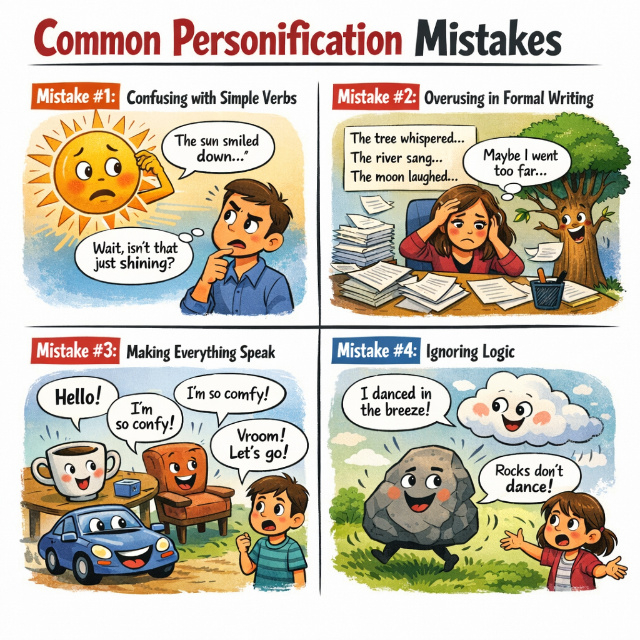
Mistake #1: Confusing with Simple Verbs
Not personification: "The sun rose" (sun actually rises)
Is personification: "The sun climbed wearily into the sky" (sun can't be weary)
Physical actions objects actually do aren't personification.
Mistake #2: Overusing in Formal Writing
Wrong context: Academic papers filled with personification sound unprofessional.
Right context: Creative writing, poetry, descriptive passages.
Match device to writing situation.
Mistake #3: Making Everything Speak
Too much: "The door said hello. The chair whispered welcome. The table offered sympathy."
Balanced: "The old house creaked a greeting."
Not everything needs human voice.
Mistake #4: Ignoring Logic
Illogical: "The mountain ran away quickly."
Mountains don't run. Personification should respect object's nature even while adding human qualities.
Writing about how personification creates emotional impact? Our essay writing service provides analysis showing exactly how human qualities shape meaning.
Downloadable Resource
MASTER THE ART OF GIVING LIFE TO WORDS.
Collaborate with our writing experts to learn and apply personification like a seasoned author.
- Foundational training in the techniques and effects of personification
- Hands-on exercises applying the device to your own projects
- A revised piece of your writing that demonstrates this powerful skill
- Collaborative Craftsmanship
Learn a classic technique that makes your writing timelessly engaging.
Get Started NowThe Bottom Line
Personification breathes life into the lifeless by giving human qualities to non-human things. Objects think, nature feels, abstract concepts act with intention.
The best personification creates emotional connections without calling attention to itself. Readers don't think "that's personification," they simply feel the wind's whisper or time's relentless march.
Master personification analysis, and you understand how writers make the world alive.
Want more figurative language? Explore our complete literary devices guide with examples.

-19964.jpg)
-20128.jpg)

-20008.jpg)
-20016.jpg)